Chapter 10: Decentralization: Responsibility, Accounting, Performance Evaluation, and Transfer Pricing
84. Cornwall Company has two divisions, A and B. Information for each division is as follows:
A
B
Net earnings for division
$40,000
$260,000
Asset base for division
$100,000
$1,200,000
Target rate of return
15%
18%
Margin
10%
20%
Weighted average cost of capital
12%
12%
What is EVA for Division B?
a. $144,000
b. $216,000
c. $116,000
d. $44,000
85. Economic value added is calculated by which of the following formulas?
a. EVA = After-tax operating income + (Weighted average cost of capital × Total capital employed)
b. EVA = After-tax operating income * Weighted average cost of capital
c. EVA = After-tax operating income – (Weighted average cost of capital × Total capital employed)
d. EVA = Total capital employed – (Weighted average cost of capital × After-tax operating income)
86. EVA encourages the right kind of behavior from divisions because of its emphasis on
a. after-tax net income.
b. total capital employed.
c. true cost of capital.
d. before-tax operating income.
87. Multiple measures of performance are beneficial if they
a. are all financial measures.
b. include nonfinancial operating measures.
c. focus only on short-run factors.
d. all of these statements are true.

Chapter 10: Decentralization: Responsibility, Accounting, Performance Evaluation, and Transfer Pricing
88. A type of fringe benefit received over and above salary is(are) called:
a. Bonus based on net income
b. Cash compensation
c. Perquisites
d. EVA
89. Which of the following is NOT an environmental factor affecting performance evaluation in the multinational firm?
a. sociological factors
b. economic factors
c. political or legal factors
d. All of these are environmental factors affecting performance evaluation in the multinational firm.
90. Which of the following would be a reason why managers would NOT provide good service?
a. They may have low ability.
b. They may not prefer to work hard.
c. They may prefer to spend company resources on perquisites.
d. All of these are reasons.
91. The right to buy a certain number of shares of a company’s stock at a particular price is(are) called:
a. Perquisites
b. Cash compensation
c. Stock-based compensation
d. Stock options
92. Which of the following managerial rewards is NOT a short-term reward?
a. stock ownership
b. cash bonuses
c. stock options
d. both a and b
93. Goal congruence can be defined as
a. an incentive plan arranged so the managers’ goals are aligned with the shareholders’ goals.
b. managers operating the business in the best interest of the shareholders.
c. tying management rewards to shareholder results.
d. all of these are correct.

Chapter 10: Decentralization: Responsibility, Accounting, Performance Evaluation, and Transfer Pricing
94. It is important to separate the evaluation of the manager from the evaluation of the division in a multinational firm.
A manager’s evaluation should NOT include
a. revenues.
b. income taxes.
c. operating costs.
d. cost of goods sold.
95. Which of the following is an economic factor affecting performance evaluation in a multinational firm?
a. currency restrictions
b. economic stability
c. impact of foreign policy
d. both a and b
96. Which of the following is a political or legal factor affecting performance evaluation in a multinational firm?
a. social attitude toward industry and business
b. literacy rate
c. effect of defense policy
d. currency restrictions
97. Comparison of an international division’s ROI can potentially be misleading because of
a. the absence of activity-based management.
b. differing production technologies.
c. the lack of good information.
d. differing environmental factors.
98. Division ‘A’ produces a component and wants to sell it to Division ‘B’. The transfer price is
a. revenue to Division ‘A’ and a cost to Division ‘B’
b. revenue to Division ‘B’ and a cost to Division ‘A’
c. revenue to Division ‘A’ and no effect on Division ‘B’
d. a cost to Division ‘B’ and no effect on Division ‘A’
99. Transfer prices are the prices charged
a. for distributing goods from one warehouse to another.
b. for the goods produced by one division to another division that needs these goods.
c. when delivering goods to the customer.
d. when transferring goods to international divisions.
Chapter 10: Decentralization: Responsibility, Accounting, Performance Evaluation, and Transfer Pricing
100. The transfer price that would leave the selling division no worse off if the good is sold to an internal division
is(are) called:
a. The maximum transfer price
b. The negotiated transfer price
c. The minimum transfer price
d. Both a and c
101. The transfer price that would leave the buying division no worse off if an input is purchased from an internal
division is(are) called:
a. The maximum transfer price
b. The minimum transfer price
c. The negotiated transfer price
d. Both a and c
102. In the Bombadier Company, Division A has a product that can be sold either to outside customers or to Division
B. Information about these divisions is given below:
Case 1
Case 2
Division A:
Capacity in units
100,000
100,000
Number of units sold externally
100,000
60,000
Market selling price
$90
$75
Variable costs per unit
73
58
Fixed costs per unit based on capacity
10
10
Division B:
Number of units needed for production
40,000
40,000
Purchase price per unit from external supplier
$86
$74
The company uses the opportunity cost approach to transfer pricing. What is the minimum transfer price in Case 1?
a. $90
b. $73
c. $83
d. $86
Chapter 10: Decentralization: Responsibility, Accounting, Performance Evaluation, and Transfer Pricing
103. In the Bombadier Company, Division A has a product that can be sold either to outside customers or to Division B.
Information about these divisions is given below:
Case 1
Case 2
Division A:
Capacity in units
100,000
100,000
Number of units sold externally
100,000
60,000
Market selling price
$90
$75
Variable costs per unit
73
58
Fixed costs per unit based on capacity
10
10
Division B:
Number of units needed for production
40,000
40,000
Purchase price per unit from external supplier
$91
$74
The company uses the opportunity cost approach to transfer pricing. What is the maximum transfer price in
Case 1?
a. $90
b. $91
c. $83
d. $73
104. In the Bombadier Company, Division A has a product that can be sold either to outside customers or to Division
B. Information about these divisions is given below:
Case 1
Case 2
Division A:
Capacity in units
100,000
100,000
Number of units sold externally
100,000
60,000
Market selling price
$90
$75
Variable costs per unit
73
58
Fixed costs per unit based on capacity
10
10
Division B:
Number of units needed for production
40,000
40,000
Purchase price per unit from external supplier
$86
$74
The company uses the opportunity cost approach to transfer pricing. What is the minimum transfer price in Case 2?
a. $58
b. $74
c. $68
d. $75
Chapter 10: Decentralization: Responsibility, Accounting, Performance Evaluation, and Transfer Pricing
105. In the Bombadier Company, Division A has a product that can be sold either to outside customers or to Division B.
Information about these divisions is given below:
Case 1
Case 2
Division A:
Capacity in units
100,000
100,000
Number of units sold externally
100,000
60,000
Market selling price
$90
$75
Variable costs per unit
73
58
Fixed costs per unit based on capacity
10
10
Division B:
Number of units needed for production
40,000
40,000
Purchase price per unit from external supplier
$86
$74
The company uses the opportunity cost approach to transfer pricing. What is the maximum transfer price in
Case 2?
a. $75
b. $68
c. $74
d. $58
Chapter 10: Decentralization: Responsibility, Accounting, Performance Evaluation, and Transfer Pricing
106. In the Bombadier Company, Division A has a product that can be sold either to outside customers or to Division B.
Information about these divisions is given below:
Case 1
Case 2
Division A:
Capacity in units
100,000
100,000
Number of units sold externally
100,000
60,000
Market selling price
$90
$75
Variable costs per unit
73
58
Fixed costs per unit based on capacity
10
10
Division B:
Number of units needed for production
40,000
40,000
Purchase price per unit from external supplier
$86
$74
The company uses the opportunity cost approach to transfer pricing. Which case should not be transferred
internally?
a. Both should be transferred internally.
b. Neither should be transferred internally.
c. Case 1
d. Case 2
107. When there is an outside market for an intermediate product that is perfectly competitive, the most equitable
method of transfer pricing is
a. market price.
b. production cost pricing.
c. variable cost pricing.
d. cost plus markup pricing.

Chapter 10: Decentralization: Responsibility, Accounting, Performance Evaluation, and Transfer Pricing
108. The Engine Division provides diesel engines for the Motor Home Division of a company. The standard unit costs
for Engine Division are as follows:
Direct materials
$ 600
Direct labor
1,200
Variable overhead
300
Fixed overhead
150
Market price per unit
2,730
What is the best transfer price to avoid transfer price problems?
a. $2,100
b. $600
c. $1,800
d. $2,730
109. Negotiated prices are transfer prices
a. determined between a division and corporate headquarters.
b. negotiated with external customers.
c. used when supplying and buying divisions independently agree on a price.
d. agreed to by division management and employees.
110. When there is an outside market for an intermediate product that is perfectly competitive, the most equitable
method of transfer pricing is
a. market price.
b. production cost pricing.
c. variable cost pricing.
d. cost plus markup pricing.
111. The “floor” in transfer pricing is
a. the transfer price that would leave the buying division no worse off if an input is purchased from an internal
division.
b. the transfer price that would leave the selling division no worse off if the good is sold to an internal division.
c. the transfer price that would leave the buying division worse off if an input is purchased from an internal
division.
d. none of these.
Chapter 10: Decentralization: Responsibility, Accounting, Performance Evaluation, and Transfer Pricing
112. The Jet Engine Division provides engines for the Jet Plane Division of a company. The standard unit costs for the
Jet Engine Division are as follows:
Direct materials
$ 600
Direct labor
1,200
Variable overhead
300
Fixed overhead
150
Market price per unit
2,730
The engine department has excess capacity. What is the best transfer price to avoid transfer price problems?
a. $1,350
b. $900
c. $2,100
d. $300
113. Hydroxide Company has two divisions, the Blending Division and Canning Division. The Blending Division
sells chemicals to the Canning Division.
Standard costs for the Blending Division are as follows:
Direct materials $3.00 per gallon
Direct labor 2.40 per gallon
The Canning Division uses the following predetermined overhead rate:
Variable overhead $3.60 per gallon
Fixed overhead 2.40 per gallon
Total $6.00 per gallon
What is the transfer price for the chemicals per gallon based on standard variable cost?
a. $3.00
b. $9.00
c. $5.40
d. $11.40
Chapter 10: Decentralization: Responsibility, Accounting, Performance Evaluation, and Transfer Pricing
114. The Engine Division provides engines for the Truck Division of a company. The standard unit costs for the
Engine Division are as follows:
Direct materials
$ 600
Direct labor
1,200
Variable overhead
300
Fixed overhead
150
Market price per unit
2,730
What is the transfer price based on full cost plus a markup of 30 percent?
a. $585
b. $2,925
c. $2,760
d. $2,730
115. The Chasis Division provides frames for the Tractor Division of a company. The standard unit costs for the Chasis
Division are as follows:
Direct materials
$ 800
Direct labor
1,500
Variable overhead
400
Fixed overhead
350
Market price per unit
4,575
What is the transfer price based on full cost plus a markup of 20 percent?
a. $5,490
b. $4,575
c. $3,240
d. $3,660
Chapter 10: Decentralization: Responsibility, Accounting, Performance Evaluation, and Transfer Pricing
116. The Engine Division provides engines for the Final Assembly Division of a company. The standard unit costs
for the Engine Division are as follows:
Direct materials
$ 600
Direct labor
1,200
Variable overhead
300
Fixed overhead
150
Market price per unit
2,730
What is the transfer price based on variable product costs plus a fixed fee of $210?
a. $210
b.$1,80
c.$2,100
d.$2,310
117. Gunnison Furniture had the following historical accounting data, per hundred board feet, concerning one of
its products:
Finished shelving:
Direct materials
$30
Direct labor
16
Variable overhead
10
Fixed overhead
12
Variable selling expenses
8
Fixed selling expenses
4
The shelving is normally transferred internally from the Cutting Division to the Finishing Division. It also may be
sold externally for $110 per hundred board feet. The minimum profit level accepted by the company is a markup
of 20 percent.
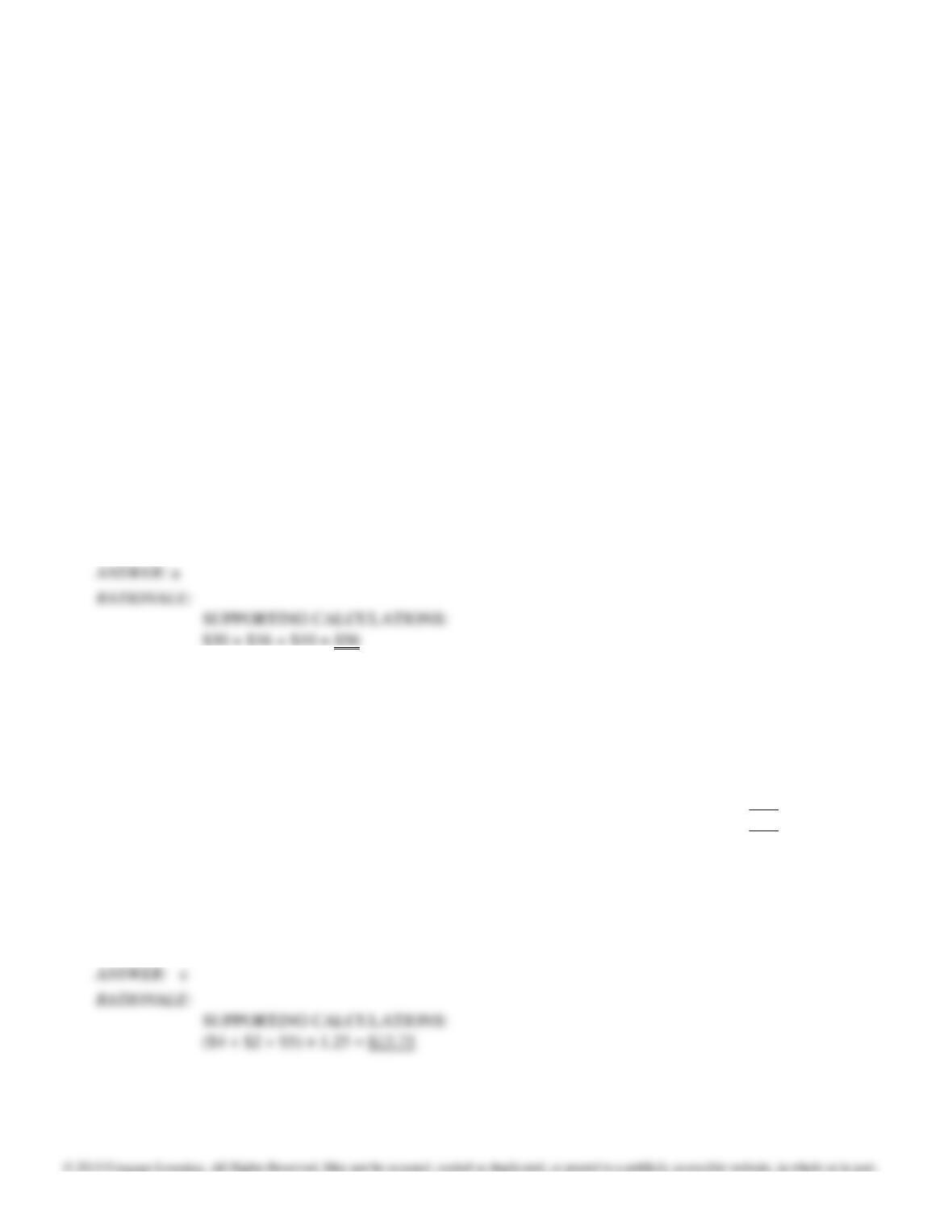
If the negotiated price is used, Gunnison Furniture’s transfer price should be a
a. maximum of $100.80.
b. minimum of $84.00.
c. minimum of $80.00.
d. maximum of $110.00.
Chapter 10: Decentralization: Responsibility, Accounting, Performance Evaluation, and Transfer Pricing
118. Gunnison Furniture had the following historical accounting data, per hundred board feet, concerning one of
its products:
Finished shelving:
Direct materials
$30
Direct labor
16
Variable overhead
10
Fixed overhead
12
Variable selling expenses
8
Fixed selling expenses
4
The shelving is normally transferred internally from the Cutting Division to the Finishing Division. It also may be
sold externally for $110 per hundred board feet. The minimum profit level accepted by the company is a markup
of 20 percent.
If the variable manufacturing cost transfer price method is used without a fixed fee, Gunnison Furniture’s transfer
price will be
a. $56
b. $84
c. $64
d. $68
119. Rags-to-Riches Corporation has two divisions, X and Y. Division X sells its product to Division Y. Standard
costs for Division X are as follows:
Direct materials $ 4 per unit
Direct labor 2 per unit
Variable overhead 5 per unit
Fixed overhead 3 per unit
Total $14 per unit
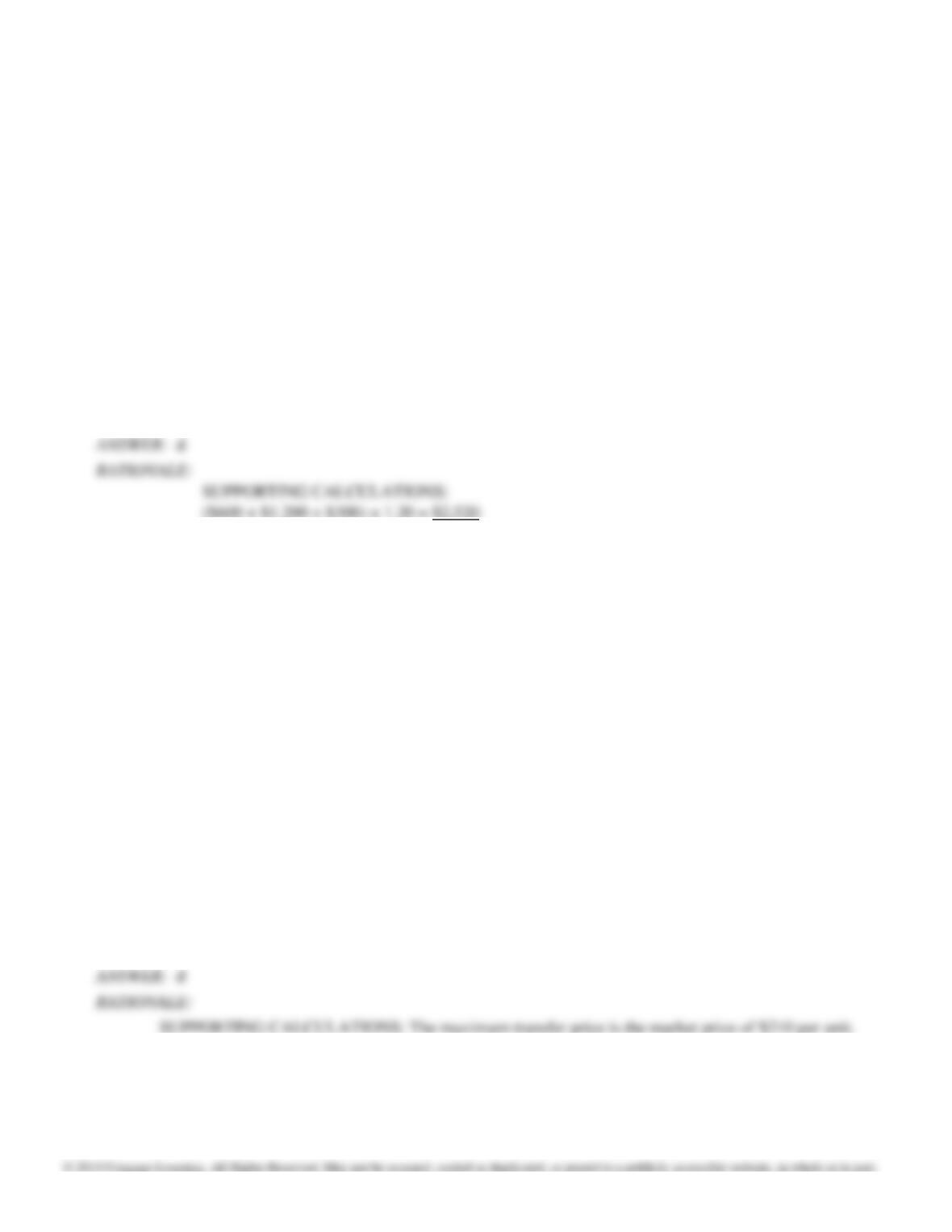
What is the transfer price for Division X based on standard variable cost plus a markup of 25 percent?
a. $11.00
b. $17.50
c. $13.75
d. $7.50
Chapter 10: Decentralization: Responsibility, Accounting, Performance Evaluation, and Transfer Pricing
120. The Engine Division provides engines for the Tractor Division of a company. The standard unit costs for the
Engine Division are as follows:
Direct materials
$ 600
Direct labor
1,200
Variable overhead
300
Fixed overhead
150
Market price per unit
2,730
What is the transfer price based on variable product costs plus 20 percent?
a. $720
b. $2,160
c. $2,100
d. $2,520
121. Panther Company had the following historical accounting data per unit:
Direct materials
$60
Direct labor
30
Variable overhead
15
Fixed overhead
24
Variable selling expenses
45
Fixed selling expenses
9
The units are normally transferred internally from Division A to Division B. The units also may be sold
externally for $210 per unit. The minimum profit level accepted by the company is a markup of 30 percent.
There were no beginning or ending inventories.
If the negotiated price is used, Division A’s transfer price should be a
a. minimum of $120.00.
b. minimum of $153.00.
c. maximum of $198.90.
d. maximum of $210.00.