10.4 Polar Coordinates and Polar Graphs
648
____ 11.
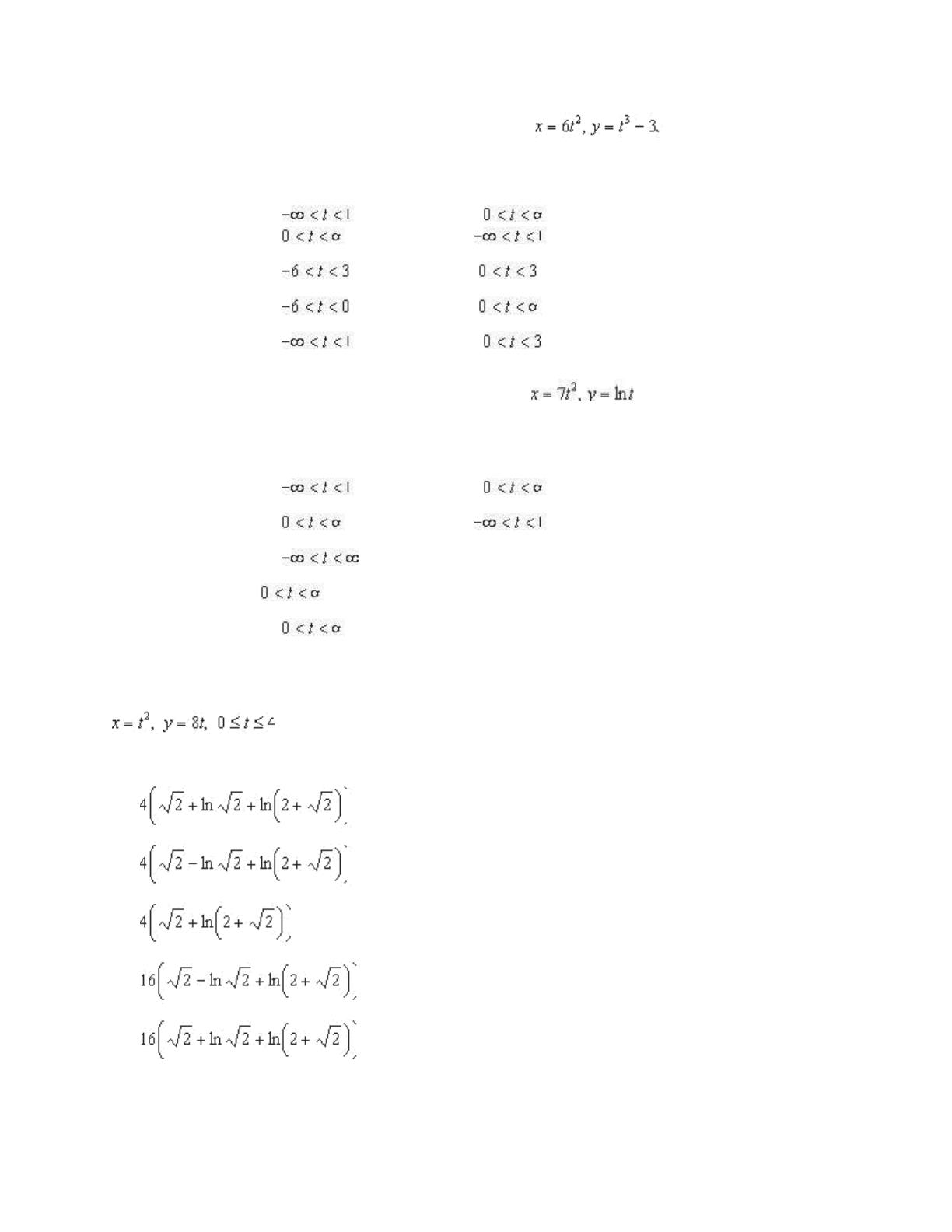
Determine the t intervals on which the curve
is concave
downward or concave upward.
concave downward: ; concave upward:
concave downward: ; concave upward:
concave downward: ; concave upward:
concave downward: ; concave upward:
concave downward: ; concave upward:
____ 12. Determine the t intervals on which the curve is concave downward
or concave upward.
concave downward: ; concave upward:
concave downward: ; concave upward:
concave downward:
concave upward:
concave downward:
____ 13. Find the arc length of the curve on the given interval.
a.
b.
c.
d.
e.
649 Chapter 10: Conics, Parametric Equations, and Polar Coordinates
____ 14. Find the arc length of the curve on the interval . Round
your answer to three decimal places.
287.453
191.635
193.606
66.480
99.721
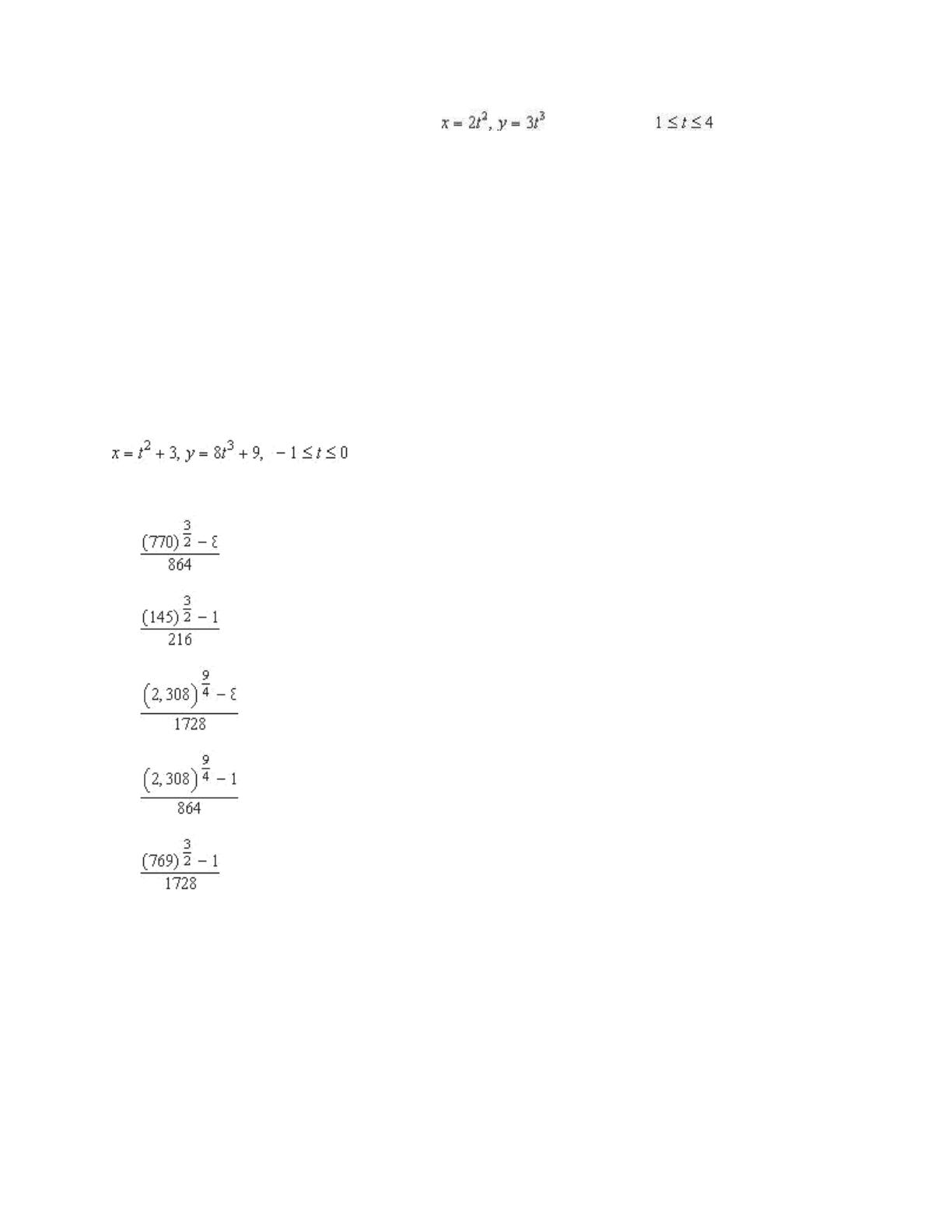
____ 15. Find the arc length of the curve on the given interval.
a.
b.
c.
d.
e.
10.4 Polar Coordinates and Polar Graphs
650
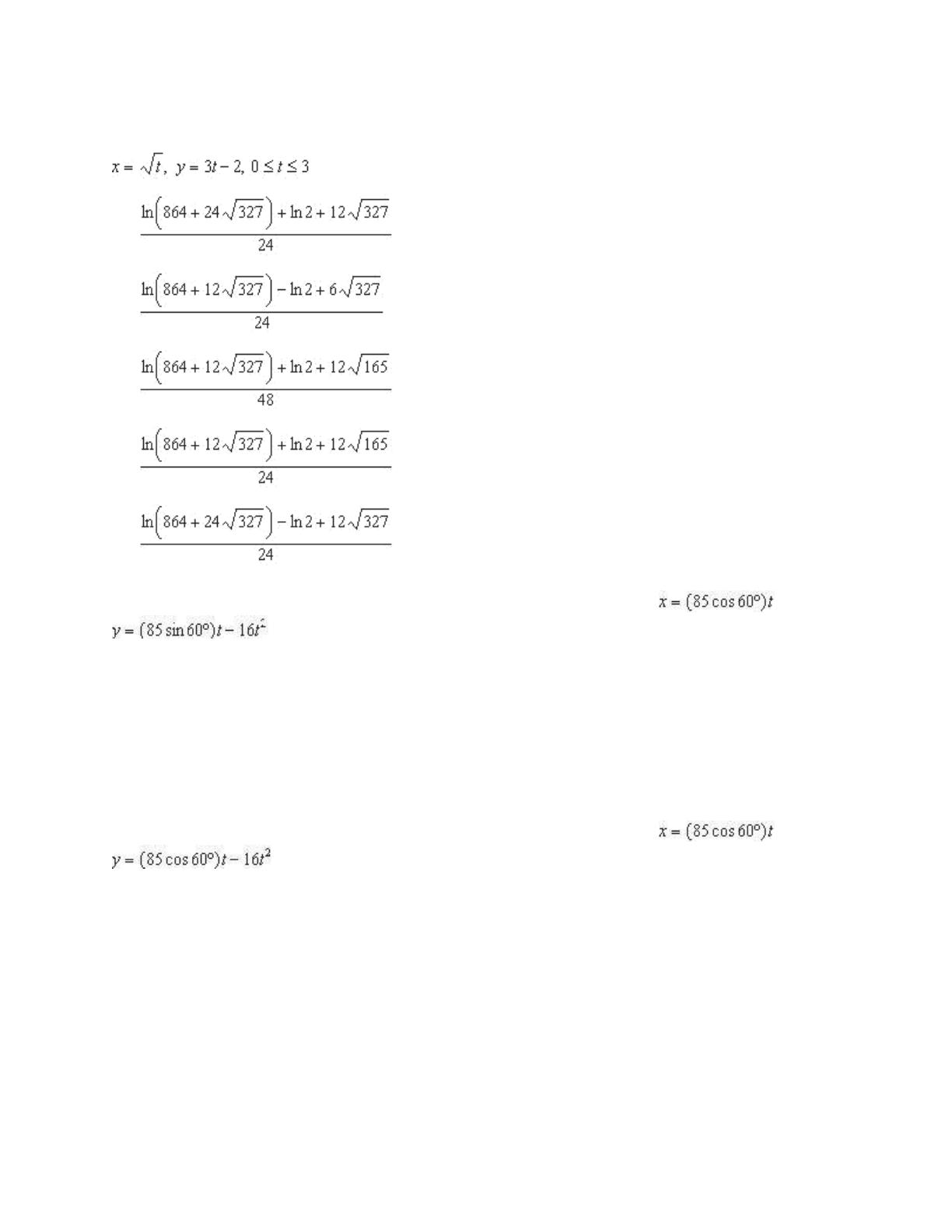
____ 16. Find the arc length of the curve on the given interval.
a.
b.
c.
d.
e.
____ 17. The path of a projectile is modeled by the parametric equations and
where x and y are measured in feet. Use a graphing utility to approximate the
range of the projectile. Round your answer to two decimal places.
312.85 ft
521.42 ft
131.09 ft
391.06 ft
195.53 ft
____ 18. The path of a projectile is modeled by the parametric equations and
where x and y are measured in feet. Use the integration capabilities of a
graphing utility to approximate the arc length of the path. Round your answer to one decimal place.
387.2 ft
595.8 ft
335.0 ft
269.9 ft
465.4 ft
651
Chapter 10: Conics, Parametric Equations, and Polar Coordinates
____
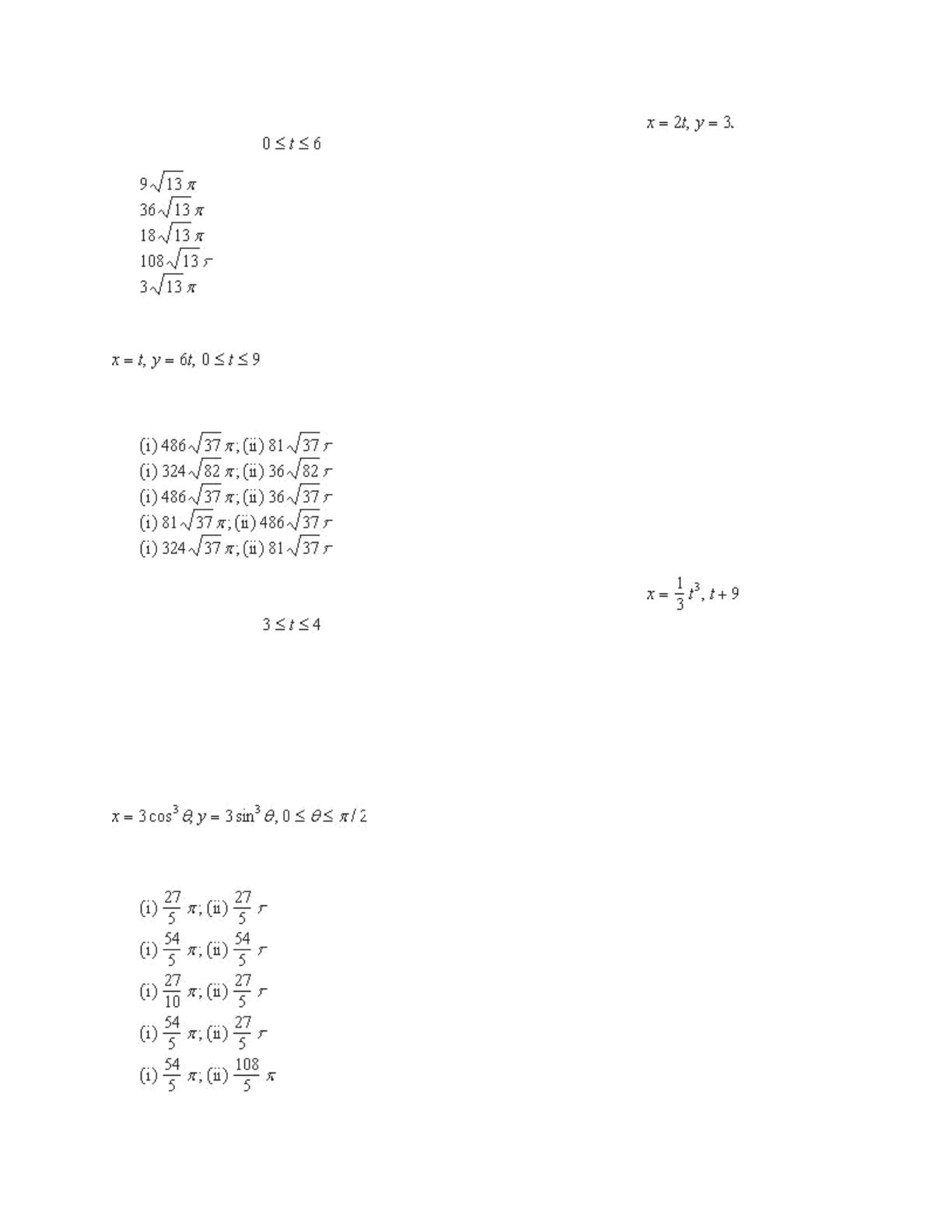
19.
Find the area of the surface generated by revolving the curve
about the
x-axis on the interval
.
a.
b.
c.
d.
e.
____ 20. Find the area of the surface generated by revolving the curve about the given axis.
(i) x-axis; (ii) y-axis
a.
b.
c.
d.
e.
____ 21.
Find the area of the surface generated by revolving the curve
about the
y-axis on the interval
. Round your answer to two decimal places.
1427.12
1178.96
1049.37
589.48
1898.04
____ 22. Find the area of the surface generated by revolving the curve about the given axis.
(i) x-axis; (ii) y-axis
a.
b.
c.
d.
e.
10.4 Polar Coordinates and Polar Graphs
652
10.4 Polar Coordinates and Polar Graphs
Answer Section
653
Chapter 10: Conics, Parametric Equations, and Polar Coordinates
20.
about a line
10.5 Area and Arc Length in Polar Coordinates
654
10.5 Area and Arc Length in Polar Coordinates
Multiple Choice
Identify the choice that best completes the statement or answers the question.
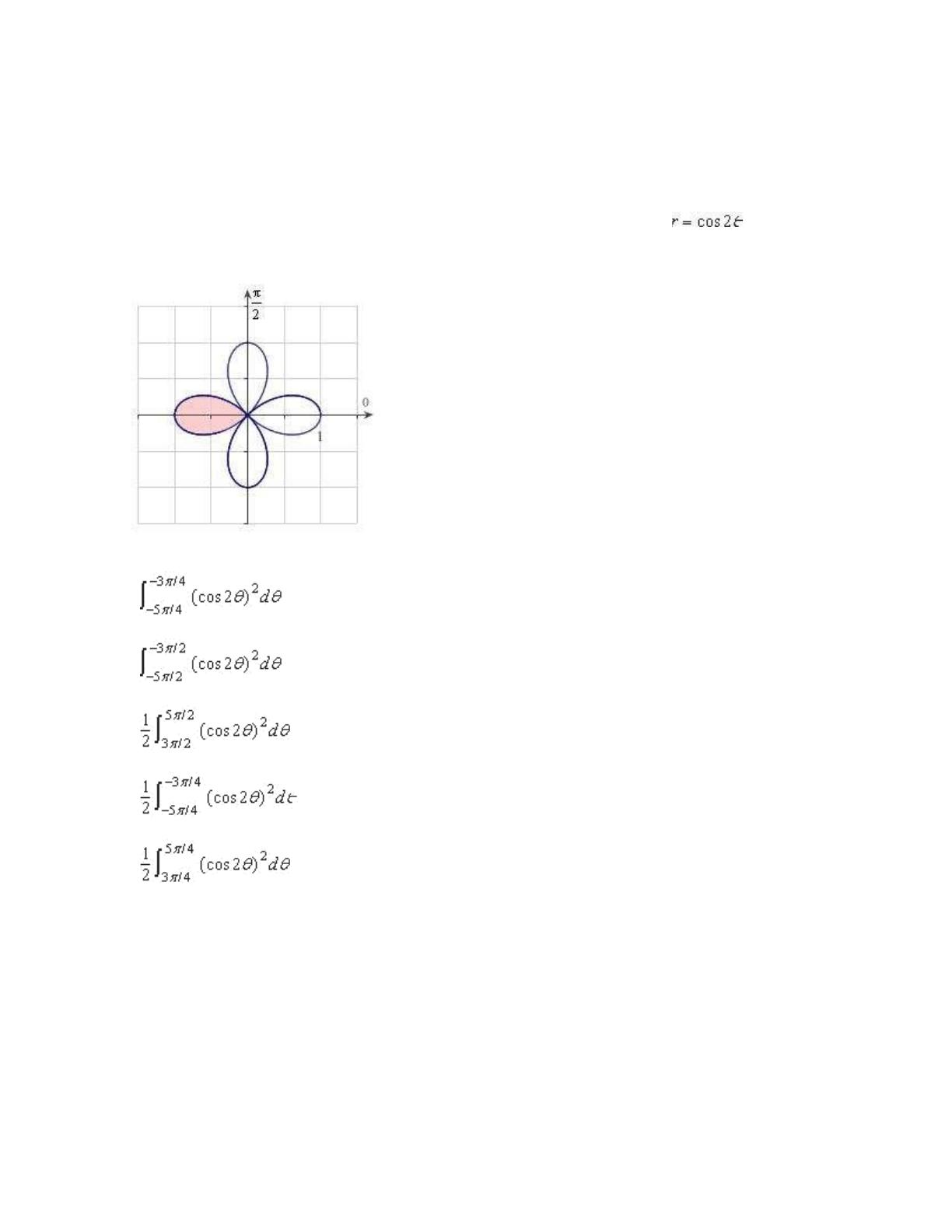
____ 1. Write an integral that represents the area of the shaded region for as
shown in the figure. Do not evaluate the integral.
a.
b.
c.
d.
e.
655 Chapter 10: Conics, Parametric Equations, and Polar Coordinates
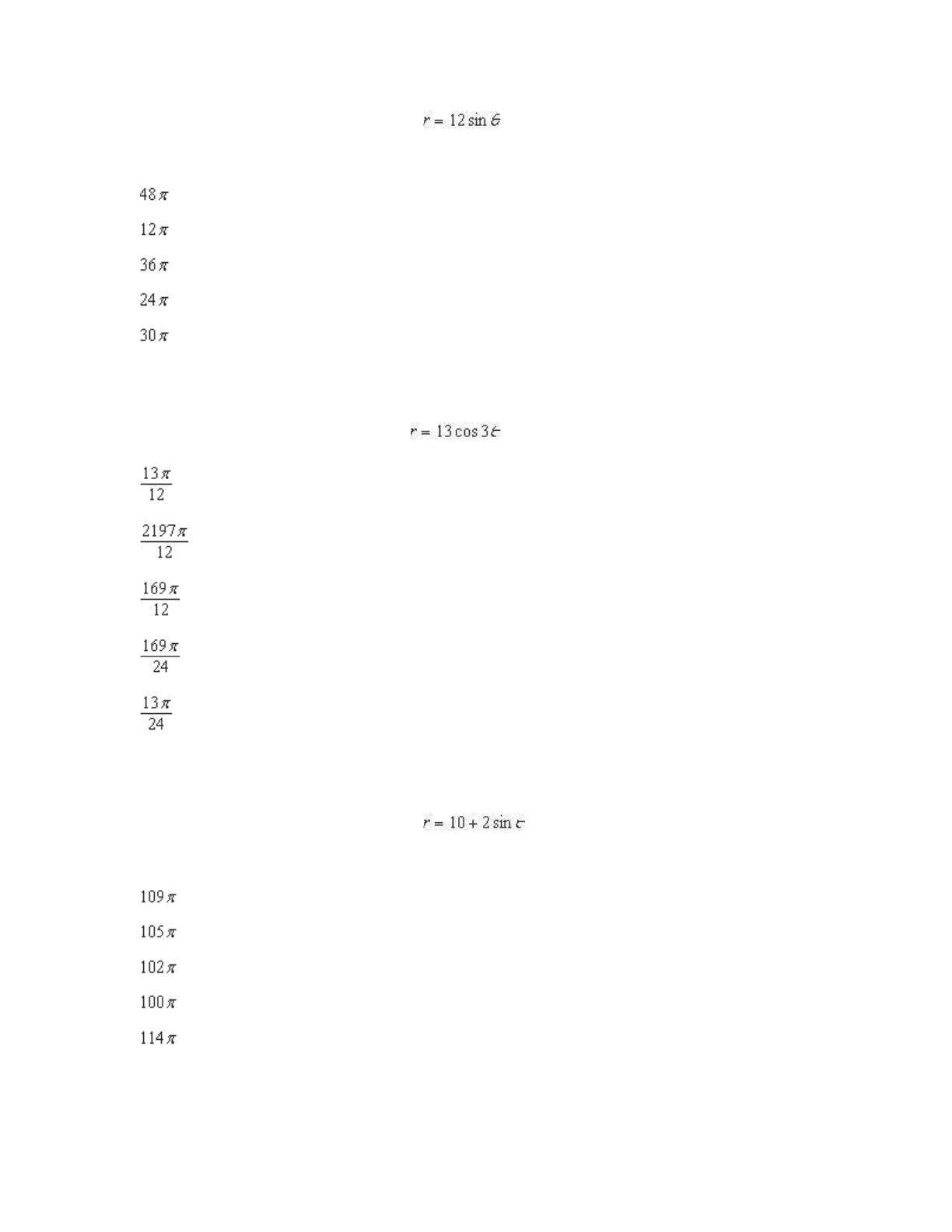
____ 2. Find the area of the interior of .
a.
b.
c.
d.
e.
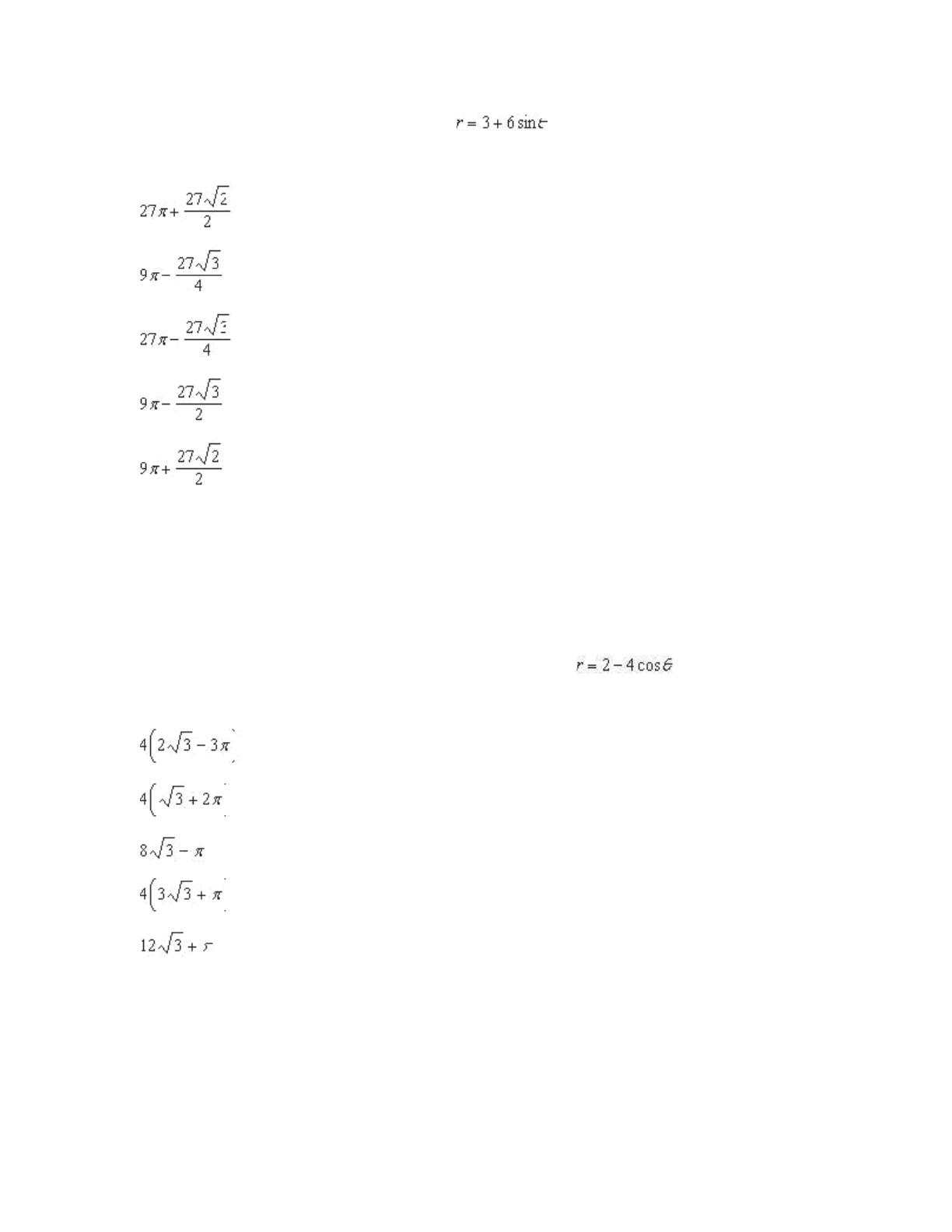
____ 3. Find the area of one petal of .
a.
b.
c.
d.
e.
____ 4. Find the area of the interior of .
a.
b.
c.
d.
e.
10.5 Area and Arc Length in Polar Coordinates
656
____ 5.
Find the area of the inner loop of
.
a.
b.
c.
d.
e.
____ 6. Find the area of the region lying between the loops of .
a.
b.
c.
d.
e.
657 Chapter 10: Conics, Parametric Equations, and Polar Coordinates
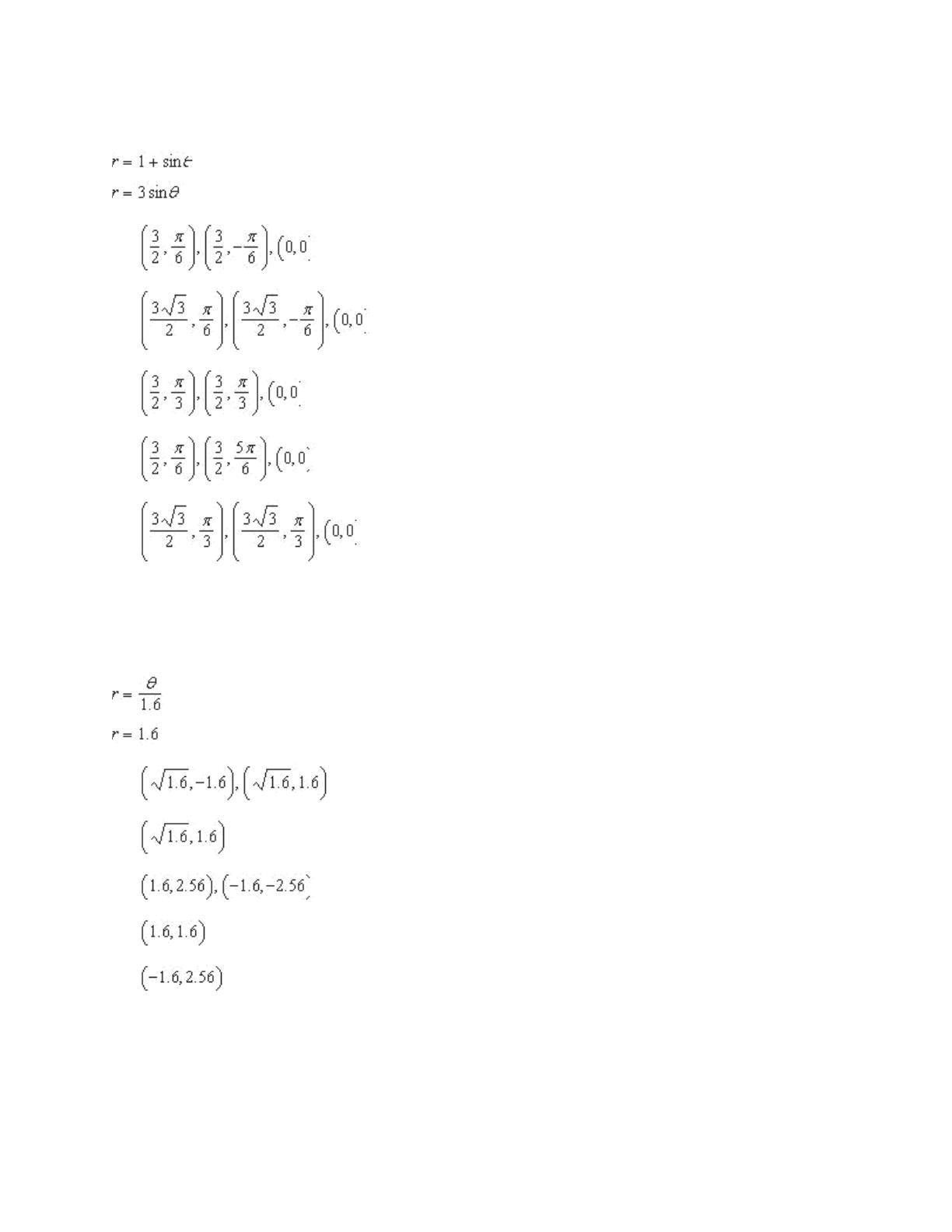
____ 7. Find all points of intersection of the graphs of the equations.
a.
b.
c.
d.
e.
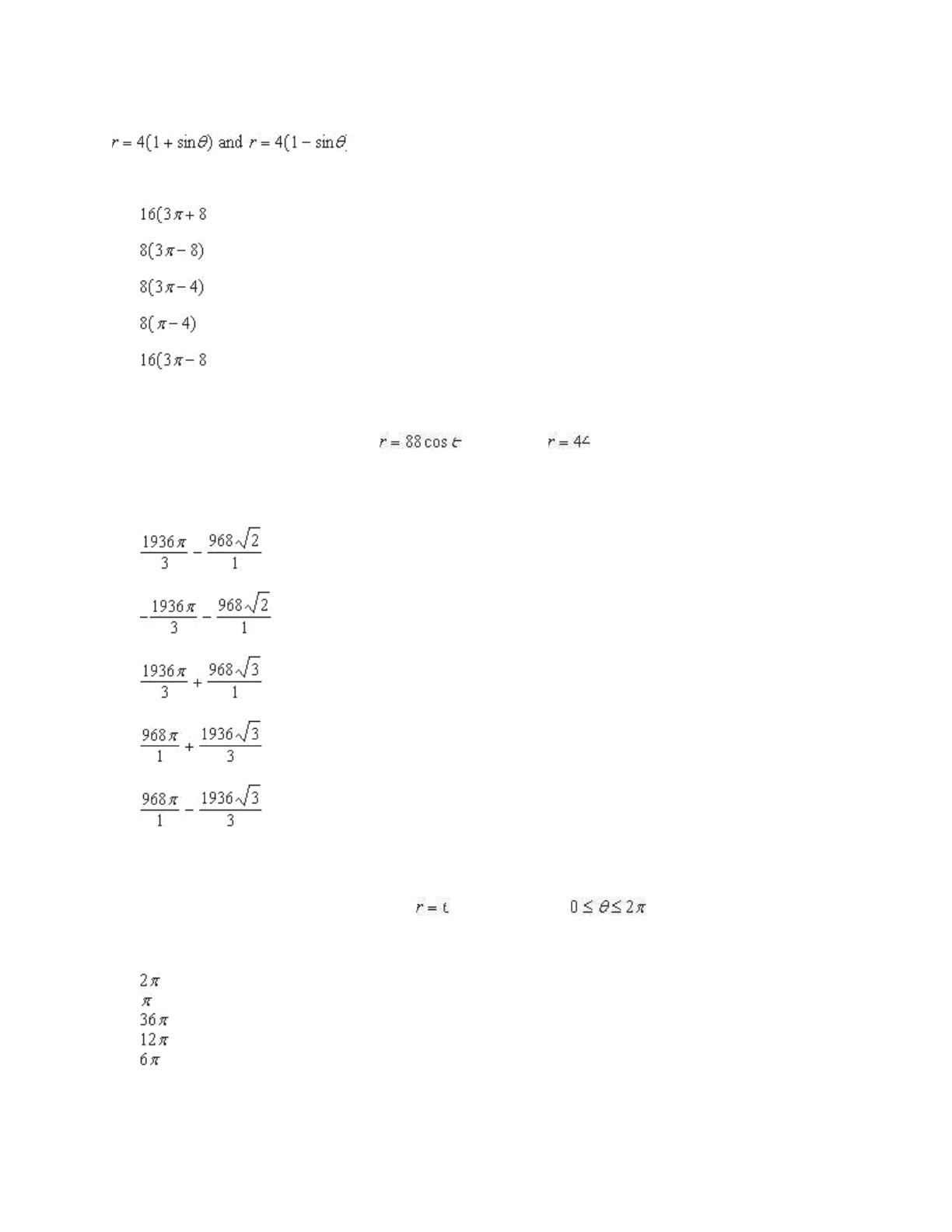
____ 8. Find the points of intersection of the graphs of the equations.
a.
b.
c.
d.
e.
10.5 Area and Arc Length in Polar Coordinates
658
____ 9. Find the area of the common interior of the polar equations
by sketching the graph of the equations using the graphing utility.
a.
b.
c.
d.
e.
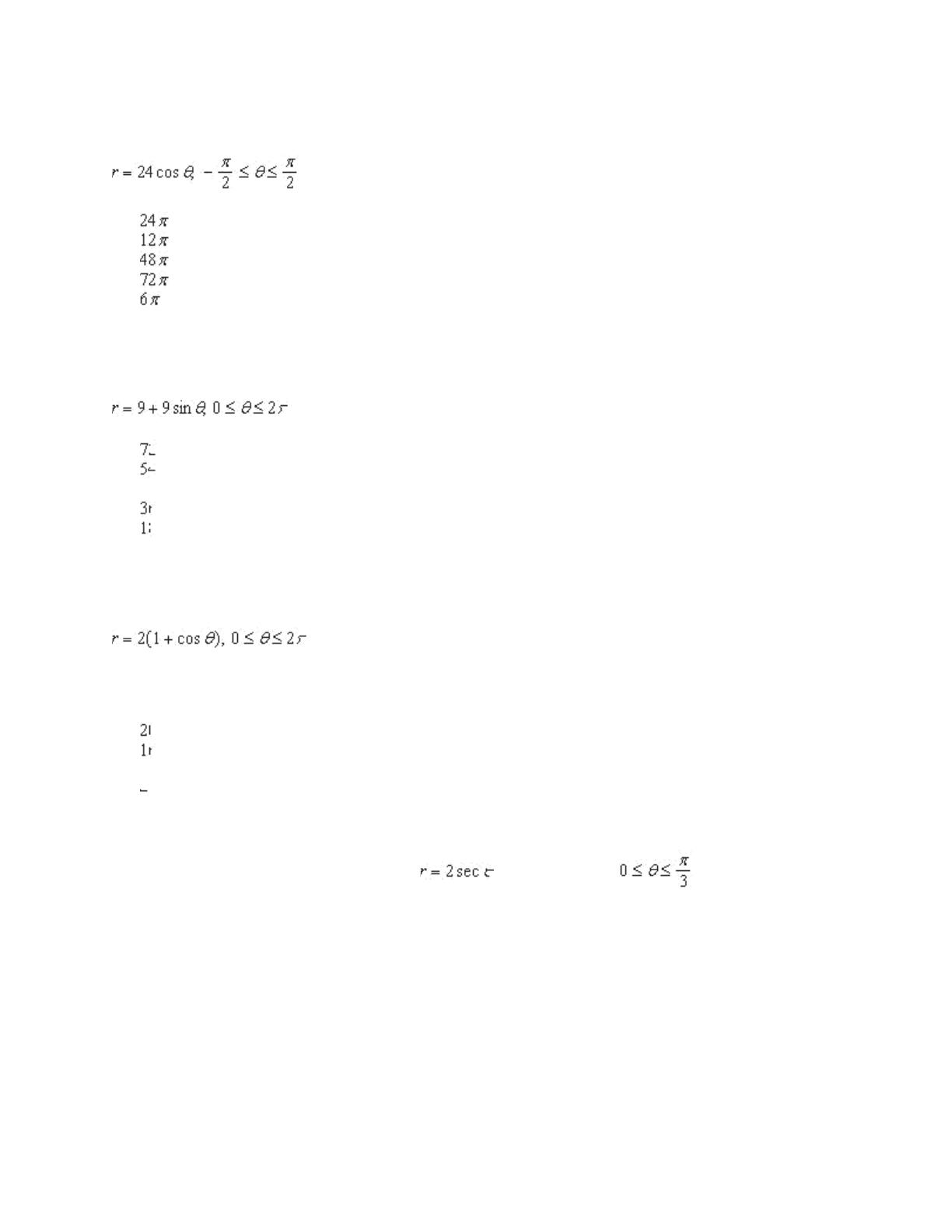
____ 10. Find the area of inside and outside by sketching the graph of the
equations using the graphing utility.
a.
b.
c.
d.
e.
____ 11. Find the length of the curve over the interval .
a.
b.
c.
d.
e.
659 Chapter 10: Conics, Parametric Equations, and Polar Coordinates
____
12.
Find the length of the curve over the given interval.
a.
b.
c.
d.
e.
____
13.
Find the length of the curve over the given interval.
a.
b.
c.
d.
e.
____
14.
Find the length of the curve over the given interval.
a.
b.
c.
d.
e.
____ 15.
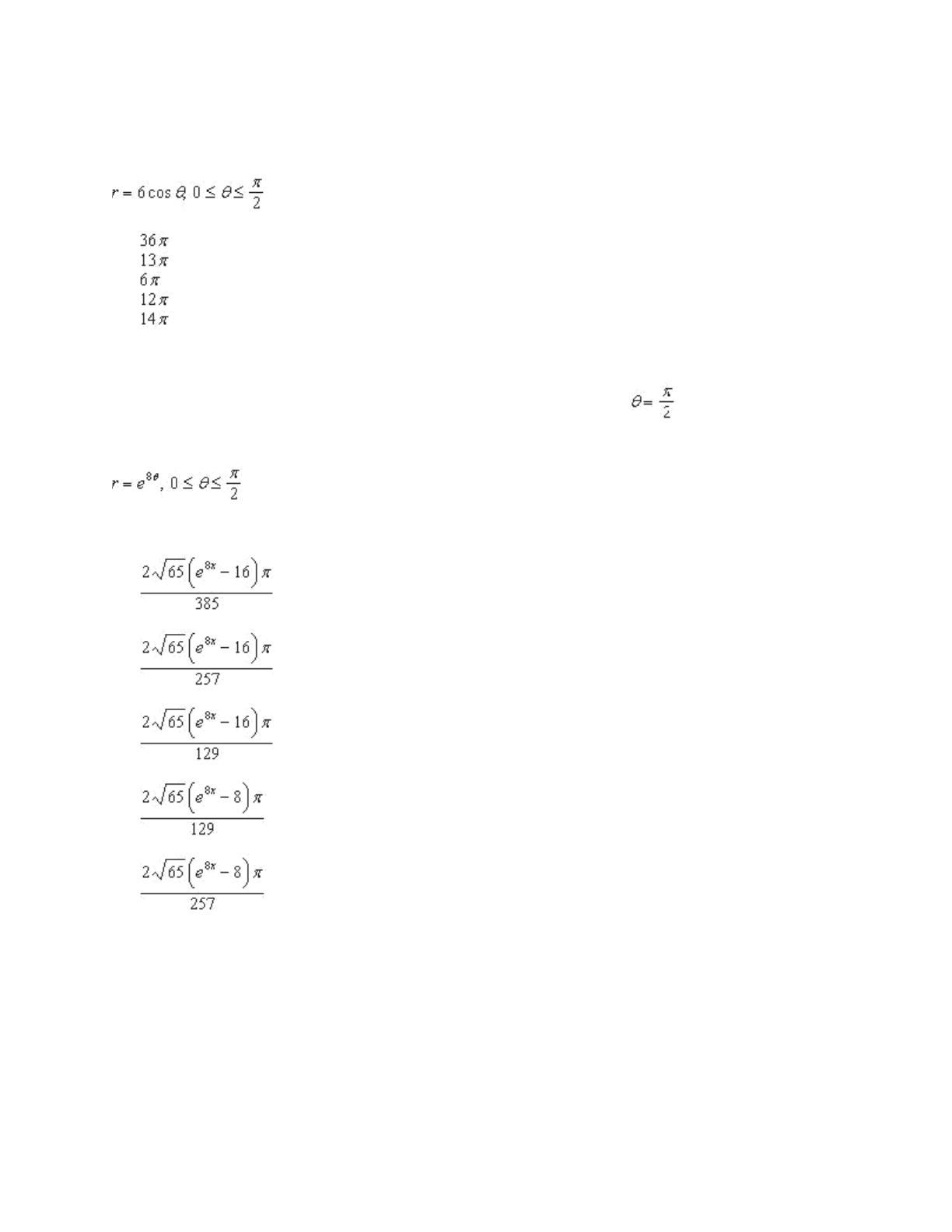
Find the length of the curve
over the interval
. Round your
answer to two decimal places.
a.
0.58
b.
3.46
c.
2.00
d.
1.15
e.
1.73
10.5 Area and Arc Length in Polar Coordinates
660
____
16.
Find the area of the surface formed by revolving about the polar axis the following
curve over the given interval.
a.
b.
c.
d.
e.
____
17.
Find the area of the surface formed by revolving about the
axis the following
curve over the given interval.
a.
b.
c.
d.
e.