21) Normal time equals the average observed time multiplied by the allowance factor.
22) Suppose that the allowance factor for a job is 0.10, and the normal time is 5 hours. What is the
standard time?
A) 5.6 hours
B) 50.0 hours
C) 4.9 hours
D) 5.1 hours
E) 4.5 hours
23) Labor standards are defined as the:
A) preset activities required to perform a job.
B) amount of space required by a specific crew to perform the job.
C) standard set of procedures to perform the job.
D) standard labor agreements.
E) amount of time required to perform a job or part of a job.
24) Labor standards can help to determine which of the following?
A) labor content of a product
B) staffing needs
C) incentive plans
D) efficiency
E) all of the above
25) Labor standards were pioneered by Frank and Lillian Gilbreth and:
A) Frederick Taylor.
B) Eli Whitney.
C) Henry Ford.
D) Alan Smith.
E) GE.
26) Which of the following is not a method used to set labor standards?
A) historical experience
B) time studies
C) predetermined time standards
D) work sampling
E) government laws and regulations
27) Normal time for a stopwatch study is equal to which of the following?
A) Average observed time × Performance rating factor
B) Average observed time + Performance rating factor
C) Average observed time / Performance rating factor
D) Average observed time – Performance rating factor
E) Performance rating factor / Average observed time
28) Suppose that the allowance factor for a job is 0.5 and the normal time is 5 hours. What is the standard
time?
A) 5 hours
B) 2.5 hours
C) 10 hours
D) 7.5 hours
E) cannot determine with the given information
29) A worker completed a task 10 times during a period in which a typical trained employee completes
the task 8 times. What is the worker’s performance rating?
A) 125%
B) 150%
C) 100%
D) 112.5%
E) cannot be determined with the given information
30) Which of the following is NOT a use of labor standards?
A) labor content of items produced
B) cost and time estimates prior to production
C) crew size and work balance
D) basis of wage-incentive plans
E) All of the above are uses of labor standards.
31) Which of the following techniques may NOT provide reliable and accurate labor standards?
A) historical experience
B) methods time measurement (MTM)
C) time studies
D) work sampling
E) predetermined time standards
32) Timing a sample of a worker’s performance and using it as a basis for setting a standard time
describes which of the following?
A) predetermined time standards
B) time studies
C) work sampling
D) methods time measurement
E) left-hand, right-hand charting
33) A manager who is conducting a time study now needs an accuracy of ±0.1 minutes, rather than ±0.2
minutes as in the past. Because of this change in accuracy, the new required sample size becomes:
A) one-fourth as large.
B) one-half as large.
C) twice as large.
D) four times as large.
E) one-tenth larger.
34) In time studies, normal time is:
A) average observed time multiplied by a performance rating factor.
B) larger than standard time.
C) determined by historical experience.
D) converted to standard time by the performance rating factor.
E) one hour later during the summer months.
35) The smaller the percentage established for allowances:
A) the closer is normal time to standard time.
B) the closer is average observed time to normal time.
C) the larger is the performance rating factor.
D) the larger is the required sample size.
E) the larger is the number of observations in the work sampling.
36) In time studies, personal time allowances are often established in which of the following ranges?
A) 0 – 2%
B) 3 – 5%
C) 4 – 7%
D) 6 – 10%
E) 10 –15%
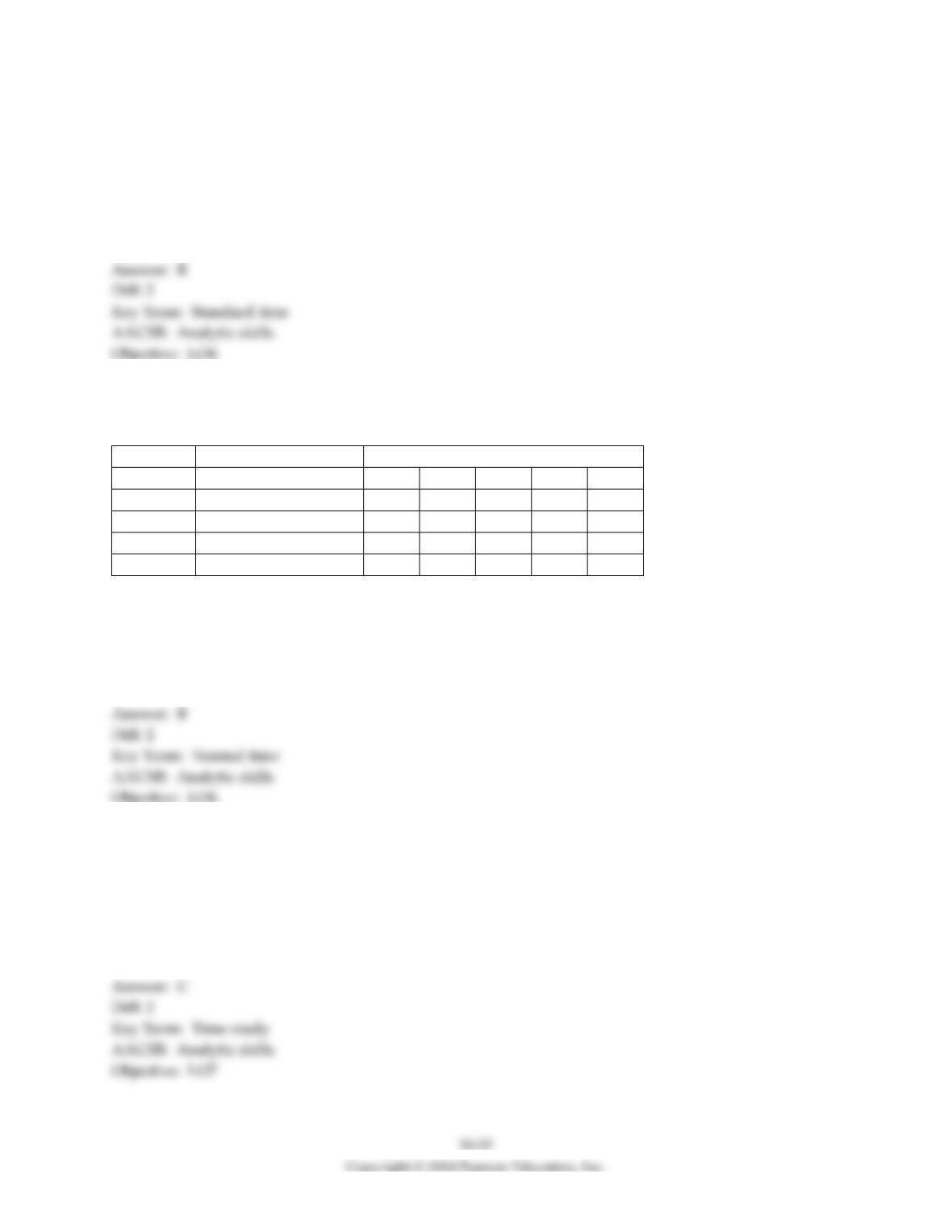
37) The average observed time for a given job is 10 minutes. The performance rating is 80%, and
allowances are set by contract at 10%. What is the standard time?
A) 8.80 minutes
B) 8.88 minutes
C) 10.00 minutes
D) 19.00 minutes
E) 19.80 minutes
38) The data below represent time study observations for an assembly operation. Assume a 7% allowance
factor. What is the normal time for element 3?
Observations (times in minutes)
Element
Performance Rating
1
2
3
4
5
1
100%
1.5
1.6
1.4
1.5
1.5
2
90%
2.3
2.2
2.1
2.2
2.4
3
115%
1.7
1.9
1.9
1.4
1.6
4
100%
3.5
3.6
3.6
3.6
3.2
A) 1.7 min.
B) 1.96 min.
C) 2.11 min.
D) 10.1 min.
E) 11.2 min.
39) The accuracy of a labor standard is to be within ± 5%, and the confidence level is 95%. The standard
deviation of the sample is 2 and the mean is 8. What sample size should be used?
A) 8
B) 10
C) 96
D) 127
E) 68
40) Which of these is the most common predetermined time standard?
A) CSD
B) TMU
C) RCH
D) SAE
E) MTM
41) A work sampling study requires an acceptable error level of 10 percent and z = 2 for 95.45 percent
confidence. The adequate sample size is ________ if the sample proportion is thought to be as large as 50
percent, but ________ if the sample proportion is thought to be about 20 percent.
A) 50; 20
B) 100; 64
C) 100; 16
D) 20; 50
E) 200; 80
42) Sample observations of a claims processor made over a 160-hour work month reveal that the worker
produced a total of 384 completed claims forms. The performance rating was 80%. The worker was idle
20% of the time (so that idle time should be subtracted from the total time when computing the average
observed time). The allowance factor is 8%. What is the normal time per unit?
A) 0.42 minutes
B) 16.0 minutes
C) 17.4 minutes
D) 20.0 minutes
E) 21.7 minutes
43) Sample observations of a claims processor made over a 160-hour work month reveal that the worker
produced a total of 384 completed claims forms. The performance rating was 80%. The worker was idle
20% of the time (so that idle time should be subtracted from the total time when computing the average
observed time). The allowance factor is 8%. What is the standard time per unit?
A) 0.42 minutes
B) 16.0 minutes
C) 17.4 minutes
D) 20.0 minutes
E) 21.7 minutes
44) A time measurement unit, or TMU, is:
A) the same as a Therblig.
B) 0.00001 minute.
C) 0.00001 hour.
D) the duration of the easiest GET motion.
E) an historical experience standard.
45) Therbligs:
A) were invented by Frederick W. Taylor.
B) were used during the scientific management era, and are no longer in use.
C) are hyperactive rodent-like pets, whose name is associated with time standards.
D) were named by Frank Gilbreth.
E) are .0006 minutes in length.
46) Therbligs are:
A) the smallest unit of time used in methods time measurement exercises.
B) the largest unit of time used in methods time measurement exercises.
C) basic physical elements of motion as used in methods time measurement exercises.
D) the full range of motions required to complete a job as used in methods time measurement exercises.
E) the smallest amount of time required to complete a job.
47) Predetermined time standards are an outgrowth of basic motions called:
A) mini-movements.
B) micro-motions.
C) SAE standards.
D) TMUs.
E) therbligs.
48) Among the advantages of predetermined time standards are all EXCEPT which of the following?
A) Unions accept them as fair.
B) They are available before a task is actually performed.
C) They can only be determined after work actually takes place.
D) They can be established in a laboratory setting.
E) No performance ratings are necessary.
49) What is a technique for estimating the percent of time a worker spends on various tasks?
A) stopwatch time study
B) simultaneous motion study
C) work sampling
D) standard elemental (historical) times
E) predetermined (published) time standards
50) A bank manager wants to determine the percent of time the bank’s tellers are working and idle. He
decides to use work sampling, and his initial estimate is that the tellers are idle 20% of the time.
Approximately how many observations should be taken to be 95% confident that the results will not be
more than 5% away from the true result?
A) 6
B) 16
C) 44
D) 210
E) 246
51) The tally sheet data from a work sampling study provides information regarding:
A) the number of wasted motions.
B) the level of difficulty in a motion.
C) the percent of time spent on various tasks.
D) the quality of the work environment.
E) the number of micro-motions involved.
52) An advantage of work sampling is that:
A) no observation is required.
B) it involves study of the equipment only.
C) a performance rating is necessary.
D) the time spent observing the employee is relatively short.
E) it is more effective than time studies when task times are short.
53) A disadvantage of work sampling is that:
A) it tends to be less accurate, particularly when task times are short.
B) it observes several workers simultaneously.
C) it is more expensive than time-study methods.
D) it is more intrusive than time-study methods, and therefore generates more complaints.
E) All of the above are disadvantages of work sampling.
54) ________ allowances are those that account for the distance from employees to restrooms, water
fountains, and other facilities.
55) A(n) ________ involves timing a sample of a worker’s performance and using it as a basis for setting a
standard time.
56) ________ divide(s) manual work into small basic elements that have established and widely accepted
times.
57) ________ estimates the percent of time that a worker spends on various tasks.
58) Explain in broad terms, using a sentence or two, what is meant by the “classical stopwatch study.” To
what extent is it still in use today?
59) List the eight steps used to develop a time study-based labor standard.
60) If historical experience data are so widely available and so easy to obtain, why aren’t they more
widely used to set labor standards?
61) Define standard time.
62) In time studies, what are the three broad categories of allowances?
63) What are predetermined time standards?
64) Identify the five steps of the work-sampling procedure.
65) What are five advantages of work sampling over time-study methods?
66) What are three disadvantages of work sampling?
67) A time study of a certain service task found an average time of 15 minutes, with a standard deviation
of 5 minutes. These figures were based on a sample of 100 measurements. Is the sample large enough that
we are 95% confident that standard time is within ±5% of its true value?
68) How many observations would be necessary for a time studies analyst to be 99% confident that the
average time is within ± .1 minutes of the true value, if the average time is 10.5 minutes and the standard
deviation is 3 minutes?
69) A work sampling study requires an acceptable error level of ± 10 percent and 95 percent confidence. a.
What is the required sample size if the sample proportion busy is as large as 50 percent? b. What is
the required sample size if the sample proportion busy is estimated to be about 20 percent?
70) In a preliminary work sample of an operation, out of 50 observations the operator was observed idle
in 5 observations. What sample size is required for a work sampling study if the desired confidence level
is 99% and the desired accuracy level is ± 5%?
71) A brake system installer in an auto factory has an actual average time of 10 minutes on her task. The
performance rating of the worker timed was estimated at 110%. Practice in this department is to allow 9%
for allowances.
a. Find the normal time for the operation.
b. Compute the standard time for the operation.
72) A Methods and Measurements Analyst needs to develop a time standard for a certain task. The task
involves use of a ruler, square, and portable electric saw to mark and cut the “notch” in a rafter (a
standard carpentry task of home construction). In a preliminary study, he observed one of his workers
performing this task five times. The observations were made in an air-conditioned, well-lit training
facility, at ground level, with all tools and equipment clean and readily available.
Observation:
1
2
3
4
5
Task time (seconds):
82
74
80
83
76
a. What is the actual average time for this task?
b. What is the normal time for this task if the employee worked at a 20% faster pace than is typical for
adequately trained workers?
c. What is standard time for this task if allowances sum to 14%?
d. If the analyst then thought more carefully about his experiment and decided that the allowances
needed to be increased to match the real (outside, not air-conditioned) work environment, and that the
proper allowance was not 14% but 20%, what is the revised standard time?
73) A task involves positioning two metal parts with a rubber gasket sandwiched between them, inserting
two bolts into predrilled holes, threading a nut onto each bolt, and tightening each bolt with a pneumatic
wrench. In a preliminary study, the manager observed one of his workers performing this task five times.
The observations were made in an air-conditioned, well-lit training facility, at ground level, with all tools
and equipment clean and readily available.
Observation:
1
2
3
4
5
Task time (seconds):
50
54
60
66
56
a. What is the average observed time for this task?
b. What is the normal time for this task if the employee worked at a 10% slower pace than is typical for
adequately trained workers?
c. What is standard time for this task if allowances sum to 14%?
74) An operation in a television factory has an average observed time of 6 minutes. The performance
rating of the worker timed was estimated at 90%. Practice in this department is to provide 8% for
allowances.
a. Find the normal time for the operation.
b. Compute the standard time for the operation.
c. Recompute the standard time if an additional fatigue allowance of 8% is factored in.
75) An initial analysis of a laboratory activity resulted in the first table below. After this analysis, the
managers determined that their element descriptions were not as accurate as they should have been–they
had left out an element, underestimated a distance, and understated the need for accuracy. They revised
the table of element data, which appears in the second table.
Original Activity: Pouring tube specimen
Element description
Element code
TMU
Get tube from rack
AA2
35
Get stopper, place on counter
AA2
35
Get centrifuge, place at sample tube
AD2
45
Pour (3 sec.)
PT
83
Place tubes in rack (simo)
PC2
40
TOTAL TMU
Revised Activity: Pouring tube specimen
Element description
Element code
TMU
Get tube from rack
AC3
70
Get stopper, place on counter
AA2
35
Get centrifuge, place at sample tube
AD2
45
Pour (3 sec.)
PT
83
Get stopper, place on tube
AC1
40
Place tubes in rack (simo)
PC2
40
TOTAL TMU
Calculate the total standard minutes for the original activity “pouring tube specimen.” Calculate the total
standard minutes for the revised activity “pouring tube specimen.” What is the increase, in seconds, from
the first version to the second? (Round calculations to four decimal places.)
76) A manufacturing plant is trying to determine standard production per day for an incentive program.
Suppose that the incentive program will pay $1 per unit produced above standard rates. A worker is
timed at an average of 280 seconds per unit, with a performance rating of 105%. The plant has an
allowance factor of 13%. If the worker later produces 100 units in an 8 hour shift, how much would he
receive under the incentive plan?
77) In a time study, what is the required sample size to be 95% confident that the observed average time
is within ± 2% of the actual value, if the process has a standard deviation of 1 minute and mean of 50
minutes?
78) Suppose that a time study analyst takes a sample of size 60 observations. The process mean is 100
seconds, and the standard deviation is 3 seconds. If the max error can be no more than ± 1 second, how
confident can the analyst be in the results?
Section 8 Ethics
1) Ethical work environment decisions by managers may be guided by which of the following?
A) state agencies
B) trade associations
C) insurers
D) employees
E) all of the above