FOR INSTRUCTOR USE ONLY
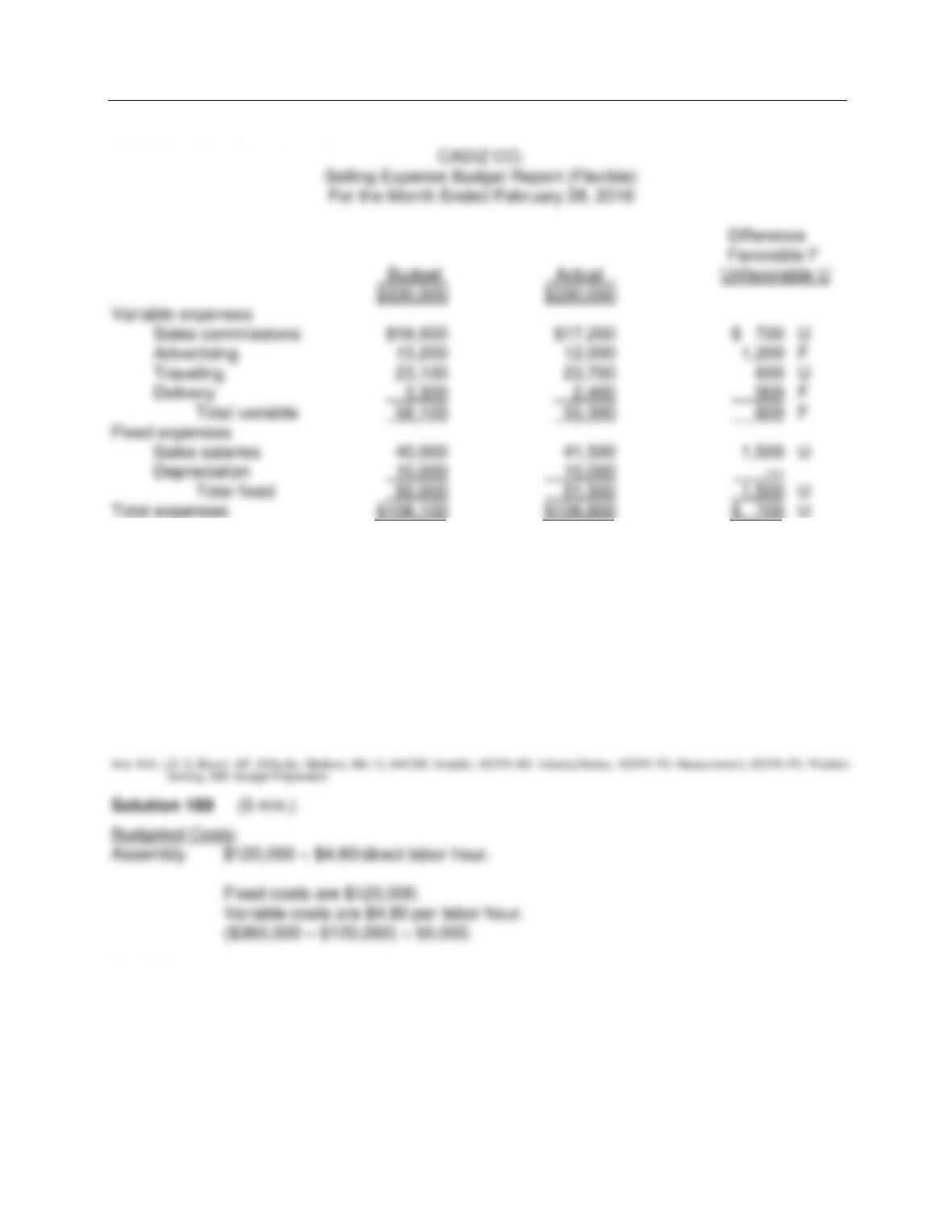
CHAPTER 10
BUDGETARY CONTROL AND
RESPONSIBILITY ACCOUNTING
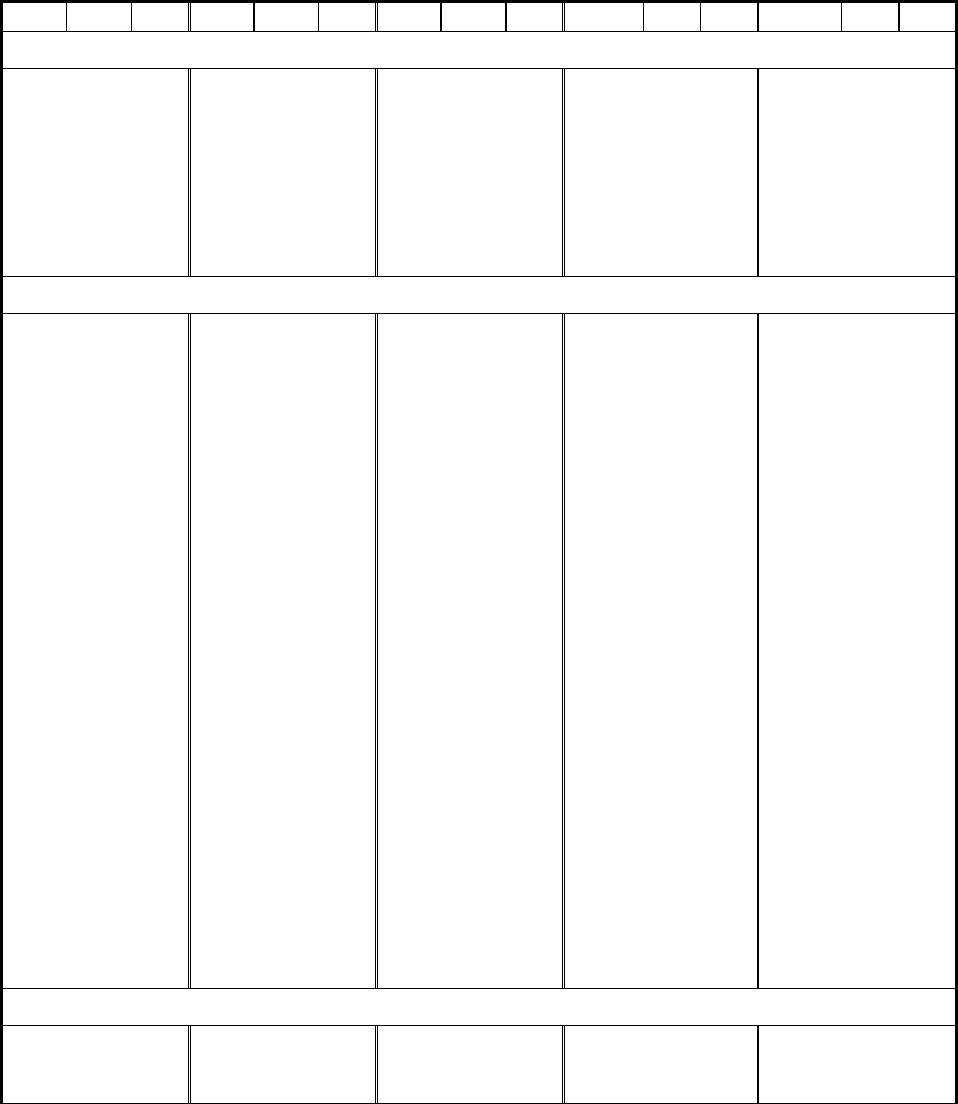
SUMMARY OF QUESTIONS BY LEARNING OBJECTIVES AND BLOOM’S TAXONOMY
Item
LO
BT
Item
LO
BT
Item
LO
BT
Item
LO
BT
Item
LO
BT
True-False Statements
1.
1
K
9.
2
C
17.
2
K
25.
3
K
33.
2
K
2.
1
C
10.
2
K
18.
2
K
26.
3
K
34.
3
C
3.
1
K
11.
2
K
19.
3
C
27.
4
K
35.
3
K
4.
1
K
12.
2
C
20.
3
C
28.
4
K
36.
4
K
5.
1
C
13.
2
C
21.
3
C
a29.
5
C
a37.
5
K
6.
1
C
14.
2
C
22.
3
C
a30.
5
C
7.
1
K
15.
2
K
23.
3
C
31.
1
K
8.
1
C
16.
2
K
24.
3
K
32.
1
K
Multiple Choice Questions
38.
1
K
64.
2
C
90.
3
AP
116.
3
C
142.
4
K
39.
1
C
65.
2
K
91.
3
C
117.
3
AP
143.
4
K
40.
1
K
66.
2
C
92.
3
C
118.
3
C
144.
4
AP
41.
1
C
67.
2
C
93.
3
C
119.
3
C
145.
4
C
42.
1
K
68.
2
K
94.
3
K
120.
3
AP
146.
4
AP
43.
1
K
69.
2
K
95.
3
C
121.
4
AP
147.
4
C
44.
1
K
70.
2
AP
96.
3
C
122.
4
AP
a148.
5
AP
45.
1
C
71.
2
C
97.
3
C
123.
4
AN
a149.
5
K
46.
1
C
72.
2
C
98.
3
C
124.
4
AP
a150.
5
C
47.
1
C
73.
2
C
99.
3
K
125.
4
AN
a151.
5
C
48.
1
C
74.
2
AP
100.
3
C
126.
4
AP
a152.
5
C
49.
1
C
75.
2
AP
101.
3
C
127.
4
AP
a153.
5
AP
50.
1
C
76.
2
AP
102.
3
C
128.
4
AP
a154.
5
AP
51.
1
C
77.
2
AP
103.
3
C
129.
4
AP
a155.
5
AP
52.
1
C
78.
2
AP
104.
3
K
130.
4
AP
156.
1
C
53.
1,2
C
79.
2
AP
105.
3
C
131.
4
AP
157.
1
K
54.
1
K
80.
2
AP
106.
3
C
132.
4
AP
st158.
1
K
55.
2
AP
81.
2
AP
107.
3
C
133.
4
AN
159.
2
AP
56.
2
AP
82.
2
AP
108.
3
C
134.
4
AP
st160.
2
K
57.
2
AP
83.
2
AP
109.
3
C
135.
4
AP
161.
2
K
58.
2
C
84.
2
AP
110.
3
K
136.
4
C
st162.
2
K
59.
2
C
85.
2
AP
111.
3
C
137.
4
C
163.
3
K
60.
2
K
86.
2
AP
112.
3
K
138.
4
K
st164.
3
K
61.
2
C
87.
2
AP
113.
3
C
139.
4
C
165.
4
K
62.
2
C
88.
2
AP
114.
3
C
140.
4
K
st166.
4
K
63.
2
C
89.
3
K
115.
3
AP
141.
4
AP
167.
4
AP
Brief Exercises
168 7
.
2
AP
171.
2
AP
174.
4
AP
177.
4
AN
169.
2
AP
172.
3
AP
175.
4
AP
a178.
5
AP
170.
2
AP
173.
.
3
AP
176.
4
AP
a179.
5
AP
Test Bank for Managerial Accounting, Seventh Edition
FOR INSTRUCTOR USE ONLY
10 – 2
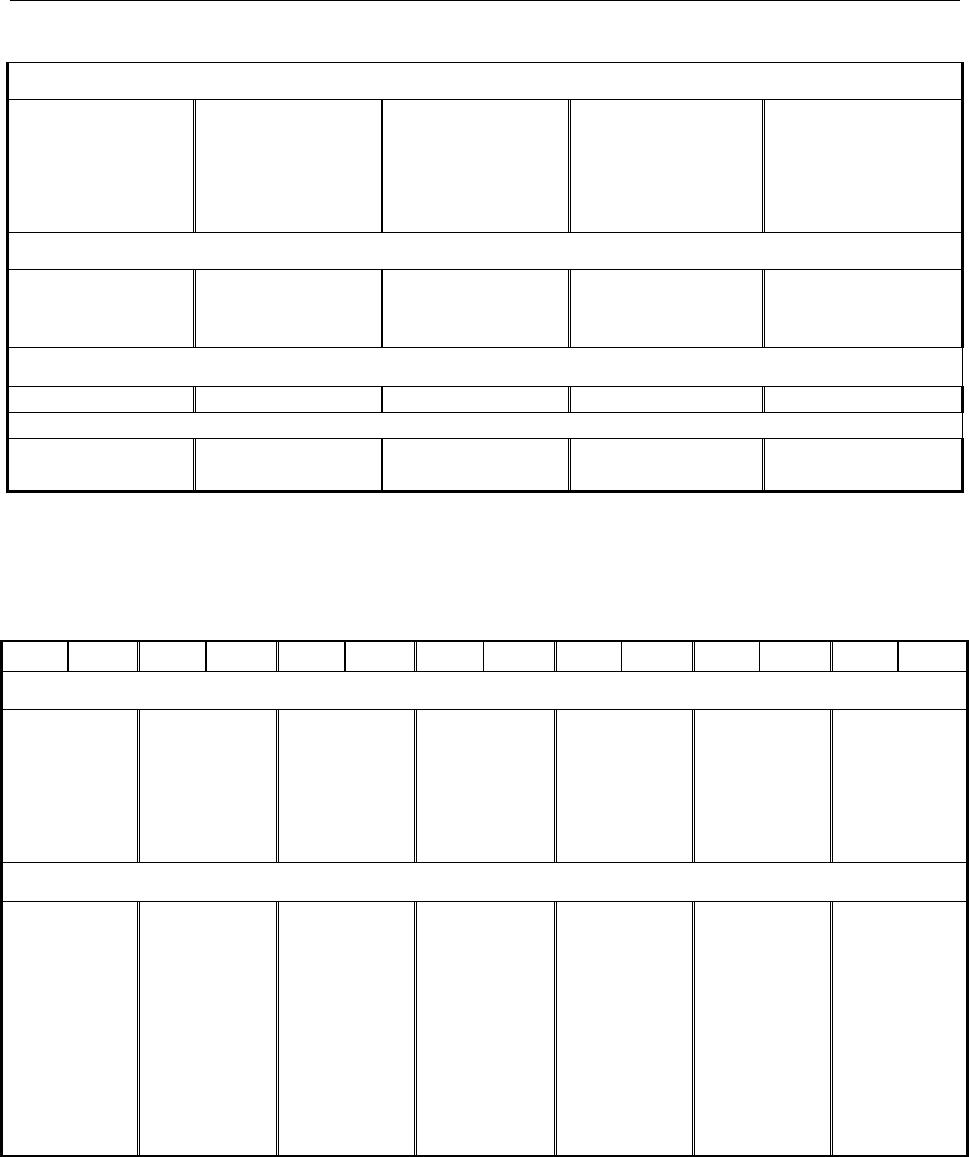
SUMMARY OF QUESTIONS BY LEARNING OBJECTIVES AND BLOOM’S TAXONOMY
Exercises
180.
1
AP
185.
2
AP
190.
2
AP
195.
3
AN
200.
4
AP
181.
1,2
AP
186.
2
AP
191.
2,3
AP
196.
3
AN
201.
4
AN
182.
2
AP
187.
2
AP
192.
3
AP
197.
3,4
AP
202.
4
AN
183.
2
AP
188.
2
AP
193.
3
AN
198.
4
AP
203.
4
AN
184.
2
AP
189.
2
AP
194.
3
AP
199.
4
AP
204.
4
AN
Completion Statements
205.
1
K
208.
1
K
211.
3
K
214.
3
K
206.
1
K
209.
2
K
212.
3
K
215.
4
K
207.
1
K
210.
2
K
213.
3
K
216.
4
K
Matching
217.
1–4
K
Short-Answer Essay
218.
1
K
220.
3
K
222.
4
K
219.
2
K
221.
3
K
223.
4
K
st This question also appears in a self-test at the student companion website.
SUMMARY OF LEARNING OBJECTIVES BY QUESTION TYPE
Item
Type
Item
Type
Item
Type
Item
Type
Item
Type
Item
Type
Item
Type
Learning Objective 1
1.
TF
7.
TF
40.
MC
46.
MC
52.
MC
180.
Ex
217.
MA
2.
TF
8.
TF
41.
MC
47.
MC
53.
MC
181.
Ex
218.
S-A
3.
TF
31.
TF
42.
MC
48.
MC
54.
MC
205.
C
4.
TF
32.
TF
43.
MC
49.
MC
156.
MC
206.
C
5.
TF
38.
MC
44.
MC
50.
MC
157.
MC
207.
C
6.
TF
39.
MC
45.
MC
51.
MC
158.
MC
208.
C
Learning Objective 2
9.
TF
33.
TF
63.
MC
73.
MC
83.
MC
168.
BE
187.
Ex
10.
TF
53.
MC
64.
MC
74.
MC
84.
MC
169.
BE
188.
Ex
11.
TF
55.
MC
65.
MC
75.
MC
85.
MC
170.
BE
189.
Ex
12.
TF
56.
MC
66.
MC
76.
MC
86.
MC
171.
BE
190.
Ex
13.
TF
57.
MC
67.
MC
77.
MC
87.
MC
181.
Ex
191.
Ex
14.
TF
58.
MC
68.
MC
78.
MC
88.
MC
182.
Ex
209.
C
15.
TF
59.
MC
69.
MC
79.
MC
159.
MC
183.
Ex
210.
C
16.
TF
60.
MC
70.
MC
80.
MC
160.
MC
184.
Ex
217.
MA
17.
TF
61.
MC
71.
MC
81.
MC
161.
MC
185.
Ex
219.
S-A
18.
TF
62.
MC
72.
MC
82.
MC
162.
MC
186.
Ex
Budgetary Planning and Responsibility Accounting
FOR INSTRUCTOR USE ONLY
10 – 3
Learning Objective 3
19.
TF
35.
TF
97.
MC
106.
MC
115.
MC
173.
BE
212.
C
20.
TF
89.
MC
98.
MC
107.
MC
116.
MC
191.
Ex
213.
C
21.
TF
90.
MC
99.
MC
108.
MC
117.
MC
192.
Ex
214.
C
22.
TF
91.
MC
100.
MC
109.
MC
118.
MC
193.
Ex
217.
MA
23.
TF
92.
MC
101.
MC
110.
MC
119.
MC
194.
Ex
220.
S-A
24.
TF
93.
MC
102.
MC
111.
MC
120.
MC
195.
Ex
221.
S-A
25.
TF
94.
MC
103.
MC
112.
MC
163.
MC
196.
Ex
26.
TF
95.
MC
104.
MC
113.
MC
164.
MC
197.
Ex
34.
TF
96.
MC
105.
MC
114.
MC
172.
BE
211.
C
Learning Objective 4
27.
TF
126.
MC
134.
MC
142.
MC
167.
MC
200.
Ex
222.
K
28.
TF
127.
MC
135.
MC
143.
MC
174.
BE
201.
Ex
223.
K
36.
TF
128.
MC
136.
MC
144.
MC
175.
BE
202.
Ex
121.
MC
129.
MC
137.
MC
145.
MC
176.
BE
203.
Ex
122.
MC
130.
MC
138.
MC
146.
MC
177.
BE
204.
Ex
123.
MC
131.
MC
139.
MC
147.
MC
197.
Ex
215.
C
124.
MC
132.
MC
140.
MC
165.
MC
198.
Ex
216.
C
125.
MC
133.
MC
141.
MC
166.
MC
199.
Ex
217.
MA
Learning Objective 5a
29.
TF
37.
TF
149.
MC
151.
MC
153.
MC
155.
MC
179.
BE
30.
TF
148.
MC
150.
MC
152.
MC
154.
MC
178.
BE
Note: TF = True-False BE = Brief Exercise C = Completion
MC = Multiple Choice Ex = Exercise S-A = Short-Answer
CHAPTER LEARNING OBJECTIVES
1. Describe budgetary control and static budget reports. Budgetary control consists of (a)
preparing periodic budget reports that compare actual results with planned objectives, (b)
2. Prepare flexible budget reports. To develop the flexible budget, it is necessary to: (a)
Identify the activity index and the relevant range of activity. (b) Identify the variable costs, and
3. Apply responsibility accounting to cost and profit centers. Responsibility accounting
involves accumulating and reporting revenues and costs on the basis of the individual
manager who has the authority to make the day-to-day decisions about the items. The
evaluation of a manager’s performance is based on the matters directly under the manager’s
control. In responsibility accounting, it is necessary to distinguish between controllable and
Test Bank for Managerial Accounting, Seventh Edition
10 – 4
noncontrollable fixed costs and to identify three types of responsibility centers: cost, profit,
and investment.
4. Evaluate performance in investment centers. The primary basis for evaluating
performance in investment centers is return on investment (ROI). The formula for computing
ROI for investment centers is Controllable margin ÷ Average operating assets.
a5. Explain the difference between ROI and residual income. ROI is controllable margin
divided by average operating assets. Residual income is the income that remains after
TRUE-FALSE STATEMENTS
1. Budget reports comparing actual results with planned objectives should be prepared only
once a year.
2. If actual results are different from planned results, the difference must always be
investigated by management to achieve effective budgetary control.
3. Certain budget reports are prepared monthly, whereas others are prepared more
frequently depending on the activities being monitored.
4. The master budget is not used in the budgetary control process.
5. A master budget is most useful in evaluating a manager’s performance in controlling
costs.
6. A static budget is one that is geared to one level of activity.
7. A static budget is changed only when actual activity is different from the level of activity
expected.
Budgetary Planning and Responsibility Accounting
10 – 5
8. A static budget is most useful for evaluating a manager’s performance in controlling
variable costs.
9. A flexible budget can be prepared for each of the types of budgets included in the master
budget.
10. A flexible budget is a series of static budgets at different levels of activities.
11. Flexible budgeting relies on the assumption that unit variable costs will remain constant
within the relevant range of activity.
FSA
12. Total budgeted fixed costs appearing on a flexible budget will be the same amount as total
fixed costs on the master budget.
FSA
13. A flexible budget is prepared before the master budget.
FSA
14. The activity index used in preparing a flexible budget should not influence the variable
costs that are being budgeted.
FSA
15. A formula used in developing a flexible budget is: Total budgeted cost = fixed cost + (total
variable cost per unit × activity level).
16. Flexible budgets are widely used in production and service departments.
FSA
17. A flexible budget report will show both actual and budget cost based on the actual activity
level achieved.
18. Management by exception means that management will investigate areas where actual
results differ from planned results if the items are material and controllable.
19. Policies regarding when a difference between actual and planned results should be
investigated are generally more restrictive for noncontrollable items than for controllable
items.
Test Bank for Managerial Accounting, Seventh Edition
FOR INSTRUCTOR USE ONLY
10 – 6
20. A distinction should be made between controllable and noncontrollable costs when
reporting information under responsibility accounting.
21. Cost centers, profit centers, and investment centers can all be classified as responsibility
centers.
22. More costs become controllable as one moves down to each lower level of managerial
responsibility.
23. In a responsibility accounting reporting system, as one moves up each level of
responsibility in an organization, the responsibility reports become more summarized and
show less detailed information.
24. A cost center incurs costs and generates revenues and cost center managers are
evaluated on the profitability of their centers.
25. The terms “direct fixed costs” and “indirect fixed costs” are synonymous with “traceable
costs” and “common costs,” respectively.
26. Controllable margin is subtracted from controllable fixed costs to get net income for a
profit center.
27. The denominator in the formula for calculating the return on investment includes operating
and nonoperating assets.
28. The formula for computing return on investment is controllable margin divided by average
operating assets.
a29. When evaluating residual income, the calculation tells management what percentage
return was generated by the particular division being evaluated.
a30. Residual income generates a dollar amount which represents the increase in value to the
company beyond the cost necessary to pay for the financing of assets.
Budgetary Planning and Responsibility Accounting
FOR INSTRUCTOR USE ONLY
10 – 7
31. Budget reports provide the feedback needed by management to see whether actual
operations are on course.
32. A static budget is an effective means to evaluate a manager’s ability to control costs,
regardless of the actual activity level.
33. The flexible budget report evaluates a manager’s performance in two areas: (1)
production and (2) costs.
34. The terms controllable costs and noncontrollable costs are synonymous with variable
costs and fixed costs, respectively.
35. Most direct fixed costs are not controllable by the profit center manager.
36. The manager of an investment center can improve ROI by reducing average operating
assets.
a37. Residual income and ROI are used as performance evaluation methods for profit center
performance
Answers to True-False Statements
Item
Ans.
Item
Ans.
Item
Ans.
Item
Ans.
Item
Ans.
Item
Ans.
Item
Ans.
Test Bank for Managerial Accounting, Seventh Edition
10 – 8
MULTIPLE CHOICE QUESTIONS
38. What is budgetary control?
a. Another name for a flexible budget
b. The degree to which the CFO controls the budget
c. The use of budgets in controlling operations
d. The process of providing information on budget differences to lower level managers
39. A major element in budgetary control is
a. the preparation of long-term plans.
b. the comparison of actual results with planned objectives.
c. the valuation of inventories.
d. approval of the budget by the stockholders.
40. Budget reports should be prepared
a. daily.
b. monthly.
c. weekly.
d. as frequently as needed.
41. On the basis of the budget reports,
a. management analyzes differences between actual and planned results.
b. management may take corrective action.
c. management may modify the future plans.
d. All of these answers are correct.
42. The purpose of the departmental overhead cost report is to
a. control indirect labor costs.
b. control selling expense.
c. determine the efficient use of materials.
d. control overhead costs.
43. The purpose of the sales budget report is to
a. control selling expenses.
b. determine whether income objectives are being met.
c. determine whether sales goals are being met.
d. control sales commissions.
44. The comparison of differences between actual and planned results
a. is done by the external auditors.
b. appears on the company’s external financial statements.
c. is usually done orally in departmental meetings.
d. appears on periodic budget reports.
Budgetary Planning and Responsibility Accounting
10 – 9
45. A static budget
a. should not be prepared in a company.
b. is useful in evaluating a manager’s performance by comparing actual variable costs
and planned variable costs.
c. shows planned results at the original budgeted activity level.
d. is changed only if the actual level of activity is different than originally budgeted.
46. A static budget report
a. shows costs at only 2 or 3 different levels of activity.
b. is appropriate in evaluating a manager’s effectiveness in controlling variable costs.
c. should be used when the actual level of activity is materially different from the master
budget activity level.
d. may be appropriate in evaluating a manager’s effectiveness in controlling costs when
the behavior of the costs in response to changes in activity is fixed.
47. A static budget is appropriate in evaluating a manager’s performance if
a. actual activity closely approximates the master budget activity.
b. actual activity is less than the master budget activity.
c. the company prepares reports on an annual basis.
d. the company is a not-for-profit organization.
48. When budgeted and actual results are not the same amount, there is a budget
a. error.
b. difference.
c. anomaly.
d. by-product.
49. Top management’s reaction to a difference between budgeted and actual sales often
depends on
a. whether the difference is favorable or unfavorable.
b. whether management anticipated the difference.
c. the materiality of the difference.
d. the personality of the top managers.
50. If costs are not responsive to changes in activity level, then these costs can be best
described as
a. mixed.
b. flexible.
c. variable.
d. fixed.
Test Bank for Managerial Accounting, Seventh Edition
10 – 10
51. Assume that actual sales results exceed the planned results for the second quarter. This
favorable difference is greater than the unfavorable difference reported for the first quarter
sales. Which of the following statements about the sales budget report on June 30 is true?
a. The year-to-date results will show a favorable difference.
b. The year-to-date results will show an unfavorable difference.
c. The difference for the first quarter can be ignored.
d. The sales report is not useful if it shows a favorable and unfavorable difference for the
two quarters.
52. A static budget is appropriate for
a. variable overhead costs.
b. direct materials costs.
c. fixed overhead costs.
d. None of these answers are correct.
53. What is the primary difference between a static budget and a flexible budget?
a. The static budget contains only fixed costs, while the flexible budget contains only
variable costs.
b. The static budget is prepared for a single level of activity, while a flexible budget is
adjusted for different activity levels.
c. The static budget is constructed using input from only upper level management, while
a flexible budget obtains input from all levels of management.
d. The static budget is prepared only for units produced, while a flexible budget reflects
the number of units sold.
54. Another name for the static budget is
a. master budget.
b. overhead budget.
c. permanent budget.
d. flexible budget.
55. The master budget of Windy Co. shows that the planned activity level for next year is
expected to be 50,000 machine hours. At this level of activity, the following manufacturing
overhead costs are expected:
Indirect labor $720,000
Machine supplies 180,000
Indirect materials 210,000
Depreciation on factory building 150,000
Total manufacturing overhead $1,260,000
A flexible budget for a level of activity of 60,000 machine hours would show total
manufacturing overhead costs of
a. $1,482,000.
b. $1,260,000.
c. $1,512,000.
d. $1,362,000.
Budgetary Planning and Responsibility Accounting
10 – 11
56. Boland Manufacturing prepared a 2016 budget for 120,000 units of product. Actual
production in 2016 was 130,000 units. To be most useful, what amounts should a
performance report for this company compare?
a. The actual results for 130,000 units with the original budget for 120,000 units.
b. The actual results for 130,000 units with a new budget for 130,000 units.
c. The actual results for 130,000 units with last year’s actual results for 134,000 units.
d. It doesn’t matter. All of these choices are equally useful.
57. A department has budgeted monthly manufacturing overhead cost of $540,000 plus $3
per direct labor hour. If a flexible budget report reflects $1,044,000 for total budgeted
manufacturing cost for the month, the actual level of activity achieved during the month
was
a. 528,000 direct labor hours.
b. 168,000 direct labor hours.
c. 348,000 direct labor hours.
d. Cannot be determined from the information provided.
58. Which one of the following would be the same total amount on a flexible budget and a
static budget if the activity level is different for the two types of budgets?
a. Direct materials cost
b. Direct labor cost
c. Variable manufacturing overhead
d. Fixed manufacturing overhead
59. In developing a flexible budget within a relevant range of activity,
a. only fixed costs are included.
b. it is necessary to relate variable cost data to the activity index chosen.
c. it is necessary to prepare a budget at 1,000 unit increments.
d. variable and fixed costs are combined and are reported as a total cost.
60. What budgeted amounts appear on the flexible budget?
a. Original budgeted amounts at the static budget activity level
b. Actual costs for the budgeted activity level
c. Budgeted amounts for the actual activity level achieved
d. Actual costs for the estimated activity level
61. The flexible budget
a. is prepared before the master budget.
b. is relevant both within and outside the relevant range.
c. eliminates the need for a master budget.
d. is a series of static budgets at different levels of activity.
Test Bank for Managerial Accounting, Seventh Edition
10 – 12
62. A flexible budget can be prepared for which of the following budgets comprising the
master budget?
a. Sales
b. Overhead
c. Direct materials
d. All of these answers are correct.
63. A flexible budget
a. is prepared when management cannot agree on objectives for the company.
b. projects budget data for various levels of activity.
c. is only useful in controlling fixed costs.
d. cannot be used for evaluation purposes because budgeted data are adjusted to reflect
actual results.
64. If a company plans to sell 48,000 units of product but sells 60,000, the most appropriate
comparison of the cost data associated with the sales will be by a budget based on
a. the original planned level of activity.
b. 54,000 units of activity.
c. 60,000 units of activity.
d. 48,000 units of activity.
65. Within the relevant range of activity, the behavior of total costs is assumed to be
a. linear and upward sloping.
b. linear and downward sloping.
c. curvilinear and upward sloping.
d. linear to a point and then level off.
FSA
66. Sales results that are evaluated by a static budget might show
1. favorable differences that are not justified.
2. unfavorable differences that are not justified.
a. 1
b. 2
c. both 1 and 2.
d. neither 1 nor 2.
67. The selection of levels of activity to depict a flexible budget
1. will be within the relevant range.
2. is largely a matter of expediency.
3. is governed by generally accepted accounting principles.
a. 1
b. 2
c. 3
d. 1 and 2
Budgetary Planning and Responsibility Accounting
10 – 13
68. Management by exception
a. causes managers to be buried under voluminous paperwork.
b. means that all differences will be investigated.
c. means that only unfavorable differences will be investigated.
d. means that material differences will be investigated.
69. Under management by exception, which differences between planned and actual results
should be investigated?
a. Material and noncontrollable
b. Controllable and noncontrollable
c. Material and controllable
d. All differences should be investigated
70. Best Shingle’s budgeted manufacturing costs for 50,000 squares of shingles are:
Fixed manufacturing costs $12,000
Variable manufacturing costs $16.00 per square
Best produced 40,000 squares of shingles during March. How much are budgeted total
manufacturing costs in March?
a. $640,000
b. $812,000
c. $800,000
d. $652,000
71. A flexible budget depicted graphically
a. is identical to a CVP graph.
b. differs from a CVP graph in the way that fixed costs are shown.
c. differs from a CVP graph in the way that variable costs are shown.
d. differs from a CVP graph in that sales revenue is not shown.
72. The activity index used in preparing the flexible budget
a. is prescribed by generally accepted accounting principles.
b. is only applicable to fixed manufacturing costs.
c. is the same for all departments.
d. should significantly influence the costs that are being budgeted.
73. A static budget is not appropriate in evaluating a manager’s effectiveness if a company
has
a. substantial fixed costs.
b. substantial variable costs.
c. planned activity levels that match actual activity levels.
d. no variable costs.
Test Bank for Managerial Accounting, Seventh Edition
10 – 14
74. Shane Industries prepared a fixed budget of 60,000 direct labor hours, with estimated
overhead costs of $300,000 for variable overhead and $90,000 for fixed overhead. Shane
then prepared a flexible budget at 57,000 labor hours. How much is total overhead costs
at this level of activity?
a. $285,000
b. $375,000
c. $370,500
d. $390,000
75. For June, Gold Corp. estimated sales revenue at $600,000. It pays sales commissions
that are 4% of sales. The sales manager’s salary is $285,000, estimated shipping
expenses total 1% of sales, and miscellaneous selling expenses are $15,000. How much
are budgeted selling expenses for the month of July if sales are expected to be $540,000?
a. $42,000
b. $327,000
c. $27,000
d. $330,000
76. Nikoto Steel Co. budgeted manufacturing costs for 50,000 tons of steel are:
Fixed manufacturing costs $50,000 per month
Variable manufacturing costs $12.00 per ton of steel
Nikoto produced 40,000 tons of steel during March. How much is the flexible budget for
total manufacturing costs for March?
a. $520,000
b. $650,000
c. $480,000
d. $530,000
77. Smart Manufacturing budgeted costs for 50,000 linear feet of block are:
Fixed manufacturing costs $24,000 per month
Variable manufacturing costs $16.00 per linear foot
Smart installed 40,000 linear feet of block during March. How much is budgeted total
manufacturing costs in March?
a. $640,000
b. $824,000
c. $800,000
d. $664,000
Budgetary Planning and Responsibility Accounting
10 – 15
78. In the Dichter Co., indirect labor is budgeted for $72,000 and factory supervision is
budgeted for $24,000 at normal capacity of 160,000 direct labor hours. If 180,000 direct
labor hours are worked, flexible budget total for these costs is
a. $96,000.
b. $108,000.
c. $105,000.
d. $99,000.
79. Stone Industries uses flexible budgets. At normal capacity of 16,000 units, budgeted
manufacturing overhead is: $48,000 variable and $270,000 fixed. If Stone had actual
overhead costs of $321,000 for 18,000 units produced, what is the difference between
actual and budgeted costs?
a. $3,000 unfavorable
b. $3,000 favorable
c. $9,000 unfavorable
d. $12,000 favorable
80. A company’s planned activity level for next year is expected to be 100,000 machine hours.
At this level of activity, the company budgeted the following manufacturing overhead
costs:
Variable Fixed
Indirect materials $140,000 Depreciation $60,000
Indirect labor 200,000 Taxes 10,000
Factory supplies 20,000 Supervision 50,000
A flexible budget prepared at the 80,000 machine hours level of activity would show total
manufacturing overhead costs of
a. $288,000.
b. $360,000.
c. $384,000.
d. $408,000.
81. In the Goblette Manufacturing Company, indirect labor is budgeted for $108,000 and
factory supervision is budgeted for $36,000 at normal capacity of 160,000 direct labor
hours. If 180,000 direct labor hours are worked, flexible budget total for these costs is:
a. $144,000.
b. $162,000.
c. $157,500.
d. $148,500.
Test Bank for Managerial Accounting, Seventh Edition
10 – 16
82. Chambers, Inc. uses flexible budgets. At normal capacity of 16,000 units, budgeted
manufacturing overhead is: $64,000 variable and $180,000 fixed. If Chambers had actual
overhead costs of $250,000 for 18,000 units produced, what is the difference between
actual and budgeted costs?
a. $2,000 unfavorable.
b. $2,000 favorable.
c. $6,000 unfavorable.
d. $8,000 favorable.
83. A company’s planned activity level for next year is expected to be 100,000 machine hours.
At this level of activity, the company budgeted the following manufacturing overhead
costs:
Variable Fixed
Indirect materials $120,000 Depreciation $50,000
Indirect labor 160,000 Taxes 10,000
Factory supplies 20,000 Supervision 40,000
A flexible budget prepared at the 90,000 machine hours level of activity would show total
manufacturing overhead costs of
a. $270,000.
b. $360,000.
c. $370,000.
d. $300,000.
84. Kevin Jarvis Industries produced 192,000 units in 90,000 direct labor hours. Production for
the period was estimated at 198,000 units and 99,000 direct labor hours. A flexible budget
would compare budgeted costs and actual costs, respectively, at
a. 96,000 hours and 99,000 hours.
b. 99,000 hours and 90,000 hours.
c. 96,000 hours and 90,000 hours.
d. 90,000 hours and 90,000 hours.
85. A company’s planned activity level for next year is expected to be 100,000 machine hours.
At this level of activity, the company budgeted the following manufacturing overhead
costs:
Variable Fixed
Indirect materials $90,000 Depreciation $37,500
Indirect labor 120,000 Taxes 7,500
Factory supplies 15,000 Supervision 30,000
A flexible budget prepared at the 90,000 machine hours level of activity would show total
manufacturing overhead costs of
a. $202,500.
b. $270,000.
c. $277,500.
d. $225,000.
Budgetary Planning and Responsibility Accounting
10 – 17
86. Kathleen Corp. produced 320,000 units in 150,000 direct labor hours. Production for the
period was estimated at 330,000 units and 165,000 direct labor hours. A flexible budget
would compare budgeted costs and actual costs, respectively, at
a. 160,000 hours and 165,000 hours.
b. 165,000 hours and 150,000 hours.
c. 160,000 hours and 150,000 hours.
d. 150,000 hours and 150,000 hours.
87. At zero direct labor hours in a flexible budget graph, the total budgeted cost line intersects
the vertical axis at $30,000. At 15,000 direct labor hours, a horizontal line drawn from the
total budgeted cost line intersects the vertical axis at $90,000. Fixed and variable costs
may be expressed as:
a. $30,000 fixed plus $4 per direct labor hour variable.
b. $30,000 fixed plus $6 per direct labor hour variable.
c. $60,000 fixed plus $2 per direct labor hour variable.
d. $60,000 fixed plus $4 per direct labor hour variable.
88. At 18,000 direct labor hours, the flexible budget for indirect materials is $36,000. If
$37,400 are incurred at 18,400 direct labor hours, the flexible budget report should show
the following difference for indirect materials:
a. $1,400 unfavorable.
b. $1,400 favorable.
c. $600 favorable.
d. $600 unfavorable.
89. The accumulation of accounting data on the basis of the individual manager who has the
authority to make day-to-day decisions about activities in an area is called
a. static reporting.
b. flexible accounting.
c. responsibility accounting.
d. master budgeting.
90. Power Manufacturing recorded operating data for its shoe division for the year.
Sales $1,500,000
Contribution margin 300,000
Controllable fixed costs 180,000
Average total operating assets 600,000
How much is controllable margin for the year?
a. 20%
b. 50%
c. $300,000
d. $120,000
Test Bank for Managerial Accounting, Seventh Edition
10 – 18
91. A cost is considered controllable at a given level of managerial responsibility if
a. the manager has the power to incur the cost within a given time period.
b. the cost has not exceeded the budget amount in the master budget.
c. it is a variable cost, but it is uncontrollable if it is a fixed cost.
d. it changes in magnitude in a flexible budget.
92. As one moves up to each higher level of managerial responsibility,
a. fewer costs are controllable.
b. the responsibility for cost incurrence diminishes.
c. a greater number of costs are controllable.
d. performance evaluation becomes less important.
93. A responsibility report should
a. be prepared in accordance with generally accepted accounting principles.
b. show only those costs that a manager can control.
c. only show variable costs.
d. only be prepared at the highest level of managerial responsibility.
94. Top management can control
a. only controllable costs.
b. only noncontrollable costs.
c. all costs.
d. some noncontrollable costs and all controllable costs.
95. Not-for-profit entities
a. do not use responsibility accounting.
b. utilize responsibility accounting in trying to maximize net income.
c. utilize responsibility accounting in trying to minimize the cost of providing services.
d. have only noncontrollable costs.
96. Which of the following is not a true statement?
a. All costs are controllable at some level within a company.
b. Responsibility accounting applies to both profit and not-for-profit entities.
c. Fewer costs are controllable as one moves up to each higher level of managerial
responsibility.
d. The term segment is sometimes used to identify areas of responsibility in
decentralized operations.
97. Costs incurred indirectly and allocated to a responsibility level are considered to be
a. nonmaterial.
b. mixed.
c. controllable.
d. noncontrollable.
Budgetary Planning and Responsibility Accounting
10 – 19
98. Management by exception
a. is most effective at top levels of management.
b. can be implemented at each level of responsibility within an organization.
c. can only be applied when comparing actual results with the master budget.
d. is the opposite of goal congruence.
99. Which responsibility centers generate both revenues and costs?
a. Investment and profit centers
b. Profit and cost centers
c. Cost and investment centers
d. Only profit centers
100. The linens department of a large department store is
a. not a responsibility center.
b. a profit center.
c. a cost center.
d. an investment center.
101. The foreign subsidiary of a large corporation is
a. not a responsibility center.
b. a profit center.
c. a cost center.
d. an investment center.
102. The maintenance department of a manufacturing company is a(n)
a. segment.
b. profit center.
c. cost center.
d. investment center.
103. Which of the following is not a correct match?
1. Incurs costs
2. Generates revenue
3. Controls investment funds
a. Investment Center 1, 2, 3
b. Cost Center 1
c. Profit Center 1, 2, 3
d. All are correct matches.
Test Bank for Managerial Accounting, Seventh Edition
10 – 20
104. A cost center
a. only incurs costs and does not directly generate revenues.
b. incurs costs and generates revenues.
c. is a responsibility center of a company which incurs losses.
d. is a responsibility center which generates profits and evaluates the investment cost of
earning the profit.
105. A manager of a cost center is evaluated mainly on
a. the profit that the center generates.
b. his or her ability to control costs.
c. the amount of investment it takes to support the cost center.
d. the amount of revenue that can be generated.
106. Performance reports for cost centers compare actual
a. total costs with static budget data.
b. total costs with flexible budget data.
c. controllable costs with static budget data.
d. controllable costs with flexible budget data.
107. In the performance report for cost centers,
a. controllable and noncontrollable costs are reported.
b. fixed costs are not reported.
c. no distinction is made between fixed and variable costs.
d. only materials and controllable costs are reported.
108. Of the following choices, which contain both a traceable fixed cost and a common fixed
cost?
a. Profit center manager’s salary and timekeeping costs for a responsibility center’s
employees.
b. Company president’s salary and company personnel department costs.
c. Company personnel department costs and timekeeping costs for a responsibility
center’s employees.
d. Depreciation on a responsibility center’s equipment and supervisory salaries for the
center.
109. Which of the following is not an indirect fixed cost?
a. Company president’s salary
b. Depreciation on the company building housing several profit centers
c. Company personnel department costs
d. Profit center supervisory salaries
Budgetary Planning and Responsibility Accounting
10 – 21
110. A profit center is
a. a responsibility center that always reports a profit.
b. a responsibility center that incurs costs and generates revenues.
c. evaluated by the rate of return earned on the investment allocated to the center.
d. referred to as a loss center when operations do not meet the company’s objectives.
111. The best measure of the performance of the manager of a profit center is the
a. rate of return on investment.
b. success in meeting budgeted goals for controllable costs.
c. amount of controllable margin generated by the profit center.
d. amount of contribution margin generated by the profit center.
112. Controllable margin is defined as
a. sales minus variable costs.
b. sales minus contribution margin.
c. contribution margin less controllable fixed costs.
d. contribution margin less noncontrollable fixed costs.
113. Controllable margin is most useful for
a. external financial reporting.
b. preparing the master budget.
c. performance evaluation of profit centers.
d. break-even analysis.
114. Which of the following will not result in an unfavorable controllable margin difference?
a. Sales exceeding budget; costs under budget
b. Sales exceeding budget; costs over budget
c. Sales under budget; costs under budget
d. Sales under budget; costs over budget
115. Given below is an excerpt from a management performance report:
Budget Actual Difference
Contribution margin $1,000,000 $1,050,000 $50,000
Controllable fixed costs $ 500,000 $ 450,000 $50,000
The manager’s overall performance
a. is 20% below expectations.
b. is 20% above expectations.
c. is equal to expectations.
d. cannot be determined from information given.
Test Bank for Managerial Accounting, Seventh Edition
10 – 22
116. Which of the following are financial measures of performance?
1. Controllable margin
2. Product quality
3. Labor productivity
a. 1
b. 2
c. 3
d. 1 and 3
117. Given below is an excerpt from a management performance report:
Budget Actual Difference
Contribution margin $600,000 $580,000 $20,000 U
Controllable fixed costs $200,000 $220,000 $20,000 U
The manager’s overall performance
a. is 10% above expectations.
b. is 10% below expectations.
c. is equal to expectations.
d. cannot be determined from the information provided.
118. A responsibility report for a profit center will
a. not show controllable fixed costs.
b. not show indirect fixed costs.
c. show noncontrollable fixed costs.
d. not show cumulative year-to-date results.
119. The dollar amount of the controllable margin
a. is usually higher than the contribution margin.
b. is usually lower than the contribution margin.
c. is always equal to the contribution margin.
d. cannot be a negative figure.
120. Pippen Co. recorded operating data for its shoe division for the year. The company’s
desired return is 5%.
Sales $1,000,000
Contribution margin 200,000
Total direct fixed costs 120,000
Average total operating assets 400,000
Which one of the following reflects the controllable margin for the year?
a. 20%
b. 50%
c. $60,000
d. $80,000
Budgetary Planning and Responsibility Accounting
10 – 23
121. Las Sendas, Inc. had average operating assets of $4,000,000 and sales of $2,000,000 in
2016. If the controllable margin was $600,000, the ROI was
a. 60%
b. 50%
c. 30%
d. 15%
122. Trails and Paths, Inc. had average operating assets of $6,000,000 and sales of
$3,000,000 in 2016. If the controllable margin was $600,000, the ROI was
a. 50%
b. 40%
c. 20%
d. 10%
123. The area manager of the Red, White, and Brew Restaurants is considering two possible
expansion alternatives. The required investments, expected controllable margins, and the
ROIs of each are as follows:
Project Investment Controllable Margin ROI
Phoenix $120,000 $30,000 25%
Chicago $540,000 $50,000 9.25%
The Red, White, and Brew segment has currently $2,000,000 in invested capital and a
controllable margin of $250,000. Which one of following projects will increase the Red,
White, and Brew division’s ROI?
a. Both the Phoenix and Chicago options
b. Only the Phoenix option
c. Only the Chicago option
d. Neither the Phoenix nor the Chicago options
124. Bogey Co. recorded operating data for its Cheap division for the year. Bogey requires its
return to be 10%.
Sales $ 1,400,000
Controllable margin 160,000
Total average assets 4,000,000
Fixed costs 100,000
What is the ROI for the year?
a. 4%
b. 35%
c. 6%
d. 1.5%
Test Bank for Managerial Accounting, Seventh Edition
10 – 24
125. Dingo Division’s operating results include: controllable margin of $150,000, sales totaling
$1,200,000, and average operating assets of $500,000. Dingo is considering a project
with sales of $100,000, expenses of $86,000, and an investment of average operating
assets of $200,000. Dingo’s required rate of return is 9%. Should Dingo accept this
project?
a. Yes, ROI will drop by 6.6% which is still above the minimum required rate of return.
b. No, the return is less than the required rate of 9%.
c. Yes, ROI still exceeds the cost of capital.
d. No, ROI will decrease to 7%.
126. Grown Industries reported the following items for 2016:
Income tax expense $ 60,000
Contribution margin 200,000
Controllable fixed costs 80,000
Interest expense 40,000
Total operating assets 650,000
How much is controllable margin?
a. $200,000
b. $120,000
c. $60,000
d. $20,000
127. Griffin Corp. is evaluating its Piquette division, an investment center. The division has a
$60,000 controllable margin and $400,000 of sales. How much will Griffin’s average
operating assets be when its return on investment is 10%?
a. $600,000
b. $660,000
c. $400,000
d. $340,000
128. An investment center generated a contribution margin of $400,000, fixed costs of
$200,000 and sales of $2,000,000. The center’s average operating assets were $800,000.
How much is the return on investment?
a. 25%
b. 175%
c. 50%
d. 75%
Budgetary Planning and Responsibility Accounting
10 – 25
129. Rhein Manufacturing recorded operating data for its auto accessories division for the year.
Sales $750,000
Contribution margin 150,000
Total direct fixed costs 90,000
Average total operating assets 400,000
How much is ROI for the year if management is able to identify a way to improve the
contribution margin by $30,000, assuming fixed costs are held constant?
a. 45.0%
b. 22.5%
c. 15.0%
d. 12.0%
130. The current controllable margin for Henry Division is $93,000. Its current operating assets
are $300,000. The division is considering purchasing equipment for $90,000 that will
increase annual controllable margin by an estimated $15,000. If the equipment is
purchased, what will happen to the return on investment for Henry Division?
a. An increase of 16.1%
b. A decrease of 13.3%
c. A decrease of 3.3%
d. A decrease of 7.2%
131. Monte, Inc. recorded operating data for its Sandtrap division for the year. Monte requires
its return to be 9%.
Sales $1,000,000
Controllable margin 180,000
Total average assets 600,000
Fixed costs 60,000
How much is ROI for the year?
a. 10%
b. 17%
c. 20%
d. 30%
132. Betsy Union is the Pika Division manager and her performance is evaluated by executive
management based on Division ROI. The current controllable margin for Pika Division is
$46,000. Its current operating assets total $210,000. The division is considering
purchasing equipment for $40,000 that will increase sales by an estimated $10,000, with
annual depreciation of $10,000. If the equipment is purchased, what will happen to the
return on investment for the division?
a. An increase of 0.5%
b. A decrease of 0.5%
c. A decrease of 3.5%
d. It will remain unchanged.
Test Bank for Managerial Accounting, Seventh Edition
10 – 26
133. Benet Division of United Refinery Company’s operating results include: controllable
margin, $200,000; sales $2,200,000; and operating assets, $800,000. The Benet
Division’s ROI is 25%. Management is considering a project with sales of $100,000,
variable expenses of $60,000, fixed costs of $40,000; and an asset investment of
$150,000. Should management accept this new project?
a. No, since ROI will be lowered.
b. Yes, since ROI will increase.
c. Yes, since additional sales always mean more customers.
d. No, since a loss will be incurred.
134. The Fulmar Division of Jayne Manufacturing had an ROI of 25% when sales were $3 million
and controllable margin was $600,000. What were the average operating assets?
a. $150,000
b. $750,000
c. $2,400,000
d. $12,000
135. Naples, Inc. recorded operating data for its shoe division for the year.
Sales $750,000
Contribution margin 135,000
Total fixed costs 90,000
Average total operating assets 300,000
How much is ROI for the year if management is able to identify a way to improve the
contribution margin by $30,000, assuming fixed costs are held constant?
a. 25%
b. 18%
c. 45%
d. 12%
136. A distinguishing characteristic of an investment center is that
a. revenues are generated by selling and buying stocks and bonds.
b. interest revenue is the major source of revenues.
c. the profitability of the center is related to the funds invested in the center.
d. it is a responsibility center which only generates revenues.
137. A measure frequently used to evaluate the performance of the manager of an investment
center is
a. the amount of profit generated.
b. the rate of return on funds invested in the center.
c. the percentage increase in profit over the previous year.
d. departmental gross profit.
Budgetary Planning and Responsibility Accounting
10 – 27
138. Return on investment is calculated by dividing
a. contribution margin by sales.
b. controllable margin by sales.
c. contribution margin by average operating assets.
d. controllable margin by average operating assets.
139. Which one of the following will not increase return on investment?
a. Variable costs are increased
b. An increase in sales
c. Average operating assets are decreased
d. Variable costs are decreased
140. If an investment center has generated a controllable margin of $150,000 and sales of
$600,000, what is the return on investment for the investment center if average operating
assets were $1,000,000 during the period?
a. 15%
b. 25%
c. 45%
d. 60%
141. Which statement is true?
a. An investment center is responsible for revenues and expenses, as well as earning a
return on assets.
b. An investment center is only responsible for its investments.
c. An investment center is only responsible for revenues and expenses.
d. A profit center is evaluated using contribution margin, while an investment center is
evaluated using ROI.
142. The denominator in the formula for return on investment calculation is
a. investment center controllable margin.
b. dependent on the specific type of profit center.
c. investment center average operating assets.
d. sales for the period.
143. In the formula for ROI, idle plant assets are
a. included in the calculation of controllable margin.
b. included in the calculation of operating assets.
c. excluded in the calculation of operating assets.
d. excluded from total assets.
Test Bank for Managerial Accounting, Seventh Edition
FOR INSTRUCTOR USE ONLY
10 – 28
144. In computing ROI, land held for future use
a. will hurt the performance measurement of an investment center’s manager.
b. is important in evaluating the performance of a profit center manager.
c. is included in the calculation of operating assets.
d. is considered a nonoperating asset.
145. Le Sud Retailers has a current return on investment of 10% and the company has
established an 8% minimum rate of return for the division. The division manager has two
investment projects available, for which the following estimates have been made:
Project A – Annual controllable margin = $24,000, operating assets = $400,000
Project B – Annual controllable margin = $60,000, operating assets = $550,000
Which project should be funded?
a. Both projects
b. Project A
c. Project B
d. Neither project
146. If an investment center has a $90,000 controllable margin and $1,200,000 of sales, what
average operating assets are needed to have a return on investment of 10%?
a. $120,000
b. $210,000
c. $900,000
d. $1,200,000
147. Which of the following valuations of operating assets is not readily available from the
accounting records?
a. Cost
b. Book value
c. Market value
d. Both cost and market value
a148. The following information is available for Halle Department Stores:
Average operating assets $600,000
Controllable margin 60,000
Contribution margin 150,000
Minimum rate of return 8%
How much is Halle’s residual income?
a. $102,000
b. $540,000
c. $12,000
d. $48,000
Budgetary Planning and Responsibility Accounting
FOR INSTRUCTOR USE ONLY
10 – 29
a149. What is the goal of residual income?
a. To maximize the amount of costs which are controllable
b. To maximize profits
c. To maximize the total amount of residual income
d. To maximize controllable margin
a150. Which one of the following is a correct statement about residual income?
a. Its goal is to maximize profits of an investment center.
b. It is less effective for evaluating investment centers than ROI.
c. It is the ratio of controllable margin to the minimum rate of return on average operating
assets.
d. It evaluates performance by comparing the return of an investment center with the
company’s minimum rate of return.
a151. Which one of the following does not impact the amount of residual income?
a. Contribution margin
b. Net income
c. Sales
d. Controllable costs
a152. For what purpose do companies calculate residual income?
a. To determine whether decentralization is possible or not
b. To motivate managers through possible termination
c. To evaluate management performance
d. To measure company profits
a153. Lew Co. had sales of $400,000, variable costs of $200,000, and direct fixed costs totaling
$100,000. The company’s operating assets total $800,000, and its required return is 10%.
How much is the residual income?
a. $120,000
b. $20,000
c. $80,000
d. $320,000
a154. Quincy Corp. earned controllable margin of $500,000 on sales of $6,400,000. The division
had average operating assets of $5,200,000. The company requires a return on
investment of at least 8%. How much is residual income?
a. $416,000
b. $84,000
c. $584,000
d. $512,000
Test Bank for Managerial Accounting, Seventh Edition
10 – 30
a155. The performance of the manager of Ottawa Division is measured by residual income.
Which of the following would decrease the manager’s performance measure?
a. Decrease in required rate of return
b. Increase in amount of return on investment desired
c. Increase in sales
d. Increase in contribution margin
156. Which of the following would not be considered an aspect of budgetary control?
a. It assists in the determination of differences between actual and planned results.
b. It provides feedback value needed by management to see whether actual operations
are on course.
c. It assists management in controlling operations.
d. It provides a guarantee for favorable results.
157. A static budget is usually appropriate in evaluating a manager’s effectiveness in
controlling
a. fixed manufacturing costs and fixed selling and administrative expenses.
b. variable manufacturing costs and variable selling and administrative expenses.
c. fixed manufacturing costs and variable selling and administrative expenses.
d. variable manufacturing costs and fixed selling and administrative expenses.
158. A static budget report is appropriate for
a. only fixed manufacturing costs.
b. only fixed selling and administrative expenses.
c. variable selling and administrative expenses.
d. both fixed manufacturing costs and fixed selling and administrative expenses.
159. Sydney, Inc. uses flexible budgets. At normal capacity of 16,000 units, budgeted
manufacturing overhead is $128,000 variable and $360,000 fixed. If Sydney had actual
overhead costs of $500,000 for 18,000 units produced, what is the difference between
actual and budgeted costs?
a. $4,000 unfavorable
b. $4,000 favorable
c. $12,000 unfavorable
d. $16,000 favorable
160. To develop the flexible budget, management takes all of the following steps except
identify the
a. activity index and the relevant range of activity.
b. variable costs and determine the budgeted variable cost per unit.
c. fixed costs and determine the budgeted fixed cost per unit.
d. All of these options are steps in developing the flexible budget.
Budgetary Planning and Responsibility Accounting
10 – 31
161. A flexible budget is appropriate for
Direct Labor Costs Manufacturing Overhead Costs
a. No No
b. Yes Yes
c. Yes No
d. No Yes
162. All of the following statements are correct about management by exception except it
a. enables top management to focus on problem areas that need attention.
b. means that management has to investigate every budget difference.
c. requires that there must be some guidelines for identifying an exception.
d. means that top management’s review of a budget report is focused primarily on
differences between actual results and planned objectives.
163. Controllable costs for responsibility accounting purposes are those costs that are directly
influenced by
a. a given manager within a given period of time.
b. a change in activity.
c. production volume.
d. sales volume.
164. All of the following statements are correct about controllable costs except
a. all costs are controllable at some level of responsibility within a company.
b. all costs are controllable by top management.
c. fewer costs are controllable as one moves up to each higher level of managerial
responsibility.
d. costs incurred directly by a level of responsibility are controllable at that level.
165. Which of the following will cause an increase in ROI?
a. An increase in variable costs
b. An increase in average operating assets
c. An increase in sales
d. An increase in controllable fixed costs
166. Costs that relate specifically to one center and are incurred for the sole benefit of that
center are
a. common fixed costs.
b. direct fixed costs.
c. indirect fixed costs.
d. noncontrollable fixed costs.
Test Bank for Managerial Accounting, Seventh Edition
10 – 32
167. If controllable margin is $300,000 and the average investment center operating assets are
$2,000,000, the return on investment is
a. .67%.
b. 6.66%.
c. 20%.
d. 15%.
Answers to Multiple Choice Questions
Item
Ans.
Item
Ans.
Item
Ans.
Item
Ans.
Item
Ans.
Item
Ans.
Item
Ans.
BRIEF EXERCISES
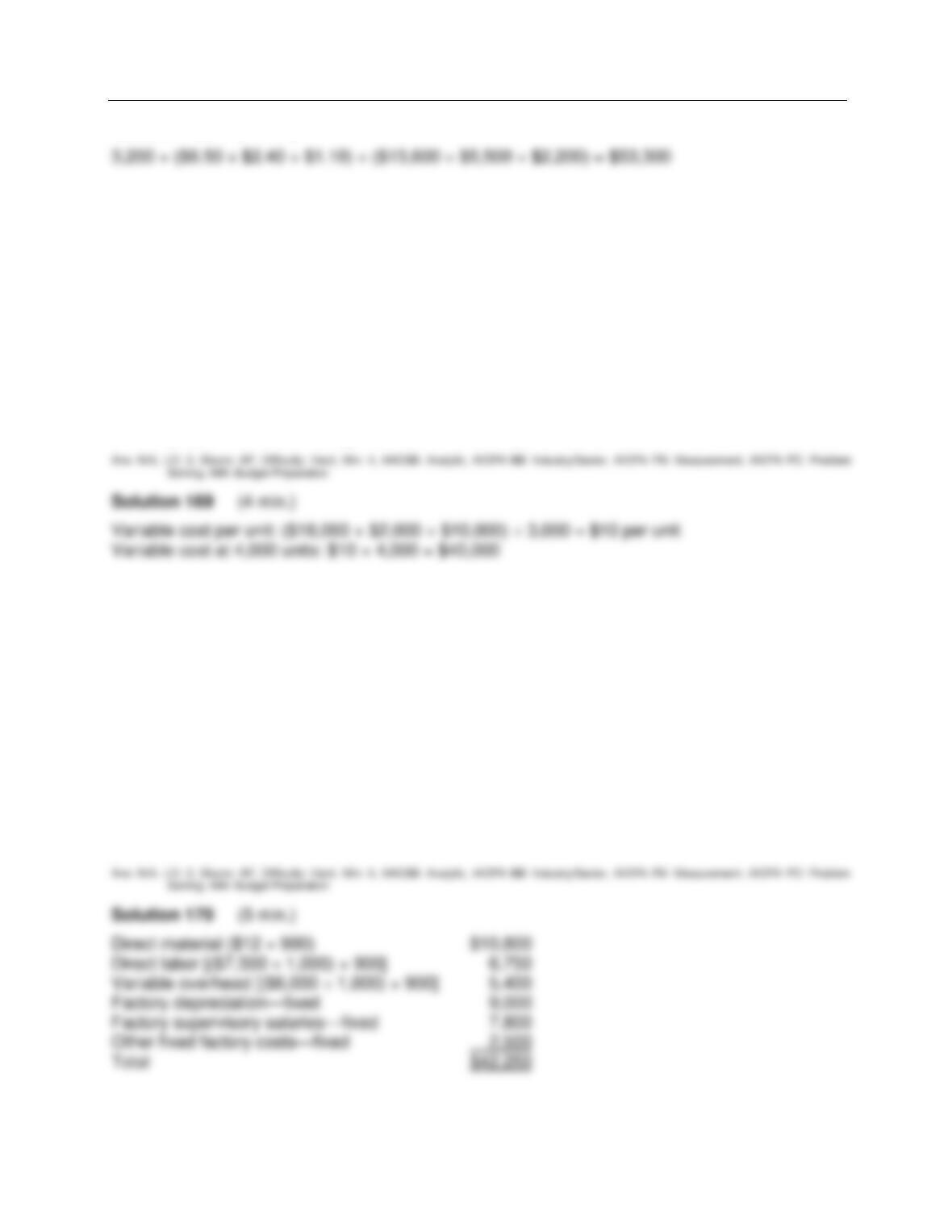
BE 168
Devlin Manufacturing makes a single product. Expected manufacturing costs are as follows:
Variable costs
Direct materials $6.50 per unit
Direct labor 2.40 per unit
Manufacturing overhead 1.10 per unit
Fixed costs per month
Supervisory salaries $13,600
Depreciation 5,500
Other fixed costs 2,200
Instructions
Determine the amount of manufacturing costs for a flexible budget level of 3,200 units per month.
Budgetary Planning and Responsibility Accounting
FOR INSTRUCTOR USE ONLY
10 – 33
Solution 168 (4 min.)
BE 169
Wind Productions uses flexible budgets. Items from the budget for March in which 3,000 units
were produced and sold appear below:
Direct materials $18,000
Indirect materials – variable 2,000
Supervisor salaries 15,000
Depreciation on factory equipment 4,000
Direct labor 10,000
Property taxes on factory 1,000
Instructions
If Wind prepares a flexible budget at 4,000 units, compute its total variable cost.
BE 170
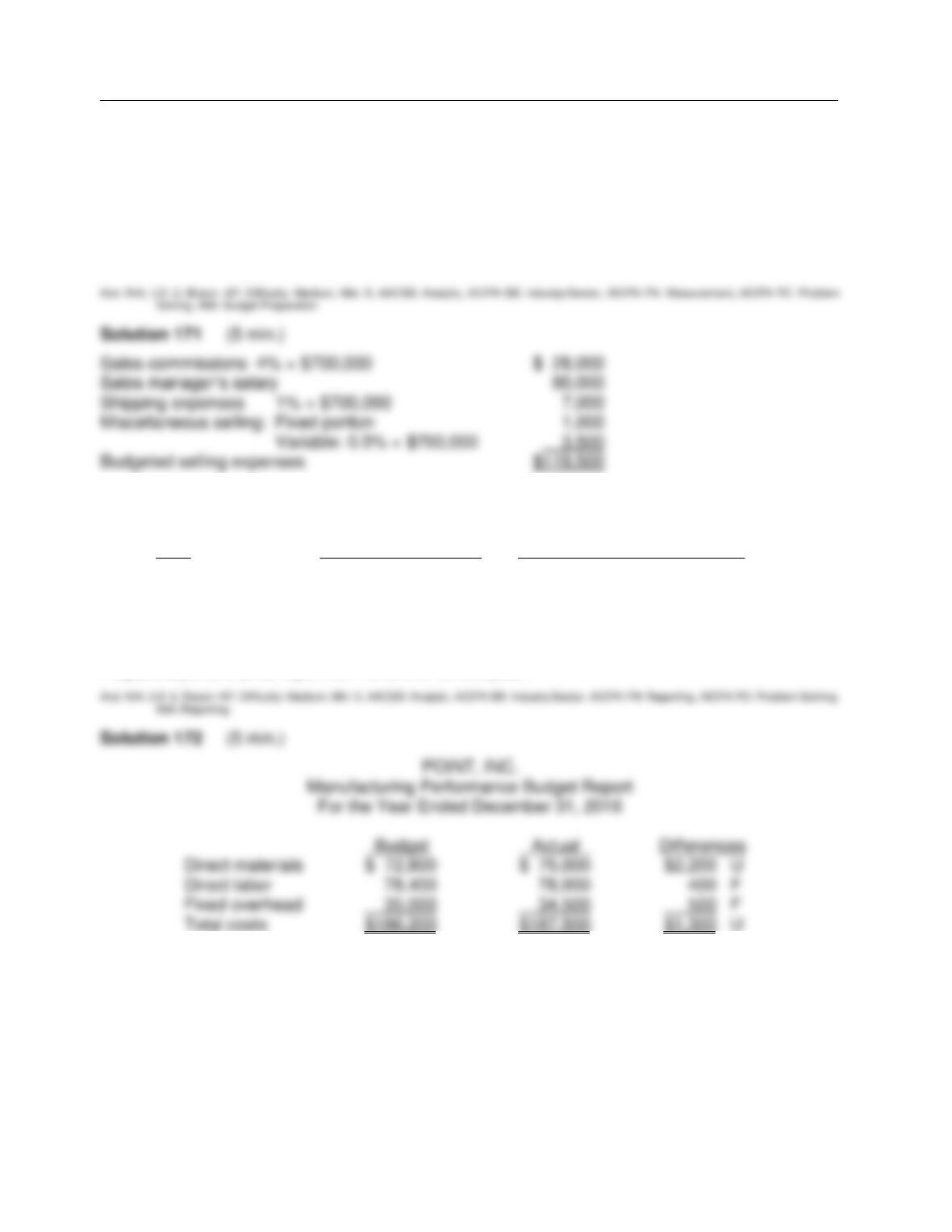
Cyber Construction’s manufacturing costs for August when production was 1,000 units appear
below:
Direct material $12 per unit
Direct labor $7,500
Variable overhead 6,000
Factory depreciation 9,000
Factory supervisory salaries 7,800
Other fixed factory costs 2,500
Instructions
Compute the flexible budget manufacturing cost amount for a month when 900 units are
produced.
Test Bank for Managerial Accounting, Seventh Edition
FOR INSTRUCTOR USE ONLY
10 – 34
BE 171
Micro Miller Company’s budgeted sales for April were estimated at $700,000, sales commissions
at 4% of sales, and the sales manager’s salary at $80,000. Shipping expenses were estimated at
1% of sales and miscellaneous selling expenses were estimated at $1,000, plus 0.5% of sales.
Instructions
Determine the budgeted selling expenses on a flexible budget for April.
BE 172
Point, Inc. produces men’s shirts. The following budgeted and actual amounts are for 2016:
Cost Budget at 2,500 units Actual Amounts at 2,800 units
Direct materials $65,000 $75,000
Direct labor 70,000 78,000
Fixed overhead 35,000 34,500
Instructions
Prepare a performance report for Point, Inc. for the year.
BE 173
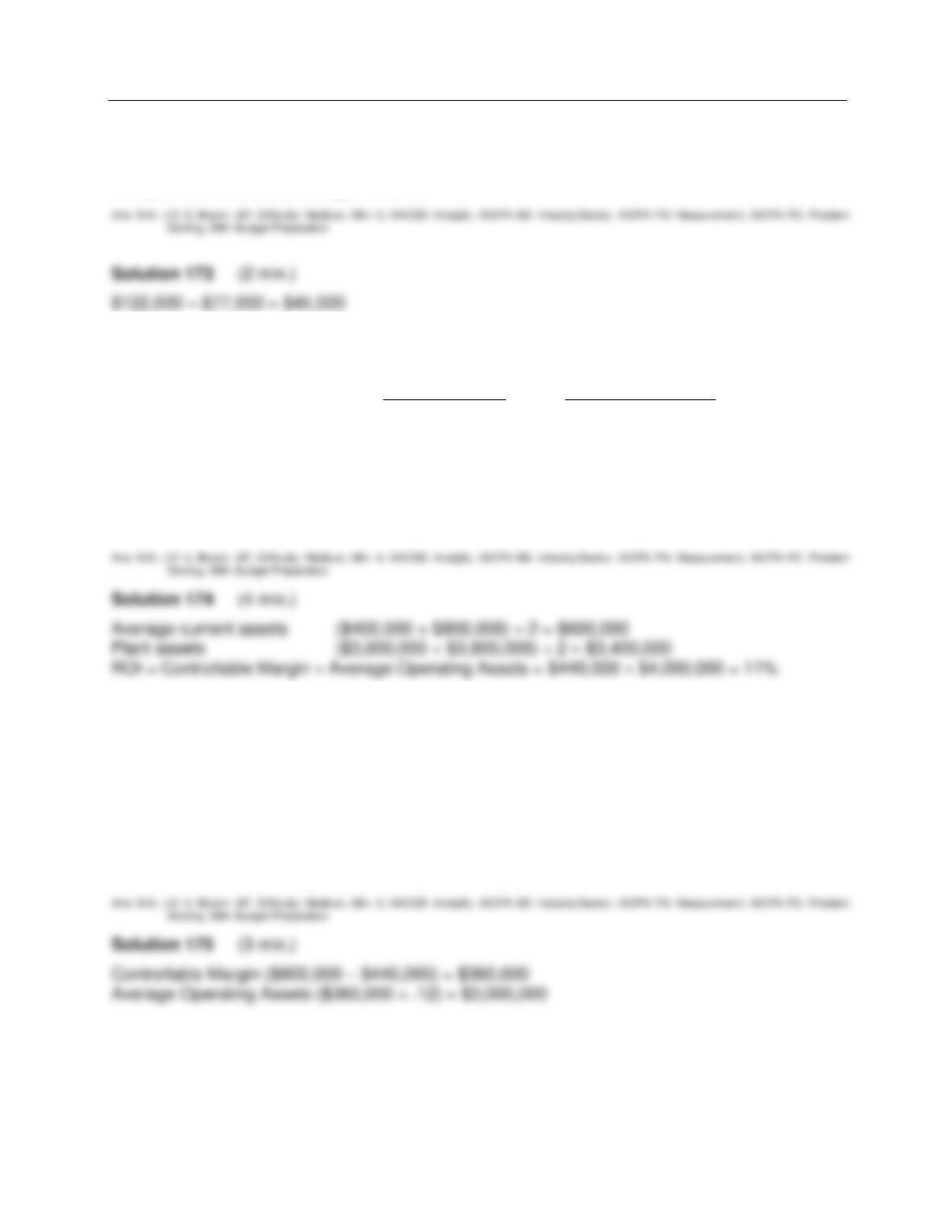
Moss Corp. reported the following items for 2016:
Controllable fixed costs $ 77,000
Contribution margin 122,000
Interest expense 20,000
Variable costs 80,000
Total assets $925,000
Budgetary Planning and Responsibility Accounting
FOR INSTRUCTOR USE ONLY
10 – 35
BE 173 (Cont.)
Instructions
Compute the controllable margin for 2016.
BE 174
The data for an investment center is given below.
January 1, 2016 December 31, 2016
Current Assets $ 400,000 $ 800,000
Plant Assets 3,000,000 3,800,000
The controllable margin is $440,000.
Instructions
Compute the return on investment for the center for 2016.
BE 175
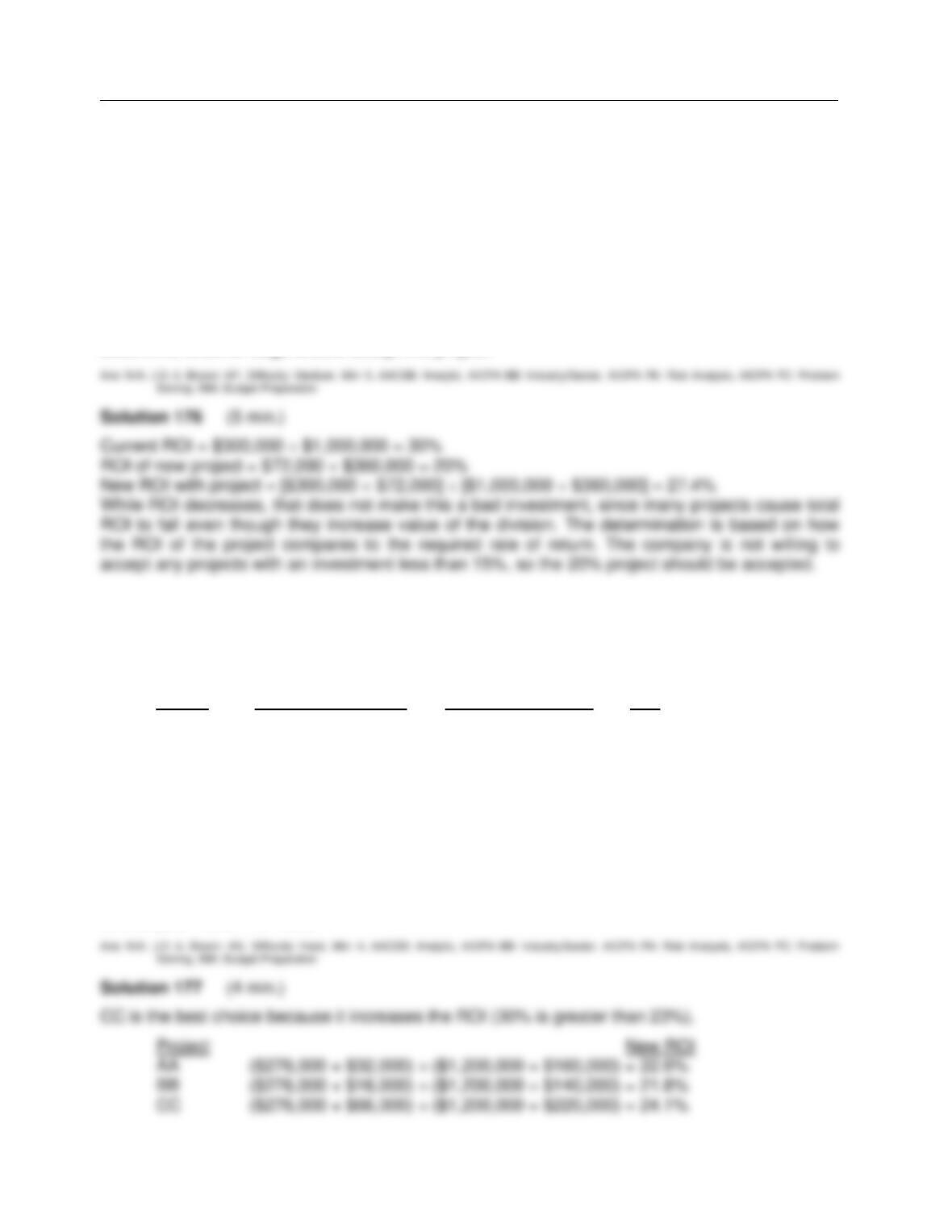
Data for the Deluxe Division of Park Industries which is operated as an investment center follows:
Sales $6,000,000
Contribution Margin 800,000
Controllable Fixed Costs 440,000
Return on Investment 12%
Instructions
Calculate controllable margin and average operating assets.
Test Bank for Managerial Accounting, Seventh Edition
FOR INSTRUCTOR USE ONLY
10 – 36
BE 176
Sage Division’s operating results include:
• Controllable margin, $300,000
• Sales revenue, $2,400,000
• Operating assets, $1,000,000
Sage is considering a project with sales of $240,000, expenses of $168,000, and an investment
of $360,000. Sage’s required rate of return is 15%.
Instructions
Determine whether Sage should accept this project.
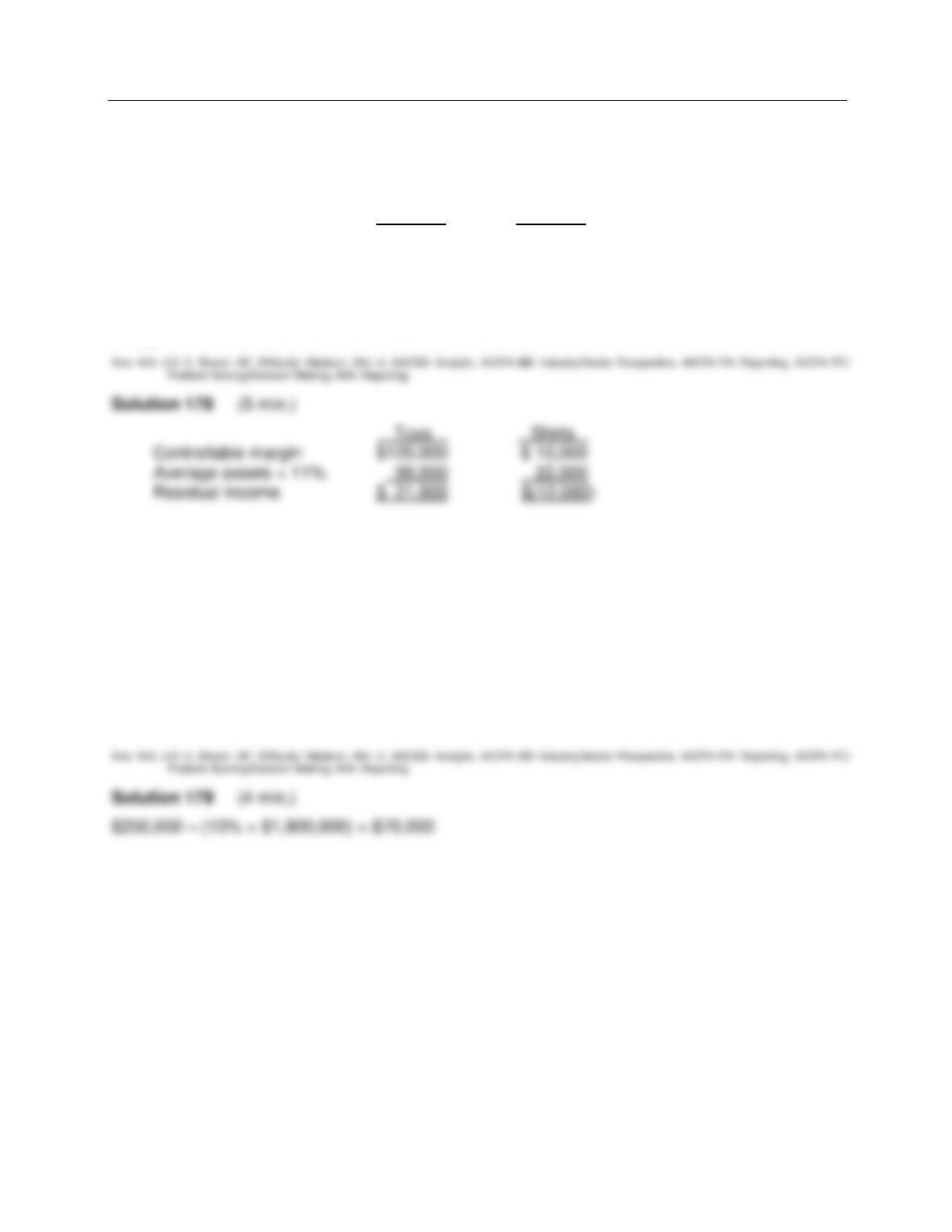
BE 177
An investment center manager is considering three possible investments. The company’s
required return is 10%. The required asset investment, controllable margins, and the ROIs of
each investment are as follows:
Project Average Investment Controllable Margin ROI
AA $160,000 $32,000 20.0%
BB 140,000 16,000 11.4%
CC 220,000 66,000 30%
The investment center is currently generating an ROI of 23% based on $1,200,000 in operating
assets and a controllable margin of $276,000.
Instructions
If the manager can select only one project, determine which one is the best choice to increase the
investment center’s ROI. Compute how much the investment center’s ROI will be if the manager
selects your recommendation.
Budgetary Planning and Responsibility Accounting
FOR INSTRUCTOR USE ONLY
10 – 37
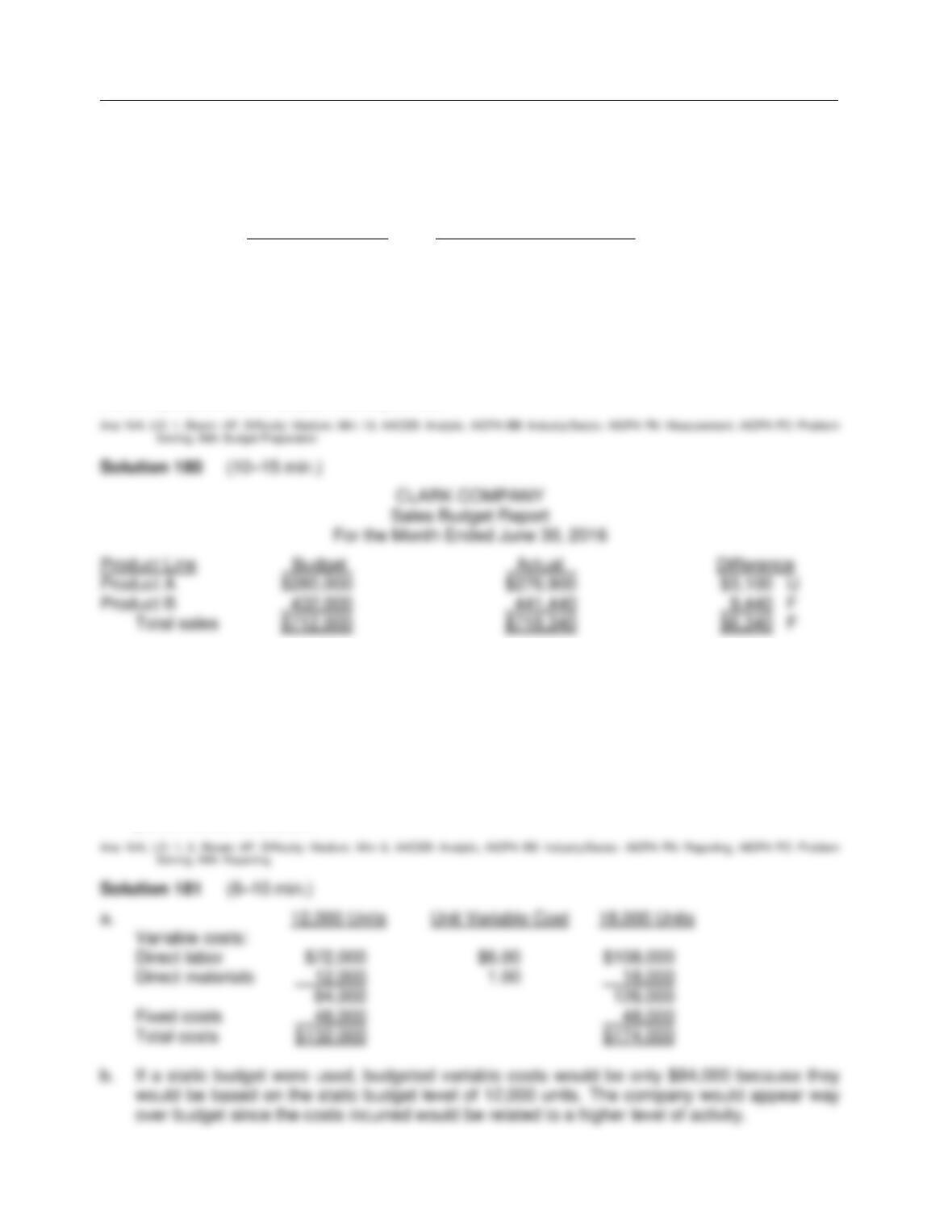
aBE 178
The owner of Denver Toy Manufacturing Company has recently expanded his business in order
to add an additional product line. In addition to toys, the company now sells shirts. The company
has a minimum rate of return of 11%.
Toys Shirts
Sales $600,000 $200,000
Controllable margin 120,000 10,000
Average operating assets 900,000 200,000
Instructions
Compute the residual income for both investment centers.
aBE 179
Floors Direct has 4 divisions. Its hardwood flooring division’s information follows for 2013:
Sales $4,000,000
Controllable margin 250,000
Variable costs 60,000
Average operating assets 1,800,000
Instructions
Floor’s required rate of return is 10%. How much is its residual income?
Test Bank for Managerial Accounting, Seventh Edition
FOR INSTRUCTOR USE ONLY
10 – 38
EXERCISES
Ex. 180
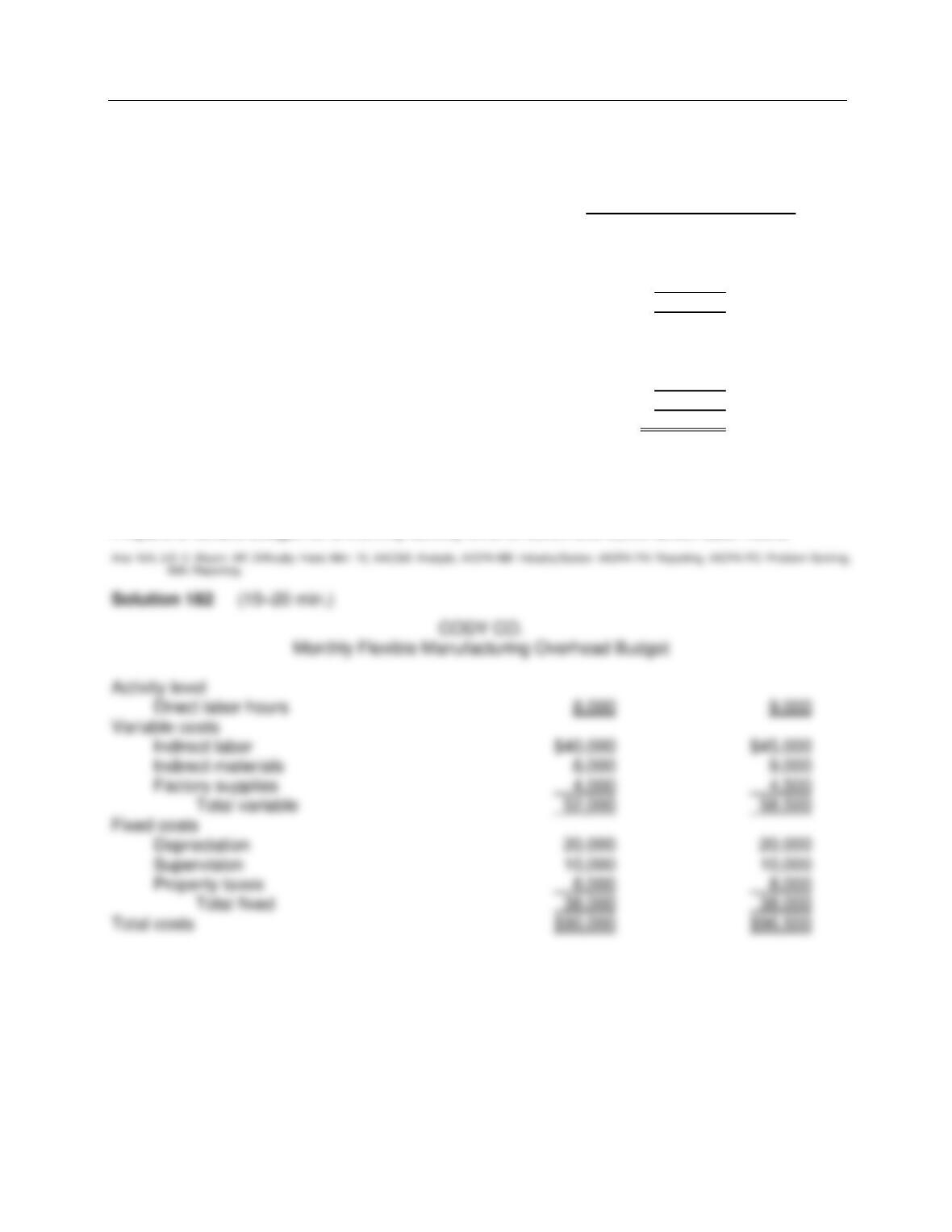
Clark Company’s master budget reflects budgeted sales information for the month of June, 2016,
as follows:
Budgeted Quantity Budgeted Unit Sales Price
Product A 40,000 $7
Product B 48,000 $9
During June, the company actually sold 39,000 units of Product A at an average unit price of
$7.10 and 49,600 units of Product B at an average unit price of $8.90.
Instructions
Prepare a Sales Budget Report for the month of June for Clark Company which shows whether
the company achieved its planned objectives.
Ex. 181
Beal Manufacturing Co.’s static budget at 12,000 units of production includes $72,000 for direct
labor and $12,000 for direct materials. Total fixed costs are $48,000.
Instructions
a. Determine how much would appear on Beal’s flexible budget for 2016 if 18,000 units are
produced and sold.
b. How would this comparison differ if a static budget were used instead of a flexible budget for
performance evaluation?
Budgetary Planning and Responsibility Accounting
FOR INSTRUCTOR USE ONLY
10 – 39
Ex. 182
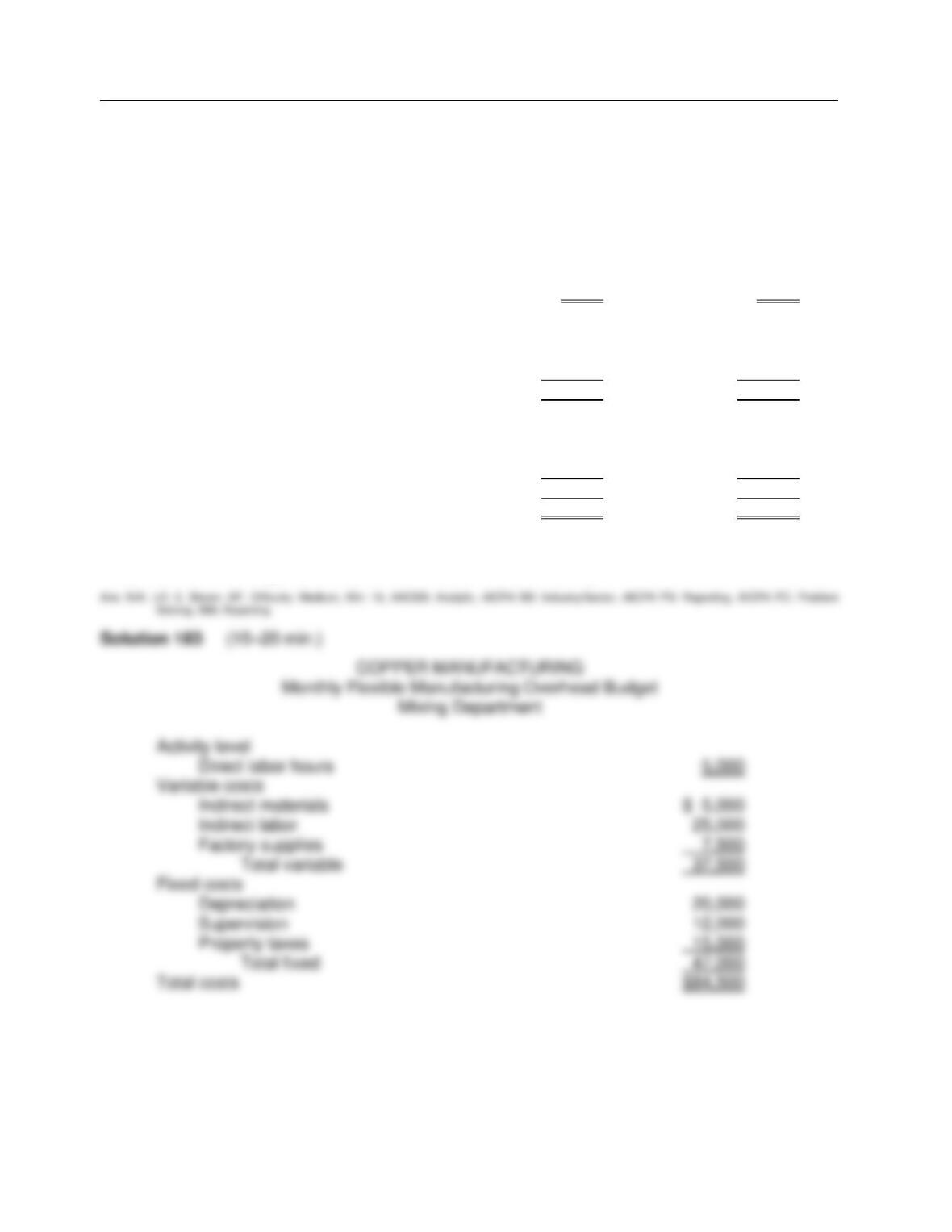
Cody Co. developed its annual manufacturing overhead budget for its master budget for 2016 as
follows:
Expected annual operating capacity 120,000 Direct Labor Hours
Variable overhead costs
Indirect labor $600,000
Indirect materials 120,000
Factory supplies 60,000
Total variable 780,000
Fixed overhead costs
Depreciation 240,000
Supervision 120,000
Property taxes 96,000
Total fixed 456,000
Total costs $1,236,000
The relevant range for monthly activity is expected to be between 8,000 and 12,000 direct labor
hours.
Instructions
Prepare a flexible budget for a monthly activity level of 8,000 and 9,000 direct labor hours.
Test Bank for Managerial Accounting, Seventh Edition
FOR INSTRUCTOR USE ONLY
10 – 40
Ex. 183
Copper Manufacturing has prepared the following monthly flexible manufacturing overhead
budget for its Mixing Department:
COPPER MANUFACTURING
Monthly Flexible Manufacturing Overhead Budget
Mixing Department
Activity level
Direct labor hours 3,000 4,000
Variable costs
Indirect materials $ 3,000 $ 4,000
Indirect labor 15,000 20,000
Factory supplies 4,500 6,000
Total variable 22,500 30,000
Fixed costs
Depreciation 20,000 20,000
Supervision 12,000 12,000
Property taxes 15,000 15,000
Total fixed 47,000 47,000
Total costs $69,500 $77,000
Instructions
Prepare a flexible budget at the 5,000 direct labor hours of activity.
Budgetary Planning and Responsibility Accounting
FOR INSTRUCTOR USE ONLY
10 – 41
Ex. 184
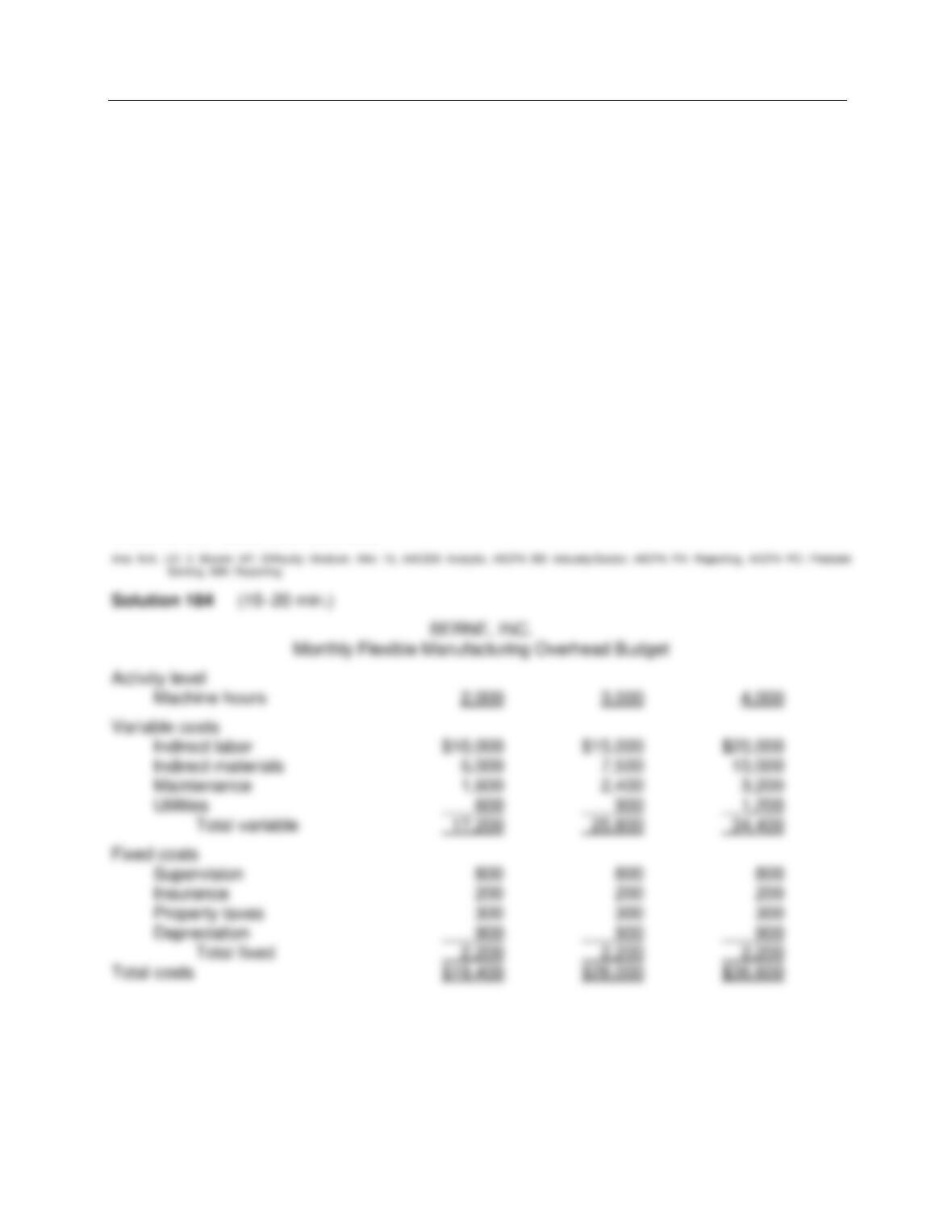
Berne, Inc. uses a flexible budget for manufacturing overhead based on machine hours. Variable
manufacturing overhead costs per machine hour are as follows:
Indirect labor $5.00
Indirect materials 2.50
Maintenance .80
Utilities .30
Fixed overhead costs per month are:
Supervision $800
Insurance 200
Property taxes 300
Depreciation 900
The company believes it will normally operate in a range of 2,000 to 4,000 machine hours per
month.
Instructions
Prepare a flexible manufacturing overhead budget for the expected range of activity, using
increments of 1,000 machine hours.
Test Bank for Managerial Accounting, Seventh Edition
FOR INSTRUCTOR USE ONLY
10 – 42
Ex. 185
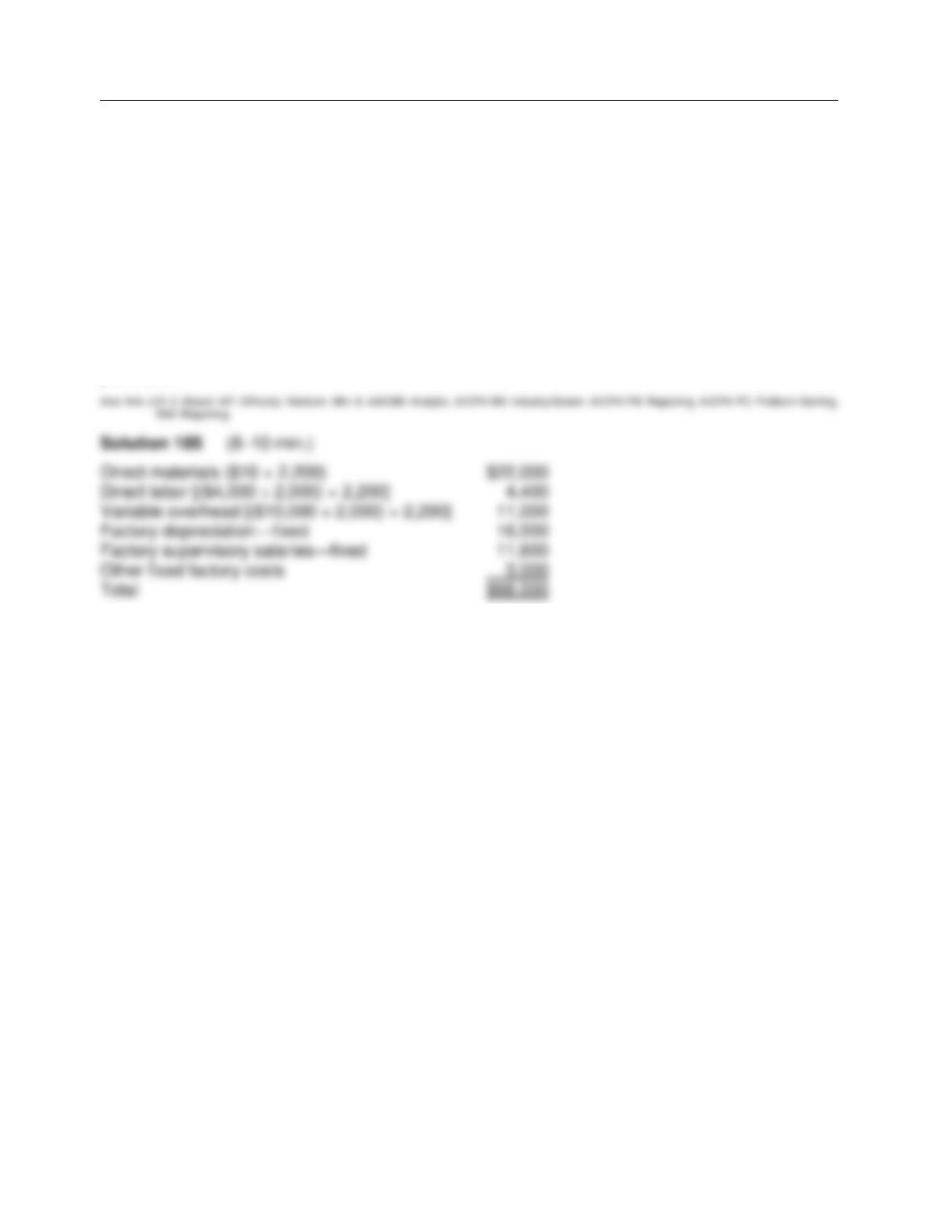
Telemark Production’s manufacturing costs for July when production was 2,000 units appears
below: Direct materials $10 per unit
Factory depreciation $16,000
Variable overhead 10,000
Direct labor 4,000
Factory supervisory salaries 11,600
Other fixed factory costs 3,000
Instructions
How much is the flexible budget manufacturing cost amount for a month when 2,200 units are
produced?
Ex. 186
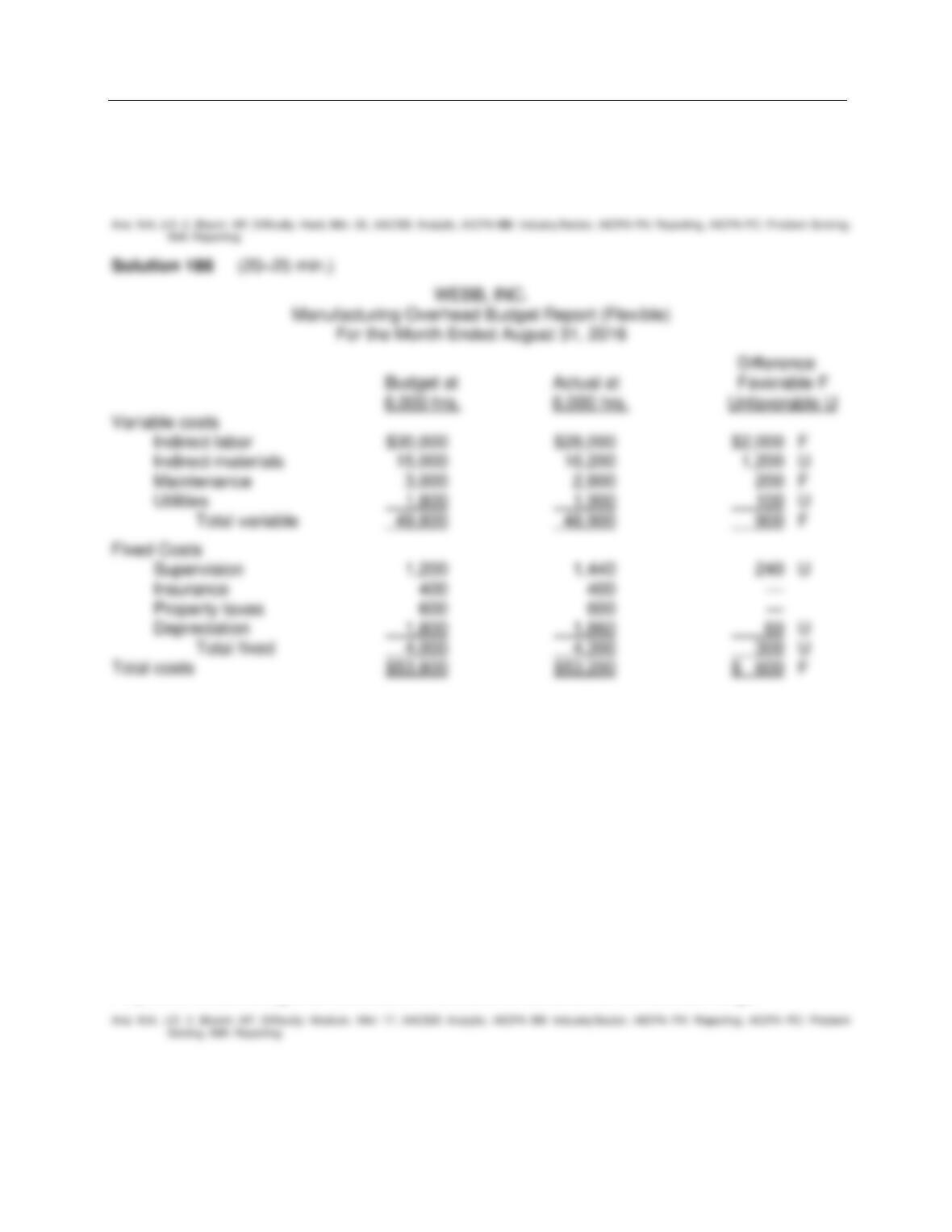
Webb, Inc. uses a flexible budget for manufacturing overhead based on machine hours. Variable
manufacturing overhead costs per machine hour are as follows:
Indirect labor $5.00
Indirect materials 2.50
Maintenance .50
Utilities .30
Fixed overhead costs per month are:
Supervision $1,200
Insurance 400
Property taxes 600
Depreciation 1,800
The company believes it will normally operate in a range of 4,000 to 8,000 machine hours per
month. During the month of August, 2016, the company incurs the following manufacturing
overhead costs:
Indirect labor $28,000
Indirect materials 16,200
Maintenance 2,800
Utilities 1,900
Supervision 1,440
Insurance 400
Property taxes 600
Depreciation 1,860
Budgetary Planning and Responsibility Accounting
FOR INSTRUCTOR USE ONLY
10 – 43
Ex. 186 (Cont.)
Instructions
Prepare a flexible budget report, assuming that the company used 6,000 machine hours during
August.
Ex. 187
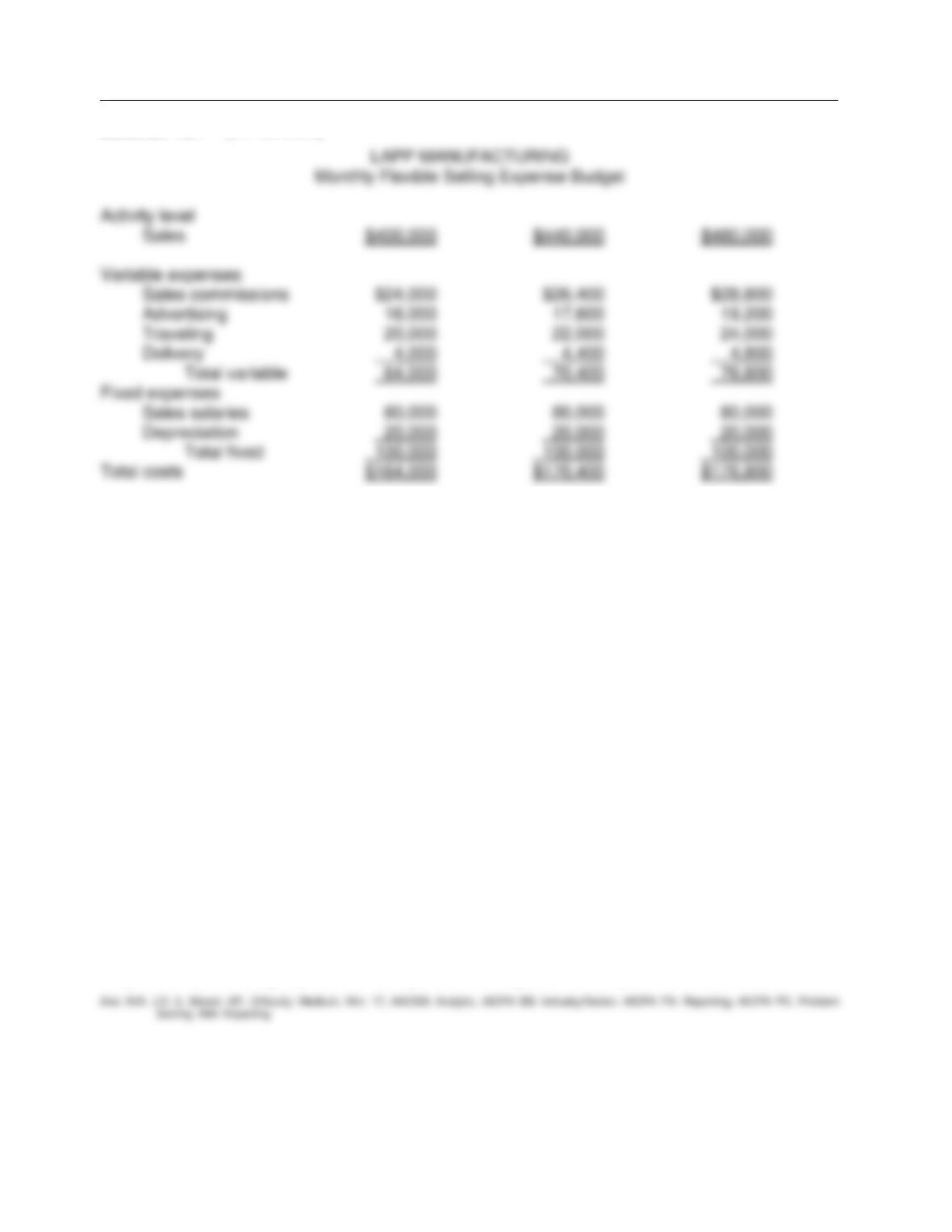
Lapp Manufacturing uses flexible budgets to control its selling expenses. Monthly sales are
expected to be from $400,000 to $480,000. Variable costs and their percentage relationships to
sales are:
Sales commissions 6%
Advertising 4%
Traveling 5%
Delivery 1%
Fixed selling expenses consist of sales salaries $80,000 and depreciation on delivery equipment
$20,000.
Instructions
Prepare a flexible budget for increments of $40,000 of sales within the relevant range.
Test Bank for Managerial Accounting, Seventh Edition
FOR INSTRUCTOR USE ONLY
10 – 44
Solution 187 (17–22 min.)
Ex. 188
Cadiz Co. uses flexible budgets to control its selling expenses. Monthly sales are expected to be
from $300,000 to $360,000. Variable costs and their percentage relationships to sales are:
Sales commissions 5%
Advertising 4%
Traveling 7%
Delivery 1%
Fixed selling expenses consist of sales salaries $40,000 and depreciation on delivery equipment
$10,000.
The actual selling expenses incurred in February, 2016, by Cadiz are as follows:
Sales commissions $17,200
Advertising 12,000
Traveling 23,700
Delivery 2,400
Fixed selling expenses consist of sales salaries $41,500 and depreciation on delivery equipment
$10,000.
Instructions
Prepare a flexible budget performance report, assuming that February sales were $330,000.
Budgetary Planning and Responsibility Accounting
FOR INSTRUCTOR USE ONLY
10 – 45
Solution 188 (17–22 min.)
Ex. 189
A flexible budget graph for the Assembly Department shows the following:
1. At zero direct labor hours, the total budgeted cost line intersects the vertical axis at $120,000.
2. At normal capacity of 50,000 direct labor hours, the line drawn from the total budgeted cost
line intersects the vertical axis at $360,000.
Instructions
Develop the budgeted cost formula for the Assembly Department and identify the fixed and
variable costs.
Ex. 190
Ace Production Co. has two production departments, Fabricating and Assembling. At a
department managers’ meeting, the controller uses flexible budget graphs to explain total
budgeted costs. Separate graphs based on direct labor hours are used for each department. The
graphs show the following.
1. At zero direct labor hours, the total budgeted cost line and the fixed cost line intersect the
vertical axis at $100,000 in the Fabricating Department, and $80,000 in the Assembling
Department.
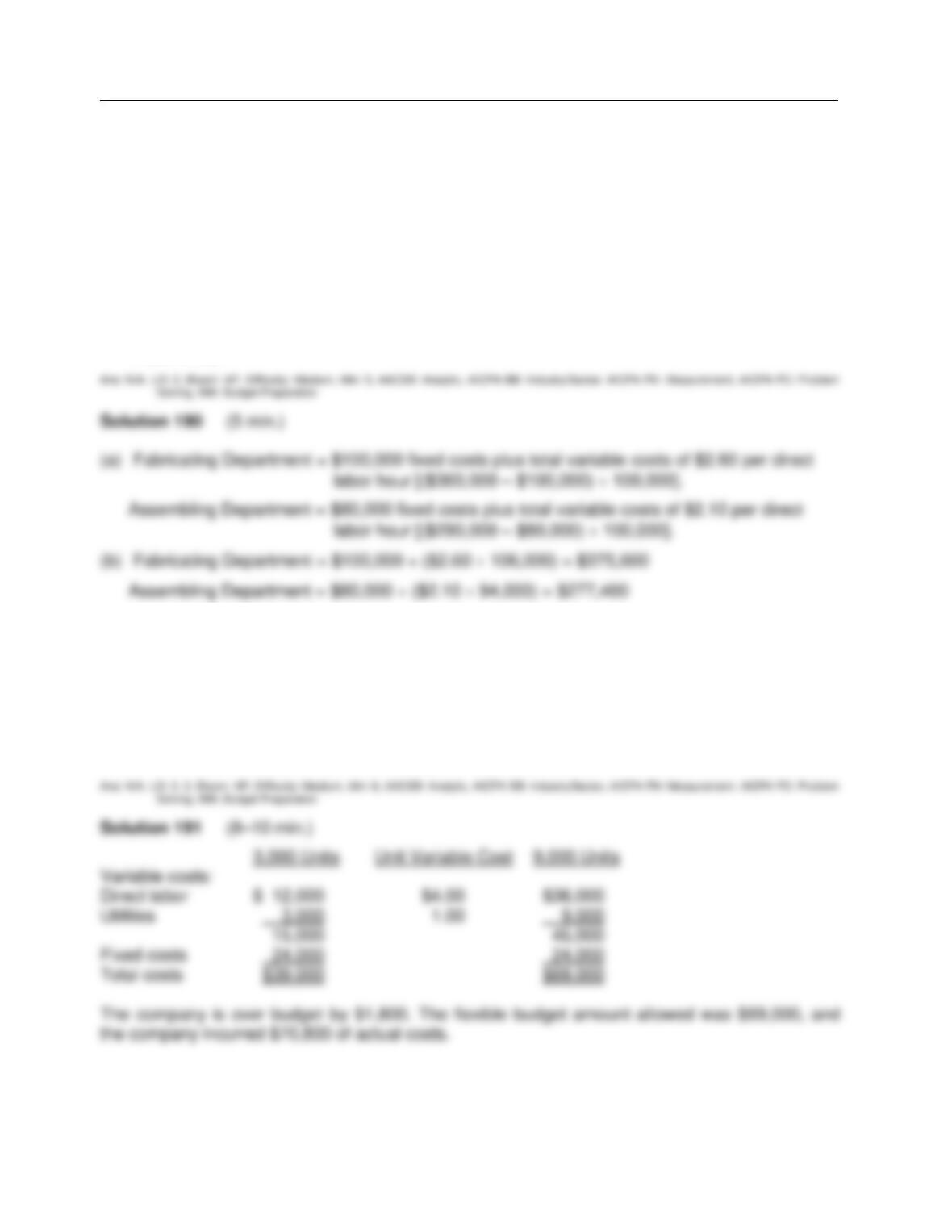
Test Bank for Managerial Accounting, Seventh Edition
FOR INSTRUCTOR USE ONLY
10 – 46
Ex. 190 (Cont.)
2. At normal capacity of 100,000 direct labor hours, the line drawn from the total budgeted cost
line intersects the vertical axis at $360,000 in the Fabricating Department, and $290,000 in
the Assembling Department.
Instructions
(a) State the total budgeted cost formula for each department.
(b) Compute the total budgeted cost for each department, assuming actual direct labor hours
worked were 106,000 and 94,000, in the Fabricating and Assembling Departments,
respectively.
Ex. 191
Hubbard, Inc.’s static budget at 3,000 units of production includes $12,000 for direct labor, $3,000
for utilities (variable), and total fixed costs of $24,000. Actual production and sales for the year
was 9,000 units, with an actual cost of $70,800.
Instructions
Determine if Hubbard is over or under budget.
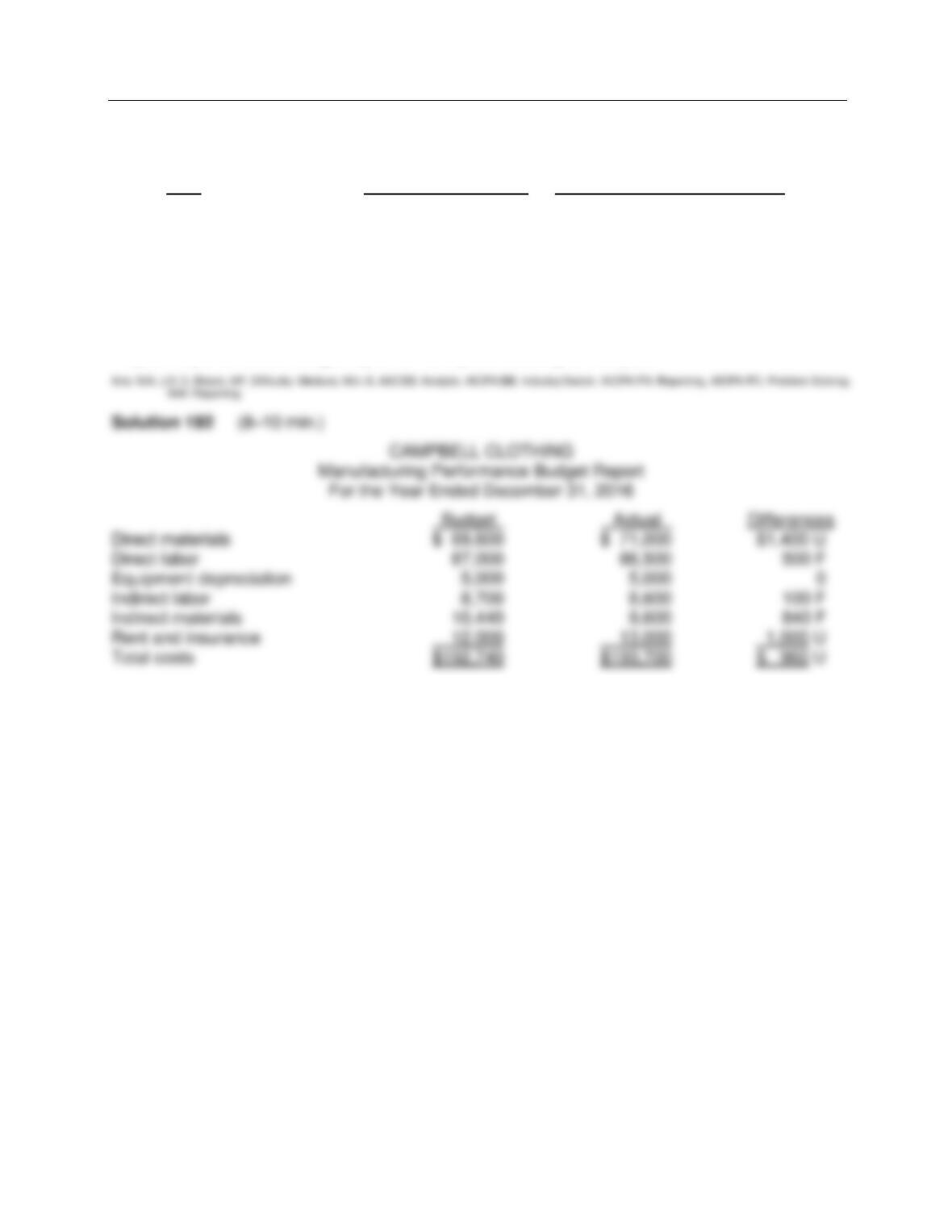
Budgetary Planning and Responsibility Accounting
FOR INSTRUCTOR USE ONLY
10 – 47
Ex. 192
Campbell Clothing produces men’s ties. The following budgeted and actual amounts are for 2016:
Cost Budget at 5,000 Units Actual Amounts at 5,800 Units
Direct materials $60,000 $71,000
Direct labor 75,000 86,500
Equipment depreciation 5,000 5,000
Indirect labor 7,500 8,600
Indirect materials 9,000 9,600
Rent and insurance 12,000 13,000
Instructions
Prepare a performance budget report for Campbell Clothing for the year.
Ex. 193
Data concerning manufacturing overhead for Wilson Industries are presented below. The Mixing
Department is a cost center.
An analysis of the overhead costs reveals that all variable costs are controllable by the manager
of the Mixing Department and that 50% of supervisory costs are controllable at the department
level.
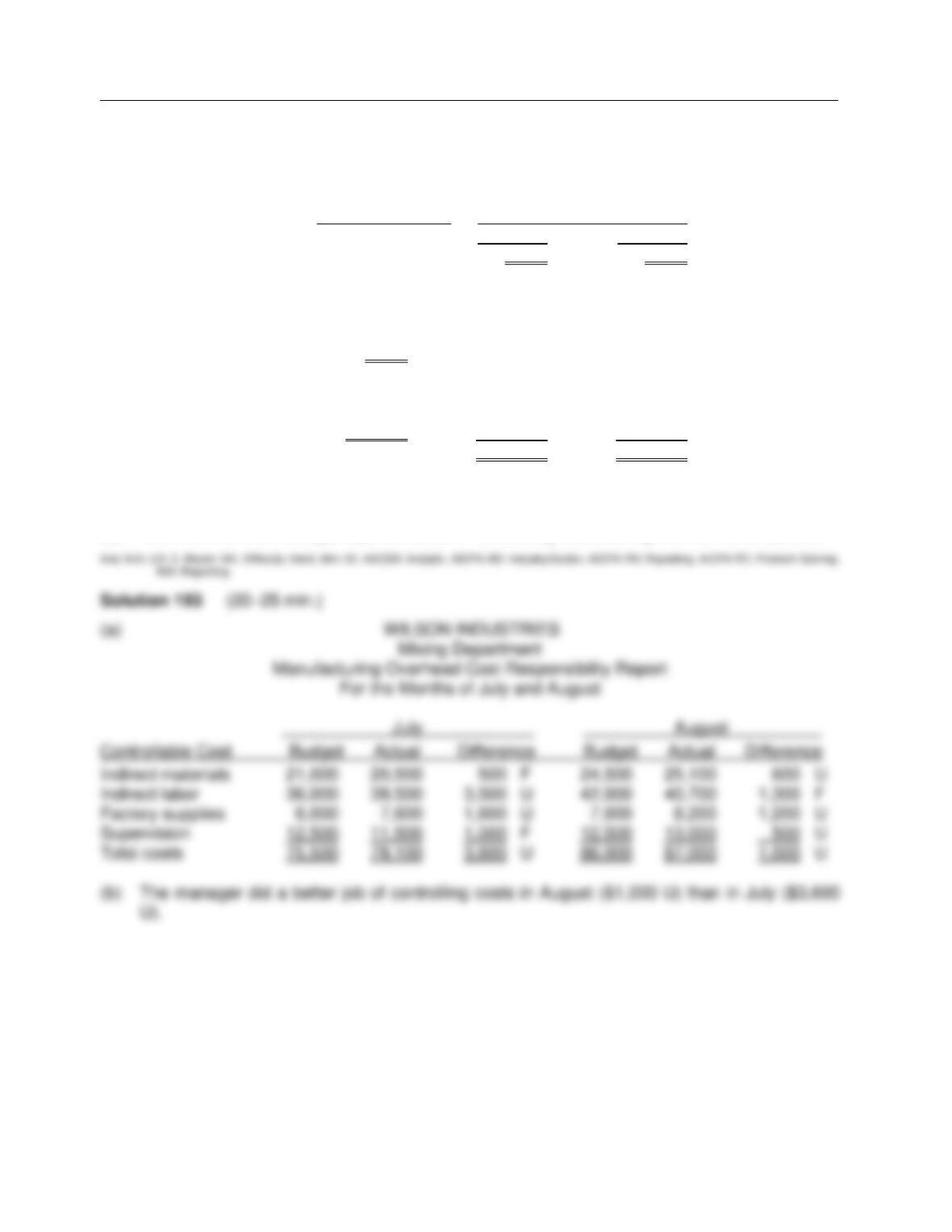
Test Bank for Managerial Accounting, Seventh Edition
FOR INSTRUCTOR USE ONLY
10 – 48
Ex. 193 (Cont.)
The flexible budget formula and the cost and activity for the months of July and August are as
follows:
Flexible Budget Per
Direct Labor Hour Actual Costs and Activity
July August
Direct labor hours 6,000 7,000
Overhead costs
Variable
Indirect materials $3.50 $ 20,500 $ 25,100
Indirect labor 6.00 39,500 40,700
Factory supplies 1.00 7,600 8,200
Fixed
Depreciation $20,000 15,000 15,000
Supervision 25,000 23,000 26,000
Property taxes 10,000 12,000 12,000
Total costs $117,600 $127,000
Instructions
(a) Prepare the responsibility reports for the Mixing Department for each month.
(b) Comment on the manager’s performance in controlling costs during the two month period.
Ex. 194
Strickland Corp.’s manufacturing overhead budget for the first quarter of 2016 contained the
following data:
Variable Costs
Indirect materials $40,000
Indirect labor 24,000
Utilities 20,000
Maintenance 12,000
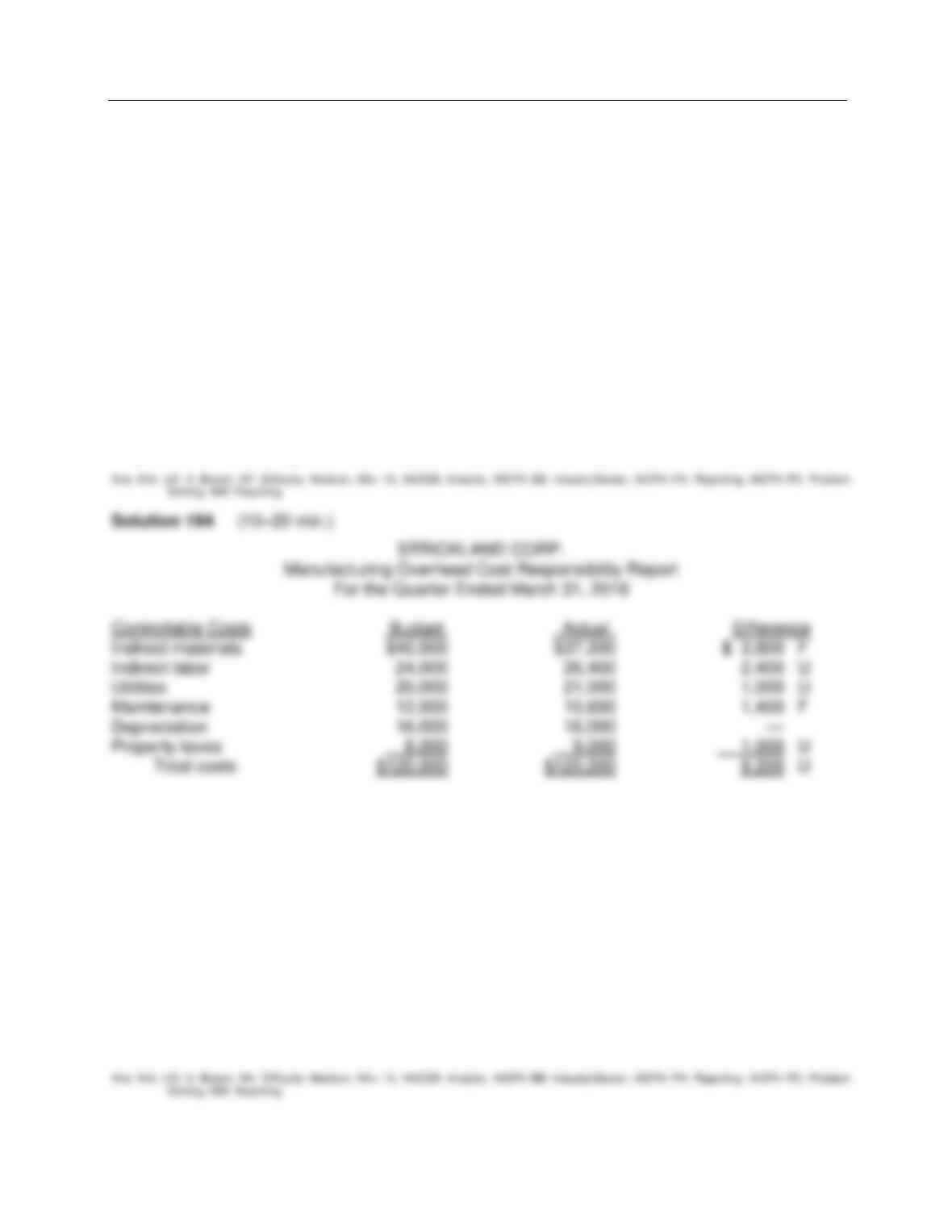
Budgetary Planning and Responsibility Accounting
FOR INSTRUCTOR USE ONLY
10 – 49
Ex. 194 (Cont.)
Fixed Costs
Supervisor’s salary $80,000
Depreciation 16,000
Property taxes 8,000
Actual variable costs for the first quarter were:
Indirect materials $37,200
Indirect labor 26,400
Utilities 21,000
Maintenance 10,600
Actual fixed costs were as expected except for property taxes which were $9,000. All costs are
considered controllable by the department manager except for the supervisor’s salary.
Instructions
Prepare a manufacturing overhead responsibility performance report for the first quarter.
Ex. 195
The Deluxe Division, a profit center of Riley Manufacturing Company, reported the following data
for the first quarter of 2016:
Sales $9,000,000
Variable costs 6,300,000
Controllable direct fixed costs 1,200,000
Noncontrollable direct fixed costs 530,000
Indirect fixed costs 300,000
Instructions
(a) Prepare a performance report for the manager of the Deluxe Division.
(b) What is the best measure of the manager’s performance? Why?
(c) How would the responsibility report differ if the division was an investment center?
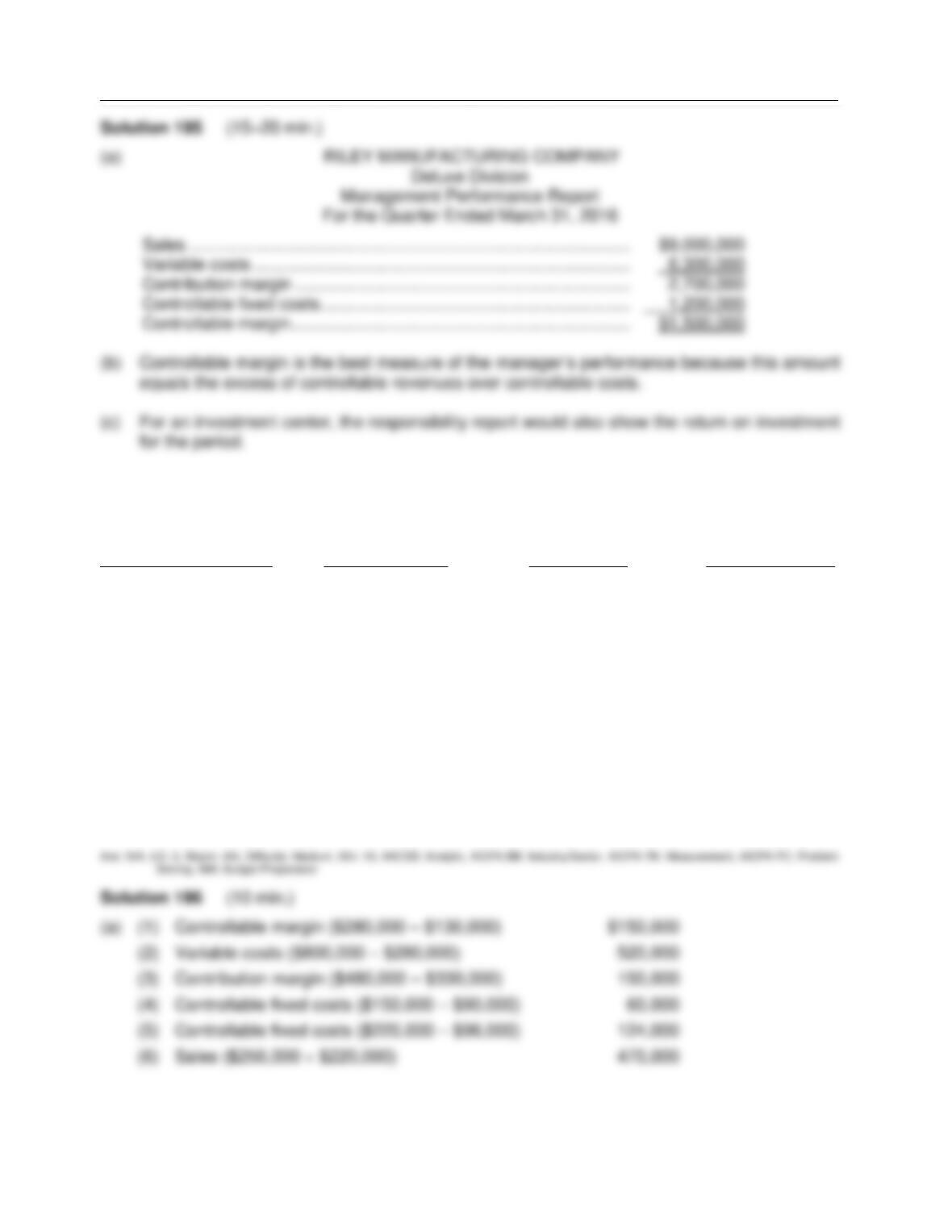
Test Bank for Managerial Accounting, Seventh Edition
FOR INSTRUCTOR USE ONLY
10 – 50
Ex. 196
Danner Co. has three divisions which are operated as profit centers. Actual operating data for the
divisions listed alphabetically are as follows.
Operating Data Women’s Shoes Men’s Shoes Children’s Shoes
Contribution margin $280,000 (3) $220,000
Controllable fixed costs 130,000 (4) (5)
Controllable margin (1) $ 90,000 96,000
Sales 800,000 480,000 (6)
Variable costs (2) 330,000 250,000
Instructions
(a) Compute the missing amounts. Show computations.
(b) Prepare a responsibility report for the Women’s Shoe Division assuming (1) the data are for
the month ended June 30, 2016, and (2) all data equal budget except variable costs which
are $20,000 over budget.
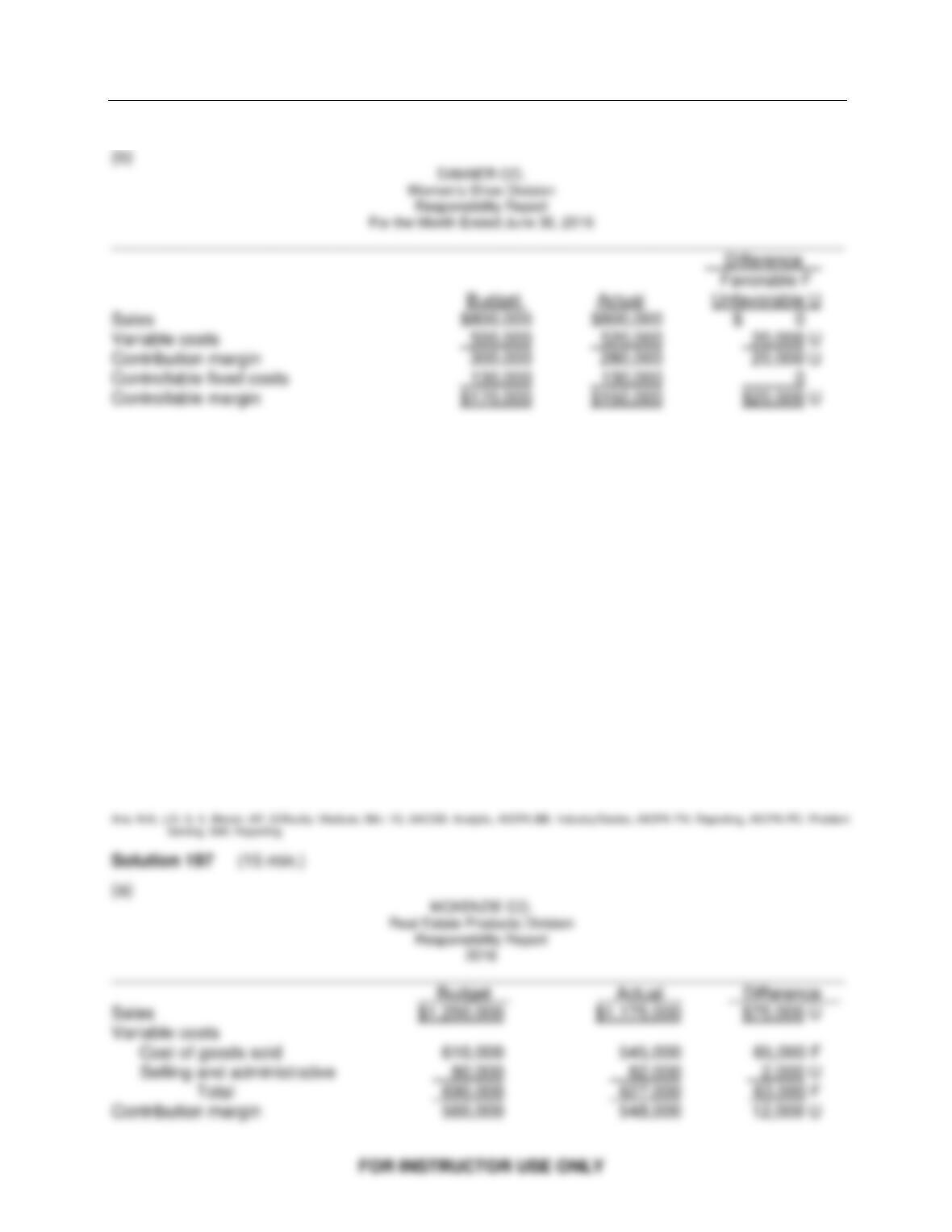
Budgetary Planning and Responsibility Accounting
10 – 51
Solution 196 (Cont.)
Ex. 197
The Real Estate Products Division of McKenzie Co. is operated as a profit center. Sales for the
division were budgeted for 2016 at $1,250,000. The only variable costs budgeted for the division
were cost of goods sold ($610,000) and selling and administrative ($80,000). Fixed costs were
budgeted at $130,000 for cost of goods sold, $120,000 for selling and administrative and $95,000
for noncontrollable fixed costs. Actual results for these items were:
Sales $1,175,000
Cost of goods sold
Variable 545,000
Fixed 140,000
Selling and administrative
Variable 82,000
Fixed 100,000
Noncontrollable fixed 105,000
Instructions
(a) Prepare a responsibility report for the Real Estate Products Division for 2016.
(b) Assume the division is an investment center, and average operating assets were
$1,200,000. Compute ROI.
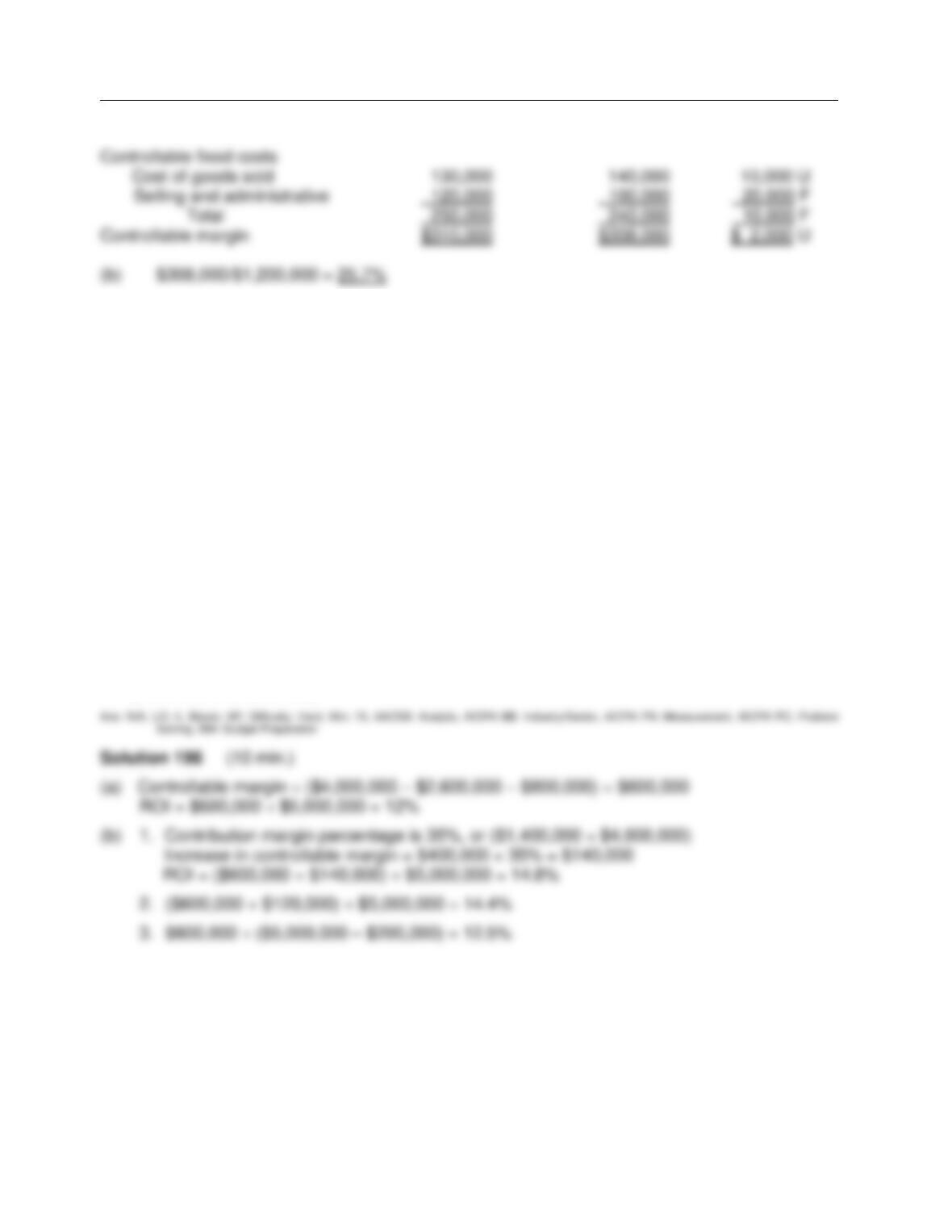
Test Bank for Managerial Accounting, Seventh Edition
FOR INSTRUCTOR USE ONLY
10 – 52
Solution 197 (Cont.)
Ex. 198
The Pacific Division of Henson Industries reported the following data for the current year.
Sales $4,000,000
Variable costs 2,600,000
Controllable fixed costs 800,000
Average operating assets 5,000,000
Top management is unhappy with the investment center’s return on investment (ROI). It asks the
manager of the Pacific Division to submit plans to improve ROI in the next year. The manager
believes it is feasible to consider the following independent courses of action.
1. Increase sales by $400,000 with no change in the contribution margin percentage.
2. Reduce variable costs by $120,000.
3. Reduce average operating assets by 4%
Instructions
(a) Compute the return on investment (ROI) for the current year.
(b) Using the ROI formula, compute the ROI under each of the proposed courses of action.
(Round to one decimal.)
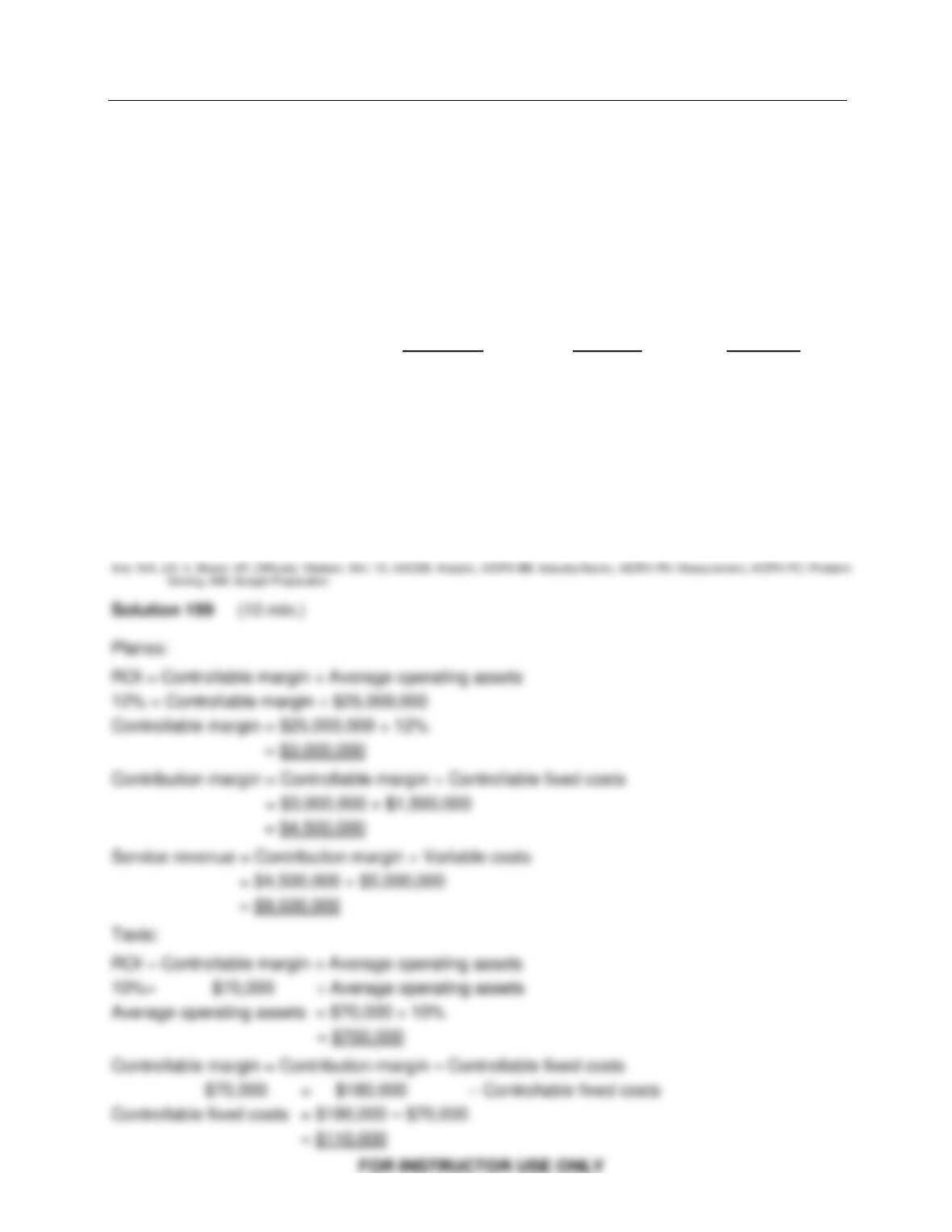
Budgetary Planning and Responsibility Accounting
10 – 53
Ex. 199
The Medford Burkett Company uses a responsibility reporting system to measure the
performance of its three investment centers: Planes, Taxis, and Limos. Segment performance is
measured using a system of responsibility reports and return on investment calculations. The
allocation of resources within the company and the segment managers’ bonuses are based in
part on the results shown in these reports.
Recently, the company was the victim of a computer virus that deleted portions of the company’s
accounting records. This was discovered when the current period’s responsibility reports were
being prepared. The printout of the actual operating results appeared as follows.
Planes Taxis Limos
Service revenue $ ? $450,000 $ ?
Variable costs 5,000,000 ? 320,000
Contribution margin ? 180,000 380,000
Controllable fixed costs 1,500,000 ? ?
Controllable margin ? 70,000 176,000
Average operating assets 25,000,000 ? 1,600,000
Return on investment 12% 10% ?
Instructions
Determine the missing pieces of information above.
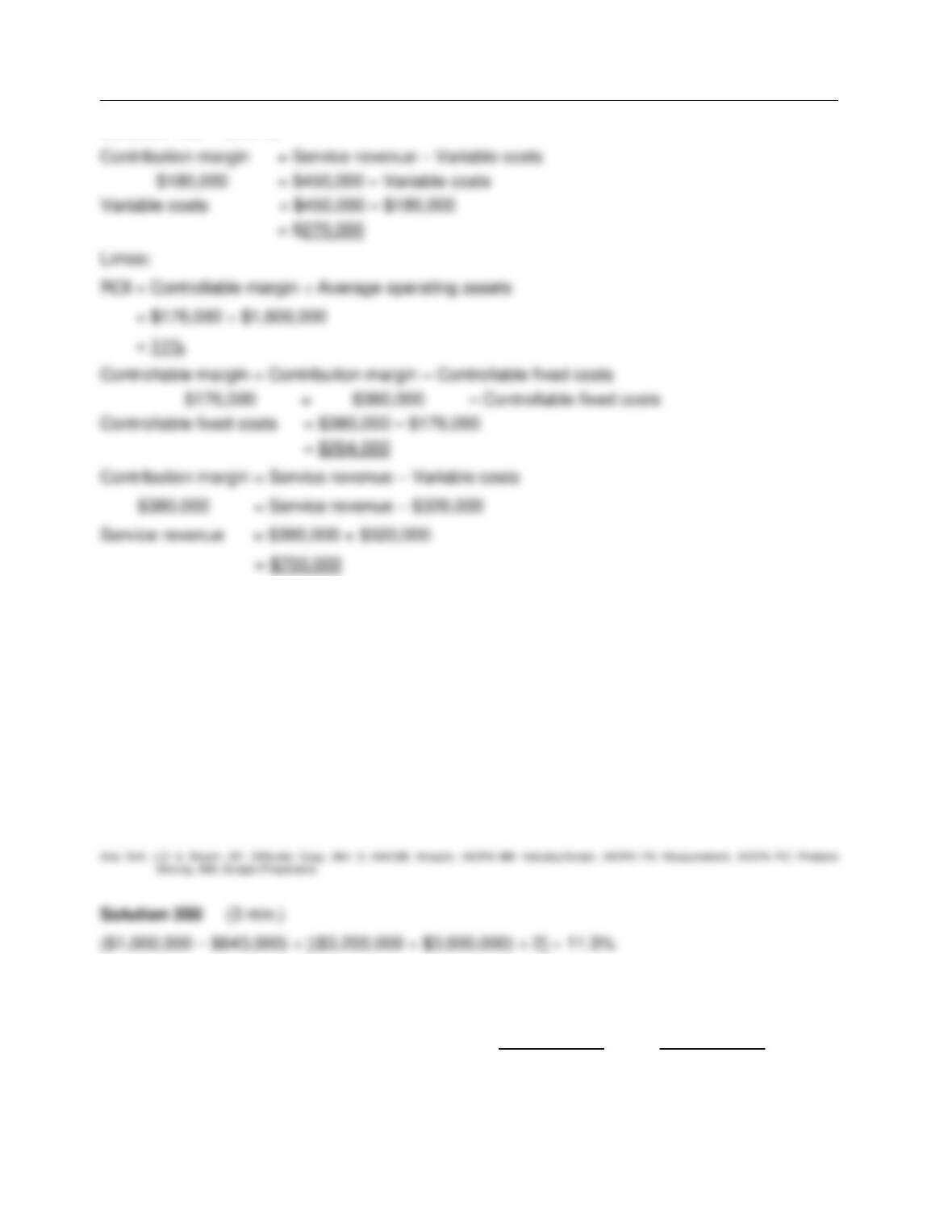
Test Bank for Managerial Accounting, Seventh Edition
FOR INSTRUCTOR USE ONLY
10 – 54
Solution 199 (Cont.)
Ex. 200
Perez Corp. reported the following:
Beginning of year operating assets $3,200,000
End of year operating assets 3,000,000
Contribution margin 1,000,000
Sales 5,000,000
Controllable fixed costs 643,000
Its required return is 10%.
Instructions
Compute the company’s ROI.
Ex. 201
Lombard, Inc. has two investment centers and has developed the following information:
Department A Department B
Departmental controllable margin $120,000 ?
Average operating assets ? $400,000
Sales 800,000 250,000
ROI 10% 12%
Budgetary Planning and Responsibility Accounting
10 – 55
Ex. 201 (Cont.)
Instructions
Answer the following questions about Department A and Department B.
1. What was the amount of Department A’s average operating assets? $____________.
2. What was the amount of Department B’s controllable margin? $____________.
3. If Department B is able to reduce its operating assets by $100,000, Department B’s new
ROI would be ____________.
4. If Department A is able to increase its controllable margin by $60,000 as a result of reducing
variable costs, Department A’s new ROI would be _________________.
Ex. 202
The Atlantic Division of Stark Productions Company reported the following results for 2016:
Sales $4,000,000
Variable costs 3,200,000
Controllable fixed costs 300,000
Average operating assets 2,500,000
Management is considering the following independent alternative courses of action in 2017 in
order to maximize the return on investment for the division.
1. Reduce controllable fixed costs by 10% with no change in sales or variable costs.
2. Reduce average operating assets by 10% with no change in controllable margin.
3. Increase sales $500,000 with no change in the contribution margin percentage.
Instructions
(a) Compute the return on investment for 2016.
(b) Compute the expected return on investment for each of the alternative courses of action.
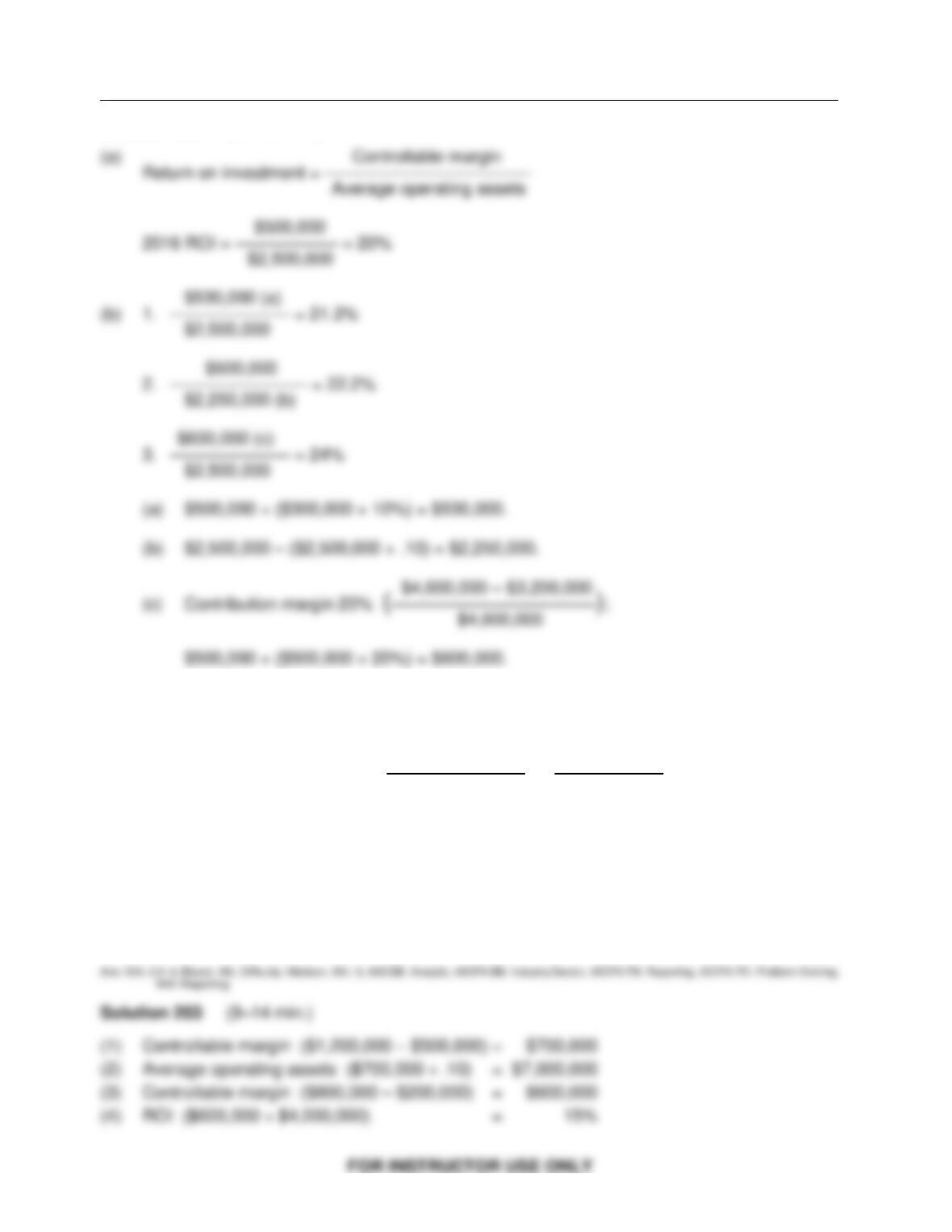
Test Bank for Managerial Accounting, Seventh Edition
10 – 56
Solution 202 (15–20 min.)
Ex. 203
Data for the following subsidiaries of Olive Manufacturing, which are operated as investment
centers, are as follows:
Fleming Company Oak Company
Sales $3,000,000 $2,000,000
Controllable margin (1) (3)
Average operating assets (2) 4,000,000
Contribution margin 1,200,000 800,000
Controllable fixed costs 500,000 200,000
Return on Investment 10% (4)
Instructions
Compute the missing amounts using the ROI formula.
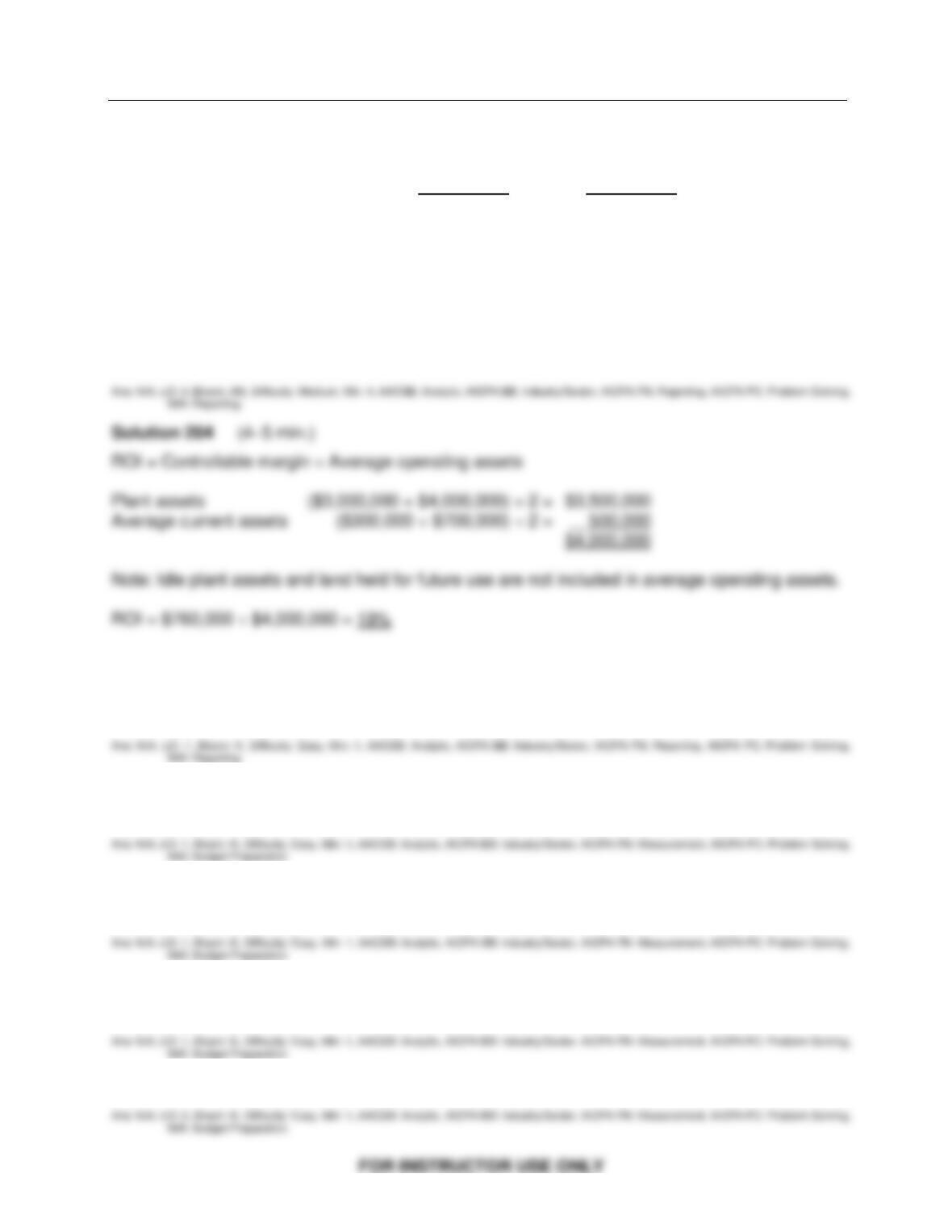
Budgetary Planning and Responsibility Accounting
10 – 57
Ex. 204
The data for an investment center is given below.
1/1/17 12/31/17
Current assets $ 300,000 $ 700,000
Plant assets 3,000,000 4,000,000
Idle plant assets 250,000 330,000
Land held for future use 1,200,000 1,200,000
The controllable margin is $760,000.
Instructions
What is the return on investment for the center for 2017?
COMPLETION STATEMENTS
205. The use of budgets in controlling operations is known as ________________.
206. A major aspect of budgetary control is the use of budget reports that compare
_____________________ with _______________________.
207. In analyzing differences from planned objectives, management may take
___________________, or it could decide to modify ___________________.
208. The master budget is a __________________ budget which is based on operating at one
budgeted activity level.
209. A __________________ budget projects budget data for various levels of activity.
Test Bank for Managerial Accounting, Seventh Edition
FOR INSTRUCTOR USE ONLY
10 – 58
210. Total ________________ costs will be the same on the master budget and on a flexible
budget which reflects the actual level of activity.
211. Under ___________________ accounting, the evaluation of a manager’s performance is
based on the costs and revenues directly under that manager’s control.
212. A cost is __________________ at a given level of managerial responsibility if a manager
has the authority to incur the cost in a given time period.
213. In general, costs ____________________ directly by the level of responsibility are
_______________, whereas costs that are ____________________ to the responsibility
level are __________________.
214. Responsibility centers may be classified into three types: (1)____________________,
(2)___________________ and, (3)____________________.
215. The primary basis for evaluating the performance of a manager of an investment center is
_________________.
216. Return on investment is calculated by dividing _________________________ by
________________________.
Answers to Completion Statements
Budgetary Planning and Responsibility Accounting
FOR INSTRUCTOR USE ONLY
10 – 59
MATCHING
217. Match the items below by entering the appropriate code letter in the space provided.
A. Budgetary control G. Responsibility reporting system
B. Static budget H. Return on Investment
C. Flexible budget I. Profit center
D. Responsibility accounting J. Investment center
E. Controllable costs K. Indirect fixed costs
F. Management by exception L. Direct fixed costs
____ 1. The review of budget reports by top management directed entirely or primarily to
differences between actual results and planned objectives.
____ 2. A part of management accounting that involves accumulating and reporting revenues
and costs on the basis of the individual manager who has the authority to make the
day–to-day decisions about the items.
____ 3. The preparation of reports for each level of responsibility shown in the company’s
organization chart.
____ 4. A projection of budget data at one level of activity.
____ 5. Costs that a manager has the authority to incur within a given period of time.
____ 6. The use of budgets to control operations.
____ 7. A projection of budget data for various levels of activity.
____ 8. A responsibility center that incurs costs, generates revenues, and has control over the
investment funds available for use.
____ 9. Costs that relate specifically to a responsibility center and are incurred for the sole
benefit of the center.
____ 10. A responsibility center that incurs costs and also generates revenues.
____ 11. Costs which are incurred for the benefit of more than one profit center.
____ 12. A measure of the profitability of an investment center computed by dividing
controllable margin (in dollars) by average operating assets.
Answers to Matching
Test Bank for Managerial Accounting, Seventh Edition
FOR INSTRUCTOR USE ONLY
10 – 60
SHORT-ANSWER ESSAY QUESTIONS
S-A E 218
The master budget and flexible budgets are important aids to management in performing the
management functions of planning and control. Briefly describe how planning and control are
facilitated by preparing a master budget and flexible budgets. How are these two types of budgets
interrelated with planning and control?
S-A E 219
Brad Ventura is confused about how a flexible budget is prepared. Identify the steps for Brad.
S-A E 220
Managers are motivated to accomplish objectives if they feel that their efforts will be fairly
evaluated. Explain why an organization may use different bases for evaluating the performance of
managers of different types of responsibility centers.
Budgetary Planning and Responsibility Accounting
10 – 61
Solution 220
S-A E 221
What is responsibility accounting? Explain the purpose of responsibility accounting.
S-A E 222 (Ethics)
Dixon Corporation evaluates its managers based on return on investment (ROI). Kathryn Bricker
and Lindsey Allan, managers of the electronics and housewares departments respectively, have
recently suffered from declining profits in their departments. Over lunch, they discuss the
problem, and how they could improve performance. Most of the discussion centers around ways
to increase sales. Near the end of the lunch period, however, Lindsey remarks that there are two
components to consider, and that they have considered only one. She wonders whether there is
some way to reduce investment, and by decreasing the denominator of the ROI fraction, to
improve the final result.
Back at work, Kathryn continues to mull over Lindsey’s remarks. She decides to pursue the
matter further, and before the end of the quarter she has sold quite a bit of older equipment and
replaced it with equipment obtained with a short-term lease. Her performance, measured by ROI,
is markedly improved, although sales continue to be disappointing.
Required:
1. Who are the stakeholders in this situation?
2. Is Kathryn’s action ethical? Briefly explain.
Test Bank for Managerial Accounting, Seventh Edition
10 – 62
S-A E 222 (Cont.)
2. Kathryn’s action is probably not ethical. It appears that she has replaced equipment that had
been purchased only because such a move would improve her ROI. Of course, it is possible
that the leased equipment will allow her department to function better, resulting in a benefit for
the company. Any action to promote one’s own benefit at the expense of the company’s
welfare is unethical.
S-A E 223 (Communication)
Eiger Manufacturing manufactures circuit boards for computer-controlled appliances for the
home. The sales have been very volatile, sometimes stressing the plant’s capacity, and
sometimes depressingly slow. During a recent slow period, Nathan Jones, a production
supervisor, complained to Janet Smith, accounting manager, about the flexible budget.
“I try as hard as I can to meet the budget,” he says, “and then I find out that just meeting the
budget’s not good enough. Last month, when we sold 8,000 units, I was $10,000 under my
budget, and then you all blow me out of the water with your report that I actually was $5,000 over,
because sales were slow. I thought this responsibility accounting business was supposed to
mean we are held accountable just for things we can control. How do we control sales? At the
beginning of the year, you gave us all targets. Mine says that for an average month of 10,000 unit
sales, I should spend about $82,000. I spend less, and get an unfavorable budget report. What
gives?”
Required:
Write a short memo to respond to Mr. Jones.