BLOOM’S TAXONOMY: KNOWLEDGE
53. The process least likely to conserve soil nutrients is
a.
crop rotation
b.
fertilizing with compost
c.
fertilizing with green manure
d.
fertilizing with animal manure
e.
irrigation
54. Aquaculture would be more sustainable if
a.
consumers chose to eat fish species that are primary consumers instead of secondary
consumers
b.
consumers chose to eat top predators
c.
fish farms were located near mangrove forests
d.
fish farms were located near estuaries
e.
chemical pesticides were used to control common fish diseases
55. Which of the following is a characteristic of polyaquaculture?
a.
Only herbivorous fish are raised.
b.
Only carnivorous fish are raised.
c.
Fish and shrimp are raised in ponds along with algae, seaweed, and shellfish.
d.
Fish are raised in estuaries where the flushing action of rivers keeps the wastes moving
away from the fish.
e.
Multiple kinds of shellfish (crab, shrimp, mussels) are raised in the same pond.
56. Which choice reflects the correct sequence of animal efficiency at converting grain into protein, from
the most efficient animal to the least?
a.
fish, chicken, pigs, beef cattle
b.
chicken, fish, beef cattle, pigs
c.
pigs, chicken, fish, beef cattle
d.
beef cattle, fish, chicken, pigs
e.
These animals are all equally efficient at converting grain into protein.
57. The largest contributor to the ecological foot print of most individuals in affluent nations is
a.
recreational hunting and fishing
b.
vacations via air travel
c.
residential heating
d.
meat production and consumption
e.
purchasing more clothing and accessories than are needed
58. Sustainable agriculture is characterized by all of the following except
a.
soil salinization
b.
crop rotation
c.
soil conservation
d.
integrated pest management
e.
promoting polyculture practices
59. In order to switch to sustainable agriculture, which of the following practices would not be favorable?
a.
Give subsidies and tax breaks to those that use the method.
b.
Shift to full-cost pricing.
c.
Increase government support of research on sustainable agriculture.
d.
Expand the use of the crops of the green revolution.
e.
Discourage monocultures.
60. You spend an evening with friends who have invited you for dinner and are gourmet cooks. During
the conversation over dinner, you learn that the food being served was all locally grown and purchased
through a CSA that your hosts participate in. Your hosts could be called
a.
environmental activists
b.
bioprospectors
c.
omnivores
d.
backyard gardeners
e.
locavores
61. Which of the following are ways that individuals can support sustainable agriculture through their
choices and behaviors?
a.
waste less food
b.
eat locally grown food and meat
c.
waste less food and compost food wastes
d.
waste less food, eat less meat, compost food wastes and eat locally grown food
e.
use a drip system for watering in your own garden
62. Compared to conventional tillage, conservation tillage
a.
reduces fuel and tillage costs
b.
accelerates water loss from the soil
c.
causes soil compaction
d.
requires increased use of herbicides
e.
can qualify the farmer for more government subsidies
TRUE/FALSE
1. Food production worldwide is now less than in previous decades.
2. There are sufficient food resources being produced to meet the basic nutritional requirements of every
person on the planet.
3. Overgrazing by cattle can ultimately result in water pollution.
4. Plantation agriculture is used primarily to reduce soil erosion and restore soil fertility.
5. Over time, the extensive addition of water through irrigation practices can actually lead to
desertification.
6. A disadvantage to the green revolution is the intensive use of commercial inorganic fertilizers.
7. Pesticides have a positive benefit in terms of public health because fungi, insects, and noncrop plants
can contaminate crops with many natural toxins.
8. Malnourished individuals may become more prone to infections, and eventually may develop a
specific deficiency disease.
9. Farmers use alley cropping with row patterns nearly level around hills—not up and down—to dissuade
soil erosion.
10. Per unit area, the application of synthetic pesticides is higher on typical crop fields than it is on the
average lawn.
11. Since 1942 the use of synthetic pesticides has increased 10-fold. In spite of this fact, food supply
damage due to pests has increased during that time.
12. Some nations have experienced an increase in certain crop yields after greatly cutting pesticide use.
13. Health problems faced by those who are overfed are completely different from the health problems
faced by those who are underfed.
14. There are no technological substitutes for fertile and uncontaminated topsoil.
15. It takes about one unit of nonrenewable fossil fuel energy to put one unit of food energy on the table.
16. Research shows that, on average, low-input polycultures produce higher crop yields than high-input
monocultures.
17. To be classified as organically grown, animals must be free-ranging.
18. Organic agriculture is globally export-oriented because it also embraces cultural diversity.
19. The main source of carbohydrates (one of the key nutrients) is lipids.
20. Polyculture lessens the need for fertilizer and water.
21. World grain production per capita has increased consistently between 1961 and 2009.
22. Excessive irrigation of food crops has never been a problem for agriculture.
COMPLETION
1. A(n) ____________________ is a chemical used to control or kill populations of organisms that we
consider undesirable such as insects, weeds, or rodents.

2. Numerous practices have been developed to deter ____________________, including reducing or
eliminating tillage, managing irrigation to reduce runoff, and keeping the soil covered with plants or
mulch.
3. ____________________ is a form of industrialized agriculture used primarily in tropical developing
countries.
4. ____________________ reduces soil oxygen levels, causes accumulation of gases toxic to plants, and
alters the concentration of nutrients around plant roots.
5. ____________________ is a way to grow food on steep slopes or mountainsides without depleting
topsoil.
6. The process of ____________________ allows for the raising of marine and freshwater fish in ponds
and underwater cages.
7. ____________________ are chemicals emitted by living organisms to send messages to individuals of
the same species and can be used as alternatives to pesticides.
8. The United States primarily uses ____________________ for food production.
9. Today in America, four of the top ten causes of death are diseases related to ____________________.
10. Low-input ____________________ produces higher yields than does high-input
____________________.
11. When farmers use _________________systems, typically 90-95% of the water input reaches the crops
12. One of the problems with genetically modified food crops is that if pollen released from the plants
spreads among non-engineered plants it will reduce the natural genetic ____________________ of
wild strains.
13. ________________is (are) a key nutrient that drives the synthesis of hormones as well as the growth
of membrane tissues in humans.

220
14. Alley cropping, agroforestry and terracing are all methods of reducing ____________________.
15. Two of the solutions for cleaning up salinized soil are flushing the soil with water, and placing
underground drainage systems. The negative aspect of these solutions is
their____________________.
16. The irrigation system with the lowest efficiency rating is __________________.
MATCHING
Indicate whether the processes listed below are used in industrialized agriculture or organic
agriculture.
a.
industrialized agriculture
b.
organic agriculture
1. globally export-oriented
2. no genetically modified seeds
3. represents a shift away from the sustainability principle of reliance on solar energy
4. growth hormones used to produce meat
5. crop rotation
6. locally oriented
7. depends on non-renewable fossil fuels
8. uses antibiotics to produce meat
9. greater use of renewable energy sources
10. synthetic inorganic fertilizers
11. produces about 80% of the world’s food
12. biological pest control
SHORT ANSWER
1. Polyface Farm in the U.S. state of Virginia raises beef, chickens and pigs. A particular practice on
Polyface Farm is to bring chickens into a pasture after the cows have eaten the grass. The chickens eat
the insect grubs that are found in the cow manure. While the chickens fatten up on the insect grubs,
they also produce waste which in turn fertilizes the grass the cows will later eat. Explain this process
in terms of sustainable agriculture and the basic principles of sustainability.
2. Michael Pollan, in his landmark book The Omnivore’s Dilemma, investigates and discussed the
practices of meat production in modern, industrialized agriculture in the United States. After his
extensive study, he writes that he believes hunting for meat may be the more humane and wise choice.
He cites the fact that game animals at least live their lives in a free, uncaged environment, compared
with beef cattle that spend much of their lives confined in feedlots, standing in manure and eating
grain they are not designed to digest. Additionally, the game animal typically has a relatively quick
and painless death.
Discuss this issue. Include in your discussion aspects of animal cruelty, relative availability of the
meat to satisfy food needs for a large population, and the relative impacts of farming versus hunting on
biodiversity.
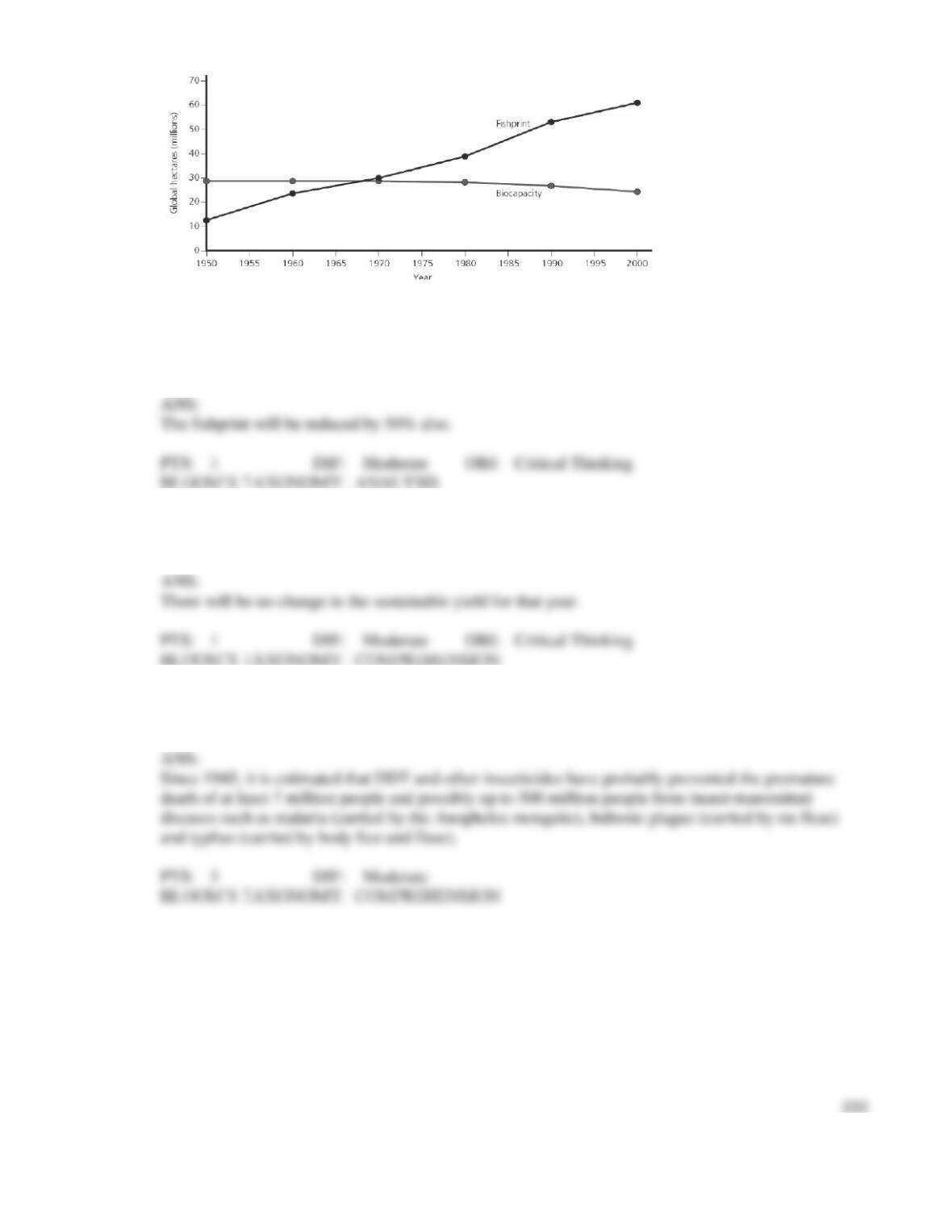
3. For a given theoretical country, assume the productivity in metric tons per hectare remains stable, and
the weighting factor remains the same, but the metric tons of fish harvested per year is reduced by
50%. How will this affect the fishprint for this country?
4. If the metric tons of fish harvested per year is reduced by 50% how will this reduction affect the
sustainable yield?
5. It is well-documented that while some synthetc pesticides have caused great harm to living creatures,
others have saved lives. Give a brief account of one that has, ironically, saved human lives: DDT.
ESSAY
1. Clearly explain the relationship between irrigation and salinization of soils.
2. Discuss the relative costs of organically grown food and conventionally produced food. In your
answer, include specifics about why the costs are as they are. Also give a possible example.
3. Explain the benefits of using perennial plants rather than annual plants for food crops.

4. Explain how growing corn in the Midwest creates a ‘dead zone’ in the Gulf of Mexico.