ch10.doc Page 1
Chapter 10
Fiduciary Funds and Permanent Funds
TRUE/FALSE (CHAPTER 10)
1. Per GASB Statement No. 34, permanent funds are classified as fiduciary funds.
2. In accounting for permanent funds only the income can be spent; the principal must be
preserved intact.
3. Fiduciary funds focus on current financial resources and use the full accrual basis of
accounting.
4. Fiduciary funds are excluded from the government-wide financial statements.
5. The concept of major versus nonmajor funds does not apply to permanent funds, as it does to
governmental and proprietary funds.
6. Accounting for the employer’s contribution to a defined contribution pension plan is straight
forward, because the employer is obligated only to make annual contributions in the amount
specified in the plan terms.
7. Accounting for the employer’s contribution to a defined benefit pension plan is straight
forward, because the employer is obligated only to make annual contributions in the amount
specified in the plan terms.
8. Not-for-profits report all investment gains and losses on endowments as additions to
temporarily restricted net assets, regardless of donor-imposed restrictions.
9. An employer may have a liability to a defined benefit pension plan other than for its annual
required contributions, depending on the future financial health of the plan.
10. In an agency fund, assets always equal fund balances because there are no liabilities.
11. Employers that provide postemployment healthcare benefit plans should account for them in
private-purpose trust funds.
12. Colleges that use a fixed rate of return approach to manage the distribution of income from
their endowments must apply the same rate to determine how much investment income to
report in their financial statements.
13. GASB standards require a defined benefit pension plan to report investments at fair market
value even if the plan’s actuary uses a different value in determining the employer’s
contribution requirements.
14. In contrast to most private-sector pension plans, most government plans are defined
contribution plans.
15. Permanent funds focus on measuring current financial resources and use a modified accrual
basis of accounting.
ch10.doc Page 2
MULTIPLE CHOICE (CHAPTER 10)
1. A government receives a gift of cash and investments with a fair value of $200,000. The
donor specified that the earnings from the gift must be used to beautify city-owned parks and
the principal must be re-invested. The $200,000 gift should be accounted for in which of the
following funds?
a) General fund.
b) Private-purpose trust fund.
c) Agency fund.
d) Permanent fund.
2. In previous years, Boze City had received a $400,000 gift of cash and investments. The
donor had specified that the earnings from the gift must be used to beautify city-owned parks
and the principal must be re-invested. During the current year, the earnings from this gift
were $24,000. The earnings from this gift should generally be considered revenue to which
of the following funds?
a) Special revenue fund.
b) Private-purpose trust fund.
c) Agency fund.
d) Permanent fund.
Use the following information to answer Questions #3-4
Carl City received $200,000 to help maintain a local art museum that is owned and operated by a
not-for-profit organization. During the year the city transferred net earnings of $20,000 to the
appropriate entity/fund.
3. The $200,000 gift would be reported in a (an):
a) Special revenue fund.
b) Private-purpose trust fund.
c) Agency fund.
d) Permanent fund.
4. The $20,000 transfer would be reported by the fund that made the transfer as a (an)
a) Transfer-out.
b) Expenditure.
c) Deduction from net position—benefits.
d) Expense.
Use the following information to answer Questions #5-6.
In the current year, Loma City earned $24,000 on the principal of a private-purpose trust fund but
disbursed only $20,000.
5. During the current year the private-purpose trust fund will recognize, related to earnings:
a) $24,000 revenues.
b) $20,000 revenues.
c) $24,000 addition to net position.
d) $20,000 addition to net position.
ch10.doc Page 3
6. During the current year the private-purpose trust fund will recognize, related to the cash
outflow:
a) $20,000 transfer-out.
b) $20,000 expenses.
c) $24,000 deduction from net position.
d) $20,000 deduction from net position.
7. Which of the following activities of a government should be accounted for in a fiduciary
fund?
a) Funds received from the federal government to support public transportation activities.
b) Funds received from an individual who specified that the principal must be kept intact but
the income can be used to support families of police officers killed in the line of duty.
c) Funds received from the state government that must be used to purchase capital assets.
d) Funds received from a contractor to assist with the development of utility infrastructure.
8. What basis of accounting is used to account for transactions of a government’s private-
purpose trust fund?
a) Full accrual basis of accounting.
b) Modified accrual basis of accounting.
c) Cash basis of accounting.
d) Budgetary basis of accounting.
9. In which of the following funds would a government report depreciation expense?
a) Private-purpose trust fund.
b) Agency fund.
c) Permanent fund.
d) None of the above
10. Which of the following would NOT be accounted for in a fiduciary fund of a government?
a) Nonexpendable resources held for the benefit of other governments.
b) Nonexpendable resources held for the benefit of the government holding the resources.
c) Expendable resources held for the benefit of other governments.
d) Funds held as an agent for other entities.
11. Permanent funds are classified as
a) Governmental funds.
b) Proprietary funds.
c) Fiduciary funds.
d) Trust funds.
12. Which of the following is NOT a fiduciary fund?
a) Pension trust fund.
b) Investment trust fund.
c) Permanent fund.
d) Private-purpose trust fund.
ch10.doc Page 4
13. What basis of accounting is used to account for the transactions of a government’s permanent
fund?
a) Full accrual basis of accounting.
b) Modified accrual basis of accounting.
c) Cash basis of accounting.
d) Budgetary basis of accounting.
Use the following information to answer Questions #14-16
Previously a local private-sector charity received a $1 million gift, the income from which was
restricted to support activities for senior citizens. During the current year the endowment earned
$40,000 of interest revenues, of which the charity designated $30,000 to support senior citizen
activities.
14. On its year-end statement of activities, the charity would report interest revenues of:
a) $0
b) $30,000
c) $40,000
d) None of the above.
15. On its year-end statement of financial position, the charity would report temporarily
restricted net assets of:
a) $40,000.
b) $ 0.
c) $30,000.
d) $1.04 million.
16. On its year-end statement of financial position, the charity would report permanently
restricted net assets of:
a) $1 million.
b) $1.04 million.
c) $1.03 million.
d) $1.01 million.
17. Maple City has a permanent fund that reported current-year investment earnings (realized and
unrealized) of $80,000. The endowment principal is $800,000 and the city council has
adopted a policy of considering only the inflation-adjusted rate of return to be available for
transfer to the recipient fund. During the current year the council declared the inflation-
adjusted rate of return to be 8 percent. How much revenue would be recognized in the
permanent fund?
a) $ 0.
b) $ 64,000.
c) $ 80,000.
d) Insufficient information to determine.
ch10.doc Page 5
18. During the year, a state-owned university received a $5 million gift. The donor specified that
the principal of the gift must be held intact for 3 years, but the earnings from the gift can be
used to support technology improvements in the college of business. At the end of the 3
years, the donor together with the university president and the college dean will decide how
the $5 million gift can be used. The university will report the gift in what type of fund?
a) Permanent fund.
b) Private-purpose trust fund.
c) Special revenue fund
c) Plant fund.
19. A wealthy citizen provided in her will for a gift of cash and other assets to Balsa city. The
will specified that the gift was to be kept intact and that the earnings from the gift were to be
used to support public parks. At the time of the donation, the gift had a book value in the
hands of the donor of $300,000 and a fair value of $500,000. When recording this gift the
city would credit
a) Contributions revenues $500,000.
b) Other financing sources—contributions $500,000.
c) Contributions revenues $300,000.
d) Other financing sources—contributions $300,000.
20. At the beginning of the year, the permanent fund of Rose City had an investment portfolio
with a historical cost of $300,000 and a fair value of $330,000. There were no purchases or
sales of securities during the year. At the end of the year the portfolio had a fair value of
$360,000. At year-end, the city s account for this increase in fair value
in which of the following ways?
a) Credit Investment income, $30,000.
b) Credit Investment income, $60,000.
c) Credit Fund balance, $30,000.
d) No entry should be made to recognize an increase in fair value.
21. Several years ago, a donor gave $5 million to Denton City and specified that the principal
was to be kept intact but the earnings were to be used to support the operations of city parks.
During the current year, the city earned $300,000 on the gift. To what type of fund, should
the city transfer the $300,000 earnings?
a) It should not make any transfers. The $300,000 should remain in the city’s permanent
fund.
b) A special revenue fund.
c) The general fund.
d) An enterprise fund.
ch10.doc Page 6
22. A defined contribution pension plan is one in which the employer agrees to do which of the
following?
a) To make payments to a specified pension plan with no guarantee of a specific pension
amount to be paid to the employees.
b) To make actuarially determined payments to a pension plan AND to guarantee that the
employees will receive a specified pension benefit (usually determined by length of
service and salary).
c) To make actuarially determined payments to a pension plan that guarantees employees
will receive a specified pension (usually determined by length of service and salary).
c) To pay specified amounts (usually determined by length of service and salary) to the
employees upon retirement.
23. Dale City Light & Water (a proprietary fund) contributes to a defined benefit pension plan for
its employees. During 2014, the city contributed $36 million to the pension plan. The city
also made a $4 million contribution related to 2013. The actuarially determined contribution
requirement for 2014 was $43 million. The amount of pension expense recognized by Dale
City Light & Water for 2014 should be:
a) $ 0
b) $ 36 million
c) $ 40 million
d) $ 43 million
24. During the fiscal year ended December 31, 2013, Glen City’s general fund contributed $60
million to a defined benefit pension plan for city employees. On February 27, 2014, the
general fund made an additional $3 million contribution related to the 2013 pension
contribution requirements. The actuarially determined contribution requirement for 2013 is
$65 million. The amount of pension expenditure recognized by the general fund for 2013
should be:
a) $ 0
b) $ 60 million
c) $ 63 million
d) $ 65 million
25. In which of the following funds would the account “net pension obligation” be most likely to
appear?
a) General fund.
b) Enterprise fund.
c) Private-purpose trust fund.
d) Agency fund.
26. The schedule of changes in long-term obligations contains an account “net pension
obligation.” Which of the following describes the event that gave rise to this account?
a) The actual contribution by a proprietary fund was less than the annual required
contribution per the actuary.
b) The actual contribution by a governmental fund was less than the annual required
contribution per the actuary.
c) The actuarially computed pension liability exceeded the pension plan assets.
d) The actuarially computed pension liability was less than the pension plan assets.
ch10.doc Page 7
27. Required disclosure by the general fund of a government related to its pension plan does
NOT include which of the following?
a) The employer’s funding policy.
b) The components of the pension cost.
c) The key assumptions used in determining the pension cost.
d) The present value of the future benefits to be paid.
28. The primary financial statements for a government-sponsored pension plan are:
a) Balance sheet and statement of activities.
b) Balance sheet, statement of activities, and cash flows statement.
c) Statement of fiduciary net assets and a statement of changes in fiduciary net assets
d) Balance sheet, statement of activities, cash flows statement, and statement of funding
progress.
29. Which of the following is NOT a criterion that an employer’s annual required contribution
must satisfy to be considered acceptable?
a) It must consist of the employer’s normal cost plus a provision for amortizing the plan’s
unfunded actuarially accrued liability.
b) Actual assumptions must be in accordance with standards of the Actuarial Standards
Board.
c) Actuarial value of pension plan assets must be based on market values on the financial
statement date.
d) Assumptions as to investment earnings should be based on long-term projections.
30. A plan’s unfunded actuarially accrued liability is the excess of the:
a) Actuarially determined plan cost over the actual contribution.
b) Actuarially determined plan cost over the plan assets.
c) Actuarially determined pension liability over the plan assets.
d) Actuarially determined pension liability over the total contributions
31. Citizens within a defined geographic area of Dolan City created a special assessment district
to facilitate the construction of sidewalks. The city was responsible for overseeing the entire
construction project. The city issued bonds in its own name to pay the contractor for the
construction. However, the city was not responsible in any manner for the bonds. The bonds
were secured by the special assessments that are levied against properties within the special
assessment district. Collections of special assessments would be recorded in which of the
following funds of Dolan City?
a) Special assessment fund.
b) Agency fund.
c) Special revenue fund.
d) Debt service fund.
32. Lomond City receives a federal grant to assist in nutrition programs for its senior citizens.
The city will select the contractors that will provide meals and approve the participants in the
program. The proceeds of this grant should be accounted for in which of the following funds
of the city?
a) A governmental fund.
b) An enterprise fund.
c) An agency fund.
d) A private-purpose trust fund.
ch10.doc Page 8
33. Ashby City receives a federal grant to assist in nutrition programs for its senior citizens.
Senior citizens whose income is below a specified amount (the amount was specified by the
Federal government) are eligible to participate in the program. Monthly checks of $100 (this
amount was specified by the Federal government) will be mailed to eligible senior citizens.
The proceeds of this grant should be accounted for in which of the following funds of the
city?
a) General fund.
b) Special revenue fund.
c) Agency fund.
d) Private-purpose trust fund.
34. Financial assets reported by most investment trust funds of governments should be reported at
a) Cost
b) Amortized historical cost.
c) Fair value on the date of the financial statements.
d) Fair value computed by a weighted-average approach.
35. Assets reported in a government’s investment trust fund should include:
a) Only investments owned by external participants in the investment pool.
b) Investments of both the sponsoring government and of external participants in the
investment pool.
c) Investments related to the sponsoring government’s governmental funds and of external
participants in the investment pool.
d) Investments related to the sponsoring government’s other fiduciary funds and of external
participants in the investment pool.
36. Financial assets reported by qqqqqqqqqqqqq2a7-like investment pools should be reported at
a) Fair value at the date of the financial statements.
b) Amortized historical cost.
c) Fair value computed using a weighted-average approach.
d) Cost.
37. GASB standards of accounting for other postemployment benefits (OPEB) require that
governments
a) Fund their OPEB benefits on an actuarially determined basis.
b) Report actuarially determined required contributions as OPEB expense, regardless of
whether the government actually makes the contributions.
c) Report OPEB costs in accordance with the FASB’s standards of accounting for OPEB.
d) Only disclose an estimate of their OPEB liabilities.
38. Liabilities reported in pension trust funds consist of
a) Liabilities accrued using the accrual basis of accounting, including the actuarial accrued
liability for the plan.
b) Liabilities accrued using the modified accrual basis of accounting, excluding the actuarial
accrued liability for the plan.
c) Liabilities accrued using the accrual basis of accounting, excluding the actuarial accrued
liability for the plan.
d) Liabilities accrued using the modified accrual basis of accounting, including the plan
benefits that will be paid with measurable and available financial resources.
39. Governments must present which of the following financial statements for fiduciary funds?
a) Statement of assets and benefits and statement of cash flows.
b) Statement of fiduciary net assets and statement of changes in benefits,

ch10.doc Page 9
c) Statement of fiduciary net position and statement of changes in fiduciary net position.
d) Statement of net assets and statement of accrued benefit obligations.
40. The fiduciary fund financial statements in a government’s annual financial report comprise
a) Consolidated statements only—no separate statements for individual pension plans.
b) A separate column in each statement for each fiduciary fund type.
c) A consolidated assets and benefits statement showing three classes of net assets.
d) Statements reporting information by major fund.
41. The liabilities related to benefits and refunds of a defined benefit pension plan are reported in
a government’s fiduciary fund financial statements using the
Full Accrual Modified Economic Resources Current Financial
Basis Accrual Basis Measurement Focus Resources Measure-
ment Focus
a) No Yes Yes No
b) Yes No No Yes
c) No Yes No Yes
d) Yes No Yes No
42. A major difference between defined benefit pension plans and defined contribution pension
plans is that
a) In defined benefit plans, the risk of loss is borne primarily by the employer.
b) Accounting for defined benefit plans is much simpler than accounting for defined
contribution plans.
c) Employees generally are required to contribute to defined contribution plans but not to
defined benefit plans.
d) There is no major difference between the two kinds of pension plans.
43. Which of the following is NOT true of agency funds?
a) Governments use them to account for resources held as trustee or agent for another
government, fund, not-for-profit entity, or individual.
b) They are required to use a modified accrual basis of accounting.
c) They have no operations and therefore are not required to prepare financial statements.
d) Agency fund assets are always offset by liabilities.
44. Whether gains on the sale of a government endowment’s investments should be considered
additions to principal or expendable income for accounting purposes is:
a) An issue that has been resolved by federal law.
b) Debatable, but generally resolved in favor of adding the gains to unrestricted assets
(expendable), absent donor or legal stipulations.
c) A matter for governments to decide, independent of donor or legal considerations.
d) Debatable, but generally resolved in favor of adding the gains to principal
(nonexpendable assets), absent donor or legal stipulations.
45. The funded status of a defined benefit pension plan is
a) The result of comparing the actuarial value of plan assets with the plan’s actuarial
accrued liability for benefits.
b) The amount by which plan assets exceed benefits due to current retirees.
c) Current-year contributions less amounts currently due but not paid to current retirees,
d) The policy as to whether the plan is being financed on a pay-as-you-go (cash) basis or
through actuarially determined employer contributions.
ch10.doc Page 10
46. Which of the following is a NOT a true statement concerning postemployment benefits other
than pensions (OPEB)?
a) OPEB comprise predominantly healthcare benefits.
b) Many governments do not provide OPEB or provide them on a pay-as-you-go basis.
c) GASB standards of accounting for OPEB are very similar to those for pension benefits.
d) OPEB plans should be accounted for in permanent funds.
ch10.doc Page 11
PROBLEMS (CHAPTER 10)
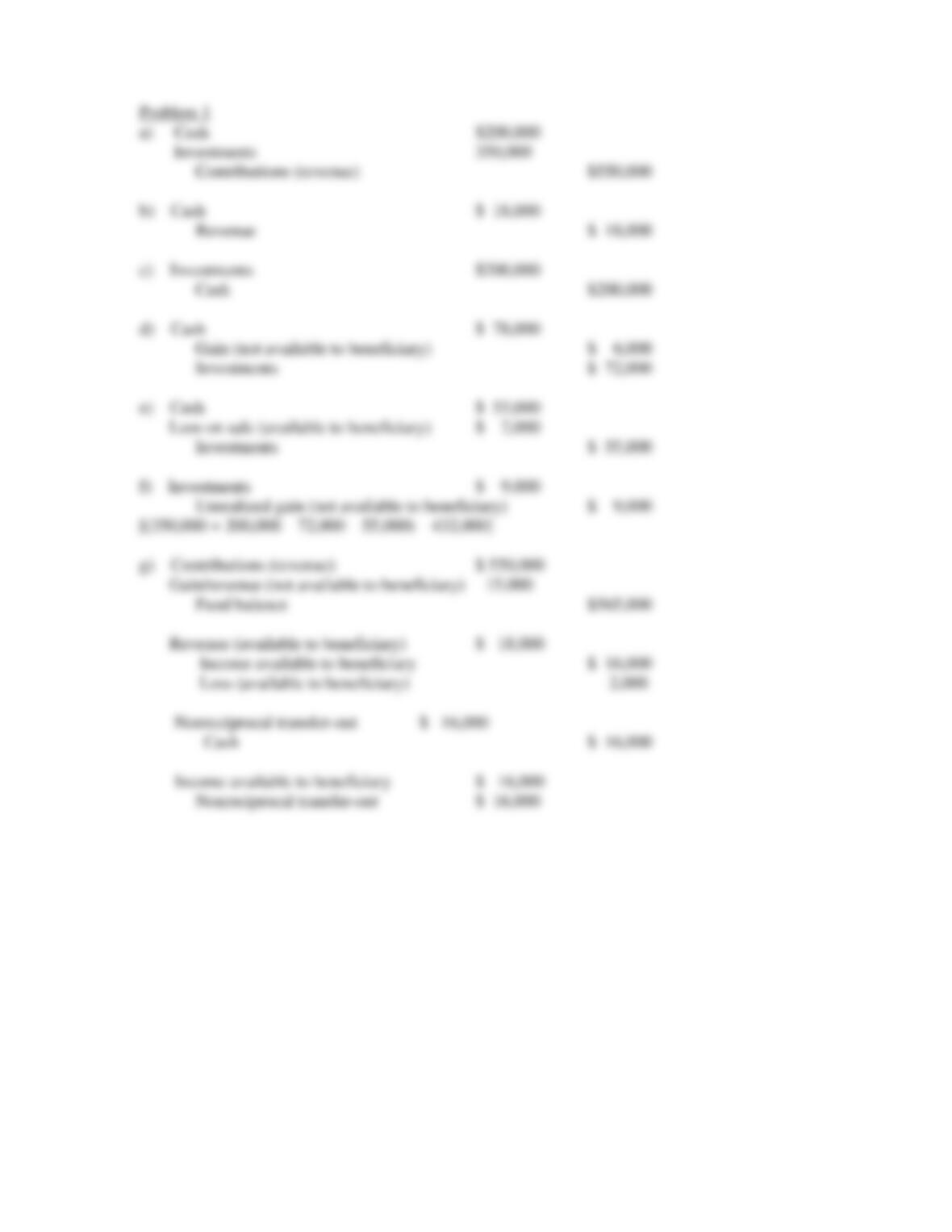
1. Scofield City received a donation from the estate of the late Lisa O’Reilly to be used to
support the city’s public library. The gift consisted of $200,000 cash and a portfolio of
securities with a market value of $350,000. The securities have a book value of $250,000.
The donor stipulated that the principal of the gift, including investment gains (realized and
unrealized) but excluding investment losses, must be kept intact. The income must be used to
care for and maintain the book collection at the newly renamed O’Reilly Public Library. All
appropriate costs, including investment losses, may be charged against the revenues yearly to
determine the amount available for the specified purposes. During the year, the city engaged
in the following transactions on behalf of the library. Prepare the appropriate entries in the
city’s permanent fund.
a) Accepted the donation.
b) Received dividends and interest of $18,000.
c) Purchased securities for $200,000.
d) Sold securities that were part of the original gift (market value at date of gift $72,000;
book value in hands of donor $68,000) for $78,000.
e) Sold some of the securities that were acquired in transaction (c) for $53,000. They were
acquired at a price of $55,000.
f) The portfolio of securities at year-end had a market value of $432,000.
g) Closed the fund’s revenue and expense accounts and transferred the amount available for
expenditure to the appropriate fund. Close the transfer account.
ch10.doc Page 12
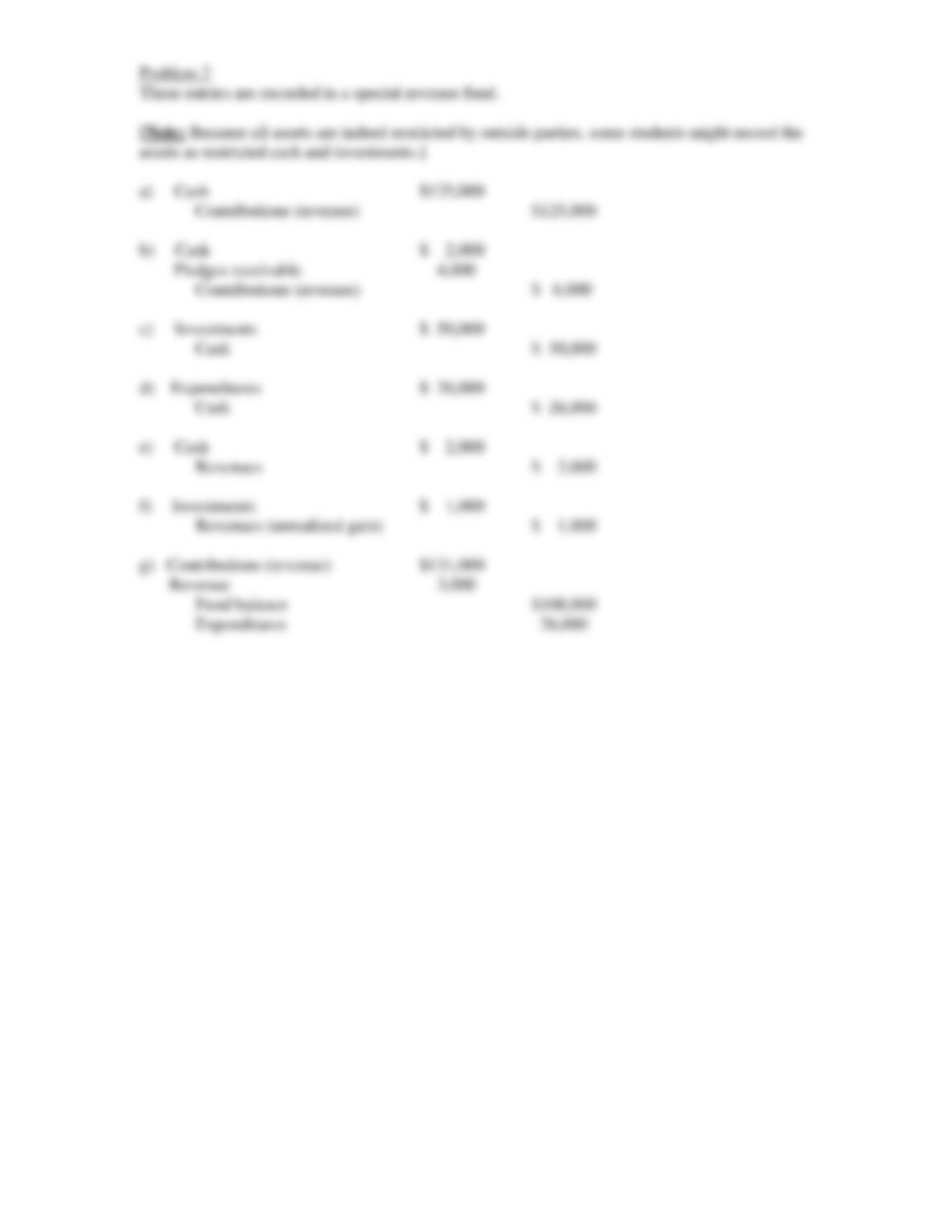
2. Kilmore City received a cash gift of $125,000 from a citizen who specified that the gift must
be used to support recreational activities for the city’s youth. The city accounted for this gift
in the appropriate fund. During the year the city engaged in the following activities. Prepare
the appropriate journal entries. Be sure to indicate in which fund the entries should be
recorded.
a) The city accepted the donation.
b) The city engaged in a fund-raising effort to provide additional funds to support youth
recreational activities and raised $6,000 in pledges. The city collected $2,000 in cash
with the remaining pledges collectible shortly after the end of the year.
c) The city temporarily invested $50,000 of the gift in marketable securities.
d) The city spent $26,000 on goal posts, nets, etc., for a soccer field.
e) The city received $2,000 in dividends and interest earned on the temporary investment.
f) At year-end the temporary investments had a market value of $51,000.
g) The city closed the revenue and expense accounts.
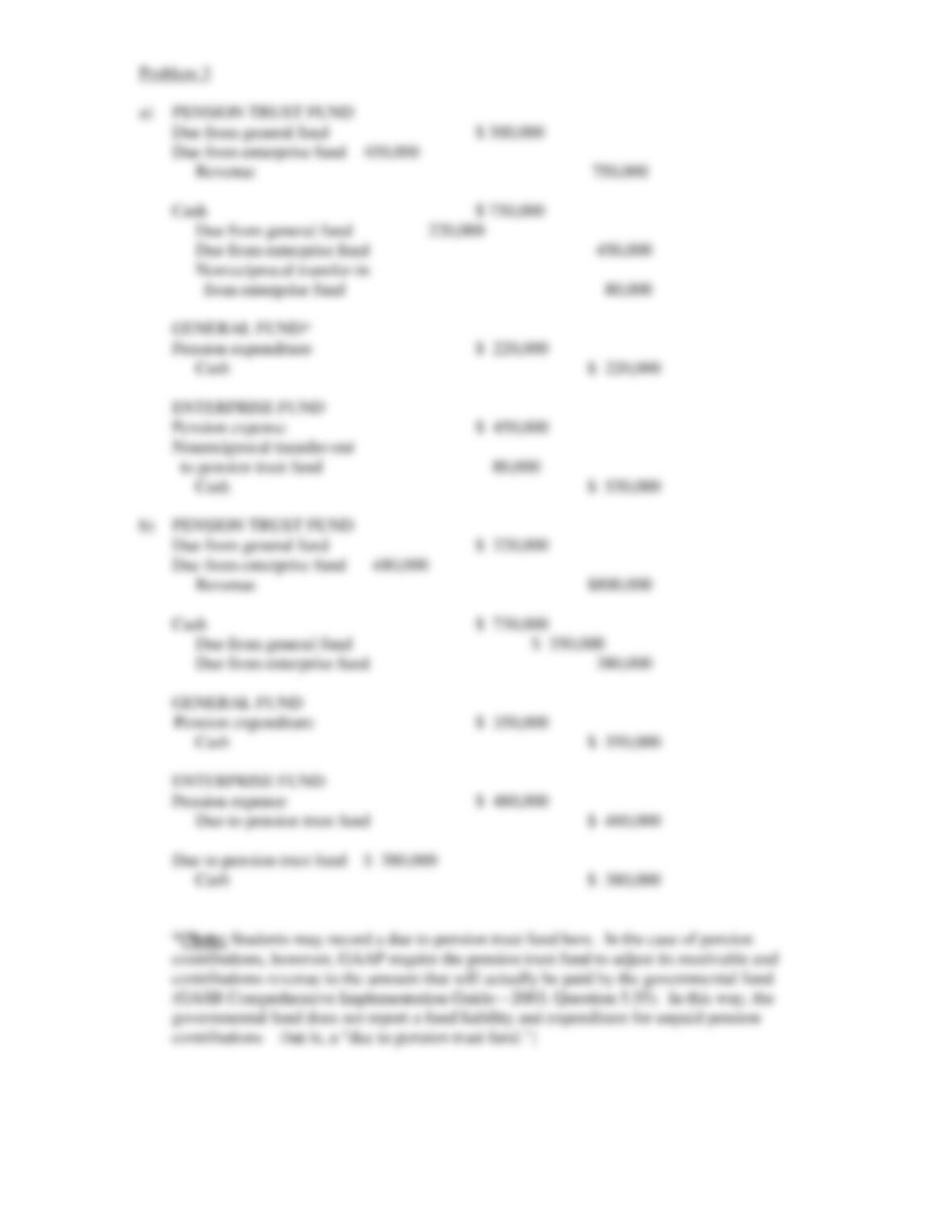
3. Wilmer County provides a defined benefit pension plan for its employees. The county
accounts for the pension plan in a pension trust fund, which is included in the county’s basic
financial statements. In the years indicated, the county engaged in the following transactions
related to the pension trust fund. Prepare all necessary journal entries. Clearly indicate the
fund in which the entry is being made. If no entry is needed, please write “No entry
required.”
a) In Year 1, the pension trust fund sent billings to the general fund and the City Utility
(enterprise) Fund for the actuarially determined amount of required contributions. The
general fund was billed $300,000 but paid only $220,000 during the year. The enterprise
fund was billed $450,000 and paid $530,000.
b) In Year 2, the pension trust fund sent billings to the general fund and the City Utility
Fund for the actuarially determined amount of required contributions. The general fund
was billed $320,000 and paid the entire amount plus $30,000 of last year’s underpayment.
The enterprise fund was billed $480,000 and paid only $380,000.
ch10.doc Page 13
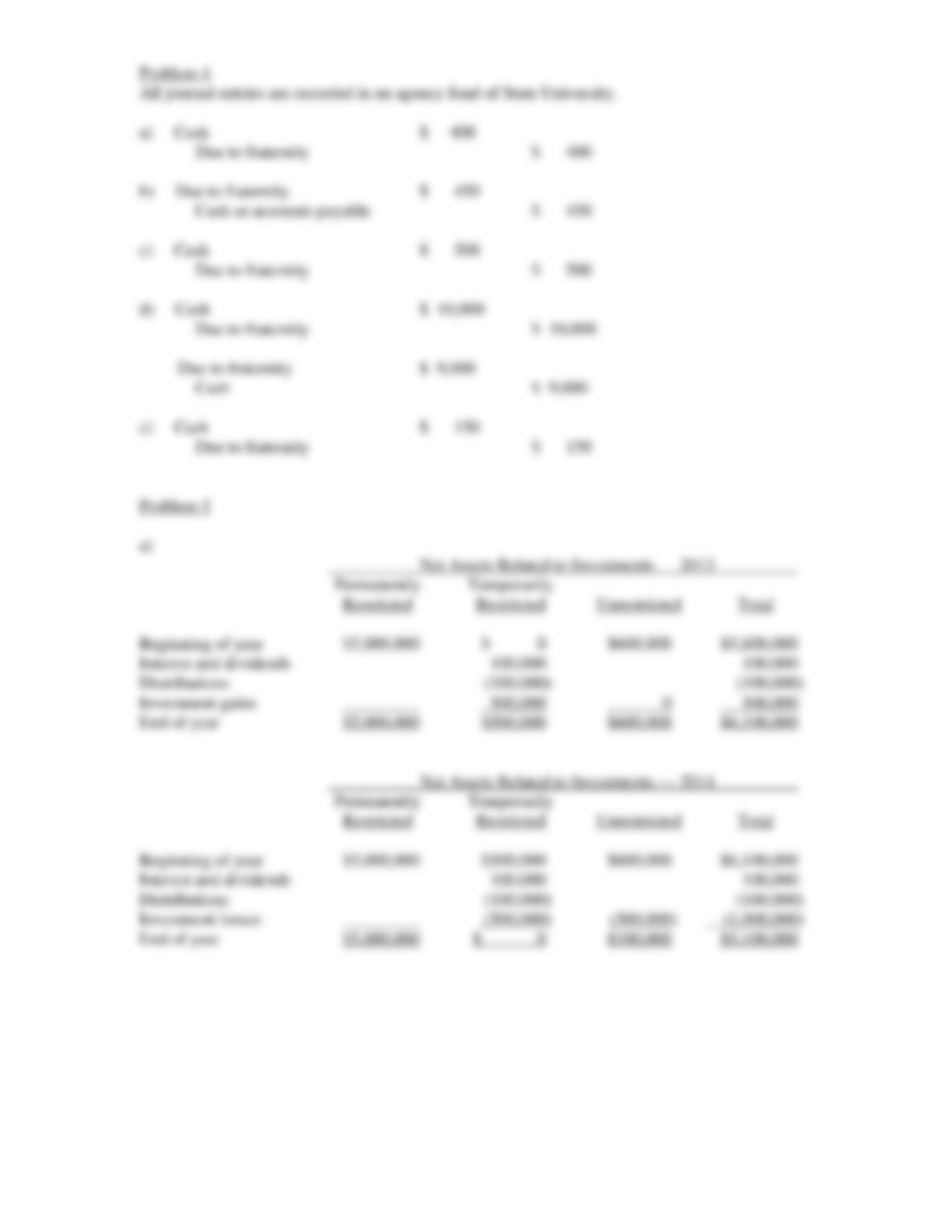
4. State University maintains accounts for each of its student groups. The monies collected by
the Accounting Fraternity are deposited with the university. As the fraternity authorizes
disbursements of its funds, the university disburses the monies. During the year, the
fraternity engaged in the following transactions. Prepare the appropriate entries on the books
of the university. Be sure to indicate in which fund the entries should be recorded.
a) The fraternity deposited $400 in student dues.
b) The fraternity authorized payments of $350 to Delta Airlines for an airline ticket for a
member to fly to the national meeting, and of $100 to the National Accounting Fraternity
for registration.
c) The fraternity received a contribution of $500 from a major accounting firm to be used by
the fraternity to offset the cost of attending the national meeting.
d) The fraternity operated a book exchange on a consignment basis and collected revenues
of $10,000. It authorized the university to write $9,000 of checks to the students whose
books the fraternity had sold. The fraternity was pleased with the $1,000 profit.
e) The fraternity received a reimbursement of $150 from the National office to offset the
costs of attending the National meeting.
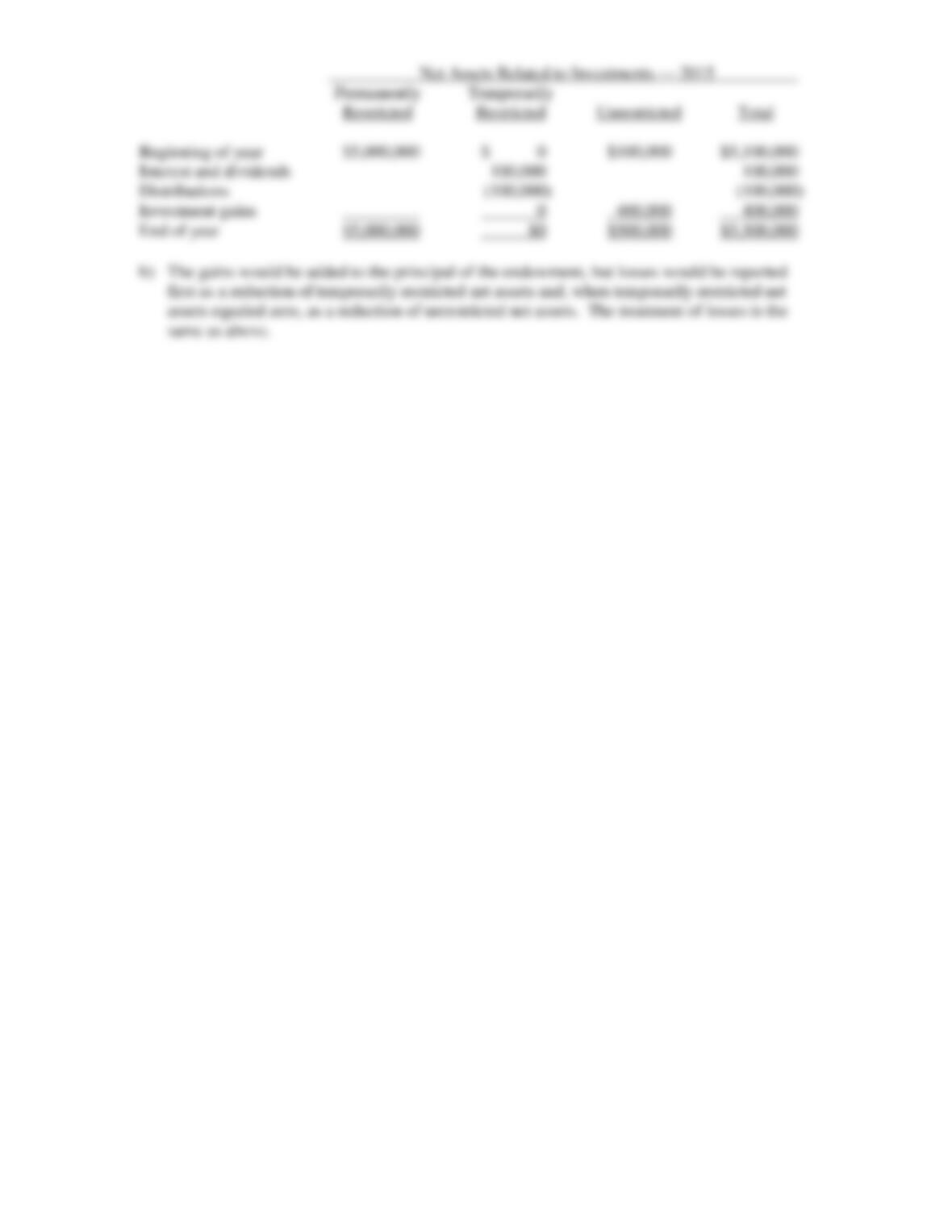
5. At the end of 2012, Learning Tree, a not-for-profit organization, received a $5 million
contribution (fair value), consisting entirely of investment securities. The contribution is
required to be used to establish a permanent endowment, the income from which must be
used exclusively to provide free “chapter books” to elementary school children. The
endowment specifies that both realized and unrealized gains may be used for this purpose in
addition to investment income. Learning Tree applies FASB accounting standards for not-
for-profit organizations.
At the start of 2013, Learning Tree had $600,000 in unrestricted net assets.
During 2013, the endowment earns $100,000 in dividends and interest. Learning Tree spends
the entire amount on books and distribution costs. At year-end, the value of the
endowment portfolio is $5.5 million.
During 2014, the endowment earns $100,000 in dividends and interest. The entire amount is
spent on books. At year-end, the fair value of the endowment portfolio has decreased by
$1 million to $4.5 million.
During 2015, the endowment earns $100,000 in dividends and interest. The entire amount is
spent on books. At year-end, the fair value of the endowment portfolio has gone back up
by $0.4 million to $4.9 million.
REQUIRED:
a) Assuming no other transactions, prepare a schedule showing the balances in unrestricted,
temporarily restricted, and permanently restricted net assets for the years ending in 2013,
2014, and 2015.
b) What effect would there be on these three balances of net assets if the donor specified
that all gains (realized and unrealized) must be reinvested?

ch10.doc Page 14
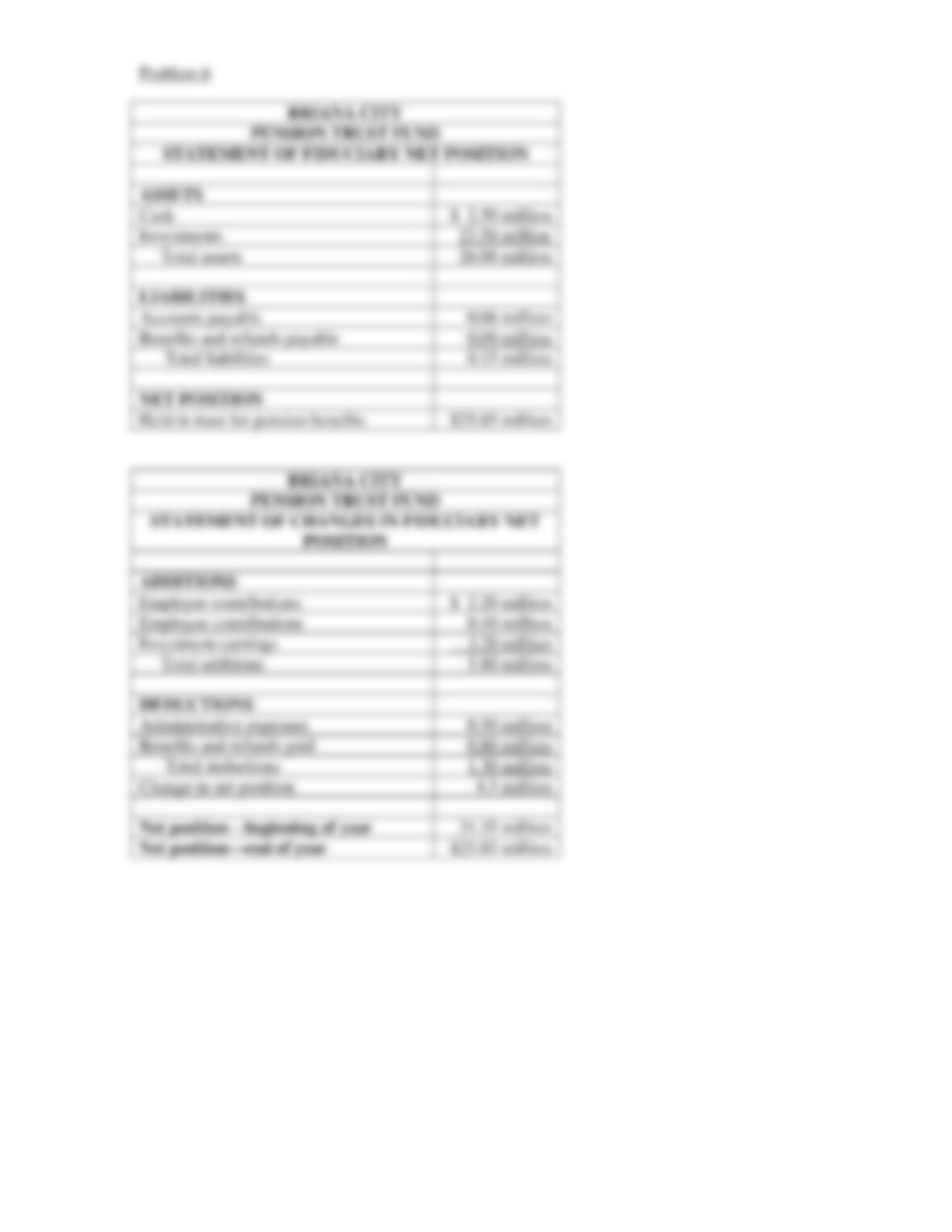
6. Briana City provides a defined benefit pension plan for its full-time employees. The city
includes the plan as a pension trust fund in its fund financial statements.
REQUIRED: Using the information below, prepare a statement of fiduciary netposition and
a statement of changes in fiduciary net position for the pension trust fund.
Cash at year-end $2.5 million
Investments at year-end $23.5 million
Actuarial value of plan assets at year-end $20.95 million
Accounts payable $0.06 million
Actuarial accrued liability $29.9 million
Refunds payable $0.09 million
Employer contributions $2.2 million
Employee contributions $0.4 million
Investment earnings $3.2 million
Benefits paid $0.8 million
Administrative expenses $0.5 million
Net position, held in trust
for pension benefits at beginning of year $21.35 million
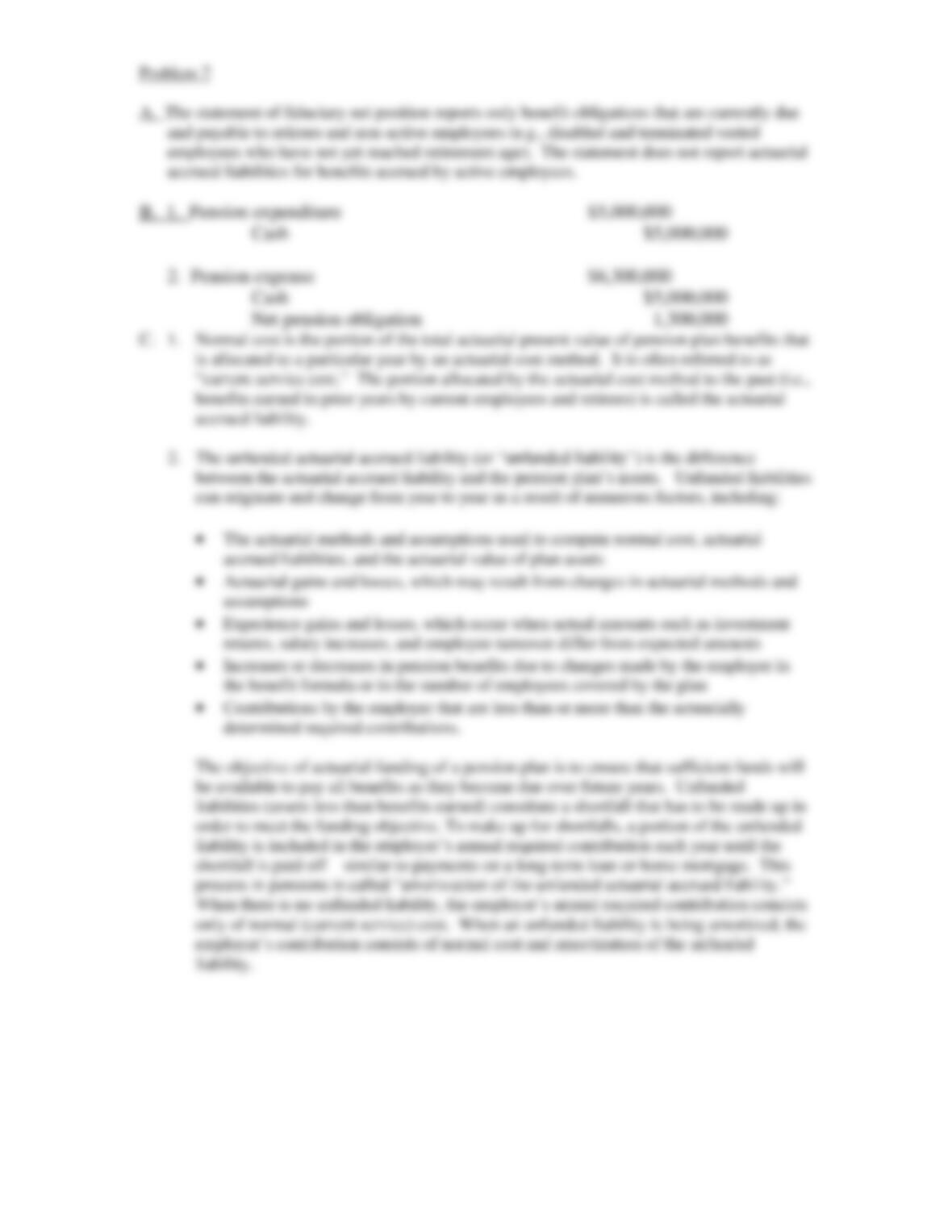
7. The statement of fiduciary net position for a school district’s defined benefit pension plan
shows the following (in condensed form and in thousands)
Assets
Cash and short-term investments $ 66,129
Receivables 49,946
Investments at fair value 3,565,931
Total assets $3,682,006
Liabilities
Benefits payable to current employees
and retirees $ 4,212
Net position $3,677,794
A. The plan has been in operation for over 20 years and covers all school district employees.
What is the most reasonable explanation of why the benefits payable to current
employees and retirees is so small relative to plan assets?
B. Suppose that in the current year the school district’s annual required contribution was
$6,300,000. In the past, the district has always paid the annual required contribution in
full. However, in the current year the district budgeted and paid into the pension trust
fund only $5,000,000.
1. Prepare the journal entry that the district (not the plan) should make to record the
year’s pension contribution. You need not make budgetary or closing entries. The
plan is accounted for in a governmental fund.
2. Prepare the journal entry to record the year’s pension contribution for reporting in the
district’s government-wide statements.
C. The district’s annual financial report indicated that its “normal cost” was $530,000 and
that the “amortization of the unfunded actuarial accrued liability” was $100,000.
ch10.doc Page 15
1. What is meant by “normal cost?”
2. What is meant by “unfunded actuarial accrued liability”? What are its principal
causes? Why must it be amortized?
ch10.doc Page 16
ESSAY QUESTIONS (CHAPTER 10)
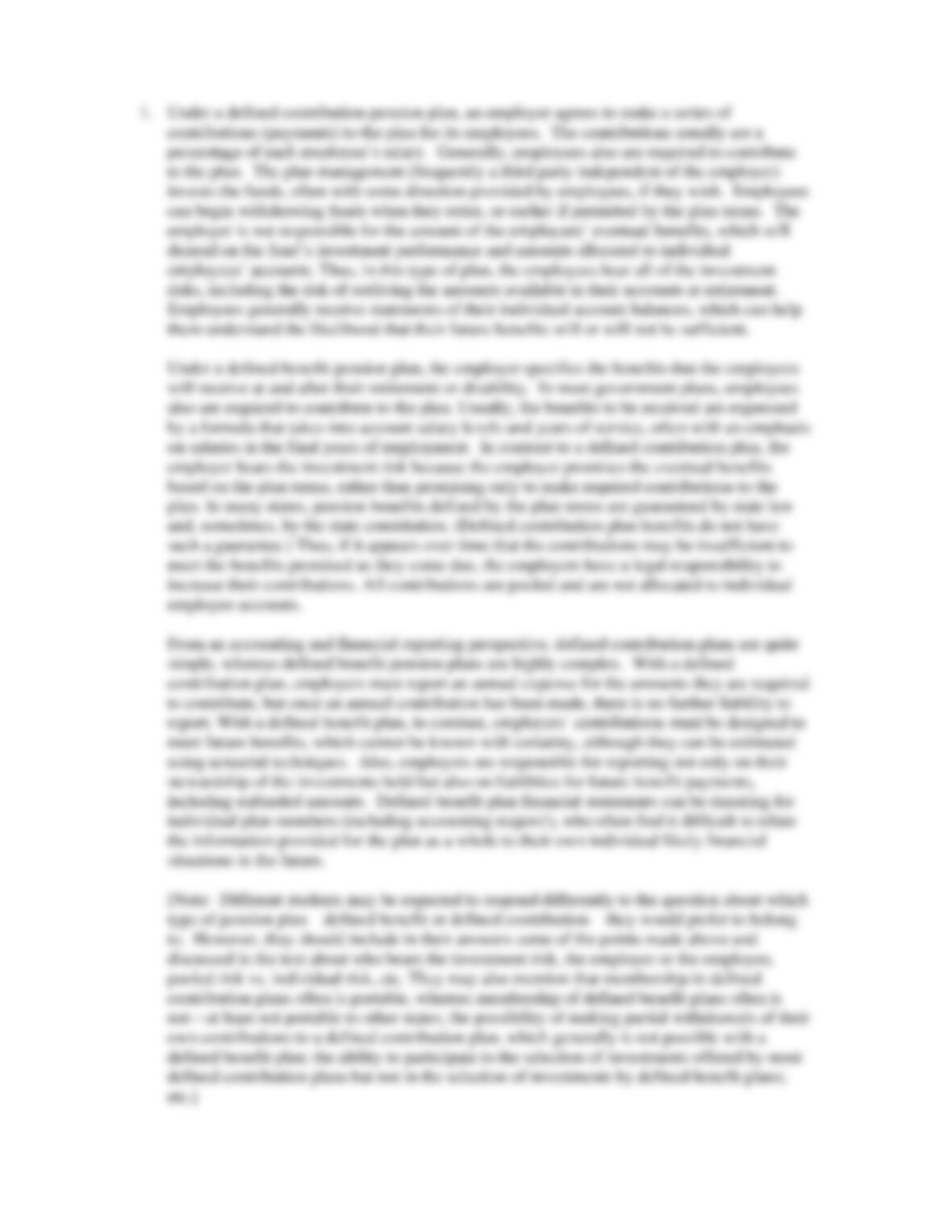
1. How does a defined contribution pension plan differ from a defined benefit pension plan?
What are some of the advantages and disadvantages of each type of plan? How do they differ
for accounting and financial reporting? Which type of plan would you prefer to belong to?
Why?
2. A donor gives your city $100,000 to be used to support youth recreational programs. What
type of fund should be used to account for this gift? How or why did you select this fund?
Include in your answer other types of funds that could be considered to account for similar
donations and why you did not select one of those funds.
3. Under GASB standards, agency funds are excluded from the face of the government-wide
financial statements. What are agency funds? Do you believe they should be presented in the
government-wide statements? Could they—or should they—be presented elsewhere?
4. Investment trust funds are one of four types of fiduciary funds. What is the purpose of
investment trust funds? What is the nature of the assets and liabilities that they report? Can
the government that provides an investment trust fund invest its own assets in that fund?
5. You are asked by a wealthy businesswoman to help construct a permanent endowment for a
local university. She asks you whether you believe the university should be required to add
investment gains to the principal of the endowment or whether it would be preferable for the
gains to be available for spending. How would you respond and why?

ch10.doc Page 17
ANSWERS TO TRUE/FALSE (CHAPTER 10)

ch10.doc Page 18
ANSWERS TO MULTIPLE CHOICE (CHAPTER 10)
ch10.doc Page 19
ANSWERS TO PROBLEMS (CHAPTER 10)
ch10.doc Page 20
ch10.doc Page 21
ch10.doc Page 22
ch10.doc Page 23
ch10.doc Page 24
ch10.doc Page 25
ch10.doc Page 26
ANSWERS TO ESSAY QUESTIONS (CHAPTER 10)
ch10.doc Page 27