Larson_Calculus_10e ch10sec01
MULTIPLE CHOICE
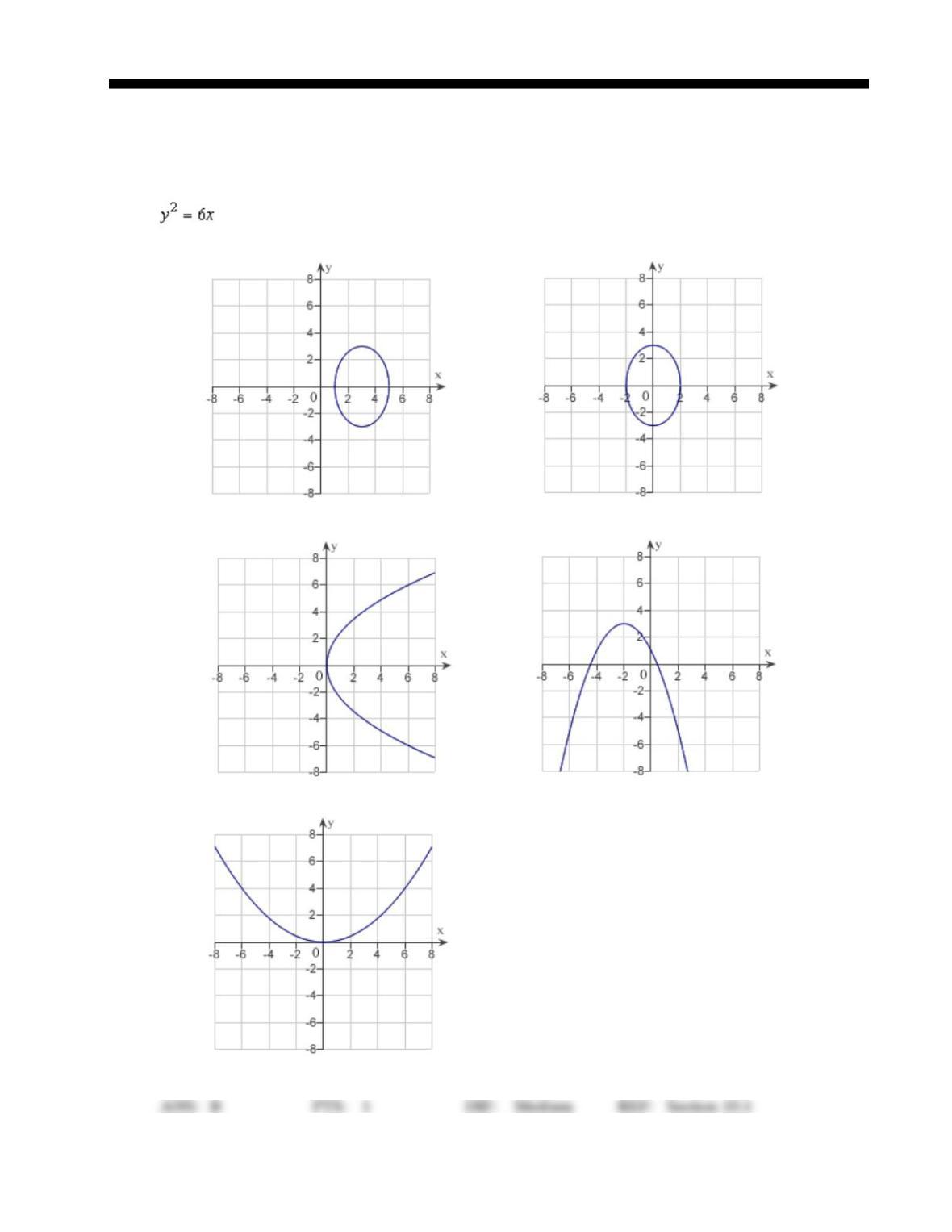
1. Match the equation with its graph.
a.
d.
b.
e.
c.
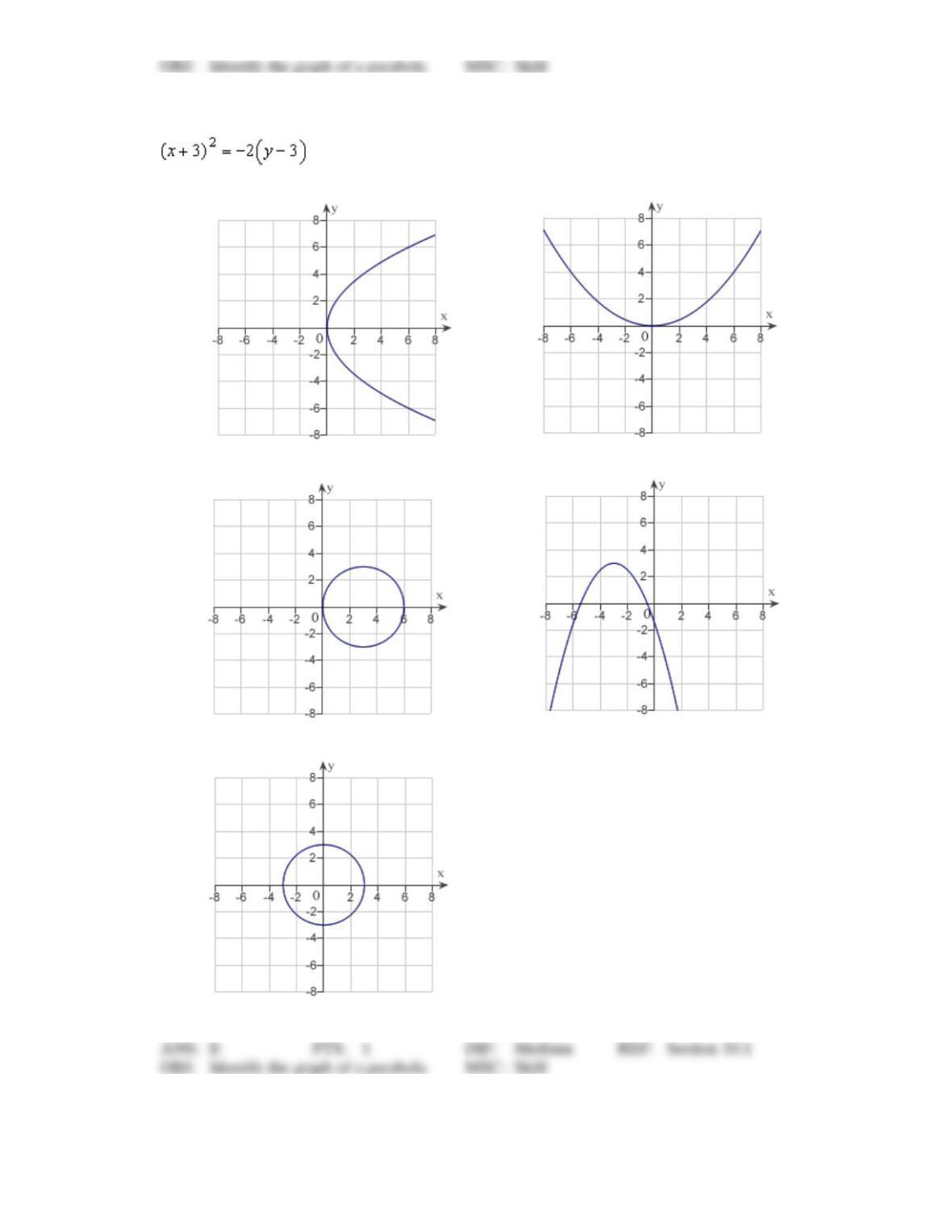
2. Match the equation with its graph.
a.
d.
b.
e.
c.
3. Match the equation with its graph.
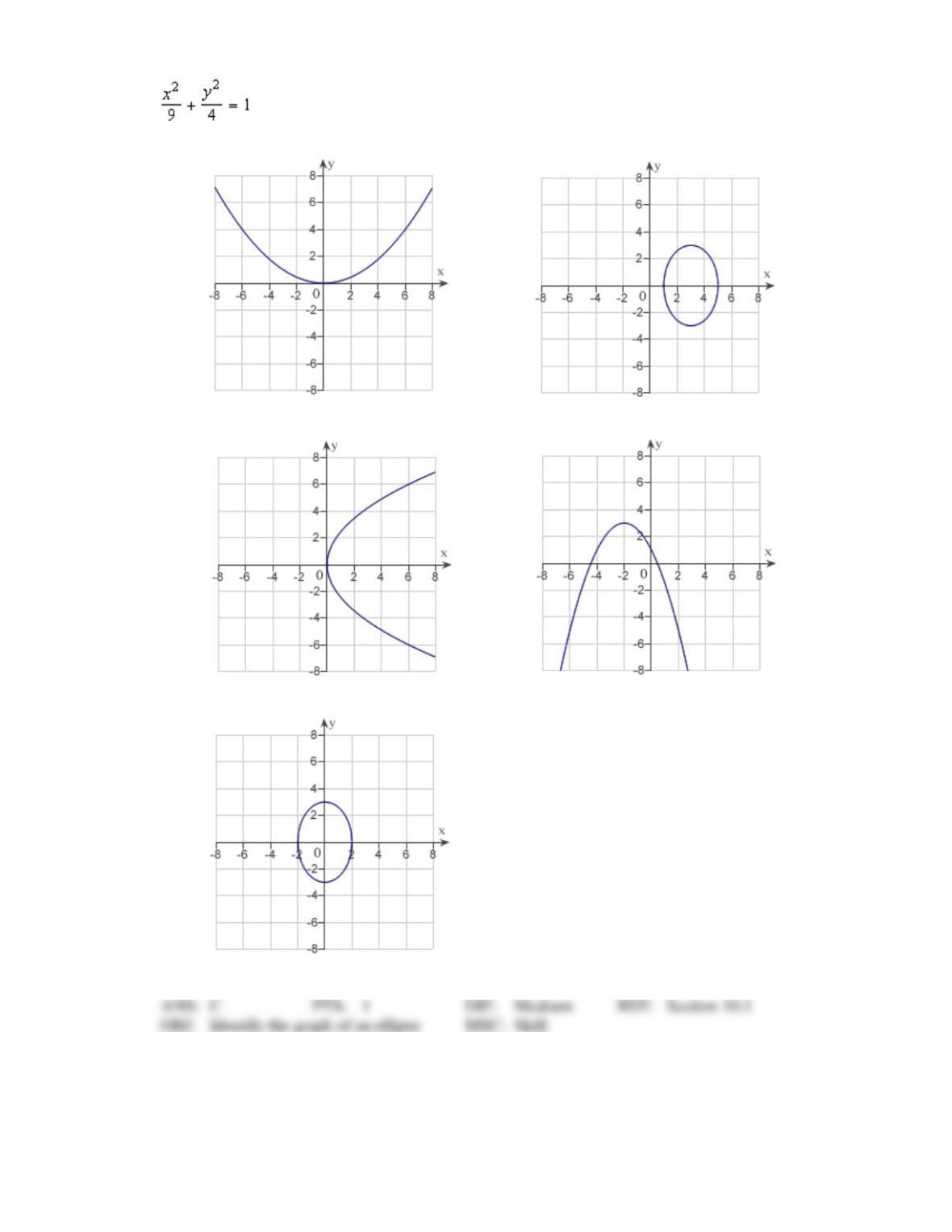
a.
d.
b.
e.
c.
4. Match the equation with its graph.
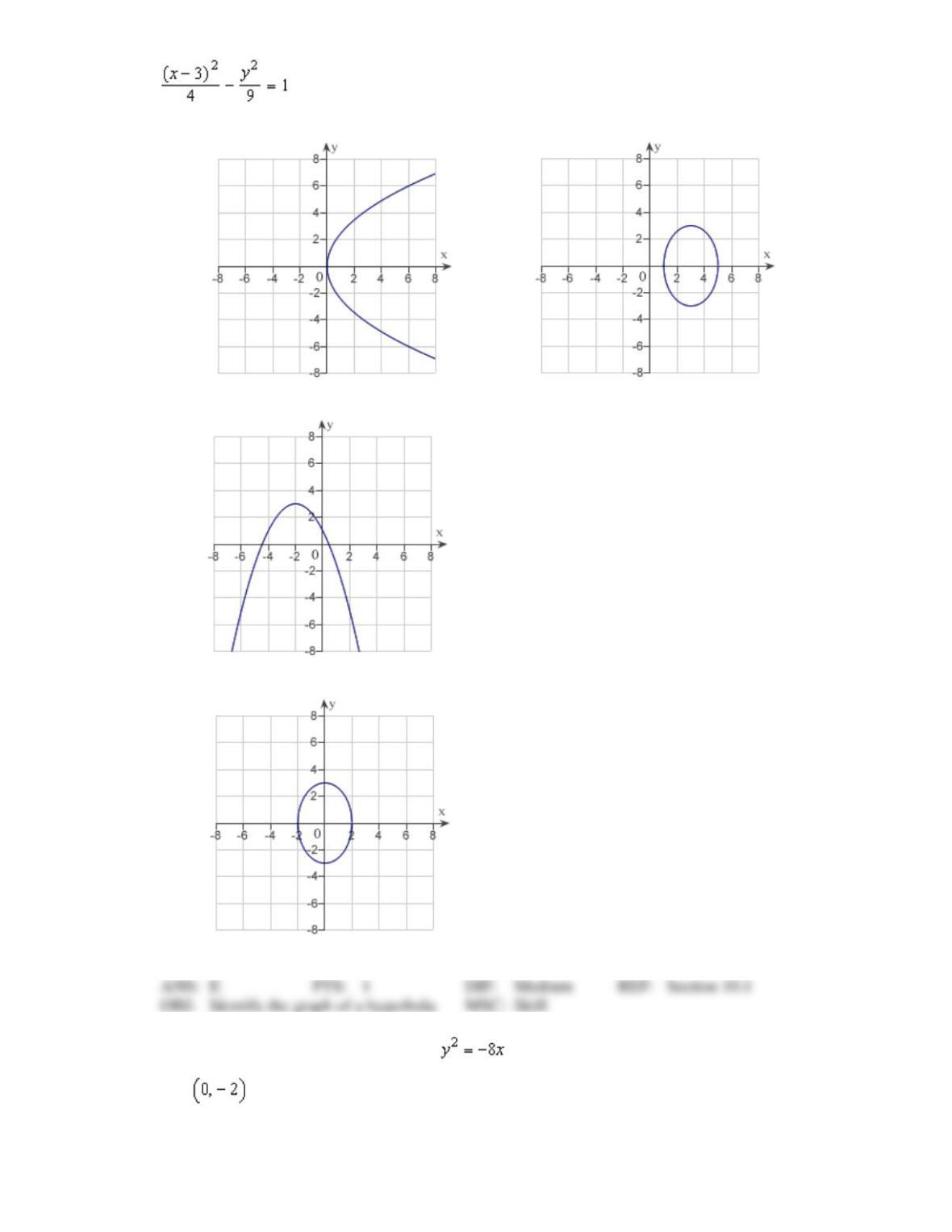
a.
d.
b.
e.
none of these
c.
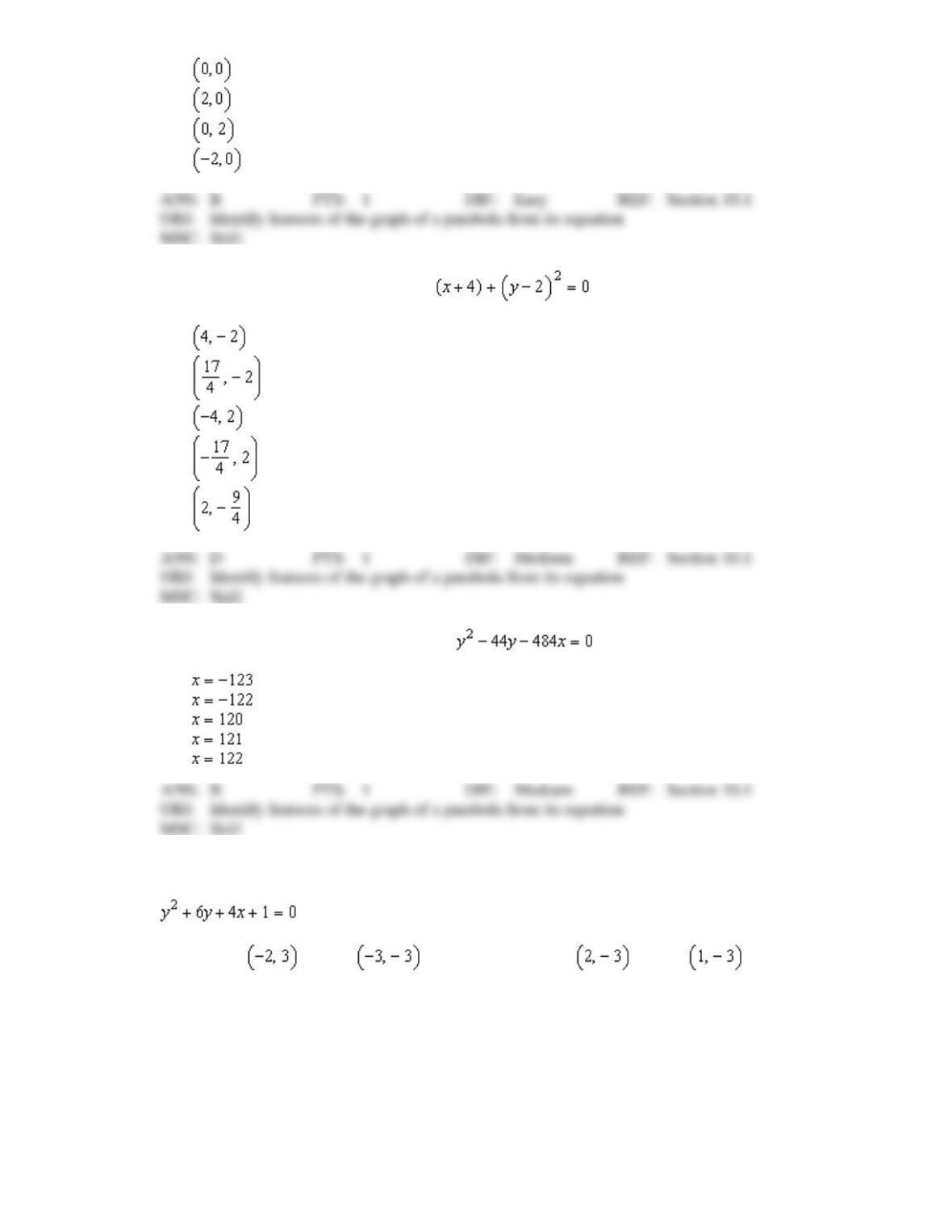
5. Find the vertex of the parabola given by .
a.
b.
c.
d.
e.
6. Find the focus of the parabola given by .
a.
b.
c.
d.
e.
7. Find the directrix of the parabola given by .
a.
b.
c.
d.
e.
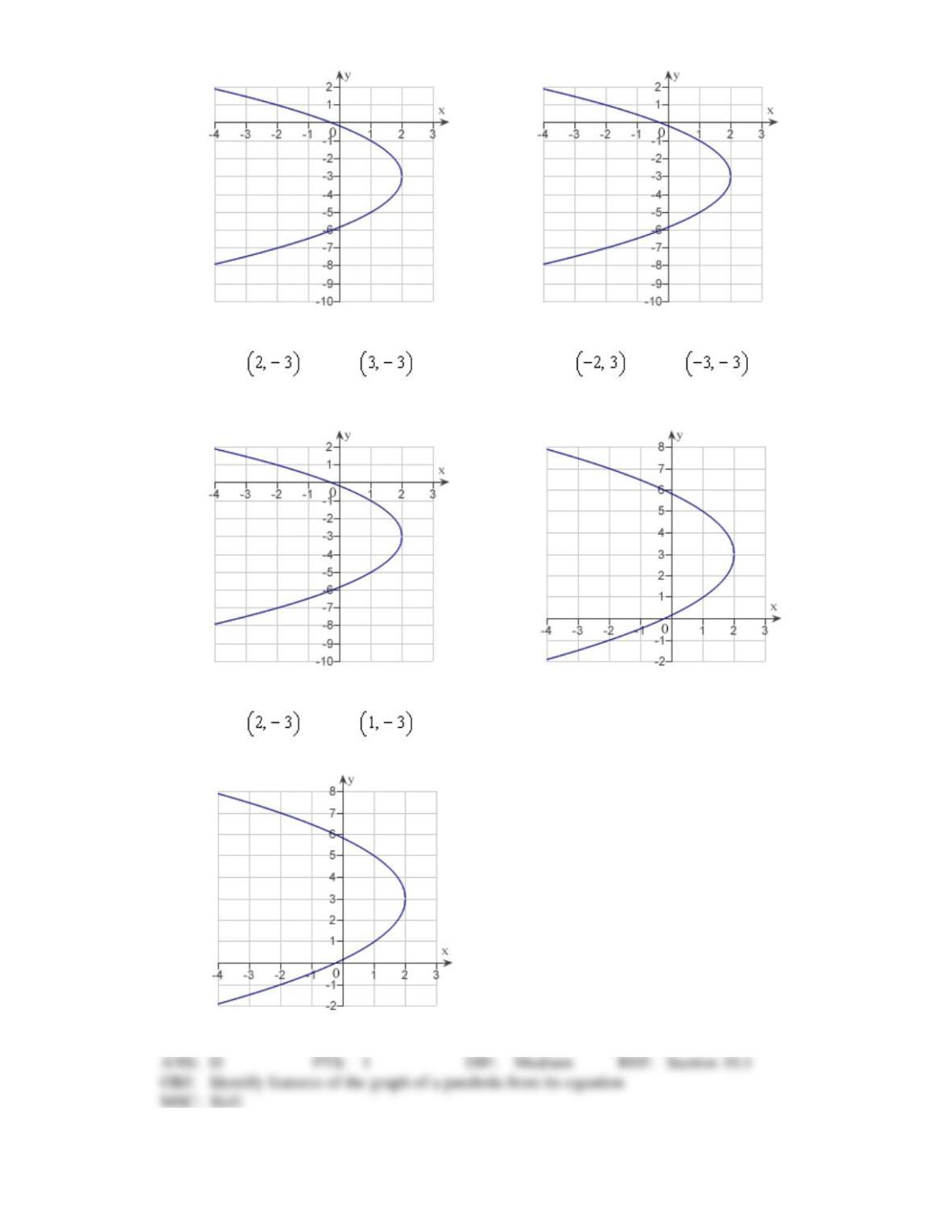
8. Find the vertex, focus, and directrix of the parabola and sketch its graph.
a.
vertex: ; focus: ;
directrix x = –1
d.
vertex: ; focus: ; directrix
x = 3
b.
vertex: ; focus: ; directrix
x = 1
e.
vertex: ; focus: ;
directrix x = –1
c.
vertex: ; focus: ; directrix
x = 3
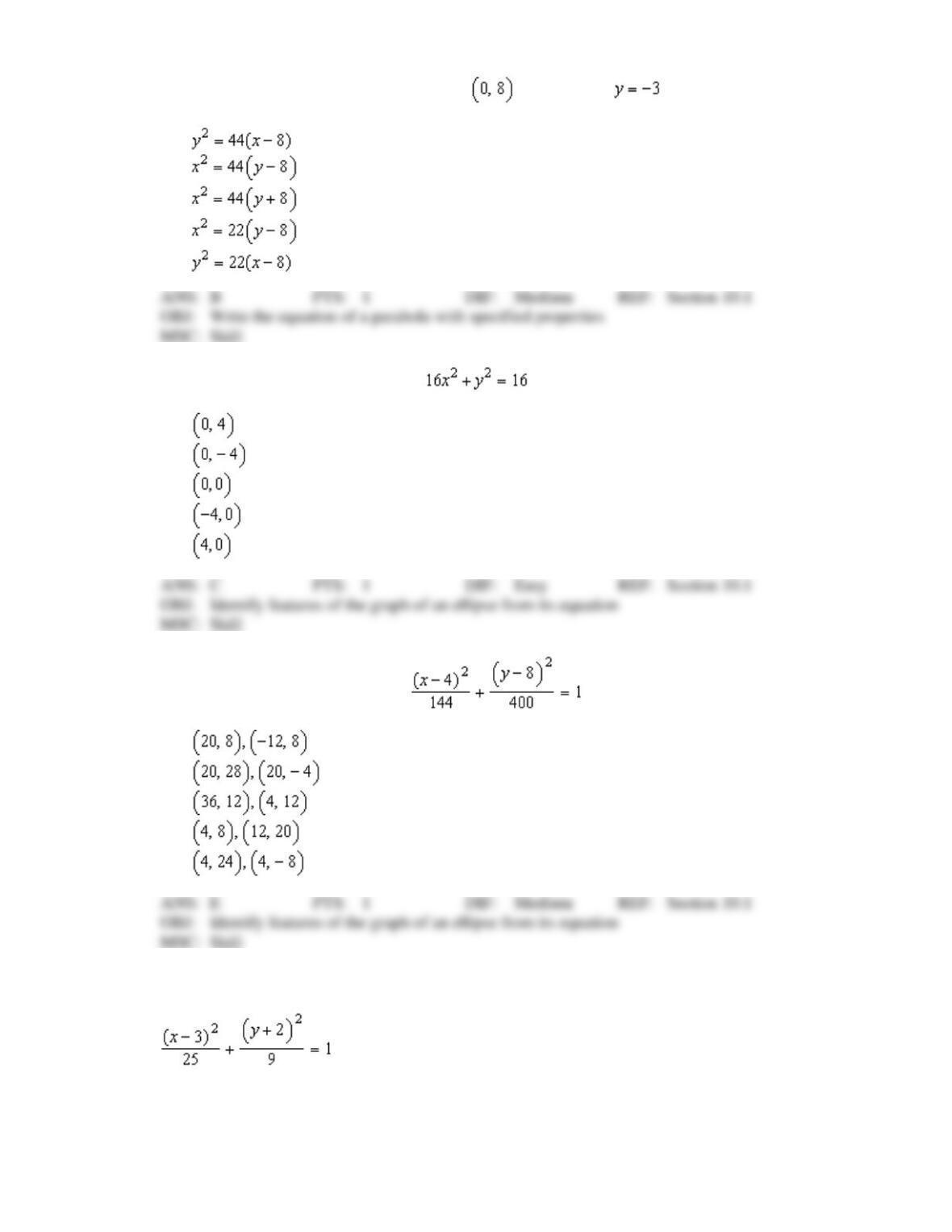
9. Find an equation of the parabola with vertex and directrix .
a.
b.
c.
d.
e.
10. Find the center of the ellipse given by .
a.
b.
c.
d.
e.
11. Find the foci of the ellipse given by .
a.
b.
c.
d.
e.
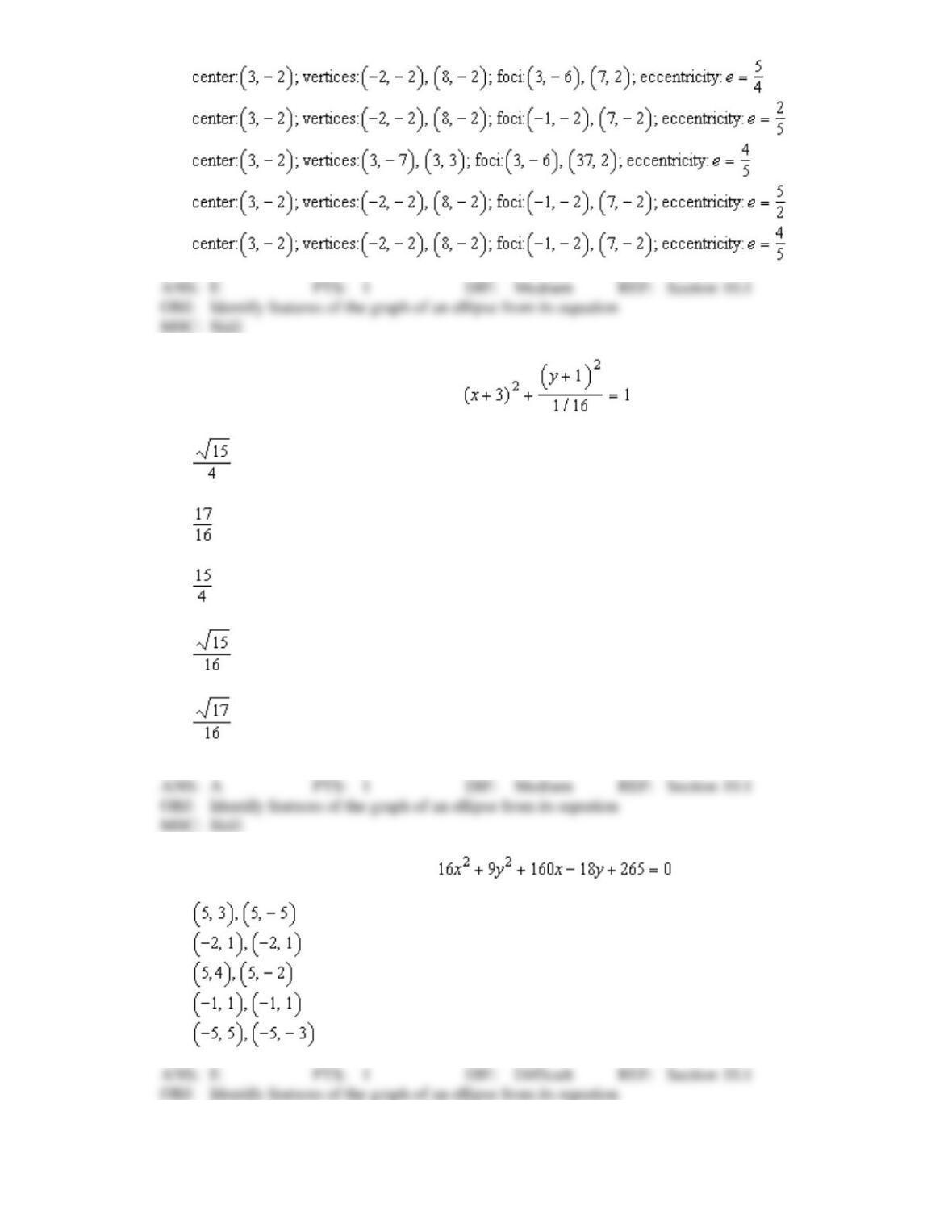
12. Find the center, foci, vertices, and eccentricity of the ellipse.
a.
b.
c.
d.
e.
13. Find the eccentricity of the ellipse given by .
a.
b.
c.
d.
e.
14. Find the vertices of the ellipse given by .
a.
b.
c.
d.
e.
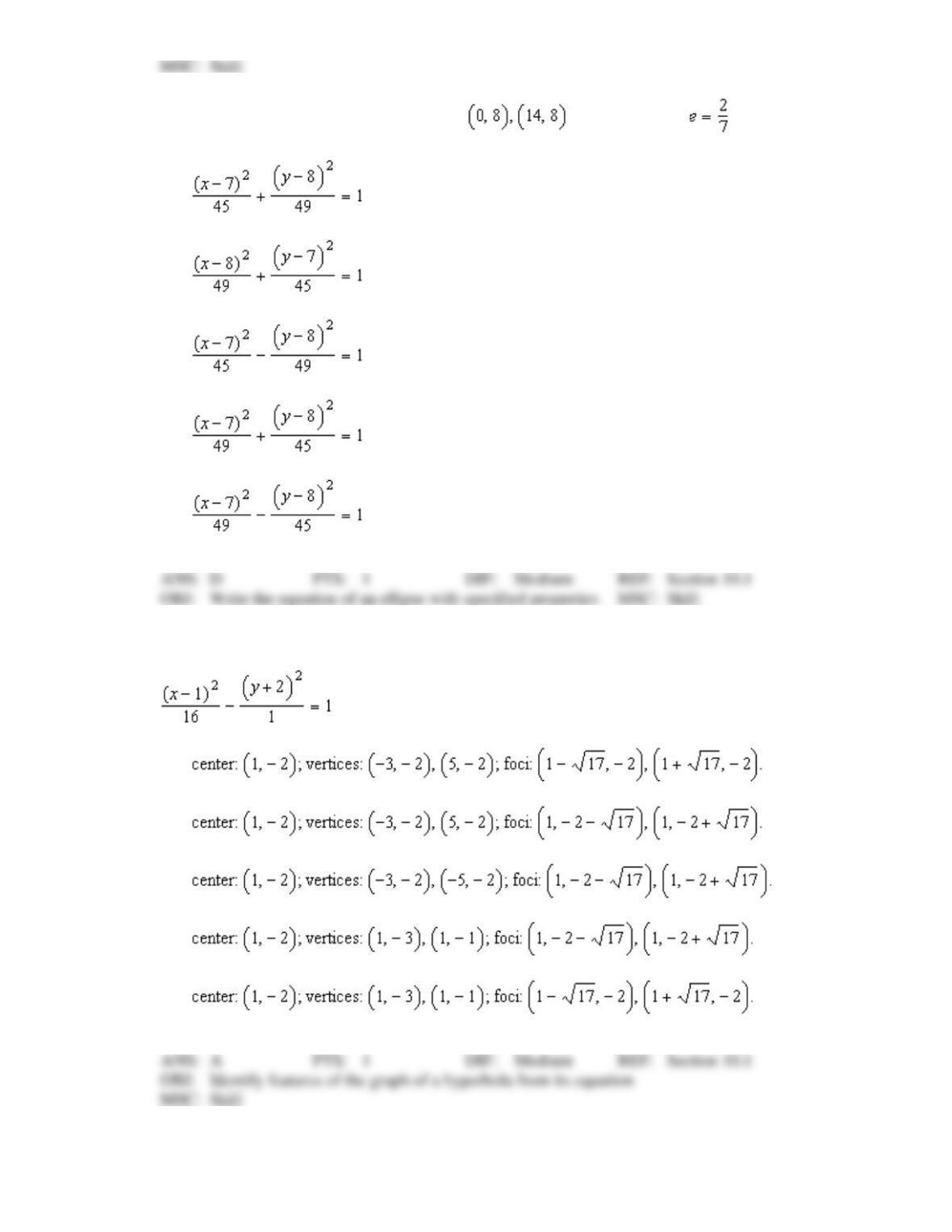
15. Find an equation of the ellipse with vertices and eccentricity .
a.
b.
c.
d.
e.
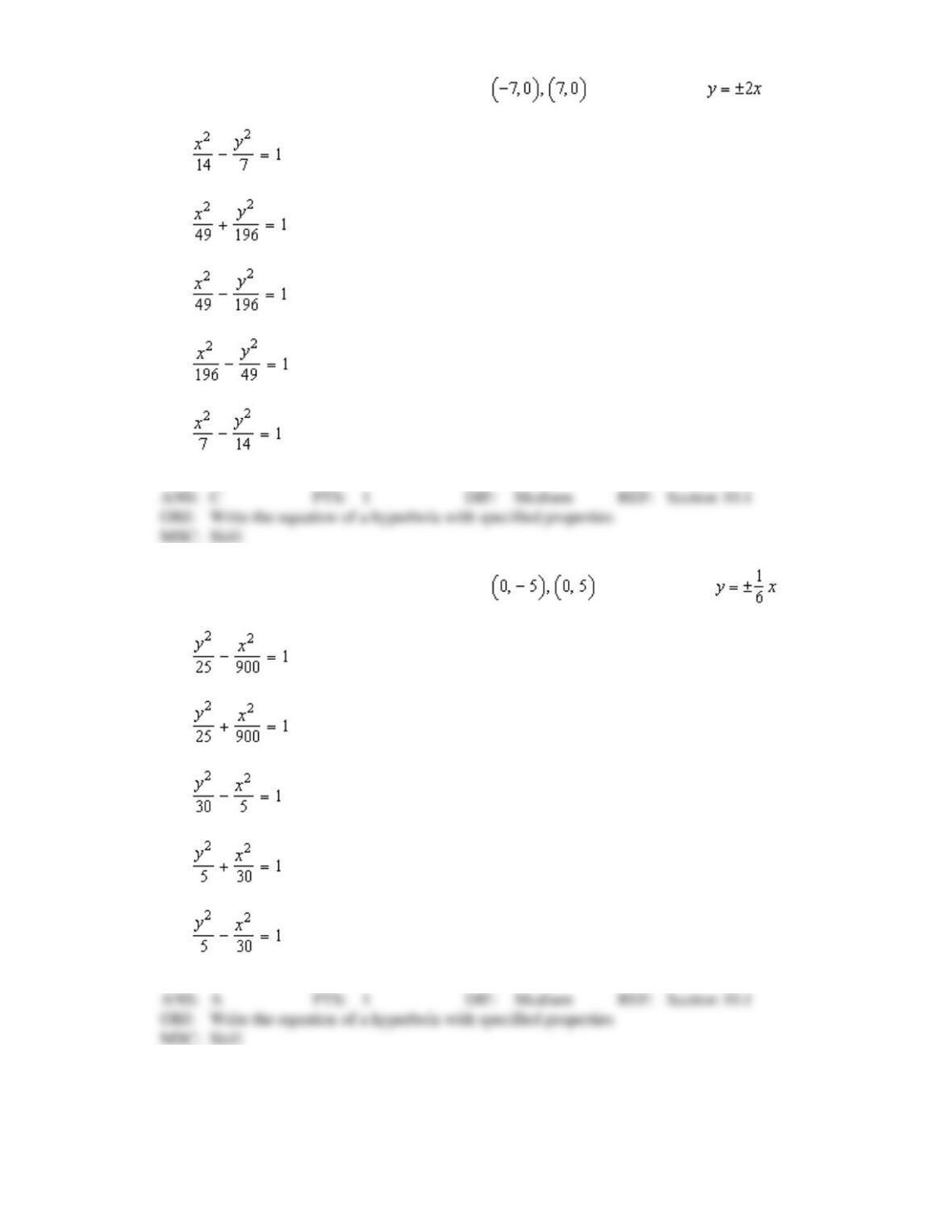
16. Find the center, foci, and vertices of the hyperbola.
a.
b.
c.
d.
e.
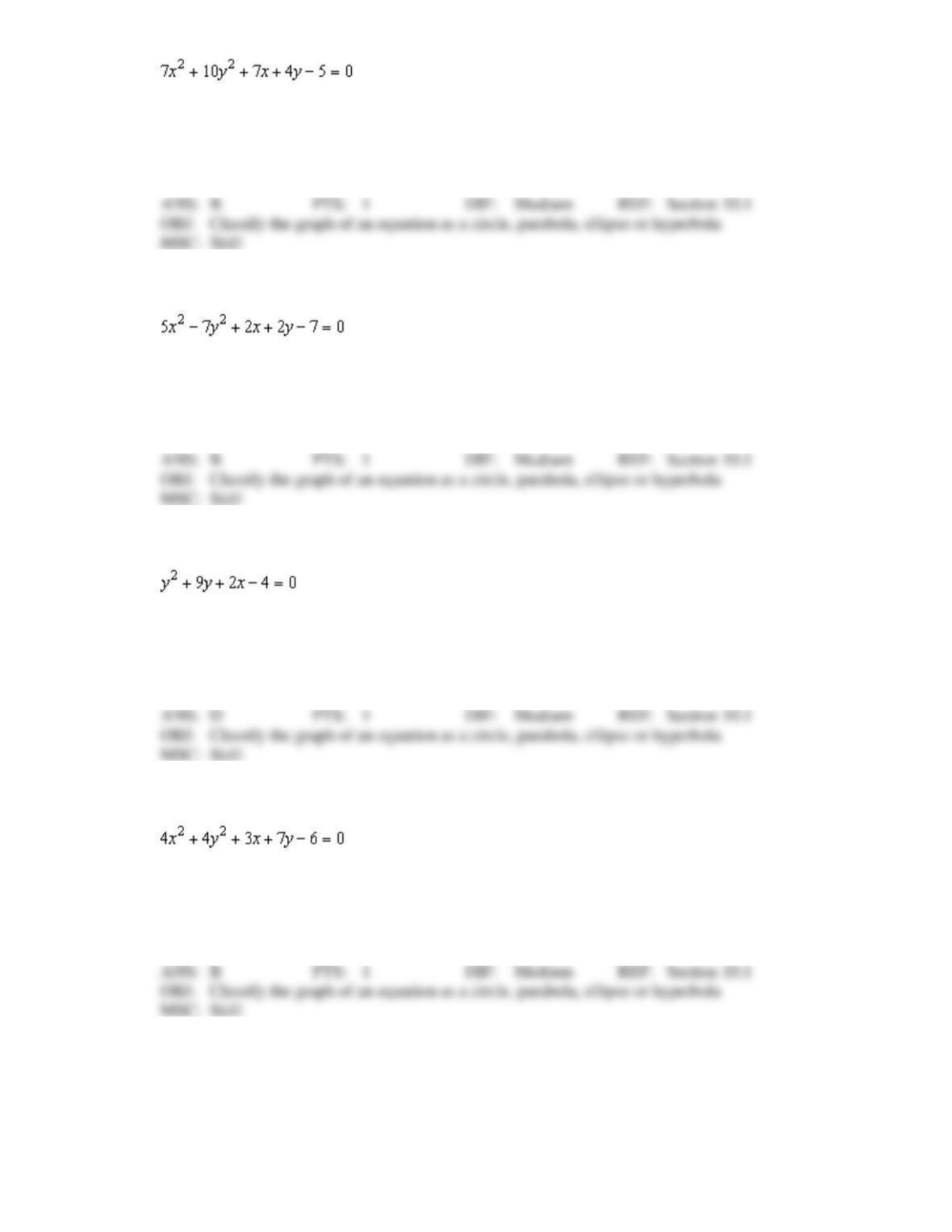
17. Find an equation of the hyperbola with vertices and asymptotes .
a.
b.
c.
d.
e.
18. Find an equation of the hyperbola with vertices and asymptotes .
a.
b.
c.
d.
e.
19. Classify the graph of the equation as a circle, a parabola, an ellipse, or a hyperbola.
a.
parabola
b.
ellipse
c.
circle
d.
hyperbola
20. Classify the graph of the equation as a circle, a parabola, an ellipse, or a hyperbola.
a.
circle
b.
hyperbola
c.
ellipse
d.
parabola
21. Classify the graph of the equation as a circle, a parabola, an ellipse, or a hyperbola.
a.
hyperbola
b.
circle
c.
ellipse
d.
parabola
22. Classify the graph of the equation as a circle, a parabola, an ellipse, or a hyperbola.
a.
parabola
b.
circle
c.
ellipse
d.
hyperbola
23. Uranus moves in an elliptical orbit with the sun at one of the foci. The length of the half of the major
axis is 2,876,769,540 kilometers, and the eccentricity is 0.0444. Find the minimum distance
(perihelion) of Uranus from the sun. Round your answer to nearest kilometer.
a.
3,004,498,108 km
b.
2,749,040,972 km
c.
2,819,234,149 km
d.
127,728,568 km
e.
2,934,304,931 km
24. Earth moves in an elliptical orbit with the sun at one of the foci. The length of the half of the major
axis is 149,598,000 kilometers, and the eccentricity is 0.0167. Find the maximum distance (aphelion)
of Earth from the sun. Round your answer to nearest kilometer.
a.
146,606,040 km
b.
2,498,287 km
c.
152,589,960 km
d.
152,096,287 km
e.
147,099,713 km