Chapter 10
Chapter Focus
Chapter 10 presents common assessment measures of cognitive ability and adaptive behavior.
Classroom teachers may be asked to conduct adaptive behavior assessments, and they should
also understand intelligence tests and how and why they are used.
Check Your Understanding
Activity 10.1 NOTE: Many of the terms used in Activity 10.1 are not discussed in the chapter.
1. Case involving administering tests in a language other than the child’s native language.
2. Case concerning students who were placed in a school for students with emotional
disturbance without the benefit of nondiscriminatory assessment.
3. Standardized norm-referenced assessment of cognitive abilities; the indirect measurement
of the construct of intelligence.
4. When, as the result of discriminatory assessment, minority students are placed in dead–
end educational or vocational tracts.
5. When a test measures different constructs for people of different groups.
6. A test may accurately predict for one group of students but not as accurately for another
group, which results in this.
7. A numerical representation of intellectual ability.
8. When the examiner does not possess skill in communicating in the student’s native
language, it may result in this.
9. Case finding that the use of IQ tests to place black students in classes for persons with
mental retardation was a discriminatory practice.
10. Case finding the same IQ tests to be nondiscriminatory even though a few items were
found to be biased.
Apply Your Knowledge
Summarize how court cases have influenced the use of intelligence tests.
Activity 10.2
1. This instrument has four index scores that measure perceptual reasoning, verbal
comprehension, working memory, and processing speed.
2. This Wechsler test is designed to be used through adulthood.
3. This subtest presents math story problems, and performance can be influenced by
attention span and concentration or working memory.
4. On this subtest, the examiner asks the student how two things are alike.
5. This index score represents the student’s ability to attend and process information in
completing tasks.
6. On this subtest, the examiner provides clues that the student uses to respond with a
specific word.
7. The subtests on this index represent the student’s ability to quickly respond on fine-motor
tasks.
8. This instrument includes subtests that assess tasks believed to measure one’s
simultaneous and successive processing ability on cognitive tasks.
9. This subtest assesses an individual’s perceptual reasoning without requiring the use of
fine-motor skills.
10. Performance on this verbal comprehension subtest can be influenced by the student’s
conscience or moral sense.
11. This subtest is divided into two parts, forward and backward, and measures auditory
short-term memory and freedom from distractibility.
12. This IQ score reflects the performance of the student on all four indices.
13. This Wechsler test was designed to be used with children from the ages of 2 years and 6
months to 7 years and 3 months.
14. Which of the cognitive assessment instruments can be administered to school age
students ages 6–16?
Apply Your Knowledge
Which of the subtests described for the Wechsler scales can be influenced by weakness in the
visual-motor areas?
Activity 10.3
1. This term means that a student processes information one bit at a time, with each new
piece of information linked to the previous bit of information
2. What two broad cognitive abilities are included in the CHC theory of intelligence?
3. Which index might be particularly useful when assessing a student whose primary
language is Spanish?
4. For very young students, what types of scores are available?
Apply Your Knowledge
What type of information is represented on a test that assesses crystallized intelligence?
Activity 10-4
1. What areas appear to represent strengths in cognitive processing?
2. What areas represent the areas of concern?
3. What areas would be of concern to you as a teacher planning instruction?
4. Look at the domain scores. In what way is this student best able to process math?
Apply Your Knowledge
What recommendations would you make to this student’s parents about assignments that need to
be completed at home?
Answer: It may be best to present information in a visual, nonverbal format. They will
Activity 10-5
1. ___ has a strong theoretical base that includes different ways to interpret the test based on
those theories.
2. ___ is the Wechsler scale that assesses adults.
3. The ___includes both verbal and nonverbal domains.
4. This test includes an attentional domain.
Apply Your Knowledge
When would a school psychologist give more than one measure of cognitive evaluation for an
initial evaluation?
Activity 10-6
1. Adaptive behavior is the ability to ___.
2. Assessments of adaptive behavior may be used to ___.
3. According to Reschly (1982), what are the four concepts of the assessment of adaptive
behavior?
Apply Your Knowledge
What research findings about adaptive behavior were summarized by Harrison (1987)?
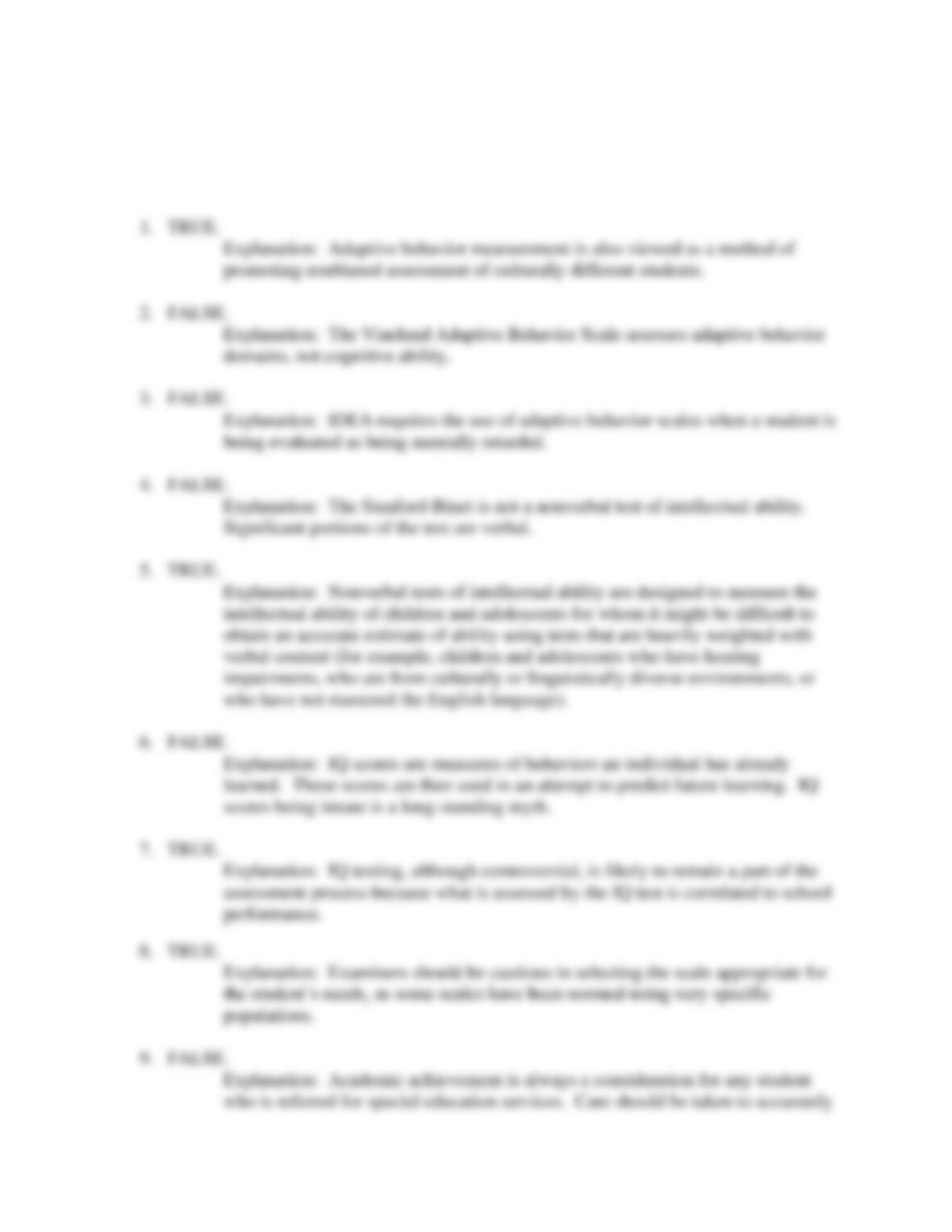
Think Ahead Exercises
NOTE: Some of the terms used in this exercise are not used within the chapter.
1. Because many of the instruments used to assess intelligence and achievement include
numerous items of a verbal nature, the assessment of students whose primary language is
not English should be given a(n) ___ measure in addition to other measures.
2. IDEA includes statements of determining eligibility that require the team to exclude ___
as the primary reason for a disability before determining a student eligible for special
education services.
3. Minority students who may appear to be within the range of mental retardation on
measures developed for use with students from the majority culture may not be within the
range of mental retardation on ___ measures.
4. Students who have a dominant language other than English are often referred to as being
bilingual, and students whose primary language is English and nonstandard English are
referred to as ___.
5. Bilingual students may have difficulty with both the language items on standardized
assessments and the level of ___ required to perform well on the items.
6. Once the standardized assessment has been completed, an examiner may use the method
of __, incorporating teaching, to determine the student’s potential to learn failed items.
7. The measure of ___ is actually a ratio comparing a student’s mental age and
chronological age.
Chapter 10 Test Bank
True and False
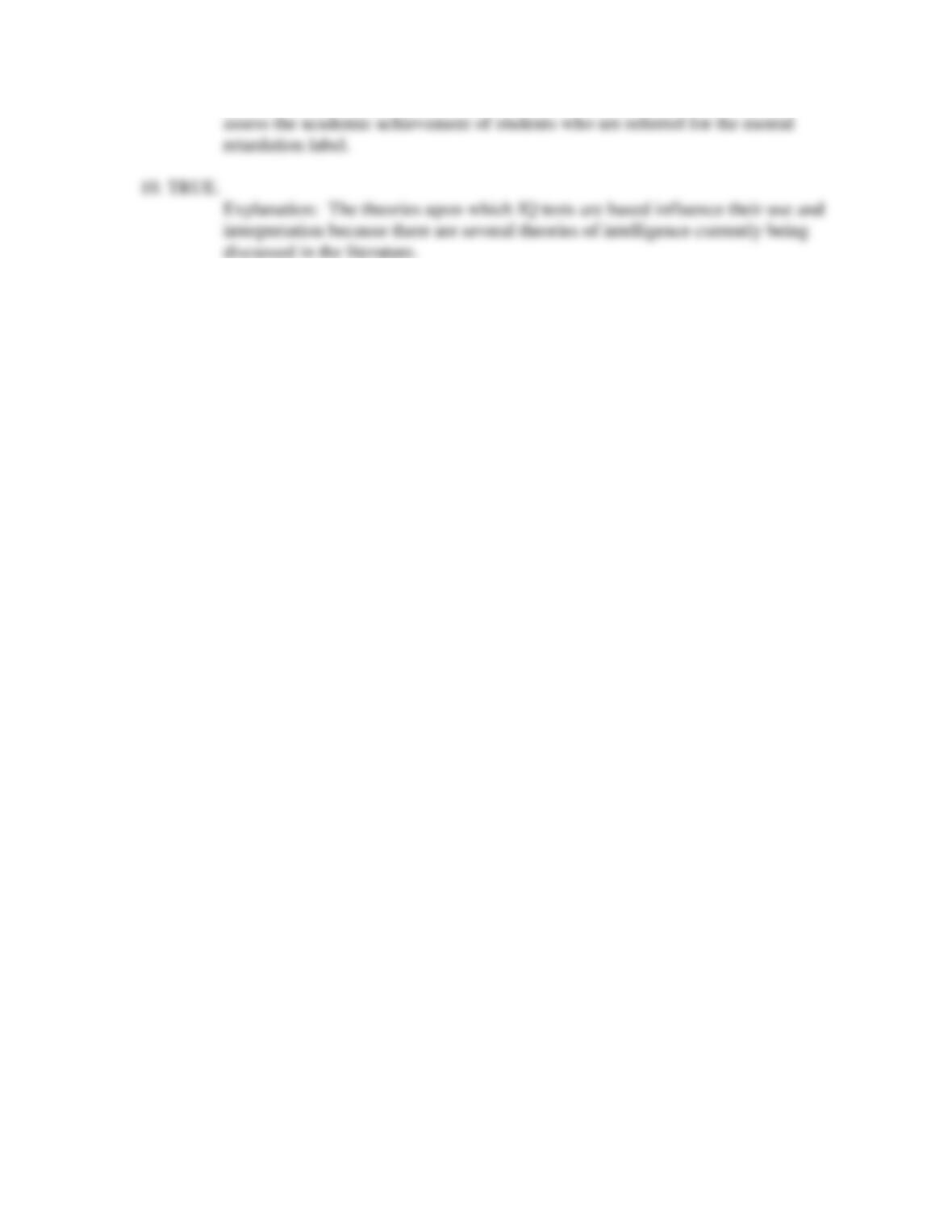
1. When assessing students from culturally different backgrounds, the use of adaptive
behavior scores is one possible method of reducing bias.
2. The Vineland Adaptive Behavior Scale measures overall cognitive ability.
3. IDEA requires that adaptive behavior be assessed when evaluating students to determine
the presence of learning disabilities.
4. The Stanford-Binet is a nonverbal measure of intellectual ability.
5. When assessing students who have linguistic differences, a fair assessment of cognitive
abilities may include administering a nonverbal measure.
6. IQ scores are measurements of potential that is innate in a person.
7. Although IQ testing is controversial, it remains a valid indicator of student performance
in academic tasks.
8. Care should be taken when choosing an adaptive behavior scale, as some scales may have
norms that better represent the demographics of the student currently being assessed.
9. In planning the educational program for a student with mental retardation, educational
achievement tests are not needed as long as the intelligence and adaptive behavior have
been assessed.
10. The theories upon which IQ tests are based influence their use and interpretation.
Multiple Choice
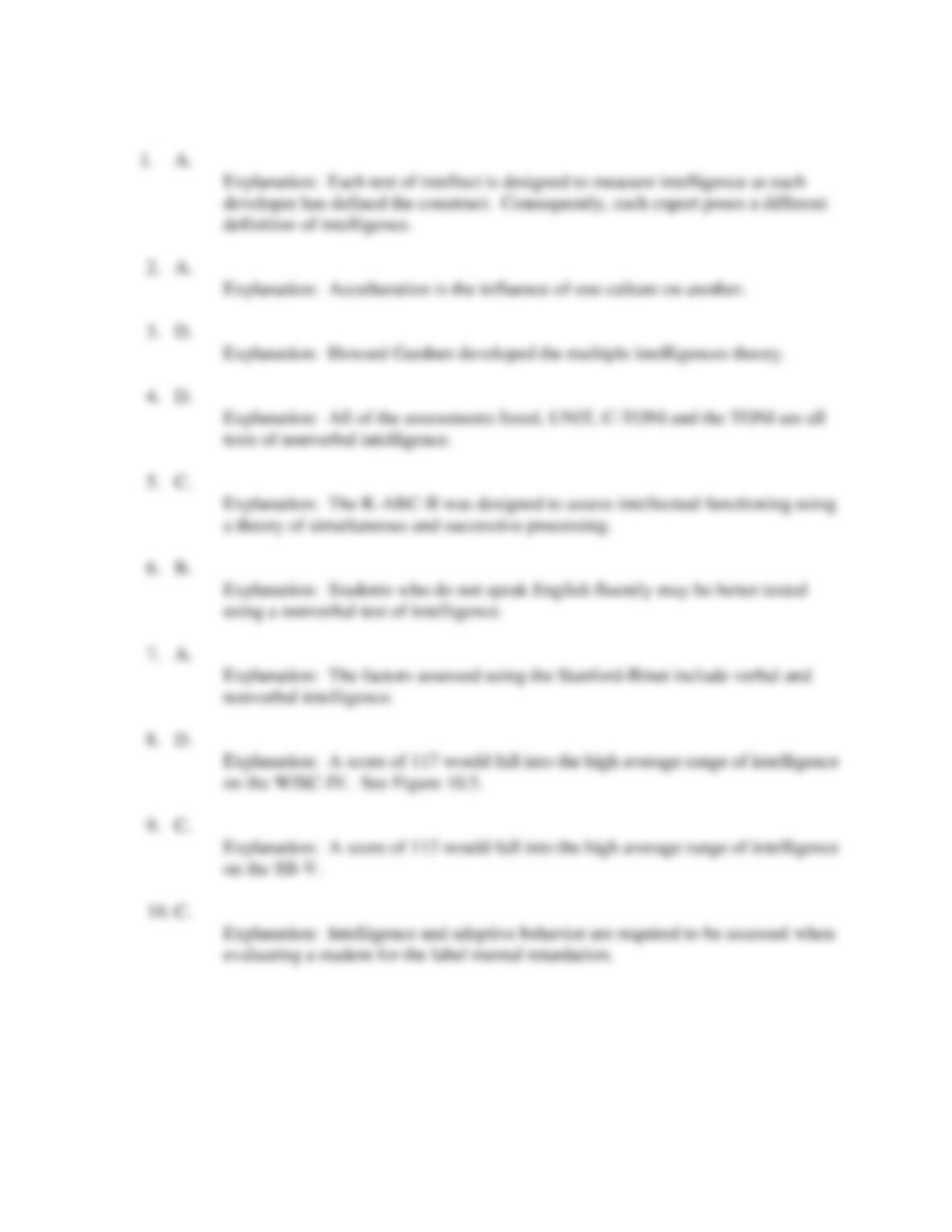
1. Which of the following statements is true?
A. Experts in the field of intellectual assessment have different definitions of
intelligence.
B. Experts in the field of intellectual assessment believe that intelligence is the
most important factor in assessment.
C. Experts in the field of intellectual assessment have targeted specific tests that
have completely eliminated bias.
D. Experts in the field of intellectual assessment do not think intellectual
assessment is predictive of anything of significance.
2. The influence of one culture on another culture is known as which of the following?
A. Acculturation
B. Environmental influence
C. Adaptive behavior
D. Innate potential
3. Which of the following individuals developed the theory of multiple intelligences?
A. B.F. Skinner
B. Sigmund Freud
C. David Wechsler
D. Howard Gardner
4. Which of the following batteries was designed to assess nonverbal intelligence?
A. UNIT
B. C-TONI
C. TONI
D. All of the above
5. Which of the following instruments is designed to assess intellectual functioning using a
theory of simultaneous and successive processing?
A. Stanford-Binet IV
B. WISC-IV
C. K-ABC-II
D. TONI-III
6. Which of the following types of intellectual assessment instruments are more commonly
used with children who are bilingual?
A. Tests with heavily weighted English verbal components
B. Nonverbal instruments
C. English verbal instrument
D. All of the above
7. On the Stanford-Binet V, the factors assessed include:
A. Verbal and nonverbal
B. Verbal only
C. Nonverbal only
D. None of the above
8. Using the WISC-IV, which of the following ranges would a full-scale score of 117 fall?
A. Average
B. Low average
C. Superior
D. High average
9. On the Stanford-Binet, a student who obtains a score of 112 would fall within which
range? A. Very gifted
B. Gifted or highly advanced
C. High average
D. Superior
10. In making the determination for eligibility under the category of mental retardation, the
following areas must be assessed:
A. Academic achievement and behavior
B. Intelligence and academic achievement
C. Intelligence and adaptive behavior
D. Behavior and intelligence
11. When a child obtains a significantly low score on an IQ test and this is determined to be a
valid estimate of the student’s ability, it usually means:
A. The student will likely have difficulty in school without interventions.
B. This will not have an impact on educational achievement.
C. This child will always require self-contained special education support.
D. The student should probably not be permitted to attend school.
12. Assessing one’s ability to function in various environments requires measuring
A. Achievement
B. Intelligence
C. Adaptive Behavior
D. Cognitive Ability
13. The formula used to calculate IQ is
A. MA + CA x 100
B. CA – MA x 100
C. 100 – CA x MA
D. 100 – MA x CA
14. This type of assessment views the ceiling as an area of functioning that warrants further
investigation.
A. Intelligence testing
B. Achievement testing
C. Adaptive behavior assessment
D. Dynamic assessment
15. Administering subtests from two or more tests to determine if a weakness exists in a
particular skill or ability.
A. Dynamic assessment
B. Adaptive behavior assessment
C. Cross-battery assessment
D. Ecological assessment
16. The mean score and standard deviation for the WISC-IV are
A. 80, 15
B. 90, 10
C. 100, 10
D. 100, 15
17. Which of the following people may fill out an adaptive behavior assessment?
A. Teacher
B. Parent
C. Job coach
D. All of the above.
18. This case resulted in the court’s finding that schools could no longer use standardized but
unvalidated IQ tests for the purpose of identifying and placing black children into
segregated special education classes for children designated as educable mentally
retarded.
A. Larry P. v. Riles
B. PASE v. Hannon
C. Diana v. State Board of Education
D. Lora v. New York City Board of Education
19. In this case, the state board of education of California agreed to test students in their
native language
A. Larry P. v. Riles
B. PASE v. Hannon
C. Diana v. State Board of Education
D. Lora v. New York City Board of Education
20. Adaptive behavior is considered to
A. be multidimensional.
B. have few ethnic group differences.
C. have few race group differences.
D. All of the above.
21. It has been recommended that the K-BIT be used for which of the following purposes?
A. Comprehensive assessment of intellectual functioning
B. Screening of intellectual functioning
C. Adaptive behavior assessment
D. Achievement and vocational assessment
22. The Woodcock-Johnson III Tests of Cognitive Ability includes which of the following?
A. Standard and extended batteries
B. Measures of cognitive ability
C. Measure of academic skills
D. All of the above.
23. The test measures reasoning and memory skills through the nonverbal presentation of the
subtests.
A. UNIT
B. CTONI
C. TONI-3
D. Wechsler Nonverbal Scale of Ability
24. The ABS-S2 assesses these two primary domains.
A. Independent living & Social behavior
B. Community navigation & Independent living
C. Social behavior & Transportation needs
D. Transportation needs & Community navigation
25. The Vineland Adaptive Behavior Scale is a comprehensive evaluation which includes a
A. Maladaptive behavior scale
B. Transportation navigation scale
C. Communication with peers scale
D. Requests assistance scale
Short Answer
1. Guidelines have been provided for the appropriate use of IQ tests. Discuss at least three
of these guidelines.
2. Explain what is meant by the term “adaptive behavior” and provide specific examples.
3. Discuss the possible ways in which IQ testing may be biased.
4. Discuss three considerations that should be addressed when determining which adaptive
behavior scale to use with a student.
5. Several issues regarding IQ testing have been debated in the literature. Discuss at least
three of these issues.
6. Identify the four index clusters measured by the WISC-IV. What subtests are included in
each measure?
7. Litigation has played an important part into how we use intelligence testing to identify
students with special education needs. Choose one court case and discuss its significance
in changing how we use IQ tests.
8. Discuss the concept of cross-battery assessment and why evaluators would participate in
this type of assessment.
9. Why would an evaluator choose to administer a test of nonverbal intelligence?
10. Explain why all intelligence tests do not claim to assess the same constructs.
11. Calculate the IQ score given the following information:
Mental Age = 4
Chronological Age = 10
12. Explain why a psychologist would choose to administer a test of non-verbal intelligence.
Chapter 10 Test Bank Answer Key
True and False
Multiple Choice
Short Answer