Chapter 9: Knowledge Construction in Social Contexts
CHAPTER TEN
MOTIVATION AND LEARNING
What Is Motivation?
* 1. Which of the following is the best definition of motivation?
a. The process involved when people seek to meet their personal needs
b. The process involved when goal-directed activity is instigated and sustained
c. The process involved when people increase their behavior to receive reinforcers and avoid punishers
d. The process involved in which people seek to be all they can be and become self-actualized
* 2. Which of the following is not true of motivated students?
a. They tend to have higher grades.
b. They learn content almost effortlessly.
c. They have more positive attitudes toward school.
d. They persist on difficult tasks.
* 3. Of the following, extrinsic motivation is best described as:
a. motivation to complete a activity that meets a need for safety.
b. motivation to complete a task as the means to an end.
c. motivation to complete a task because it enhances self-efficacy.
d. motivation to complete an activity because it results in a feeling of competence.
* 4. Which of the following is the best description of intrinsic motivation?
a. Motivation to complete a task as a means to an end
b. Motivation to complete a task to meet a need for intellectual achievement
c. Motivation to engage in an activity for its own sake
d. Motivation to complete a task to meet the need for relatedness
* 5. Which of the following is considered to be an activity that is intrinsically motivating?
a. An activity that illustrates performance compared to others
b. An activity that displays high performance
c. An activity that will result in reinforcement
d. An activity that is inherently interesting
* 6. Students engrossed in the unusual results of a lab experiment best illustrate the intrinsically motivating
effects of:
a. curiosity.
b. autonomy.
c. utility value.
d. expectation for success.
* 7. Which of the following task characteristics is not associated with intrinsic motivation?
a. Task challenge
b. Task ease
c. Task novelty
d. Task autonomy
Chapter 9: Knowledge Construction in Social Contexts
** 8. Which of the following statements is most likely to increase learners’ intrinsic motivation?
a. “Well done. You’ve finished all your problems, so you can go back to the reading corner and read
any book you want.”
b. “Well done. I like it when people are willing to participate in a new activity.”
c. “Well done. Everyone has done so well on their seat work, so we won’t have homework tonight.”
d. “Well done. You are getting very good at solving two–step problems.”
* 9. Which of the following statements most accurately describes the relationship between intrinsic and
extrinsic motivation?
a. People high in intrinsic motivation are generally low in extrinsic motivation.
b. People who are low in intrinsic motivation are generally high in extrinsic motivation.
c. People who are high in intrinsic motivation are also generally high in extrinsic motivation.
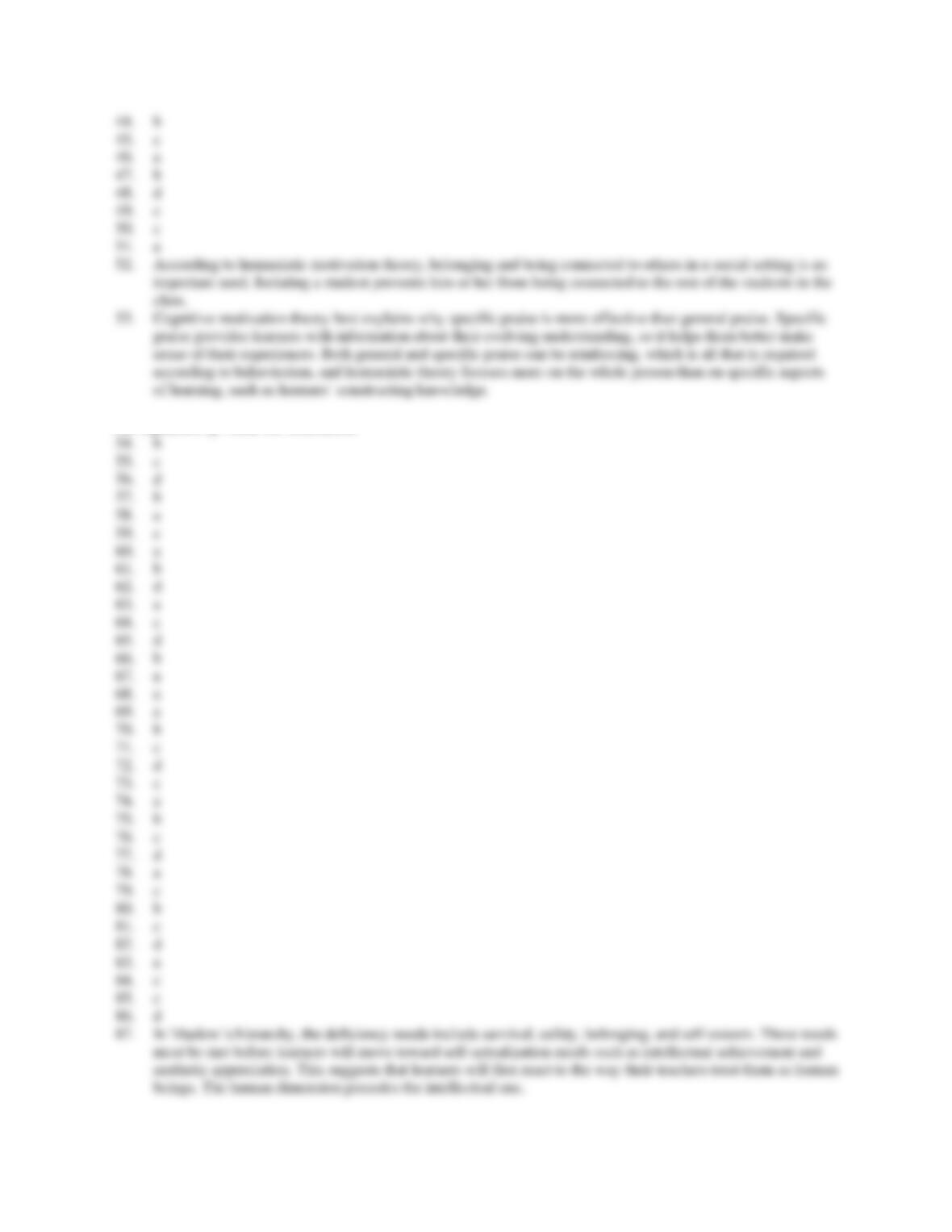
d. People can be high in one and low in the other, high in both, or low in both.
** 10. David Moore tries to start each of his lessons with a demonstration, such as dropping two objects of
unequal weight and seeing them fall with the same rate of acceleration. Which of the following best
describes Mr. Moore’s attempts?
a. He is trying to capitalize on learners’ extrinsic needs to feel competent.
b. He is trying to capitalize on learners’ intrinsic needs for intellectual achievement.
c. He is trying to capitalize on the intrinsically motivating effects of curiosity.
d. He is trying to capitalize on learners’ intrinsic needs for control and self-determination.
** 11. Sengi Fumalaro begins the study of inertia in his physical science class by swinging a cup of water attached
to a string around his head and asks–as the cup of water is swinging–why the water does not fly out of the
cup. Sengi is trying to capitalize primarily on which of the following?
a. The motivational effects of students’ beliefs about ability
b. The intrinsically motivating effects of curiosity
c. The intrinsically motivating effects of a safe and orderly learning environment
d. The intrinsically motivating effects of students’ needs for intellectual achievement
** 12. Which of the following is the best illustration of intrinsic motivation?
a. Brad does trigonometry problems, because, “I want to understand stuff, like the way buildings are
built.”
b. Sue studies hard so, “I can maintain my A average in trig.”
c. Janet does her homework faithfully, because, “I need a scholarship to be able to go to college.”
d. Rick works hard in trig, because, “Mrs. Stevens told me I have a lot of potential in math if I am
willing to work.”
* 13. Which of the following best describes the concept motivation to learn?
a. The tendency to find topics intrinsically interesting and engaging
b. The tendency to find topics meaningful and worthwhile
c. The tendency to increase efforts to learn as a result of positive reinforcement
d. The tendency to engage in an activity because equilibrium has been disrupted
* 14. Of the following, the person most closely associated with the concept of extrinsic motivation is:
a. Piaget.
b. White.
c. Maslow.
d. Skinner.
** 15. Your students are involved in an activity that is intrinsically interesting. You decide to also offer a reward
in an attempt to further enhance students’ interest and motivation. According to research as presented in
your text, which of the following is most likely in the long term?
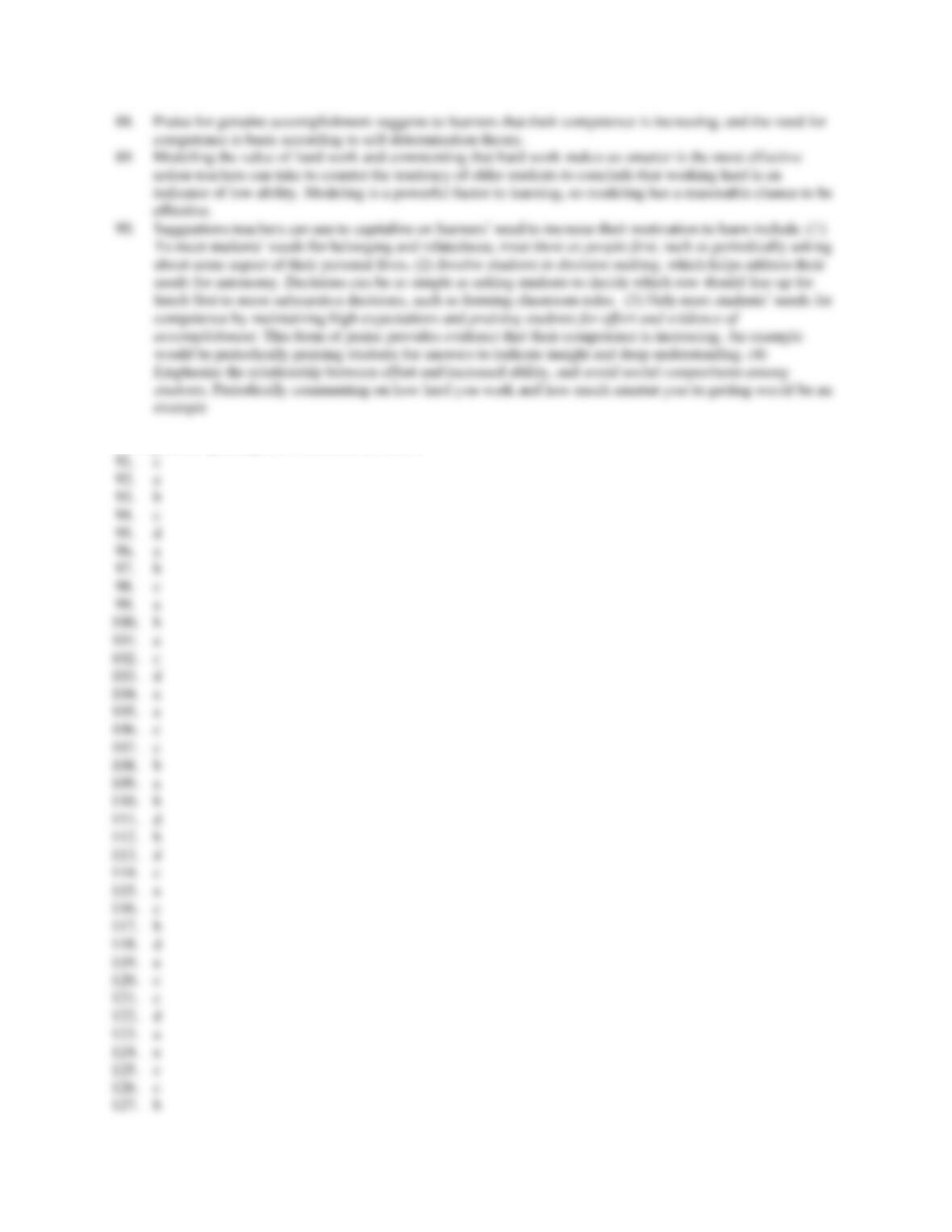
Chapter 9: Knowledge Construction in Social Contexts
a. The offer of a reward will further increase students’ interest and motivation.
b. The offer of a reward will decrease students’ interest and motivation.
c. The offer of a reward is unlikely to affect students’ interest and motivation one way or the other.
d. The offer of a reward will enhance students’ creativity and task orientation.
* 16. Research examining the use of rewards in classrooms suggests that which of the following statements is
most likely to be true?
a. Since using rewards to increase motivation is controversial, they are not commonly used in
classrooms.
b. Offering rewards for participating in intrinsically motivating activities will sustain and increase
motivation for those tasks.
c. Rewards can be effective for encouraging participation in tasks that are not initially intrinsically
interesting.
d. Using rewards to communicate that competence is increasing can decrease motivation because it
sends a low-ability message.
* 17. Of the following, which would be least recommended for the use of rewards in an attempt to motivate
students to learn?
a. Use rewards to increase participation in activities that are not initially intrinsically interesting.
b. Base rewards on participation in a learning activity, not on the quality of work.
c. Use rewards to communicate increasing competence.
d. Avoid using rewards to control students’ behavior.
** 18. Mrs. Jacobson and Mr. Lucas have their students involved in problem-solving activities. They each have a
wide range of problems, and the students can choose those they attempt to solve. In an attempt to motivate
her students, Mrs. Jacobson offers students a reward for each problem solved correctly. Mr. Lucas does
not. If their students’ behavior is consistent with patterns identified by research, which of the following is
most likely?
a. The students in Mrs. Jacobson’s class will select more difficult problems to solve than will the
students in Mr. Lucas’s class.
b. The students in Mr. Lucas’s class will select more difficult problems to solve than will the students
in Mrs. Jacobson’s class.
c. The students in Mrs. Jacobson’s class will initially select easier problems to solve, but as they
practice, they will select increasingly difficult problems.
d. The offer of the reward will have little effect one way or the other on the problems the students in
either class choose.
* 19. Mr. Wright offers his geography class free time if they complete the assignment of identifying the countries
of the world on a colored map, an assignment they enjoy. If his students’ behaviors are consistent with
patterns identified by research, the effect of offering them free time for completing the assignment will
result in:
a. students’ general motivation to learn decreasing.
b. students’ general motivation to learn increasing.
c. students being less likely to work with maps during free time.
d. students being more likely to work with maps during free time.
* 20. According to your text, of the following which is not a reward typically given in elementary school
classrooms?
a. Consumable items
b. Teacher praise
c. Trophies
Chapter 9: Knowledge Construction in Social Contexts
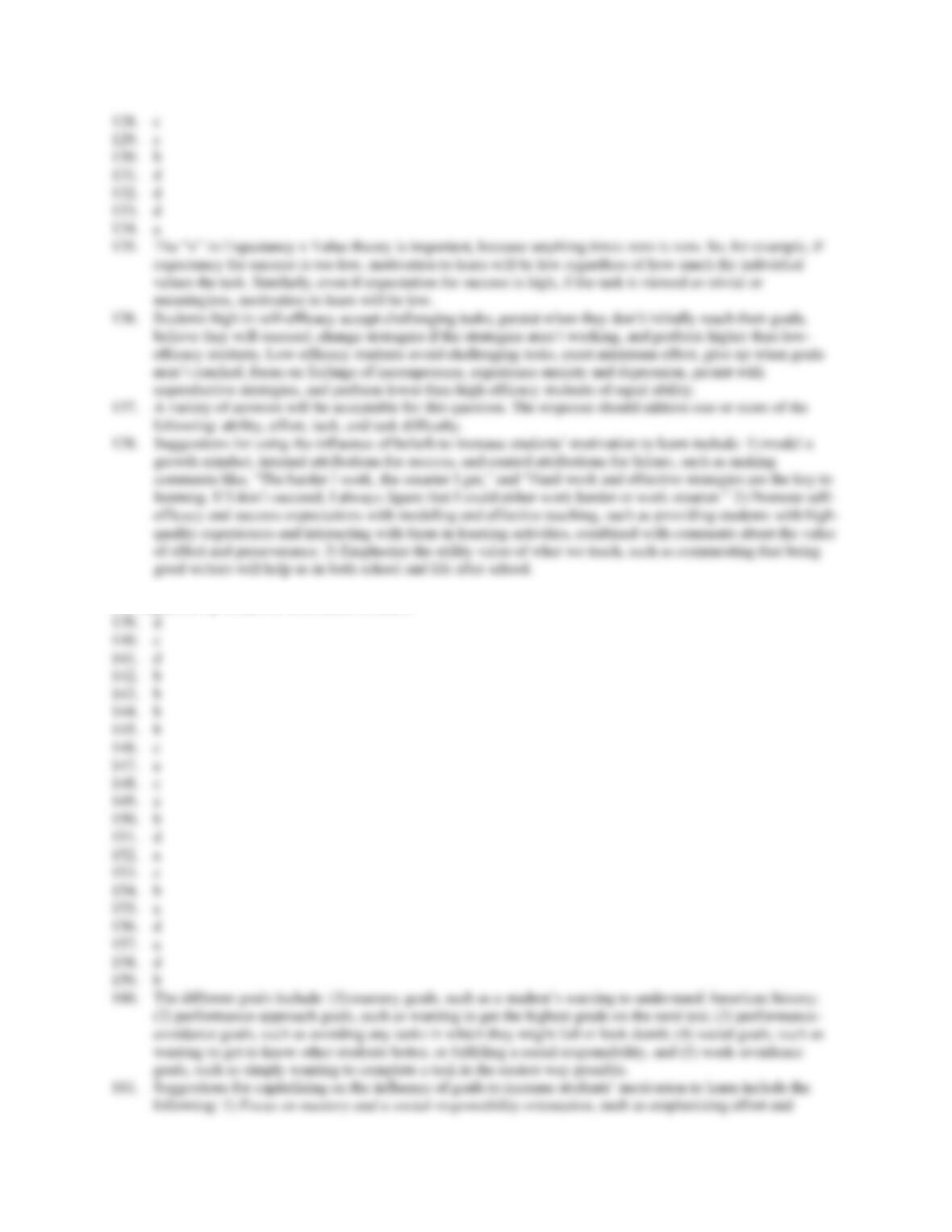
d. Entertainment
* 21. According to your text, which of the following is not a reward typically given in middle and secondary
school classrooms?
a. Teacher comments on papers
b. Free time to talk to classmates
c. High test scores or good grades
d. Public displays of reward or praise
* 22. Cognitive and social cognitive views of motivation focus on each of the following except:
a. learners’ beliefs.
b. learners’ need to understand.
c. learners’ expectations for success.
d. learners’ needs for positive regard.
*` 23. Of the following, the person most associated with cognitive views of motivation that stress students’ need
to understand is:
a. Skinner.
b. Maslow.
c. Piaget.
d. Combs.
* 24. Of the following, beliefs and expectations most closely relate to:
a. behaviorist views of motivation.
b. humanistic views of motivation.
c. psychoanalytic views of motivation.
d. cognitive and social cognitive views of motivation.
** 25. John is engrossed in taking apart and putting together his block train. Which theorist would be most likely
to say John has a need for order, predictability, and an understanding of the way the world works?
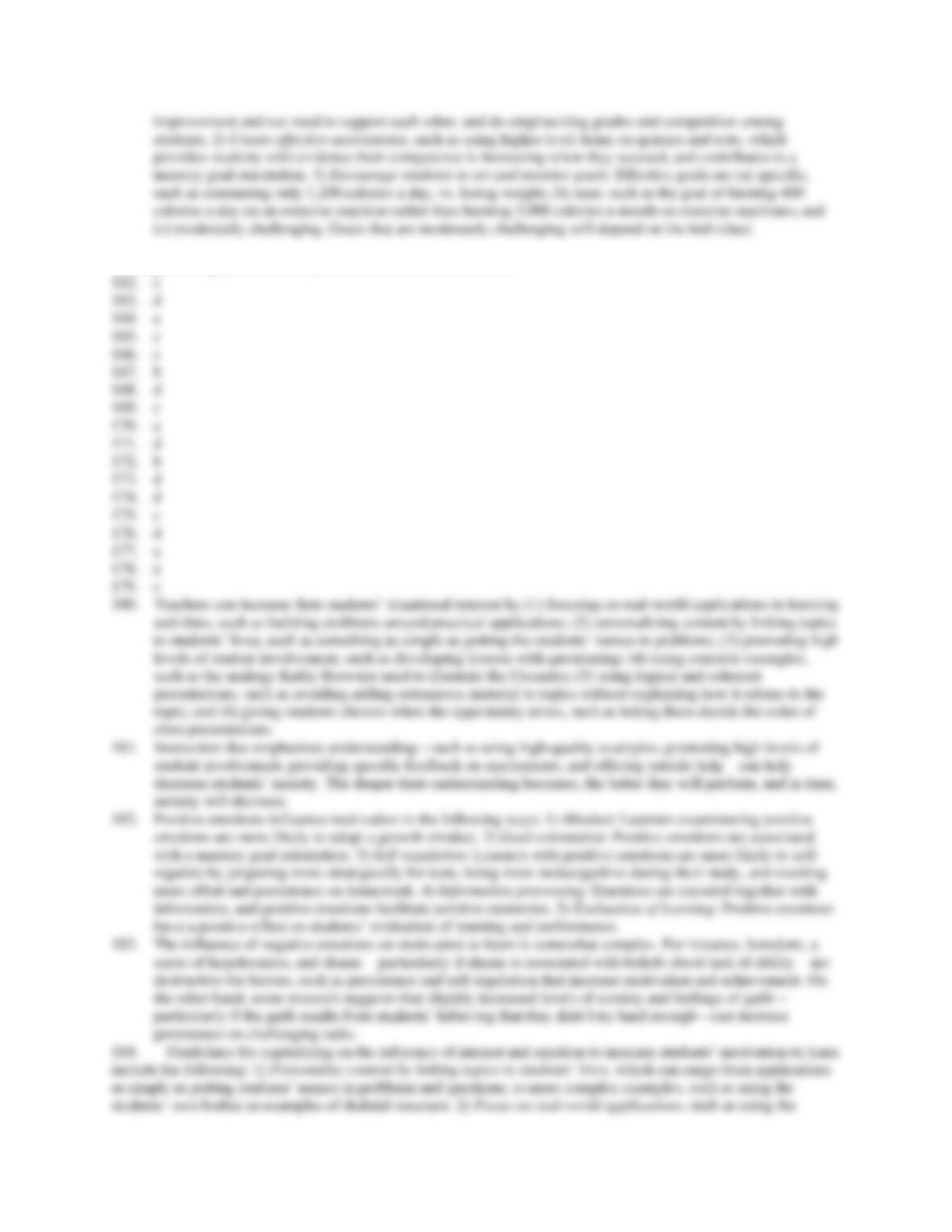
a. Piaget
b. Skinner
c. Freud
d. Bronfenbrenner
** 26. “Aha! I’ve figured out what I need to do to get the computer to run this program. I’ll be right with you. I
want to go back in the lab and see if it will work on my assignment.” The theory of motivation that best
explains why a student would make such a statement is:
a. behaviorist.
b. cognitive.
c. humanistic.
d. sociocultural.
* 27. Which theoretical view of motivation suggests that individuals in communities of learners are more
motivated than they would be in a classroom environment that is competitive or provides less support?
a. Behaviorist
b. Cognitive
c. Sociocultural
d. Humanistic
* 28. Which of the following descriptions is most consistent with a sociocultural view of motivation?
a. Students are motivated by the need to receive rewards and avoid punishers.
b. A positive learning environment provides motivational scaffolding that encourages learners to
engage in activities that they would not do on their own.
c. Students have an innate need to become competent, and they will be motivated to engage in
activities that allow them to develop their competence.
Chapter 9: Knowledge Construction in Social Contexts
d. People have an innate need for unconditional positive regard, and their motivation increases when
they are treated with courtesy and respect.
* 29. Which of the following people would be most likely to say that we are motivated by a need for personal
growth and development?
a. Skinner
b. Maslow
c. Piaget
d. White
* 30. Of the following, the concept most closely related to the foundation of humanistic views of motivation is:
a. the self.
b. reinforcement.
c. competence.
d. self-efficacy.
* 31. According to humanistic views of motivation and management, one suggestion for application of
humanistic views of motivation for classrooms is for teachers to handle their problem students by:
a. first building a personal relationship with them.
b. warning them before punishing any infractions of rules.
c. establishing rules for the class at the beginning of the school year.
d. trying to understand their need for achievement.
** 32. In an effort to help students feel a sense of control and autonomy, their teacher asked them whether they
would prefer taking their short quiz at the beginning or end of the class period. What general view of
motivation would most advocate this procedure?
a. Behavioral
b. Cognitive
c. Humanistic
d. Sociocultural
** 33. James is misbehaving in Norma Washington’s class. After the third incident, Norma removes James from
the group and puts him in a time-out area. The next day Norma greets James warmly and treats him as if his
past behavior was irrelevant. If Norma was using humanistic views of motivation to guide her decision,
which of the following statements best describes her efforts?
a. Norma was trying to communicate unconditional positive regard for James.
b. Norma was attempting to negatively reinforce James for desirable behaviors.
c. Norma was trying to increase James’ sense of self-worth.
d. Norma was trying to reduce James’ anxiety about being back with the group.
For items 34–51, mark “a” if the statement or quote most closely relates to humanistic views of motivation, mark
“b” if it most closely relates to behaviorism, mark “c” if it most closely relates to cognitive or social cognitive views
of motivation, and mark “d” if it most closely relates to sociocultural views of motivation.
** 34. “I often make statements like ‘I’m going to make you think on this one,’ and then I try to help them get it.”
** 35. Challenge is one of the key characteristics of motivating activities, because learners view challenging
activities as worthwhile.
** 36. “Joe is the class clown. He acts this way to get the attention of his buddies.”
** 37. “I always get A’s on my writing assignments because I’m a good writer, and I work hard on my
assignments.”
** 38. “I try to promote the idea that ‘We’re all in this together,’ with my students. We’re all here to help each
other learn.”
Chapter 9: Knowledge Construction in Social Contexts
** 39. “You need to try something other than grades to motivate these kids. Try giving them free time or a pizza
party if they turn in their work.”
** 40. “Our understanding of motivation will never be complete if we don’t take kids’ feelings into account when
we plan and teach.”
** 41. “Call on all the kids, so they’ll feel like they’re a part of a classroom learning community.”
** 42. “When they give you a right answer, genuinely praise them. You want to try to get them to feel good about
themselves.”
** 43. “I try to convince them that they can do it if they try hard enough, so the first thing I work at is getting them
to try. Then I try to convince them that their effort will pay off on problems they view as useful outside of
the class.”
** 44. “I have a chart on the wall with all the kids’ names on it. Whenever they turn in their homework, no matter
how inaccurate it may be, they get to put a red star by their name. If they do it and they get 7 or more out
of 10 right, they get to put a blue star by their name.”
** 45. “I always try to start a lesson with something unexpected. It keeps the kids interested.”
** 46. “We’d like you to work with Mr. Z. The kids think he hates them, and consequently they don’t like him, so
they won’t do their work.”
** 47. “I try to give my kids’ tests back to them the next day. Immediate feedback rewards the ones who did
well.”
** 48. “I try to do an appropriate amount of group work. Kids will sometimes do more work in groups than by
themselves, because the other kids push them along.”
** 49. “Kids need to succeed on activities that are important to them. If they can’t do the work or if they don’t
think the activity is worthwhile, they won’t try.”
** 50. “I always try to tell the kids why we’re studying the particular topic we’re on. Even if they don’t quite
agree, I think they try harder when I tell them why. ”
** 51. “Children come to school for more than just academics. Some of these kids come here to be part of a
home, a community. Part of our job as teachers is to make it a safe place to be.”
Essay Items
** 52. “Timeout,” or the removal of a student from the body of the class, has been demonstrated as an effective
deterrent for inappropriate behavior. Explain why “timeout” works on the basis of humanistic theories of
motivation.
** 53. Research indicates that specific praise (praise that not only tells the learner that the answer was
commendable, but also identifies what about the answer made it commendable) is superior to general praise
(praise that merely notes that the answer was commendable). Which view of motivation—behaviorist,
cognitive, or humanistic—would best explain why specific praise is preferable to general praise? Explain
why.
The Influence of Needs on Motivation to Learn
* 54. An internal force or drive to attain or to avoid a certain state or object is best described as a:
Chapter 9: Knowledge Construction in Social Contexts
a. goal.
b. need.
c. expectation.
d. belief.
* 55. In Maslow’s hierarchy, which of the following is a deficiency need?
a. The need for competence
b. The need for autonomy
c. The need for safety
d. The need for self-actualization
** 56. Butler Elementary School provides free breakfast for children from low SES families. Of the following,
which best explains why providing the breakfast is important for learner motivation?
a. It establishes the expectation that school will be an inviting place to study.
b. It reinforces students for behaving properly and following school rules and procedures.
c. It helps create the perception of a learning community in the classroom.
d. It meets a survival need according to Maslow’s hierarchy of needs.
* 57. According to Maslow, which of the following is a growth need?
a. The need for self-esteem
b. The need for self-actualization
c. The need to preserve a sense of self-worth
d. The need for autonomy
* 58. Having a clear perception of reality and accepting self, others, and the world are characteristics of:
a. self-actualization.
b. self-esteem.
c. self-awareness.
d. self-efficacy.
** 59. According to Maslow, which of the following needs will predominate if there is a conflict among needs?
a. Need to spend time at concerts and museums
b. Need to stay informed about events in the world
c. Need to belong to a family
d. Need to be seen as a unique individual
** 60. Mrs. Baker is concerned about Jane being left out by her peers, so she gives Jane the job of class librarian
in an attempt to increase the number of interactions between Jane and her classmates. Mrs. Baker was most
concerned with what level of Maslow’s hierarchy?
a. Belonging
b. Safety
c. Self-actualization
d. Physical
** 61. Of the following, which is the best example of an application of Maslow’s theory in meeting the needs of
elementary-aged students?
a. Providing children with a chance to explore and gather experience
b. Providing a midmorning snack in case children haven’t eaten at home
c. Giving the children ample opportunities for success in classroom activities
d. Providing ample verbal praise for accomplishments
** 62. Which of the following statements would best be explained using Maslow’s hierarchy of needs?
a. An individual’s first reaction to others, including teachers, is usually an assessment of how
intelligent or competent they are.
Chapter 9: Knowledge Construction in Social Contexts
b. An individual’s first reaction to others, including teachers, is usually an assessment of the extent to
which they flatter and reinforce the individual.
c. An individual’s first reaction to others, including teachers, will usually be an assessment of how
interesting and engaging they are.
d. An individual’s first reaction to others, including teachers, will usually be an assessment of how nice
or caring they are.
** 63. Our first reaction to others is usually at an emotional, personal, and “human” level. This is best explained
by:
a. Maslow’s hierarchy of needs.
b. the need for self-determination.
c. the need to preserve our sense of self-worth.
d. the need to be reinforced by others.
** 64. Karen is an avid reader, and she loves reading great literature. In fact, the more she reads, the greater her
interest appears to be. Using Maslow’s hierarchy as a basis, which of the following best explains Karen’s
tendency?
a. Kathy is a self-actualized individual.
b. Kathy’s growth needs have been met.
c. Kathy’s belonging need has been met.
d. Kathy is compensating for low self-esteem by being an avid reader.
* 65. The needs for competence, control, and relatedness are most closely related to:
a. attribution theory.
b. expectancy x value theory.
c. self-efficacy theory.
d. self-determination theory.
* 66. Which of the following is the best description of competence?
a. The need to act on and control one’s environment
b. The ability to function effectively in the environment
c. The ability to reach one’s full potential and be all one can be
d. Independence and an individual’s ability to alter the environment when necessary
* 67. The concepts of autonomy and competence most closely relates to which of the following?
a. The need for self-determination
b. The need to preserve self-worth
c. The need to avoid failure
d. The need to derive pleasure from novel or unique events
** 68. Research indicates that praise for genuine accomplishment can increase intrinsic motivation. Which of the
following best explains this research result?
a. People’s needs for self-determination
b. People’s needs to protect their self–worth
c. People’s beliefs in their capabilities
d. People’s social goals
** 69. Joanne Castle asks students to suggest which topic they would like to study first, second, third, and so on.
Javier Sanchez carefully describes the content and format of his quizzes in an effort to reduce test anxiety.
Jim West gives quizzes back the day after he gives them, so the students will understand how they did and
why. Clarence Williams makes a concerted effort to point out the value of what the class is studying for
their success in the future. The teacher whose efforts most nearly meet students’ needs for self–
determination theory is:
a. Joanne.
b. Javier.
c. Jim.
d. Clarence.
Chapter 9: Knowledge Construction in Social Contexts
** 70. Jennifer Dussette, a middle school teacher, liberally praises her students for their efforts, even if they are
unsuccessful, and praises their answers to both difficult and easy questions. Using students’ needs for self–
determination as a basis, which of the following is the best assessment of Jennifer’s efforts?
a. It is likely to be effective because she is attempting to help the students believe they have high
ability, so it is likely to increase the students’ sense of self-worth.
b. It is likely to be ineffective because students may perceive praise for answering easy questions as
indicating that Jennifer believes they are not competent.
c. It is likely to be effective because it helps meet the students’ need for relatedness.
d. It is likely to be ineffective because her general praise provides no information about the utility
value of what the students are learning.
** 71. Cassie Green asks her students to help her with decisions about the rules and procedures they will follow to
make their classroom function smoothly. Cassie incorporates much of what the students offer into her final
list of rules and procedures. Of the following, which description best explains the effectiveness of Cassie’s
efforts?
a. Students’ beliefs about their capability
b. Students’ goals
c. Students’ needs for self-determination
d. Students’ beliefs about attainment value
** 72. Research indicates that challenging tasks are intrinsically motivating. Of the following, which description
best explains the intrinsically motivating effects of challenge?
a. People’s needs for self–actualization, because challenging tasks increase students’ perception that
they’re becoming self-actualized
b. People’s goals, because challenging goals generally lead to a high-performance orientation in
learners
c. Behaviorist theory, because learners are likely to perceive challenging goals as reinforcing, whether
or not they’re successful
d. People’s needs for self-determination, because meeting challenges indicates that competence is
increasing
* 73. Independence and an individual’s ability to alter the environment when necessary best describes which of
the following?
a. Self-actualization
b. Competence
c. Autonomy
d. Self-worth
** 74. According to self-determination theory, the need for autonomy is an innate psychological need. Of the
following, which is most likely to increase students’ perceptions of autonomy?
a. Create high levels of student involvement in learning activities.
b. Create learning activities on which all the students can succeed.
c. Reinforce students for participating in learning activities, even if they aren’t successful.
d. Communicate to students the utility value of what they’re studying.
** 75. Of the following, which is likely to best meet students’ need for relatedness?
a. A teacher who reinforces students for participating in learning activities, whether or not the students
are successful.
b. A teacher who spends time with students outside of class in an effort to help students meet high
expectations.
Chapter 9: Knowledge Construction in Social Contexts
c. A teacher who carefully explains assignments and uses a variety of high-quality examples to clarify
the topics they’re studying.
d. A teacher who creates learning activities on which all students can succeed the first time they try.
* 76. The desire to be accepted and judged positively by others is best described as:
a. the need for belonging.
b. the need for self-actualization.
c. the need for approval.
d. the need to preserve a sense of self-worth.
* 77. Which of the following statements is most likely to be true of older students, such as those in middle
schools and high schools, if they have a strong need for approval?
a. Their need for relatedness has been met.
b. They feel a sense of autonomy.
c. Their self-actualization needs are being met.
d. They have low self-esteem.
** 78. Which of the following assessment practices is most effective for helping students meet their need for self–
determination?
a. Increase the number of assessments, and provide detailed feedback for all items.
b. Publicly recognize students who score high on assessments, so they can serve as role models for
other students.
c. Keep the number of assessments during a grading period to a minimum to avoid damaging students’
sense of self-worth.
d. Avoid telling students how they will be assessed to increase the sense of challenge in assessments.
* 79. Of the following, the term that is often used interchangeably with the term self-worth is:
a. self-confidence.
b. self-efficacy.
c. self-esteem.
d. self-determination.
* 80. In our society, which of the following tends to be most closely associated with our sense of self-worth?
a. Our self-schemas
b. Our perceptions of our ability
c. Our perceptions of our self-efficacy
d. Our perceptions of others’ reactions to us
* 81. Which of the following best describes older students’ views of the relationship between effort and ability?
a. They believe that effort and ability are essentially synonymous.
b. They believe that ability is alterable, and effort increases ability.
c. They believe that expending effort is an indicator of low ability.
d. They believe that high-ability students tend to be hard workers.
** 82. Students sometimes make a point of not studying for tests and telling their peers that they haven’t studied.
According to self-worth theory, which of the following is the best explanation for this kind of behavior?
a. They are attempting to meet their need for relatedness with their peers.
b. They are attempting to maintain their sense of autonomy by choosing not to study.
c. They are attempting to meet their belonging need by identifying with their peers.
d. They are attempting to preserve the perception that they have high ability.
Use the following information for items 83 and 84.
Chapter 9: Knowledge Construction in Social Contexts
After their teacher returned a test, students are commenting on the results.
Seeing a C, Ken shrugged, “Not bad, particularly when you consider how hard I studied. I didn’t crack a book
on this one.”
“I don’t get it,” John added. “I got a B and I didn’t know what was going on. I must have been good at
guessing or something. I don’t know how I did it.”
“I just can’t do this stuff,” Korri sighed, throwing up her hands in exasperation. “I guess I’m just not cut out for
chemistry,” she added, seeing the D on her paper.
Seeing a C+, Pam noted, “I knew this test was going to be a bear, and I just didn’t study enough. Next time I’ll
be ready.”
** 83. The student whose reaction can be best explained by self-worth theory is:
a. Ken.
b. John.
c. Korri.
d. Pam.
** 84 The student who is in the most danger of engaging in “self–handicapping” strategies is:
a. Ken.
b. John.
c. Korri.
d. Pam.
Use the following information for items 85 and 86.
Older students, such as those in middle and high schools, tend to view working hard as an indicator of low
ability, so they will sometimes avoid studying to preserve the perception that they have high ability.
Four teachers are aware of this tendency and take steps to change their views.
Vicki Barnhart frequently tells students that working hard is very important, and they must work hard if they are
going to be successful in life.
Nick Evans posts his students’ test scores on the board and tells those who did poorly to start giving the ones
who score high a run for their money.
Whenever opportunities come up, Mike Brown tells his students about how hard he works and says he is getting
a lot smarter as a result.
Norma Layton offers her students help sessions after school and tells them that anyone who is struggling with a
topic should come in for extra help.
** 85. The teacher who is most likely to overcome the students’ tendencies to view working hard as an indicator of
low ability is:
a. Vicki.
Chapter 9: Knowledge Construction in Social Contexts
b. Nick.
c. Mike.
d. Norma.
** 86. The teacher who is least likely to overcome the students’ tendencies to view working hard as an indicator of
low ability is:
a. Vicki.
b. Nick.
c. Mike.
d. Norma.
Essay Items
** 87. Using Maslow’s hierarchy of needs as a basis, explain the meaning of the statement, “We are personal,
social, emotional creatures before we’re intellectual ones.” What implications does this statement have for
our teaching?
** 88. Explain why praising a student for a genuine accomplishment can help meet the student’s need for self–
determination.
** 89. Describe what teachers can do to help overcome older students’ tendencies to view working hard as an
indicator of low ability, and explain why the actions are likely to be effective.
** 90. Describe four suggestions teachers can follow as they attempt to capitalize on learners’ needs to increase
motivation to learn. Provide an example that illustrates each of the suggestions.
The Influence of Beliefs on Motivation to Learn
* 91. A cognitive idea we accept as true without necessarily having definitive evidence to support it is best
described as a(n):
a. need.
b. expectation.
c. belief.
d. goal.
* 92. Of the following, which is the best description of an expectation?
a. A belief about a future outcome
b. A belief about a person’s capability
c. A belief about a cause of performance
d. A belief about the effectiveness of a goal
** 93. “How are you going to do on the test?” Misty asks Alvenia as they walk into the classroom just before a
test.
“Fine, I think. I’m generally good at solving problems, and Mr. Garcia said that this whole test would
be problem solving.” Of the following, Alvenia’s comment is best explained by:
a. behaviorist views of motivation.
b. expectancy x value theory.
c. attribution theory.
d. self-determination theory.
** 94. Olivia loves tennis and wants very much to be a good tennis player. However, she has taken several
lessons, and she is struggling to acquire the fundamentals of the game. Using the role of expectations in
Chapter 9: Knowledge Construction in Social Contexts
motivation to learn as the basis, of the following, which best describes her future motivation to learn to play
tennis?
a. Her motivation will increase because she loves tennis.
b. Her motivation will increase because she wants very much to be a good tennis player.
c. Her motivation will decrease because her expectations for success have not been met.
d. Her motivation will decrease because her need for autonomy hasn’t been met.
** 95. Promoting motivation to learn with low achievers is particularly challenging for teachers. Using learners’
beliefs as a basis for the explanation, which of the following best explains why promoting motivation to
learn with these students is so difficult?
a. Low-achieving students’ needs for relatedness are rarely met, and lack of relatedness detracts from
motivation to learn.
b. Low-achieving students are often punished for misbehavior, and the punishment detracts from their
motivation to learn.
c. Low-achieving students rarely get to the level of growth needs in Maslow’s hierarchy, and meeting
growth needs is essential for motivation to learn.
d. Low-achieving students have a history of failure, so their expectation for success is low, and low
success expectations detract from motivation to learn.
* 96. Of the following, which is the best description of a fixed mindset?
a. The belief that intelligence is essentially fixed and stable over time
b. The belief that intelligence is unstable and can be increased with effort
c. The belief that intelligence is a single trait rather than a construct composed of several factors
d. The belief that intelligence depends on a combination of factors from both heredity and the
environment
* 97. Of the following, which is the best description of a growth mindset?
a. The belief that intelligence is essentially fixed and stable over time
b. The belief that intelligence is unstable and can be increased with effort
c. The belief that intelligence is composed of several factors as opposed to being a single trait
d. The belief that intelligence depends primarily on heredity rather than the environment
** 98. You have a student who has a growth mindset. He scores poorly on one of your tests. Based on this
information, which of the following is most likely?
a. He will avoid challenging tasks in the future to protect his self-esteem.
b. He will develop a sense of learned helplessness.
c. He will view his lack of success as lack of effort and will try harder in the future.
d. He will consciously avoid trying, so he can attribute lack of success to lack of effort rather than lack
of ability.
** 99. You have a student who has a fixed mindset, and he is struggling in your class. He scores poorly on one of
your tests. Based on this information, which of the following is most likely?
a. He will engage in self-handicapping behaviors, such as not studying, to avoid perceptions of low
ability.
b. He will seek help from you, explaining that he is struggling with your class, and that he needs help.
c. He will seek help from his peers who are succeeding in your class, since they are effective models
for him.
d. He will view his lack of success as lack of effort and will try harder in the future.
** 100. You have a number of students in your class who make comments indicating that they have fixed mindsets.
Of the following, which is likely to be most successful in helping change their beliefs about ability?
Chapter 9: Knowledge Construction in Social Contexts
a. Explain to students that evidence indicates that intelligence can be altered with effort, and cite
research saying that experience creates new neurons in the brain.
b. Model the belief that you get smarter with effort with statements such as, “I’ve been really studying
Spanish, and I’m getting a little smarter in it all the time.”
c. Use some of the hard-working students in the class as examples of how work can lead to success and
achievement.
d. Display students’ test scores on the board and point out that those will the highest scores are usually
the ones who work the hardest.
* 101. Which psychologist proposed the concept of self-efficacy?
a. Bandura
b. Skinner
c. Erikson
d. Maslow
* 102. A student’s beliefs related to his or her capability of succeeding on a specific task is called:
a. self-esteem.
b. self-concept.
c. self-efficacy.
d. self-awareness.
* 103. Which of the following is a characteristic of low self-efficacy learners?
a. They expend high effort on challenging tasks.
b. They control stress and anxiety when goals aren’t met.
c. They discard unproductive strategies.
d. They focus on feelings of incompetence.
* 104. Research indicates that past performance and verbal persuasion both influence an individual’s self-efficacy.
Which of the following is an additional factor indicated by research to influence self-efficacy?
a. Modeling
b. Academic self-concept
c. Learning style
d. Ethnicity
* 105. Of the following, factors that influence a student’s sense of self-efficacy, which is most important?
a. Past performance
b. Modeling
c. Teacher expectations
d. Other students’ perceptions
** 106. Damien is improving a great deal in math, and he feels as if he can solve even tough problems now, such as
those involving three or more steps. When he encounters a difficult problem, he persists and is generally
able to solve it. Of the following, which best explains Damien’s persistence in solving difficult problems?
a. His need for self-determination
b. His need to preserve his self-worth
c. His beliefs in his capability
d. His social responsibility goals
** 107. Dexter is given a set of physics problems to do. According to research examining self-efficacy, of the
following, which will have the strongest influence on his beliefs about his capability of solving the
problems?
a. Seeing solutions successfully modeled by his teacher.
b. Seeing solutions successfully modeled by his peers.
c. His success on solving physics problems in the past.
d. His teacher’s conviction that he is capable of solving physics problems.
Chapter 9: Knowledge Construction in Social Contexts
** 108. Which of the following is the most likely reason why modeling increases self–efficacy?
a. Seeing others succeed is a positive emotional experience for the observer.
b. Modeling provides information about how a skill is performed.
c. Modeling provides opportunities for positive attributions.
d. Modeling reinforces appropriate behaviors.
* 109. Of the factors influencing a student’s sense of self-efficacy, which of the following is least under teacher
control or influence?
a. Past performance
b. Modeling
c. Verbal persuasion
d. Psychological state
** 110. A learner sees a fellow student explain a math problem at the board and concludes that she can probably do
the problems assigned for homework. In this situation, which of the following is most influencing her sense
of self-efficacy?
a. Past performance
b. Modeling
c. Verbal persuasion
d. Psychological state
** 111. A teacher decides to give her students extra time on a test to minimize test anxiety. In this situation, the
students’ self-efficacy is most likely to be influenced by which of the following factors?
a. Past performance
b. Modeling
c. Verbal persuasion
d. Psychological state
** 112. “Your reasoning is good,” Mr. Krathwohl comments in response to Bessie’s frustration as she tries to solve
a perplexing algebra problem. “But you’re missing one little piece of information. I know that you can do
it. Try the problem again. You can do it.” Of the following, the theory that best explains Mr. Krathwohl’s
attempts to increase Bessie’s motivation to continue trying is:
a. expectancy x value theory.
b. self-efficacy theory.
c. goal theory.
d. self-determination theory.
** 113. Simone is a high-efficacy student, and Cal is a low-efficacy student. They both encounter a challenging
assignment. Which of the following best describes how they will respond to the challenge of the
assignment?
a. Simone will continue with a particular strategy longer than will Cal.
b. Simone will feel more stress than Cal if they are unable to solve the problem.
c. Simone will more quickly try to find an easier problem to solve than will Cal.
d. Simone will continue trying to solve the problem longer than will Cal.
* 114. With respect to motivation, “the benefits, rewards, or advantages that individuals believe may result from
participating in an activity” best describes which of the following?
a. Beliefs about intelligence
b. Beliefs about capability
c. Beliefs about value
d. Beliefs about causes of performance
Chapter 9: Knowledge Construction in Social Contexts
* 115. The importance an individual attaches to doing well on a task because it allows people to confirm (or
disconfirm) beliefs they have about themselves is best described as:
a. attainment value.
b. task value.
c. utility value.
d. expectancy value.
Use the following information for items 116 and 117.
“I’m really working hard on this term paper,” Jana comments to her friend, Lee. “I think I’m a good writer, and I’m
thinking about majoring in English in college, so I need to prove to myself that I can do it.”
** 116. Using learners’ beliefs as a basis, which of the following best explains why Jana is motivated to do well on
her term paper?
a. Doing well on the term paper will be reinforcing for her, since reinforcers increase behavior.
b. Doing well on the paper will help her meet her self-esteem need because a good grade will increase
her self-esteem.
c. Doing well on the term paper has high attainment value for her, since it will confirm her beliefs
about her writing ability.
d. Doing well on the paper will help her meet her need for of self-determination, because her sense of
autonomy will be increasing.
** 117. Jana’s comment, “I think I’m a good writer” best illustrates which of the following?
a. Her sense of self-worth.
b. An aspect of her self-schema.
c. An attribution about her ability in English.
d. Her aesthetic appreciation of English.
* 118. The belief that a topic, activity, or course of study will be useful for meeting future goals best describes:
a. expectation for success.
b. self-efficacy.
c. attainment value.
d. utility value.
* 119. The concept of utility value is most closely related to which of the following theories?
a. Expectancy x value theory
b. Goal theory
c. Attribution theory
d. Self-determination theory
** 120. “I work really hard on my math,” Mike, a middle school student, comments. “I know that math courses in
high school are tough, so the better I understand it now, the better I’ll understand it when I get to the tough
classes.” Using learners’ beliefs as a basis, which of the following best explains why Mike is motivated to
study math?
a. Doing well in math will be reinforcing for him, since reinforcers increase behavior.
b. Doing well in math will help him develop his sense of self-worth need, since it will suggest he has
high ability in math.
c. Doing well in math has high utility value for him, since he sees it as useful for meeting future goals.
d. Doing well in math will help him meet his need for self-determination, because it will give him a
feeling of autonomy.
* 121. The consideration of what an individual must give up to engage in a task best describes which of the
following?
Chapter 9: Knowledge Construction in Social Contexts
a. Beliefs about utility value
b. Beliefs about attainment value
c. Beliefs about cost
d. Beliefs about future outcomes
** 122. “I’m going to drop French,” Dana says to her friend, Judy. “I’m taking calculus, AP English, and physics
this year, which is difficult, and French is overwhelming me. I know French is important, and I’m fairly
good at it, but I simply don’t have the time to devote to it.” Which of the following is the best explanation
for Dana’s reaction?
a. The attainment value for French is not high enough for Dana, so she isn’t motivated to study it.
b. French doesn’t have high utility value for Dana, so she is not motivated to study it.
c. Studying French doesn’t help Dana meet her need for competence, so she is not motivated to study
it.
d. Dana believes that the cost of taking French is too high, so she is not motivated to study it.
* 123. Research indicates that students tend to view the causes of their successes and failures as being due
primarily to four factors. They are:
a. ability, effort, luck, and task difficulty.
b. aptitude, effort, interest, and luck.
c. interest, motivation, aptitude, and achievement.
d. values, interest, aptitude, and achievement.
** 124. You have a student who seems to have “given up,” and she won’t try no matter how much effort you make.
According to attribution theory, she most likely has been attributing her lack of success to:
a. lack of ability.
b. lack of effort.
c. bad luck.
d. tests and assignments that are too hard.
** 125. Which of the following theories best explains the idea that people are motivated to understand why they
perform the way that they do?
a. expectancy x value theory.
b. goal theory.
c. attribution theory.
d. self-determination theory.
** 126. Of the following, the term most closely related to the concept of attribution is:
a. need.
b. reinforcer.
c. explanation.
d. achievement.
Use the following example, and answer items 127-132 on the basis of students’ beliefs about the causes of their
performance (their attributions). (This is the same vignette that appeared before items 83 and 84.)
Their teacher has returned a test, and the students are commenting on the results.
Seeing a C, Ken shrugged, “Not bad, particularly when you consider how hard I studied. I didn’t crack a book
on this one.”
“I don’t get it,” John added. “I got a B and I didn’t know what was going on. I must have been good at
guessing or something. I don’t know how I did it.”
Chapter 9: Knowledge Construction in Social Contexts
“I just can’t do this stuff,” Korri sighed, throwing up her hands in exasperation. “I guess I’m just not cut out for
chemistry,” she added, seeing the D on her paper.
Seeing a C+, Pam noted, “I knew this test was going to be a bear, and I just didn’t study enough. Next time I’ll
be ready.”
** 127. The student whose attribution has a locus outside the learner:
a. Ken.
b. John.
c. Korri.
d. Pam.
** 128. The student who most attributes performance to a stable cause is:
a. Ken.
b. John.
c. Korri.
d. Pam.
** 129. The student who is in the greatest danger of developing “learned helplessness” is:
a. Ken.
b. John.
c. Korri.
d. Pam.
** 130. The students whose attributions are most nearly uncontrollable are:
a. Ken and John.
b. John and Korri.
c. Ken and Korri.
d. John and Pam.
** 131. The student whose emotional reaction is most likely to be guilt is:
a. Ken.
b. John.
c. Korri.
d. Pam.
** 132. The student whose attribution is most likely to lead to increased achievement is:
a. Ken.
b. John.
c. Korri.
d. Pam.
** 133. Joe said, “I just can’t do geometry. I never liked angles.” Based on attribution theory his response best
represents:
a. an excuse because he is not doing well in geometry.
b. lack of interest in geometry.
c. an effort to protect his self-worth by not trying.
d. explaining lack of success as being due to lack of ability.
** 134. Mary failed Spanish twice. She said, “What is the use? Even if I repeat it, I won’t pass.” These statements
best illustrate the concept(s) of:
a. learned helplessness.
b. uncontrollable attributions.
Chapter 9: Knowledge Construction in Social Contexts
c. extrinsic locus of control.
d. competence and skill mastery.
Essay Items
** 135. Explain why the “x” in expectancy x value theory is important for explaining people’s motivation. Offer an
example to illustrate your explanation.
** 136. Several differences exist between the way students who are high in self-efficacy approach and think about
tasks compared to students who are low in self-efficacy. Identify four of those differences.
** 137. Provide an example of when you were successful on a task, and describe how/why you were successful.
Provide an example of a time when you were not successful on a task, and describe how/why. Classify
your attributions based upon attribution theory as discussed in your text.
** 138. Describe three suggestions teachers can follow for using the influence of beliefs to increase students’
motivation to learn, and provide an example of each.
The Influence of Goals on Motivation to Learn
* 139. An outcome an individual hopes to achieve is best described as a(n):
a. expectation.
b. need.
c. belief.
d. goal.
* 140. Which of the following goals are most commonly set by students who lack self-confidence and have low
self-efficacy?
a. Mastery goals
b. Performance-approach goals
c. Performance-avoidance goals
d. Social goals
* 141. At what grade level is a student’s tendency to adopt performance goals likely to be the highest?
a. Kindergarten
b. 1–4
c. 5–8
d. 9–12
* 142. Goals that focus on demonstrating ability, particularly as it compares to others’, are called:
a. ability goals.
b. performance goals.
c. learning goals.
d. achievement goals.
* 143. Which of the following is a typical performance goal?
a. To increase understanding
b. To outperform peers
c. To improve personal performance
d. To master a task
* 144. When a learner adopts a goal orientation that is characterized by an emphasis on concerns about looking
incompetent or being judged unfavorably, that learner is said to have adopted a:
a. mastery-avoidance goal.
b. performance-avoidance goal.
c. mastery-approach goal.
d. performance-approach goal.
Chapter 9: Knowledge Construction in Social Contexts
* 145. The most detrimental type of goal orientation for learning outcomes is a:
a. social goal.
b. performance-avoidance goal.
c. mastery goal.
d. performance-approach goal.
* 146. Of the following, which is accurate regarding social goals and motivation to learn?
a. The relationship between social goals and motivation to learn is generally high and positive.
b. The relationship between social goals and motivation to learn is generally high and negative.
c. The relationship between social goals and motivation to learn varies and may be either positive or
negative.
d. The relationship between social goals and motivation to learn is generally low and positive.
** 147. Which of the following is the best example of a social goal?
a. Assisting and supporting others
b. Outperforming peers on a task
c. Improving and increasing competence
d. Avoiding looking incompetent to others
** 148. One of the characteristics of some middle school children is the wish to make minimal contributions, put
forth little effort, and to be successful when tasks are easy. These characteristics best relate to which of the
following types of goals?
a. Mastery-avoidance
b. Social responsibility
c. Work-avoidance
d. Attributional orientation
** 149. Marcus puts off studying until the last minute and then does not do well on the exam. Marcus likely has
which of the following goal orientations?
a. Work-avoidance
b. Mastery-avoidance
c. Performance-approach
d. Performance-avoidance
Use the following information for items 150-155.
Five students are working on a group presentation for their geography class. They are to present geographical
factors that influence the politics and economies of countries in the Middle East. The following illustrates their
thinking as they prepare to get together to work on the project.
“My dad reads all the time,” Nile thinks. “He’s really up on current events. I get him to help us, and our
presentation will be the best in the class.”
“This should be interesting,” Misty thinks. “I don’t know much about the Middle East, and there’s so much
going on over there now. And, Mr. Carver expects us to do a good job. We need to make a presentation he’ll like.”
“I hate this,” Sylvia grimaces to herself. Misty and Nile are so smart. What can I do? They’ll think I’m the
dumbest one in the group. I’m just going to stay quiet.”
“Great,” Malisa thinks. “I love group work. We get to talk a lot, and we should be able to get this done pretty
easily. And, Misty and Nile are smart, so they’ll probably be able to do most of the work.”
“I don’t know anything about the Middle East,” Antonio thinks. “I’ll get on the Internet and find some stuff. I
don’t want the others to think that I’m not doing my part.
** 150. Of the following, the student whose thinking best illustrates a mastery goal is:
a. Nile.
Chapter 9: Knowledge Construction in Social Contexts
b. Misty.
c. Sylvia.
d. Malisa.
** 151. Of the following, the student whose thinking best illustrates a social responsibility goal is:
a. Nile.
b. Sylvia.
c. Malisa.
d. Antonio.
** 152. Of the following, the student whose thinking best illustrates a performance-approach goal is:
a. Nile.
b. Misty.
c. Sylvia.
d. Antonio.
** 153. Of the following, the student whose thinking best illustrates a performance-avoidance goal is:
a. Nile.
b. Misty.
c. Sylvia.
d. Malisa.
** 154. If they are consistent with patterns identified by research, which student of the following is likely to be the
highest achiever?
a. Nile
b. Misty
c. Sylvia
d. Malisa
** 155. If their thinking is consistent with patterns identified by research, which student is most likely to have an
fixed mindset?
a. Nile
b. Misty
c. Malisa
d. Antonio
** 156. If the students’ thinking is consistent with patterns identified by research, which of the following is likely
to have the strongest performance orientation in his or her goals?
a. Julie, a first grader
b. Don, a fourth grader
c. Evelyn, a seventh grader
d. Michael, a ninth grader
** 157. Morton is determined to improve his work and is setting a goal to help him improve in pre-algebra. Which
of the following is the most effective goal for him?
a. To solve and explain all the homework problems before the next test
b. To get an A on the next test
c. To get a higher score on the test than Rosario, the buddy he studies with who sits behind him
d. To pay attention all the time in class
** 158. Which of the following best illustrates the characteristics of effective goals?
a. I am going to study harder in all of my classes.
b. I am going to get a B or better on my next test.
c. From now on I am going to study for understanding instead of memorizing definitions.
d. I am going to paraphrase the definition of each of the boldfaced terms in the next chapter.
Chapter 9: Knowledge Construction in Social Contexts
** 159. Which of the following is the best example of a performance goal?
a. To try to solve each of the sample problems in the book before reading the solution the authors offer
b. To score in the top 10% of the class on the next quiz
c. To write the definition of each boldfaced term in the text
d. To do all the homework assignments for the next week
Essay Items
** 160. Describe each of the types of goals, provide an example of each, and explain how they can affect learner
motivation.
* 161. Describe three suggestions teachers can follow to capitalize on the influence of goals to increase students’
motivation to learn, and give an example of each.
The Influence of Interest and Emotion on Motivation to Learn
* 162. In motivation theory, “A person’s ongoing affinity, attraction, or liking for a domain, subject area, topic, or
activity” is best described as:
a. self-efficacy
b. self-determination
c. personal interest
d. situational interest
* 163. In motivation theory, “A person’s current enjoyment, pleasure, or satisfaction generated by the immediate
context” is best described as:
a. self-actualization.
b. self- efficacy.
c. personal interest.
d. situational interest.
* 164. Which of the following is one of the suggestions that your text provides that can be used to increase student
interest?
a. Provide real-world tasks.
b. Provide easily accomplished tasks.
c. Provide abstract, complicated tasks.
d. Provide tasks with no correct answer.
* 165. Of the following, which is the most important for developing personal interest in a topic?
a. Reinforcement for studying the topic
b. A peer who models interest in the topic
c. A well-developed level of prior knowledge
d. High self-esteem
** 166. Karen is very interested in the arts, including the symphony, ballet, and visual arts. She is taking a course in
art history, simply “because it is so intriguing.” Which of the following statements best explains Karen’s
motivation in her art history course?
a. Her self-efficacy in art history is high.
b. Studying art history has high utility value for her.
c. She has high personal interest in art history.
d. She has high situational interest in art history.
Chapter 9: Knowledge Construction in Social Contexts
* 167. Research indicates that three of the following can increase situational interest in students. Which of the
following is not likely to increase situational interest?
a. Building lessons around real-world tasks
b. Reinforcing students for performing well in quizzes
c. Personalizing the topics the students are studying
d. Using concrete examples to illustrate the topics the students are studying
** 168. You are teaching a topic that you believe is important for your students to understand, but the students are
not initially interested in it. Of the following, which is most effective for increasing your students’
situational interest in the topic?
a. Offer your students a series of rewards for studying the topic.
b. Explain that the topic is very important for their development, and encourage them to take the topic
seriously.
c. Put the students in groups, and have the groups each identify two reasons why studying the topic
might be important.
d. Model your interest in the topic by explaining why the topic is so interesting and important to you.
Use the following information for items 169 and 170.
The English teachers at Lakeshore Middle School are working with their students on figurative language such
as similes, metaphors, and hyperbole, and how language can make writing more engaging.
Jennifer Daniels explains what figurative language is and why it is important for making writing more
attractive. She defines each of the types of figurative language, such as hyperbole, metaphor, and simile, and she
then shows the students a written passage, points out different examples of figurative language in it, and carefully
explains which type of figurative language the example is, and why it is an example.
Delaney Cross carefully explains what figurative language is and tells the students that it can be used to make
writing more attractive. She presents examples, such as “That’s the most beautiful song in history,” “He is a paragon
of virtue,” and “Her smile is like a breeze on a summer day,” as examples of hyperbole, metaphor, and simile,
respectively. She then has the students write additional examples for homework.
Kevin Solano writes a series of vignettes about the school and the students, such as, “Lakeshore is the most
stupendous school on the planet, and its students are gems that sparkle like the stars.” The class discusses the
vignettes and with Kevin’s guidance identifies parts such as, “Lakeshore is the most stupendous school on the
planet” as examples of hyperbole, “its students are gems” as examples of metaphor, and, “sparkle like the stars” as
examples of simile. He then has the students work in pairs to write a short passage in which as many examples of
figurative language as possible are embedded.
Chris Floyd defines different types of figurative language for students and then reads them a passage from their
textbook in which several examples of figurative language are embedded. She has students follow along in their
textbooks as she reads. When an example appears in the story, she stops, identifies the example, and explains why it
is an example of figurative language. She then writes a series of examples on the board and has the students identify
them as hyperbole, metaphor, simile, and so on.
** 169. The teacher who is the most likely to create a high degree of situational interest in the students is:
a. Jennifer.
b. Delaney.
c. Kevin.
d. Chris.
** 170. The teacher who is the least likely to create a high degree of situational interest in the students is:
a. Jennifer.
b. Delaney.
c. Kevin.
d. Chris.
* 171. A general uneasiness and feeling of tension relating to a situation with an uncertain outcome best describes:
Chapter 9: Knowledge Construction in Social Contexts
a. expectations.
b. beliefs.
c. self-fulfilling prophesies.
d. anxiety.
* 172. Which of the following best describes the relationship between anxiety and motivation to learn?
a. Anxiety is damaging for motivation and achievement, and it should be avoided if possible.
b. Some anxiety can be beneficial for motivation and achievement, but too much can be damaging.
c. A high level of anxiety increases motivation and achievement and is desirable when learners are first
developing skills but not when the skills are well developed.
d. A high level of anxiety increases motivation and achievement because it makes students work hard
and develop competence.
** 173. You have studied very hard for a test that you know will be challenging, and you know the content very
well. However, you are a bit nervous when you go into the test. If your performance is consistent with
patterns identified by research, which of the following is the most likely result?
a. Your nervousness will seriously detract from your performance on the test.
b. Your nervousness will detract from your performance on the test, but it won’t be serious.
c. Your nervousness won’t impact your performance on the test one way or the other.
d. Your nervousness will improve your performance on the test.
* 174. Which of the following describes the primary problem that highly test-anxious students encounter?
a. They use effective learning strategies when they study, but they forget to apply the strategies in tests.
b. They expect to succeed when they study, but the testing atmosphere detracts from their expectations.
c. They understand the content when they study, but they develop mental blocks in tests.
d. They don’t learn the content very well in the first place, which increases their anxiety.
Use the following information for items 175 and 176.
You have a highly test-anxious student in your class, and the student asks you for advice about how to cope with her
anxiety.
** 175. Of the following, what is the best advice you can give the student?
a. Put all the important definitions on note cards, and practice with the definitions until they’re
automatic.
b. Outline the chapter, and then read the chapter carefully. Reread the chapter before the test.
c. When studying for the test, connect examples to definitions, and find relationships among the topics
that will be covered on the test.
d. A few minutes before the test begins, take several slow, deep breaths to settle down and reduce
anxiety.
** 176. Which of the following is the poorest advice you can give the student?
a. Put all the important definitions on note cards, and practice with the definitions until they’re
automatic.
b. Outline the chapter as you study for the test, and be sure you understand what topics are subsumed
under the major headings.
c. When studying for the test, connect examples to definitions, and find relationships among the topics
that will be covered on the test.
d. A few minutes before the test begins, take several slow, deep breaths to settle down and reduce
anxiety.
Use the following example to answer items 177-179.
Chapter 9: Knowledge Construction in Social Contexts
Mrs. Wood, a first-grade teacher, and Mrs. Augmon, an eighth-grade teacher, use praise in an attempt to motivate
their students. They are very liberal with their praise, strongly complimenting their students in class discussions
whether or not the students’ answers demonstrate thought and insight.
** 177. If the effects are consistent with patterns identified by research, which of the following is the most likely
outcome of the teachers’ technique?
a. It will be more effective in Mrs. Wood’s class than in Mrs. Augmon’s.
b. It will be more effective in Mrs. Augmon’s class than in Mrs. Wood’s.
c. It is likely to be quite effective in both classes.
d. It is likely to be ineffective in both classes.
** 178. Judy is a high-achieving student in Mrs. Wood’s class. She responds to an easy question, and Mrs. Wood
liberally praises her. If Judy’s reaction is consistent with patterns identified by research, what is her most
likely perception of Mrs. Wood’s effusive praise?
a. She will accept the praise at “face value,” i.e., a good answer to the question.
b. She will question Mrs. Wood’s sincerity, since Mrs. Wood effusively praises all the students.
c. She will think Mrs. Wood views her as a low-ability student, since she was praised for an easy
answer.
d. She will have no reaction to the praise.
** 179. Kristy is a student in Mrs. Augmon’s class. She responds to an easy question, and Mrs. Augmon liberally
praises her. If Kristy’s reaction is consistent with patterns identified by research, what is her most likely
perception of Mrs. Augmon’s effusive praise?
a. She will accept the praise at “face value,” i.e., a good answer to the question.
b. She will think Mrs. Augmon views her as a high-ability student, since she praised her effusively.
c. She will think Mrs. Augmon views her as a low-ability student, since she was praised for an easy
answer.
d. She will have no reaction to the praise.
Essay Items
** 180. Describe four ways in which teachers can increase their students’ situational interest in the topics they’re
studying. Provide an example of each.
** 181. Describe three ways in which teachers can help their students cope with anxiety.
* 182. Describe five ways in which positive emotions influence motivation to learn.
* 183. Describe the relationship between negative emotions and motivation to learn.
** 184. Describe four guidelines for capitalizing on the influence of interest and emotion to increase students’
motivation to learn and provide an example of each.

Chapter 9: Knowledge Construction in Social Contexts
CHAPTER TEN ANSWERS
What Is Motivation?
Chapter 9: Knowledge Construction in Social Contexts
The Influence of Needs on Motivation
Chapter 9: Knowledge Construction in Social Contexts
The Influence of Beliefs on Motivation to Learn
Chapter 9: Knowledge Construction in Social Contexts
The Influence of Goals on Motivation to Learn
Chapter 9: Knowledge Construction in Social Contexts
The Influence of Interest and Emotion on Motivation to Learn

Chapter 9: Knowledge Construction in Social Contexts