CHAPTER 10
LONG-TERM LIABILITIES
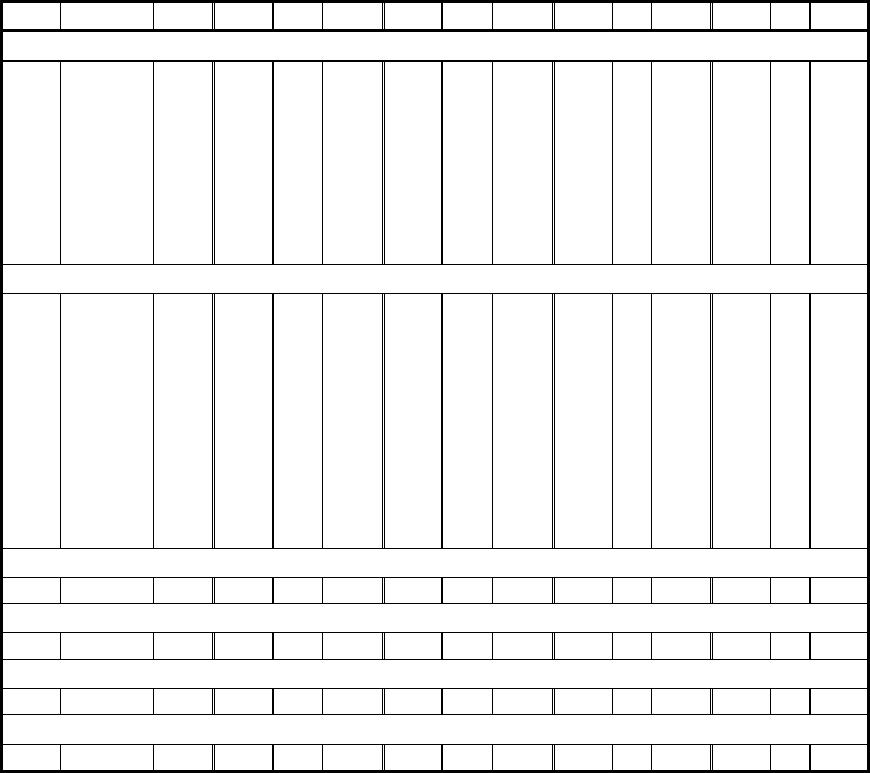
SUMMARY OF QUESTION TYPES BY STUDY OBJECTIVE AND
LEVEL OF DIFFICULTY
Item
LO
LOD
Item
LO
LOD
Item
LO
LOD
Item
LO
LOD
Item
LO
LOD
True-False Statements
1.
2
M
9.
2
H
17.
3
E
25.
4
E
33.
7
M
2.
2
E
10.
2
E
18.
3
E
26.
5
E
34.
8
M
3.
2
E
11.
2
H
19.
4
H
27.
5
H
35.
8
M
4.
2
E
12.
2
H
20.
4
M
28.
5
E
36.
8
M
5.
2
E
13.
3
E
21.
4
M
29.
5
E
37.
8
E
6.
2
M
14.
3
M
22.
4
M
30.
5
E
38.
8
H
7.
2
M
15.
3
E
23.
4
H
31.
5
M
8.
2
E
16.
3
M
24.
4
M
32.
6
E
Multiple Choice Questions
39.
2
M
49.
2
M
59.
3
E
69.
4
M
79.
7
E
40.
2
H
50.
3
E
60.
3
M
70.
5
H
80.
8
H
41.
2
H
51.
3
E
61.
3
E
71.
5
H
81.
8
E
42.
2
E
52.
3
E
62.
3
H
72.
5
H
82.
8
H
43.
2
M
53.
3
E
63.
4
H
73.
7
M
83.
8
E
44.
2
M
54.
3
M
64.
4
M
74.
7
M
84.
8
M
45.
2
M
55.
3
H
65.
4
M
75.
7
E
46.
2
M
56.
3
H
66.
4
E
76.
7
E
47.
2
M
57.
3
M
67.
4
E
77.
7
E
48.
2
H
58.
3
E
68.
4
M
78.
7
E
Exercises
85.
2
M
86.
3
H
87.
3
M
88.
5
M
89.
8
M
Matching
90.
2
M
91.
3
M
92.
7
M
Short-Answer Essay
93.
2
H
94.
3
M
95.
3,4,8
H
96.
6
M
97.
7
H
Essay
98.
2
H
99.
3
H
100.
4
H
101.
7
M
Note: E = Easy M = Medium H = Hard
10 – 2 Test Bank for Understanding Financial Accounting, Canadian Edition
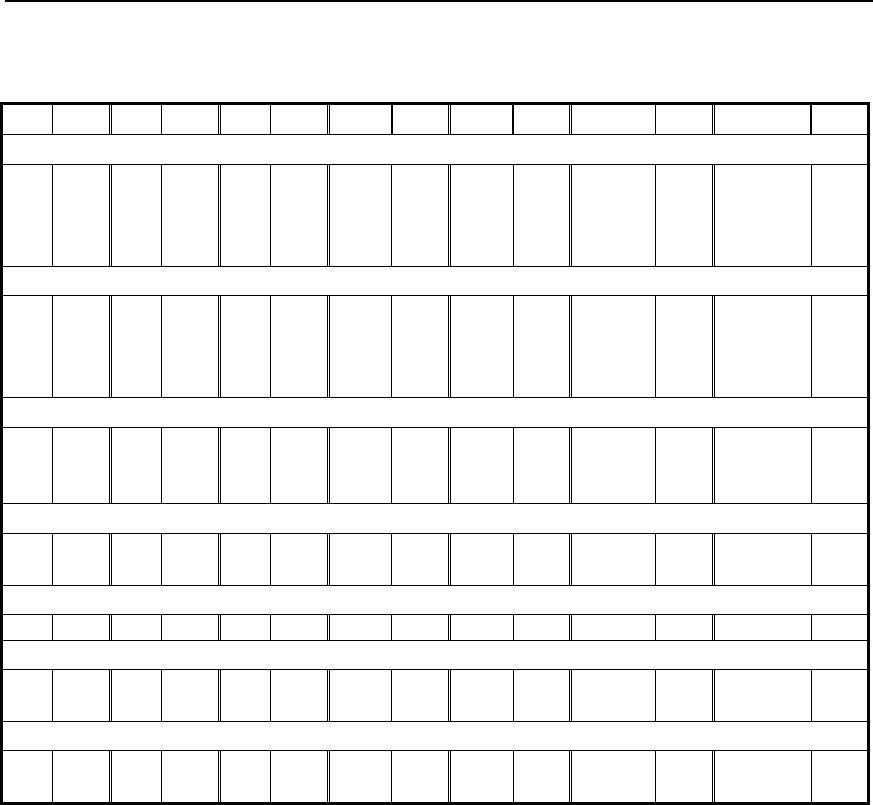
SUMMARY OF STUDY OBJECTIVES BY QUESTION TYPE
Item
Type
Item
Type
Item
Type
Item
Type
Item
Type
Item
Type
Item
Type
Study Objective 2
1.
TF
5.
TF
9.
TF
39.
MC
43.
MC
47.
MC
90.
Ma
2.
TF
6.
TF
10.
TF
40.
MC
44.
MC
48.
MC
93.
SAE
3.
TF
7.
TF
11.
TF
41.
MC
45.
MC
49.
MC
98.
Es
4.
TF
8.
TF
12.
TF
42.
MC
46.
MC
85.
Ex
Study Objective 3
13.
TF
17.
TF
52.
MC
56.
MC
60.
MC
87.
Ex
99.
Es
14.
TF
18.
TF
53.
MC
57.
MC
61.
MC
91.
Ma
15.
TF
50.
MC
54.
MC
58.
MC
62.
MC
94.
SAE
16.
TF
51.
MC
55.
MC
59.
MC
86.
Ex
95.
SAE
Study Objective 4
19.
TF
22.
TF
25.
TF
65.
MC
68.
MC
100.
Es
20.
TF
23.
TF
63.
MC
66.
MC
69.
MC
21.
TF
24.
TF
64.
MC
67.
MC
95.
SAE
Study Objective 5
26.
TF
28.
TF
30.
TF
70.
MC
72.
MC
27.
TF
29.
TF
31.
TF
71.
MC
88.
Ex
Study Objective 6
32.
TF
96.
SAE
Study Objective 7
33.
TF
74.
MC
76.
MC
78.
MC
92.
Ma
101.
Es
73.
MC
75.
MC
77.
MC
79.
MC
97.
SAE
Study Objective 8
34.
TF
36.
TF
38.
TF
81.
MC
83.
MC
89.
Ex
35.
TF
37.
TF
80.
MC
82.
MC
84.
MC
Note: TF = True-False Ex = Exercise SAE = Short-Answer Essay
MC = Multiple Choice Ma = Matching Es = Essay
Long-Term Liabilities 10 – 3
CHAPTER LEARNING OBJECTIVES
1. Explain why long-term liabilities are of significance to users.
2. Identify the long-term liabilities that arise from transactions with lenders and
explain how they are accounted for.
3. Identify the long-term liabilities that arise from transactions with other creditors
and explain how they are accounted for.
10 – 4 Test Bank for Understanding Financial Accounting, Canadian Edition
4. Identify the long-term liabilities that arise from transactions with employees and
explain how they are accounted for.
5. Identify the long-term liabilities that arise from differences between accounting
standards and income tax regulations or law.
6. Explain what commitments and guarantees are and how they are treated.
7. Explain contingencies and how they are accounted for.
8. Calculate leverage and coverage ratios and use them to assess a company ’ s
financial health using the information from these ratios.
Long-Term Liabilities 10 – 5

10 – 6 Test Bank for Understanding Financial Accounting, Canadian Edition
TRUE-FALSE STATEMENTS
1. There is an inverse relationship between the discount rate and the selling price of a
bond.
2. The carrying value of a bond issued at a discount decreases over time.
3. Restrictions placed on a company by the lender are also known as covenants.
4. An investment banker is usually hired to assist a company in issuing debt securities.
5. Companies are NOT required to disclose the details of their long-term loans in the
notes to the financial statements.
6. Companies must always accrue interest between the last loan payment date and the
company’s reporting date.
7. Bank loan covenants only pertain to financial data such as ratios.
8. Non-financial covenants may include a requirement to have an annual audit.
9. All bond covenants are recorded in an agreement called a debenture agreement.
10. A public offering is open to all investors including institutions.
11. Debentures can be either senior or subordinated.
12. The interest rate paid on the bond is known as the effective rate.
13. A lease that runs eight years on an asset with a 12-year useful life may qualify as an
operating lease.
14. A finance lease allows a firm to report more expenses over the life of a lease than an
operating lease.

Long-Term Liabilities 10 – 7
15. The operating lease classification is considered the “default” classification.
16. At the end of a finance lease the lessee will NEVER have the option to purchase the
asset at less than the fair market value.
17. Under a finance lease the liability is recorded as “obligation under finance lease”.
18. Off-balance sheet financing occurs only for finance leases.
19. Post-employment benefits other than pensions are expensed on an accrual basis.
20. Benefits that are NOT contingent upon an employee’s continued employment are
called vested benefits.
21. The two kinds of pension plans that are commonly used by employers are: defined
obligation plans and defined contribution plans.
22. A defined benefit plan is similar to a defined contribution plan in that only employers
contribute to the plan.
23. An actuary is only necessary when there is a dispute between contributions made
and benefits expected to be received for a defined benefit plan.
24. Pension funds are described as underfunded if the value of the pensions fund assets
is less than the present value of the future pension obligations.
25. Hybrid pension plans are also known as target benefit plans.
26. Temporary differences between accounting and taxable income will eventually offset.
27. A deferred tax asset can be recognized when lower income taxes will expected in
the future.
28. Deferred income taxes represent amounts due to Canada Revenue Agency.
29. A temporary difference is a difference between tax and accounting income that will
not reverse in a future period.

10 – 8 Test Bank for Understanding Financial Accounting, Canadian Edition
30. The calculation of future taxes is based on the temporary differences between book
income and tax income.
31. Accrued warranty expenses create temporary differences for the purpose of
calculating future taxes.
32. A purchase commitment is an example of a mutually unexecuted contract.
33. Liabilities are the result of events or transactions that have already occurred.
34. The debt/equity ratio is most commonly used by a lender in order to evaluate an
entity’s profitability.
35. The interest coverage ratio uses interest expense as its numerator.
36. Leverage is the extent to which a company is using the funds provided by its
shareholders to generate returns for creditors.
37. The debt to equity ratio measures the extent of debt relative to each dollar in equity.
38. Net debt is the name given to the amount of interest-bearing debt less all current
assets.
Long-Term Liabilities 10 – 9
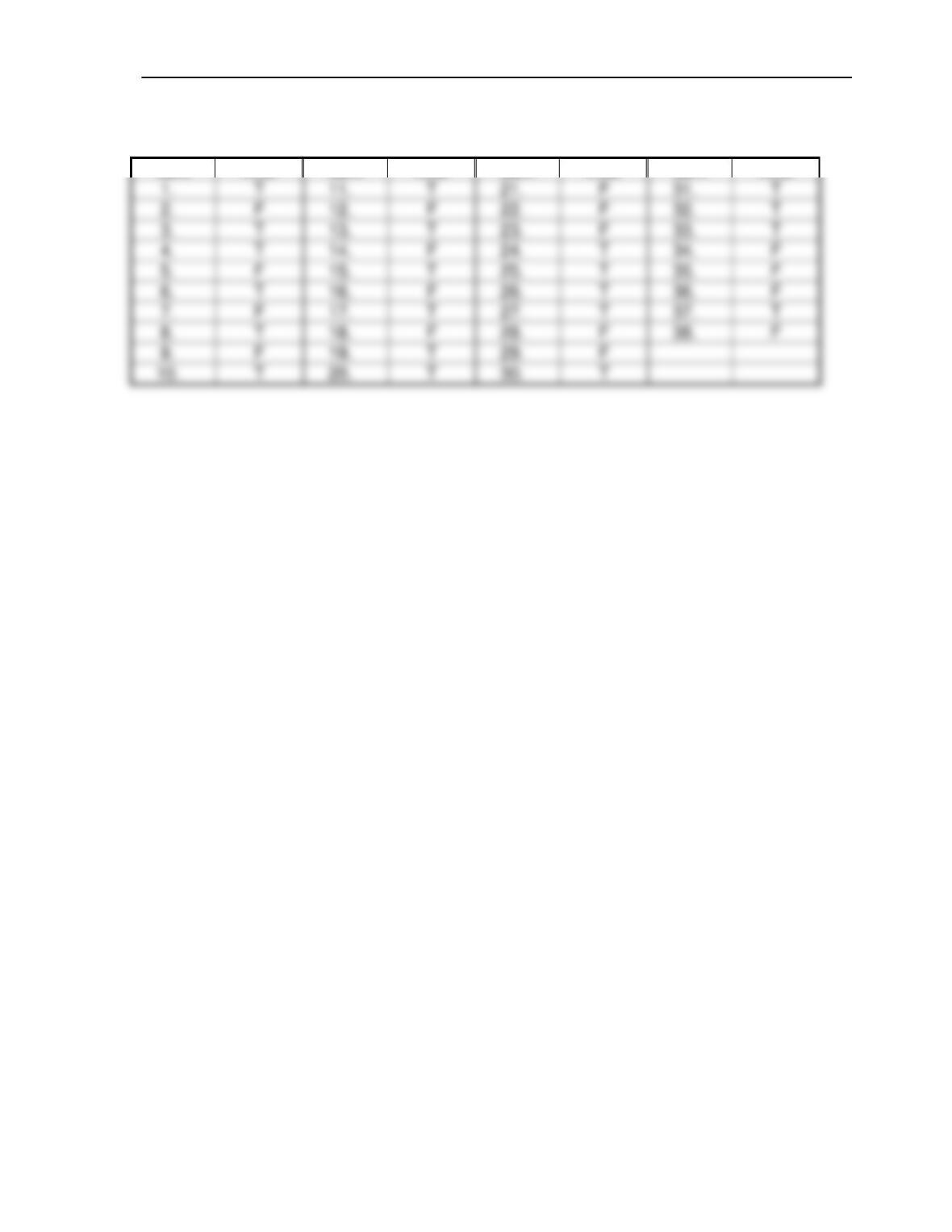
ANSWERS TO TRUE-FALSE STATEMENTS
Item
Ans.
Item
Ans.
Item
Ans.
Item
Ans.

10 – 10 Test Bank for Understanding Financial Accounting, Canadian Edition
MULTIPLE CHOICE QUESTIONS
39. The distinction between senior and subordinated debt is associated with
a) general debenture bonds.
b) mortgage bonds.
c) collateral trust bonds.
d) commercial bonds.
40. All of the following are used to determine the bond premium or the bond discount
EXCEPT for
a) market rate.
b) yield rate.
c) coupon rate.
d) capital rate.
41. The proceeds from the sale of a bond are equal to
a) the face value of the bond.
b) the face value of the bond plus the present value of the interest to be paid.
c) the maturity value of the bond plus the interest to be paid.
d) the present value of the principal and interest to be paid.
42. A bond issue is a form of
a) equity financing.
b) debt financing.
c) collateral financing.
d) financing similar to an instalment loan.
43. If a bond is issued at a premium, the coupon rate is
a) equal to the effective rate.
b) less than the effective rate.
c) greater than the effective rate.
d) not needed to determine the bond’s sale price.
44. If a bond is issued at a discount, the coupon rate is
a) equal to the effective rate.
b) less than the effective rate.
c) greater than the effective rate.
d) not needed to determine the bond’s sale price.
45. If a bond is trading at 103 the
a) the interest expense is greater than the interest payment.
b) the interest expense is less than the interest payment.
c) the interest expense is equal to the interest payment.

Long-Term Liabilities 10 – 11
d) the interest expense can not be determined.
46. If a bond is trading at 98 the
a) the interest expense is greater than the interest payment.
b) the interest expense is less than the interest payment.
c) the interest expense is equal to the interest payment.
d) the interest expense can not be determined.
47. Restrictions placed on a company in their bond indenture agreement are known as
a) collateral.
b) bond indenture.
c) bond covenants.
d) agreements.
48. How would the Depreciation of a bond discount affect each of the following?
Bond’s Net Bond’s
Carrying Value Interest Expense
a) increase decrease
b) increase increase
c) decrease increase
d) decrease decrease
49. If a bond sells at a premium, the depreciation of the premium will
a) have no effect on periodic expense.
b) decrease periodic expense.
c) increase periodic interest expense.
d) make periodic interest expense equal to the periodic interest payment.
50. If a company made the following journal entry
Dr. Rent expense (SE) ……………………….. xx
Cr. Cash (A) ……………………………….. xx
what type of lease do they have?
a) capital lease
b) finance lease
c) operating lease
d) sales-type lease
51. If a company made the following entry
Dr. Asset under lease (A) ……………………. xx
Cr. Lease obligation (L) ………………… xx
what type of lease do they have?
a) capital lease
b) finance lease
c) operating lease
d) sales-type lease

10 – 12 Test Bank for Understanding Financial Accounting, Canadian Edition
52. If the lessee makes the following entry
Dr. Depreciation expense (SE) …………….. xx
Cr. Accumulated depreciation (XA) …. xx
what type of lease do they have?
a) commercial lease
b) finance lease
c) operating lease
d) sales-type lease
53. From the lessee’s perspective, a finance lease results in all of the following EXCEPT
a) recognition of an asset on the Statement of Financial Position.
b) recognition of a liability on the Statement of Financial Position.
c) recognition of interest expense on the Statement of Income.
d) recognition of rent expense on the Statement of Income.
54. Tough Tracks Inc. has leased an excavator for a 5-year period. The excavator has
an estimated useful life of 15 years and a current market value of $125,000. At the end
of the lease Tough Tracks can buy the asset for its market value at that time. How
should Tough Tracks account for the lease?
a) as a finance lease because the market value of the asset is known
b) as a finance lease because they will own the asset at the end of the lease
c) as an operating lease because they might not purchase the asset at the end of the
lease
d) as an operating lease because the lease is only for one-third of the estimated useful
life
55. From the lessee’s point of view, a lease qualifies as a finance lease if it contains
which one of the following?
a) The lease term is for a major part of the asset’s economic life.
b) Title to the lease remains with the lessor.
c) The lease does not contain a bargain purchase option.
d) The present value of the minimum lease payments represents all of the asset’s fair
market value.
56. Which of the following is NOT a criterion for classifying a lease as a finance lease,
from the lessee‘s point of view?
a) The lease payments are more frequent than annually.
b) Title to the lease passes to the lessee at the end of the lease.
c) The lease term is for a major portion of the asset’s economic life.
d) Present value of the minimum lease payments is equal to substantially all of the FV of
the asset.
57. Which of the following is a reason a lessee would enter into an operating lease
instead of buying an asset?

Long-Term Liabilities 10 – 13
a) The risk of loss from obsolescence is reduced.
b) The company’s ability to borrow increases due to larger assets.
c) The company can claim capital cost allowance.
d) The company benefits from the appreciation in value of the asset.
58. An operating lease will be reflected on the Statement of Financial Position of the
lessee as
a) a current liability.
b) a non-current liability.
c) a non-current liability and a fixed asset.
d) nothing; it is not reflected on the Statement of Financial Position.
Use the following information to answer questions 59–60.
Canin Cranes Co. leased an asset under the following terms:
Annual lease payments ………………………. $7,500
Asset’s estimated useful life ………………… 8 years
Bargain purchase option ……………………… none
Asset’s fair market value …………………….. $65,000
Transfer of title at end of lease …………….. none
Lease term ……………………………………….. 4 years
Present value of lease payments ………….. $35,500
59. The lease should be classified by Canin Cranes Co. as a(n)
a) operating lease.
b) commercial lease.
c) leveraged lease.
d) finance lease.
60. Assume Canin Cranes decides to account for the lease as a finance lease. The
lessee’s entry to record the leased asset and lease acquired would include a
a) debit to asset under lease for $35,500.
b) debit to asset under lease for $40,000.
c) credit to obligation under finance lease for $7,500.
d) credit to lease payable for $7,500.
61. From the lessee’s point of view, which type of lease means that its debt to equity
ratio will not be affected?
a) operating lease
b) sales-type lease
c) leveraged lease
d) finance lease
62. DRM Corporation leased a piece of machinery and correctly classified and recorded

10 – 14 Test Bank for Understanding Financial Accounting, Canadian Edition
it as a finance lease. At the date of signing, January 1, 2017, the asset and lease
obligation were recorded for $42,000. The first lease payment of $8,200 was due
December 31, 2017 and the interest rate they used in their calculations was 7%. The
lease term was 10 years. Which of the following best describes what would be reported
on AFC’s Statement of Income for the year ending December 31, 2017?
a) $8,200 Lease Expense
b) $8,200 Lease Expense, $4,200 Depreciation Expense
c) $2,940 Interest Expense, $1,260 Depreciation Expense
d) $2,940 Interest Expense, $4,200 Depreciation Expense
63. Which of the following statements about defined benefit pension plans is true?
a) The expense is equal to the contribution amounts in a period.
b) The contributions to the fund are equal to the benefits paid in a period.
c) The expense is equal to the present value of the future benefit obligations incurred
that period.
d) The amount of benefits the employee will receive depends on the performance of the
pension plan.
64. The entry made when cash is set aside to pay for future pension benefits is called
a(n)
a) funding entry.
b) adjusting entry.
c) accrual entry.
d) reclassification entry.
65. Which of the following statements concerning pensions is correct?
a) Defined benefit plans offer a retiree more security than defined contribution plans.
b) The accounting for a defined contribution plan is more complex than for a defined
benefit plan.
c) Pension funding must always equal the pension expense.
d) The employee will forfeit vested pension contributions if he/she is terminated.
66. Vested benefits in a pension plan
a) belong to an employee even if they leave the firm.
b) are paid to an employee if they leave the firm.
c) revert to the company if an employee leaves the firm.
d) are paid to an employee in the year of vesting.
67. If the assets in the pension fund exceed the present value of future pension
obligations, the pension fund is described as
a) fully funded.
b) underfunded.
c) partially funded
d) overfunded.

Long-Term Liabilities 10 – 15
68. A pension plan that pays employees benefits upon retirement based on how well the
investments in the pension plan perform is called a
a) defined contribution plan.
b) defined performance plan.
c) defined benefit plan.
d) defined investment plan.
69. A pension plan that pays employees benefits upon retirement based on their length
of service and salary is called a
a) defined contribution plan.
b) defined service plan
c) defined benefit plan.
d) defined performance plan.
70. All of the following transactions lead to temporary timing differences EXCEPT
a) the use of straight-line depreciation of accounting purposes.
b) the use of estimated warranty costs for calculating warranty expense.
c) the recognition of dividend income for dividends received from another Canadian
company.
d) all of the above lead to temporary timing differences.
71. A deferred income tax asset is created when the difference will result in
a) higher income taxes in the future.
b) no income taxes in the future.
c) lower income taxes in the future.
d) none of the above.
72. The journal entry to record income taxes owing is
a) Dr. Income Taxes Receivable, Cr. Income Tax Revenue.
b) Dr. Income Tax Expense, Cr. CRA Payable.
c) Dr. Income Tax Expense, Cr. Deferred Tax Liability.
d) Dr. Income Tax Payable, Cr. Cash.
73. Which of the following would best describe a contingent liability?
a) An obligation to transfer services instead of cash to settle a liability
b) an obligation where the costs will be covered by insurance
c) an obligation with a high degree of uncertainty about the amount or timing of the
payment
d) an obligation with a low degree of uncertainty about the amount or timing of the
payment
74. In which of the following situations would a contingent loss be recognized?
Chance of Estimability of
occurrence amount
a) Likely Estimable

10 – 16 Test Bank for Understanding Financial Accounting, Canadian Edition
b) Likely Unestimable
c) Unlikely Estimable
d) Unlikely Unestimable
75. When the occurrence of a liability is dependent on the outcome of some future event,
the liability is referred to as a(n)
a) contingent liability.
b) commitment.
c) accrued liability.
d) accounts payable.
76. How should a contingent liability that has a likely chance of occurring and can be
reasonably estimated be disclosed?
Accrual Footnote
a) No No
b) Yes No
c) No Yes
d) Yes Yes
77. How should a contingent liability that has an unlikely chance of occurring and is
insignificant in size be disclosed?
Accrual Footnote
a) No Yes
b) No No
c) Yes No
d) Yes Yes
78. How should a contingent liability that has a likely chance of occurring but the amount
of the loss cannot be reasonably estimated be disclosed?
Accrual Footnote
a) No No
b) Yes Yes
c) Yes No
d) No Yes
79. Which of the following contingent losses would require footnote disclosure only?
a) a likely loss with an amount that can be reasonably estimated
b) a likely loss of a known amount
c) an unlikely loss
d) a likely loss with an amount that cannot be reasonably estimated
80. Wahi Limited reported the following items on their Statement of Financial Position:
Prepaid Expenses ……………………………… $ 85,000
Current liabilities ………………………………… 135,000

Long-Term Liabilities 10 – 17
Long-term note payable ………………………. 250,000
Bonds payable ………………………………….. 95,000
Share capital …………………………………….. 125,000
Retained earnings ……………………………… 157,500
The debt to equity ratio for Wahi is closest to
a) 2.0.
b) 1.7.
c) 1.22.
d) 0.88.
81. The interest coverage ratio is calculated as
a) (net income – taxes – interest) ÷ interest
b) (net income + taxes – interest) ÷ interest
c) (net income + interest) ÷ interest
d) (net income + taxes + interest) ÷ interest
82. The debt to equity ratio and interest coverage ratio for Lopez Corporation for the last
two years are as follows:
2017 2016
Debt to equity .34 .35
Interest-coverage ratio 4.2x 5.5x
Which of the following conclusions could be made about Lopez Corporation?
a) The company is less able to pay its interest costs in 2017.
b) The company is better able to pay its interest costs in 2017.
c) The company has more debt outstanding in 2017.
d) The company is less risky in 2017.
83. A debt to equity ratio of 50% indicates that
a) half of the company’s assets are financed through equity.
b) 50% of the company’s interest expense comes from long-term debt financing.
c) the company is close to bankruptcy.
d) the company spends 50% of its operating earnings on interest.
84. The following information is from the financial statements of Duff Inc.:
Net income ……………………………………….. $450,000
Income tax expense …………………………... 250,000
Interest expense ………………………………… 150,000
Long-term debt ………………………………….. 1,875,000
The interest coverage ratio for Duff would be closest to
a) 3 times.
b) 4.7 times.
c) 5.7 times.
d) 8 times.
10 – 18 Test Bank for Understanding Financial Accounting, Canadian Edition
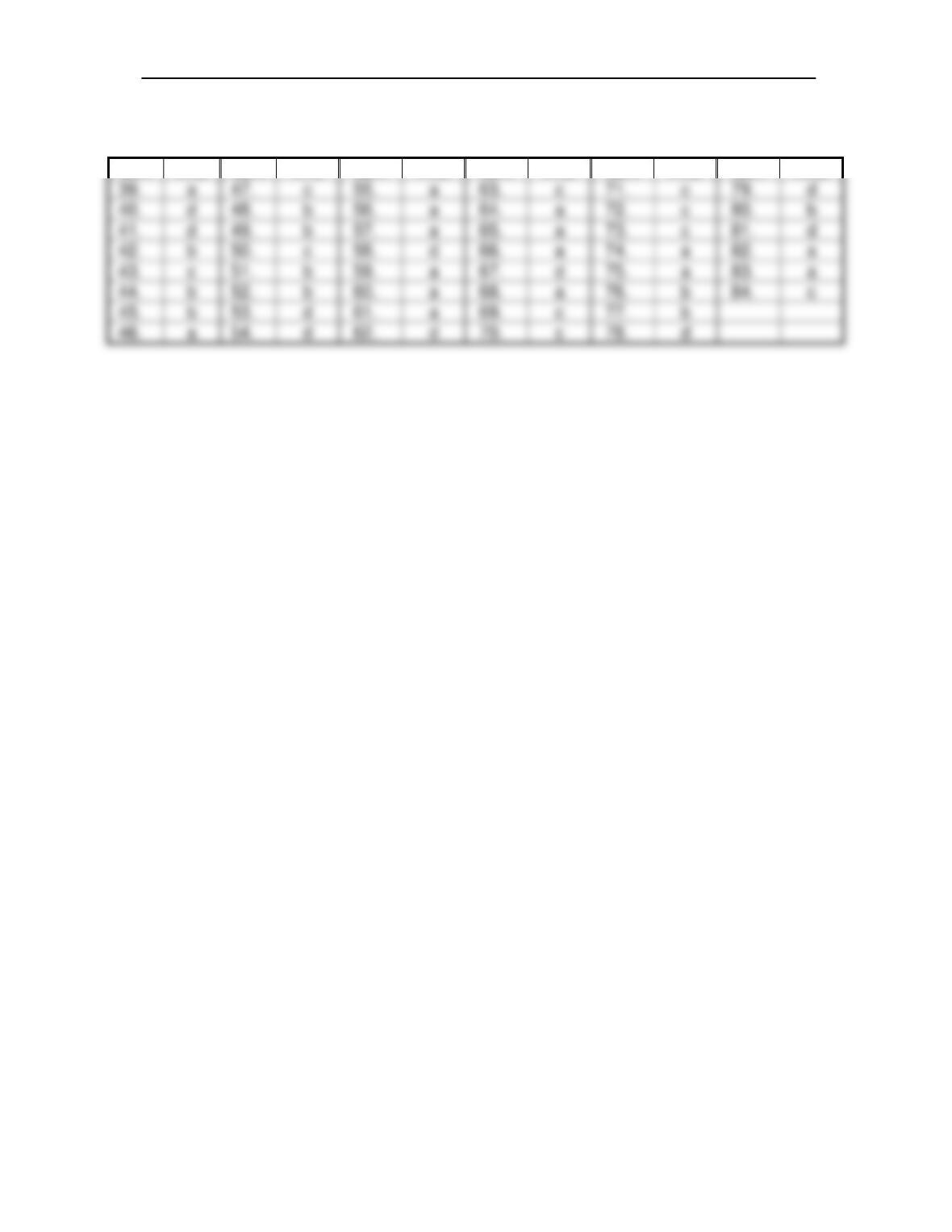
ANSWERS TO MULTIPLE CHOICE QUESTIONS
Item
Ans.
Item
Ans.
Item
Ans.
Item
Ans.
Item
Ans.
Item
Ans.
Long-Term Liabilities 10 – 19
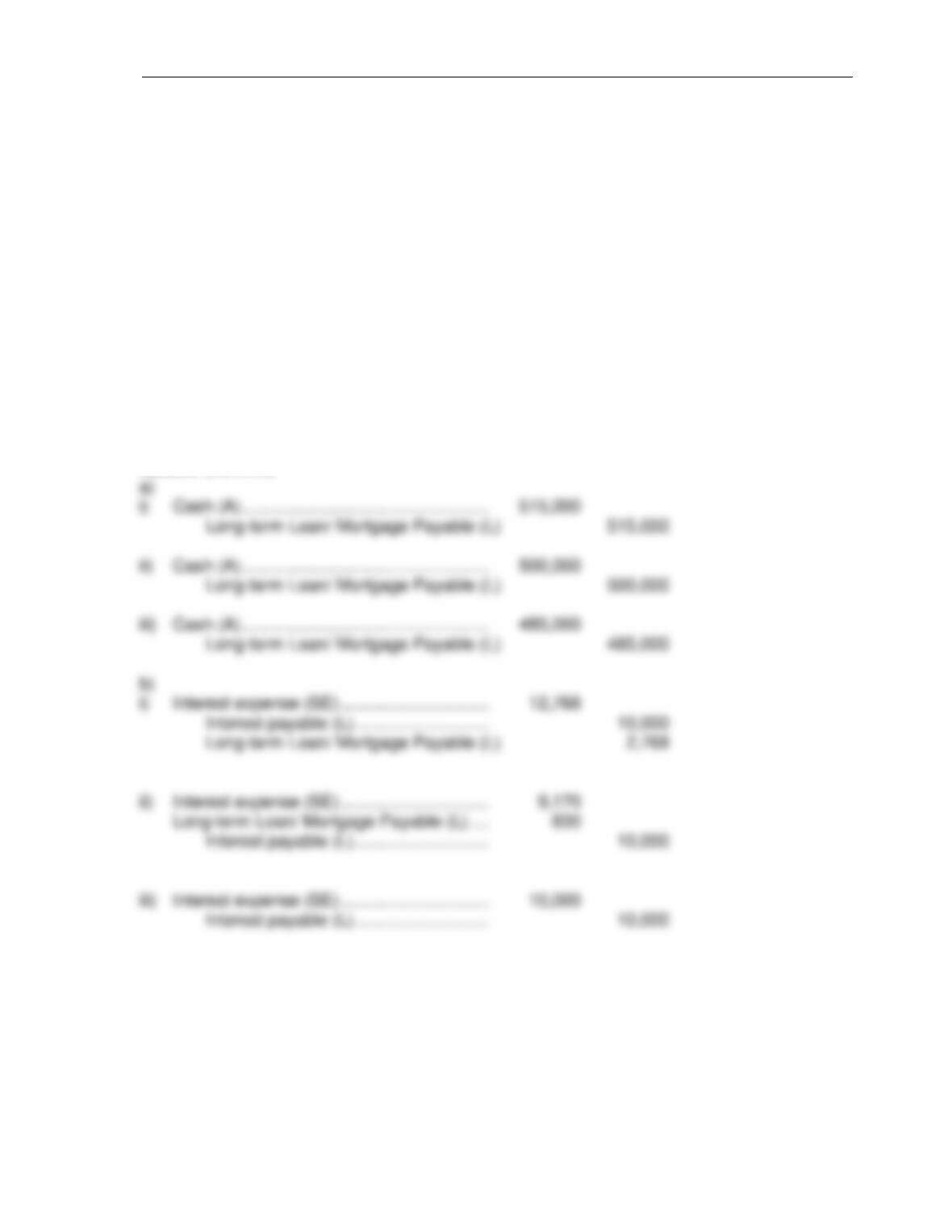
EXERCISES
85. A company issued a $500,000 Bond.
Instructions
a) Prepare the journal entry to record the issuance if
i) the bond sells for 103.
ii) the bond sells at par.
iii) the bond sells for .97.
b) Prepare the journal entry to record the first interest payment of $10,000 if the
interest expense is
i) $12,768.
ii) $9,770.
iii) $10,000.
Solution (15 min.)
86. On January 1, your company leased two trucks. Truck No. 1 had a purchase price of
$50,000; the annual lease payment is $16,000; the lease term is four years; and the
useful life is five years. Present value of the lease payments is $55,800. Truck No. 2 had
a purchase price of $195,000; the annual lease payment is $30,000; the lease term is
three years; and the useful life is eight years. The present value of the lease payments
for Truck 2 is $82,067. For both leases, the first lease payment is due immediately.
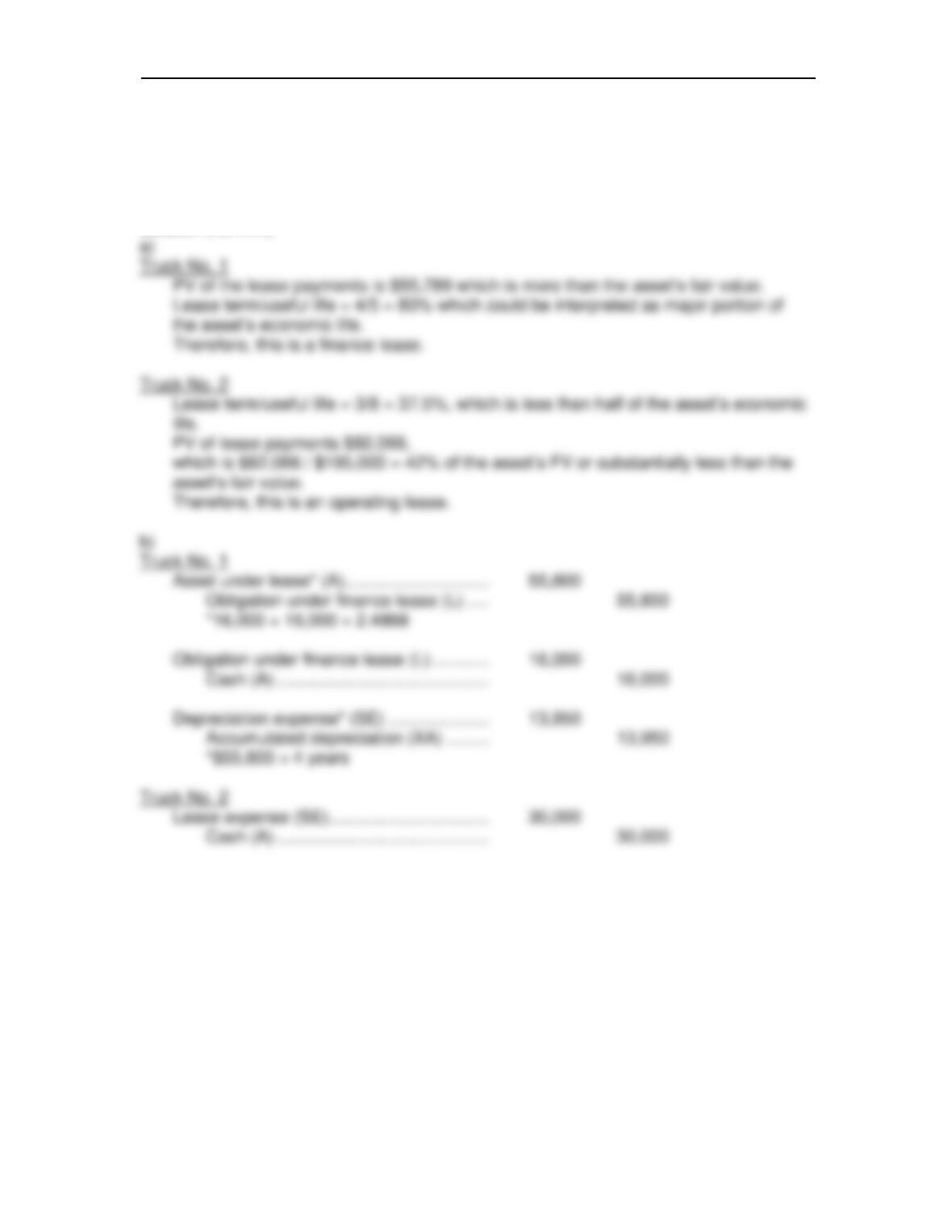
10 – 20 Test Bank for Understanding Financial Accounting, Canadian Edition
Instructions
a) Determine the type of lease on each truck. Explain your rationale.
b) Prepare the journal entries for the first year for each truck. The company uses
straight-line depreciation.
Solution (12 min.)
87. Deborah Limited has entered into an agreement to lease manufacturing equipment.
The following terms are included in the lease:
Lease terms ……………………………………… 9 years
Payments required semi-annually on
June 30 and December 31 ………………….. $10,000
Estimated useful life of equipment ………… 12 years
PV of lease payments. ………………………… $116,896
At the end of the lease term, the company may acquire the equipment for $1,000. The
lease is entered into on January 1, 2017. The equipment can be purchased for
$120,000.
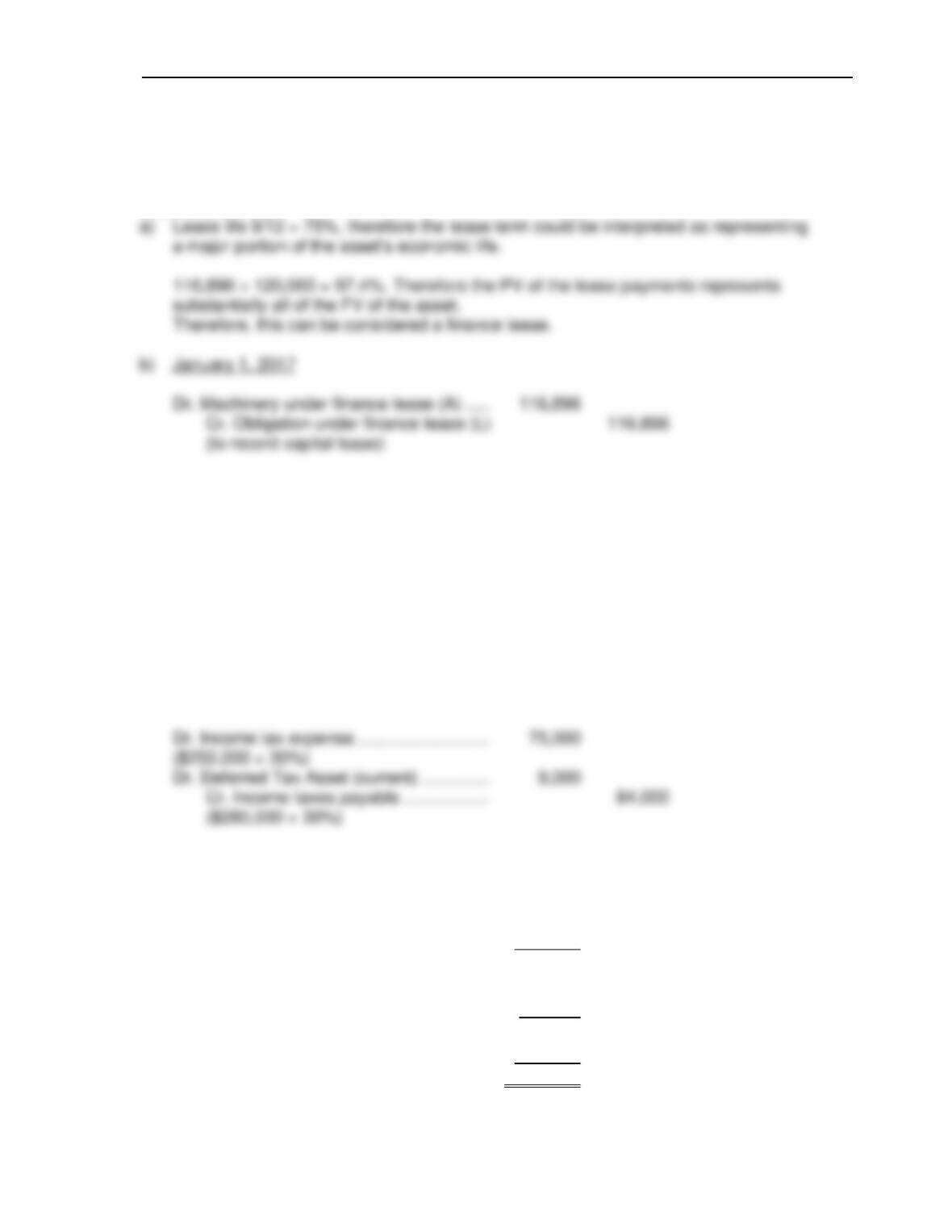
Long-Term Liabilities 10 – 21
Instructions
a) Is the above lease a finance lease or an operating lease? Support your answer.
b) Prepare the journal entry for 2017 to recognize the lease.
Solution (12 min.)
88. Nora Corp reports pre-tax accounting income of $250,000, but due to a difference
between its actual warranty costs and those estimated for accounting purposes, taxable
income is $280,000. At the beginning of the year, no temporary differences existed. The
temporary difference is expected to reverse in the next year as actual warranty
expenses incurred are expected to reach the warranty provision. Nicca is subject to a
corporate tax rate of 30%.
Instructions
Prepare the journal entry to record Nora’s income taxes.
Solution (5 min.)
89. Raging Rousseau Corporation has the following Statement of Income for the year
ended May 31, 2017:
Sales ……………………………………………….. $1,675,200
Cost of goods sold ……………………………… 887,600
Gross margin …………………………………….. 787,600
Selling & administrative expense ………….. 241,200
Interest expense ………………………………… 65,000
Income before income taxes………………… 481,400
Income taxes …………………………………….. 192,500
Net income …………………………..…………… $ 288,900
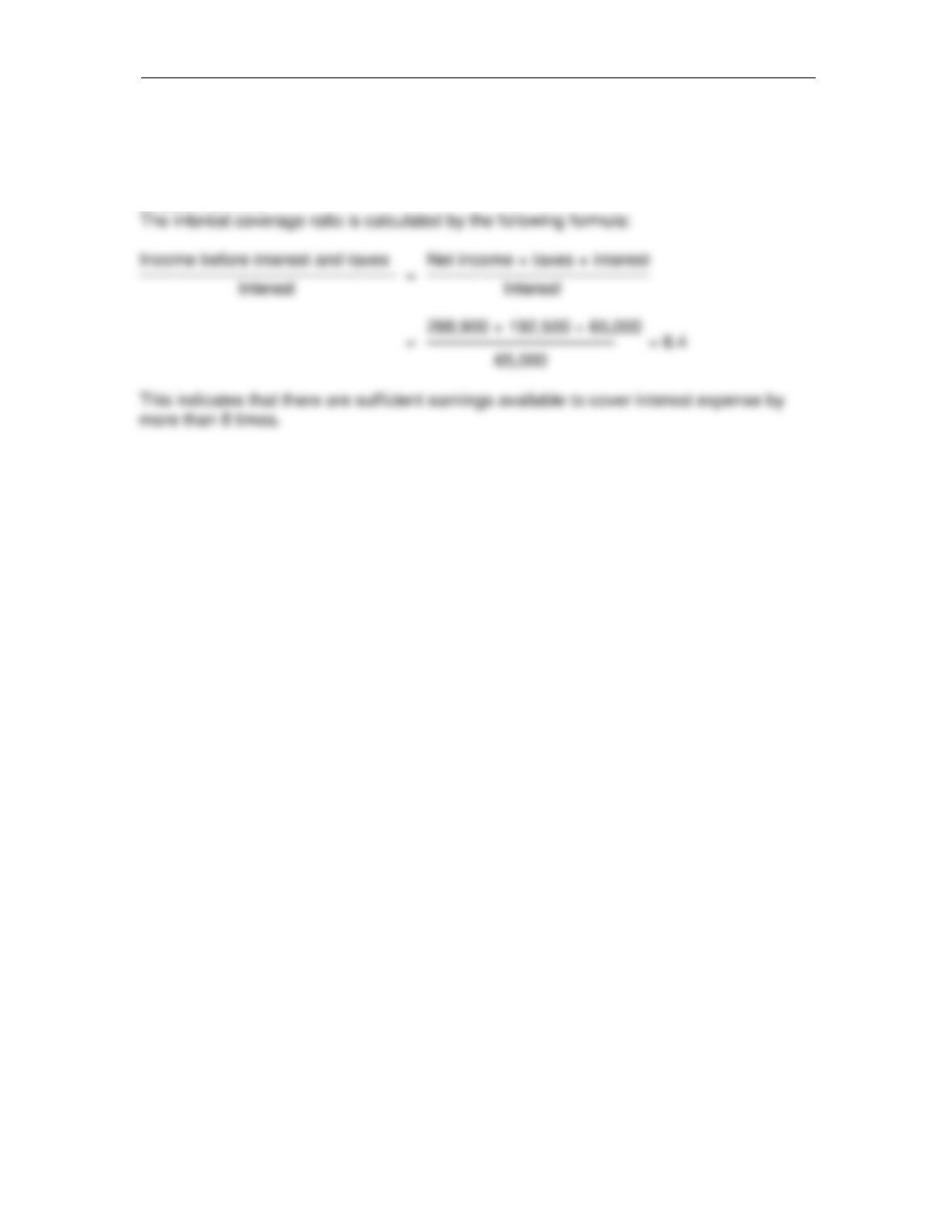
10 – 22 Test Bank for Understanding Financial Accounting, Canadian Edition
Instructions
Calculate the interest coverage ratio for Raging Rousseau Corporation for May31, 2017.
What does this mean?
Solution (5 min.)

Long-Term Liabilities 10 – 23
MATCHING
90. Listed below are various bond terms followed by a series of descriptions of bond
characteristics. Match the terms to the descriptions by placing the appropriate letter in
the space provided.
TERMS
A. Bond G. Mortgage
B. Bond covenants H. Yeild
C. Coupon rate I. Public Offering
D. Convertible bond J. Face value
E. Debenture
F. Blended payments
DESCRIPTIONS
____ 1. A bond issue with no specific collateral
____ 2. Restrictions placed on a firm that issues bonds
____ 3. Real property as collateral
____ 4. A bond that can be exchanged for common shares
____ 5. Periodic payments of both interest and principal
____ 6. Open to all investors, both individuals and institutions.
____ 7. Generally $1,000 per bond
____ 8. Interest rate used to calculate the interest expense
____ 9. A long-term borrowing with periodic coupon payments for interest and the
principal repaid at maturity
____ 10. Interest rate used to calculate the semi-annual interest payments
Solution (3 min.)

10 – 24 Test Bank for Understanding Financial Accounting, Canadian Edition
91. Listed below are various leasing terms followed by a series of descriptive
statements. Match the terms to the most accurate descriptions by placing the
appropriate letter in the space provided.
TERMS
A. Finance lease G. Lease term
B. Finance lease criteria H. Lessee
C. Lease obligation I. Lessor
D. Depreciation J. Operating lease
E. Residual value
F. Lease agreement
STATEMENTS
____ 1. Lease term is three years on an asset with a six-year life
____ 2. The renter in a lease agreement
____ 3. The title to the asset passes to the lessee by the end of the lease term
____ 4. The contract between the lessee and the lessor
____ 5. The asset’s value at the end of a lease when the asset reverts to the lessor
____ 6. The length of a lease agreement
____ 7. Present value of the lease payments
____ 8. The recipient of the lease payment
____ 9. The asset is specially designed for the use of the lessee
____ 10. Expense taken over the useful life of a leased asset
Solution (3 min.)
Long-Term Liabilities 10 – 25
92. Listed below are various disclosure options followed by a series of situations. Match
the disclosure options to the situations by placing the appropriate letter in the space
provided.
DISCLOSURE OPTIONS
A. Footnote disclosure required C. Footnote disclosure permitted
B. Accrual required D. Footnote disclosure not recommended
SITUATIONS
____ 1. It is likely that the company will have to pay on a note that it is the
guarantor on and the amount can be estimated reliably.
____ 2. The company is a defendant in a lawsuit where the loss is unlikely, but the
amount can be reliably estimated.
____ 3. The firm is a plaintiff in a liability lawsuit in which a gain is reasonably
possible and the amount can be reliably estimated.
____ 4. It is unlikely that the company will have to pay another company’s note that
it guaranteed. The amount cannot be reliably estimated.
____ 5. It is likely that the firm may lose a lawsuit. The amount cannot be reliably
estimated.
____ 6. It is unlikely that the firm may realize a gain on a pending insurance claim.
The amount cannot be reliably estimated.
____ 7. The company offers a warranty on its products and it is likely that claims
will be filed. The amounts can be reliably estimated.
____ 8. The company signed a purchase commitment. The chance that it will be
honoured is likely and the cost is known with certainty.
Solution (3 min.)

10 – 26 Test Bank for Understanding Financial Accounting, Canadian Edition
Long-Term Liabilities 10 – 27
SHORT-ANSWER ESSAY QUESTIONS
93. A first-year accounting student comes to you and wants to know why he can buy a
bond in the market for less than its $1,000 face value.
Instructions
Answer the student’s question.
Solution (7 min.)
94. Your company provides automobiles for the executives and salesmen. The manager
in charge of acquiring and maintaining these vehicles understands that there are criteria
for what constitutes a finance lease. He comes to you, the controller, and wants to know
what the criteria are and what impact this will have.
Instructions
a) Discuss the criteria for a finance lease.
b) Explain what, if any, challenges this creates for accountants and auditors.
c) Explain how the finance lease will impact the financial statements and financial
statement ratios.
Solution (5 min.)
10 – 28 Test Bank for Understanding Financial Accounting, Canadian Edition
95. You are considering investing in one of two companies in the same industry; Hanzel
Inc. and Gretel Inc. You have calculated the debt/equity ratios and profitability ratios for
each and they are very similar. You did notice that although the sales are the same for
both companies, Gretel Inc. has a smaller amount invested in capital assets. You also
know that Hanzel Inc. has a defined contribution pension plan for its employees while
Gretel Inc. has a defined benefit plan. Your friend suggests that you look in the notes
before making your investment decision.
Instructions
What information should you be looking for in the notes related to the assets and
pension plans and how will it influence your decision?
Solution (12 min.)
Long-Term Liabilities 10 – 29
96. A purchasing agent has just signed a two-year purchase commitment with a major
supplier. He has brought the contract to the bookkeeper and told her to record a liability
for the obligation the firm has committed to for the next two years. The bookkeeper
comes to you, the chief accountant, for advice on how to record this item.
Instructions
Explain to the bookkeeper why no entry is necessary and under what circumstances a
commitment would be recognized.
Solution (5 min.)
97. After reading about contingencies in her text, an introductory accounting student
believes that such items should never be recorded.
Instructions
Explain what criteria must be met before a contingent liability is recorded on the financial
statements.
Solution (5 min.)
10 – 30 Test Bank for Understanding Financial Accounting, Canadian Edition
ESSAY QUESTIONS
98. Your grandmother has some of her money invested in corporate bonds. She has just
come from a meeting with her investment advisor and asks you the following: “What is
all this confusion about interest rates? There is a coupon rate, a market rate, and the
current yield. And, as I understand it, some of the rates change during the life of a bond
and some don’t. Why is it so confusing?”
Instructions
Explain what is meant by the coupon rate and the market rate. Also, indicate which rates
change and which remain constant during a bond‘s life.
Solution (5 min.)
99. The CFO wants to know whether it is better to purchase or lease a new warehouse.
Instructions
Prepare a response discussing the pros and cons for each alternative.
Solution (6 min.)
100. A personnel officer has come to you for information concerning the difference
between pension plans. He has heard that an emerging plan is gaining popularity. The
company is planning on offering a pension plan to its employees and needs to decide
Long-Term Liabilities 10 – 31
which type would best meet their needs.
Instructions
Define the three types of pension plans.
Solution (8 min.)
101. What factors are important in determining whether a pending lawsuit should be
accrued in the financial statements? What type of evidence would be necessary to
support the accrual?
Solution (5 min.)
10 – 32 Test Bank for Understanding Financial Accounting, Canadian Edition
LEGAL NOTICE