
Chapter 10: Decentralization: Responsibility, Accounting, Performance Evaluation, and Transfer Pricing
122. Panther Company had the following historical accounting data per unit:
Direct materials
$60
Direct labor
30
Variable overhead
15
Fixed overhead
24
Variable selling expenses
45
Fixed selling expenses
9
The units are normally transferred internally from Division A to Division B. The units also may be sold externally
for $210 per unit. The minimum profit level accepted by the company is a markup of 30 percent. There were no
beginning or ending inventories.
What would be the transfer price if Division X uses full cost plus markup?
a. $198.90
b. $167.70
c. $136.50
d. $129.00
123. Panther Company had the following historical accounting data per unit:
Direct materials
$60
Direct labor
30
Variable overhead
15
Fixed overhead
24
Variable selling expenses
45
Fixed selling expenses
9
The units are normally transferred internally from Division A to Division B. The units also may be sold
externally for $210 per unit. The minimum profit level accepted by the company is a markup of 30 percent.
There were no beginning or ending inventories.
If variable manufacturing costs without a fixed fee are used as the transfer price, Division A’s transfer price would
be
a. $60.
b. $105.
c. $90.
d. $144.
Chapter 10: Decentralization: Responsibility, Accounting, Performance Evaluation, and Transfer Pricing
124. Worldwide Inc., is a multinational company with divisions around the world. Division A in the United States
purchases a part from Division G in China. The part can be purchased externally for $7 each. Transportation costs
amount to $1 and the commission of $.50 will not need to be paid.
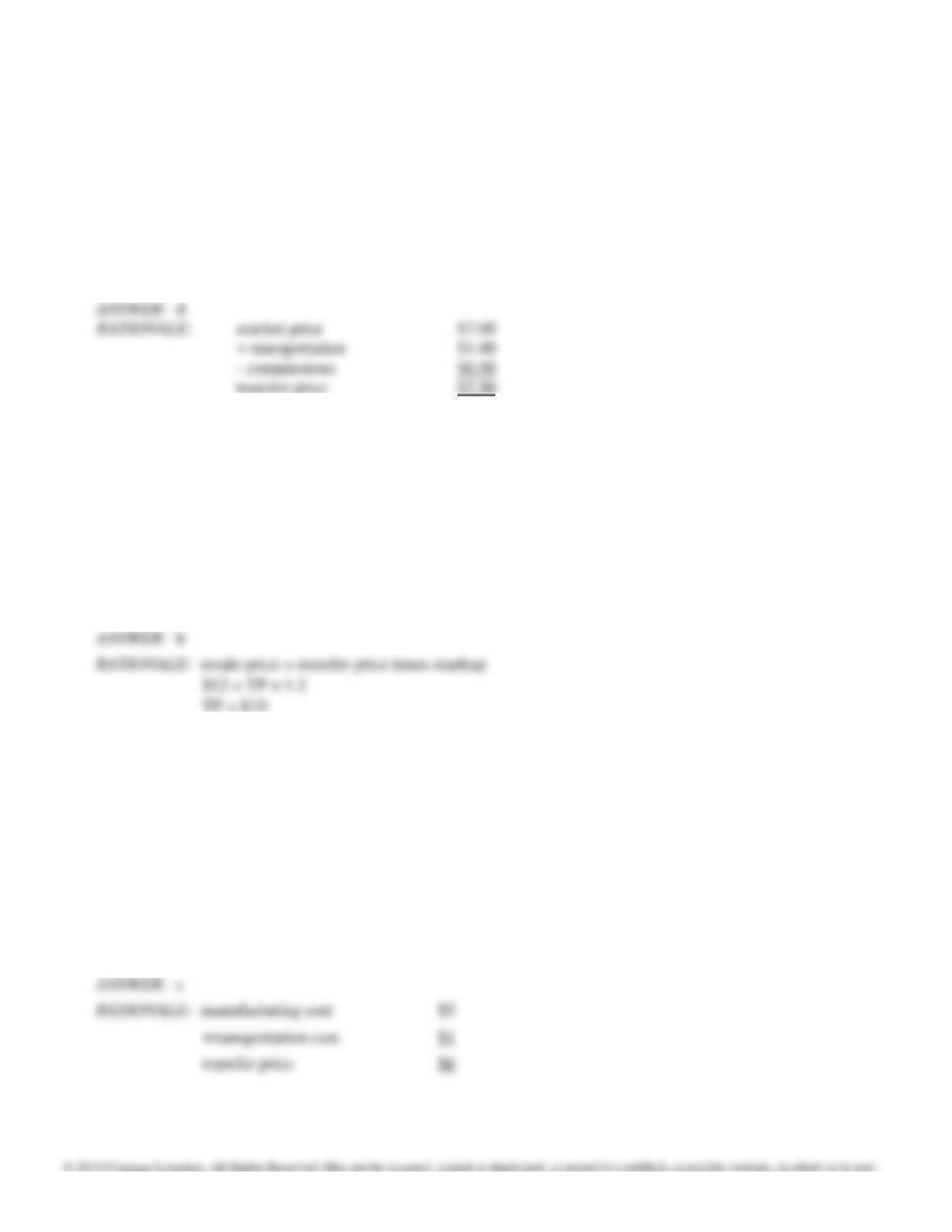
What is the transfer price using the comparable uncontrolled price method?
a. $8.50
b. $8
c. $7
d. $7.50
125. Worldwide Inc., is a multinational company with divisions around the world. Division A in the United States
purchases a part from Division G in China. There is no outside market for the part. The part is sold for $12 and
normally receives a 20% markup on cost.
What is the transfer price using the resale price method?
a. $9.60
b. $10
c. $12
d. $14.40
126. Worldwide Inc., is a multinational company with divisions around the world. Division A in the United States
purchases a part from Division G in China. There is no outside market for the part because it is used to
manufacture another product. The manufacturing cost for the part is $5. Transportation is $1 and commissions are
$.5 but do not need to be paid.
What is the transfer price using the cost-plus method?
a. $5.50
b. $6.50
c. $6
d. $5
Chapter 10: Decentralization: Responsibility, Accounting, Performance Evaluation, and Transfer Pricing
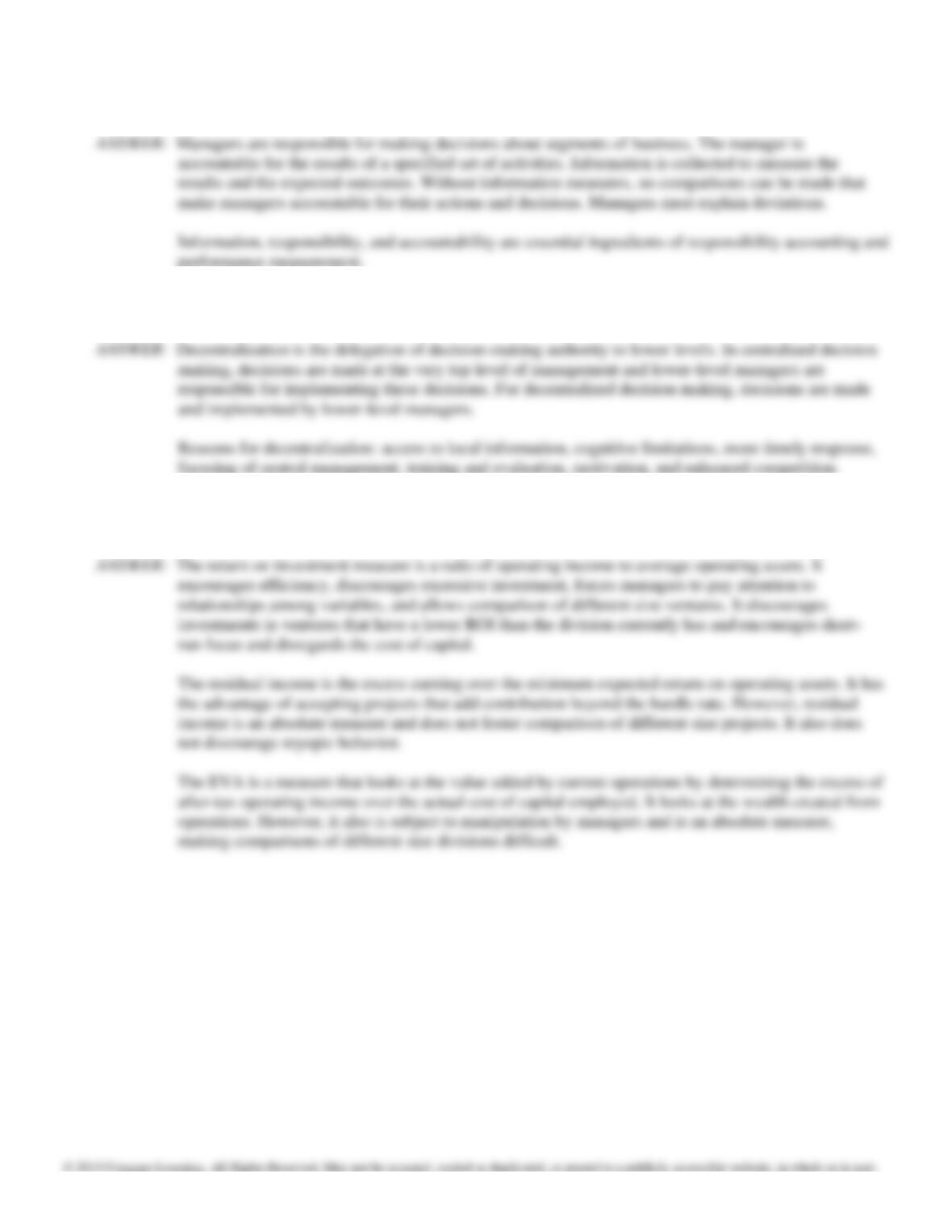
127. How are accountability, information, and responsibility, related?
128. How do the differences between centralization and decentralization affect decision making? Why would a
Company decentralize its operations?
129. Compare and discuss the advantages and disadvantages of the following performance measures: ROI, EVA, and
Residual Income.
Chapter 10: Decentralization: Responsibility, Accounting, Performance Evaluation, and Transfer Pricing
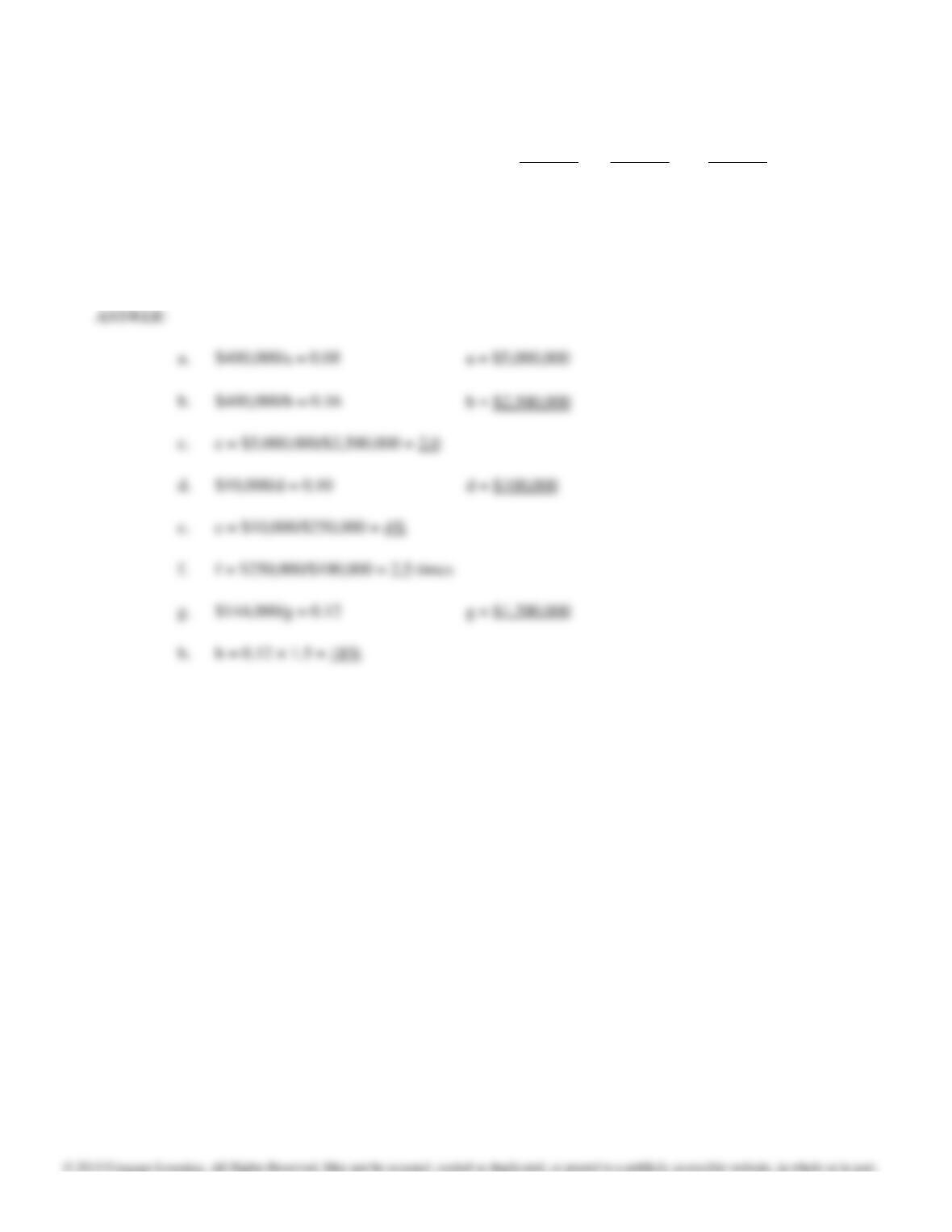
130. Provide the missing data in the following situations:
Northern
Southern
Central
Division
Division
Division
Sales
$ (a)
$250,000
$ (g)
Operating assets
$ (b)
$ (d)
$800,000
Net operating income
$400,000
$10,000
$144,000
Margin
0.08
(e)
0.12
Turnover
(c)
(f)
1.5
Return on investment
16%
10%
(h)
Chapter 10: Decentralization: Responsibility, Accounting, Performance Evaluation, and Transfer Pricing
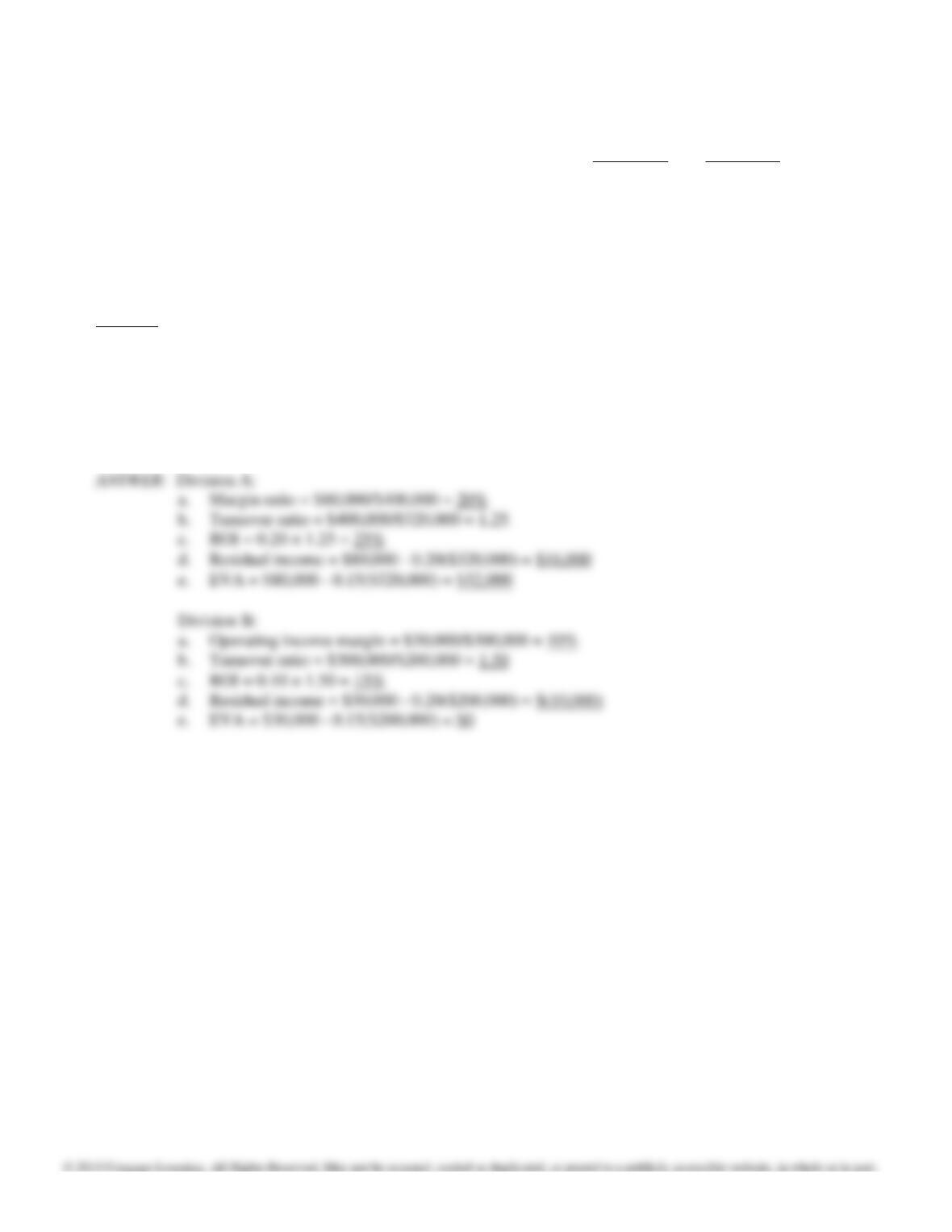
131. O’Malley Company requires a return on capital of 15 percent. The following information is available for 2016:
Division X
Division Y
Division Z
Book
Current
Book
Current
Book
Current
Sales
$200,000
$200,000
$400,000
$400,000
$600,000
$600,000
Income
24,000
20,000
32,000
34,000
37,500
39,000
Assets
120,000
160,000
180,000
200,000
450,000
435,000
Required:
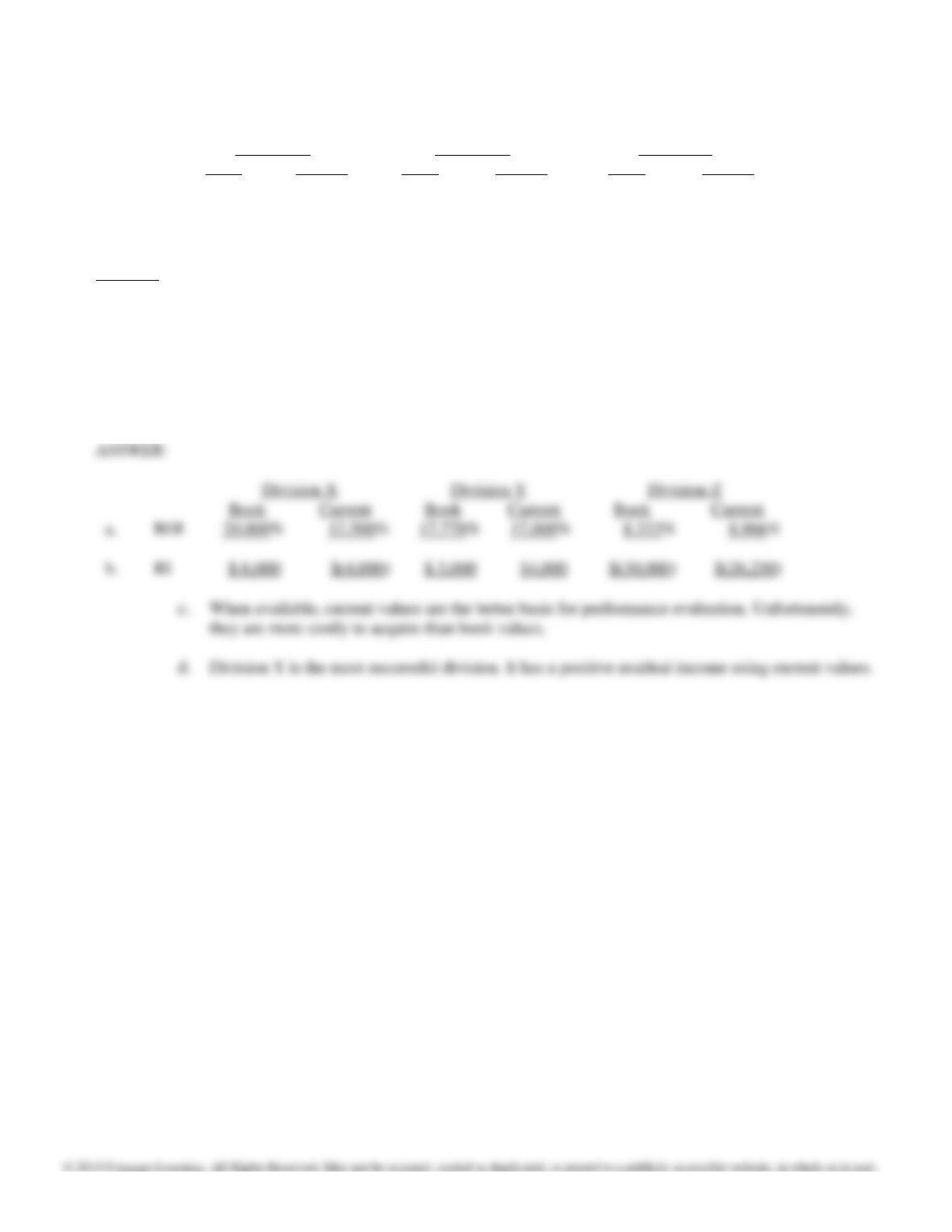
a. Compute return on investment using both book and current values for each division. (Round
answer to three decimal places.)
b. Compute residual income for both book and current values for each division.
c. Does book value or current value provide the better basis for performance evaluation?
d. Which division do you consider the most successful?
Division X
Book
Current
Book
Book
Current
8.333%
8.966%
b.
$ 6,000
$ 5,000
$4,000
Chapter 10: Decentralization: Responsibility, Accounting, Performance Evaluation, and Transfer Pricing
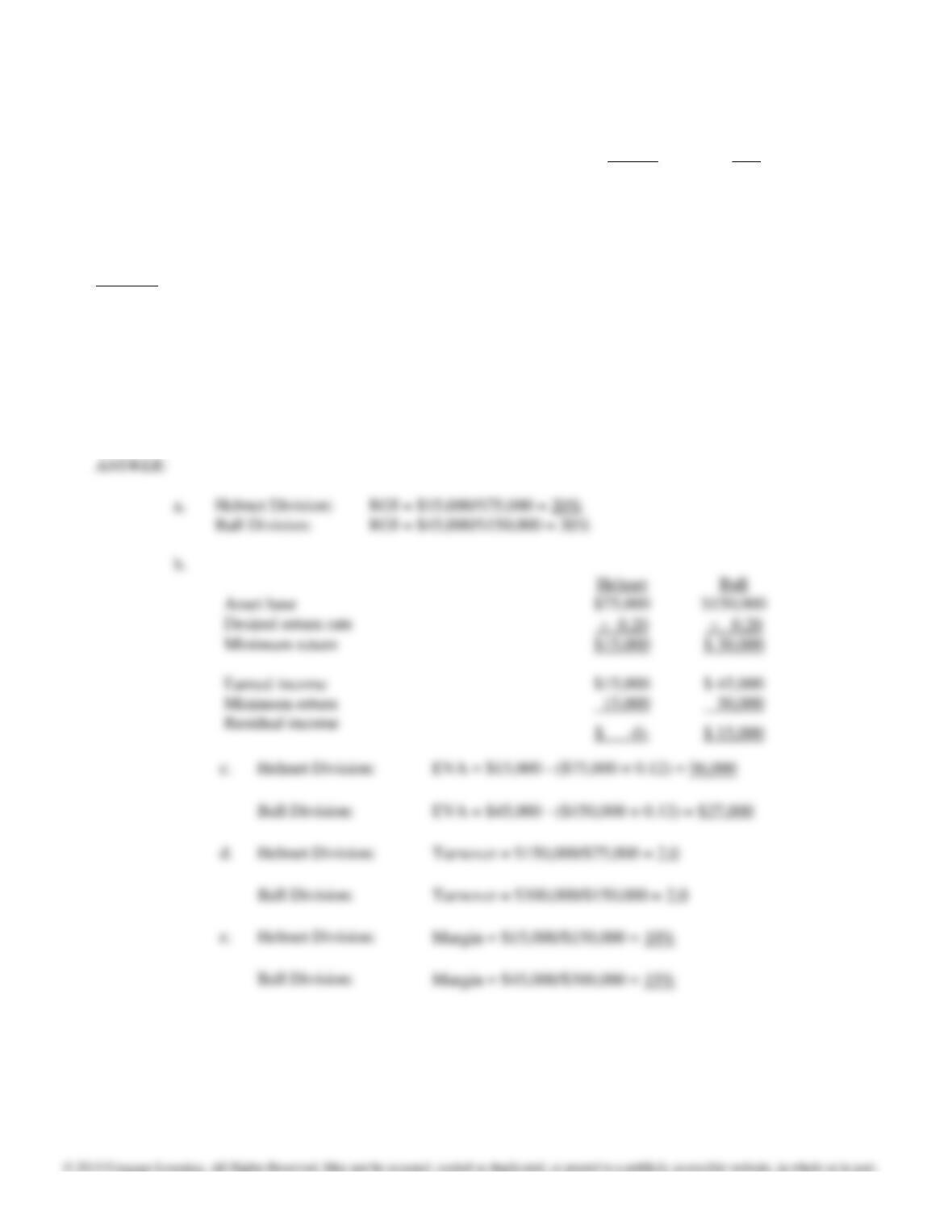
132. Sporadic Company has the following data for 2016:
Division A
Division B
Sales
$400,000
$300,000
Contribution margin
160,000
125,000
Operating income
80,000
30,000
Average operating assets
320,000
200,000
Weighted average cost of capital
15%
15%
Sprint Company has a target ROI of 20 percent.
Required:
Calculate the following amounts for each division:
a. Margin ratio
b. Turnover ratio
c. ROI
d. Residual income
e. EVA
Chapter 10: Decentralization: Responsibility, Accounting, Performance Evaluation, and Transfer Pricing
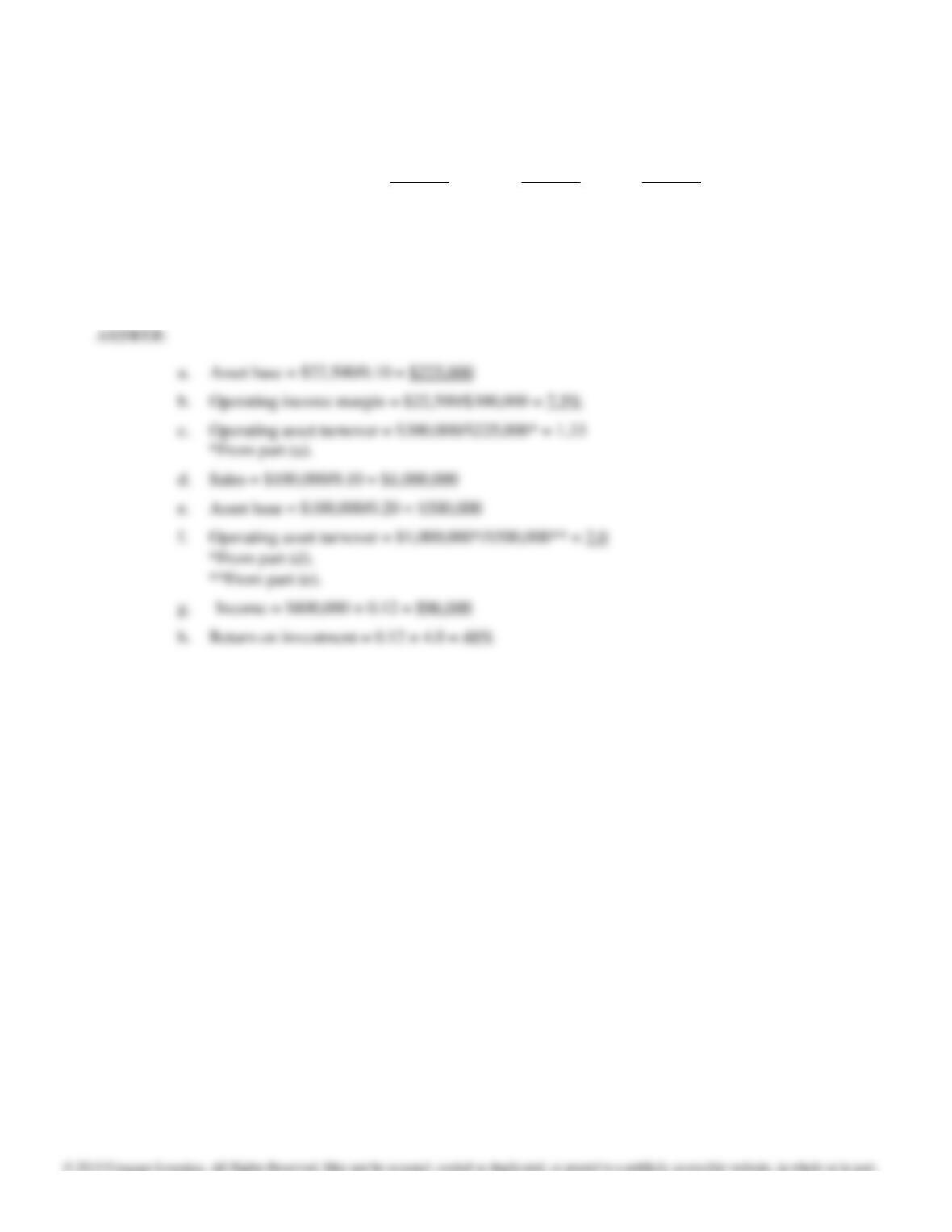
133. Nantucket Company has two divisions that report on a decentralized basis. Their results for 2016 were as follows:
Helmet
Ball
Sales
$150,000
$300,000
Income
$ 15,000
$ 45,000
Asset base
$ 75,000
$150,000
Weighted average cost of capital
12%
12%
Required:
Compute the following amounts for each division:
a. Return on investment (ROI).
b. Residual income if the desired rate of return is 20 percent.
c. EVA.
d. Turnover.
e. Margin for each division.
Chapter 10: Decentralization: Responsibility, Accounting, Performance Evaluation, and Transfer Pricing
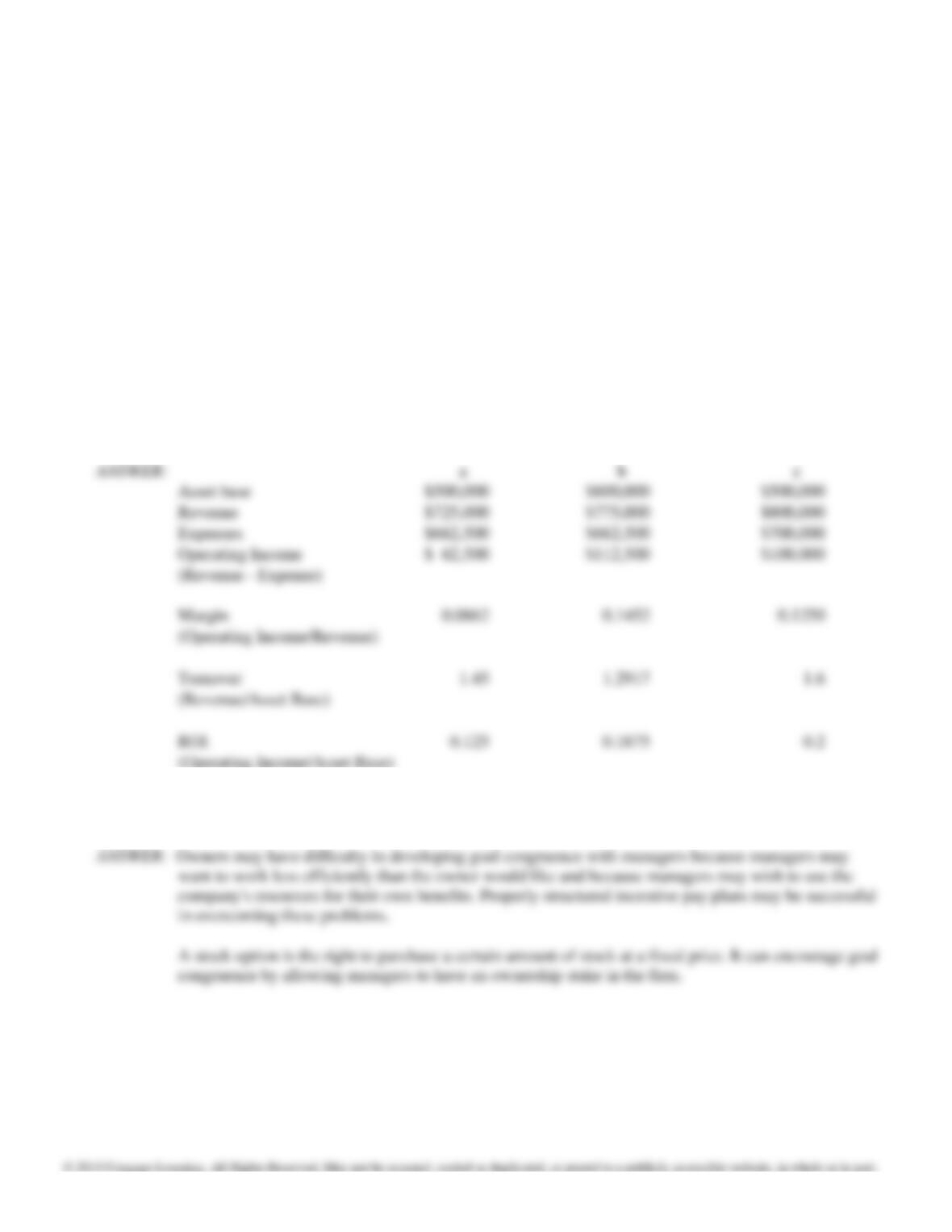
134. Provide the missing data for the following divisions.
Epsilon
Chi
Lambda
Division
Division
Division
Sales
$300,000
$ (d)
$800,000
Income
$ 22,500
100,000
$ (g)
Asset base
$ (a)
$ (e)
$200,000
Return on investment
10%
20%
(h)
Operating income margin
(b)
0.10
0.12
Operating asset turnover
(c)
(f)
4.0
Chapter 10: Decentralization: Responsibility, Accounting, Performance Evaluation, and Transfer Pricing
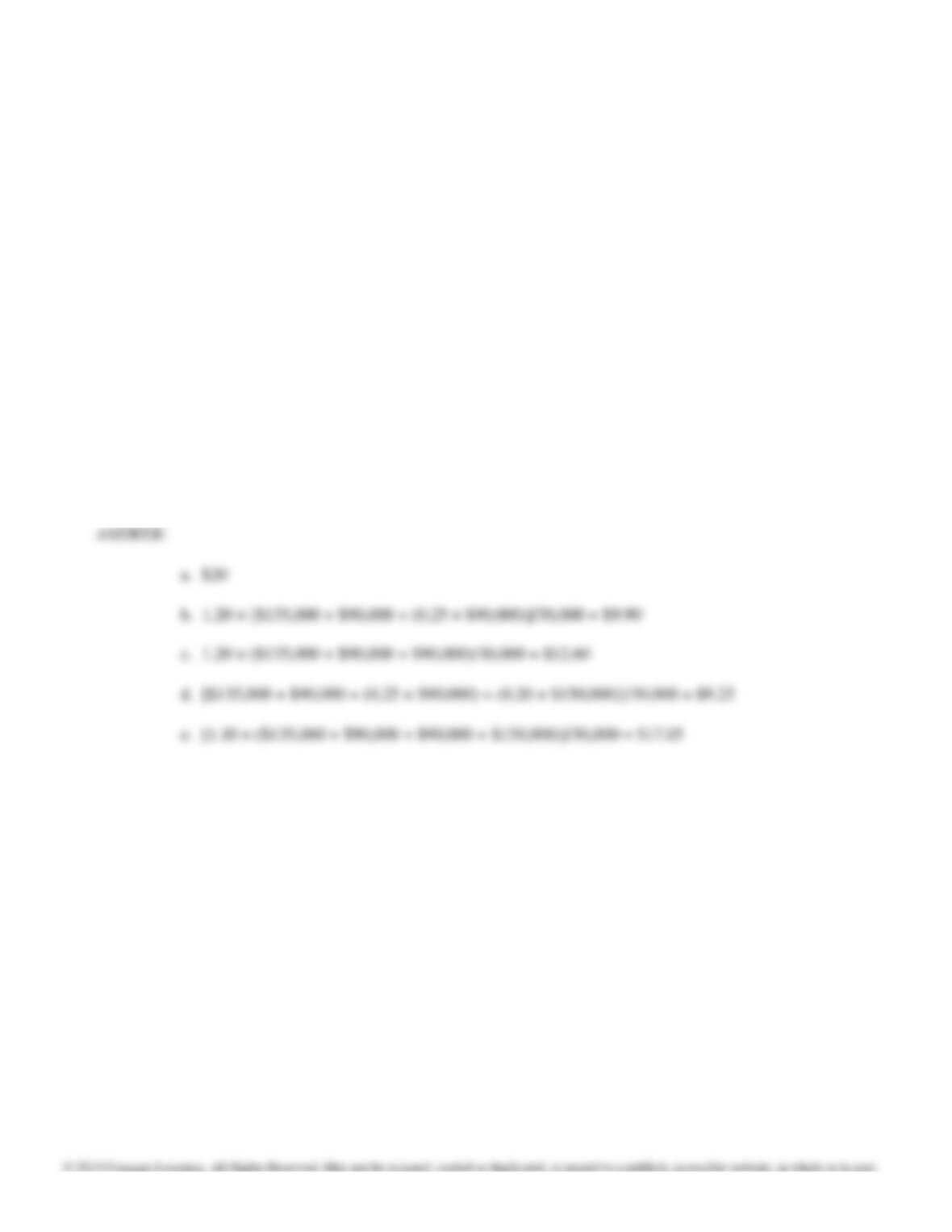
135. The records for the Venusian Division show the following data:
Asset base
$500,000
Sales Revenues
$725,000
Expenses
Required:
$662,500
a. What is the margin, turnover, and ROI for Venusian Division?
b. Venusian has an option to make an additional investment that would add $100,000 to
the asset base. It would generate an additional $50,000 in sales revenue and no
additional expenses. What would be the effect on margin, turnover, and ROI?
c. Another alternative (independent of alternative ‘b’) for Venusian is to run an advertising
campaign that would require additional advertising expenses of $37,500, but the best
estimate is the campaign would generate an additional $75,000 of revenue. What would
be the effect on margin, turnover, and ROI?
136. What problems do owners face in encouraging goal congruence of managers? What is a stock option? How can
stock options encourage goal congruence?
Chapter 10: Decentralization: Responsibility, Accounting, Performance Evaluation, and Transfer Pricing
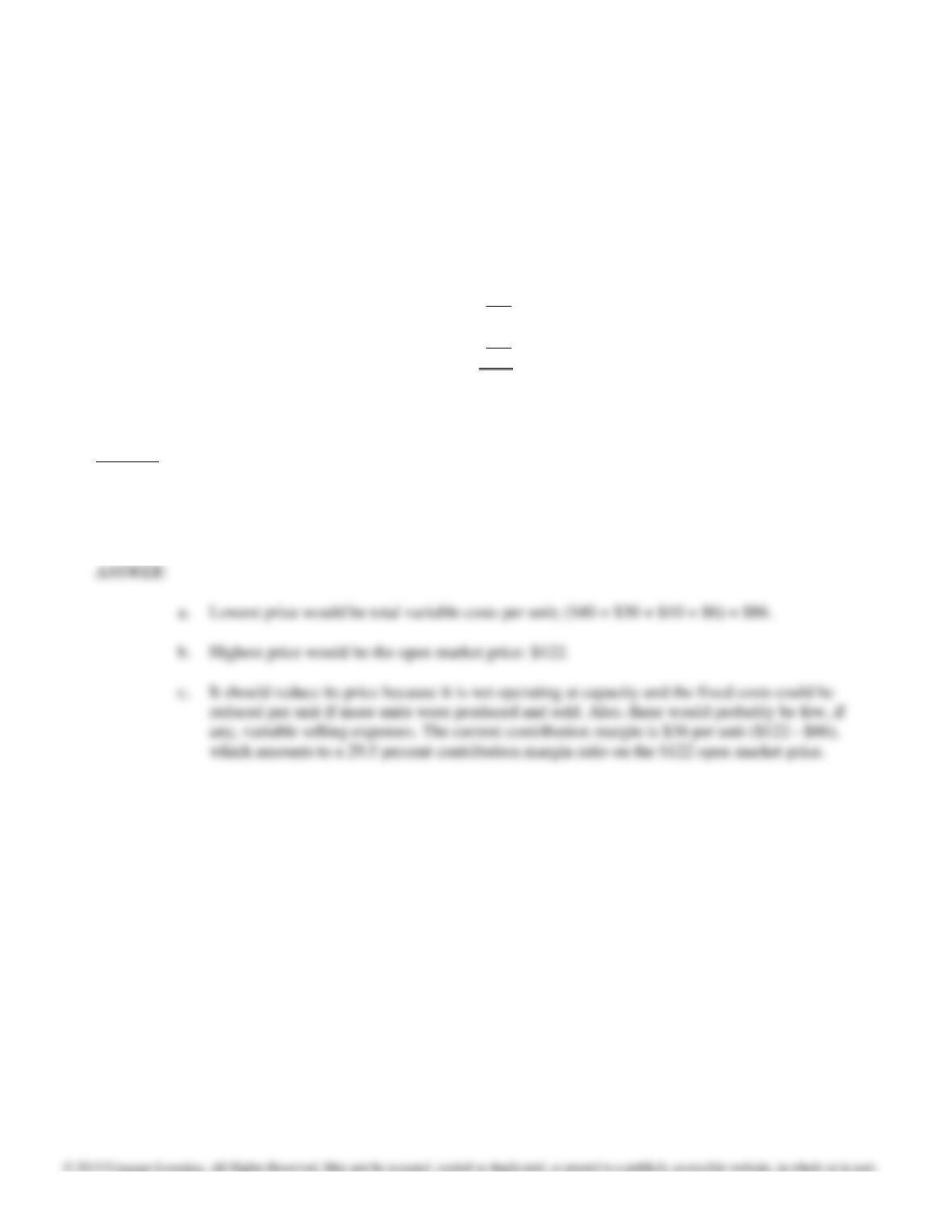
137. The Hampton Division of Long Island Company sells all of its output to the Finishing Division of the company.
The only product of the Hampton Division is chair legs that are used by the Finishing Division. The retail price of
the legs is $20 per leg. Each chair completed by the Finishing Division requires four legs. Production quantity and
cost data for 2016 are as follows:
Chair legs
30,000
Direct materials
$135,000
Direct labor
$90,000
Factory overhead (25% is variable)
$90,000
Operating expenses (20% is variable)
Required:
Compute the transfer price for a chair leg using:
$150,000
a. market price.
b. variable product costs plus a fixed fee of 20 percent.
c. full cost plus 20 percent markup.
d. variable costs.
e. full cost plus 10 percent markup.
Chapter 10: Decentralization: Responsibility, Accounting, Performance Evaluation, and Transfer Pricing
138. The Uniforms Division of Baseball Company has just revised its actual cost data for 2016. Uniforms Division
transfers goods to the Sport Division. Sport Division can buy the same goods in the open market for $122 each.
Uniforms’s new cost data are as follows:
Direct materials
$ 40
Direct labor
30
Variable overhead
10
Fixed overhead
16
Variable selling expenses
6
Fixed selling and administrative expenses
12
Total costs
$114
Desired return
20
Sales price
$134
Current production is 200,000 units, and the Uniforms Division has a capacity of 300,000 units.
Required:
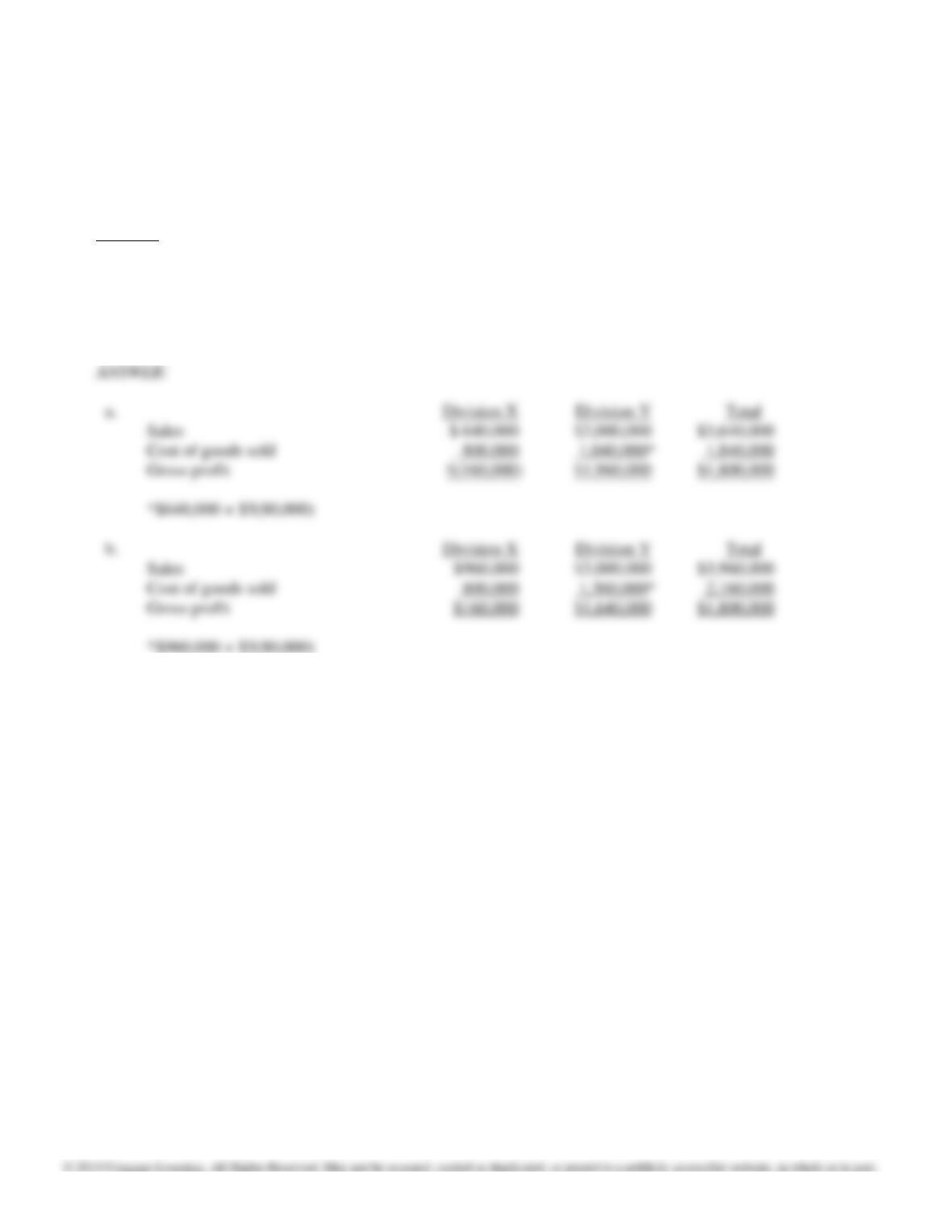
a. What is the lowest price the Uniforms Division should charge for the internal transfers of its
goods?
b. What is the highest price the Sport Division should pay for the units?
c. Give the primary reason why the Uniforms Division should reduce its price.
Chapter 10: Decentralization: Responsibility, Accounting, Performance Evaluation, and Transfer Pricing
139. Benjamin Manufacturing Company has two divisions, X and Y. Division X prepares the steel for processing.
Division Y processes the steel into the final product. No inventories exist in either division at the beginning or end
of 2016. During the year, Division X prepared 80,000 lbs. of steel at a cost of $800,000. All the steel was
transferred to Division Y where additional operating costs of $5 per lb. were incurred. The final product was sold
for $3,000,000.
Required:
a. Determine the gross profit for each division and for the company as a whole if the transfer
price is $8 per lb.
b. Determine the gross profit for each division and for the company as a whole if the transfer
price is $12 per lb.