
Biology: A Guide to the Natural World, 5e (Krogh)
Chapter 10 Preparing for Sexual Reproduction: Meiosis
1) The fertilization of an egg by a sperm produces a cell called a/an:
A) ovum.
B) gamete.
C) zygote.
D) oocyte.
2) How many chromosomes are in a human gamete?
A) 43
B) 42
C) 26
D) 23
E) 46
3) The products of meiosis are:
A) two diploid cells.
B) four haploid cells.
C) four diploid cells.
D) two haploid cells.
4) How are the products of meiosis and the products of mitosis different?
A) The products of mitosis are gametes.
B) The products of mitosis are always haploid.
C) The products of meiosis are genetically identical to each other.
D) The products of meiosis are gametes.
E) The products of meiosis are always diploid.

5) A 2n cell from an organism has 40 chromosomes. How many chromosomes would be in a
haploid gamete from this organism?
A) 46
B) 80
C) 10
D) 40
E) 20
6) If a eukaryotic cell has 20 chromosomes and it undergoes meiosis, how many cells will result,
and how many chromosomes will they contain?
A) 4 cells, each with 20 chromosomes
B) 4 cells, each with 10 chromosomes
C) 2 cells, each with 10 chromosomes
D) 2 cells, each with 20 chromosomes
7) If the chromosome number were not halved when gametes are produced, what would be the
result of fertilization?
A) They zygote would have the same number of chromosomes as the parents.
B) The zygote would have double the number of chromosomes as the parents.
C) The zygote would have half the number of chromosomes as the parents.
D) The zygote would undergo meiosis again to halve the number of chromosomes.
8) Cells that are ________ possess a single set of chromosomes.
A) diploid
B) haploid
C) zygotes
D) somatic

9) In mitosis, cells duplicate their chromosomes once and divide once. In meiosis, cells duplicate
their chromosomes ________ and divide ________.
A) once; once
B) twice; once
C) twice; twice
D) once; twice
10) You have homologous pairs of chromosomes in each of your cells. In what way are these
pairs of chromosomes identical?
A) They have exactly the same genes.
B) They both come from the same parent.
C) They have genes for the same traits.
D) They will stay together during meiosis.
11) Crossing over occurs during which stage of meiosis?
A) telophase I
B) metaphase II
C) anaphase II
D) prophase II
E) prophase I
12) Which of the following occurs during anaphase I?
A) Homologous chromosomes are moved to the metaphase plate.
B) Sister chromatids are separated.
C) Crossing over begins.
D) Homologous chromosomes are separated.
E) Cytokinesis occurs.

13) Homologous chromosomes pair up to form a structure called a:
A) sister chromatid.
B) tetrad.
C) homologue.
D) haploid.
14) What event occurs in both anaphase of mitosis and anaphase II of meiosis II?
A) Cytokinesis ends.
B) Homologous chromosomes separate.
C) Chromatin decondenses.
D) Homologous chromosomes pair.
E) Sister chromatids separate.
15) The cells at the end of meiosis I are not ready to function as gametes. Why not?
A) They have the right number of chromosomes but no cytoplasm.
B) They have the right number of chromosomes but too much cytoplasm.
C) They are haploid, but the chromosomes are still in duplicated form.
D) The chromosomes have divided, but there has been no cytokinesis.
E) The homologous chromosomes have not yet separated.
16) Meiosis II is essentially the same as mitosis except that the outcome produces cells that are:
A) diploid.
B) somatic.
C) autosomal.
D) genetically identical to each other.
E) haploid.

17) Which of the following occur during telophase I?
A) Cytokinesis produces four haploid gametes.
B) Sister chromatids separate and move to opposite poles.
C) Cytokinesis produces two cells that will each go through meiosis II.
D) Homologous chromosomes separate.
E) One cell divides two times, without interruption, into four cells.
18) In the process of crossing over:
A) sister chromatids separate.
B) maternal chromosomes assort independently of paternal chromosomes.
C) homologous chromosomes separate.
D) sister chromatids exchange genetic material.
E) non-sister chromatids of homologous chromosomes exchange genetic material.
19) Imagine that a species has eight chromosomes (four homologous pairs). If some event
occurred that prevented meiosis from occurring after replication, how many chromosomes would
this species have after two generations?
A) 64
B) 8
C) 32
D) 16
E) 4
20) A cell contains eight chromosomes at the end of prophase I. How many chromosomes will
be in each daughter cell at the end of prophase II?
A) 4
B) 8
C) 16
D) 32

21) In metaphase I ________ are aligned along the metaphase plate, and in metaphase II
________ are aligned along the metaphase plate.
A) pairs of sister chromatids; homologous chromosomes
B) maternal chromosomes; paternal chromosomes
C) homologous chromosomes; tetrads
D) homologous chromosomes; pairs of sister chromatids
22) If a cell has a haploid number of 5, during mitosis there will be ________ chromosomes at
metaphase, ________ chromosomes at anaphase, and ________ chromosomes per daughter cell
at telophase.
A) 5; 10; 5
B) 5; 5; 5
C) 10; 20; 10
D) 10; 10; 10
E) 10; 10; 5
23) What process produces genetic diversity through random distribution of chromosomes?
A) alignment of the metaphase plate to one side instead of in the middle
B) cytokinesis
C) independent assortment
D) recombination
E) crossing over
24) What is the result of recombination (crossing over) during meiosis?
A) It ensures retention of genetic information and helps to preserve cell characteristics.
B) It binds homologous chromosomes tightly, so they do not accidentally separate.
C) It eliminates unused genes by removing them.
D) It allows the cell to complete DNA replication.
E) It creates chromosomes that are a new combination of paternal and maternal material.

25) Which of the following processes contributes least to genetic diversity?
A) crossing over
B) combining of gametes from two different individuals
C) independent assortment of chromosomes at the metaphase plate
D) duplication of DNA
26) What is the result of independent assortment during meiosis?
A) The cells that result have either all maternal or all paternal chromosomes.
B) Parts of homologous chromosomes are exchanged.
C) Both copies of a sister chromatid pair end up in the same gamete.
D) The cells that result are genetically identical to each other.
E) Genetically diverse gametes are produced.
27) If a 2n cell has three chromosome pairs, how many different combinations of chromosomes
are possible in gametes after meiosis?
A) 16
B) 32
C) 8
D) 64
E) 36
28) If a diploid cell has 12 chromosome pairs, how many different combinations of
chromosomes are possible in gametes after meiosis?
A) 1220
B) 122
C) 212
D) 1012
E) 1212

8
29) What factors produce genetic diversity in bacteria?
A) crossing over
B) mitosis
C) crossing over and independent assortment
D) mutation and gene transfer
30) Imagine you start a population of 1 million bacteria from a single bacterial cell. Now
imagine that a population this large is started from a male and female housefly. How would these
two populations differ?
A) The cells of the bacterial population would be larger on average than the cells that make up
the houseflies.
B) Individuals of the housefly population would differ genetically from each other much more
than would cells of the bacterial population.
C) No cells of the housefly population would ever divide by meiosis, but some cells of the
bacterial population would divide by meiosis.
D) The cells of the bacterial population would differ genetically from each other much more than
would individuals of the housefly population.
E) No cells of the bacterial population would ever divide by binary fission, but some cells of the
housefly population would divide by binary fission.
31) In a human cell that is haploid, how many chromosomes are there? How many are
autosomes, and how many are sex chromosomes?
A) 45 chromosomes: 44 autosomes and 1 sex chromosome
B) 46 chromosomes: 44 autosomes and 2 sex chromosomes
C) 23 chromosomes: 22 autosomes and 1 sex chromosome
D) 11 chromosomes: 11 autosomes and no sex chromosomes
E) 12 chromosomes: 11 autosomes and 1 sex chromosome
32) What is an autosome?
A) one of the non-sex chromosomes
B) a chromosome that confers male or female sex
C) a Y chromosome
D) an X chromosome
33) A gamete from a human male contains:
A) 23 autosomes and an X chromosome.
B) 22 autosomes, one X chromosome, and one Y chromosome.

9
C) 23 autosomes and either an X or a Y chromosome.
D) 23 autosomes and a Y chromosome.
E) 22 autosomes and either an X or a Y chromosome.
34) In birds, the female carries an unmatched pair of chromosomes (denoted WZ), corresponding
roughly to the XY chromosomes in mammalian males, and male birds carry a matched set of
chromosomes (denoted WW), corresponding to the pair of XX chromosomes in mammalian
females. Therefore, in birds the ________ chromosome determines the sex of the offspring, and
it is gametes from the ________ parent that determine sex.
A) Z; male
B) Z; female
C) W; female
D) W; male
E) W; either male or female
35) In gamete formation, the starting cells in females are the ________, and the starting cells in
males are ________.
A) primary oocytes; prmary spermatocytes
B) primary spermatocytes; primary oocytes
C) oogonia; spermatogonia
D) spermatogonia; oogonia
E) ooctyes; spermatids
36) What would the consequence be if spermatogonia were not stem cells?
A) Only a limited quantity of sperm could be produced by males, and then no more could be
produced.
B) Sperm would be diploid rather than haploid.
C) Sperm would have to be produced by mitosis instead of meiosis.
D) Mature spermatids would make more sperm by meiosis.
37) In a human female, what happens to the collection of oocytes in the ovaries once puberty
begins?
A) The oocytes all mature into eggs as soon as puberty is reached.
B) Ovulation stimulates all of the oocytes to complete meiosis II.
C) One oocyte per month matures and completes meiosis I.
D) One oocyte per month matures and completes meiosis I and meiosis II.

E) All ooctyes are expelled from the ovaries to complete meiosis II.
38) A human egg contains:
A) 23 autosomes and an X or a Y chromosome.
B) 22 autosomes and an X or a Y chromosome.
C) 46 chromosomes, as 23 pairs.
D) 22 pairs of autosomes and two X chromosomes.
E) 22 autosomes and one X chromosome.
39) In the process of egg production, one cell produced during meiosis will become the egg, and
the other three will become:
A) primary oocytes.
B) oogonia.
C) primary bodies.
D) polar bodies.
40) What is the fate of sperm that are never released?
A) They are stored indefinitely.
B) Their cell cycles are stopped in meiosis I.
C) They continue dividing by mitosis to produce more mature sperm.
D) They are destroyed by the body’s immune system.
E) They combine to make diploid spermatogonia.

41) Which of the following is true about both sperm and egg production?
A) Initiation of meiosis is continuous after puberty.
B) All cells that result from meiosis function as gametes.
C) All resulting gametes are the same size.
D) Millions of mature gametes are produced daily.
E) All resulting gametes are haploid.
42) What is the advantage of ova production resulting in one egg and three polar bodies?
A) This allows the egg to receive most of the cytoplasm.
B) This reduces egg size by distributing most of the cytoplasm to the polar bodies.
C) This allows the egg to receive all the chromosomes.
D) This removes Golgi complex, lysosomes, and other organelles from the egg.
E) This creates more polar bodies, which are the cells that will actually be fertilized.
43) What is one of the cellular differences between human eggs and sperm?
A) Sperm are arrested in meiosis II; eggs have completed meiosis.
B) Eggs have 200,000 times the volume of sperm.
C) Sperm contain a haploid set of chromosomes; eggs are diploid.
D) Sperm are arrested in meiosis I; eggs have completed meiosis.
E) Sperm have 200,000 times the volume of eggs.
44) In a human zygote, where did most of the cytoplasm come from?
A) sperm
B) oocyte
C) spermatogonia
D) polar bodies

45) When does an oocyte complete meiosis II?
A) in the seventh month of fetal life
B) immediately after release from the ovary
C) immediately after birth
D) after fertilization
E) as soon as puberty begins
46) What is the flagellum in sperm for?
A) to provide a diploid set of chromosomes
B) for energy production
C) to provide a haploid set of chromosomes
D) to serve as a structure for the physical propulsion of the sperm
E) to serve as a reserve of energy and nutrients for the zygote
47) Spermatogonia are called stem cells because they develop into two different types of cells.
What are they?
A) primary spermatocytes and sperm
B) more spermatogonia and primary spermatocytes
C) polar bodies and oocytes
D) more spermatogonia and oocytes
E) polar bodies and sperm
48) From the list below, which choice represents a correct difference between sperm production
and egg production?
A) Sperm are produced by mitosis; eggs are produced by meiosis.
B) Sperm are produced by meiosis; eggs are produced by mitosis.
C) Four mature sperm are produced from one cell; one large egg is produced from one cell.
D) Eight mature sperm are produced from one cell; two eggs are produced from one cell.
E) Sperm are produced by somatic (body) cells; eggs are produced by gametes.

49) In humans, which cells undergo meiosis?
A) polar bodies
B) oogonia and spermatogonia
C) zygotes
D) primary oocytes and spermatocytes
E) sperm and eggs
50) From an evolutionary perspective, why is sexual reproduction advantageous over asexual
reproduction?
A) Sexual reproduction is faster and easier than asexual reproduction.
B) Asexual reproduction minimizes differences, so natural selection can act more easily.
C) Sexual reproduction produces greater genetic diversity than asexual reproduction.
D) Sexual reproduction produces less genetic diversity than asexual reproduction.
51) At what two stages in the human life cycle are diploid cells found?
A) in adult humans and as the zygote
B) as the zygote and in the sperm and eggs
C) in gametes and in sperm and eggs
D) in adult humans and in sperm and eggs
E) in gametes and as the zygote
52) A plant branch that regenerates roots and develops into another plant is:
A) genetically unique.
B) the product of a special type of sexual reproduction.
C) the product of self-fertilization.
D) the product of a recombination event.
E) genetically identical to the plant from which the branch was taken.

53) Bacteria (prokaryotes) divide by ________ reproduction, and eukaryotes reproduce by
________ reproduction.
A) sexual; asexual
B) either asexual or sexual; either asexual or sexual
C) sexual; either asexual or sexual
D) asexual; both asexual and sexual
E) asexual; sexual
54) When a cutting from a plant sprouts roots and yields a new, independent plant, what process
has occurred?
A) sexual reproduction
B) self-fertilization
C) recombination
D) asexual reproduction
E) cytokinesis
55) The number of chromosomes present in a human cell at anaphase of mitosis and anaphase of
meiosis II is the same.
56) The number of chromosomes present in a cell in metaphase I and metaphase II is the same.
57) At the end of meiosis I, each of the sister chromatids is considered a full-fledged
chromosome.

58) In recombination (crossing over), DNA is exchanged between homologous, non-sister
chromatids.
59) In humans, the sperm contributes the chromosome that determines whether the child will be
a boy or a girl.
60) If an egg is fertilized by a sperm carrying an X chromosome, the resulting child might be
either a boy or a girl, depending on the sex chromosome carried by the egg.
61) The X and Y chromosomes are not homologous, but in the meiosis of sperm formation, they
pair and separate in anaphase I as though they were homologous.

Match the following.
A) anaphase I
B) metaphase II
C) anaphase II
D) prophase I
E) metaphase I
62) Sister chromatids separate
Topic: Section 10.2
Skill: Knowledge/Comprehension
63) Pairs of sister chromatids line up at the equator, with each one facing opposite poles
Topic: Section 10.2
Skill: Knowledge/Comprehension
64) Homologous chromosomes separate
Topic: Section 10.2
Skill: Knowledge/Comprehension
65) Recombination occurs
Topic: Section 10.2
Skill: Knowledge/Comprehension
66) Random alignment of maternal and paternal homologous chromosomes results in
independent assortment
Topic: Section 10.3
Skill: Knowledge/Comprehension
67) ________ is the process in which a single diploid cell divides to produce haploid
reproductive cells.
68) The primary purpose of meiosis is to ________ the number of chromosomes; meiosis also
generates ________ in the resulting cells.

69) The haploid number of an organism is 20. A somatic cell from this organism has ________
chromosomes, and its gametes have ________ chromosomes.
70) Once produced, a zygote will divide by ________ to develop into a whole organism.
71) ________ have both male and female reproductive parts.
72) Suppose a researcher claims to be able to make a hybrid animal that is a cross between a
human and a rhesus monkey. The normal diploid number for humans is 46, and the normal
diploid number for rhesus monkeys is 48. Based on normal meiosis, how many chromosomes
would the human gamete have, and how many chromosomes would the rhesus monkey have?
Given these numbers, how many chromosomes would you expect the hybrid embryo to contain?
73) Errors in meiosis can be one mechanism of evolution. A change in the number of
chromosomes can lead to the production of new species. Some plant species may have originated
from errors during cell division, which led to them having more than two sets of chromosomes, a
condition called polyploidy. Hypothesize what kind of error during meiosis might occur to cause
a normally diploid plant to generate tetraploid offspring, in which the offspring have four sets of
chromosomes.

18
74) Different species can sometimes interbreed to produce hybrid offspring. For example, the
breeding of a horse with a donkey produces a mule. However, these hybrids are usually sterile. A
horse will produce gametes with 32 chromosomes, and a donkey will produce gametes with 31
chromosomes, resulting in a mule with 63 chromosomes. Using your understanding of meiosis,
propose a reason why mules are sterile.
75) In meiosis, X and Y chromosomes will pair as homologous chromosomes, but they will
recombine only in a few limited regions, at the ends. Explain why recombination is limited in
this situation.
76) Describe how sperm and egg cells are different from somatic cells in number of
chromosomes (in humans), the cell division processes they undergo and the process that
generates them, and the process they undergo to generate a zygote.
77) Describe the process of meiosis and ova formation in a human female; start with prenatal
life, and end with fertilization.
78) What features of spermatogonia allow males to produce sperm throughout most of their
lives? What would happen if the spermatogonia, instead of producing more spermatogonia,
divided and produced four gametes?
79) Explain why a life cycle that includes meiosis must also include fertilization. What is the
advantage of such a life cycle?
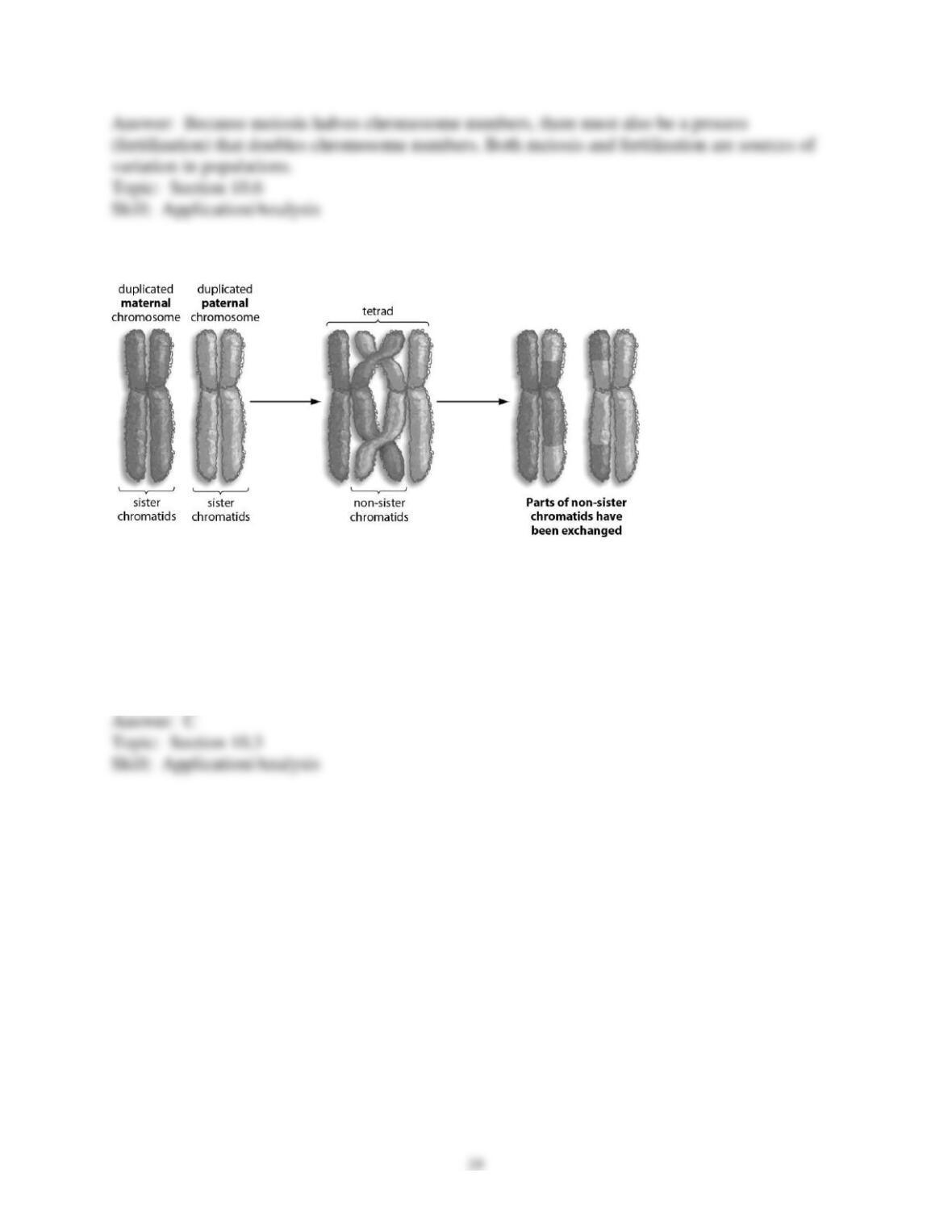
Refer to the figure below, and then answer the question that follows.
80) If crossing over occurs as shown in the figure above, which of the following is true?
A) Sister chromatids exchange genetic material during crossing over.
B) The result of crossing over is four genetically identical chromatids.
C) The result of crossing over is four genetically different chromatids.
D) The resulting chromatids all have a combination of maternal and paternal genetic material.
E) The resulting chromatids either have only maternal genetic material or paternal genetic
material.
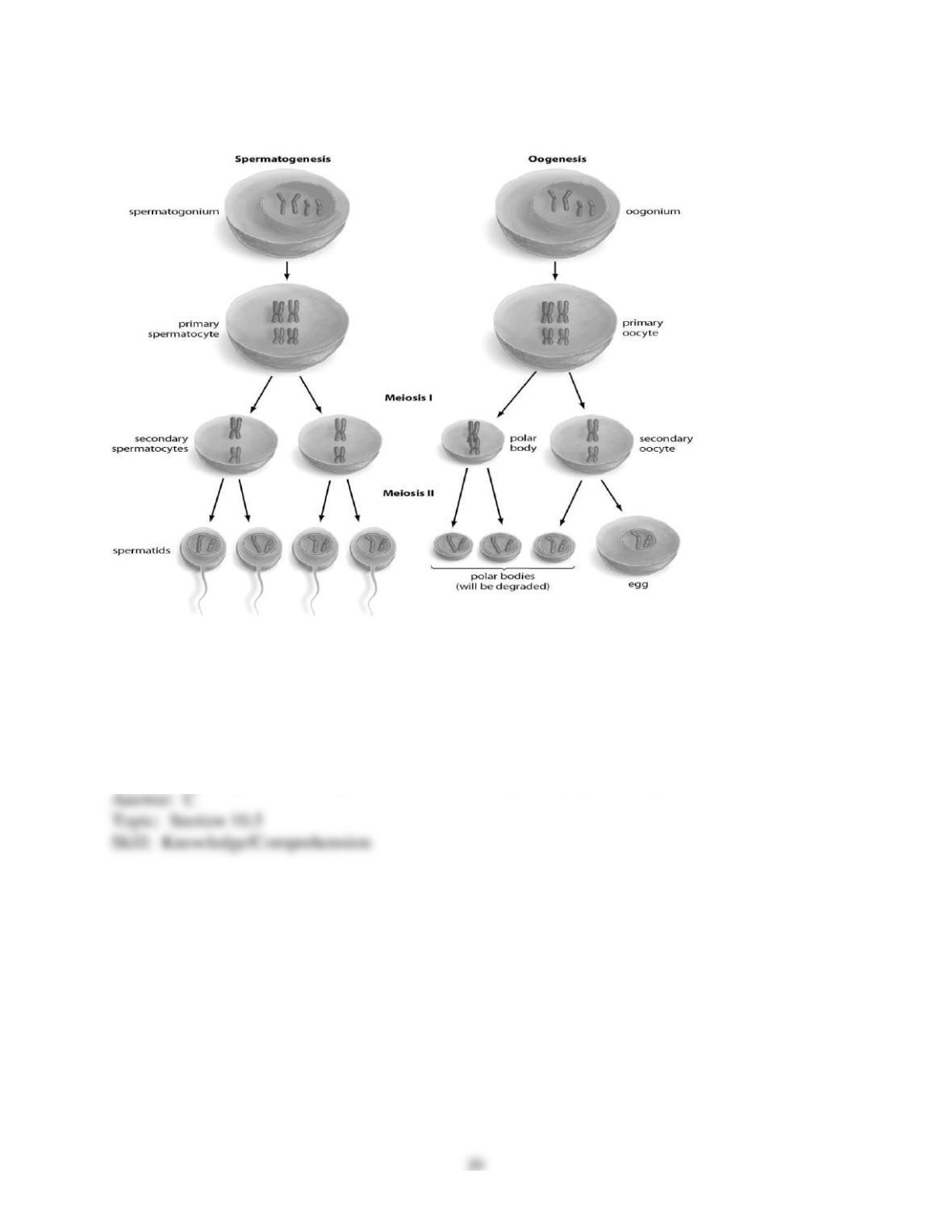
Refer to the figure below, and then answer the question that follows.
81) A difference between spermatogenesis and oogenesis is:
A) sperm are produced after meiosis II, but an egg is produced after meiosis I.
B) spermatids all have the same amount of genetic material, but polar bodies have less genetic
material then the egg.
C) meiosis produces four sperm but only one egg.
D) sperm are haploid, but eggs are diploid.
E) a primary oocyte has more genetic material than a primary spermatocyte.