10
Certain Business Deductions and Losses
Solutions to Tax Research Problems
10-30 Section 165(a) provides the general rule for losses, stating, “there shall be allowed
as a deduction any loss sustained during the taxable year and not compensated for
by insurance or otherwise.” Subsection 165(c)(3) further limits losses sustained by
individuals regarding nonbusiness property to losses arising “from fire, storm,
shipwreck, or other casualty, or from theft.” Several court decisions have dealt
with the issue of whether or not a casualty loss is deductible by a taxpayer if it is
covered by insurance, but the taxpayer does not claim insurance benefits for the
loss. The controversy is focused on the meaning of the phrase in § 165(a), “… any
loss … not compensated for by insurance or otherwise.” The Internal Revenue
Service takes the position that the word “compensated” means “covered” by
insurance. In the cases where the issue has been examined, taxpayers have taken
the position that the word “compensated” means actual payment of insurance
benefits, and that the taxpayer is not “compensated” [i.e., within the meaning of §
165(a)] even though he has insurance to cover the loss, when he elects not to file
an insurance claim.
The Tax Reform Act of 1986 addressed this problem with respect to personal
casualties. Section 165(h)(4)(E) now provides that a personal casualty loss is not
deductible unless the taxpayer files a timely insurance claim with respect to
damage to that property. This requirement applies to the extent any insurance
policy would provide reimbursement. The new law, however, does not address
business and nonbusiness casualties. By implication, it might appear that such a
requirement does not extend to such casualties. The discussion herein reviews the
case law existing prior to the 1986 Act.
The issue was examined in Kentucky Utilities Co. v. Glenn, 68-1 USTC
¶9361, 21 AFTR 2d 1263, 394 F. 2d 631 (6th Cir. 1968), aff’g. 250 F. Supp. 265
(W. D. Ky. 1965). There the taxpayer, Kentucky Utilities Co., sustained a loss
when a generator built by Westinghouse, Inc. was damaged. Although the
taxpayer had insurance coverage through Lloyd’s of London, the taxpayer elected
not to claim the insurance because this would have allowed Lloyd’s of London to
bring suit on behalf of the taxpayer against Westinghouse, Inc. for breach of
warranty. The taxpayer indicated that such litigation would have adversely
affected business relations between itself and Westinghouse, Inc., and thus the
taxpayer opted not to claim the insurance. The taxpayer did seek to deduct the
amount of the loss on its income tax return as a casualty loss. The U.S. District
Court stated that the taxpayer’s loss was one which was compensated (i.e.,
covered) by insurance within the meaning of § 23(f) of the Internal Revenue Code
of 1939 [the predecessor of present § 165(a)], and thus the taxpayer could not
deduct any loss by reason of the damage to its generator. The U.S. Court of
Appeals for the Sixth Circuit upheld the decision of the District Court by merely

stating that it was not clearly erroneous (i.e., meaning that the Appellate Court did
not closely scrutinize the lower court’s decision).
In Axelrod v. Commissioner, 56 T.C. 248 (1971), the facts of the case made it
unnecessary for the Court to confront the pertinent issue; however, in the
concurring opinions of the Court decision, several judges examined the issue.
Judge Quealy indicated that the term “compensated” encompassed “covered”
regarding insurance and casualty losses, pointing to Regulation § 1.165-1(d)(2)(ii)
which refers to allowance of a deduction for a loss in which there is a reasonable
prospect of recovery. According to Judge Quealy, this language indicated that if a
reasonable prospect of recovery existed (e.g., via insurance coverage), then the
loss was a compensated one and no deduction should be allowed. Judge Quealy
also made the analogy that no bad debt deduction would be allowed a creditor
where the facts indicated that the debt could be collected, and the creditor chose
not to collect the debt. He stated that there was no substantive difference between
that situation and the situation where a taxpayer chooses not to collect insurance
on a loss, and that no casualty loss deduction should be allowed a taxpayer with
an insured (i.e., covered) casualty loss.
In the same case, Judge Fay wrote in a separate concurring opinion that a
taxpayer with a loss that is covered by insurance should be allowed a deduction
despite his failure to claim the insurance. Judge Fay stated that given the realities
of the insurance world where a taxpayer might have his insurance policy canceled
or have the policy rates increased substantially if he turns in a claim, he should be
allowed a casualty loss deduction where he relinquishes his right to a claim for
such a valid, practical reason.
In Henry L. Hills v. Commissioner, 82-2 USTC ¶9669, 50 AFTR 2d 82-6070,
691 F. 2d 997 (CA-11, 1982), reh’g denied 1-17-83, aff’g. 76 T.C. 484 (1981), the
U.S. Tax Court and the U.S. Court of Appeals for the Eleventh Circuit squarely
addressed the issue. In that case, the taxpayer’s home had been burglarized several
times. On the fourth such occurrence, the taxpayer did not file an insurance claim
because he feared cancellation of the policy for numerous claims; however, the
taxpayer did deduct the loss as a casualty loss on his income tax return. In
deciding the issue, the Court considered the legislative history of the casualty loss
provisions and concluded that the phrase “losses not compensated for by
insurance” was intended to embody all losses, whether or not the insurance was
claimed. The Court also addressed the statutory construction of § 165(a), stating
that the word “compensated” means “to pay” or “to make up for.” Thus, the Court
concluded that an insured loss which was not (claimed by the insured and) paid
should nonetheless be deductible. The Court did not agree with the IRS argument
that a taxpayer’s failure to file for an insurance claim signifies that the loss results
from that election and not the loss event or transaction. The Court paid particular
attention to Regulation § 1.165-1 (d)(2)(I) which states that the year in which a
loss deduction may be taken depends on certain facts, including when the
taxpayer produced evidence of abandonment of a claim. Although that regulation
appears to be directed toward a litigation context, the Court said that it would be

equally applicable to an insurance claim. The Court thus inferred from this
regulation that abandonment of a claim, including an insurance claim, should not
preclude a taxpayer from taking a casualty loss deduction where such a loss has
been sustained.
Finally, the Court overruled the results of Kentucky Utilities v. Glenn, supra,
due to its failure to deal in any depth with the issue. Axelrod, supra, was dismissed
by the Court as not having dealt sufficiently with the issue, and the case of
Bartlett v. U.S., 75-2 USTC ¶9648, 36 AFTR 2d 75-5574, 397 F. Supp. 216 (D.
Md. 1975), which had held that taxpayers were not entitled to claim a casualty
loss deduction when they voluntarily elected not to pursue their insurance claims,
was expressly disagreed with by the Court.
It should be noted that in 1978 the IRS issued Rev. Rul. 78-141, 1978-1 C.B.
58, which dealt with the pertinent issue. It precluded a taxpayer (here an attorney)
from deducting as an ordinary business expense under § 162 an amount which he
paid to reimburse a client for faulty advice that he gave the client, where the
taxpayer could have, but did not, submit a claim to a malpractice insurer. The
payment was also disallowed as a casualty loss under § 165. In this ruling the IRS
addressed the issue of whether or not a taxpayer may deduct as a loss an amount
that the taxpayer incurs as a loss but does not claim under insurance where an
insurance claim could be pursued. The IRS stated that no such loss deduction
would be allowed in such circumstances. In that ruling, the IRS cited most of the
cases that had dealt with the issue and concluded that the loss in such a situation
would not be deductible under §§ 162 or 165.
The above Revenue Ruling was cited by the IRS in the Hills case, supra, in its
argument for disallowance of a casualty loss deduction where the taxpayer seeks
to deduct a casualty loss which is insured but for which the taxpayer claims no
insurance. As noted above, the IRS did not prevail in the Hills case, supra. A
petition for a rehearing of the latter case was filed by the IRS to the U.S. Court of
Appeals for the Eleventh Circuit, and the decision was upheld; the rehearing of
the appeal was denied January 17, 1983. Thus, it appears that while the IRS
maintains its position enunciated in Rev. Rul. 78-141, supra, the taxpayer in the
pertinent situation could rely on the Hills case, supra, if he sought to deduct an
insured casualty loss for which he made no insurance claim.
The Court of Appeals carefully scrutinized the language of the statute with
specific reference to two areas. The court found (1) that the words “sustained
loss” do not mean that a taxpayer must exhaust insurance claims before a loss is
considered as having been sustained; rather, a loss is sustained for purposes of §
165(c)(3) when the loss event (meaning the fire, storm, shipwreck, etc.) occurs.
The court also found (2) that the phrase “not compensated by” does not mean “not
covered by” insurance; instead, it was found that “compensated” is a word distinct
from “covered,” and that “compensated” means actual receipt of indemnification
from insurers. See D.F. Miller v. Comm., 84-1 USTC ¶9451, 53 AFTR 2d 84-
1252, 733 F. 2d 399 (1984), aff’g. 42 TCM 665, T.C. Memo 1981-431. Thus, the

Sixth Circuit joined the Eleventh Circuit in holding that an insured taxpayer who
elects to forgo filing an insurance claim is nevertheless allowed to deduct the
portion of the loss which could have been compensated for by insurance.
Regarding the facts of the problem, they seem to closely match the fact-
pattern of Hills, supra. In these cases taxpayers had sustained numerous casualty
losses of the type suffered, each taxpayer elected not to claim for an insured loss
due to fear of some adverse change with respect to his insurance policy (e.g., a
cancellation of the policy, an increase in the policy premium rates, etc.), and each
taxpayer sought to deduct the loss as a casualty loss. Given the legal background
of the issue in question here, it seems clear that R (taxpayer in the problem) would
find opposition by the IRS if he sought to deduct as casualty loss his latest auto
accident for which he claimed no insurance; however, R should prevail over the
IRS, if he should choose to litigate the issue, by reliance on the Hills case, supra.
10-31 Section 165 provides the general rule governing the tax treatment of a taxpayer’s
losses. Under this provision, taxpayers are generally allowed to deduct any loss
sustained during the taxable year for which they are not compensated by
insurance. However, § 165(c) limits the deduction of losses of individuals to three
types: (1) a loss incurred in a trade or business; (2) a loss incurred in a transaction
entered into for profit; or (3) a casualty or theft loss. T would probably be unable
to find relief under §§ 165(c)(1) or (2) because his loss was related to his personal
residence rather than his business or an income-producing activity. In addition, it
is unlikely that the loss could be considered a theft loss.
The Code does not define theft. However, the Regulations do provide some
guidance. Reg. § 1.165-8 indicates that theft includes but is not limited to,
larceny, embezzlement, or robbery. Although T may believe that the contractor’s
actions were the equivalent of theft and should be within the reach of the
Regulations definition, the courts have generally allowed a theft loss only when
the alleged theft actually constituted theft under state law. In this case, the
contractor’s actions would not qualify as theft under state law, and, therefore, T
could not claim a casualty loss deduction (nor would he probably want to, due to
the severe limitations imposed on the deductions of personal casualty losses).
Although the general rules governing losses provide little assistance to T, he
will probably be able to claim a deduction under § 166 dealing with bad debts.
Section 166(a) allows a deduction for any debt which becomes worthless within
the taxable year. In order for T to claim a deduction for his loss as a bad debt
under § 166, the contractor’s obligation must be considered a bona fide debt. Reg.
§ 1.166-1(c) provides that a bona fide debt is a debt that arises from a debtor-
creditor relationship based upon a valid and enforceable obligation to pay a fixed
or determinable sum of money. The major issue here is whether the requisite
debtor-creditor relationship exists.
In T’s case, he initially advanced the contractor a sum of money in return for
services to be performed. A strict reading of the Regulations definition would not

extend debt status to this advance in that T does not have a valid and enforceable
obligation to receive a sum of money. This view was taken in Electric Reduction
Co. 275 U.S. 243 (1927). In Electric Reduction, the Supreme Court held that
when a seller breaches an executory contract after the buyer prepays the purchase
price for certain merchandise, the buyer’s right under the agreement was not a
“debt” in either the technical or the colloquial sense for purposes of § 166.
However, if T could obtain a judgment to this end, T’s claim would probably be
elevated to the required debt status.
In Rev. Rul. 69-457 (1969-2 C.B. 32), the Service considered the unfortunate
circumstances of a taxpayer who had made a deposit toward the purchase of a
personal residence that was to be built by a construction company under the terms
of a contract. The construction company became insolvent and discontinued
business without beginning construction of the residence and the taxpayer was
unable to recover his deposit. There was no mention of a court action brought by
the taxpayer. In this situation, the IRS believed that when the taxpayer’s right
under the contract for the delivery of the house became unenforceable, his claim
against the construction company became a right for repayment of money, and,
therefore created the requisite bona fide debtor-creditor relationship. T’s situation
would appear to be somewhat analogous to that of the taxpayer in the ruling.
Although the facts do not indicate the terms of agreement, and, therefore, it is not
known whether there is any obligation for the contractor to refund T’s money
under the contract, this would seem unnecessary in light of the ruling.
10-32 Under the general rule of Code § 165(a), “there shall be allowed as a deduction
any loss sustained during the taxable year and not compensated for by insurance
or otherwise.” For individuals like Mac and Beth, who suffer losses of property
used for personal purposes, deductions are limited under § 165(c)(3) to losses
which “arise from fire, storm, shipwreck, or other casualty, or theft.” The Internal
Revenue Service (IRS) defines a casualty as “damage, destruction, or loss of
property which results from an identifiable event that is sudden, unexpected, or
unusual” ranging from natural calamities such as floods and hurricanes to
vandalism and sonic booms. (See Nonbusiness Disasters, Casualties, and Thefts,
IRS Publication 547 (1993), p. 2).
Once it is determined that, under the guidelines noted above, the losses qualify
as casualty losses, the amount of the loss must be determined. The general rule for
determining the amount deductible is provided by Reg. § 1.165-7(b), which limits
the deduction to the difference between the pre-casualty and post-casualty fair
market values or the adjusted basis of the property, whichever is the lesser.
Standing alone, this provision would allow Mac and Beth a deductible loss of
$105,000 (the lesser of the decline in fair market value ($225,000 – $120,000) or
adjusted basis ($150,000)]. Sound too good to be true? In light of Reg. § 1.165-
7(a)(2)(I), it is. This regulation provides that the fair market value should be
ascertained by competent appraisal which “must recognize the effects of any
general market decline affecting undamaged as well as damaged property which
may occur simultaneously with the casualty, in order that any deduction under

this section shall be limited to the actual loss resulting from damage to the
property.” Herein lies the difficulty confronting Mac and Beth. What portion of
this $105,000 represents “actual loss resulting from damage to the property” as a
consequence of the flood?
Taxpayers have tested the interpretation of Reg. § 1.165-7(a)(2)(I) on
numerous occasions, as is evidenced by the volume of litigation in this area. In
general, the IRS strictly limits casualty losses to the decrease in market value due
to actual physical damage to the property. This position is reflected in Rev. Rul.
66-242, 1966-2 C.B. 56 which addresses a situation where a taxpayer’s home was
damaged in a flood and the appraisal made immediately after the flood took into
account not only the physical damage to the property, but also the decline in
market value due to economic obsolescence attributable to buyer resistance. The
Ruling states, in part, that “the phenomenon of a decline and rise in market value
which commonly occurs after a flood due to psychological resistance to inundated
properties is usually short-lived and is more often than not a mere ‘fluctuation’ in
value. In such case it does not represent an actual loss resulting from damage to
property.”
The courts, in general, have supported the IRS in its interpretation of “damage
to property” i.e., there must be actual physical damage to the property that is the
immediate and direct result of the casualty. In Pulvers, 69-1 USTC ¶9222, 23
AFTR2d 69-678, 407 F.2d 838 (CA-3, 1969), the taxpayer’s residence sustained
no damage during a landslide, but 3 nearby houses were destroyed. The taxpayers
deducted the decline in the fair market value as a casualty loss. The IRS promptly
disallowed it. The court agreed with the Service, stating that
“[the taxpayer’s] loss is one Congress could not have intended to include in §
165(c)(3). The specific losses named are fire, storm, shipwreck, and theft.
Each of those surely involve physical damage or loss of physical property.
Thus we read ‘or other casualty’ in para materia, meaning ‘something like
those specifically mentioned.'”
[See also Kamanski, 73-1 USTC 9371, 31 AFTR2d 73-1157, 477 F.2d 452 (CA-
9, 1973) and Squirt Co., 51 T.C. 543 (1969).]
The courts have made exceptions to this general rule in cases where there was
little physical damage to the property but where there was permanent impairment
due to other causes. In the case of Stowers, 59-1 USTC ¶9186, 3 AFTR 2d 505,
169 F.Supp. 246 (D.Ct. Ms., 1958), the taxpayer was allowed a deduction for the
decline in market value of his physically undamaged property when the court
determined that it was “no longer useful” because the primary means of access to
the property was destroyed by a landslide and then permanently sealed off by
local authorities.
An exception which deserves especially close attention because of its
similarity with the situation at hand, is Finkbohner, 86-1 USTC ¶9393, 57

AFTR2d 86-1400, 188 F.2d 723 (CA-11, 1986). Here the taxpayer’s home
received relatively minor damage from flooding in the immediate vicinity.
However, the municipal authorities demolished over half of the surrounding
homes and acquired the lots to be maintained as permanent open space, creating a
“lonesome neighborhood,” more exposed to crime and less private because of the
maintenance of open spaces. In addition, the original decision to demolish the
taxpayer’s home was reversed after it was determined that even a serious flood, as
would occur only once every 100 years, would do little damage to the taxpayer’s
home. The taxpayer claimed a loss of $24,900 based on the decline in fair market
value. The IRS disallowed all but $1200 (representing the decline in value due to
physical damage). In this instance, the District Court agreed with the taxpayer and
the Court of Appeals upheld the decision, noting that the case at hand differed
from similar cases in that:
… the impact of the flood on the market value shows itself not wholly or
chiefly in the expectation that additional floods will in the future occur, but
more directly in changes in the neighborhood, or acts of public officials that
will outlast the fresh recollections of disaster … It is evident that, for example,
the permanent removal of seven out of twelve neighboring houses is a
permanent change. Awareness of it by buyers does not reflect their
anticipation of future catastrophe … Since the loss of value from this and other
causes is permanent, there will not be any recovery of it as fears for the future
become less acute. That is another matter with which the cited case authority
does not deal. Plaintiffs, taxpayers, perceiving this, were astute enough to
state and present their case on the permanent impairment theory.
As a result of Finkbohner, can taxpayers be more confident of claiming as
casualty losses, at least in part, the decline in market value of their property which
is not attributable to the physical damage sustained? Possibly, but based on the
bulk of the case law relating to this issue, the IRS will continue to challenge a
deduction of this portion of a casualty loss and, as yet, there is no indication that
other district and circuit courts will rely on Finkbohner as a precedent. If the
taxpayer is willing to challenge the IRS on this issue, they should be prepared to
show that the decline in market value of their property is tied to a permanent loss
of the intrinsic qualities of the surrounding community and not to temporary
buyer resistance. [Note: There are no Code or Regulation guidelines which aid the
taxpayer in this determination. In Finkbohner, the jury assigned a value of
$12,500 for the loss of value due to permanent impairment. This was
approximately 50% of the original deduction they had claimed.]
If Mac and Beth prefer to avoid the risk of litigation, they should treat as a
casualty loss only that portion of the decline in market value attributable to the
physical damage sustained. Guidance as to the determination of this value is
provided by Reg. § 1.165-7(2)(ii), which states that the cost of repairs is
acceptable as evidence of the loss of value if the following criteria are met:
1. the repairs are necessary to restore the property to its condition

immediately before the casualty;
2. the amount of the repairs is not excessive;
3. the repairs do not care for more than the casualty damages; and
4. the value of the property after repairs does not, as a result of the
repairs, exceed the value of the property before the casualty.
Once the amount of the casualty loss is determined, it is reduced by any
insurance reimbursements or other compensation received by the taxpayers. In the
case of property used for personal purposes, this amount is then subject to the
restriction under § 165(h)(1), which provides that the deduction is limited to that
portion of the loss which exceeds $100. This $100 limitation applies separately to
each casualty occurrence, not to separate items of damaged, destroyed or lost
property. The application of this provision gives the taxpayer a net casualty loss,
which is subject to yet another limitation under § 165(h)(2), which states that only
the amount of the net casualty loss exceeding 10% of the taxpayer’s A.G.I. is
allowable as a deduction.
Mac and Beth may also be interested in knowing that the appraisal fees
incurred in determining a casualty loss, although not a part of the casualty loss
deduction, is allowed as a miscellaneous itemized deduction subject to the 2% of
A. G. I. limit (Nonbusiness Disasters, Casualties, and Thefts, IRS Publication 547
(1993), p. 4).
10-33 Section 166 allows a deduction for worthless bad debts. However, the treatment is
quite different depending on whether the worthless loan is a business or
nonbusiness bad debt. If the loan is a nonbusiness bad debt, § 166(d) provides that
the loss must be treated as a short-term capital loss for which the deduction is
severely limited (capital gains plus $3,000 of ordinary income). In contrast, if the
loan is a business bad debt, § 166(a) treats the loss as an ordinary loss that is fully
deductible in the year of worthlessness. Moreover, the loss can add to or create a
net operating loss which the taxpayer could immediately carryback to generate a
refund.
Unfortunately, the Code and Regulations provide little guidance as to when a
worthless bad debt is a business or nonbusiness bad debt. Section 166(d)(2)
defines a nonbusiness bad debt as a debt other than “(A) a debt created or
acquired¶in connection with a trade or business of the taxpayer; or (B) a debt the
loss from the worthlessness of which is incurred in the taxpayer’s trade or
business.” Regulation 1.166-5(b) echoes the Code providing that a business debt
is a debt which is created, or acquired, in the course of a trade or business of the
taxpayer, determined without regard to the relationship of the debt to a trade or
business of the taxpayer at the time when the debt becomes worthless; or a debt
the loss from the worthlessness of which is incurred in the taxpayer’s trade or
business. The Regulations go on to explain that the “question whether a debt is a

nonbusiness debt is a question of fact in each particular case.” The Regulations
also indicate that “the character of the debt is to be determined by the relation
which the loss resulting from the debt’s becoming worthless bears to the trade or
business of the taxpayer. If that relation is a proximate one in the conduct of the
trade or business in which the taxpayer is engaged at the time the debt becomes
worthless, the debt is a business bad debt.
The long list of court cases that have dealt with this problem have struggled to
identify when a debt has the requisite “proximate” relationship to the taxpayer’s
trade or business. In a landmark case in this area, Whipple v. Comm. 63-1 USTC
¶9466, 11 AFTR2d 1454, 373 U.S. 193 (USSC, 1963), Whipple had made sizable
cash advances to the Mission Orange Bottling Co., one of the several enterprises
that he owned. He spent considerable effort related to these enterprises but
received no type of compensation, either salary, interest, or rent. When the
advances subsequently became worthless, Whipple deducted them as a business
bad debt. The Supreme Court held that the loans made by the shareholder to his
closely held corporation were nonbusiness bad debts even though Whipple had
worked for the company. According to the Court:
Devoting one’s time and energies to the affairs of a corporation is not of itself,
and without more, a trade or business of the person so engaged. Though such
activities may produce income, profit or gain in the form of dividends—this
return is distinctive to the process of investing—as distinguished from the
trade or business of the taxpayer himself. When the only return is that of an
investor, the taxpayer has not satisfied his burden of demonstrating that he is
engaged in a trade or business.
Since this holding, taxpayers have achieved limited success where they have been
able to convince the court that the loans were made to protect their employment
rather than their investment. In this regard, taxpayers must demonstrate that
protection of employment is not just one of the reasons for which the loan was
made but the primary reason. In U.S. v. Generes 72–1 USTC ¶9259 (USSC,
1972), the Supreme Court indicated that “in determining whether a bad debt has a
proximate relation to the taxpayer’s trade or business-the proper standard is that of
dominant motivation.” Coupling the court’s arguments in Whipple and Generes,
Malone can claim ordinary loss treatment only if he is able to show that the
primary reason for making the loan was to protect his employment and not his
investment.
To assess the motivation for the loan, subsequent decisions have generally
tried to look at the relationship between the taxpayer’s investment in the
corporation (the fair market value of the corporation at the time of the loan), his or
her compensation from the corporation, and other sources of income. As a general
rule, if the taxpayer has a small investment but a large salary, the implication is
that the loan is to protect the salary and not the investment. Conversely, if the
taxpayer has a large investment and draws a small salary, the belief is that the
loan is to protect the investment. A thorough analysis of the issue will go beyond

these obvious observations and attempt to focus-as the courts have done-on the
relationship between the investment and salary. For example, in Generes, the
Supreme Court in holding against the taxpayer partially seized on the fact that the
taxpayer’s investment was over five times his aftertax salary. In contrast, the court
found for the taxpayer in Litwin 93-1 USTC ¶50,041 (CA-10, 1993) where the
taxpayer’s investment was only about 2 and Vi times has salary. One issue that
should be discussed is whether the analysis should be based on the value of the
original investment or the value of the corporation at the time the loan was made.
In Charles L. Hutchinson, 43 T.C.M. 440 (1982) the court found a loan could
not be obtained from traditional sources, suggesting that the value of the
corporation at the time the loan was made would not support it. The court also
saw this as one fact that suggested the loan was made to protect the taxpayer’s
salary rather than his investment. The situation appears similar here. Although
Malone had invested over $200,000 initially, it would appear that the value at the
time of the loan was far less. This is suggested by the fact that Malone made the
loan rather than securing it from traditional sources such as a bank. Presumably
lenders would not make the loan because the corporation’s value would not
support it. As in Hutchinson, this fact suggests that the motivation for the loan
was to protect the taxpayer’s salary. If this is the case, the salary might exceed the
value of the investment. But, this is not made clear from the facts. The facts
indicate only that Malone was forced to loan the corporation money in order to
keep it afloat. (Instructors can make this case more interesting by telling the
students that there may be critical facts missing and they are free to make an
appointment with the taxpayer (the instructor) to ask additional questions). If in
fact the value of the company is minimal, this would suggest the primary
motivation for the loan was to protect the taxpayer’s salary.
The courts also take into account other sources of income available to the
taxpayer. If the taxpayer has other sources of income, this suggests that the salary
is of less importance than the investment. For example, in Hutchinson, the court
held for the taxpayer in part because the taxpayer’s only source of salary income
was from the corporation to which he made the loan and this constituted about 60
percent of his entire gross income. In this case, the taxpayer has pension income
of $20,000, making has salary 78 percent ($70,000/$90,000) of his total income.
A thorough analysis of this issue might assess how other court’s have evaluated
this relationship. For example, in Generes, the salary was about 30 percent of the
taxpayer’s total income and the court held against the taxpayer.
The courts have also looked at the size of the loan relative to the size of the
investment to ascertain the primary motivation. For example, in Litwin, the loan
was far greater than the investment suggesting that the motivation was to protect
something other than the investment.
Other facts have helped to sway the court one way or another. For example,
the courts have looked at whether or not the individual could obtain other
employment if the borrowing corporation were to fail. For example, in Litwin, the

taxpayer was 82 years old, causing the court to conclude that he would be unable
to secure employment if he were to lose the job provided by his corporation.
Similar facts seem to be present here since Malone is about 77. Another factor to
consider is the amount of time spent working for the corporation. In Generes, the
taxpayer spent only six to eight hours a week working at the business. In this case,
Malone spends 20 hours a week.
Although it is far from clear, based on the facts and circumstances, it would
appear that Malone’s dominant motivation for the loan was to protect his
employment and the salary he was drawing. Consequently, he should be able to
treat the loan as a business bad debt.
10
Certain Business Deductions and Losses
Test Bank
True or False
________ 1. Dr. S has done extremely well financially. Several years ago, his good
friend T started a small amusement park with such attractions as a water
slide and a miniature golf course. T persuaded S to lend his new business
$5,000, which he would repay to S in three years with 15 percent interest
annually. The note came due this year and T was unable to repay
because his business had failed. In light of the business nature of this
debt, Dr. S may treat the bad debt as an ordinary loss.
________ 2. Q Corporation uses the cash method of accounting. The corporation
manufactures microwave ovens. Two years ago it loaned $50,000 to a
supplier who was having difficulties due to an unexpected rise in
material prices. This year the debt became worthless. Q may not claim a
deduction because it is a cash basis taxpayer and has no basis in the debt.
________ 3. B made a $20,000 loan to his good friend C to help his struggling
business venture. This year, C filed for bankruptcy. B anticipates
receiving $4,000 after the bankruptcy proceedings are complete,
probably next year. B may claim a deduction this year.
________ 4. N Airlines declared bankruptcy this year. As a result, it was unable to
pay many of its employees their salaries which they had earned. For
example, S, one of its pilots, worked all of October and did not receive
his $5,000 salary for that month. S is not entitled to a bad debt
deduction.
________ 5. An individual’s nonbusiness bad debt is treated as if it arose from the
sale of a capital asset.

________ 6. Cash basis taxpayers are not allowed a bad debt deduction for worthless
accounts receivable arising from routine credit sales.
________ 7. C operates a glass business as a sole proprietorship. The business uses
the cash method of accounting. C replaced all of the windows for J
Corporation when they were broken by high winds. J Corporation went
out of business before C could collect the $3,000 due for the work he
performed. C may deduct $3,000 as a bad debt.
________ 8. In accordance with generally accepted accounting principles, JKL
Manufacturing Corporation uses the reserve method of accounting for
bad debts for financial accounting purposes. JKL also must use this
method for tax purposes.
________ 9. R backed into his neighbor’s mailbox, destroying it. R repaired the
mailbox and may deduct this cost (subject to limitations) as a casualty
loss.
________ 10. Under § 165(c)(3) (deductions for losses related to personal property), X
may deduct, subject to limitations, the loss of value in his home when a
vacant lot in the adjoining neighborhood is discovered to be a toxic
waste dump.
________ 11. H’s house was flooded this year due to abnormal rainfall. She was forced
to stay in a motel while the water subsided. Her motel stay, which cost
$300, was not covered by her insurance policy. H may deduct the $300
as part of her casualty loss from the flood.
________ 12. A fire in T’s garage destroyed several uninsured items. The items
included a moped (cost $400, FMV $300), a lawnmower (cost $95, FMV
$75), and an electric table saw (cost $60, FMV $50). Only the value of
the moped is potentially deductible, because the other items do not
exceed the $100 floor for nonbusiness casualty losses.
________ 13. E’s bake shop business suffered slight property loss due to a recent
earthquake. Unfortunately, his insurance policy did not provide coverage
for damage caused by an earthquake. Moreover, assuming the damage is
less than 10 percent of E’s adjusted gross income, he will receive no
relief from the tax law for his loss.
________ 14. M and his wife are Kansas wheat farmers. This November he suffered a
casualty loss when his entire crop was destroyed by a flash flood,
resulting in a $40,000 loss. Thankfully, none of his personal belongings
were damaged. In order to help farmers in his area obtain low interest
loans and provide them with other relief, the whole town in which he
lived, including his farm, was declared a disaster area. M’s A.G.I. last
year was $30,000 due to the terrible drought. This year he anticipates his
A.G.I. to be over $130,000 before the casualty. M should deduct the loss

in the prior year.
________ 15. In providing the deduction for net operating losses, Congress intended to
allow a taxpayer to deduct only his true economic loss or business loss.
Accordingly, such nonbusiness expenses as a personal casualty loss do
not increase a taxpayer’s NOL.
________ 16. This year R opened a retail shoe store, Shoe Jamboree. The business has
less than $10 million in gross receipts. Even if the business adopts the
cash method of accounting, it is still required to use the accrual method
to account for purchases and sales of inventory.
________ 17. Feelwell Corporation manufactures aspirin. Its gross receipts for the last
10 years have averaged just over $1 million. The corporation must
capitalize costs of direct materials and direct labor but may expense any
indirect costs.
________ 18. Unlimited Appliances Corporation, a retailer, sells home appliances. Its
gross receipts for the last 10 years have averaged just over $1 million.
The corporation must capitalize the costs of direct material and direct
labor but may expense any indirect costs.
________ 19. Great Greeting Card Corporation operates a chain of retail card shops.
The company’s current policy is to capitalize the cost of cards purchased
and expense all freight charges. This practice violates the method of
accounting for inventory prescribed by the Regulations.
________ 20. Colossal Chocolate Company manufactures candy bars. Its gross receipts
over the last several years have averaged $5 million. For budgeting and
financial reporting purposes, the accounting department prepares
financial statements using the variable costing approach. Under this
approach, direct materials and labor are capitalized. Indirect costs that
vary with production are capitalized, while fixed indirect costs are
expensed. Colossal is not allowed to adopt this method of accounting for
tax purposes.
________ 21. The management of Mogul Manufacturing has decided to switch from
FIFO to LIFO. Because this is a change in accounting method, the
company must secure approval from the IRS before it can switch.
________ 22. For many years, T Corporation accounted for inventories using FIFO
and the lower of cost or market methods. T may switch to LIFO and
retain the lower of cost or market valuation method.
________ 23. Taxpayers may use the lower of cost or market valuation method in
conjunction with FIFO.
________ 24. In the past, Zip Corporation has used FIFO and the lower of cost or

market valuation method to account for inventories. A switch to LIFO is
considered a change in accounting method. However, they may continue
to use the same valuation method.
________ 25. For tax purposes, LIFO inventories must be valued using the lower of
cost or market valuation method.
________ 26. Taxpayers are not permitted to adopt LIFO for tax purposes if they use
FIFO for financial reporting purposes such as reports to shareholders or
creditors.
________ 27. In valuing inventories using the lower of cost or market approach, the
term market means the price at which the item normally sells in the
market that it is normally traded (e.g., retail or wholesale) by the
taxpayer.
________ 28. Z Corporation operates a department store that offers hundreds of
different items for sale, from lawn mowers to lollipops. It values its
inventory using the lower of cost or market approach. In applying this
method, the company can either compare the total cost of the inventory
to its total value or compare each item to its market value.
________ 29. For financial accounting purposes, R uses FIFO and the lower of cost or
market to value his inventories. For tax purposes, no deductions may be
claimed for any write-downs of inventory to market.
________ 30. Although financial accounting allows write-downs of inventory to net
realizable value, there is nothing comparable in the tax law. The tax law
limits the write-down to replacement cost.
Multiple Choice
________ 31. W is an entrepreneur. He owns numerous companies including Guns
Corporation. He also serves as the corporation’s chief financial officer.
Because of bad publicity relating to assault weapons and fire arms in
general, the corporation’s sales suffered this year. As a result, W
advanced $30,000 to the corporation. No note or other evidence of
indebtedness was prepared relating to the advance. Subsequently,
legislation was passed which put the corporation out of business and W’s
loan became worthless.
a. Assuming that the loan was to protect W’s investment, he may treat
the $30,000 as an ordinary loss.
b. Assuming that the loan was to protect W’s employment, he may treat
the $30,000 as a short term capital loss.
c. Assuming that the loan was to protect W’s employment, he may treat

the $30,000 as a business bad debt and deduct it to the extent of his
capital gains plus $3,000.
d. Assuming that the loan was to protect W’s employment, he may treat
the $30,000 as a business bad debt and deduct it as an ordinary loss.
e. The treatment of the $30,000 will be the same regardless of W’s
motivation for the loan.
________ 32. X, a psychiatrist, is a cash-basis taxpayer. He charges Z $100 per session
and bills him monthly. When Z declares bankruptcy, he owes X $400.
What course of action is open to X?
a. $400 may be currently deducted against ordinary income.
b. $400 may be currently deducted against capital gains.
c. Any deduction is postponed until Z is released.
d. No deduction is allowed.
________ 33. J, a cash basis taxpayer, is the general manager of a minor league
baseball club. The corporate owner has promised J, in a valid contract, a
$5,000 bonus if attendance exceeded 250,000 this year. Attendance was
250,070. The owner reneges on the $5,000 bonus. Upset, J quits and
goes to Florida.
a. J can treat the $5,000 that was not paid as a business bad debt.
b. J can treat the $5,000 that was not paid as a nonbusiness bad debt.
c. J cannot deduct the $5,000 that was not paid.
d. None of the above
________ 34. T’s personal boat is damaged in a hurricane. The damage is appraised at
$300, and the appraiser charges a $50 fee. T’s A.G.I. this year is
$100,000. If the insurer reimburses T $250, what amount related to this
casualty may be deductible from A.G.I.?
a. $0
b. $50
c. $100
d. $350
________ 35. R’s personal sailboat is destroyed in a hurricane. The sailboat has a basis

of $2,000 and a fair market value of $3,000. If R chooses not to file a
claim with the insurer for the loss of the boat, she may deduct what
amount of the loss?
a. $0
b. $900
c. $1,900
d. $2,900
________ 36. In January of this year, B’s family automobile was completely destroyed
in a collision with an uninsured drunk driver. The car, which originally
cost $3,500 and had a fair market value of $2,700 immediately before
the accident, was worthless afterwards. B had $250 deductible on his
insurance and in June received a $2,450 check from the insurance
company. He used the proceeds to purchase a car for $2,000. B itemizes
his deductions. Based on these facts, the amount of casualty loss he may
claim in computing his taxable income is
a. $150
b. $250
c. $600
d. $950
________ 37. F’s furniture business suffered a substantial property loss due to a recent
earthquake. F’s insurance policy did not provide coverage for damage by
an earthquake. The property, which was totally worthless after the
quake, had been worth $60,000 (basis $20,000). F’s A.G.I. this year
before the casualty is $90,000. F is provided some relief from his
misfortune in that he may deduct
a. $10,900
b. $11,000
c. $20,000
d. $60,000
________ 38. D purchased a personal residence in Los Angeles three years ago for
$200,000 and insured it for that amount. Its fair market value this year
was $300,000. This year the house burned down. The insurer paid the
insured value of $200,000 in full. D’s A.G.I. is $25,000. Assuming she

has no capital gains or other losses for the year, what amount may she
deduct?
a. $0
b. $97,400
c. $99,900
d. $200,000
e. Some other amount
________ 39. Last year F was accident-prone. He knocked over an expensive vase,
shattering it; left an old radio on that caused a fire that destroyed his
office equipment; and wrecked his bike. The bases and fair market
values of the property are shown below. Assuming F does not elect to
replace the vase or bike, and that he receives $5,000 for the vase,
$25,000 for the office equipment, and $25 for the bike, what must he
report?
Fair Market Value
Adjusted Basis Before Casualty After Casualty
Vase $ 2,000 $ 5,000 $ 0
Office equipment 20,000 26,000 0
Bike 300 95 50
a. $7,900 capital gain
b. $8,000 capital gain
c. $8,025 capital gain
d. $7,980 capital gain
e. Some other amount
________ 40. This year D’s hunting cabin worth $5,000 (basis $8,000) was destroyed
by fire. The cabin was uninsured. If D’s A.G.I. is $40,000 this year, how
much of the loss may be claimed as an itemized deduction?
a. $900
b. $4,000

c. $4,900
d. $5,000
e. Some other amount
________ 41. B’s antique furniture, which cost her $5,000 and was worth $10,000, was
completely destroyed by a burglar. She carried no insurance. B’s A.G.I.
for the year was $20,000. How would this loss affect B’s adjusted gross
income (A.G.I.)?
a. Decrease A.G.I. by $2,000
b. Decrease A.G.I. by $2,900
c. Decrease A.G.I. by $4,900
d. Decrease A.G.I. by $5,000
________ 42. Which of the following cannot create a net operating loss that can be
carried back or forward?
a. A loss from operating a sole proprietorship
b. A casualty or theft loss to personal-use property
c. A loss attributable to an interest in a partnership
d. A loss attributable to an interest in an S corporation
e. All of the situations above can create an NOL
________ 43. Which of the following can add to or create a net operating loss that can
be carried back or forward?
a. Moving expenses
b. Interest and taxes on a personal residence
c. Alimony
d. Contribution to an individual retirement account
e. More than one of the above
________ 44. Which of the following statements regarding the net operating loss
provisions is false?
a. The provisions generally allow a loss in one year to offset income in

other years.
b. Personal and dependent exemptions are deducted in computing the
net operating loss deduction.
c. A net operating loss may be carried back three years and forward
until it is exhausted.
d. In lieu of carrying back a loss, the taxpayer may elect to carry the
loss forward.
e. More than one but less than all of the statements above are false.
________ 45. Dotcom Corporation suffered a net operating loss for 2012. Under the
general rules, the corporation
a. May carry back the loss first to 2010, and 2011, and then carry it
forward until 2027
b. May elect to forgo the carryback period and carry the loss forward
until 2027
c. May carry back the loss first to 2010, and 2011, and then carry it
forward until 2032
d. May carry back the loss first to 2009
e. None of the above is correct.
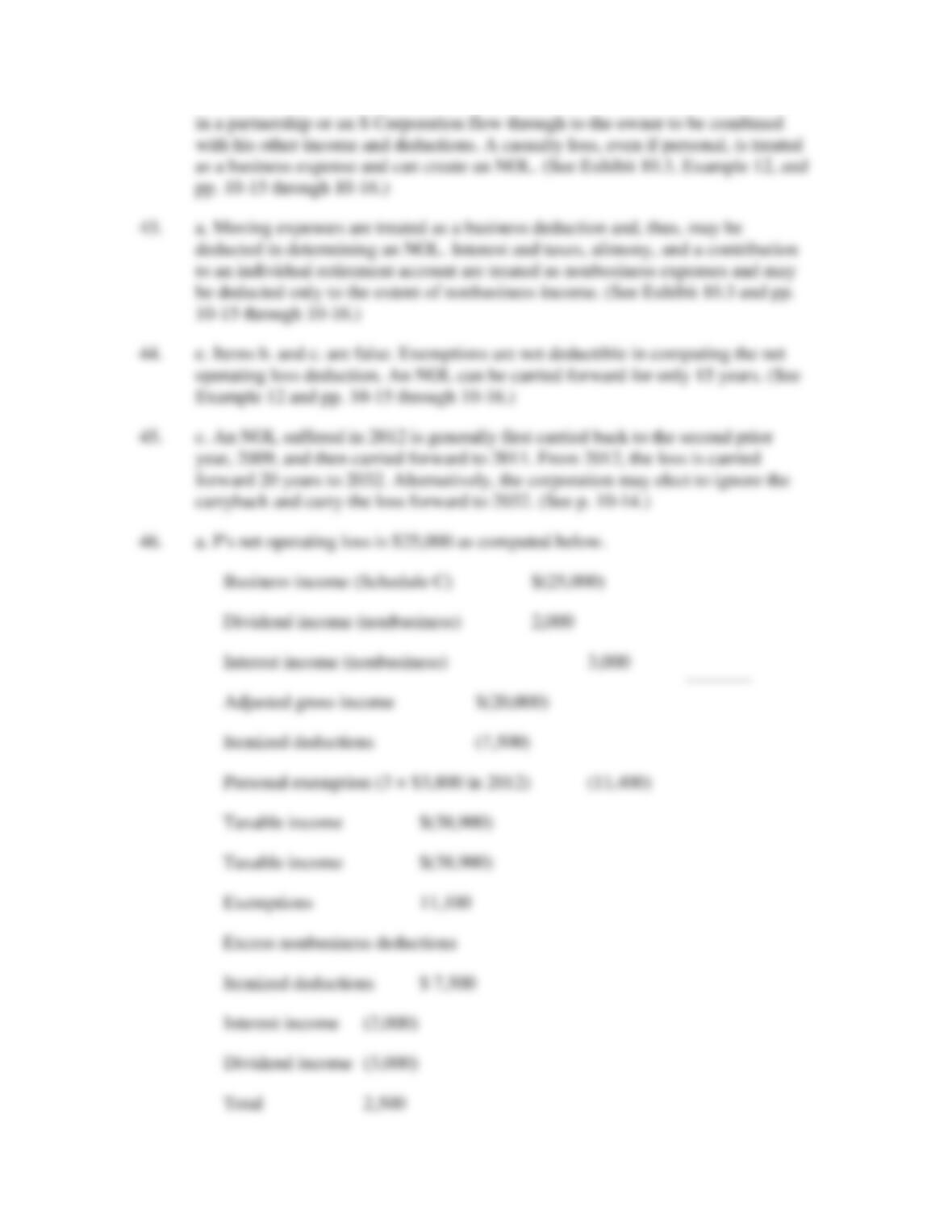
________ 46. P is divorced with two children. P owns and operates a small
photography lab, Fast Photos Corporation, an S Corporation. For the
current year, P’s loss from the business was $25,000. In addition, the
following information was obtained from his personal records:
Interest income $ 3,000
Dividend income 2,000
Mortgage interest 7,500
Personal and dependent exemptions (3 × $3,650) 10,950
P’s net operating loss for the year is
a. $25,000
b. $38,000
c. $27,500

d. $20,000
e. Some other amount
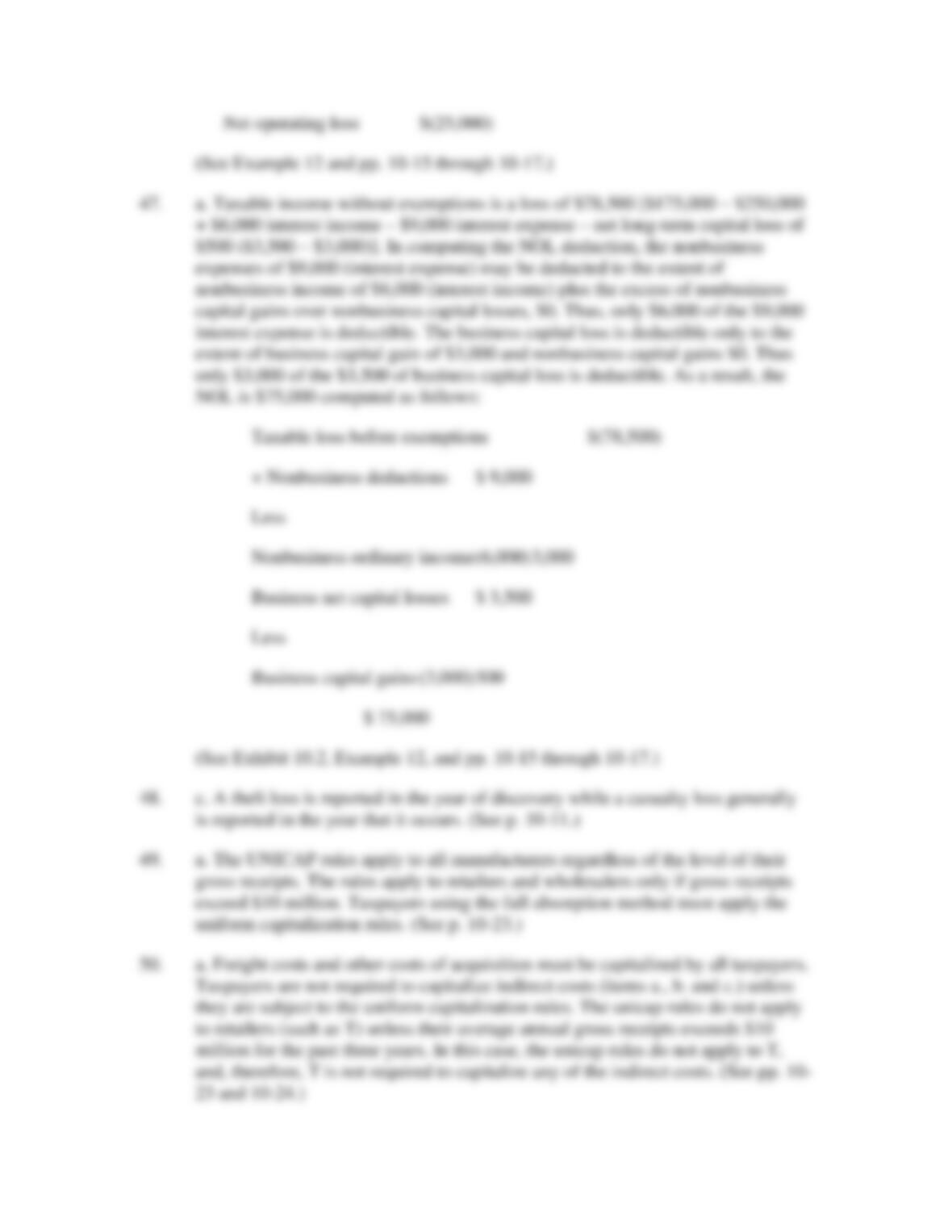
________ 47. H and M, married with two dependent children, operate a piano and
organ store. Their records for the current year revealed the following:
Gross income from sales $175,000
Business operating expenses 250,000
Interest income from investment 6,000
Interest expense on home mortgage 9,000
Long-term capital gain (business) 3,000
Long-term capital loss (business) 3,500
Their net operating loss for the year is
a. $75,000
b. $75,500
c. $78,500
d. $82,000
________ 48. In the fall of 2011, a severe storm struck the resort area of South Padre
Island. As a result, many people suffered losses due to water damage and
subsequent looting. R did not discover that his resort condominium had
been burglarized until 2012. Similarly, S did not determine that there had
been water damage to his condominium until 2012.
a. R will report his loss on an amended return for 2011.
b. Both R and S will report their losses on their 2012 tax returns.
c. R will report his loss on his 2012 tax return.
d. None of the above
________ 49. Which of the following statements is true regarding application of the
uniform capitalization rules?
a. The unicap rules apply to all manufacturers.
b. The unicap rules apply to all retailers and wholesalers.

c. The unicap rules do not apply to any taxpayers who have average
annual gross receipts for the last three years of less than $10 million.
d. The unicap rules do not apply to taxpayers using the full-absorption
method.
________ 50. T operates a hardware store, selling primarily to the public. The
company’s average sales are $900,000. Which of the following costs
must it capitalize in accounting for its inventory?
a. Freight
b. Utility costs of a warehouse several miles from the retail outlet
c. An allocable portion of general and administrative costs
d. Salary cost of person in charge of purchasing inventory
e. More than one of the above
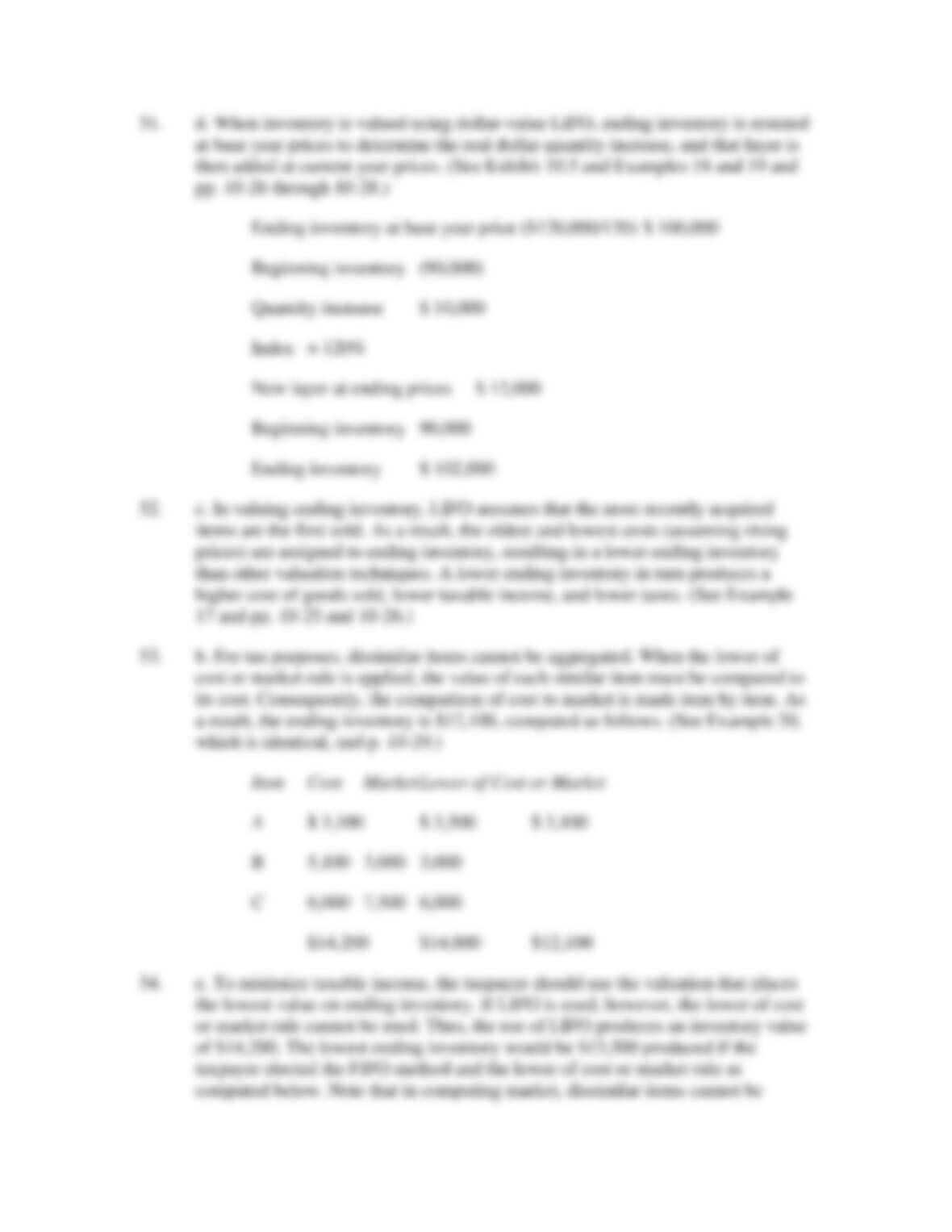
________ 51. Gizmo Corporation adopted the dollar-value method of accounting for
its inventory on January 1, 2011. On that date, its ending inventory was
valued at $90,000. On December 31, 2012, ending inventory’s value at
current prices was $120,000. If the current year index is 120%, the value
of Gizmo’s ending inventory is
a. $144,000
b. $108,000
c. $120,000
d. $102,000
e. None of the above
________ 52. Taxpayers who adopt LIFO during periods of rising prices can expect
a. Lower ending inventory, lower costs of goods sold, higher net
income, and higher tax liability
b. Higher ending inventory, lower costs of goods sold, higher net
income, and higher tax liability
c. Lower ending inventory, higher costs of goods sold, lower net
income, and lower tax liability
d. Higher ending inventory, higher costs of goods sold, lower net
income, and lower tax liability

________ 53. Y’s inventory records reveal the following information:
Item Cost Market
A $ 3,100 $ 3,500
B 5,100 3,000
C 6,000 7,500
$14,200 $14,000
For financial accounting purposes, Y values its ending inventory using
FIFO and the lower of cost or market methods. For tax purposes, the
value of Y’s ending inventory is
a. $14,200
b. $12,100
c. $14,000
d. Some other amount
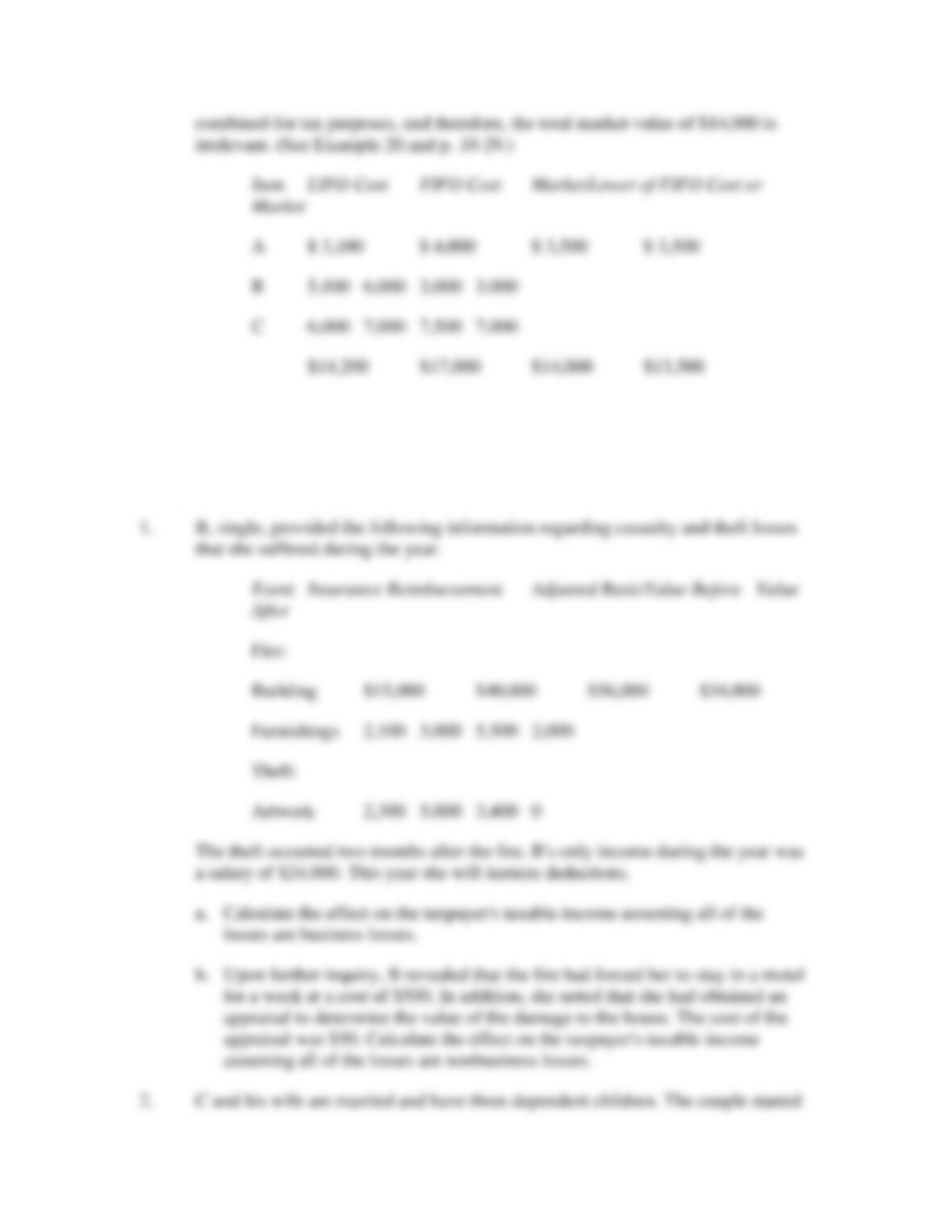
________ 54. L’s inventory records reveal the following information:
Item LIFO Cost FIFO Cost Market
A $ 3,100 $ 4,000 $ 3,500
B 5,100 6,000 3,000
C 6,000 7,000 7,500
$14,200 $17,000 $14,200
Assuming L wishes to value its inventory so as to produce the lowest
taxable income for the current year, its ending inventory value would be
a. $14,200
b. $12,100
c. $14,000
d. $17,000
e. Some other amount
10
Certain Business Deductions and Losses
Solutions to Test Bank
True or False
Multiple Choice
10
Certain Business Deductions and Losses
Comprehensive Problems
Solutions to Comprehensive Problems