1. To recover for a defective product, an injured person must be in a contractual relationship (privity) with the seller.
a.
True
b.
False
2. Most states in the United States have adopted strict product liability whereby an injured person may recover damages
by showing that a defendant was negligent.
a.
True
b.
False
False
1
Easy
10-1 Theories of Recovery
3. In regard to a product liability action, a disclaimer of liability is generally effective.
a.
True
b.
False
False
1
Moderate
10-5 Who May Be Strictly Liable for Product Defects?
4. Strict liability in tort applies only to products, not to services.
a.
True
b.
False
True
1
Moderate
5. An unusual use that is reasonably foreseeable may be considered a normal use of a product.
False
1
Easy
10–1a Breach of Warranty
a.
True
b.
False
6. The main holding in CASE 10.1, MacPherson v. Buick Motor Co. (1916), was Buick’s liability without privity of
contract with the buyer, MacPherson.
a.
True
b.
False
False
1
Moderate
10–1b Negligence
7. A court is not bound by the Restatement’s formulation of product liability law.
a.
True
b.
False
1
Moderate
10-1 Theories of Recovery
8. A design defect may result from the manufacturer’s choice of the product’s materials.
a.
True
b.
False
True
1
Moderate
10–4b Design Defect
9. Under federal law, manufacturers, but not sellers, may be held strictly liable for a defective product.
a.
True
b.
False
True
1
Moderate
10–8e Unforeseeable Misuse of the Product
10. A seller should enter into a contract of indemnity with a manufacturer giving the seller a right to reimbursement if
found liable for a defect caused by the manufacturer.
a.
True
b.
False
True
1
Moderate
10-5 Who May Be Strictly Liable for Product Defects?
11. Because other countries have applied principles of assumption of risk, the U.S. is the only country where the tobacco
industry faces legal problems.
a.
True
b.
False
False
1
Moderate
10–10 Tobacco and “Big Food”
12. If the use of a product carries an obvious risk, the manufacturer will not be held liable for injuries that result from
ignoring the risk.
a.
True
b.
False
True
1
Moderate
10–8c Obvious Risk
13. Product liability is the legal liability manufacturers and sellers have for defective products that cause injury to
purchasers, users, bystanders, or their property.
a.
True
False
1
Moderate
10–1c Strict Liability in Tort
b.
False
14. The Restatement (Third) requires that any claim of design defect be supported by a showing of a reasonable
alternative design.
a.
True
b.
False
True
1
Moderate
10–4b Design Defect
15. Under federal law a retailer who had no role in the manufacture of a defective good may not be held liable to a
consumer injured by the good.
a.
True
b.
False
False
1
Moderate
10-1 Theories of Recovery
16. For a defendant to be held strictly liable, the plaintiff must prove that the defect existed at the time the product left the
defendant.
a.
True
b.
False
True
1
Moderate
10–1c Strict Liability in Tort
17. The assumption of risk doctrine makes the manufacturer liable for a resulting injury.
a.
True
True
1
Easy
Introduction
b.
False
18. A statute of repose cuts off the right to assert a product liability action.
a.
True
b.
False
True
1
Moderate
10–9f Statutes of Repose
19. Under the preemption defense, certain federal laws and regulations that set minimum safety standards are held to
preempt state-law product liability claims.
a.
True
b.
False
1
Moderate
10–8h Preemption Defense
20. The European Union applies strict liability to services.
a.
True
b.
False
False
1
Moderate
21. Which of the following is NOT a rationale of strict product liability?
a.
Manufacturers should not escape liability simply because they typically do not sign a formal contract with the
end-user.
False
1
Moderate
10–8a Assumption of Risk
b.
The law should protect consumers against unsafe products.
c.
Manufacturers should not escape liability simply because they acted negligently as opposed to intentionally.
d.
Manufacturers and sellers of products are in the best position to bear the costs of injuries caused by their
products.
22. Which of the following is true under the UCC regarding the requirement of privity in regard to a breach of warranty
action?
a.
The UCC limits liability to those in privity with the seller who are injured by the goods.
b.
The UCC extends protection to those in privity with the seller who are injured by the goods and also to those
in the buyer’s household reasonably expected to use, consume, or be affected by the goods and who are injured
by the goods.
c.
The UCC extends protection not only to those in privity with the seller, but also to any person who may
reasonably be expected to use, consume or be affected by the goods and who is injured by the goods.
d.
The UCC has alternate provisions regarding the need for privity from which adopting states may choose.
d
1
Moderate
United States – BUSBROG: – Analytic
DISC: – AICPA: BB-Legal
10–1a Breach of Warranty
Blooms: Comprehension
23. Which of the following allows the filing of a lawsuit previously barred by the running of the statute of limitations?
a.
A statute of repose
b.
A recommence statute
c.
A revival statute
d.
None of these choices because any such law would be unconstitutional.
d
1
Moderate
United States – BUSBROG: – Analytic
DISC: – AICPA: BB-Legal
10–9e Statutes of Limitations
Blooms: Comprehension
24. A product that was sold without a component part properly fastened to the product is an example of a __________
defect.
a.
design
b.
manufacturing
c.
non-liability forming
c
1
United States – BUSBROG: – Analytic
DISC: – AICPA: BB-Legal
10–1c Strict Liability in Tort
Blooms: Comprehension
d.
design and manufacturing
25. Following several injuries, a manufacturer of a chain saw installed an additional safety guard. In a lawsuit based on
products liability, which of the following is the company’s best position in opposition to a plaintiff’s efforts to introduce
evidence of the modification?
a.
That the modification was just recently designed.
b.
That the modification involved a subsequent remedial measure.
c.
That the company was not negligent.
d.
There is no best position because it is well established that the evidence would be admitted.
b
1
Moderate
United States – BUSPROG: – ANALYTIC
DISC: – AICPA: BB-Legal
10–1b Negligence
Blooms: Knowledge
26. If a product valuable to society is unavoidably unsafe, the __________ determines whether the dangerous product is
also defective.
a.
adequacy of the warning label
b.
obviousness of the risk
c.
care in design and manufacture
d.
extent of the danger
a
1
Moderate
United States – BUSBROG: – Analytic
DISC: – AICPA: BB-Legal
10–4c Inadequate Warnings, Labeling, or Instructions
Blooms: Comprehension
27. Which of the following is NOT true regarding product liability in the European Union according to the European
Union product liability directive?
a.
Both a statute of limitations and a statute of repose are available.
b.
A manufacturer will not be liable if the defect was due to compliance of the product with mandatory
regulations.
c.
The directive applies to services as well as products.
d.
A supplier or wholesales is not strictly liable unless the injured party is unable to identify the manufacturer.
c
1
b
1
Moderate
United States – BUSPROG: – ANALYTIC
DISC: – AICPA: BB-Legal
10–4a Manufacturing Defect
Blooms: Comprehension
28. Which of the following is true regarding causation in a failure-to-warn claim?
a.
Causation is not an issue so long as the plaintiff can prove that the defendant intentionally refused to warn of
known dangers.
b.
Causation is not an issue so long as the plaintiff can prove that the defendant either intentionally refused to
warn of known dangers or negligently failed to warn of known dangers.
c.
Cause in fact, but not proximate cause, is required in a failure-to-warn claim.
d.
In an extreme case, a judge may set aside a jury verdict on causation grounds.
d
1
United States – BUSBROG: – Analytic
DISC: – AICPA: BB-Legal
10–4c Inadequate Warnings, Labeling, or Instructions
Blooms: Comprehension
29. Under the doctrine of __________, when a person voluntarily and unreasonably assumes the risk of a known danger,
the manufacturer is not liable for any resulting injury.
a.
assumption of risk
b.
comparative negligence
c.
contributory negligence
d.
assumption of harm
1
United States – BUSBROG: – Analytic
DISC: – AICPA: BB-Legal
10–8a
Blooms: Comprehension
30. Under the doctrine of __________, the plaintiff’s damages in a strict liability action may be reduced by the degree to
which his or her own negligence contributed to the injury.
a.
comparative fault
b.
contributory negligence
c.
assumption of risk
d.
both comparative fault and contributory negligence
1
United States – BUSBROG: – Analytic
DISC: – AICPA: BB-Legal
United States – BUSBROG: – Analytic
DISC: – AICPA: BB-Legal
Global View: Product Liability in the EU
Blooms: Knowledge
31. Which of the following products has traditionally been viewed as “unavoidably unsafe” by the courts?
a.
Medical services
b.
Outdoor consumer goods
c.
Some vaccines
d.
Automobiles
c
1
Moderate
United States – BUSBROG: – Analytic
DISC: – AICPA: BB-Legal
10–4c Inadequate Warnings, Labeling, or Instructions
Blooms: Comprehension
32. Which state court was the first to adopt the doctrine of strict product liability?
a.
New York.
b.
Michigan.
c.
California.
d.
Pennsylvania.
c
1
Moderate
United States – BUSBROG: – Analytic
DISC: – AICPA: BB-Legal
10–1c Strict Liability in Tort
Blooms: Knowledge
33. A __________ cuts off the right to assert a cause of action after a specified period of time from the delivery of the
product or the completion of the work.
a.
statute of limitations
b.
statute of repose
c.
revival statute
d.
statute of resolution
b
1
Moderate
United States – BUSBROG: – Analytic
DISC: – AICPA: BB-Legal
10–9f Statutes of Repose
Blooms: Comprehension
34. In regard to strict liability in tort, which of the following is true in the case of a seller of used goods?
a.
Sellers of used goods are not usually held strictly liable for goods sold.
b.
A seller of used goods is strictly liable for defective repairs made by the seller.
10–8b Comparative Fault
Blooms: Comprehension
c.
A seller of used goods is usually held strictly liable only for inherently dangerous items such as power tools.
d.
A seller of used goods is usually held strictly liable only for inherently dangerous items such as power tools or
for defective repairs made by the seller.
35. To prove __________ in a product liability case, the injured party must show that the defendant did not use reasonable
care in the design or manufacture of its product.
a.
negligence
b.
strict liability
c.
breach of warranty
d.
defect
a
1
Moderate
United States – BUSBROG: – Analytic
DISC: – AICPA: BB-Legal
10–1b Negligence
Blooms: Application
36. The preemption defense involves certain __________, which set minimum safety standards for products.
a.
federal laws
b.
court decisions
c.
state laws
d.
private guidelines
a
1
Moderate
United States – BUSBROG: – Analytic
DISC: – AICPA: BB-Legal
10–8h Preemption Defense
Blooms: Application
37. A statute of __________ prevents recovery for product injuries by limiting the time period for recovery from the date
when the injury occurred.
a.
limitations
b.
repose
c.
recovery
d.
discovery
a
1
b
1
Moderate
DISC: – AICPA: BB-Legal
10–5e Sellers of Used Goods and Occasional Sellers
Blooms: Comprehension
38. Which of the following is NOT a theory on which a product liability claim can be based?
a.
Negligence
b.
Breach of warranty
c.
Ultrahazardous activity
d.
Strict liability
c
1
Moderate
United States – BUSBROG: – Analytic
DISC: – AICPA: BB-Legal
10-1 Theories of Recovery
Blooms: Comprehension
39. In regard to successor liability, courts applying the __________ look for constancy between the buyer and seller to
determine whether the successor company is essentially a mere continuation or reincarnation of the predecessor entity.
a.
market-share approach
b.
product-line theory
c.
traditional successor liability rule
d.
continuity-of-enterprise approach
d
1
Challenging
United States – BUSBROG: – Analytic
DISC: – AICPA: BB-Legal
10–6a Successor Liability
Blooms: Comprehension
40. On a failure to warn claim, adequate warnings and instructions for a product’s safe use can shield a manufacturer from
liability for a:
a.
properly manufactured and designed product.
b.
defectively designed product.
c.
defectively manufactured product.
d.
properly manufactured and designed product or defectively designed product.
a
1
Moderate
DISC: – AICPA: BB-Legal
10–4c Inadequate Warnings, Labeling, or Instructions
Blooms: Comprehension
Moderate
United States – BUSBROG: – Analytic
DISC: – AICPA: BB-Legal
10–9e Statutes of Limitations
Blooms: Comprehension
41. Under the __________ defense, a manufacturer is not liable to a sophisticated user of its product for failure to wan of
a risk harm, or danger if the sophisticated user knew or should have known of the risk, harm, or danger.
a.
excused warning
b.
unnecessary warning
c.
sophisticated user
d.
absolute user
42. A __________ defect occurs when, even though the product is manufactured according to specifications, it is
unreasonably dangerous to users.
a.
design
b.
contractor’s
c.
manufacturing
d.
state of the art
a
1
Moderate
United States – BUSBROG: – Analytic
DISC: – AICPA: BB-Legal
10–4b Design Defect
Blooms: Application
43. The FDA requires that manufacturers provide full labeling in __________ for nonprescription drugs sold in the United
States mainland.
a.
English only
b.
English and Spanish
c.
English, Spanish, and Chinese
d.
all spoken languages in California
a
1
Moderate
United States – AACSB: Diversity
DISC: – AICPA: BB-Legal
10–4c Inadequate Warnings, Labeling, or Instructions
Blooms: Comprehension
44. A court might consider a product to be unreasonably dangerous if:
a.
a less dangerous alternative was commercially feasible but was not produced.
b.
the product was less dangerous than was expected by the ordinary consumer.
c
1
Challenging
United States – BUSBROG: – Analytic
DISC: – AICPA: BB-Legal
10–8d Sophisticated User
Blooms: Application
c.
the product was frequently misused by consumers, despite adequate warnings about the dangers of misusing
the product.
d.
the product was adequately labeled with warnings for the ordinary consumer.
45. If the societal value of an inherently dangerous product outweighs the risk of harm from its use, it is known as a(n)
__________ product.
a.
state-of-the-art
b.
unavoidably unsafe
c.
obvious risk
d.
abnormal
b
1
Moderate
United States – BUSBROG: – Analytic
DISC: – AICPA: BB-Legal
10–4c Inadequate Warnings, Labeling, or Instructions
Blooms: Comprehension
46. Which of the following members of the chain of distribution cannot be strictly liable in a products lawsuit?
a.
The manufacturer
b.
The wholesaler
c.
The retailer
d.
The occasional seller
d
1
Moderate
United States – BUSBROG: – Analytic
DISC: – AICPA: BB-Legal
10–5e Sellers of Used Goods and Occasional Sellers
Blooms: Comprehension
47. Which of the following provides some protection to defendants in that they establish a rebuttable presumption about
how long consumers can continue to safely use a product?
a.
Discovery-of-injury statutes
b.
Statutes of limitation
c.
Useful life statutes
d.
Statutes of repose
c
1
Moderate
a
1
Moderate
10–4b Design Defect
Blooms: Comprehension
48. CASE 10.2 Branham v. Ford Motor Co. (2010) was reversed and remanded for a new trial, with plaintiff ordered to
prove the __________ approach, after the court adopted the __________ regarding defective product claims.
a.
unavoidably safe product, Restatement (Third)
b.
inadequate warnings, Restatement (Third)
c.
reasonable alternative design, Restatement (Third)
d.
reasonable alternative design, Restatement (Fourth)
1
DISC: – AICPA: BB-Legal
10–4b Design Defect
Blooms: Analysis
49. CASE 10.3 James v. Meow Media, Inc. (2002) addressed whether a video game manufacturer was strictly liable for a
teenager’s shooting spree. What was the court’s holding?
a.
That the shooting was so aberrant as to be unforeseeable by the video game producer.
b.
That the products were defective.
c.
That the video game manufacturer was liable for the shooting.
d.
That the shooting was so aberrant as to be unforeseeable by the video game producer but also that the products
at issue were defective.
1
United States – BUSBROG: – Analytic
DISC: – AICPA: BB-Legal
10–8e Unforeseeable Misuse of the Product
Blooms: Analysis
50. The PLIVA, Inc. v. Mensing case discussed in the text, involved the issue of whether the federal law requirement that
generic drugs must bear the same FDA-approved labels as their brand-name counterparts preempts state law claims for
failure to warn. What was the holding by the US Supreme Court?
a.
That federal law did not preempt state law claims for failure to warn.
b.
That federal law preempted state law claims for failure to warn.
c.
That federal law preempted state law claims for failure to warn based on strict liability but that failure to warn
claims based on negligence could proceed.
d.
That federal law preempted state law claims for failure to warn based on negligence but that failure to warn
claims based on strict liability could proceed.
b
1
United States – BUSBROG: – Analytic
DISC: – AICPA: BB-Legal
United States – BUSBROG: – Analytic
DISC: – AICPA: BB-Legal
10–9g Useful Life Statutes
Blooms: Comprehension
51. Which of the following is true regarding computer software is considered a product subject to state product liability
law?
a.
Courts examining the issue have ruled that computer software is a product subject to state product liability
law.
b.
Courts examining the issue have ruled that computer software is not a product subject to state product liability
law.
c.
Courts examining the issue have reached varying results regarding whether computer software is a product
subject to state product liability law.
d.
Courts examining the issue have found that computer software is a product subject to state product liability
law only if the software is marketed to children.
c
1
United States – AACSB: Technology
52. The main question for the U.S. Supreme Court in CASE 10.4 Mutual Pharmaceutical Co., Inc. v. Bartlett (2013) was
whether:
a.
New Hampshire’s “risk-utility” analysis was Constitutional.
b.
New Hampshire had properly licensed Mutual Pharmaceutical to dispense medications within its boundaries.
c.
the generic drug Clinoril was properly prescribed to patient Bartlett.
d.
consumers could sue generic drug manufacturers for defectively designed drugs that makes them unreasonably
dangerous.
d
1
Challenging
United States – BUSBROG: – Analytic
DISC: – AICPA: BB-Legal
10–8h Preemption Defense
Blooms: Analysis
53. Sally purchased a used toaster at a yard sale. The seller told Sally that although the toaster was over ten years old, she
had not had any problems with it. Sally takes the toaster home and uses if for a few months. One day, however, as Sally
was using the toaster, it malfunctioned and caused a small fire in Sally’s kitchen along with significant smoke damage.
Sally decides that she wants to sue the manufacturer of the toaster and that she is going to do so within one month of the
fire. What would likely be the manufacturer’s best defense in a strict liability in tort action brought by Sally?
a.
The statute of limitations
b.
The statute of repose
c.
The fact that Sally bought the toaster at a yard sale, not from a recognized retailer
d.
There would be no viable defense.
b
1
Challenging
United States – BUSPROG: – ANALYTIC
DISC – AICPA: BB-Legal
10–9f Statutes of Repose
Blooms: Analysis
10–8h Preemption Defense
Blooms: Analysis
Fact Pattern 10-1
Polly buys a new iron and uses it for a few months without incident. She was surprised, however, when one day the iron
gave her a significant shock. She suffered no lasting damages, but did have some pain from the incident. A few weeks
later she read in the newspaper that the manufacturer had known for over a year about the iron’s propensity to shock users,
but had refused to take recall measures. She also read that some users had been severely shocked. Polly was outraged but
wondered if she could sue because she really did not have significant injuries.
54. Refer to Fact Pattern 10–1. What type of damages would likely give Polly the most significant recovery?
a.
Punitive
b.
Compensatory
c.
Nominal
d.
Benefit of the bargain
55. Refer to Fact Pattern 10–1. Which of the following would be an advantageous type of action with which Polly should
become associated?
a.
A unified action
b.
A class action
c.
A remedial action
d.
A compensatory action
b
1
Challenging
United States – BUSPROG: – ANALYTIC
DISC: – AICPA: BB-Legal
10-7 Product Liability Class Actions
Blooms: Analysis
56. In 1963, the state of __________ became the first state to adopt the __________ theory, after the state supreme court
decided the __________ case.
a.
California, strict liability, Greenman v. Yuba Power Products
b.
California, product negligence, Greenman v. Yuba Powder Products
c.
New York, strict liability, Greenman v. Yuba Power Products
d.
Florida, breach of warranty, Petito v. A.H. Robins Co.
a
1
Moderate
DISC: – AICPA: BB-Legal
a
1
Challenging
United States – BUSPROG: – ANALYTIC
DISC: – AICPA: BB-Legal
10-2 Litigation Strategy and the Availability of Punitive Damages
Blooms: Analysis
57. Scuba manufacturer designs and sells the best scuba gear on the market. All industry and governmental standards are
met, and there is no better technologically feasible design than that used by the manufacturer. There had been no previous
problems with the gear, but on one unfortunate day, the breathing apparatus on a unit malfunctioned resulting in a diver
needing medical care. Assuming recognition in the jurisdiction involved, which of the following is the best defense to a
lawsuit alleging a design defect brought by the diver?
a.
Comparative fault
b.
Assumption of the risk
c.
State-of-the-art
d.
Ultrahazardous activity
c
1
Challenging
United States – BUSPROG: – ANALYTIC
DISC: – AICPA: BB-Legal
10–8g State-of-the-Art Defense
58. ABC Company manufactures a contraption meant to enable a rider to fly behind a ski boat. After a few months, ABC
begins to hear of injuries when riders crash into water or boats. In hopes of escaping liability, the president of ABC
Company decides to discontinue business and sell all assets to XYZ Company. The president of XYZ Company is excited
to purchase the assets at a bargain price and help ABC avoid liability based upon the assertion of the president of ABC
that XYZ cannot legally be held liable for the flying accidents. Which of the following is true in a majority of states
applying the traditional successor liability rule?
a.
XYZ Company will not be held liable for the accidents so long as there is no contractual agreement by which
it agrees to accept liability.
b.
XYZ Company will only be held liable if it continues to manufacture the same product lines as ABC.
c.
XYZ Company will only be held liable if it keeps the same tax number as ABC Company.
d.
XYZ Company will likely be held liable for the accidents based upon the transaction being entered into
wrongfully in order for ABC Company to escape successor liability.
d
1
Challenging
United States – BUSPROG: – ANALYTIC
DISC: – AICPA: BB-Legal
10–6a Successor Liability
Blooms: Analysis
59. A few years ago Bernice purchased some medication through her veterinarian for her aging pet iguana, Scales, who
had a skin disease. Scales died a few months after beginning the medication. At the time of the death, Bernice thought that
Scales had died of natural causes. She just read in the newspaper, however, that a number of reptilian type animals had
been harmed by the drug Scales ingested. Bernice immediately talked to her veterinarian who told her that while she now
believes the medication was harmful to Scales, it was manufactured by a number of different manufacturers, and there is
no way to determine the exact manufacturer of the medication given to Scales. Which of the following is Bernice’s best
chance at recovery?
a.
Market-share liability
b.
Joint and several liability
c.
Product-line theory
10–1c Strict Liability in Tort
Blooms: Analysis
d.
Continuity theory
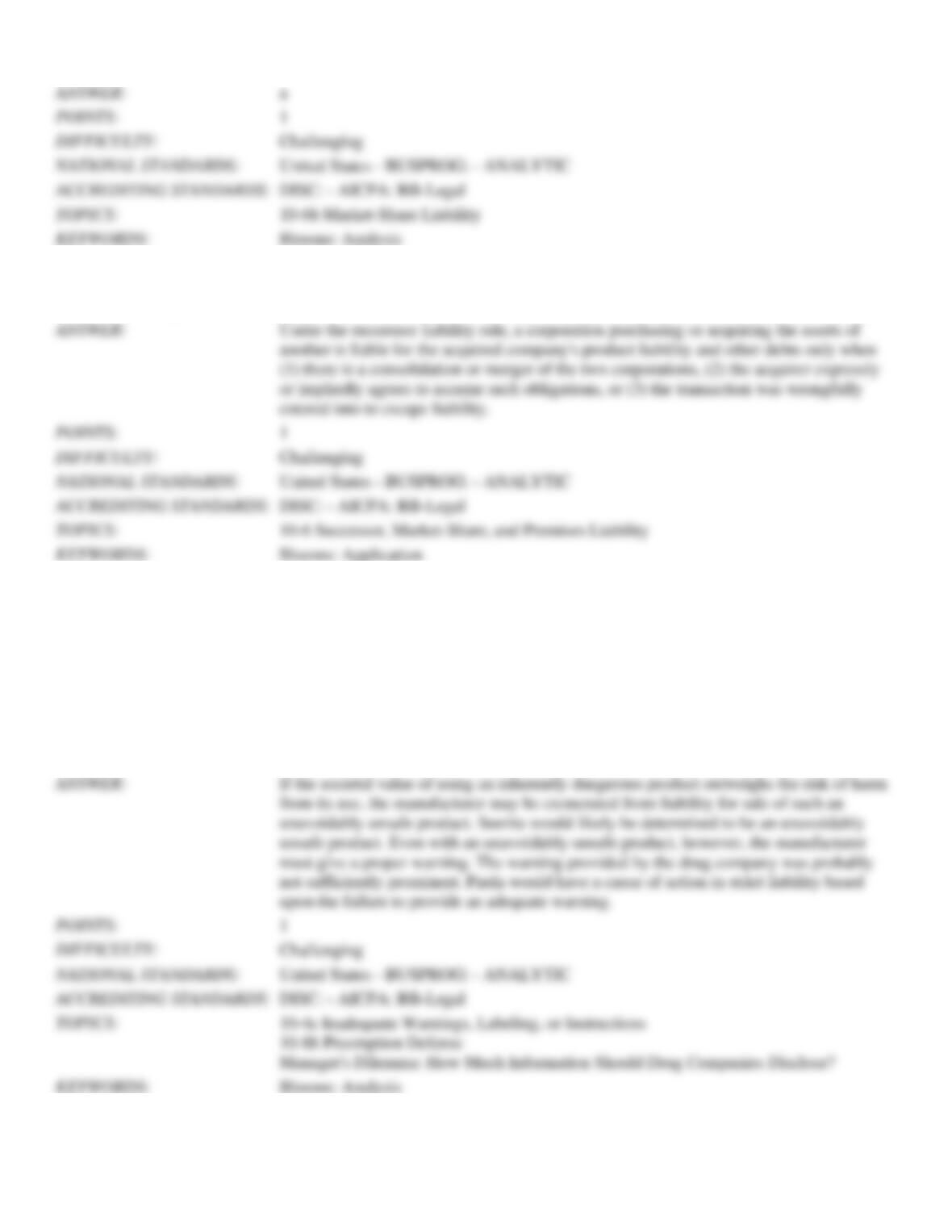
60. Under what circumstances will a successor corporation be held liable in a product liability action under the traditional
successor liability rule?
or impliedly agrees to assume such obligations, or (3) the transaction was wrongfully
entered into to escape liability.
1
United States – BUSPROG: – ANALYTIC
DISC: – AICPA: BB-Legal
10-6 Successor, Market-Share, and Premises Liability
Blooms: Application
61. Paula recently went to see her doctor for severe glaucoma. He told her that her vision is in danger and prescribed
Seerite made by Drugco. Seerite was the newest and most promising treatment for glaucoma that exists. The product
literature stated, “When used as directed, Seerite is 100% safe and effective for glaucoma.” After Paula read this she put
the literature in the trash. She overlooked a small statement on the back reading “Warning: in 2% of the population this
product may produce uncontrollable weight gain.” Three weeks after using Seerite, Paula had gained 50 pounds and
continued to gain weight rapidly. Paula has stopped using Seerite, but she cannot lose the weight and this condition is now
a separate health risk. Is Seerite a defectively designed drug? What defenses would be available to Drugco against this
claim? Is there any other theory under strict product liability law that Paula may use to recover against Drugco? Discuss
fully.
not sufficiently prominent. Paula would have a cause of action in strict liability based
upon the failure to provide an adequate warning.
1
United States – BUSPROG: – ANALYTIC
DISC: – AICPA: BB-Legal
10–8h Preemption Defense
Manager’s Dilemma: How Much Information Should Drug Companies Disclose?
Blooms: Analysis
62. Set forth what a manufacturer of products under contract to the government must show in order to avoid product
liability based on the government-contractor defense along with the rationale for the government-contractor defense.
1
United States – BUSPROG: – ANALYTIC
DISC: – AICPA: BB-Legal
10–6b Market-Share Liability
Blooms: Analysis
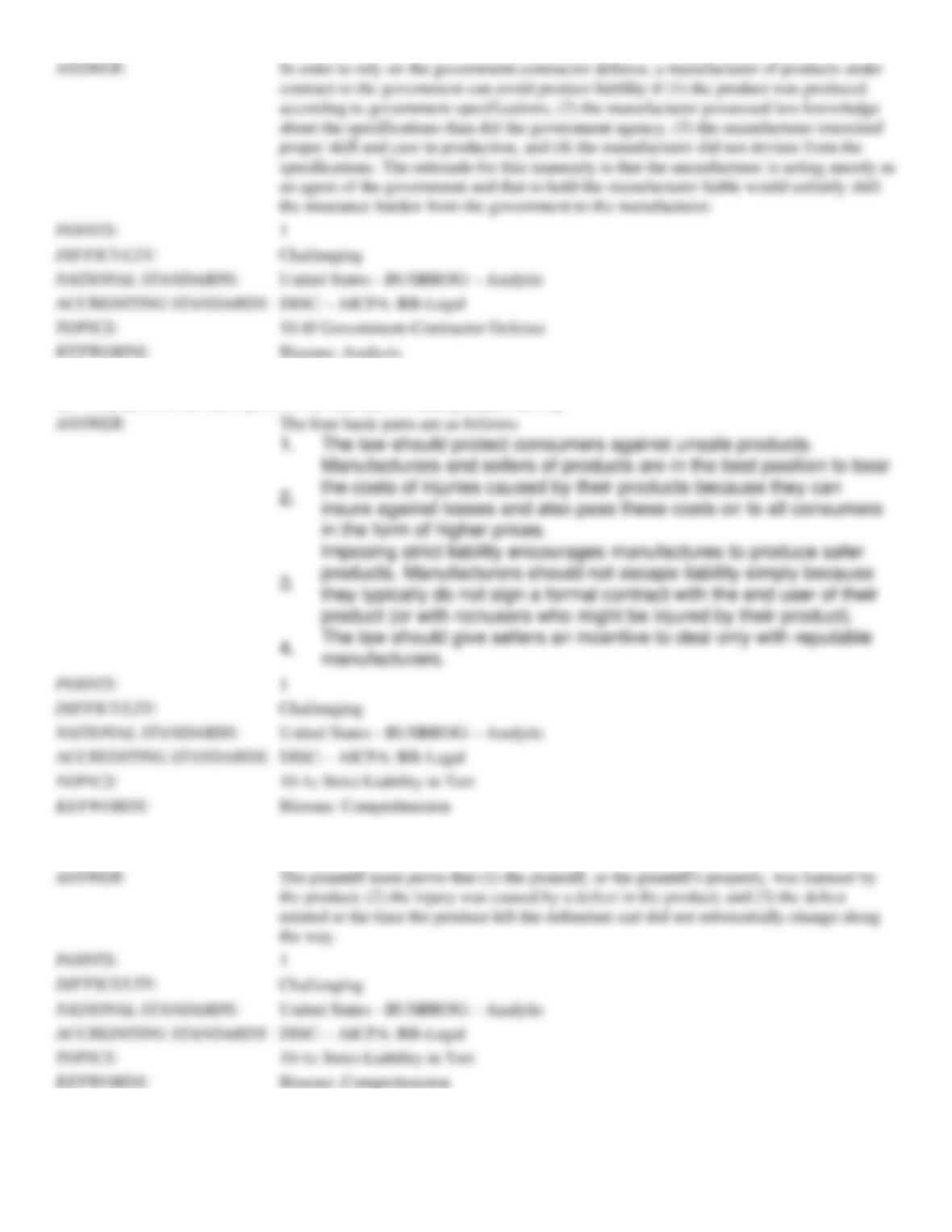
63. What are the four basic parts of the rationale for strict product liability?
64. Set forth the elements of a strict liability claim.
65. Fred sued Document Security Company, alleging he had suffered injuries to his hands as a result of attempting to fix a
jam in one of Document Security’s paper shredders. Fred alleged the shredder was defective because it failed to contain
warnings regarding the dangers to fingers and hands while attempting to fix jams. In order to succeed, Fred will have to
show:
a.
all risk of harm could have been reduced or avoided by the provision of reasonable instructions or warnings by
Document Security Company.
b.
paper shredders are inherently dangerous products.
c.
his injuries would not have occurred but for the absence of the warnings.
d.
foreseeable risks of harm could have been reduced or avoided by the provision of reasonable instructions or
warnings by Document Security Company.
d
1
Challenging
United States – BUSPROG – Analytic
DISC: – AICPA: BB-Legal
10–4c Inadequate Warnings, Labeling, or Instructions
Blooms: Analysis