Chapter 10: Fixed Assets and Intangible Assets
177.
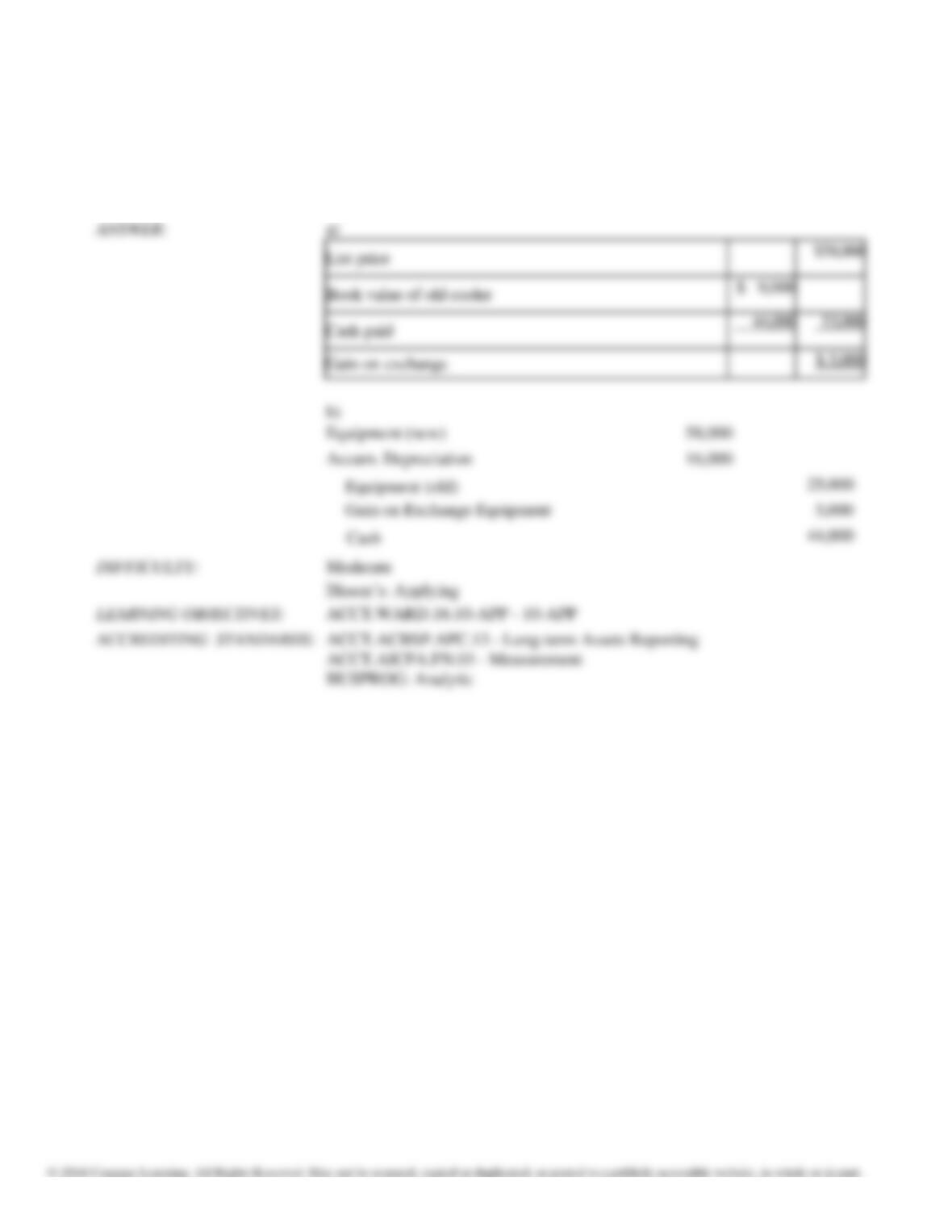
On the first day of the fiscal year, a new walk-in cooler with a list price of $58,000 was acquired in exchange
for
an old cooler and $44,000 cash. The old cooler had a cost of $25,000 and accumulated depreciation of
$16,000.
Assume the transaction has commercial substance.
a)
Determine the gain to be recorded on the exchange.
b)
Journalize the entry to record the exchange.
Chapter 10: Fixed Assets and Intangible Assets
178.
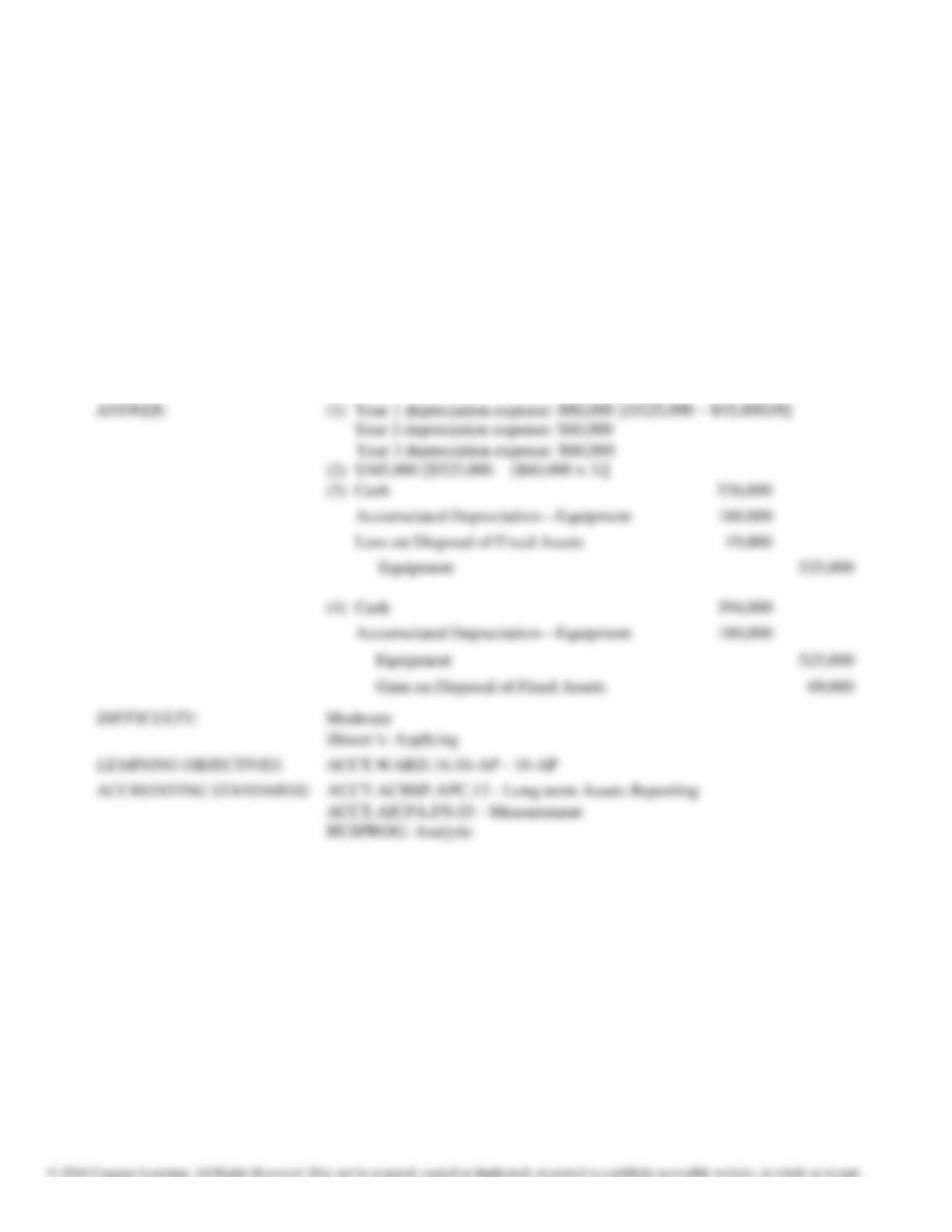
Equipment acquired on January 2, Year 1, at a cost of $525,000 has an estimated useful life of eight years and
an
estimated residual value of $45,000.
Required:
(1)
What is the annual amount of depreciation for the first three years, assuming the
straight-line method of depreciation is used?
(2)
What is the book value of the equipment on January 1, Year 4?
(3)
Assuming that the equipment is sold on January 2, Year 4, for $326,000, journalize
the
entry to record the sale.
(4)
Assuming that the equipment is sold on January 2, Year 4, for $394,000 instead of
$168,500, journalize the entry to record the sale.
Chapter 10: Fixed Assets and Intangible Assets
179.
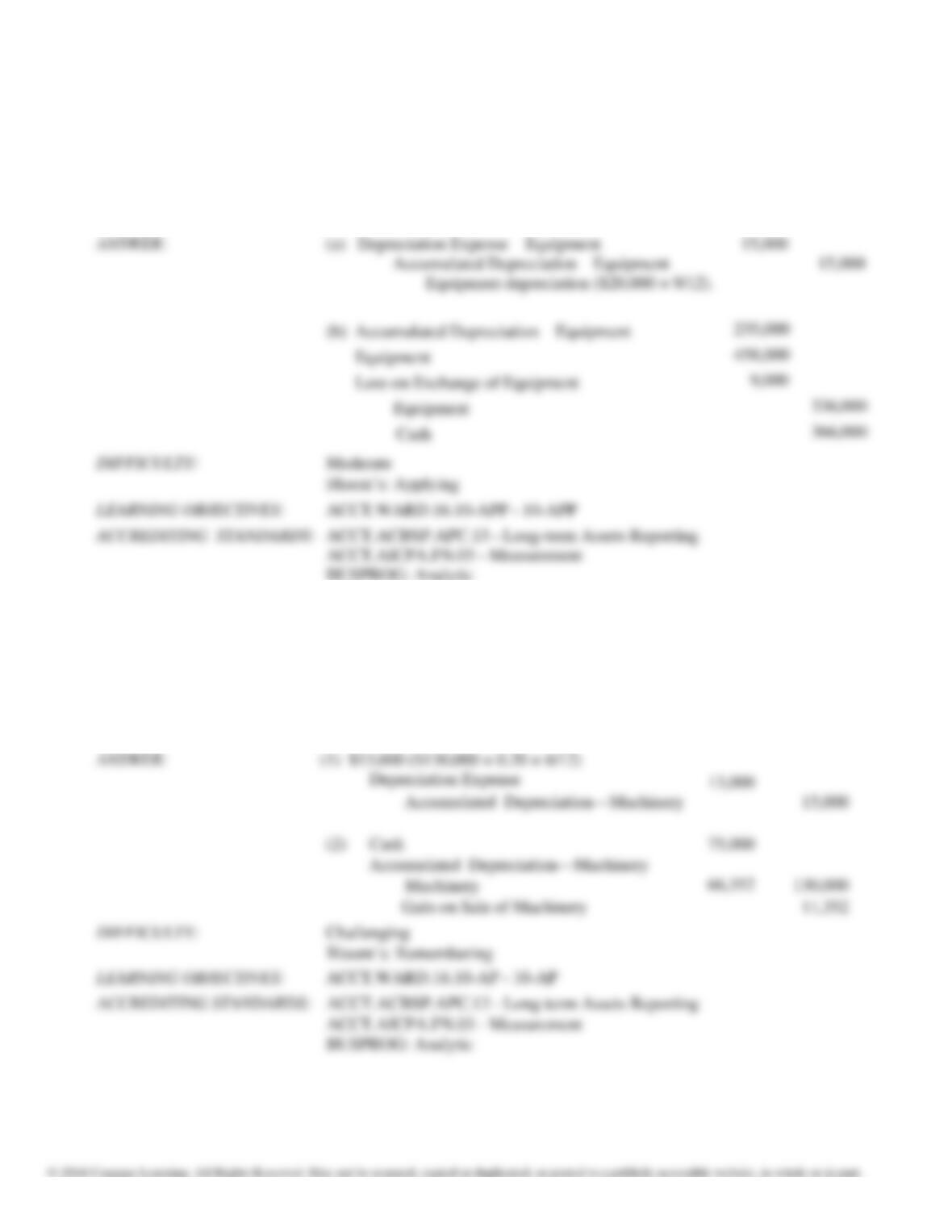
On October 1, Sebastian Company acquired new equipment with a fair market value of $458,000. Sebastian
received a trade-in allowance of $92,000 on the old equipment of a similar type and paid cash of $366,000. The
following information about the old equipment is obtained from the account in the equipment ledger: Cost,
$336,000;
accumulated depreciation on December 31, the end of the preceding fiscal year, $220,000; annual
depreciation, $20,000. Assuming the exchange has commercial substance, journalize the entries to record: (a) the
current
depreciation of the old equipment to the date of trade-in and (b) the exchange transaction on October 1.
180.
Williams Company acquired machinery on July 1, Year 1, at a cost of $130,000. The estimated useful life of the
machinery was 10 years and the estimated residual value was $10,000. Williams uses the double-declining-
balance
method of depreciation. On October 1, Year 4, Williams sold the equipment for $75,000.
(1)
Record the journal entry for the depreciation on this machinery for Year 4.
(2)
Record the journal entry for the sale of the machinery.
Chapter 10: Fixed Assets and Intangible Assets
181.
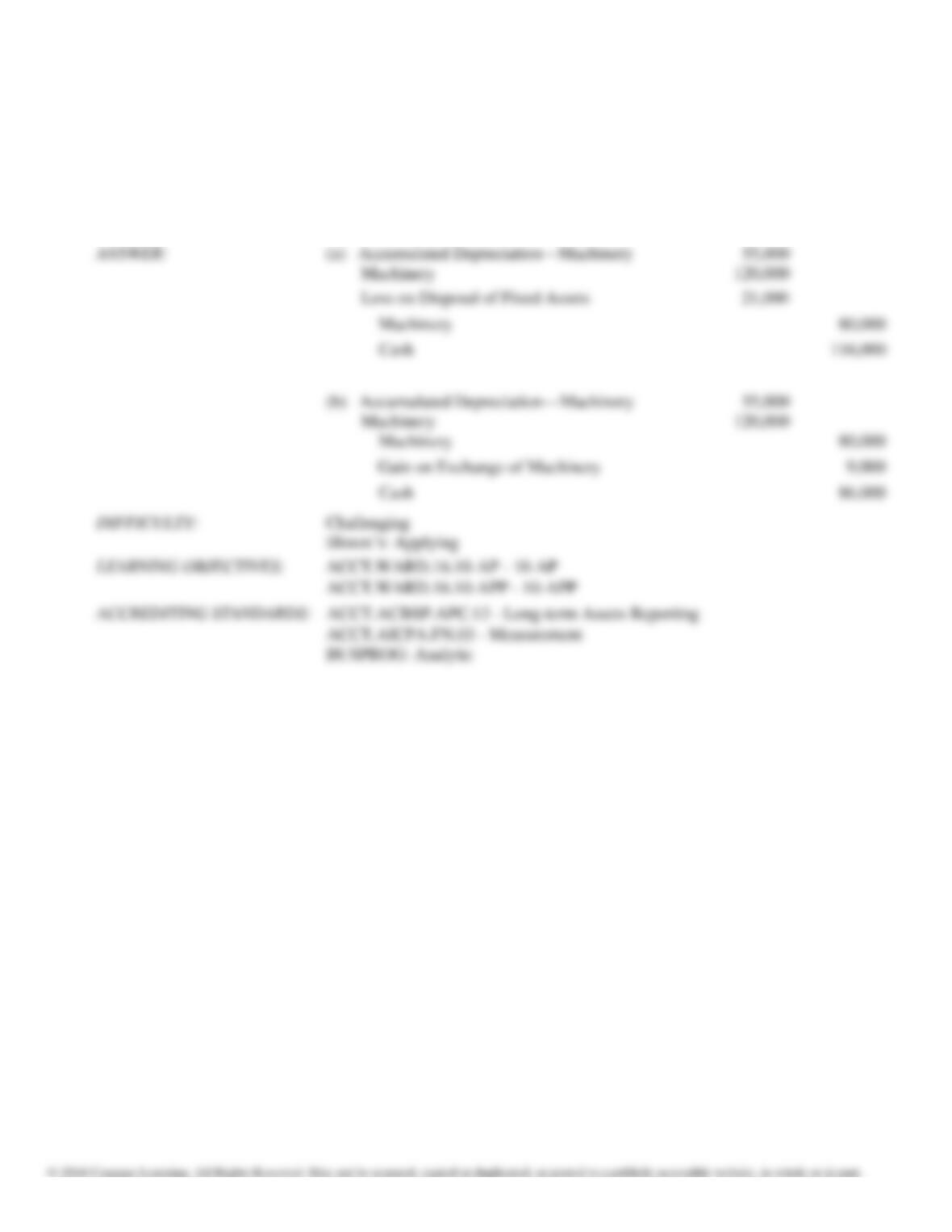
Machinery acquired at a cost of $80,000 and on which there is accumulated depreciation of $55,000 (including
depreciation for the current year to date) is exchanged for similar machinery. Assume that the transaction has
commercial substance. For financial reporting purposes, present entries to record the exchange of the
machinery
under each of the following assumptions:
(a)
Price of new, $120,000; trade-in allowance on old, $4,000; balance paid in cash.
(b)
Price of new, $120,000; trade-in allowance on old, $34,000; balance paid in cash.
Chapter 10: Fixed Assets and Intangible Assets
182.
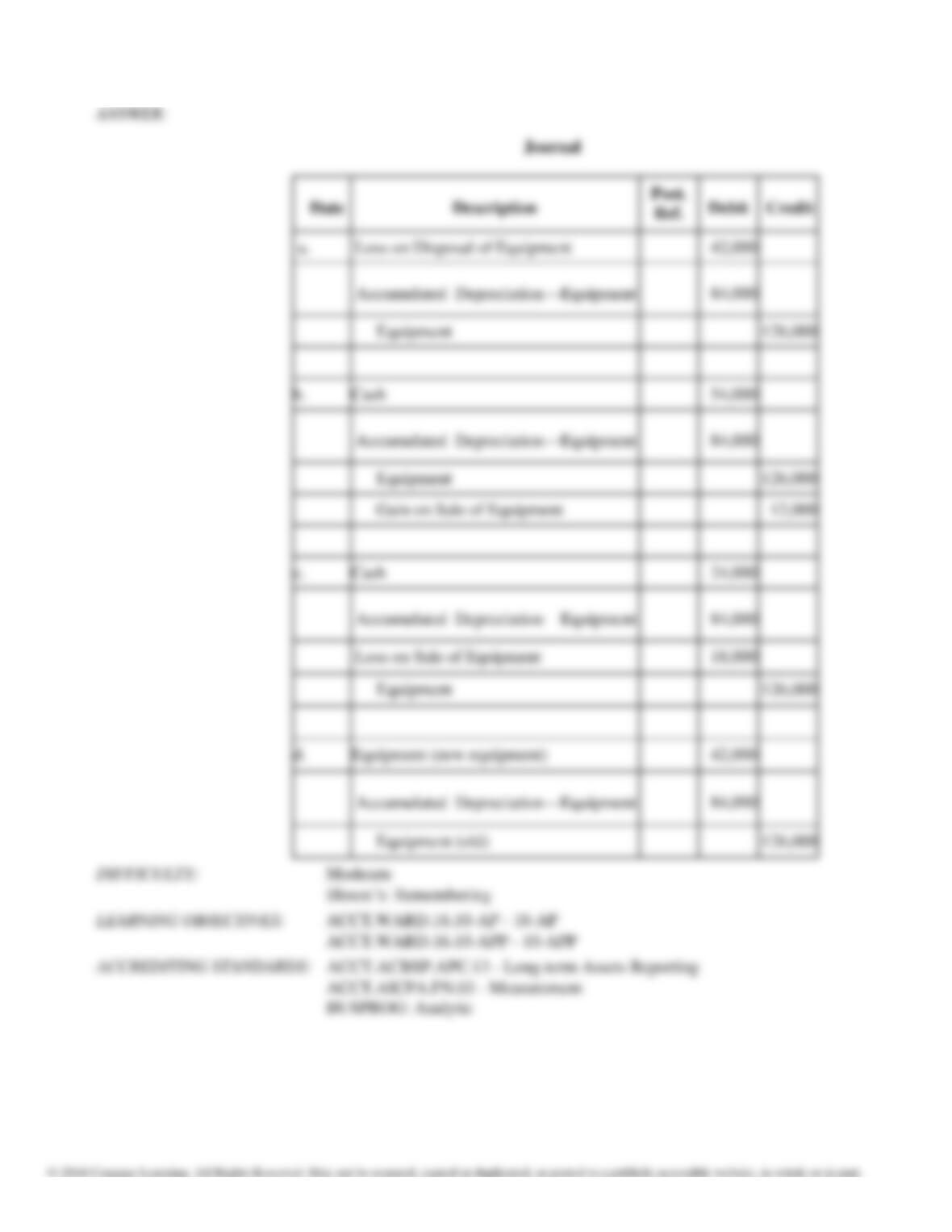
Equipment acquired at a cost of $126,000 has a book value of $42,000. Journalize the disposal of the
equipment
under the following independent assumptions.
a.
The equipment had no market value and was discarded.
b.
The equipment is sold for $54,000.
c.
The equipment is sold for $24,000.
d.
The equipment is traded-in for a similar asset. The list price of the new equipment is
$63,000. The buyer gave no cash in the exchange. The transaction lacks commercial
substance.
Journal
Date
Description
Post.
Ref.
Debit
Credit
Chapter 10: Fixed Assets and Intangible Assets
Chapter 10: Fixed Assets and Intangible Assets
Classify each of the following as:
a.
Ordinary maintenance and repairs
b.
Asset improvements
c.
Extraordinary repairs
DIFFICULTY: Moderate
Bloom’s: Remembering
LEARNING OBJECTIVES: ACCT.WARD.16.10-01 – 10–01
ACCREDITING STANDARDS: ACCT.ACBSP.APC.13 – Long-term Assets Reporting
ACCT.AICPA.FN.03 – Measurement
BUSPROG: Analytic
183.
Fixing damage due to a car accident
184.
Paving a new parking lot
185.
Resurfacing a pool in an apartment building
186.
Exterior and interior painting
187.
Adding refrigerant to an air conditioning system
188.
Installing a new air conditioning system in an old building
189.
Overhauling an engine in a large truck
190.
New landscaping
Chapter 10: Fixed Assets and Intangible Assets
Classify each of the following costs associated with long-lived assets as one of the following:
a.
Buildings
b.
Machinery and equipment
c.
Land
d.
Land improvements
DIFFICULTY: Easy
Bloom’s: Remembering
LEARNING OBJECTIVES: ACCT.WARD.16.10-01 – 10–01
ACCREDITING STANDARDS: ACCT.ACBSP.APC.13 – Long-term Assets Reporting
ACCT.AICPA.FN.03 – Measurement
BUSPROG: Analytic
191.
Cost of insurance during the construction of new office building
192.
Landscaping at new business location
193.
Interest on money borrowed to finance construction of new office building
194.
Freight costs paid on purchase of new equipment
195.
Sales taxes paid on new factory equipment
196.
Costs of government permits required to develop land for a new business location
197.
Fees paid to architect to design new office building
198.
Purchase price of land purchased for new business site
Chapter 10: Fixed Assets and Intangible Assets
199.
Costs to survey a new piece of land for a new business location
200.
Repairs made to used office equipment
Classify each of the following costs associated with long-lived assets as one of the following:
a.
Land improvements
b.
Buildings
c.
Land
d.
Machinery and equipment
DIFFICULTY: Easy
Bloom’s: Remembering
LEARNING OBJECTIVES: ACCT.WARD.16.10-01 – 10–01
ACCREDITING STANDARDS: ACCT.ACBSP.APC.13 – Long-term Assets Reporting
ACCT.AICPA.FN.03 – Measurement
BUSPROG: Analytic
201.
Outdoor lighting at new business location
202.
Cost assessed by city for paving a public street that borders land on which a new business location will
be
constructed
203.
Walkways to surround new business location
204.
Fences around land at new business location
205.
Modifying a building purchased for new business location
206.
Cost of installing new equipment
Chapter 10: Fixed Assets and Intangible Assets
207.
Paved parking areas at new business location
208.
Cost of grading and leveling land to be used for a new business site
209.
Cost of removing an existing building to ready land for use as a new business site
210.
Supplies (materials) used to test new equipment
Match the intangible assets described with their proper classification (a-d).
a.
Patent
b.
Copyright
c.
Trademark
d.
Goodwill
DIFFICULTY: Moderate
Bloom’s: Remembering
LEARNING OBJECTIVES: ACCT.WARD.16.10-05 – 10–05
ACCREDITING STANDARDS: ACCT.ACBSP.APC.13 – Long-term Assets Reporting
ACCT.AICPA.FN.03 – Measurement
BUSPROG: Analytic
211.
Rights to sell a book and make a profit
212.
A new kitchen gadget that can be produced by only one company
213.
Mickey Mouse
214.
Location of a company
Chapter 10: Fixed Assets and Intangible Assets
215.
McDonald’s golden arches
216.
I-Tunes music
217.
Reputation of a company
218.
Nike swoosh
Match each account name to the financial statement section (a-i) in which it would appear.
a.
Current Assets
b.
Fixed Assets
c.
Intangible Assets
d.
Current Liability
e.
Long-Term Liability
f.
Owners’ Equity
g.
Revenues
h.
Operating Expenses
i.
Other Income/Expense
DIFFICULTY: Moderate
Bloom’s: Remembering
LEARNING OBJECTIVES: ACCT.WARD.16.10-06 – 10–06
ACCT.WARD.16.10-AP – 10–AP
ACCREDITING STANDARDS: ACCT.ACBSP.APC.13 – Long-term Assets Reporting
ACCT.AICPA.FN.03 – Measurement
BUSPROG: Analytic
219.
Loss from Impaired Goodwill
220.
Buildings
Chapter 10: Fixed Assets and Intangible Assets
221.
Trademarks
222.
Gain on Sale of Equipment
223.
Research and Development Costs
224.
Loss on Disposal of Asset
225.
Accumulated Depreciation—Buildings
226.
Depreciation Expense
227.
Land Improvements
228.
Amortization Expense
229.
Repairs Expense