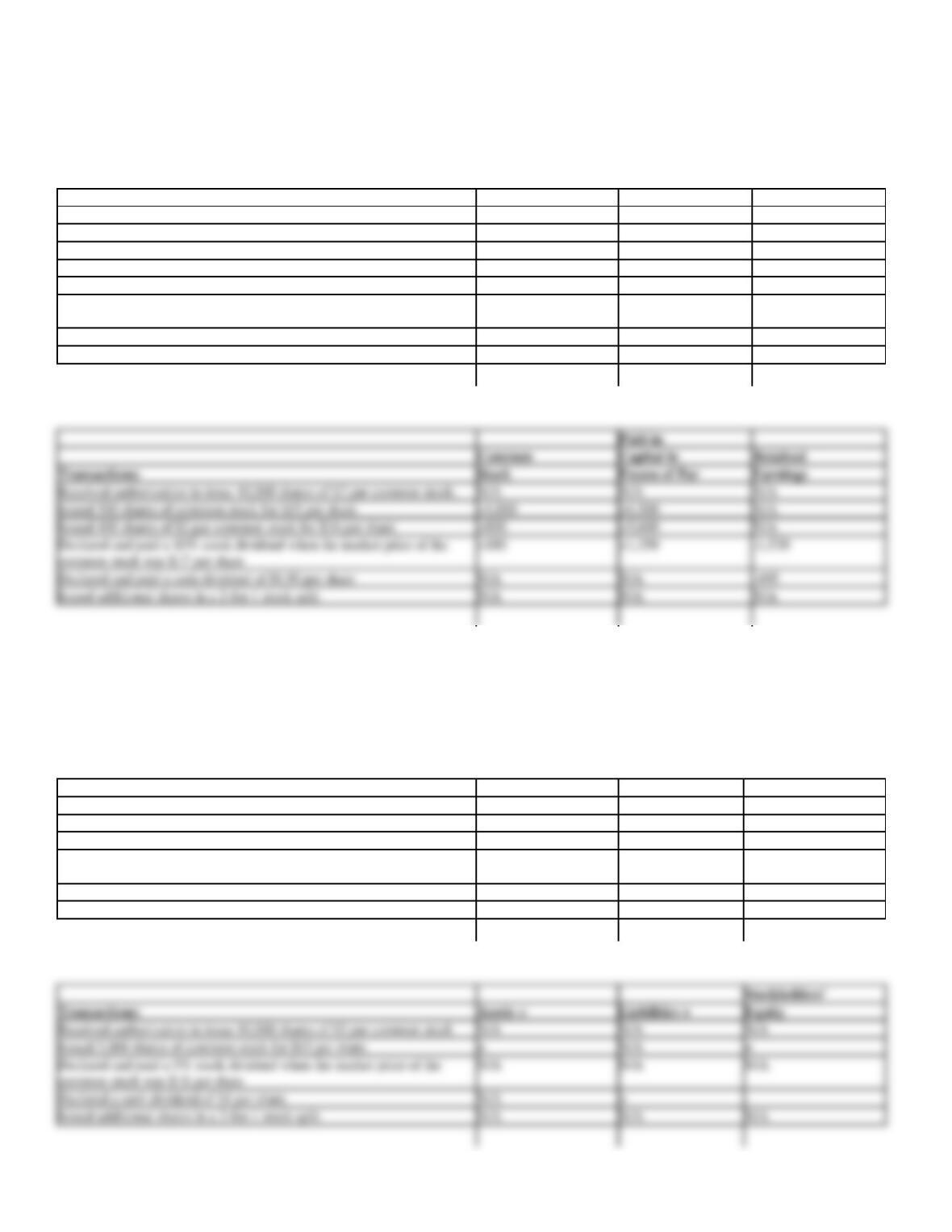
188. A corporation had several transactions affecting its stockholders’ equity accounts during the year. The
transactions are presented in chronological order. In the space provided, indicate the impact on the equity
accounts shown by placing the respective dollar amounts along with a plus sign (+) for an increase in the
account balance, minus sign (-) for a decrease, or N/A if there is no impact on the account balance.
Paid-in
Common
Capital in
Retained
Transactions:
Stock
Excess of Par
Earnings
Received authorization to issue 10,000 shares of $2 par common stock.
Issued 500 shares of common stock for $15 per share
Issued 400 shares of common stock for $16 per share
Declared and paid a 10% stock dividend when the market price of the
common stock was $17 per share
Declared and paid a cash dividend of $0.50 per share
Issued additional shares in a 2-for-1 stock split
189. A corporation had several transactions affecting its stockholders’ equity accounts during the year. In the
space provided, show the impact on the accounting equation by placing a plus sign (+) for an increase, a minus
sign (-) for a decrease, or N/A for no impact or no total net impact.
Stockholders’
Transactions:
Assets =
Liabilities +
Equity
Received authorization to issue 10,000 shares of $5 par common stock
Issued 5,000 shares of common stock for $15 per share
Declared and paid a 5% stock dividend when the market price of the
common stock was $18 per share
Declared a cash dividend of $1 per share
Issued additional shares in a 2-for-1 stock split
Stockholders’
Transactions:
Assets =
Liabilities +
Equity
Received authorization to issue 10,000 shares of $5 par common stock
N/A
N/A
N/A
Issued 5,000 shares of common stock for $15 per share
+
N/A
+
Paid-in
Common
Capital in
Retained
Transactions:
Stock
Excess of Par
Earnings
Received authorization to issue 10,000 shares of $2 par common stock.
N/A
N/A
N/A
Issued 500 shares of common stock for $15 per share
+1,000
+6,500
N/A
Issued 400 shares of $2 par common stock for $16 per share
+800
+5,600
N/A
Declared and paid a 10% stock dividend when the market price of the
+180
+1,350
-1,530
Declared and paid a cash dividend of $0.50 per share
N/A
N/A
-495
Issued additional shares in a 2-for-1 stock split
N/A
N/A
N/A
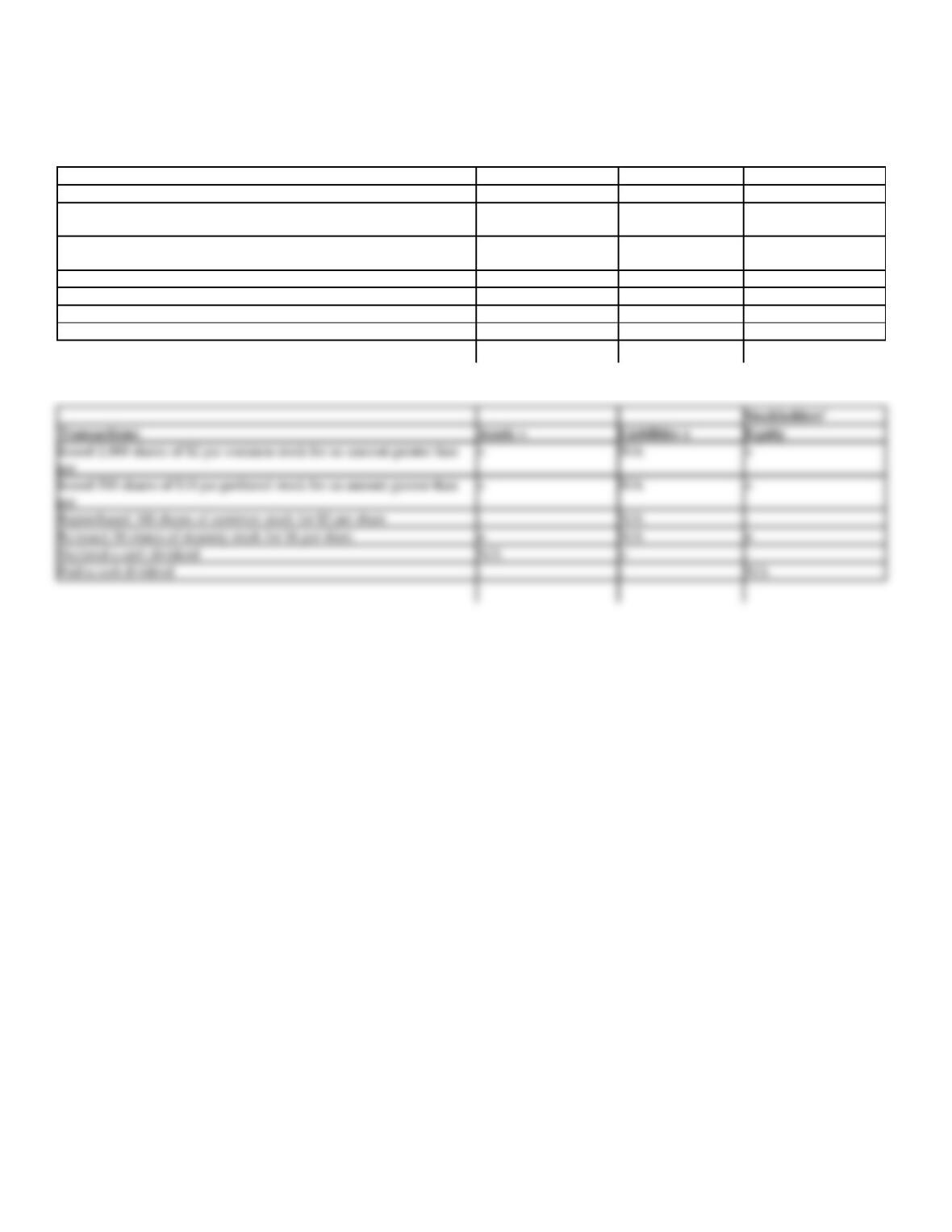
190. A corporation had several transactions affecting its stockholders’ equity accounts during the year. In the
space provided, show the impact on the accounting equation by placing a plus sign (+) for an increase, a minus
sign (-) for a decrease, or N/A for no impact or no total net impact.
Stockholders’
Transactions:
Assets =
Liabilities +
Equity
Issued 2,000 shares of $2 par common stock for an amount greater than
par
Issued 500 shares of $10 par preferred stock for an amount greater than
par
Repurchased 100 shares of common stock for $5 per share
Reissued 50 shares of treasury stock for $6 per share
Declared a cash dividend
Paid a cash dividend
Stockholders’
Transactions:
Assets =
Liabilities +
Equity
Reissued 50 shares of treasury stock for $6 per share
+
N/A
+
Declared a cash dividend
N/A
+
–
Paid a cash dividend
–
–
N/A
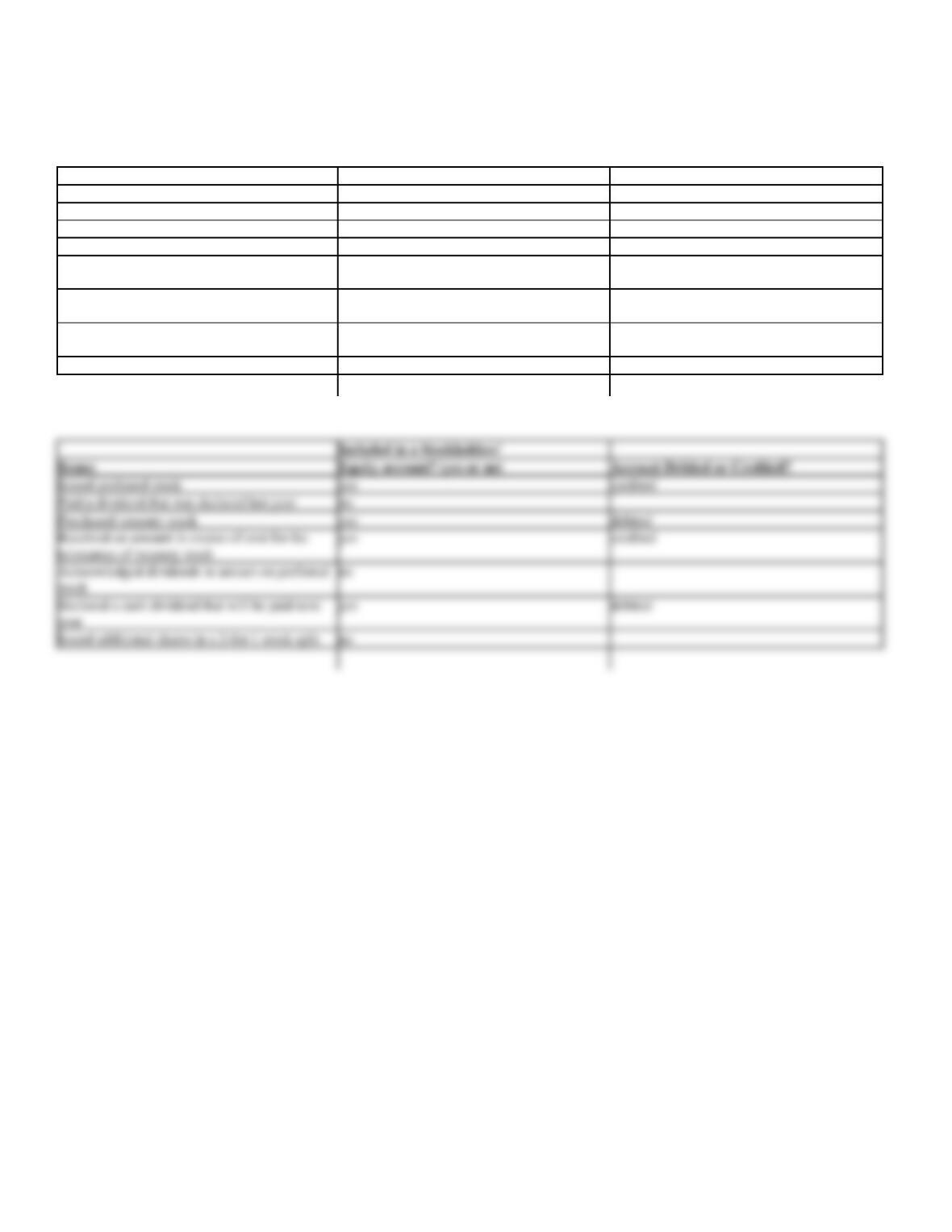
191. In the space provided, indicate whether the journal entry for the transaction described includes an entry to a
stockholders’ equity account and if so, whether the account(s) should be debited or credited as a result of the
entry.
Included in a Stockholders’
Items:
Equity account? (yes or no)
Account Debited or Credited?
Issued preferred stock
Paid a dividend that was declared last year
Purchased treasury stock
Received an amount in excess of cost for the
reissuance of treasury stock
Acknowledged dividends in arrears on preferred
stock
Declared a cash dividend that will be paid next
year
Issued additional shares in a 2-for-1 stock split
Items:
Equity account? (yes or no)
Account Debited or Credited?
Issued preferred stock
yes
credited
Paid a dividend that was declared last year
Purchased treasury stock
yes
debited
Received an amount in excess of cost for the
yes
credited
Acknowledged dividends in arrears on preferred
Declared a cash dividend that will be paid next
year
yes
debited
Issued additional shares in a 2-for-1 stock split
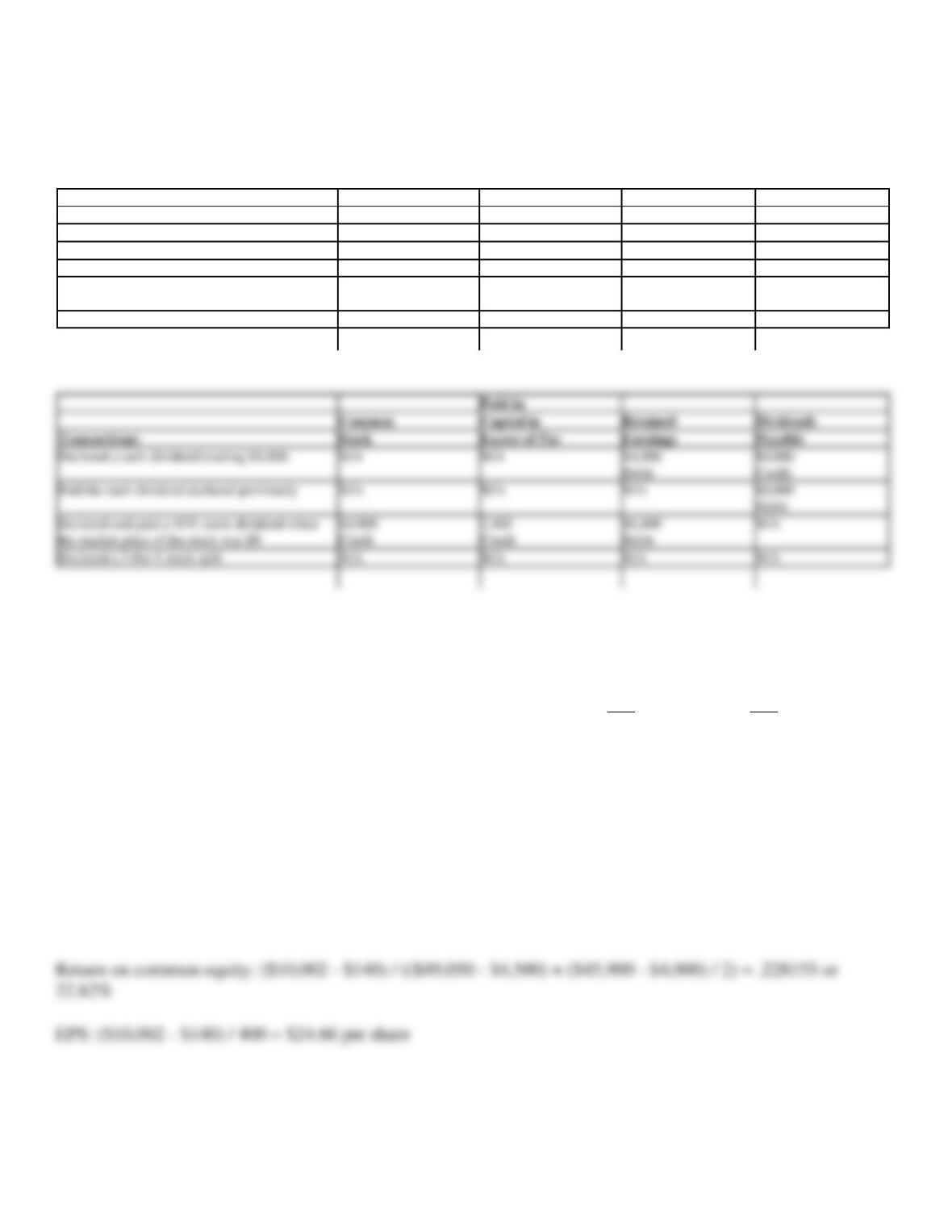
192. A corporation has 10,000 shares of $5 par common stock authorized but only 8,000 shares issued and
outstanding. In the space provided, indicate the effect of the following dividend transactions (shown in
chronological order) on each account listed by writing the amount and whether the account would be debited or
credited. For any instances where there is no effect on the account, place N/A in the space.
Paid-in
Common
Capital in
Retained
Dividends
Transactions:
Stock
Excess of Par
Earnings
Payable
Declared a cash dividend totaling $4,000
Paid the cash dividend declared previously
Declared and paid a 10% stock dividend when
the market price of the stock was $8
Declared a 3-for-1 stock split
193. Consider the following financial statement information:
2015
2014
Preferred Stock
$4,500
$4,000
Total Stockholders’ Equity
$49,050
$45,900
Net Income
$10,002
Stock Price per Common Share
$113
Common Dividends
$521
Preferred Dividends
$140
Purchases of Treasury Stock
$8,061
Dividends per Common Share
$1.30
Average Common Shares Outstanding
400
Calculate the return on common equity and earnings per share ratios.
Paid-in
Common
Capital in
Retained
Dividends
Transactions:
Stock
Excess of Par
Earnings
Payable
Paid the cash dividend declared previously
N/A
N/A
N/A
$4,000
Declared and paid a 10% stock dividend when
the market price of the stock was $8
$4,000
Credit
2,400
Credit
$6,400
Debit
N/A
Declared a 3-for-1 stock split
N/A
N/A
N/A
N/A

194. Consider the following financial statement information:
2015
2014
Preferred Stock
$4,500
$4,000
Total Stockholders’ Equity
$49,050
$45,900
Net Income
$10,002
Stock Price per Common Share
$113
Common Dividends
$521
Preferred Dividends
$140
Purchases of Treasury Stock
$8,061
Dividends per Common Share
$1.30
Average Common Shares Outstanding
400
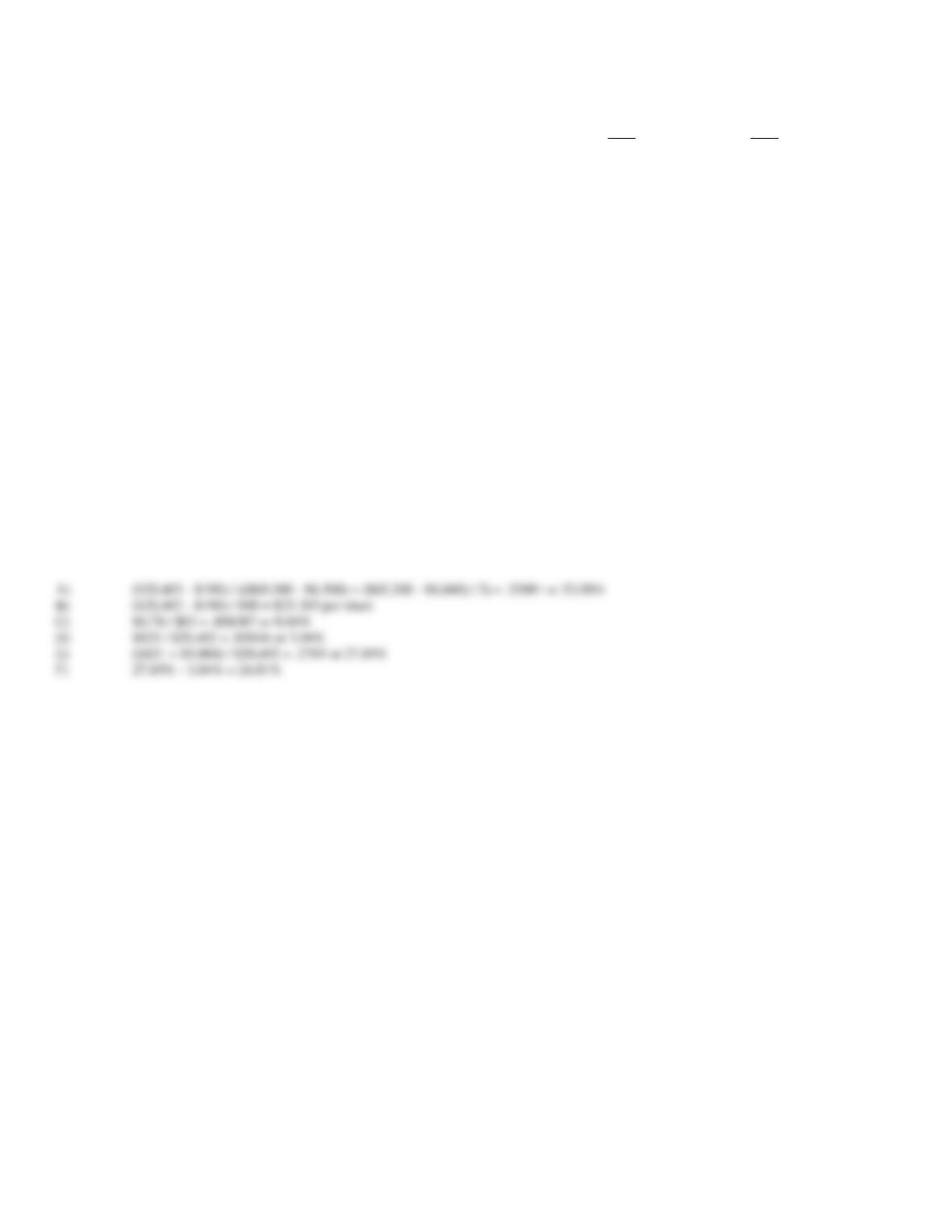
Dividend yield:
$1.30 / $113 = .0115 or 1.15%
Dividend payout ratio:
$521 / $10,002 = .05209 or 5.21%
Total payout ratio:
($521 + $8,061) / $10,002 = .8580 or 85.80%
Stock repurchase payout ratio:
85.8% – 5.21% = 80.59%
195. Consider the following information from the financial statements of a retail company:
2015
2014
Preferred Stock
$6,500
$6,040
Total Stockholders’ Equity
$69,500
$65,200
Net Income
$20,402
Stock Price per Common Share
$93
Common Dividends
$621
Preferred Dividends
$190
Purchases of Treasury Stock
$5,060
Dividends per Common Share
$0.78
Average Common Shares Outstanding
800
Calculate the following financial ratios:
A)
Return on common equity
B)
Earnings per share
C)
Dividend yield
D)
Dividend payout
E)
Total payout
F)
Stock repurchase payout
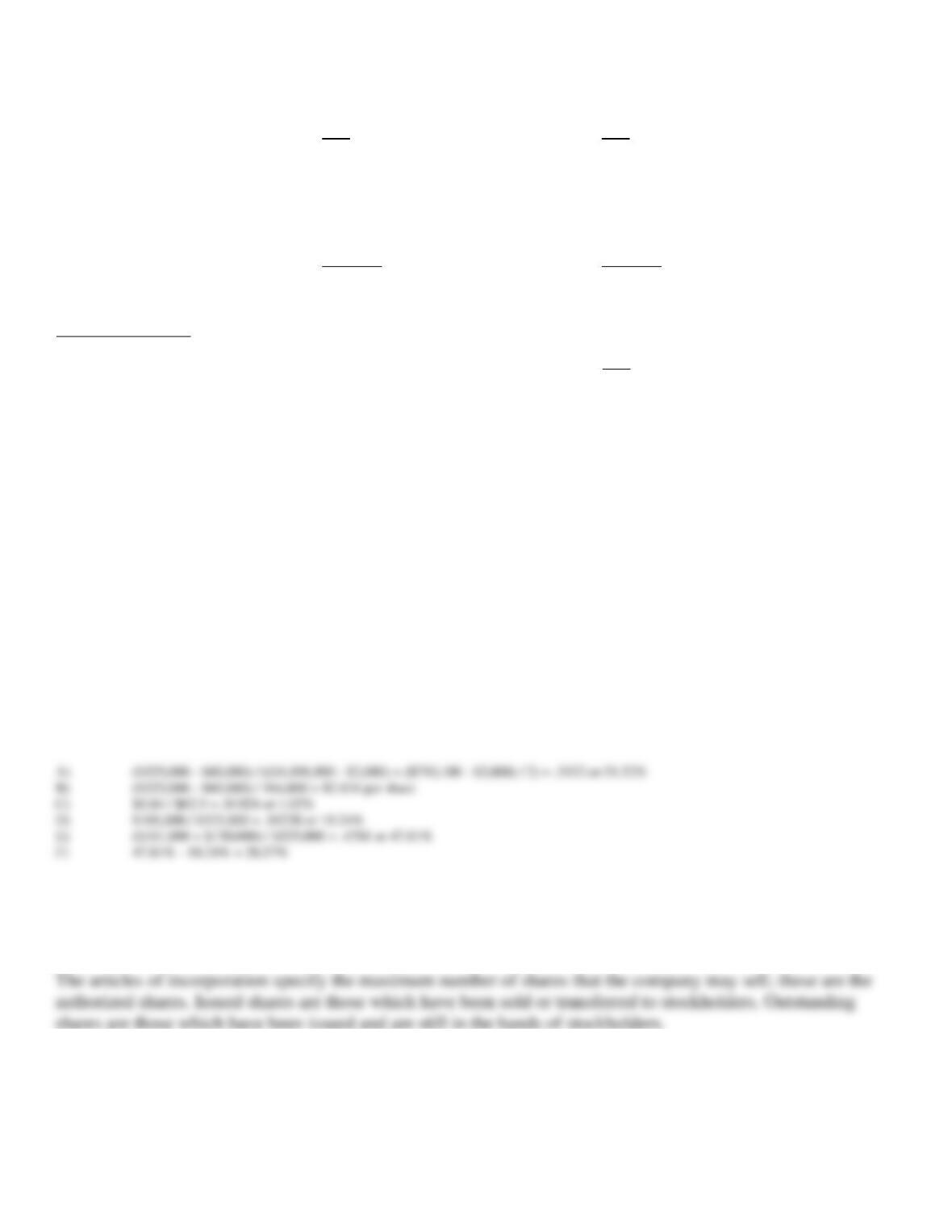
A)
($20,402 – $190) / (($69,500 – $6,500) + ($65,200 – $6,040) / 2) = .33091 or 33.09%
B)
($20,402 – $190) / 800 = $25.265 per share
C)
$0.78 / $93 = .008387 or 0.84%
D)
$621 / $20,402 = .03044 or 3.04%
E)
($621 + $5,060) / $20,402 = .2785 or 27.85%
27.85% – 3.04% = 24.81%
196. Below is information from the stockholders’ equity section of a balance sheet:
2015
2014
7% Preferred Stock
$ 2,000
$ 2,000
Common Stock
5,700
5,500
Paid-in Capital in Excess of Par—Common
Stock
560,000
450,000
Retained Earnings
1,404,000
1,003,000
Accumulated Other Comprehensive
Income/(Loss)
27,200
(400)
Treasury Stock
(900,000)
(750,000)
Total Stockholders’ Equity
$1,098,900
$ 710,100
Additional Information:
2015
Net Income
$525,000
Stock Price per Common Share
$62.50
Common Dividends
$101,000
Preferred Dividends
$60,000
Dividends per Common Share
$0.64
Average Common Shares Outstanding
164,000
Calculate the following financial ratios:
A)
Return on common equity
B)
Earnings per share
C)
Dividend yield
D)
Dividend payout
E)
Total payout
F)
Stock repurchase payout
197. What is the difference between authorized, issued, and outstanding shares?
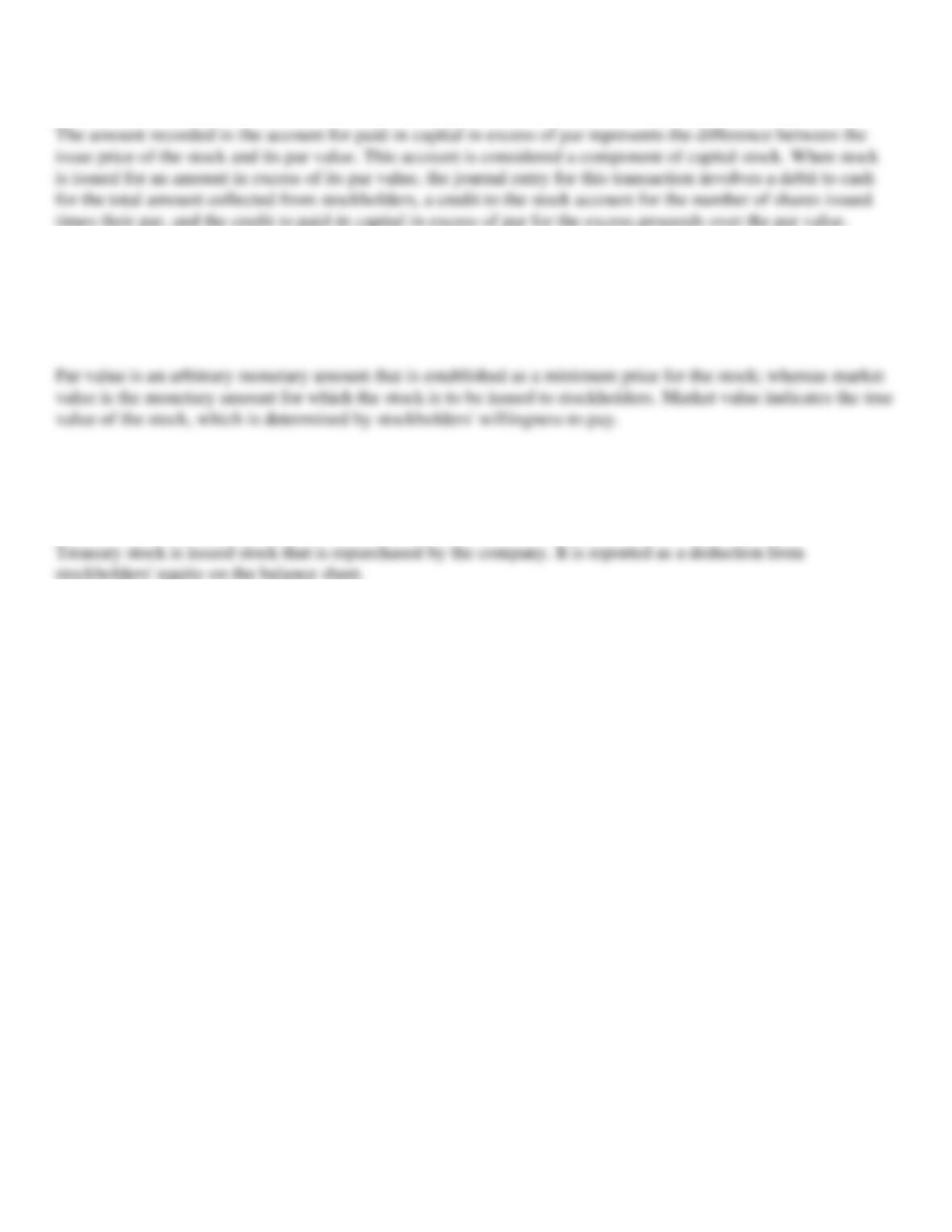
A)
($525,000 – $60,000) / (($1,098,900 – $2,000) + ($710,100 – $2,000) / 2) = .5152 or 51.52%
B)
($525,000 – $60,000) / 164,000 = $2.834 per share
$0.64 / $62.5 = .01024 or 1.02%
D)
$101,000 / $525,000 = .19238 or 19.24%
E)
($101,000 + $150,000) / $525,000 = .4781 or 47.81%
F)
47.81% – 19.24% = 28.57%
198. When a corporation issued stock to stockholders, explain the use of the account for paid-in capital in
excess of par value.
199. Distinguish between par value and market value. Which measure is the better indicator of the true value of
the stock?
200. What is treasury stock and how is it reported in the financial statements?
201. The following stockholders’ equity appeared on a balance sheet at December 31, 2014:
Common Stock $1 par, 1,000,000
shares authorized
$ 200,000
Paid-in Capital in Excess of Par—
Common Stock
800,000
Retained Earnings
(450,000)
Total Stockholders’ Equity
$550,000
A)
Has the company been profitable since its inception? How do you know?
B)
What is the meaning of the balance in a retained earnings account? What causes this balance to change from period to period?
C)
Can you tell from the balance sheet whether a company paid a dividend during the current period?
D)
How many shares of common stock are issued and outstanding and how can these amounts be determined?
202. Identify and describe the four primary rights for the owners of common stock.
No, the information presented in the stockholders’ equity section of the balance sheet is not sufficient to determine whether the
treasury stock is indicated, all of the issued shares remain outstanding.
203. Compare and contrast stock dividends and stock splits.
Both stock dividends and stock splits involve transferring shares of stock from the corporation to the
stockholders, and both result in an increased number of outstanding shares without altering the proportionate
ownership of the corporation. Both of these transactions tend to result in a decrease in the market price of the
corporation’s stock. However, stock dividends and stock splits differ in their accounting treatment.
204. Distinguish between stock warrants and stock options.
Stock warrants are rights to purchase a specified number of shares of a corporation’s capital stock at a stated
price and within a stated time period. These rights are granted by a corporation to bondholders or potential
stockholders as a feature to make the securities more attractive, or they may be granted to existing stockholders
as an incentive for maintaining their relative level of ownership in the corporation.
205. If a corporation desires to reacquire some of its issued shares of stock, how would it accomplish this, i.e.,
how would the corporation determine which of its shares to buy back or from which stockholders?
206. Differentiate a cumulative dividend preference from a participating dividend preference. Describe the
circumstances under which these preferences would be utilized.
207. “You Decide” Essay
You are the Chief Financial Officer of Laser Craft Technology. Your company needs to raise capital to pursue
an expansion project, but the company does not want to sell additional common stock. What factors should you
consider in deciding whether to issue debt or preferred stock?
208. “You Decide” Essay
You are the chief accountant for Laureate Medical Group. The Board of Directors has decided to distribute
$1,000,000 in excess cash to common shareholders. In what ways can this distribution be accomplished? What
factors should be considered when determining the best way?