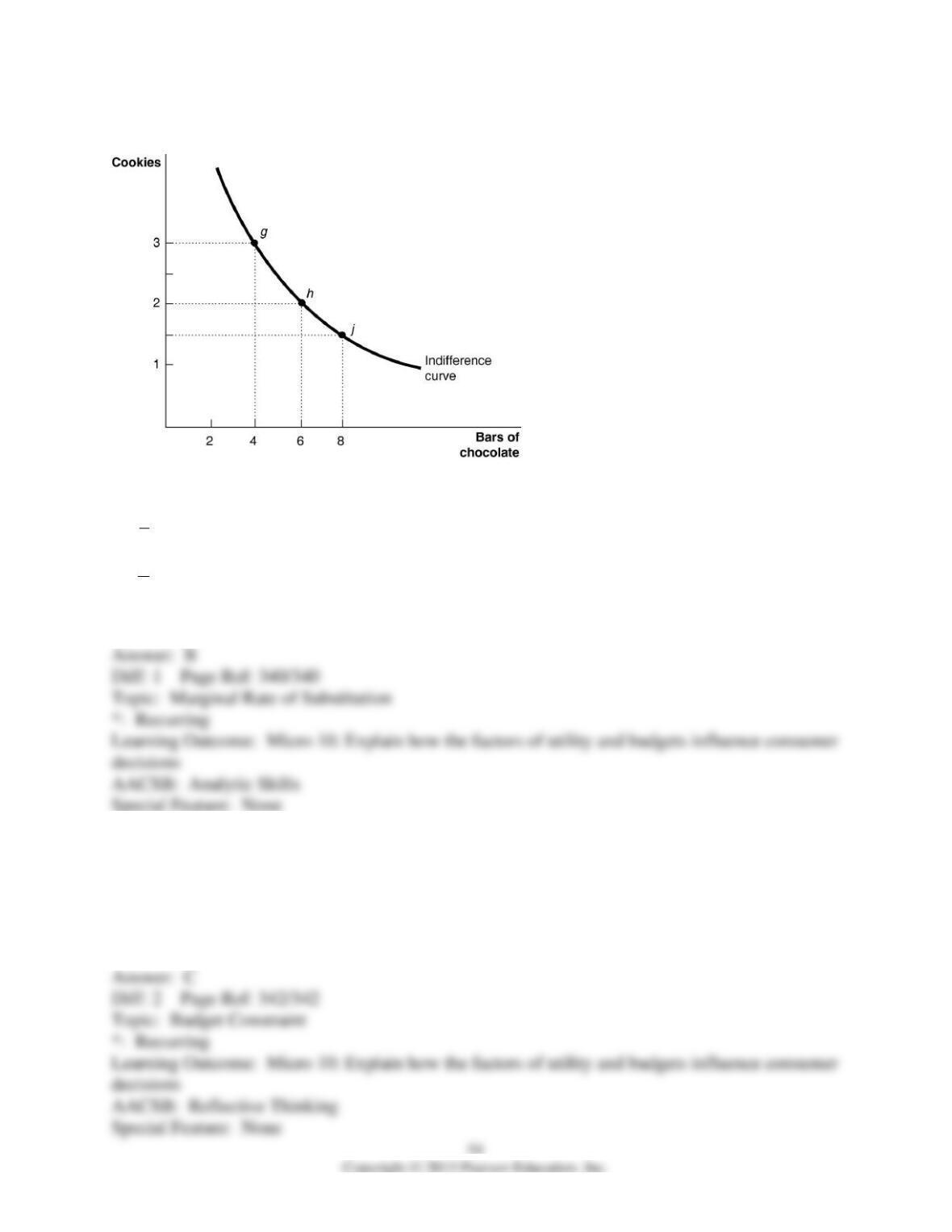
Figure 10-3
7) Refer to Figure 10-3. What is the marginal rate of substitution between g and h?
A)
3
1
cookie.
B)
2
1
cookie.
C) 2 cookies.
D) 3 cookies.
8) The absolute value of the slope of the budget constraint is equal to
A) the marginal rate of substitution between the two goods in question.
B) the price of good on the vertical axis divided by the price of the good on the horizontal axis.
C) the price of good on the horizontal axis divided by the price of the good on the vertical axis.
D) quantity of the good on the vertical axis divided by the quantity of the good on the horizontal
axis.
9) A consumer’s utility-maximizing combination of goods is given by the bundle that
corresponds to the point on
A) the indifference curve that intersects the horizontal axis.
B) the indifference curve that intersects the vertical axis.
C) an indifference curve that is tangent to the budget constraint.
D) the budget constraint where it intersects one of the axes.
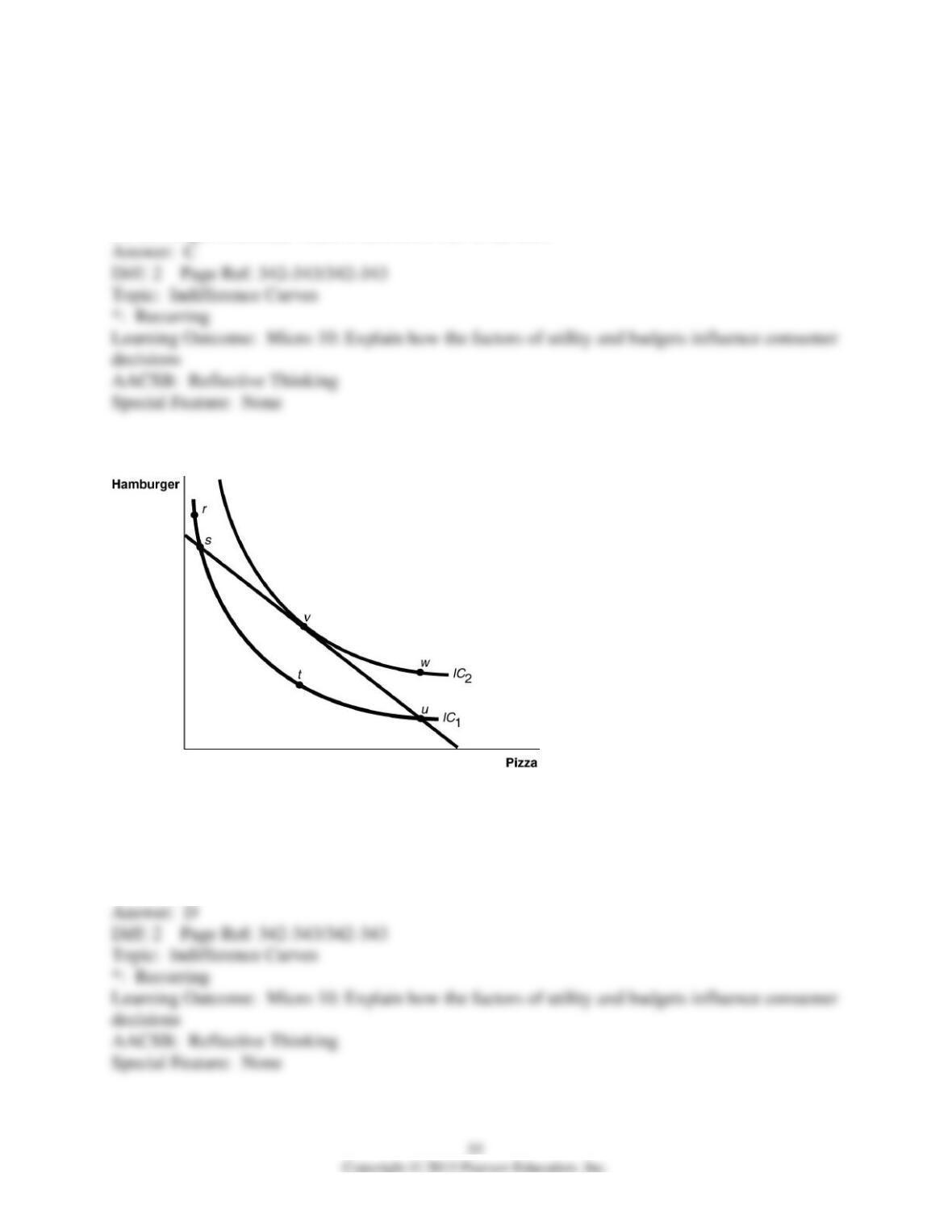
Figure 10-4
10) Refer to Figure 10-4. The consumer can afford consumption bundles
A) r, s, t and u.
B) r, s, v and u.
C) s, v and u only.
D) s, v, t and u.
11) Refer to Figure 10-4. Which of the following statements is true?
A) The consumer gets more utility from bundle r than from bundle v.
B) The consumer gets less utility from bundle w than from bundle v.
C) Bundles r, s, t and u all cost the same.
D) Bundles r and w are not affordable.
12) Refer to Figure 10-4. Suppose the price of pizza increases while the price of hamburger
remains constant. Then, the consumer’s
A) indifference curve becomes more concave away from the origin.
B) indifference curve becomes straighter.
C) budget constraint moves inward toward the origin on the pizza axis while the hamburger
intercept remains the same.
D) budget constraint moves outward away from the origin on the pizza axis while the hamburger
intercept remains the same.
13) Aisha and Debbie both purchase milk and bread at the same Quik Mart. They have different
tastes for milk and bread and different incomes. They both buy some milk and some bread, but
they buy considerably different quantities of the two goods. Which of the following statements is
true, given that Aisha and Debbie are utility-maximizers?
A) In equilibrium, their marginal rate of substitution between milk and bread is the same.
B) In equilibrium, their marginal rate of substitution between milk and bread is higher for the
person with the higher income.
C) In equilibrium, the marginal rate of substitution between milk and bread is greater for the
person who prefers milk more than bread.
D) No statement can be made about their respective marginal rates of substitution without their
budget constraint/indifference curve diagrams.
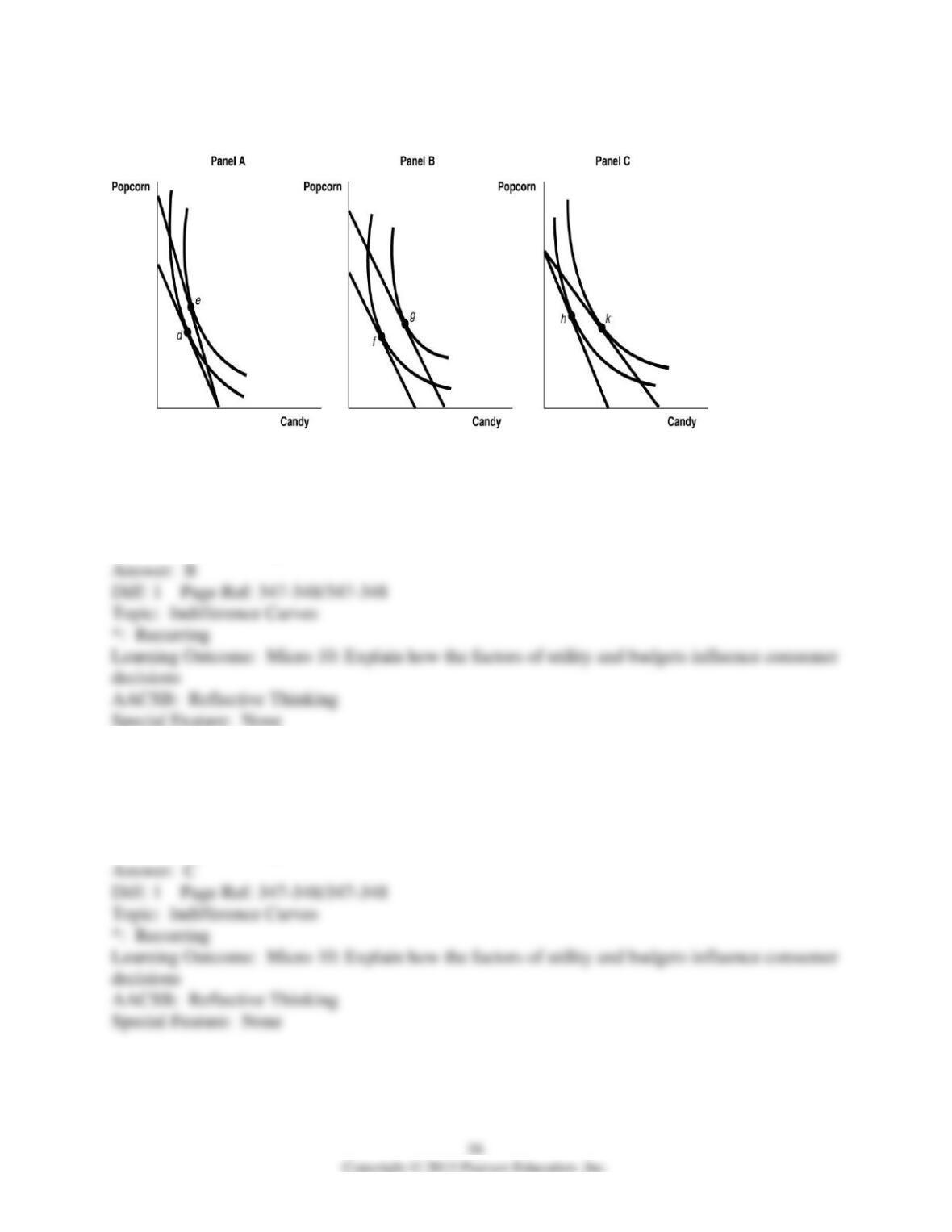
Figure 10-5
14) Refer to Figure 10-5. A change in income is shown in
A) Panel A.
B) Panel B.
C) Panel C.
D) none of the above panels.
15) Refer to Figure 10-5. A change in the price of candy only is shown in
A) Panel A.
B) Panel B.
C) Panel C.
D) none of the above panels.
16) Refer to Figure 10-5. A change in the price of popcorn only is shown in
A) Panel A.
B) Panel B.
C) Panel C.
D) none of the above panels.
17) Refer to Figure 10-5. Which diagram demonstrates an increase in total utility following a
decrease in the price of popcorn?
A) the movement from d to e in Panel A
B) the movement from f to g in Panel B
C) the movement from h to k in Panel C
D) none of the above
18) Refer to Figure 10-5. Which diagram demonstrates a decrease in total utility following an
increase in the price of candy?
A) the movement from e to d in Panel A
B) the movement from g to f in Panel B
C) the movement from k to h in Panel C
D) none of the above
19) Suppose the consumer’s income increases while the prices of the goods remain constant.
Then the
A) budget constraint shifts inward parallel to the original budget constraint.
B) budget constraint shifts outward parallel to the original budget constraint.
C) indifference curves shift outward away from the origin.
D) indifference curves become flatter.
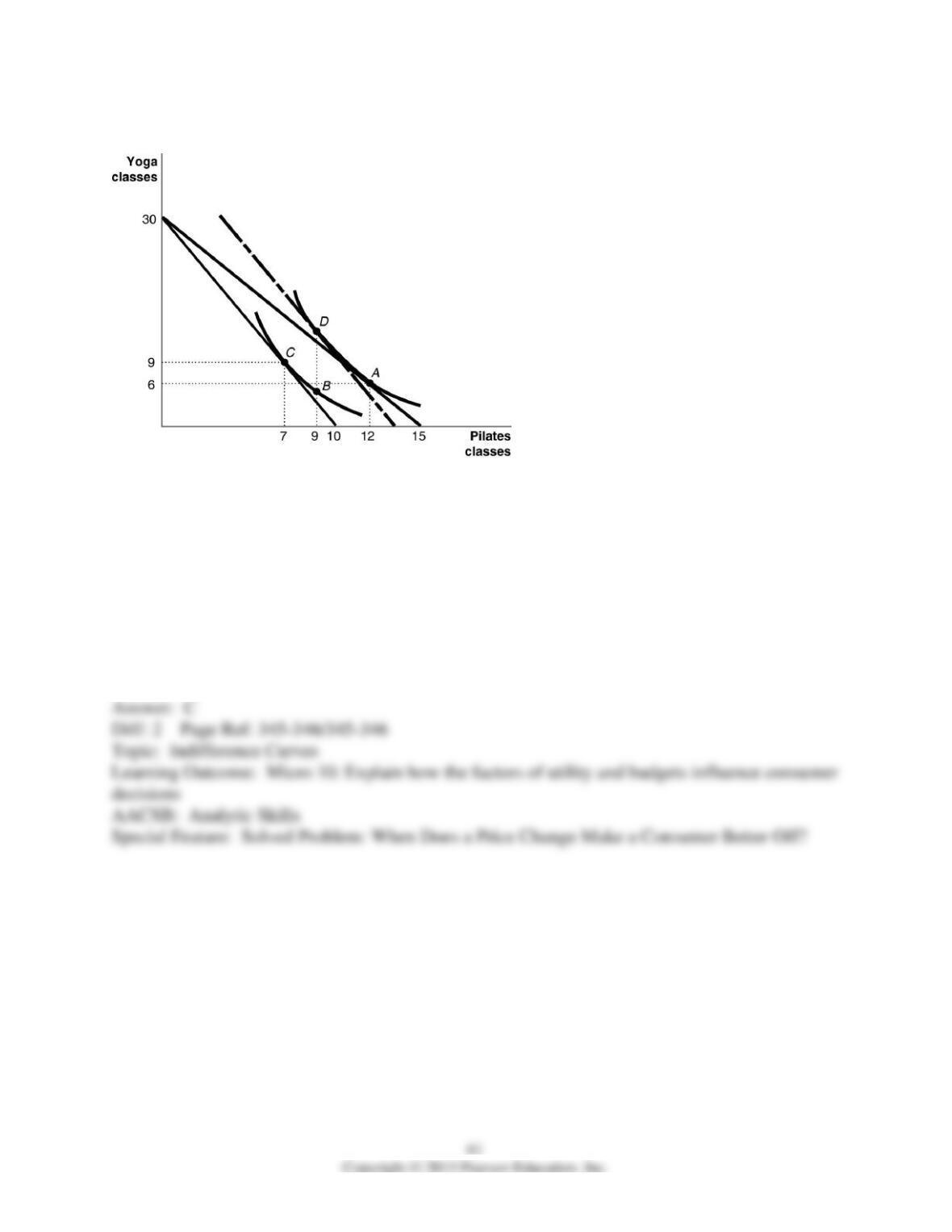
Figure 10-6
Manuri has $300 to spend on Pilates classes and Yoga classes. The price of a group Pilates class
is $20 and the price of a group Yoga class is $10. Manuri’s optimal bundle is given by “A” in
Figure 9-6.
20) Refer to Figure 10-6. Suppose the price of Pilates sessions rises to $30 while income and
the price of Yoga sessions remain unchanged. What is her new optimal bundle?
A) still remains at bundle A.
B) bundle B.
C) bundle C.
D) bundle D.
21) Refer to Figure 10-6. Suppose the price of Pilates sessions rise to $30 while income and the
price of Yoga sessions remain unchanged. The substitution effect of this price change is
represented by the movement from
A) A to B.
B) A to C.
C) A to D.
D) D to B.
22) Refer to Figure 10-6. Suppose the price of Pilates sessions rise to $30 while income and the
price of Yoga sessions remain unchanged. The income effect of this price change is represented
by the movement from
A) A to B.
B) B to C.
C) D to B
D) D to C.
23) The marginal rate of substitution is determined by the slope of an indifference curve.
24) A consumer’s indifference curves can never cross.
25) A consumer’s utility-maximizing combination of goods is given by the bundle that
corresponds to the highest point on his indifference curve.
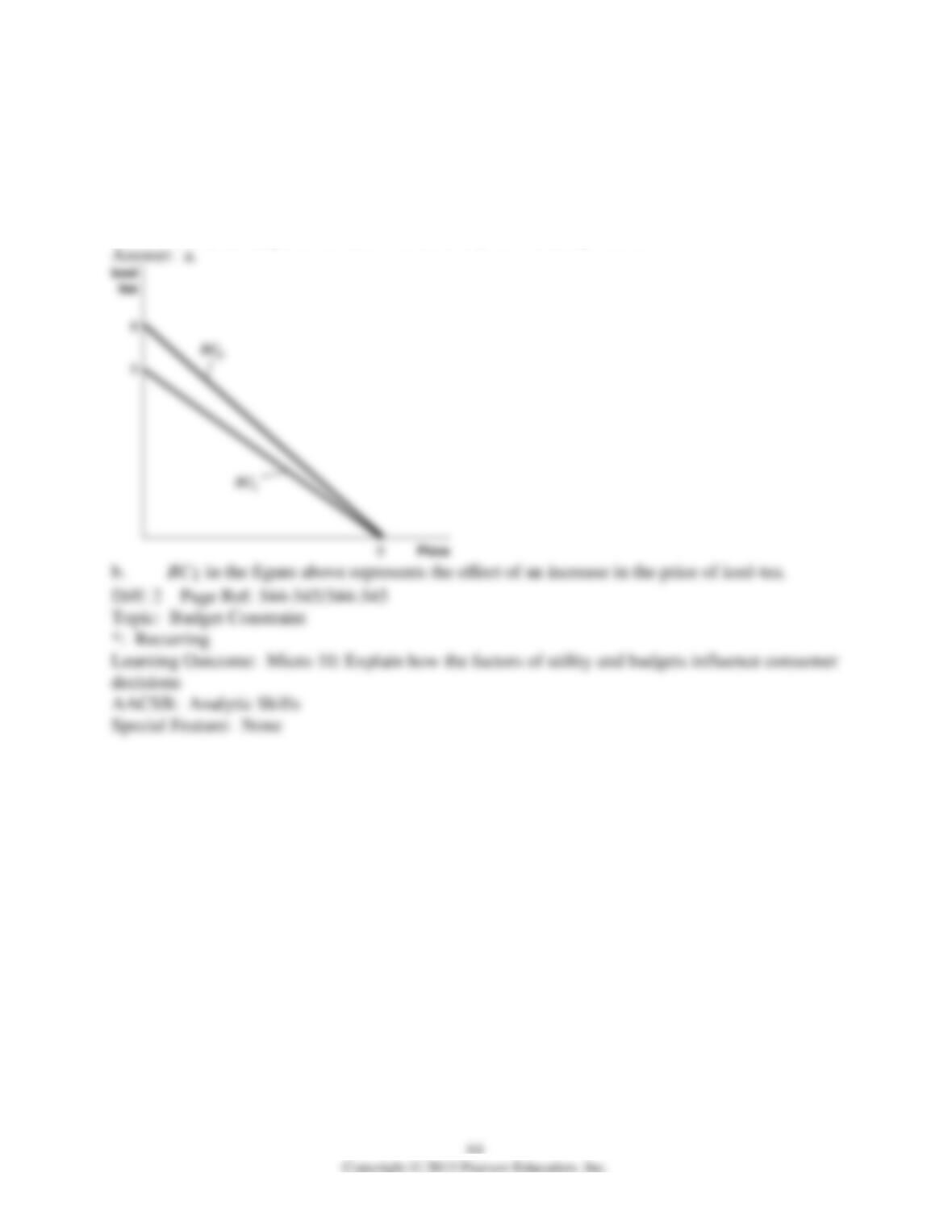
26) Gowri has $6 per day to purchase lunch. She spends all of her lunch money on pizza and
iced-tea. The price of pizza is $2.00 per slice and iced-tea costs $1 per bottle.
a. Draw Gowri’s budget constraint and label it BC0. Put pizza on the horizontal axis and iced-
tea on the vertical axis. Be sure to identify the intercept values.
b. If the price of iced-tea rises to $1.20 per bottle, show what will happen to her budget
constraint in your diagram. Be sure to indicate any new intercept values.
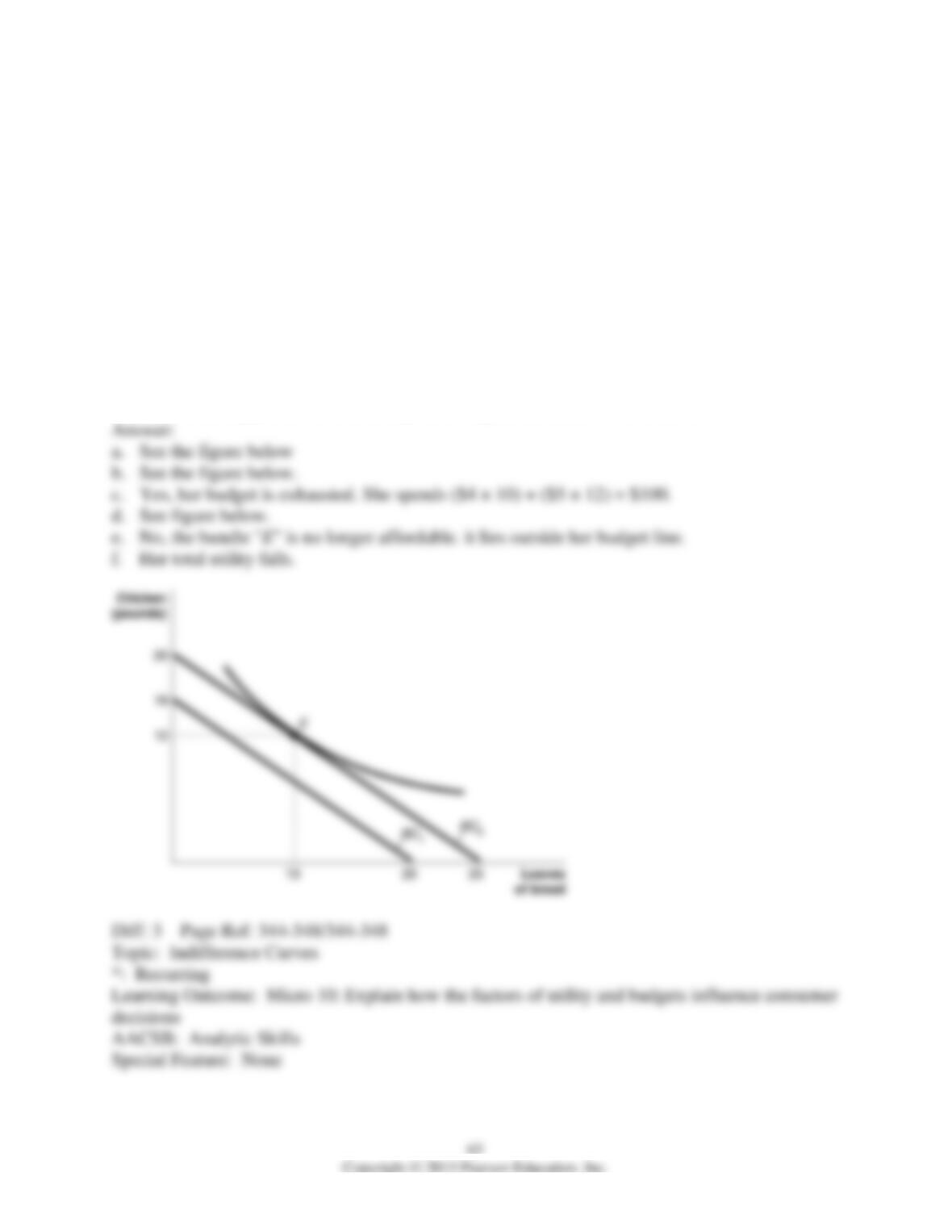
27) Farah has $100 to spend each month on bread and chicken. Suppose the price of bread is $4
a loaf and the price of chicken is $5 per pound.
a. Draw her budget constraint and label it BC0. Put bread on the horizontal axis and chicken on
the vertical axis. Be sure to identify the intercept values.
b. Suppose Farah is a utility maximizer and she consumes 10 loaves of bread and 12 pounds of
chicken. On the same graph you drew in part (a), draw an indifference curve to identify her
optimal bundle. Label this bundle “E.”
c. Is her budget exhausted? Verify your answer.
d. Now suppose Farah’s income falls to so that she can now devote $80 to the two goods. Prices
however remain unchanged. In the same diagram, graph her new budget constraint and label it
BC1. Be sure to identify any new intercept values.
e. Following the change in income, can Farah consume the same bundle “E“? Explain your
answer.
f. What must happen to her total utility following the decrease in her income?