86.
A company prepared the following journal entry:
Interest expense
xxx
Discount on bonds payable
xxx
Cash
xxx
Which of the following statements correctly describes the effect of this journal entry on the
financial statements?
87.
A company prepared the following journal entry:
Interest expense
xxx
Premium on bonds payable
xxx
Cash
xxx
Which of the following statements incorrectly describes the effect of this journal entry on the
financial statements?
88.
A company prepared the following journal entry:
Cash
xxx
Discount on bonds payable
xxx
Bonds payable
xxx
Which of the following statements incorrectly describes the effect of this journal entry on the
financial statements?
89.
A company prepared the following journal entry:
Cash
xxx
Premium on bonds payable
xxx
Bonds payable
xxx
Which of the following statements correctly describes the effect of this journal entry on the
financial statements?
90.
When a bond payable is issued at a discount, which of the following would not occur as the
bond is amortized each year?
91.
Which of the following is correct when using the effective-interest method of amortizing the
discount on bonds payable?
92.
When a bond payable is issued at a premium, subsequent amortization of the premium does
which of the following?
93.
If a bond is issued at 101, the coupon rate was
94.
If a bond is issued at 98, the coupon rate was
95.
When recording bond issuance costs for underwriter fees:
96.
When recording bond issuance costs for fees paid to underwriters:
97.
On July 1, 2017, immediately after recording interest payments, Salsa, Inc. retired one fifth of
its $500,000 of bonds payable for $97,500. The bonds were originally issued at par value in
2012. Which of the following statements is correct?
98.
A company prepared the following journal entry:
Bonds payable
xxx
Premium on bonds payable
xxx
Loss on bond retirement
xxx
Cash
xxx
Which of the following statements is correct?
99.
A company prepared the following journal entry:
Bonds payable
xxx
Premium on bonds payable
xxx
Gain on bond retirement
xxx
Cash
xxx
Which of the following statements is incorrect?
100.
On March 31, 2016, Bundy Company retired $10,000,000 of bonds, which have an unamortized
premium of $500,000, by paying bondholders $9,850,000. What is the amount of the gain or
loss on the retirement of the bonds?
101.
A company retired $500,000 of bonds, which have an unamortized discount of $10,000, by
repurchasing them for $500,000. What is the amount of the gain or loss on the retirement of
the bonds?
102.
A company retired $900,000 of bonds which have an unamortized discount of $30,000, by
paying bondholders $920,000. What is the amount of the gain or loss on the retirement of the
bonds?
103.
A company retired $200,000 of bonds, which have an unamortized premium of $8,000, by
purchasing them on the open market for $210,000. What is the amount of the gain or loss on
the retirement of the bonds?
104.
Which of the following statements is correct?
105.
Which of the following statements is incorrect?
106.
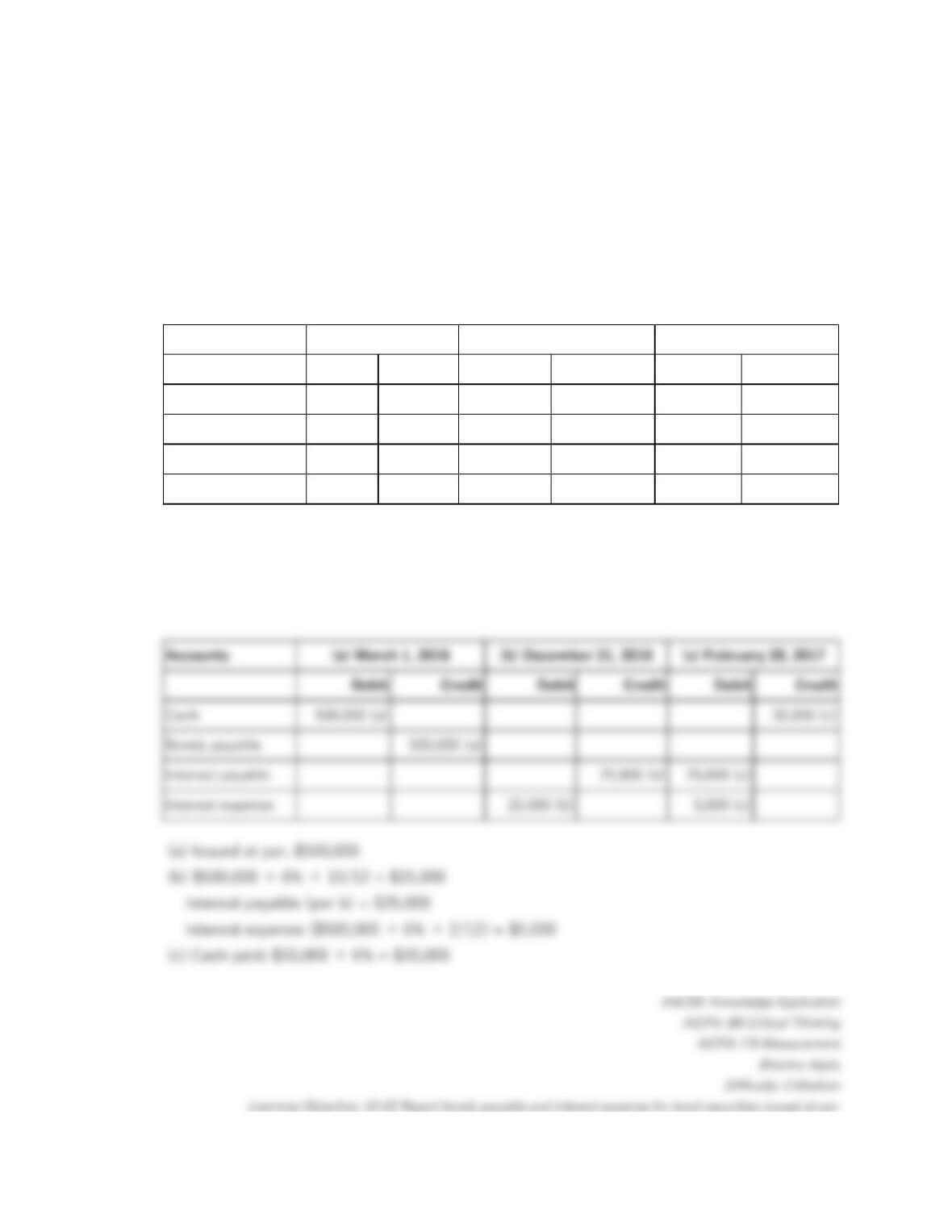
On March 1, 2016, Halbur Company, issued $500,000 of 6%, five-year bonds at par. The bonds
were dated March 1, 2016, and the first annual interest payment will be on February 28, 2017.
The accounting period ends December 31. Assume no adjusting entries have been made
during the year.
Required:
Complete the journal entry grid for each of the following dates:
Accounts
(a) March 1, 2016
(b) December 31, 2016
(c) February 28, 2017
Debit
Credit
Debit
Credit
Debit
Credit
Cash
Bonds payable
Interest payable
Interest expense
Cash
Bonds payable
Interest payable
Interest expense
107.
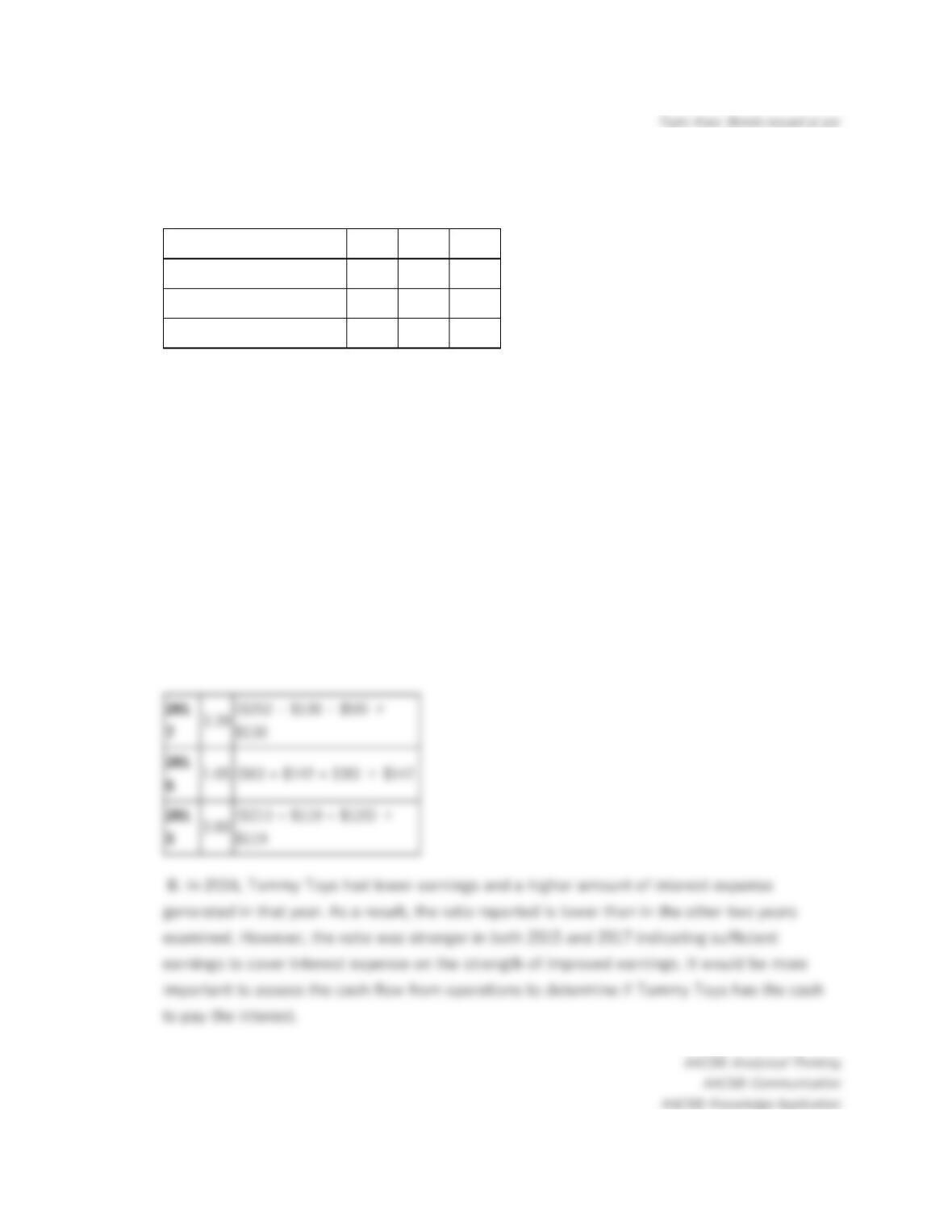
The following information was taken from the income statement of Tommy Toys for the years
2015 through 2017 (in millions):
2017
2016
2015
Interest expense
$130
$142
$119
Income tax expense
$59
$30
$120
Net income (loss)
$252
$63
$213
Required:
A. Compute Tommy Toys times interest earned ratio for all three years. Round your answers
to two decimal places.
B. Briefly interpret the times interest earned ratio for the three years.
Times interest earned ratio = (Net income + Interest expense + Income Tax Expense) ÷
Interest expense.
A.
108.
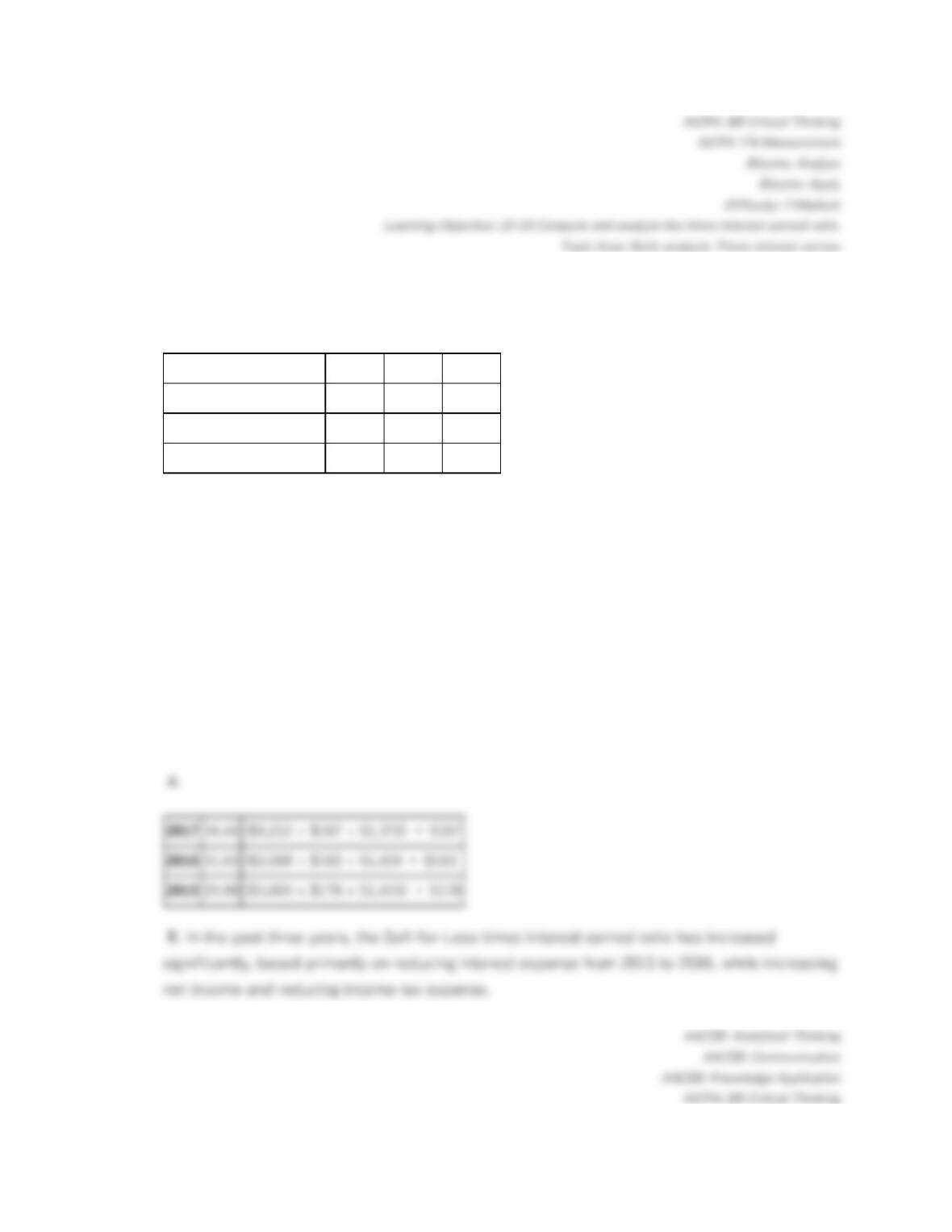
The following information is available for Sell–for-Less for the years 2015 through 2017 (in
millions):
2017
2016
2015
Interest expense
$167
$163
$178
Income tax expense
$1,372
$1,424
$1,433
Net income (loss)
$4,212
$3,568
$3,000
Required:
A. Compute the Sell-for-Less times interest earned ratio for 2017, 2016, and 2015. Round
your answers to two decimal places.
B. Briefly interpret the times interest earned ratio for the three years.
Times interest earned ratio = (Net income + Interest expense + Income Tax Expense) ÷
Interest expense.
109.
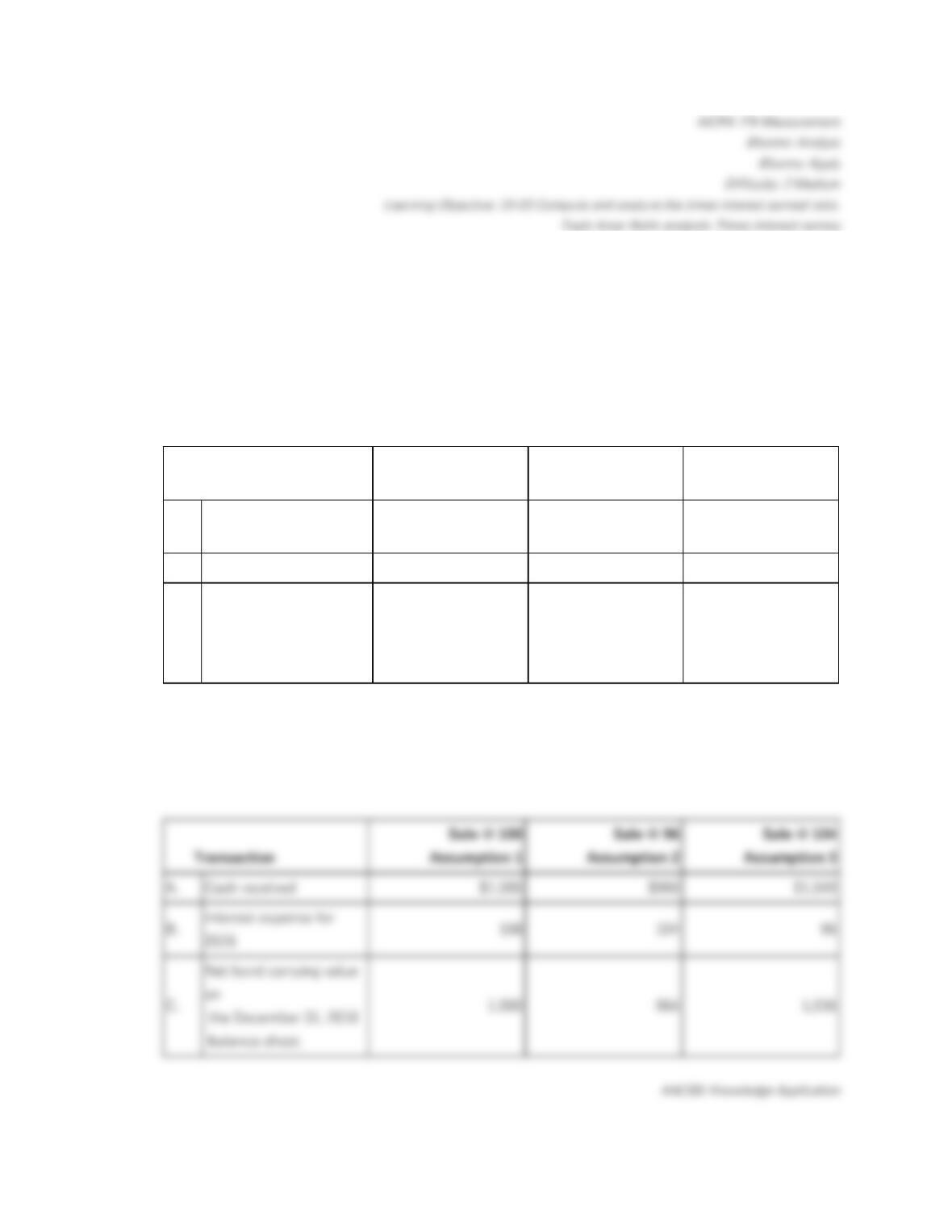
On January 1, 2016, Clintwood Company issued a $1,000, ten-year, 10% bond payable
(interest payable each December 31).
Required:
For the three assumptions below, complete the following schedule if the fiscal year end is
December 31, and straight-line amortization is used:
Transaction
Sale @ 100
Assumption 1
Sale @ 96
Assumption 2
Sale @ 104
Assumption 3
A.
Cash received on
issuance
B.
Interest expense for 2016
C.
Net bond carrying value
on
the December 31, 2016
balance sheet
Cash received
Interest expense for