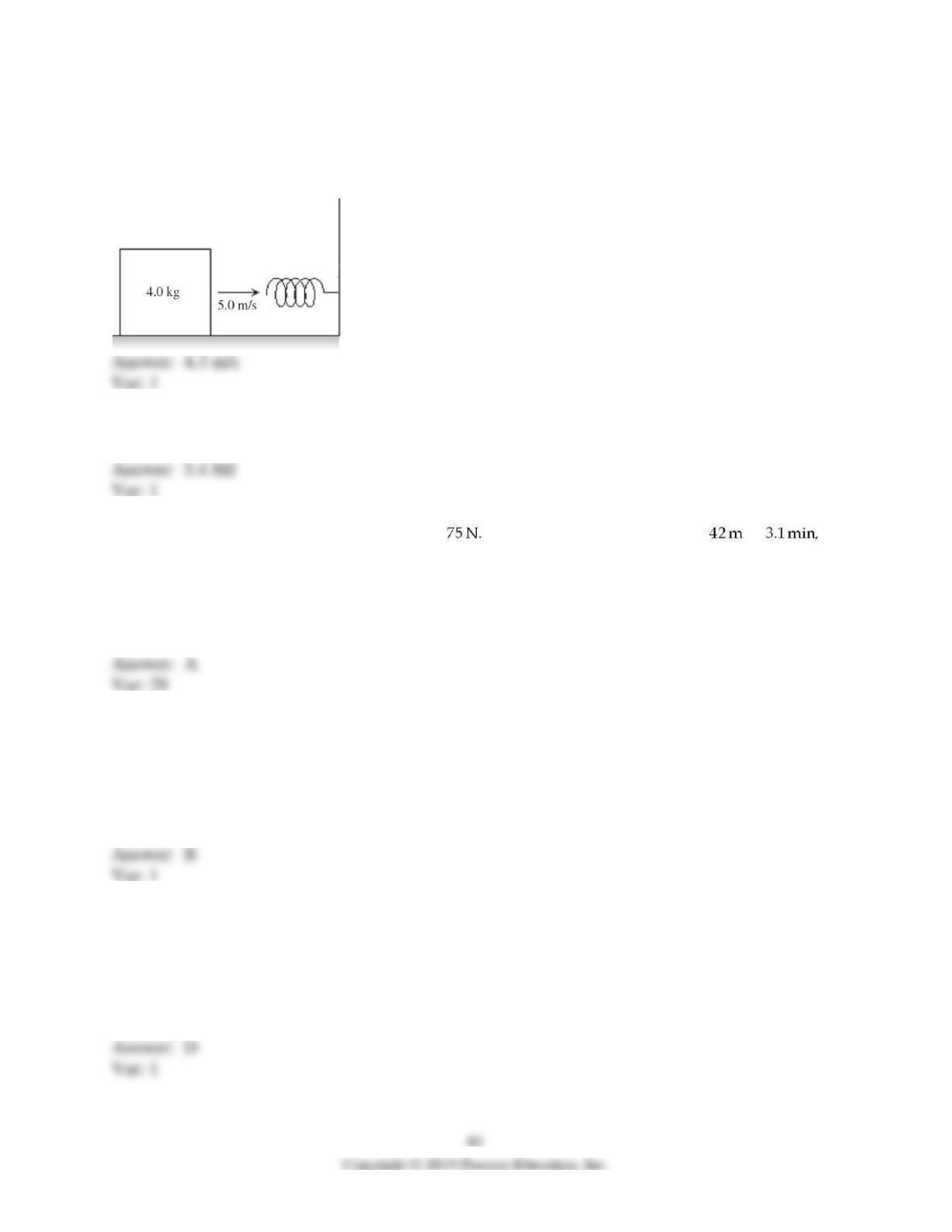
80) As shown in the figure, a 4.0-kg block is moving at 5.0 m/s along a horizontal frictionless
surface toward an ideal spring that is attached to a wall. After the block collides with the spring,
the spring is compressed a maximum distance of 0.68 m. What is the speed of the block when
the spring is compressed to only one-half of the maximum distance?
81) How many joules of energy are used by a 2.0 hp motor that runs for 1.0 hour? (1 hp = 746
W)
82) A child pulls on a wagon with a force of If the wagon moves a total of in
what is the average power delivered by the child?
A) 17 W
B) 21 W
C) 22 W
D) 26 W
83) How many joules of energy are used by a 1.0-hp motor that runs for 1.0 hour? (1 hp = 746
W)
A) 3.6 kJ
B) 2.7 MJ
C) 45 kJ
D) 4.8 J
84) A 1500-kg car accelerates from rest to 25 m/s in 7.0 s. What is the average power delivered
by the engine? (1 hp = 746 W)
A) 60 hp
B) 70 hp
C) 80 hp
D) 90 hp

85) At what minimum rate is a 60.0-kg boy using energy when, in 8.00 s, he runs up a flight of
stairs that is 10.0-m high?
A) 75.0 W
B) 735 W
C) 4.80 kW
D) 48.0 W
86) If electricity costs 7.06¢/kW∙h, how much would it cost you to run a stereo system
per day for
A) $0.95
B) $0.14
C) $1.62
D) $2.66
87) A 1321-kg car climbs a 5.0° slope at a constant speed of Assuming that air
resistance may be neglected, at what rate (in kW) must the engine deliver energy to the drive
wheels of the car?
A) 25 kW
B) 287 kW
C) 38 kW
D) 48 kW
88) A typical incandescent light bulb consumes 75 W of power and has a mass of 30 g. You want
to save electrical energy by dropping the bulb from a height great enough so that the kinetic
energy of the bulb when it reaches the floor will be the same as the energy it took to keep the
bulb on for 1.0 hour. From what height should you drop the bulb, assuming no air resistance and
constant g?
89) What is the net power needed to change the speed of a 1600-kg sport utility vehicle from
15.0 m/s to 40.0 m/s in 4.00 seconds?
A) 100 kW
B) 10.0 kW
C) 140 kW
D) 14.0 kW
E) 275 kW
90) Water flows over a waterfall that is 20 m high at the rate of 4.0 × 10⁴ kg/s. If this water
powers an electric generator with a 40% efficiency, how many watts of electric power can be
supplied?
91) A certain battery charger uses 12 W of power. At 6.0 cents per kilowatt-hour, how much
does it cost to charge batteries for a full day?
A) 28¢
B) 1.4¢
C) 75¢
D) 1.7¢
E) 2.3¢
92) A family goes on vacation for one week but forgets to turn off an electric fan that consumes
electricity at the rate of 200 W. If the cost of electricity is 12.0¢/kW∙h how much does it cost (to
the nearest penny) to run the fan for the week?
93) Suppose you left five 100-W light bulbs burning in the basement for two weeks. If electricity
costs 10.0¢/kW∙h, (a) how much did the electricity cost (to the nearest dollar) to leave those
bulbs on, and (b) how many joules of electrical energy did they consume?
94) Rita raises a 10kg package to a height of 2.5 m in 2.0 s.
(a) How much work did she do on the package?
(b) How much power was expended on the package?
(c) If she were to raise the package in 1.0 s rather than 2.0 s, how do the work and power
change?
95) In a physical fitness program, a woman who weighs 510 N runs up four flights of stairs in 22
s. Each flight rises 3.1 m. (1 hp = 746 W)
(a) What is her total change in potential energy?
(b) What was the minimum average power (in watts) that she expended during the 22 s?
(c) What horsepower motor would be required to generate the same power?
96) A sand mover at a quarry lifts 2,000 kg of sand per minute a vertical distance of 12 m. The
sand is initially at rest and is discharged at the top of the sand mover with speed 5.0 m/s into a
loading chute. What minimum power must be supplied to this machine?
A) 520 W
B) 3.9 kW
C) 6.7 kW
D) 4.3 kW
E) 1.1 kW
97) A 100%-efficient engine is being used to raise a 89-kg crate vertically upward at a steady
rate. If the power output of the engine is 1620 W, how long does it take the engine to lift the
crate a vertical distance of 18.7 m? Friction in the system is negligible.
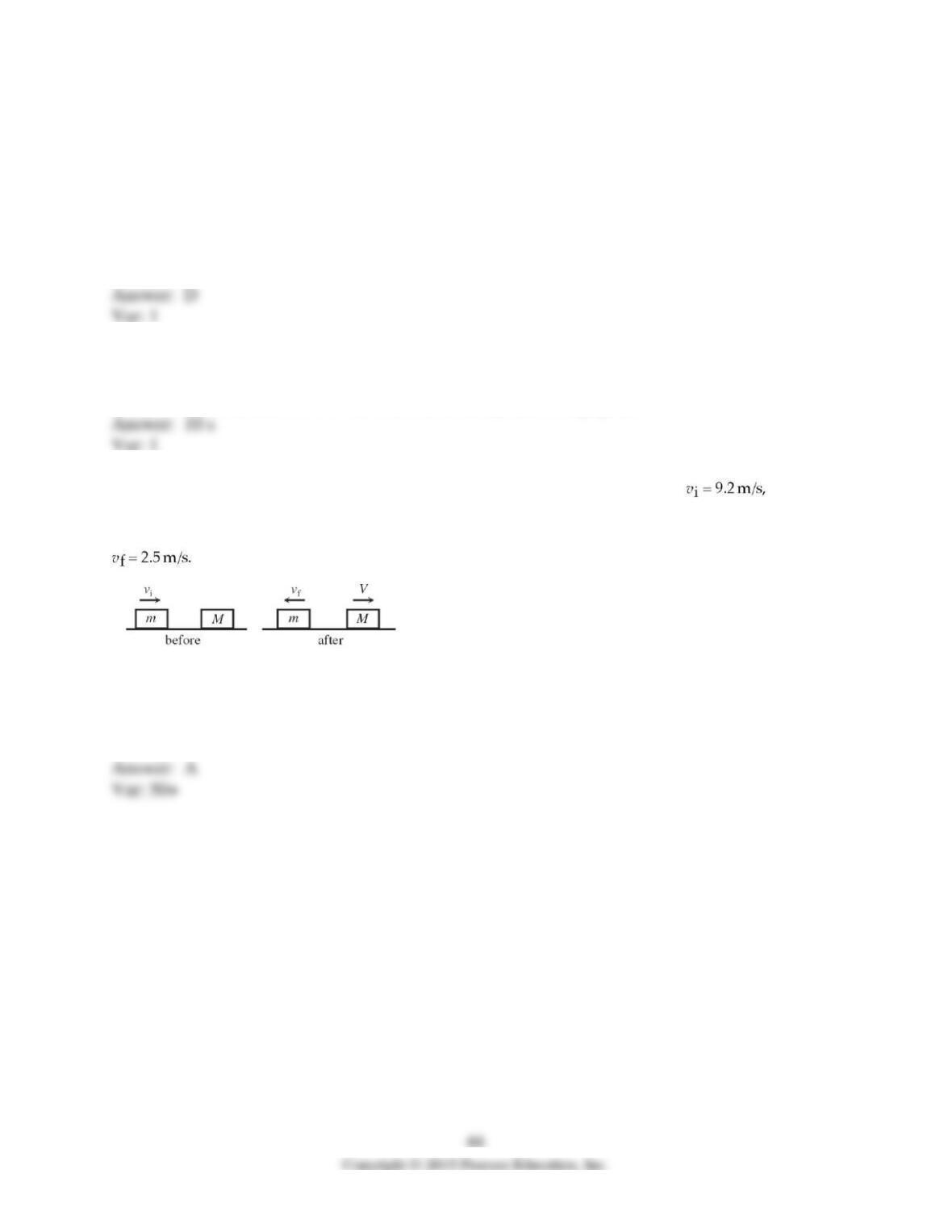
98) A block of mass m = 4.4 kg, moving on frictionless surface with a speed makes a
sudden perfectly elastic collision with a second block of mass M, as shown in the figure. The
second block is originally at rest. Just after the collision, the 4.4-kg block recoils with a speed of
What is the mass M of the second block?
A) 7.7 kg
B) 0 kg
C) 0 kg
D) 0 kg
E) 0 kg
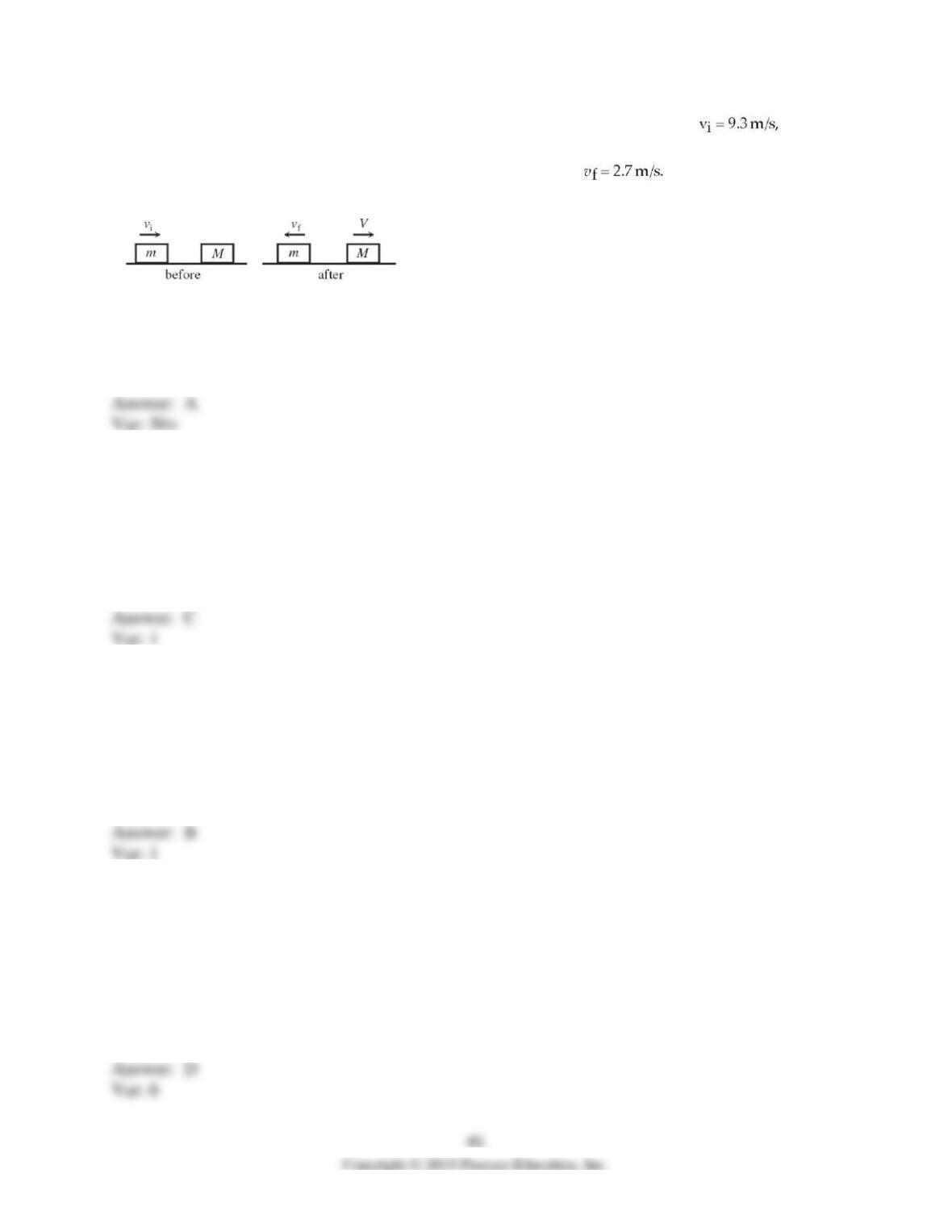
99) A block of mass m = 3.6 kg, moving on a frictionless surface with a speed makes
a sudden perfectly elastic collision with a stationary block of mass M, as shown in the figure.
Just after the collision, the 3.6-kg block recoils with a speed of What is the speed V of
the other block?
A) 6.6 m/s
B) 8.0 m/s
C) 9.3 m/s
D) 10.7 m/s
E) 12.0 m/s
100) A 320-g air track cart traveling at 1.25 m/s suddenly collides elastically with a stationary
270-g cart. What is the speed of the 270-g cart just after the collision?
A) 0.678 m/s
B) 0.106 m/s
C) 1.36 m/s
D) 1.14 m/s
E) 2.72 m/s
101) A 320-g air track cart traveling at 1.25 m/s suddenly collides elastically with a stationary
270-g cart. What is the speed of the 320-g cart just after the collision?
A) 0.68 m/s
B) 0.11 m/s
C) 0.21 m/s
D) 1.4 m/s
E) 1.1 m/s
102) A 550-g ball traveling at 8.0 m/s undergoes a sudden head-on elastic collision with a 250-g
ball traveling toward it also at 8.0 m/s. What is the speed of the 250-g mass just after the
collision?
A) 15 m/s
B) 8.0 m/s
C) 4.0 m/s
D) 14 m/s
E) 0 m/s
103) A 340-g air track cart traveling at 1.25 m/s suddenly collides elastically with a stationary
300-g cart. What is the speed of the 300-g cart just after the collision?
A) 0.0781 m/s
B) 1.33 m/s
C) 0.625 m/s
D) 1.25 m/s
E) 0.664 m/s
104) A proton of mass m is at rest when it is suddenly struck head-on by an alpha particle (which
consists of 2 protons and 2 neutrons) moving at speed v. If the collision is perfectly elastic, what
speed will the alpha particle have after the collision? (Assume the neutron’s mass is equal to the
proton’s mass.)
A) zero
B) 2v/3
C) 3v/5
D) 5v/3
105) A 50-g ball moving at 10 m/s in the +x direction suddenly collides head-on with a
stationary ball of mass 100 g. If the collision is perfectly elastic, what is the velocity of each ball
immediately after the collision?
A) -3.3 m/s, +6.7 m/s
B) +3.3 m/s, -6.7 m/s
C) -6.7 m/s, +3.3 m/s
D) +6.7 m/s, -3.3 m/s
106) In a perfectly elastic collision, a 400-g ball moving toward the east at 3.7 m/s suddenly
collides head-on with a 200 g ball sitting at rest.
(a) Determine the velocity of the first ball just after the collision.
(b) Determine the velocity of the second ball just after the collision.
(c) Is kinetic energy conserved in this collision? How do you know?
107) A 0.140-kg baseball is dropped from rest from a height of 2.20 m above the ground and
experiences negligible air resistance as it falls. It rebounds to a height of 1.60 m. What change in
the ball’s momentum occurs as it rebounds from the ground?
A) 0.117 kg ∙ m/s upwards
B) 0.117 kg ∙ m/s downwards
C) 1.70 kg ∙ m/s upwards
D) 0.350 kg ∙ m/s upwards
E) 0.350 kg ∙ m/s downwards
108) A 0.32-kg ball is moving horizontally at 30 m/s just before suddenly bouncing off a wall
Just after the bounce, it is moving horizontally at 25 m/s but in the opposite direction.
(a) What is the magnitude of the change in momentum of the ball during the bounce?
(b) What percentage of the ball’s original kinetic energy was lost in the collision?
109) In a police ballistics test, a 2.00-g bullet suddenly hits and becomes embedded in a 5.00-kg
wood block which is hanging from a 1.20-m long string. This causes the block to swing through
an arc of 3.50°. What was the speed of the bullet just before it hit the block?
A) 16.7 m/s
B) 524 m/s
C) 25.3 m/s
D) 262 m/s
E) 789 m/s
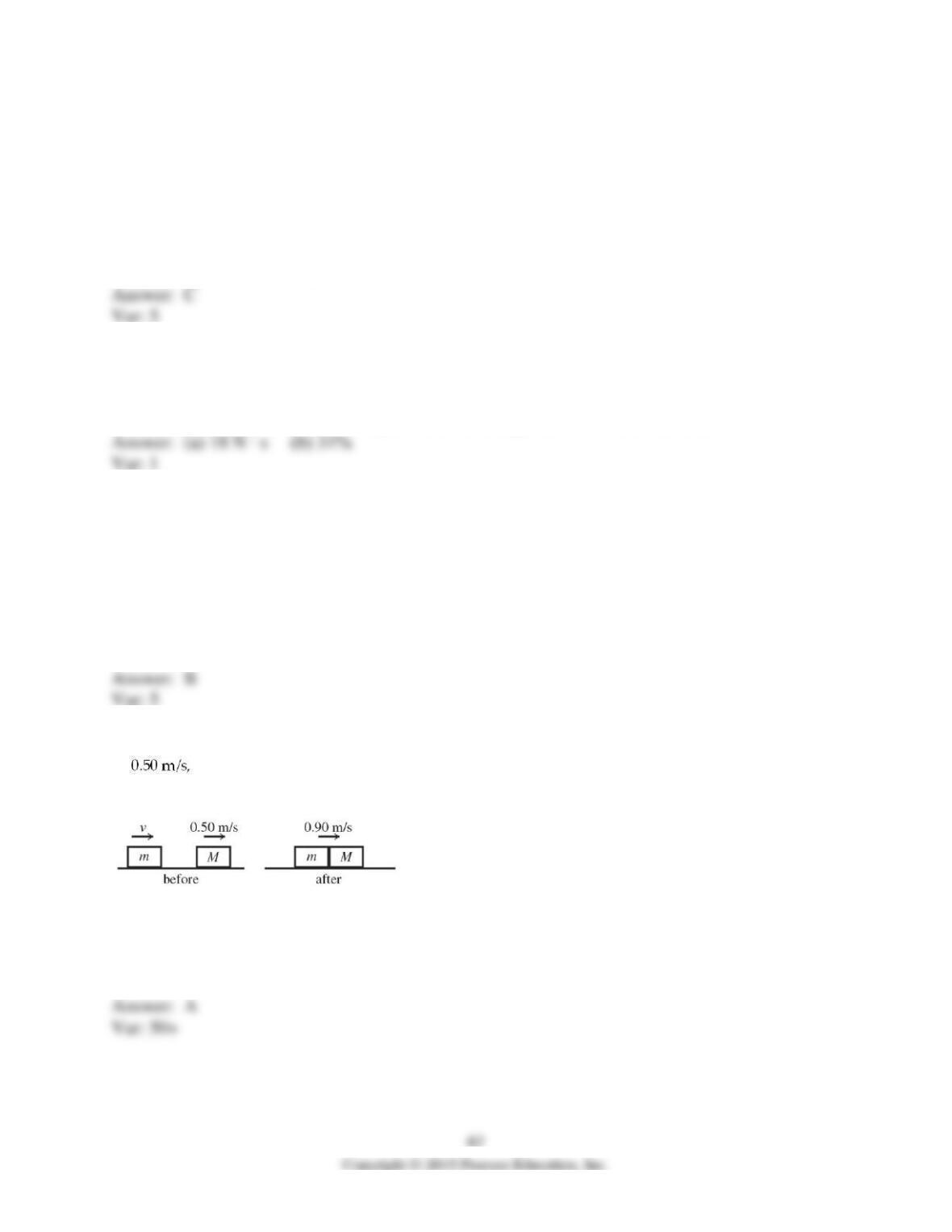
110) A block of mass m = 9.0 kg and speed V and is behind a block of mass M = 27 kg and speed
of as shown int the figure. The surface is frictionless, and the blocks suddenly collide
and couple. After the collision, the blocks have a common speed of 0.90 m/s. How much kinetic
energy of the blocks is lost due to the collision?
A) 8.6 J
B) 2.0 J
C) 4.6 J
D) 11 J
E) 31 J
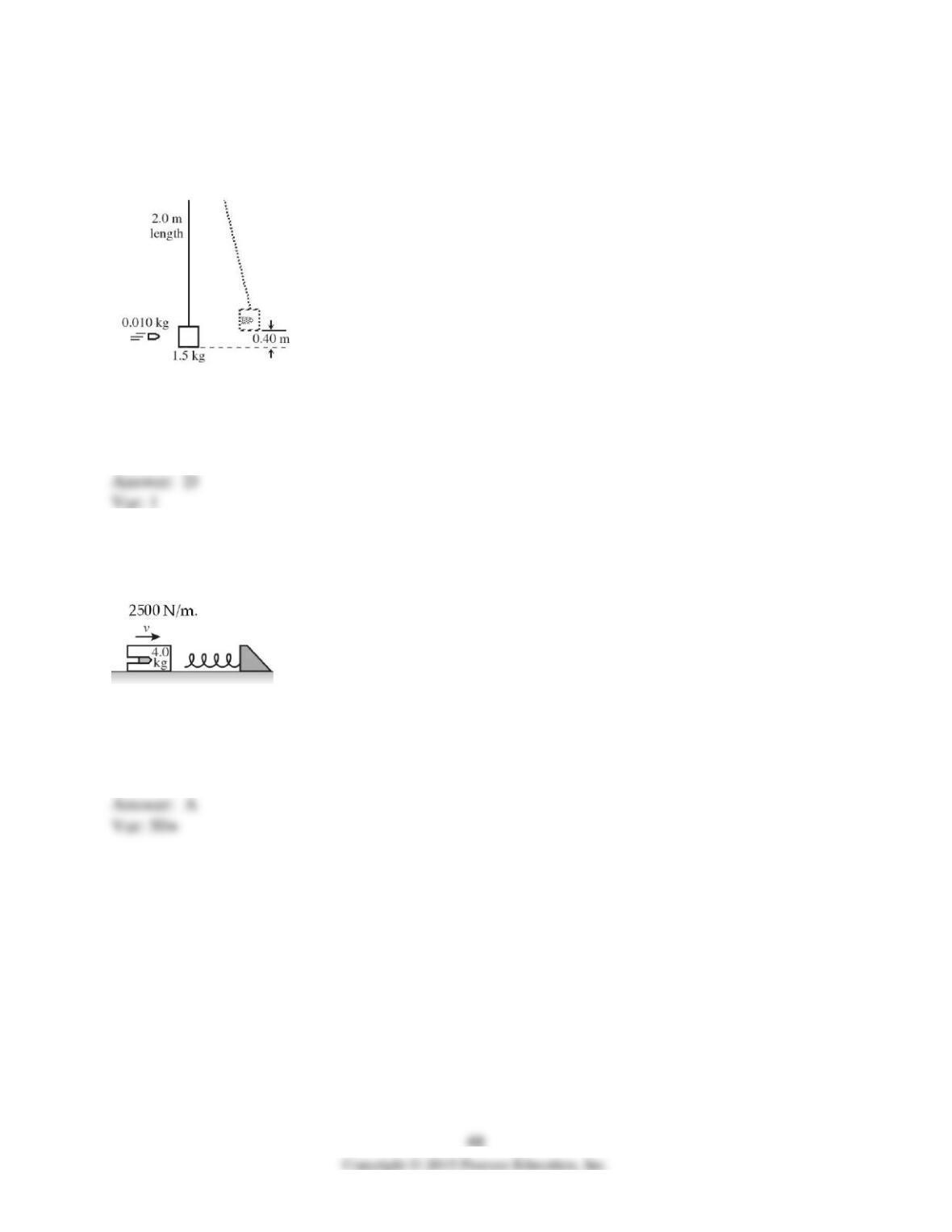
111) As shown in the figure, a bullet of mass 0.010 kg moving horizontally suddenly strikes a
block of wood of mass 1.5 kg that is suspended as a pendulum. The bullet lodges in the wood,
and together they swing upward a vertical distance of 0.40 m. The length of the string is 2.0 m.
What was the speed of the bullet just before it struck the wooden block?
A) 67 m/s
B) 250 m/s
C) 370 m/s
D) 420 m/s
E) 650 m/s
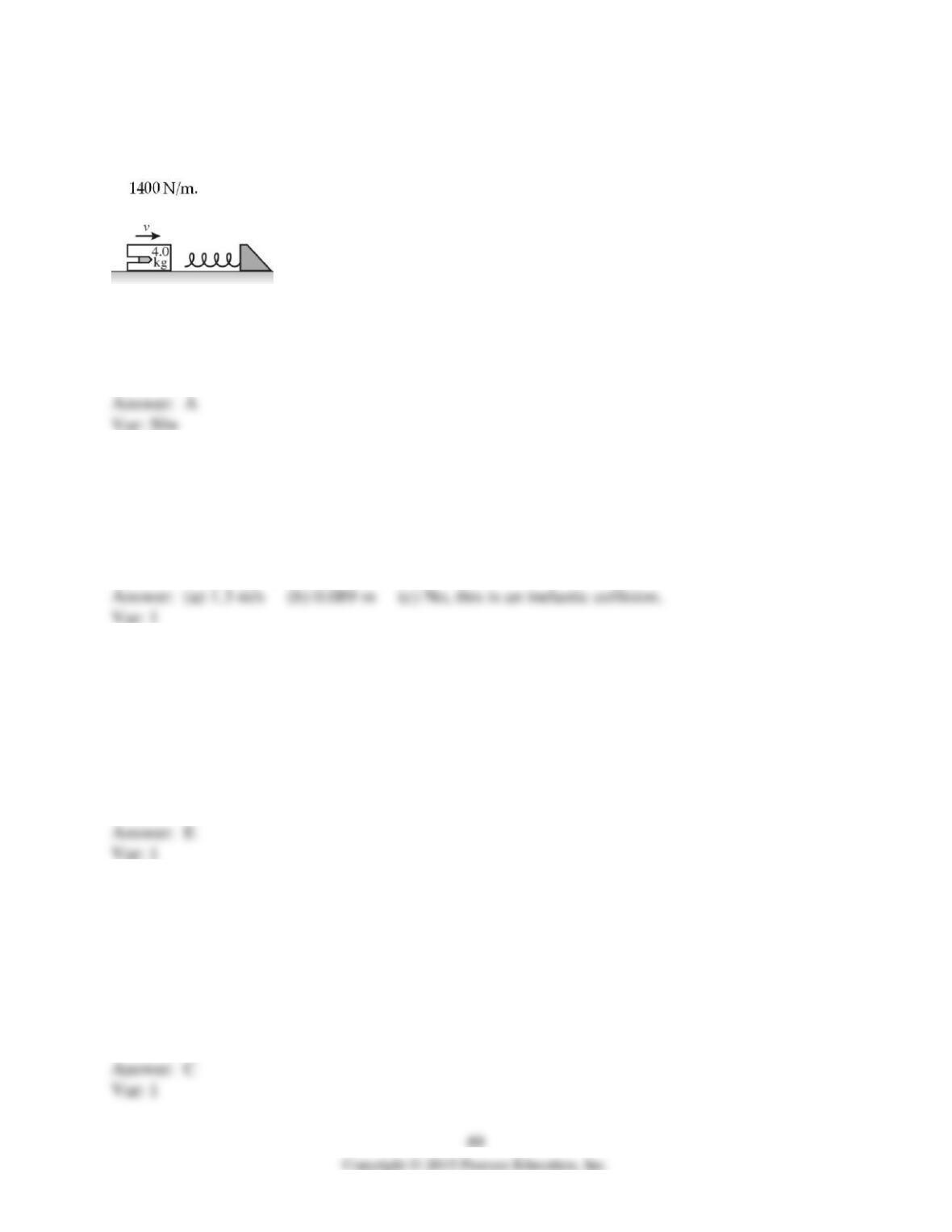
112) An 8.0-g bullet is suddenly shot into a 4.0-kg block that is at rest on a frictionless horizontal
surface, as shown in the figure. The bullet remains lodged in the block. The block then moves
against a spring and compresses it by 3.7 cm. The force constant (spring constant) of the spring
is What was the initial speed v of the bullet?
A) 460 m/s
B) 440 m/s
C) 480 m/s
D) 500 m/s
E) 520 m/s
113) An 8.0-g bullet is suddenly shot into a 4.0-kg block, at rest on a frictionless horizontal
surface, as shown in the figure. The bullet remains lodged in the block. The block then moves
against a spring and compresses it by 8.9 cm. The force constant (spring constant) of the spring
is What is the magnitude of the impulse on the block (including the bullet inside) due
to the spring during the entire time interval during which the block compresses the spring?
A) 13 N ∙ s
B) 12 N ∙ s
C) 10 N ∙ s
D) 8.3 N ∙ s
E) 6.7 N ∙ s
114) In a police rifle test, a 15-g bullet traveling 213 m/s in a vertical direction suddenly buries
itself in a 2.4-kg block of wood at rest directly above it. As a result, the bullet-block
combination moves vertically upward.
(a) Determine the velocity of the bullet-block combination just after the impact.
(b) Determine the maximum height reached by the bullet/block combination.
(c) Is kinetic energy conserved in this collision?
115) In a certain nuclear reactor, neutrons suddenly collide with deuterons, which have twice the
mass of neutrons. In a head-on elastic collision with a stationary deuteron, what fraction of the
initial kinetic energy of a neutron is transferred to the deuteron?
A) 1/2
B) 1/3
C) 3/4
D) 5/6
E) 8/9
116) In a certain nuclear reactor, neutrons suddenly collide with carbon nuclei, which have 12
times the mass of neutrons. In a head-on elastic collision with a stationary carbon nucleus, what
fraction of its initial speed does the neutron have after the collision?
A) 11/12
B) 1/12
C) 11/13
D) 5/6
E) 10/13
117) An object initially at rest suddenly explodes in two fragments of masses and
that move in opposite directions. If the speed of the first fragment is find the internal
energy of the explosion.
A) 30 J
B) 30 kJ
C) 38 J
D) 38 kJ
118) Two simple pendulums of equal length l = 0.45 m are suspended from the same point. The
pendulum bobs are small solid steel spheres. The first bob is drawn back to make a 35° angle
with the vertical, while the other one is left hanging at rest. If the first bob has a mass of 0.25 kg
and the second has a mass of how high will the second bob rise above its initial position
when struck elastically by the first bob after it is released?
A) 3.3 cm
B) 2.7 cm
C) 3.9 cm
D) 4.4 cm
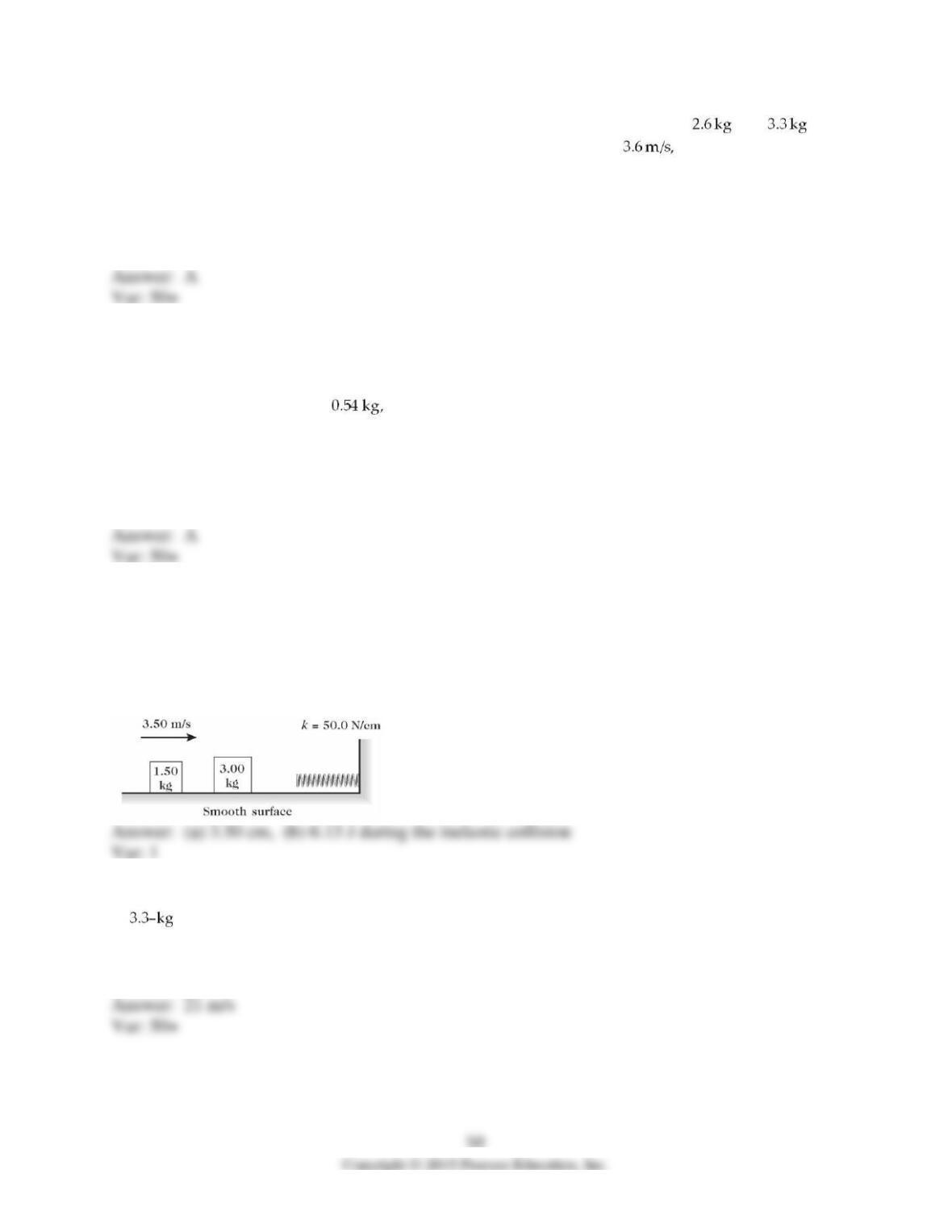
119) On a frictionless horizontal surface, a 1.50-kg mass traveling at 3.50 m/s suddenly collides
with and sticks to a 3.00-kg mass that is initially at rest, as shown in the figure. This system then
runs into an ideal spring of force constant (spring constant) 50.0 N/cm.
(a) What will be the maximum compression distance of the spring?
(b) How much mechanical energy is lost during this process? During which parts of the process
(the collision and compression of the spring) is this energy lost?
120) A baseball pitcher is employing a ballistic pendulum to determine the speed of his fastball.
A lump of clay is suspended from a cord 2.0 m long. When the pitcher throws his fastball
aimed directly at the clay, the ball suddenly becomes embedded in the clay and the two swing up
to a maximum height of 0.080 m. If the mass of the baseball is 0.21 kg, find the speed of the
pitched ball.

121) A 1200-kg pick-up truck traveling south at 15 m/s suddenly collides with a 750-kg car that
is traveling east. The two vehicles stick together and slide along the road after colliding. A
highway patrol officer investigating the accident determines that the final position of the
wreckage after the collision is 25 m, at an angle of 50° south of east, from the point of impact.
She also determines that the coefficient of kinetic friction between the tires and the road at that
location was 0.40. What was the speed of the car just before the collision?
A) 20 m/s
B) 4.8 m/s
C) 14 m/s
D) 23 m/s
E) 17 m/s
122) A uniform solid cylinder with a radius of 10 cm and a mass of 3.0 kg is rotating about its
center with an angular speed of 33.4 rpm. What is its kinetic energy?
A) 0.18 J
B) 0.092 J
C) 0.96 J
D) 1.1 J
E) 17 J
123) What is the kinetic energy of a 120-cm thin uniform rod with a mass of 450 g that is
rotating about its center at 3.60 rad/s?
A) 0.350 J
B) 4.20 J
C) 0.700 J
D) 0.960 J
E) 2.10 J
124) To drive a typical car at 40 mph on a level road for one hour requires about 3.2 × 10⁷ J of
energy. Suppose we tried to store this much energy in a spinning, solid, uniform, cylindrical
flywheel. A large flywheel cannot be spun too fast or it will fracture. If we used a flywheel of
diameter 1.2 m and mass 400 kg, what angular speed would be required to store 3.2 × 10⁷ J?
A) 1800 rad/s
B) 3600 rad/s
C) 940 rad/s
D) 530 rad/s
E) 5500 rad/s
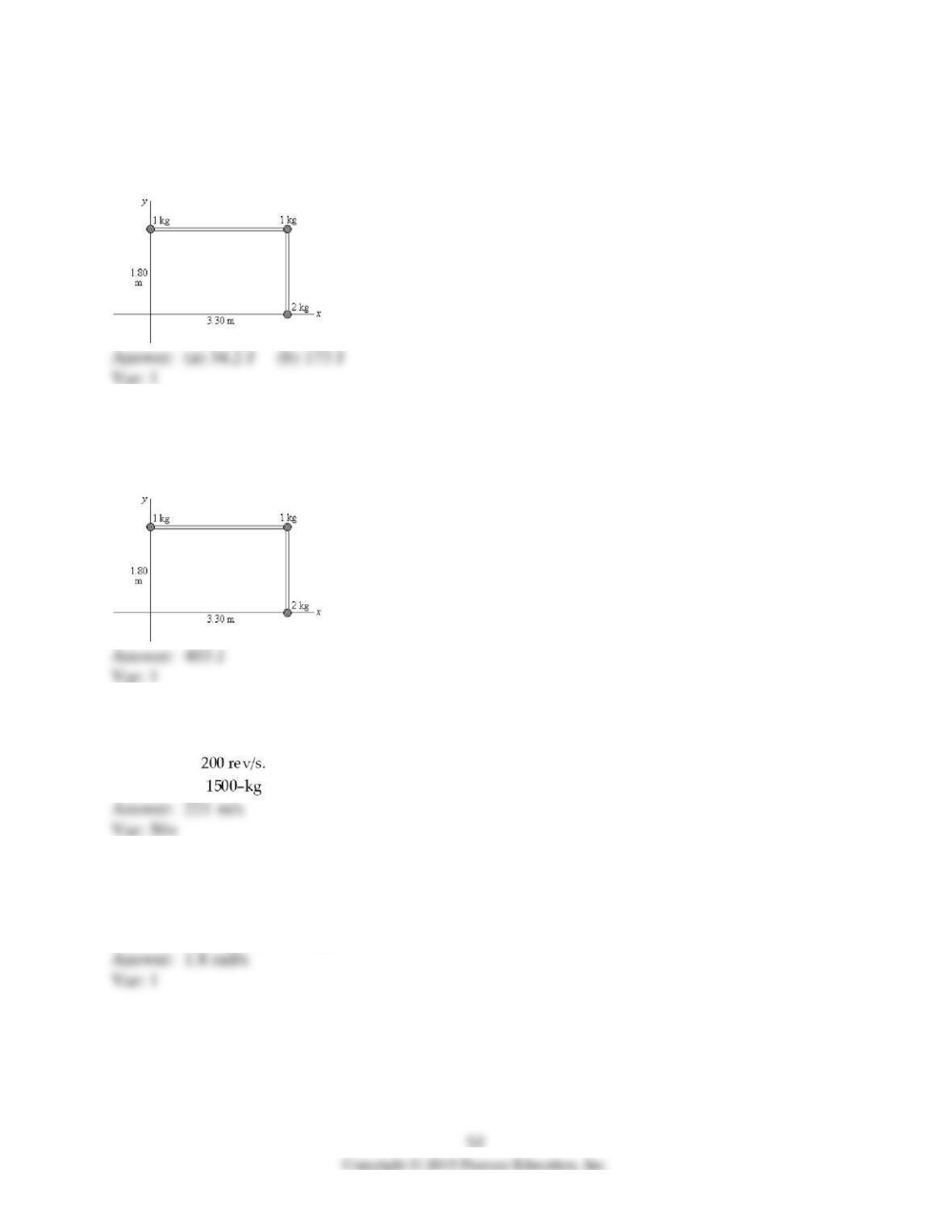
125) The L-shaped object shown in the figure consists of three small masses connected by
extremely light rods. Assume that the masses shown are accurate to three significant figures.
How much work must be done to accelerate the object from rest to an angular speed of 3.25 rad/s
(a) about the x-axis, (b) about the y-axis?
126) The L-shaped object shown in the figure consists of three small masses connected by thin
uniform rods, each rod of mass 3.00 kg. Assume that the masses shown are accurate to three
significant figures. How much work must be done to accelerate the object from rest to an angular
speed of 3.25 rad/s about the y-axis?
127) A futuristic design for a car is to have a large flywheel within the car to store kinetic
energy. The flywheel is a solid uniform disk of mass 370 kg with a radius of 0.50 m, and it can
rotate up to Assuming all of this stored kinetic energy could be transferred to the linear
speed of the car, find the maximum attainable speed of the car.
128) A small ball is tied to one end of a light 2.5-m wire, and the other end of the wire is hooked
to the ceiling. A person pulls the ball to the side until the wire makes an angle of 35° with the
plane of the ceiling and then gently releases it. What is the angular speed of the ball, in rad/s, as
it swings through its lowest point?

129) While spinning down from 500 rpm to rest, a flywheel does of work. This flywheel is
in the shape of a solid uniform disk of radius 1.2 m. What is the mass of this flywheel?
A) 4.0 kg
B) 3.4 kg
C) 4.6 kg
D) 5.2 kg
130) A solid uniform sphere of mass 120 kg and radius 1.7 m starts from rest and rolls without
slipping down an inclined plane of vertical height 5.3 m. What is the angular speed of the sphere
at the bottom of the inclined plane?
A) 5.1 rad/s
B) 8.7 rad/s
C) 9.7 rad/s
D) 6.1 rad/s
131) A solid uniform disk of diameter 3.20 m and mass 42 kg rolls without slipping to the
bottom of a hill, starting from rest. If the angular speed of the disk is 4.27 rad/s at the bottom,
how high did it start on the hill?
A) 3.57 m
B) 2.68 m
C) 3.14 m
D) 4.28 m
132) A wheel having a moment of inertia of 5.00 kg ∙ m2 starts from rest and accelerates under a
constant torque of 3.00 N ∙ m for 8.00 s. What is the wheel’s rotational kinetic energy at the end
of 8.00 s?
A) 57.6 J
B) 64.0 J
C) 78.8 J
D) 122 J
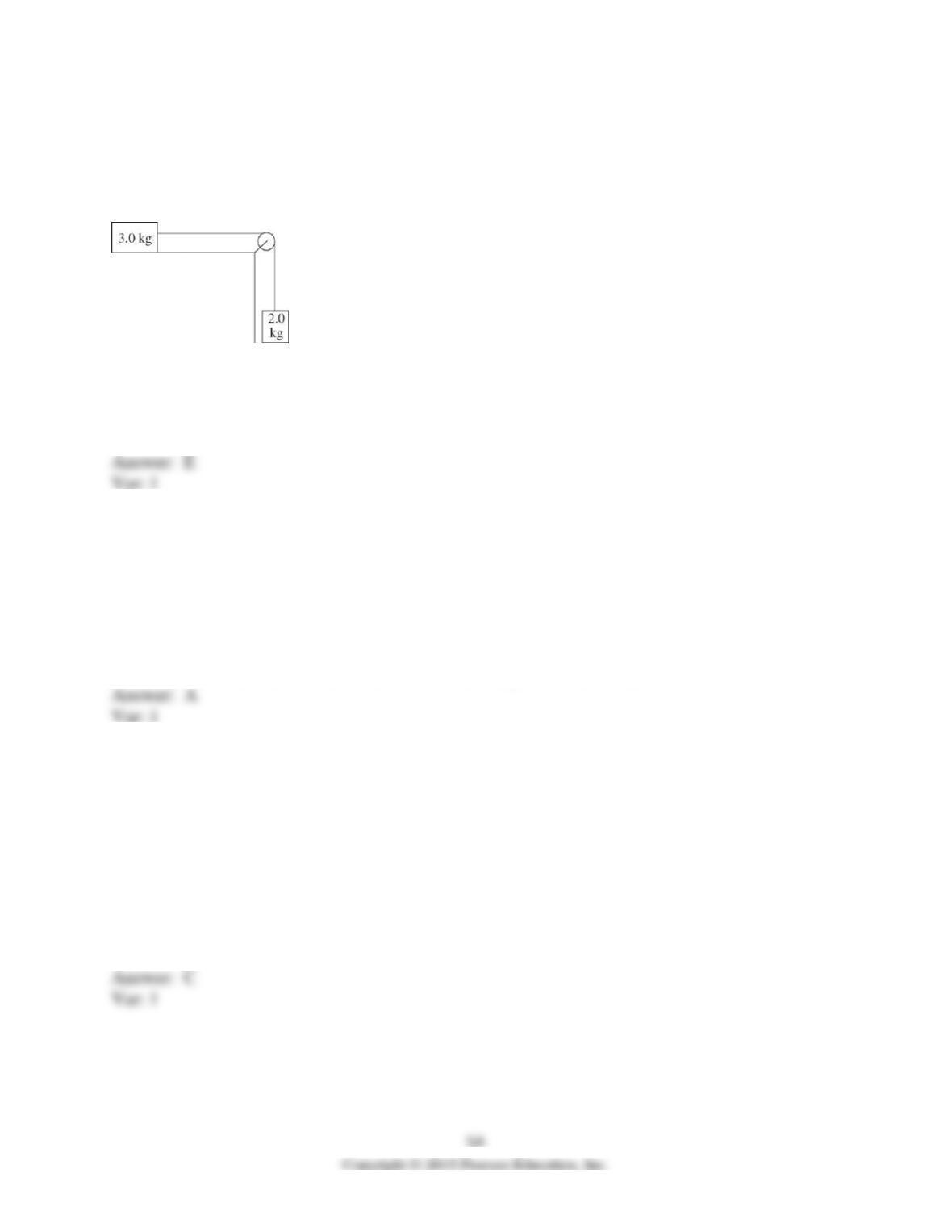
133) As shown in the figure, two blocks are connected by a light string that passes over a
frictionless pulley having a moment of inertia of 0.0040 kg ∙ m2 and diameter 10 cm. The
coefficient of kinetic friction between the table top and the upper block is 0.30. The blocks are
released from rest, and the string does not slip on the pulley. How fast is the upper block moving
when the lower one has fallen 0.60 m?
A) 1.2 m/s
B) 5.4 m/s
C) 3.2 m/s
D) 2.0 m/s
E) 1.4 m/s
134) A solid uniform ball with a mass of 125 g is rolling without slipping along the horizontal
surface of a table with a speed of 4.5 m/s when it rolls off the edge and falls towards the floor,
1.1 m below. What is the rotational kinetic energy of the ball just before it hits the floor?
A) 0.51 J
B) 0.73 J
C) 1.1 J
D) 2.6 J
E) This question cannot be answered without knowing the radius of the ball.
135) A string is wrapped tightly around a fixed pulley that has a moment of inertia of 0.0352 kg ∙
m2 and a radius of 12.5 cm. A mass of 423 g is attached to the free end of the string. With the
string vertical and taut, the mass is gently released so it can descend under the influence of
gravity. As the mass descends, the string unwinds and causes the pulley to rotate, but does not
slip on the pulley. What is the speed of the mass after it has fallen through 1.25 m?
A) 2.00 m/s
B) 2.28 m/s
C) 1.97 m/s
D) 3.94 m/s
E) 4.95 m/s
136) A string is wrapped tightly around a fixed frictionless pulley that has a moment of inertia of
0.0352 kg ∙ m2 and a radius of 12.5 cm. The string is pulled away from the pulley with a constant
force of 5.00 N, causing the pulley to rotate. What is the speed of the string after it has unwound
1.25 m if the string does not slip on the pulley?
A) 2.09 m/s
B) 2.36 m/s
C) 1.18m/s
D) 3.18 m/s
E) 4.95 m/s
137) An Atwood machine consists of a mass of 3.5 kg connected by a light string to a mass of
6.0 kg over a frictionless pulley with a moment of inertia of 0.0352 kg ∙ m2 and a radius of 12.5
cm. If the system is released from rest, what is the speed of the masses after they have moved
through 1.25 m if the string does not slip on the pulley?
A) 2.0 m/s
B) 2.3 m/s
C) 4.0 m/s
D) 5.0 m/s
E) 6.0 m/s
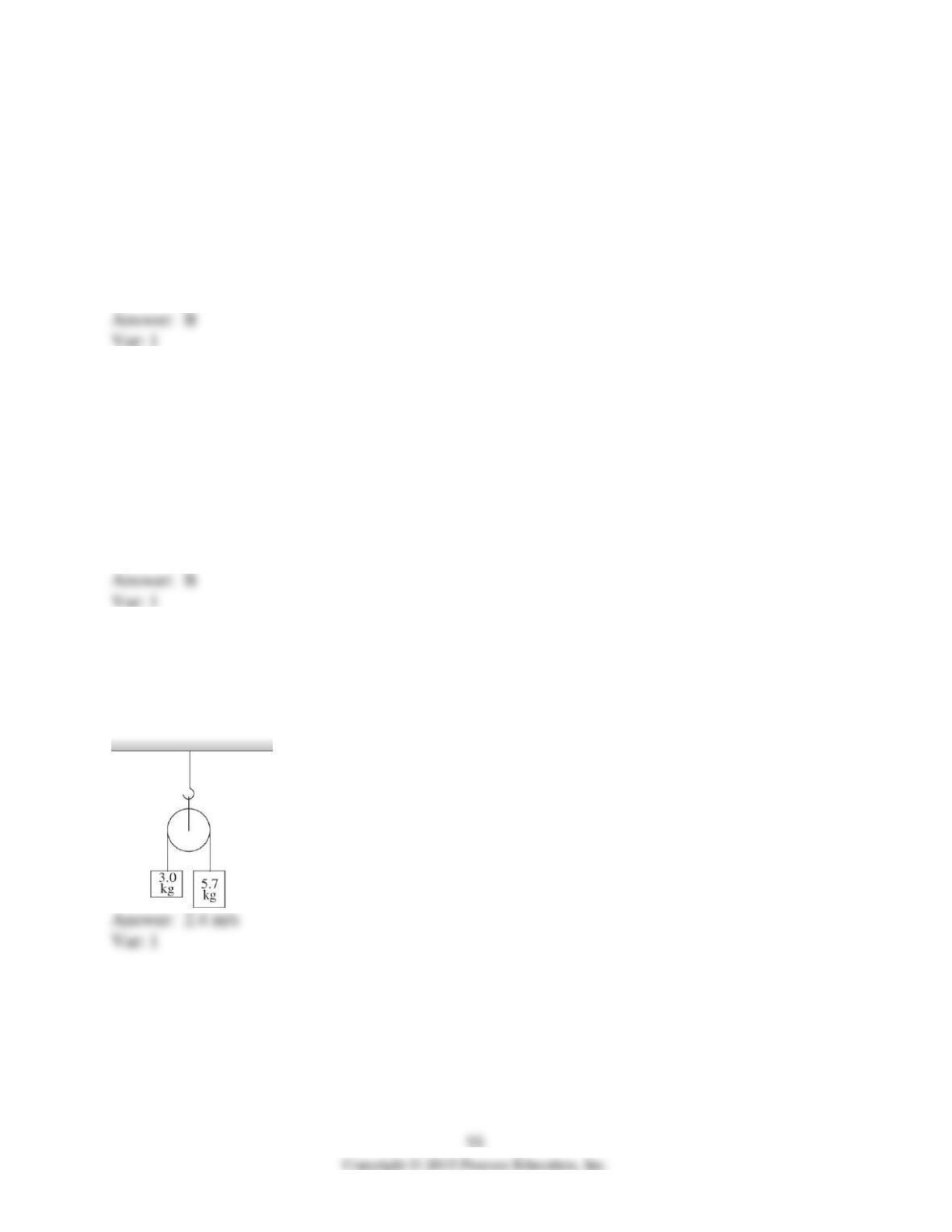
138) The figure shows two blocks connected by a light cord over a pulley. This apparatus is
known as an Atwood’s machine. There is no slipping between the cord and the surface of the
pulley. The pulley itself has negligible friction and it has a radius of 0.12 m and a mass of 10.3
kg. We can model this pulley as a solid uniform disk. At the instant that the heavier block has
descended 1.5 m starting from rest, what is the speed of the lighter block?

139) A pencil that is 15.7 cm long is released from a vertical position with the eraser end resting
on a table. The eraser does not slip as it tips over. Treat the pencil like a uniform rod. What is the
angular speed of the pencil just before it hits the table?
A) 13.7 rad/s
B) 7.23 rad/s
C) 3.70 rad/s
D) 24.5 rad/s
E) 16.8 rad/s
140) A uniform solid disk is released from rest and rolls without slipping down an inclined plane
that makes an angle of 25° with the horizontal. What is the forward speed of the disk after it has
rolled 3.0 m, measured along the plane?
A) 2.0 m/s
B) 3.5 m/s
C) 4.1 m/s
D) 5.7 m/s
E) 6.3 m/s
141) A solid uniform disk is rolling without slipping along a horizontal surface with a speed of
4.5 m/s when it starts up a ramp that makes an angle of 25° with the horizontal. What is the
speed of the disk after it has rolled 3.0 m up as measured along the surface of the ramp?
A) 4.0 m/s
B) 1.9 m/s
C) 2.1 m/s
D) 6.8 m/s
E) 8.0 m/s
142) A solid uniform sphere is rolling without slipping along a horizontal surface with a speed of
5.5 m/s when it starts up a ramp that makes an angle of 25° with the horizontal. What is the
speed of the sphere after it has rolled 3.0 m up as measured along the surface of the ramp?
A) 4.0 m/s
B) 8.0 m/s
C) 1.9 m/s
D) 2.2 m/s
E) 3.5 m/s
143) A hoop is rolling without slipping along a horizontal surface with a forward speed of 5.50
m/s when it starts up a ramp that makes an angle of 25.0° with the horizontal. What is the speed
of the hoop after it has rolled 3.00 m up as measured along the surface of the ramp?
A) 4.22 m/s
B) 1.91 m/s
C) 2.06 m/s
D) 3.79 m/s
E) 8.02 m/s
144) A hoop with a mass of 2.75 kg is rolling without slipping along a horizontal surface with a
speed of 4.5 m/s when it starts down a ramp that makes an angle of 25° below the horizontal.
What is the forward speed of the hoop after it has rolled 3.0 m down as measured along the
surface of the ramp?
A) 4.9 m/s
B) 6.3 m/s
C) 5.2 m/s
D) 5.7 m/s
E) 8.0 m/s
145) A hoop with a mass of 2.75 kg is rolling without slipping along a horizontal surface with a
speed of 4.5 m/s when it starts down a ramp that makes an angle of 25° below the horizontal.
What is the rotational kinetic energy of the hoop after it has rolled 3.0 m down as measured
along the surface of the ramp?
A) 34 J
B) 22 J
C) 45 J
D) 62 J
E) This question cannot be answered without knowing the radius of the hoop.
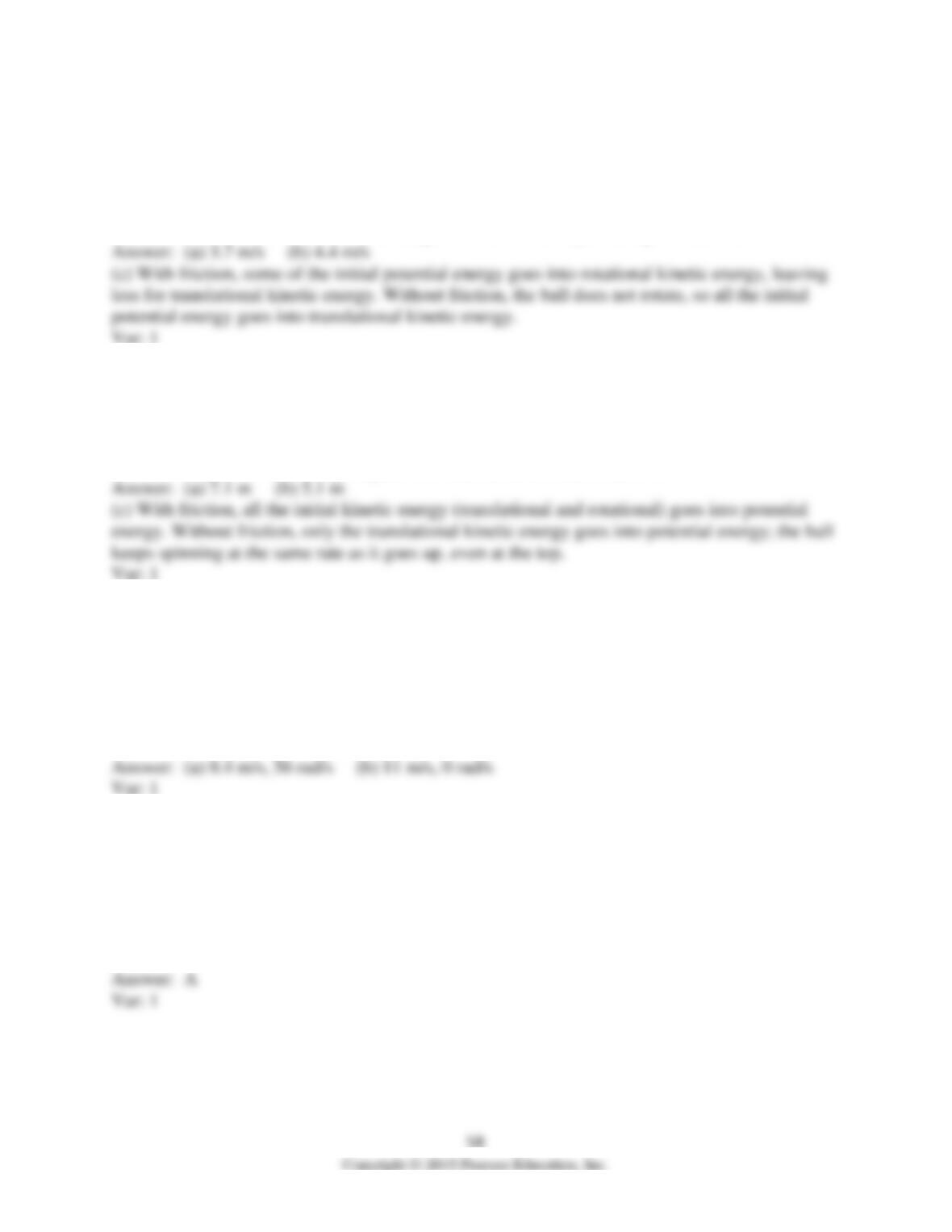
146) A solid uniform 3.33-kg disk has thin string of negligible mass wrapped around its rim,
with one end of the string tied to the ceiling, as shown in the figure. The disk is released from
rest, and as it falls, it turns as the string unwraps. At the instant its center has fallen 2.25 m, (a)
how fast is the center moving, and (b) how much rotational kinetic energy does the disk have?
147) A solid uniform ball of mass 1.0 kg and radius 1.0 cm starts from rest and rolls down a 1.0-
m high ramp. There is enough friction on the ramp to prevent the ball from slipping as it rolls
down.
(a) What is the forward speed of the ball when it reaches the bottom of the ramp?
(b) What would be the forward speed of the ball if there were no friction on the ramp?
(c) Since the ball starts from the same height in both cases, why is the speed different?
148) A solid ball of mass 1.0 kg and radius 10 cm rolls with a forward speed of 10 m/s when it
comes to a hill. There is enough friction on the hill to keep the ball from slipping as it rolls up.
(a) How high vertically up the hill can the ball roll before coming to rest?
(b) How high vertically could the ball go if the hill were totally frictionless?
(c) How is it that the ball can go higher with friction than without friction?
149) A ball in the shape of a uniform spherical shell (like a soccer ball) of mass 1.5 kg and radius
15 cm rolls down a 35° incline that is 6.0 m high, measured vertically. The ball starts from rest,
and there is enough friction on the incline to prevent slipping of the ball.
(a) How fast is the ball moving forward when it reaches the bottom of the incline, and what is its
angular speed at that instant?
(b) If there were no friction on the incline, how fast would the ball be moving forward and what
would be its angular speed at the bottom?
150) A solid uniform cylinder is rolling without slipping. What fraction of its kinetic energy is
rotational?
A) 1/3
B) 2/3
C) 1/2
D) 1/4
E) 3/4
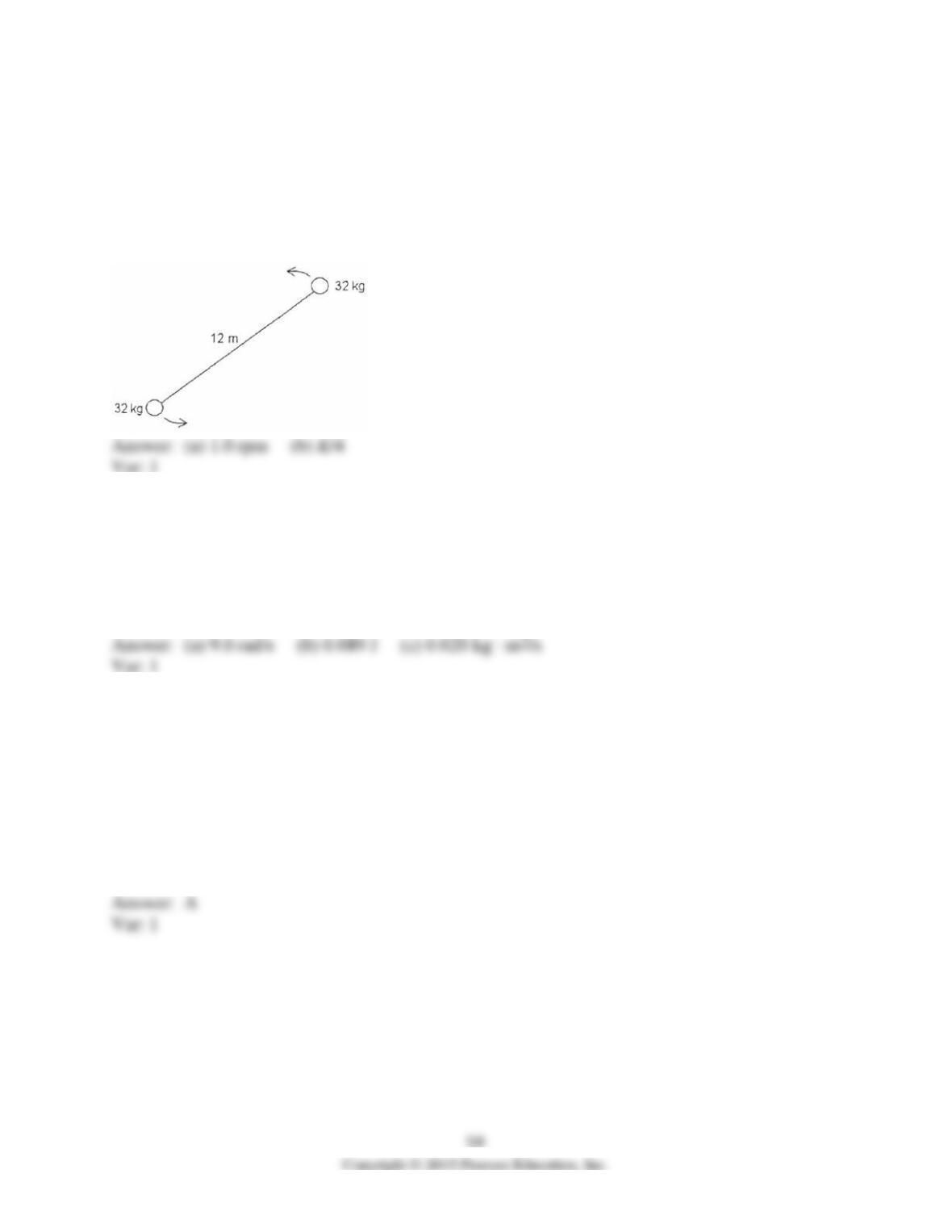
151) NASA puts a satellite into space that consists of two small 32-kg balls connected by a 12-m
long light cable, as shown in the figure. The entire system is initially rotating at 4.0 rpm about an
axis perpendicular to the cable at the center of mass. Motors in each mass reel out more cable so
that the masses double their separation to 24 m.
(a) What is the final rotational speed (in rpm) of the balls?
(b) If the initial rotational kinetic energy of the system was K, what is the final rotational kinetic
energy in terms of K?
152) A uniform ball with diameter of 10 cm rolls without slipping on a horizontal tabletop. The
moment of inertia of the ball about an axis through its center is 2.2 × 10⁻³ kg ∙ m2, and the
translational speed of its center is 0.45 m/s.
(a) What is its angular speed of the ball about its center of mass?
(b) What is the rotational kinetic energy of the ball?
(c) What is the ball’s angular momentum about its center of mass?
153) A solid wooden door, 90 cm wide by 2.0 m tall, has a mass of 35 kg. It is open and at rest.
A small 500-g ball is thrown perpendicular to the door with a speed of 20 m/s and hits the door
60 cm from the hinged side, causing it to begin turning. The ball rebounds along the same line
with a speed of 16.0 m/s relative to the ground. How much energy is lost during this collision?
A) 30 J
B) 16 J
C) 15 J
D) 13 J
E) 4.8 J