Solve the problem.
102)
Suppose an object moves along the y–axis so that its location is y = f(x) =x2+ x at time x (y is in
meters and x is in seconds). Find the average velocity (the average rate of change of y with respect
to x) for x changing from 2 to 9 seconds.
102)
A)
12 m/s
B)
84 m/s
C)
3 m/s
D)
15 m/s
Find the limit.
103)
Determine the limit.
lim
x –10 –
f(x), where f(x) =1
x + 10
103)
A)
–1
B)
C)
0
D)
–
Provide an appropriate response.
104)
Determine the points at which the function is discontinuous.
h(x) =
x2– 4 for x <-1
0 for -1
x 1
x2+ 4 for x >1
104)
A)
–1, 0, 1
B)
1
C)
–1, 1
D)
None
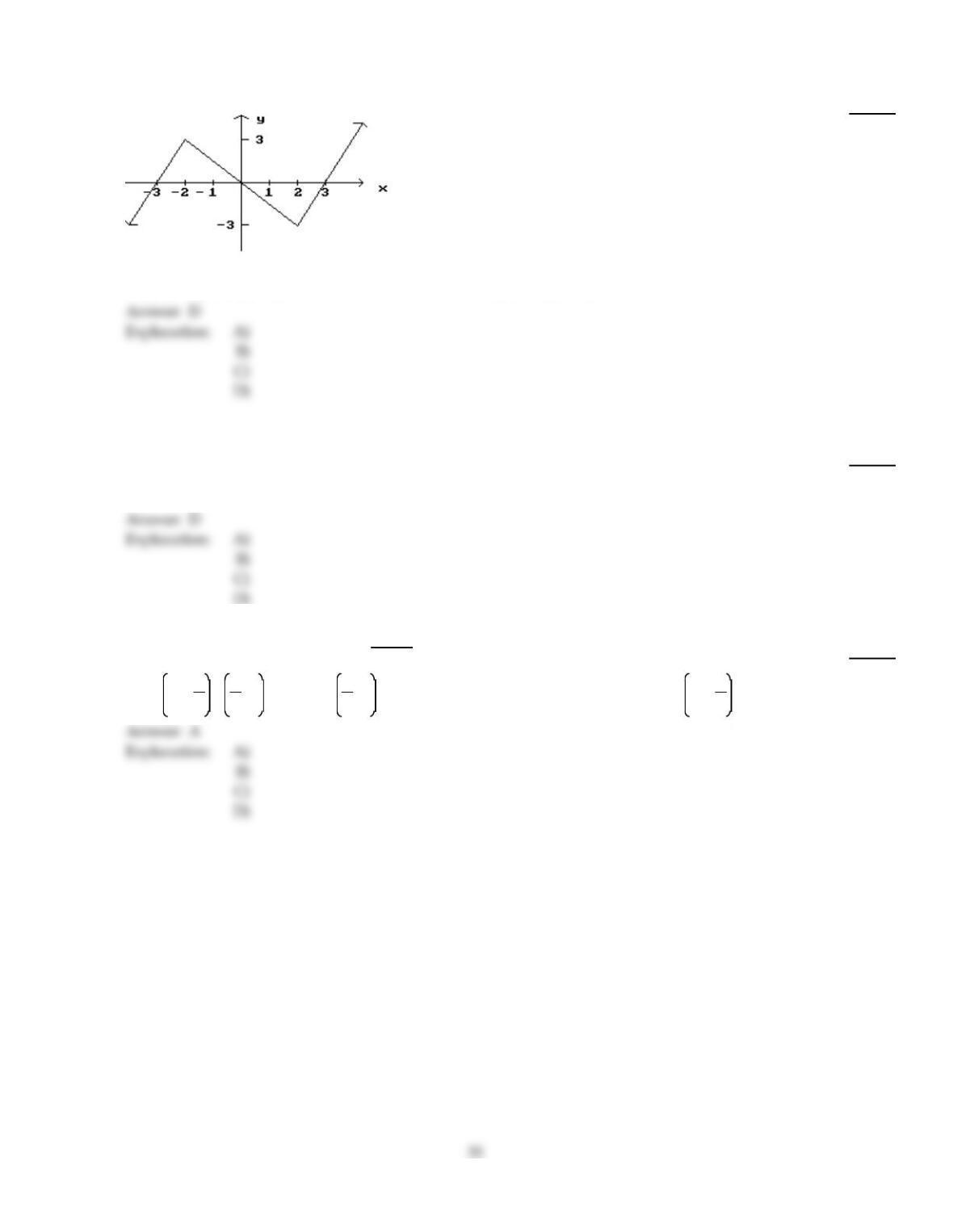
List the x–values in the graph at which the function is not differentiable.
105)
105)
A)
x = – 3, x = 3
B)
x = – 3, x = 0, x = 3
C)
x = – 2, x = 0, x = 2
D)
x = – 2, x = 2
Provide an appropriate response.
106)
Find the equation of the tangent line at x = 7 for f(x) = 6 –x2. Write the answer in the form y = mx
+ b.
106)
A)
y = 7x + 55
B)
y = 14x – 55
C)
y = – 2x
D)
y = – 14x + 55
107)
Determine where the function f(x) =5x
2x – 3 is continuous.
107)
A)
–, 3
23
2,
B)
3
2,
C)
(–, )
D)
–, 3
2
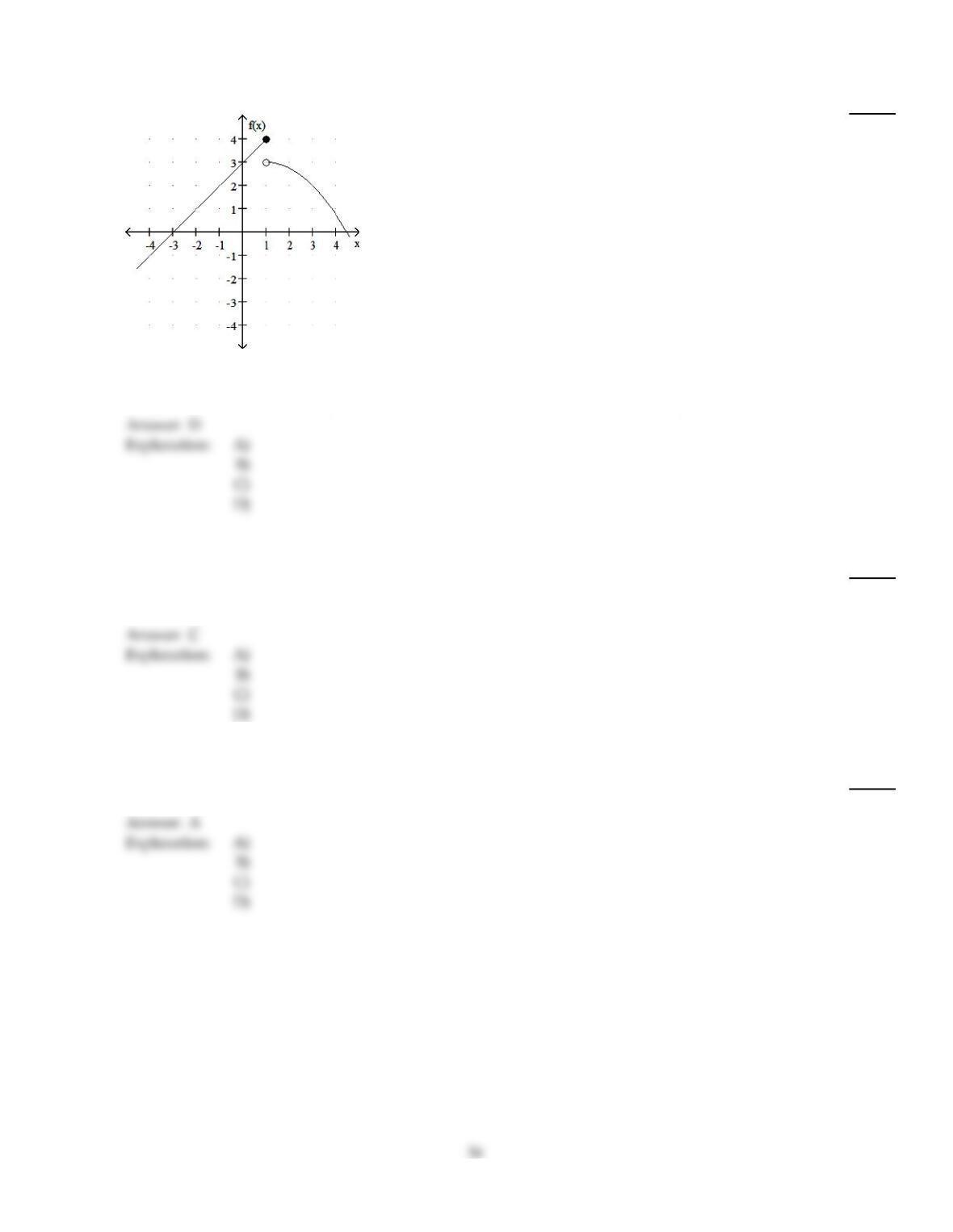
Use the given graph to find the indicated limit.
108)
Find lim
x f(x).
108)
A)
B)
4
C)
3
D)
Solve the problem.
109)
If an object moves along a line so that it is at y = f(x) =2x2+ 6x – 9 at time x (in seconds), find the
instantaneous velocity function v = f'(x).
109)
A)
2x + 6
B)
4x2+ 6
C)
4x + 6
D)
2x2+ 6
Find dy.
110)
y =2x2– 9x – 7
110)
A)
(4x – 9) dx
B)
4x – 7 dx
C)
4x – 18 dx
D)
4x dx
Use or where appropriate to describe the behavior at each zero of the denominator and identify all vertical
asymptotes.
111)
f(x) =x2– 16
x2+ 16
111)
A)
lim
x –4–
f(x) =; lim
x –4+
f(x) = ; x = – 4 is a vertical asymptote
B)
No zeros of denominator; no vertical asymptotes
C)
lim
x
4–
f(x) =; lim
x
4+
f(x) =; x = 0 is a vertical asymptote
D)
lim
x
4–
f(x) =; lim
x
4+
f(x) = ; x = 4 is a vertical asymptote
Find the limit, if it exists.
112)
Evaluate the following limit
lim
x
2
1
x – 2
112)
A)
2
B)
C)
–
D)
Does not exist
D
Provide an appropriate response.
113)
Use a graphing utility to find the discontinuities of the given rational function.
g(x) =x + 1
x3+ 2x2+ 10x – 13
113)
A)
–1
B)
1
C)
3
D)
Continuous at all values of x
B
Solve the problem.
114)
Suppose an object moves along the y–axis so that its location is y = f(x) =x2+ x at time x (y is in
meters and x is in seconds). Find the instantaneous velocity at x = 4 seconds.
114)
A)
20 m/s
B)
10 m/s
C)
9 m/s
D)
8 m/s
C
35
B
115)
Suppose an object moves along the y–axis so that its location is y = f(x) =x2+ x at time x (y is in
meters and x is in seconds). Find the average velocity for x changing from 3 to 3 + h seconds.
115)
A)
7 + h m/s
B)
12 + h m/s
C)
12 – h m/s
D)
7 – h m/s
Find the limit, if it exists.
116)
Let f(x) =
x2– 16
x + 4 if x > 0
x2– 16
x – 4 if x < 0
Find lim
x
0f(x)
116)
A)
–4
B)
0
C)
4
D)
Does not exist
Provide an appropriate response.
117)
Given that f(x) =x
7 – x , find f –4
5. Express the answer as a simplified fraction.
117)
A)
–39
4
B)
–4
39
C)
39
4
D)
4
39
118)
Find y’ if y = 6x.
118)
A)
0
B)
x2
C)
x
D)
6
Find the limit, if it exists.
119)
Evaluate the following limit.
lim
x
2
1
x – 2
119)
A)
–
B)
2
C)
D)
Does not exist
120)
Find: lim
x
5
x – 5
x – 5
120)
A)
1
B)
–1
C)
0
D)
Does not exist
Solve the problem.
121)
An object moves along the y–axis (marked in feet) so that its position at time t (in seconds) is given
by f(t) = 9t3– 9t2+ t + 7. Find the velocity at three seconds.
121)
A)
197 feet per second
B)
190 feet per second
C)
192 feet per second
D)
109 feet per second
122)
Suppose that the cost C of removing p% of the pollutants from a chemical dumping site is given by
C(p) =$35,000
100 – p .
Can a company afford to remove 100% of the pollutants? Explain.
122)
A)
No, the cost of removing p% of the pollutants increases without bound as p approaches 100.
B)
Yes, the cost of removing p% of the pollutants is $350, which is certainly affordable.
C)
No, the cost of removing p% of the pollutants is $350, which is a prohibitive amount of
money.
D)
Yes, the cost of removing p% of the pollutants is $35,000, which is certainly affordable.

Find the instantaneous rate of change for the function at the value given.
123)
Find the instantaneous rate of change for the function x2+3x at x = – 4.
123)
A)
4
B)
–8
C)
–1
D)
–5
38
Answer Key
Testname: C10
Answer Key
Testname: C10
Answer Key
Testname: C10