
9) If a project’s IRR is greater than the cost of capital, the project should be rejected.
10) What is the IRR for the following project if its initial after-tax cost is $5,000,000 and it is
expected to provide after-tax operating cash inflows of $1,800,000 in year 1, $1,900,000 in year
2, $1,700,000 in year 3, and $1,300,000 in year 4?
A) 15.57%
B) 0.00%
C) 13.57%
D) 12.25%
11) What is the IRR for the following project if its initial after-tax cost is $5,000,000 and it is
expected to provide after-tax operating cash flows of ($1,800,000) in year 1, $2,900,000 in year
2, $2,700,000 in year 3, and $2,300,000 in year 4?
A) 5.83%
B) 9.67%
C) 11.44%
D) 6.85%

10.5 Use net present value profiles to compare NPV and IRR techniques.
1) A project’s net present value profile is a graph that plots a project’s NPV for various discount
rates.
2) A project’s net present value profile is a graph that plots a project’s IRR for various discount
rates.
3) Net present value profiles are most useful when selecting among independent projects.
4) For conventional projects, both NPV and IRR techniques will always generate the same
accept-reject decision.

5) The IRR method assumes the cash flows are reinvested at the internal rate of return rather than
the required rate of return.
6) Net present value profiles are most useful when selecting among mutually exclusive projects.
7) Consider the following projects, X and Y, where the firm can only choose one. Project X costs
$600 and has cash flows of $400 in each of the next 2 years. Project Y also costs $600, and
generates cash flows of $500 and $275 for the next 2 years, respectively. Which investment
should the firm choose if the cost of capital is 10 percent?
A) Project X, since it has a higher NPV than Project Y
B) Project Y, since it has a higher NPV than Project X
C) Project X, since it has a lower NPV than Project Y
D) Project Y, since it has a lower NPV than Project X

8) Consider the following projects, X and Y where the firm can only choose one. Project X costs
$600 and has cash flows of $400 in each of the next 2 years. Project Y also costs $600, and
generates cash flows of $500 and $275 for the next 2 years, respectively. Which investment
should the firm choose if the cost of capital is 25 percent?
A) Project X, since it has a higher NPV than Project Y
B) Project Y, since it has a higher NPV than Project X
C) neither, since both the projects have negative NPV
D) neither, since both the projects have positive NPV
9) Which of the following is true of NPV profile?
A) It is used for evaluating and comparing independent projects when conflicting ranking exists.
B) It is a graph that illustrates a project’s IRR against various values of NPV.
C) It shows an inverse relationship between a project’s IRR and NPV.
D) It charts the net present value of a project as a function of the cost of capital.
10) Tangshan Mining Company is considering investing in a new mining project. The firm’s cost
of capital is 12 percent and the project is expected to have an initial after-tax cost of $5,000,000.
Furthermore, the project is expected to provide after-tax operating cash flows of $2,500,000 in
year 1, $2,300,000 in year 2, $2,200,000 in year 3, and ($1,300,000) in year 4?
(a) Calculate the project’s NPV.
(b) Calculate the project’s IRR.
(c) Should the firm make the investment?
10.6 Discuss NPV and IRR in terms of conflicting rankings and the theoretical and practical
strengths of each approach.
1) Conflicting rankings in the case of mutually exclusive projects using NPV and IRR often
result from differences in the magnitude and/or timing of cash flows.

2) Net present value (NPV) assumes that intermediate cash inflows are reinvested at the cost of
capital, whereas internal rate of return (IRR) assumes that intermediate cash inflows can be
reinvested at a rate equal to the project’s IRR.
3) Projects having higher cash inflows in the early years tend to be less sensitive to changes in
the cost of capital and are therefore often acceptable at higher discount rates compared to
projects with higher cash inflows that occur in the later years.
4) In general, projects with similar-sized investments and lower cash inflows in the early years
tend to be preferred at higher discount rates.
5) In general, the greater the difference between the magnitude and/or timing of cash inflows, the
greater the likelihood of conflicting ranking between NPV and IRR.

6) Although differences in the magnitude and timing of cash flows explain conflicting rankings
under the NPV and IRR techniques, the underlying cause is the implicit assumption concerning
the reinvestment of intermediate cash inflows.
7) On a purely theoretical basis, NPV is the better approach to capital budgeting than IRR
because NPV implicitly assumes that any intermediate cash inflows generated by an investment
are reinvested at the firm’s cost of capital.
8) On a purely theoretical basis, IRR is the better approach to capital budgeting than NPV
because IRR implicitly assumes that any intermediate cash inflows generated by an investment
are reinvested at the firm’s cost of capital.
9) Certain mathematical properties may cause a project with a nonconventional cash flow pattern
to have multiple IRRs; this problem does not occur with the NPV approach.

10) On a purely theoretical basis, NPV is preferred over IRR because NPV assumes a more
conservative reinvestment rate and does not exhibit the mathematical problem of multiple IRRs
that often occurs when IRRs are calculated for nonconventional cash flows.
11) The internal rate of return assumes that a project’s intermediate cash inflows are reinvested at
a rate equal to the firm’s cost of capital.
12) On a purely theoretical basis, NPV is a better approach when selecting among two mutually
exclusive projects.
13) On a purely theoretical basis, IRR is a better approach when selecting among two mutually
exclusive projects.

14) The appeal of the IRR technique is due to the general disposition of business people to think
in terms of rates of return rather than actual dollar returns.
15) The financial decision makers find NPV more intuitive because it measures benefits relative
to the amount invested.
16) The ________ is the discount rate that equates the present value of the cash inflows with the
initial investment.
A) payback period
B) net present value
C) cost of capital
D) internal rate of return
17) The ________ is the compound annual rate of return that a firm will earn if it invests in the
project and receives the given cash inflows.
A) risk-free rate
B) internal rate of return
C) opportunity cost
D) cost of capital
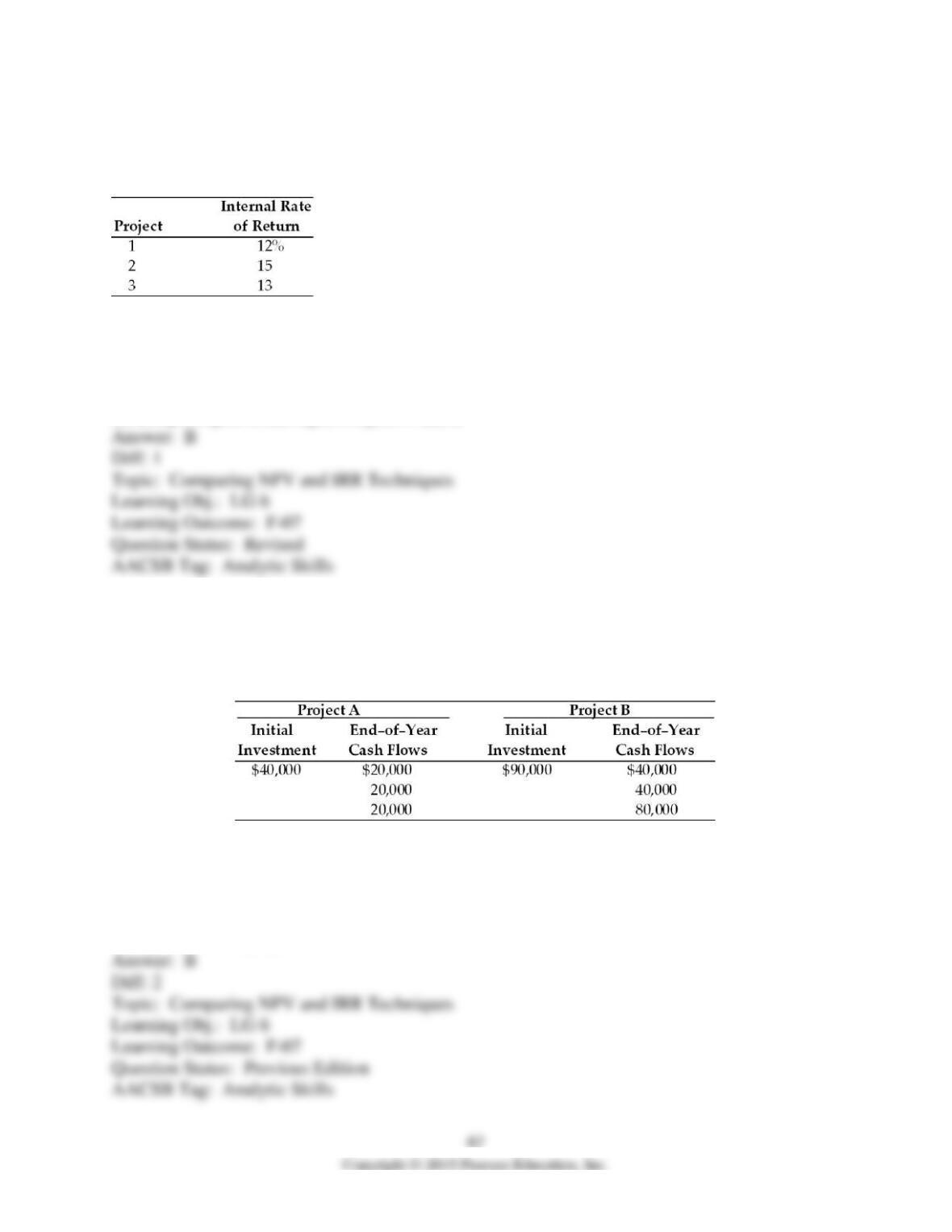
18) A firm with a cost of capital of 13 percent is evaluating three capital projects. The internal
rates of return are as follows:
The firm should ________.
A) accept Project 1 and 2, and reject Project 3
B) accept Project 2, and reject Projects 1 and 3
C) accept Project 1, and reject Projects 2 and 3
D) accept Project 3, and reject Projects 1 and 2
Table 10.3
A firm is evaluating two projects that are mutually exclusive with initial investments and cash
flows as follows:
19) If the firm in Table 10.3 has a required payback of two years, it should ________.
A) accept Project A and Project B
B) accept Project A and reject Project B
C) reject Project A and accept Project B
D) reject both the projects
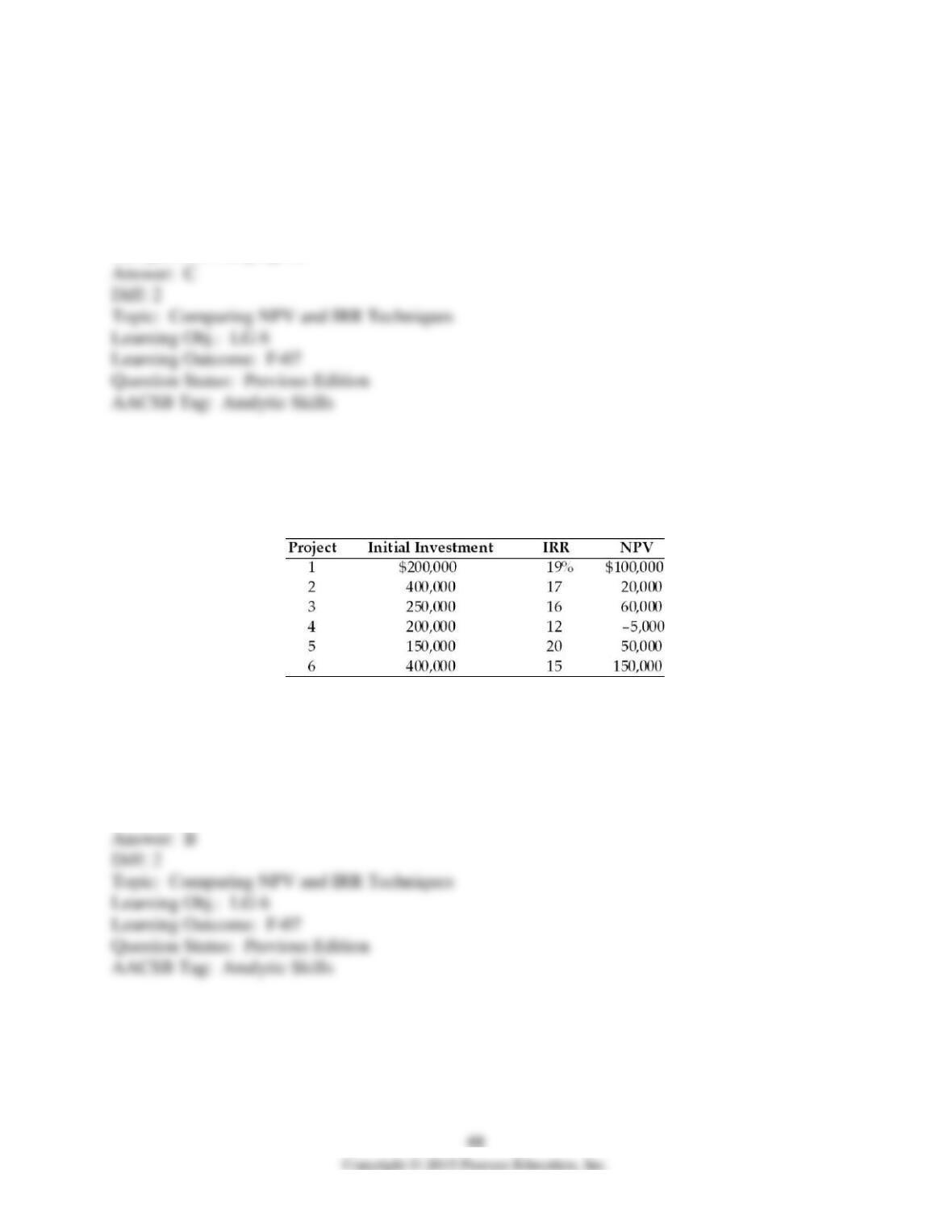
20) The new financial analyst does not like the payback approach (Table 10.3) and determines
that the firm’s required rate of return is 15 percent. Based on IRR, his recommendation would be
to ________.
A) accept both the projects
B) accept Project A and reject Project B
C) reject Project A and accept Project B
D) reject both the projects
Table 10.4
A firm must choose from six capital budgeting proposals outlined below. The firm is subject to
capital rationing and has a capital budget of $1,000,000; the firm’s cost of capital is 15 percent.
21) Using the internal rate of return approach to ranking projects, which project(s) should the
firm accept? (See Table 10.4)
A) 1, 2, 3, 4, and 5
B) 1, 2, 3, and 5
C) 2, 3, 4, and 6
D) 1, 3, 4, and 6

22) Using the net present value approach to ranking projects, which projects should the firm
accept? (See Table 10.4)
A) 1, 2, 3, 4, and 5
B) 1, 2, 3, 5, and 6
C) 2, 3, 4, and 5
D) 1, 3, 4, 5, and 6
23) When the net present value is negative, the internal rate of return is ________ the cost of
capital.
A) greater than
B) greater than or equal to
C) less than
D) equal to
24) A firm is evaluating two independent projects utilizing the internal rate of return technique.
Project X has an initial investment of $80,000 and cash inflows at the end of each of the next five
years of $25,000. Project Z has an initial investment of $120,000 and cash inflows at the end of
each of the next four years of $40,000. The firm should ________.
A) accept both the projects because they have equal IRR
B) accept Project Y because its IRR is higher than Project Z
C) accept Project Z because its IRR is higher than Project X
D) reject both the projects because they have negative IRR

25) Comparing net present value and internal rate of return ________.
A) always results in the same ranking of projects
B) always results in the same accept-reject decision
C) may give different accept-reject decisions
D) is only necessary on independent projects
26) Unlike the net present value criteria, the internal rate of return approach assumes a
reinvestment rate equal to ________.
A) the relevant cost of capital
B) the project’s internal rate of return
C) the project’s opportunity cost
D) the market’s interest rate
27) When evaluating projects using NPV approach, ________.
A) projects having lower early-year cash flows tend to be preferred at higher discount rates
B) projects having higher early-year cash flows tend to be preferred at higher discount rates
C) projects having higher early-year cash flows tend to be preferred at lower discount rates
D) the discount rate and magnitude of cash flows do not affect the ranking by NPV approach

28) Which capital budgeting method is most useful for evaluating a project that has an initial
after-tax cost of $5,000,000 and is expected to provide after-tax operating cash flows of
$1,800,000 in year 1, ($2,900,000) in year 2, $2,700,000 in year 3, and $2,300,000 in year 4?
A) net present value
B) internal rate of return
C) payback
D) accounting rate of return
29) The underlying cause of conflicts in ranking for projects by internal rate of return and net
present value methods is ________.
A) the reinvestment rate assumption regarding intermediate cash flows
B) that neither method explicitly considers the time value of money
C) the assumption made by the IRR method that cash inflows are spread equally throughout the
timeline
D) that NPV approach favors small projects with high returns
30) Which of the following is a reason that makes NPV a better approach to capital budgeting on
a purely theoretical basis?
A) It measures the benefits relative to the relative amount invested.
B) The reinvestment rate assumed by this method is reasonable.
C) Financial decision makers are inclined to higher rates of return.
D) Interest rates are expressed as annual rates of return.
31) In comparing the internal rate of return and net present value methods of evaluation,
________.
A) internal rate of return is theoretically superior, but financial managers prefer net present value
B) net present value is theoretically superior, but financial managers prefer to use internal rate of
return
C) financial managers prefer net present value, because it is presented as a rate of return
D) financial managers prefer net present value, because it measures benefits relative to the
amount invested
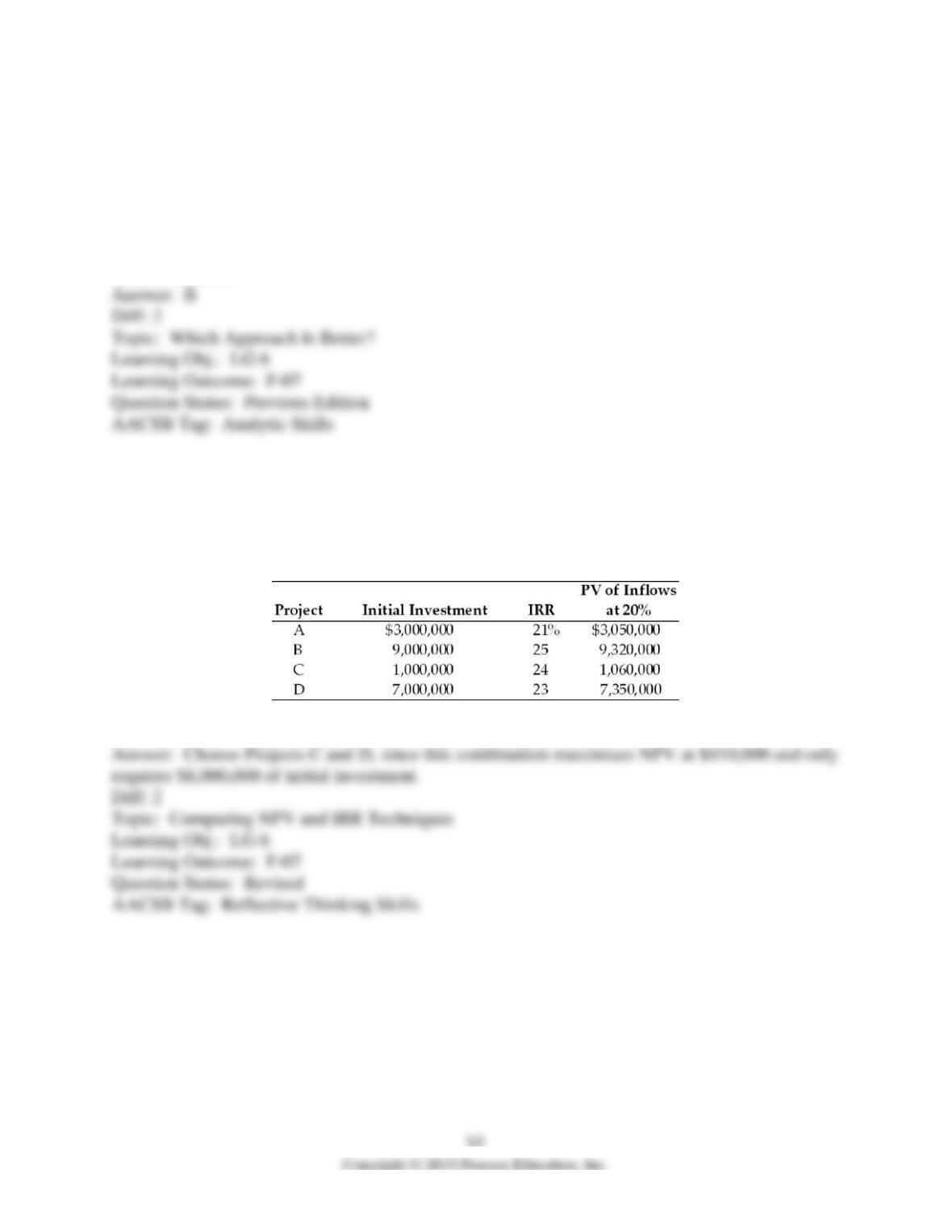
Table 10.5
Galaxy Satellite Co. is attempting to select the best group of independent projects competing for
the firm’s fixed capital budget of $10,000,000. Any unused portion of this budget will earn less
than its 20 percent cost of capital. A summary of key data about the proposed projects follows.
32) Use the NPV approach to select the best group of projects. (See Table 10.5)

33) Use the IRR approach to select the best group of projects, if the required rate of return is
23.5%. (See Table 10.5)
34) Which projects should the firm implement? (See Table 10.5)
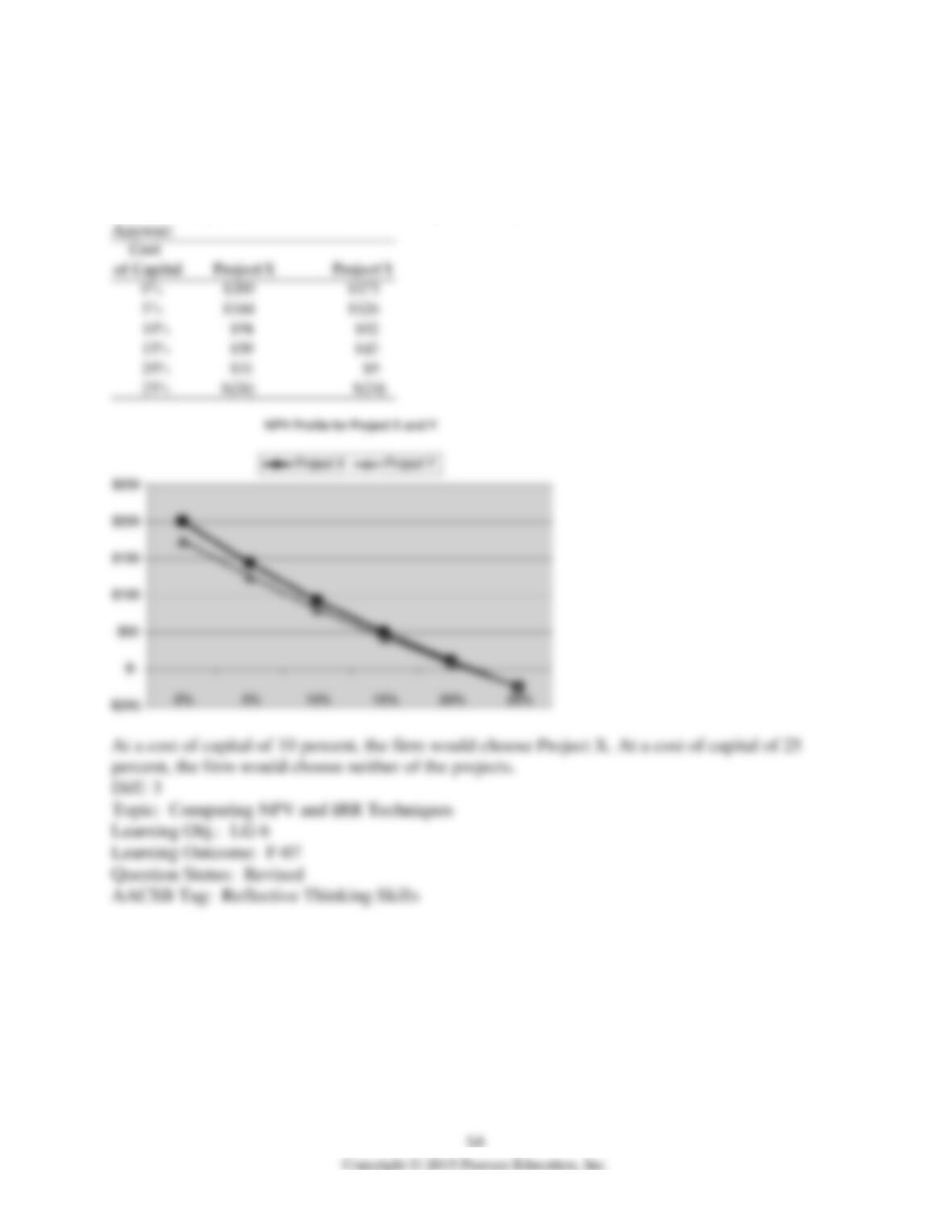
35) Consider the following projects, X and Y where the firm can only choose one. Project X
costs $600 and has cash flows of $400 in each of the next 2 years. Project Y also costs $600, and
generates cash flows of $500 and $275 for the next 2 years, respectively. Sketch a net present
value profile for each of these projects. Which project should the firm choose if the cost of
capital is 10 percent? What if the cost of capital is 25 percent? Show all work.