2) The observation that people tend to value something more highly when they own it than when
they don’t is called the
A) wealth effect.
B) endowment effect.
C) path dependent effect.
D) endorsement effect.
3) What is the endowment effect?
A) the phenomenon that economic agents are endowed with different qualities and abilities so
that trade among individuals increase efficiency
B) the tendency for economic agents with abundant resources to consume a proportionately
greater quantity of goods and services
C) the tendency of people to be unwilling to sell something they already own even if they are
offered a price that is greater than the price they would be willing to pay to buy the good if they
didn’t already own it.
D) the tendency of firms to use celebrities endowed with good looks to promote their products
4) The endowment effect suggests that that people
A) have a strong attachment to their entitlement, regardless of whether they paid to acquire them.
B) have a strong sense of fairness.
C) are concerned about the welfare of others.
D) act in ways to distort market prices.
5) If you exhibit the endowment effect as a decision maker, then you are
A) deciding on the basis of sunk costs.
B) buying something you can’t really afford because you expect to save in the future.
C) ignoring non-monetary opportunity costs.
D) consuming based on celebrity endorsements.
6) Which of the following demonstrates the endowment effect?
A) Whelan inherits a cottage in Cape Cod from his grandfather and is unwilling to sell it for
sentimental reasons.
B) Robert Pattinson commands a premium in the movie industry because he is endowed with
dashing looks.
C) Isabella was not willing to part with her “Robert Pattinson” poster although she was offered
$100 for it, a sum greater than what it costs to purchase another such poster.
D) If you received a good as a gift, you are less likely to attach a monetary value to the good.
7) The average price of gasoline in your neighborhood is $3.53 per gallon. Your neighbor,
Diana tells you that you can “save a lot” by frequenting a gas station 20 miles outside your
neighborhood where the price of gasoline is $3.46 per gallon However, she cautions you that
there usually long lines at that station. Is her suggestion beneficial to you?
A) Yes, since gasoline is a necessity for car owners, the total cost savings would be relatively
substantial.
B) No, if one factors in the non-monetary opportunity costs (driving time and waiting in line), it
could prove more costly to go to the lower-priced gasoline station.
C) Yes, the lower price of gasoline at the rival station increases my purchasing power and
enables me to consume more of other goods.
D) No, my friend is misled; clearly, the lower priced gasoline must be of inferior quality and
could damage vehicles.
8) Consider the following hypothetical scenarios:
Scenario A: You are about to purchase a pair of 7 for All Mankind jeans for $175 and a t-shirt
for $45. The sales attendant at the store tells you that the pair of jeans you wish to buy is on sale
for $160 at another store, located about a 20-minute drive away.
Scenario B: You are about to purchase a pair of 7 for All Mankind jeans for $175 and a t-shirt
for $45. The sales attendant at the store tells you that the t-shirt you wish to buy is on sale for
$30 at another store, located about a 20-minute drive away.
Based on standard economic theory, under which scenario would you make the 20-minute trip to
the other store?
A) Scenario A because the pair of jeans is a very expensive item and $15 saving is quite
substantial
B) Scenario B because a $15 saving amounts to a substantial discount (about 33 percent)
C) in either scenario if I think a $15 savings is worth the 20-minute trip
D) in none of these scenarios if I think the $15 saving is not worth the 20-minute trip
E) C and D are correct answers.
9) Psychologists Daniel Kahneman and Amos Tversky conducted the following experiments by
asking a sample of people the following questions:
Scenario A: “Imagine that you have decided to see a play and paid the admission price of $10
per ticket. As you enter the theater you discover that you have lost the ticket. The seat was not
marked and the ticket cannot be recovered. Would you pay $10 for another ticket?”
Scenario B: “Imagine that you have decided to see a play where admission is $10 per ticket. As
you enter the theater you discover that you have lost a $10 bill. Would you still pay $10 for a
ticket for the play?”
As long as additional tickets are available, there’s no meaningful difference between losing $10
in cash before buying a ticket, and losing the $10 ticket after buying it. In both cases, you are out
$10. Yet, far more subjects (88 percent) in Scenario B say they would pay $10 for another ticket
and see the play while in Scenario A, only 46 percent of the subjects say they would be willing to
spend another $10 to see the play.
Which of the following is the best explanation for the results of the experiment?
A) The endowment effect applies in Scenario A since people already own the ticket and therefore
it is more valuable but this is not so in Scenario B.
B) In Scenario B, people had not anticipated spending an additional $10 so in effect the price of
the ticket is $20 and not $10 whereas in Scenario A, the price of the ticket is still $10.
C) In Scenario A, people make an immediate connection between the lost ticket and the play and
feel poorer by incorrectly assigning a greater value to the value of the ticket whereas in Scenario
B, they do not make the connection between the lost $10 bill and the play.
D) The net benefit derived from watching the play is lower in Scenario A where the effective
cost is $20 compared to the net benefit in Scenario B.
10) Most film processing companies have a policy of printing every picture on a roll of film and
allowing customers to request a refund for pictures that were not clearly developed. The
companies do this knowing that most customers do not ask for refunds. This is an example of
consumers
A) failing to ignore sunk costs.
B) being overly optimistic about their future behavior.
C) not taking nonmonetary opportunity costs into account.
D) not making themselves aware of the policy regarding refunds.
11) Sunk costs
A) are costs associated with repairing something you already own.
B) are important for optimal decision making.
C) are costs that have already been paid and cannot be recaptured in any significant way.
D) are costs that firms sink into marketing.
12) Which of the following is a common mistake consumers commit when they make decisions?
A) They take into account nonmonetary opportunity costs but ignore monetary costs.
B) They are overly pessimistic about their future behavior.
C) They fail to ignore sunk costs.
D) They sometimes value fairness too much.
13) Which of the following is not a common mistake made by consumers?
A) the failure to take into account the implicit costs of an activity
B) the failure to ignore sunk costs
C) being overly optimistic about their future behavior
D) being overly pessimistic about their future behavior
14) Grace Makutsi finally bought a pair of blue shoes that she had been coveting for a long time.
In less than a week she discovered that the shoes were uncomfortable. Grace went back to
wearing her old pair and stashed away the new pair. When asked by her boss, Mme. Ramotswe
why does she not simply give away the new pair, she said: “But I paid so much for them.”
Grace’s behavior
A) is rational: she should not discard a valuable item.
B) ignores the fact that the purchase price is now a sunk cost and has no bearing on whether she
should give them away or not.
C) supports the endowment effect which states that ownership of an item makes it more valuable.
D) is rational because the more you pay for an item the more valuable it is.
15) Standard economic theory asserts that sunk costs are irrelevant in making economic
decisions, yet studies conducted by behavioral economists reveal that sunk costs often affect
economic decisions. Which of the following could explain this observation?
A) People measure the value of a good in terms of its purchase price.
B) Even though sunk costs cannot be recovered, it has been incurred and therefore should be
treated as part of the product’s value.
C) If consumers maximize their utility, it makes sense to consider the full purchase price of a
product in their consumption decisions.
D) Sunk costs have a higher opportunity cost than costs that can be recovered.
16) Many celebrities are paid to endorse products, but celebrity endorsements do come with
risks. Once a firm is associated with a celebrity, consumers associate the product with the
celebrity. This association can turn negative if the celebrity gets arrested or becomes associated
with an embarrassing scandal. Should a company whose celebrity endorser was just arrested be
guided by the amount it has already poured into making ads featuring the celebrity in its decision
about whether or not to cancel the ad campaign?
A) Yes, even in the case of negative publicity, celebrity endorsements really do have a
significant effect on consumer choice so the amount already spent to purchase this endorsement
is relevant.
B) No, the amount spent to launch the campaign is a sunk cost; the firm’s primary concern at this
point is the effect of the negative publicity on the product’s image.
C) Yes, a firm must take in all costs in deciding whether or not to yank the campaign. If the
revenue loss (due to the negative publicity) is small compared to the cost of the campaign, then it
makes sense to continue the campaign.
D) No, although the amount spent to launch the campaign cannot be recovered, the firm can still
reap some benefit by taking out another ad in support of the celebrity.
17) Arnold Kim began blogging about Apple products during his fourth year of medical school.
Kim’s Website, MacRumors.com, became so successful that he decided to give up his medical
career and work full time on his Website, despite the nearly $200,000 he had invested in his
education. In making his decision, Kim decided to ignore the money and time he spent on his
education. Economists would say that Kim made a
A) rational decision to ignore these sunk costs.
B) poor decision since he had already invested his time and money on his medical career.
C) poor decision since doctors are in greater demand than bloggers.
D) hasty decision by not waiting to recoup his financial investment before giving up his medical
career.
18) Research conducted by Professors Cass Sunstein and Richard Thaler show that employees
are much more likely to enroll in a savings plan under automatic enrollment than under a default
term of non-enrollment because it turns out that very few employees drop out if automatically
enrolled.
Source: Sunstein, Cass R. and Richard H. Thaler. 2003. “Libertarian Paternalism Is Not an
Oxymoron,” University of Chicago Law Review, 70:1159-1202.
What does this suggest about getting people to save for their retirement?
A) Planning for one’s retirement is complex and emotional and most people deliberately avoid
confronting these financial decisions.
B) People are overly pessimistic about their future financial prospects; many fear that the social
security scheme may be non-existent by the time they retire.
C) Many people need to be “tricked” into saving because they are unrealistic about their future
behavior. They spend money today that they should be saving for retirement, partly because they
overestimate their ability to save in the future.
D) One way to get people to save more is to make mandatory contributions to a saving plan part
and parcel of employment, and to make opting-out legally impossible.
19) A fair number of people buy expensive gym memberships to commit themselves to
exercising. Yet, data from health clubs show that many do not follow through with their
intentions and end up losing money on their membership contracts. Which of the following
could explain this behavior?
A) People have a tendency to pursue immediate gratification in a way that their ‘long-run selves’
do not appreciate (quoted from Ted O’Donoghue and Matthew Rabin, “Choice and
Procrastination,” Quarterly Journal of Economics, February 2001, pp. 125-26.)
B) People tend to be overly optimistic about their future behavior so much so that after making
an expensive investment in the membership, they overate the dividends they expect to reap.
C) People fail to ignore the sunk cost of a gym membership when making the purchase.
D) People realize after the fact that they have made a mistake but unfortunately memberships are
often not transferable and not refundable.
20) A common mistake made by consumers is the failure to take into account the sunk costs of
their actions.
21) The endowment effect is the tendency of people to be unwilling to sell a good they already
own even if they are offered a price greater than they would be willing to pay to buy the good if
they did not already own it.
22) Behavioral economics is the study of situations in which people make rational choices.
23) Molly received an autographed poster of David Hasselhoff for her 21st birthday. Her friend
Helga offered her $50 for the poster, but Molly refused to sell the poster even though she knows
she would never pay that much to replace it if it was ever damaged or destroyed. Explain this
inconsistency in Molly’s behavior.
24) A construction project in Congressman Foghorn’s district is unfinished. Foghorn has asked
that a new appropriations bill include funds to complete the project, despite a report by an
independent agency that the project is a waste of taxpayer money. Foghorn’s project is a bridge
that crosses a river between two cities in his district. The press has criticized Foghorn and
dubbed the project “a bridge too far” since another bridge, located closer to the same two cities
Foghorn’s bridge will connect, already exists and can accommodate all traffic between the two
cities. Foghorn argues that if the bridge project is not completed, the $50 million already spent
will have been wasted. Is Foghorn’s argument economically rational? Explain your answer.
1) What is an indifference curve?
A) It is a curve that shows the total utility and the marginal utility derived from consuming a
bundle of goods.
B) It is a curve that shows the combinations of consumption bundles that gives the consumer the
same utility.
C) It is a curve that shows ranks a consumer’s preference for various consumption bundles.
D) It is a curve that shows the tradeoff a consumer faces among different combinations of
consumption bundles.
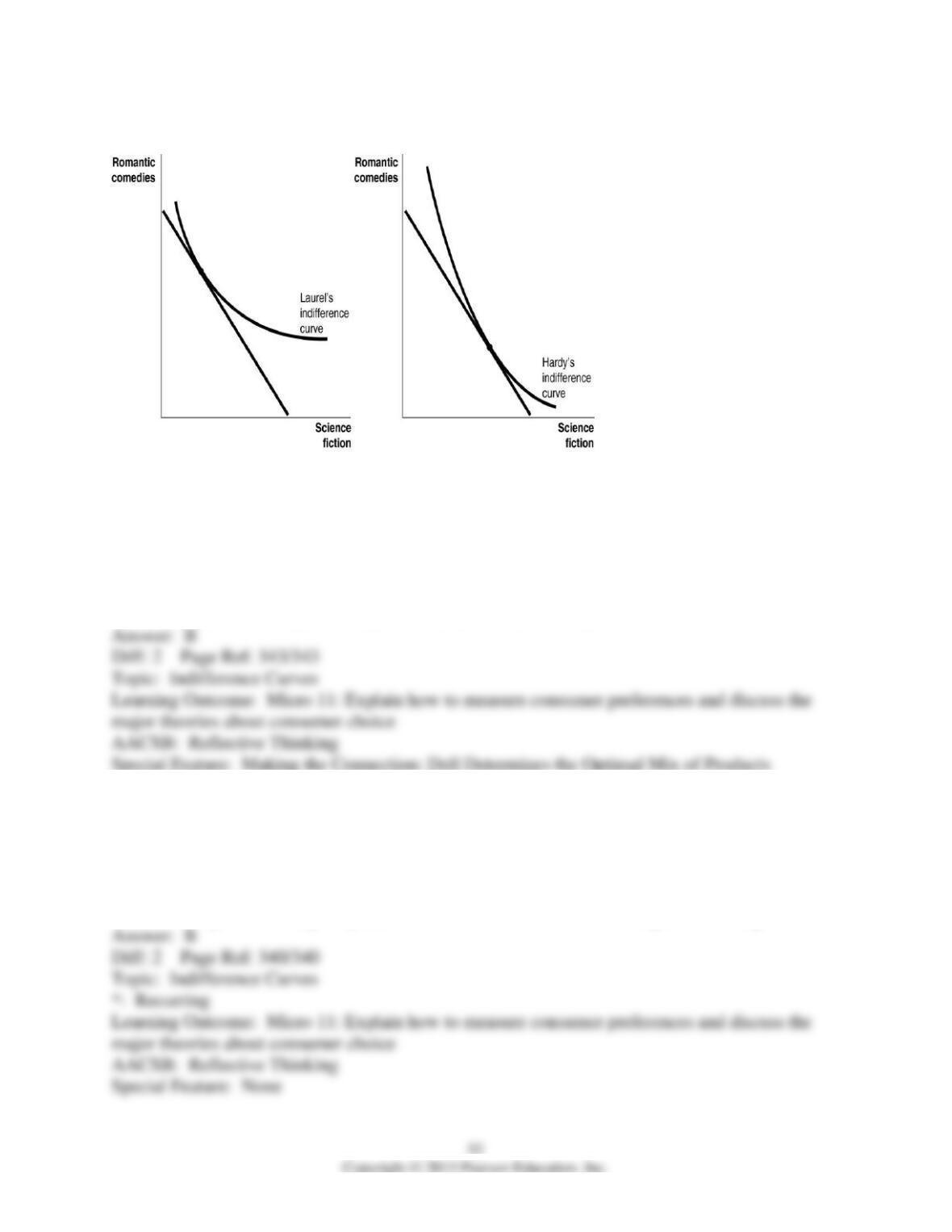
Figure 10-2
2) Refer to Figure 10-2. The Bobsey twins, Laurel and Hardy, both enjoy watching romantic
comedies and science fiction movies. Based on the diagrams above what can you conclude about
their movie preferences?
A) They have identical movie preferences.
B) Laurel enjoys romantic comedies more than Hardy.
C) Laurel enjoys science fiction movies more than Hardy.
D) The diagrams do not provide any information about relative preferences.
3) If Dawson prefers pizza to hamburgers and hamburgers to hot dogs, then if preferences are
transitive,
A) at times she could be indifferent among the three items.
B) she must prefer pizza to hot dogs.
C) she could prefer hamburgers to pizza on some occasions but not hot dogs to pizza.
D) she could prefer hot dogs to pizza on some occasions but not hamburgers to hot dogs.
4) If preferences are transitive, indifference curves
A) intersect at the equilibrium consumption bundle.
B) intersect at the optimum consumption bundle.
C) intersect where the marginal rate of substitution for each indifference curve is equal.
D) do not intersect.
5) The slope of an indifference curve
A) is calculated by dividing the price of good on the vertical axis by price of the good on the
horizontal axis.
B) measures total utility.
C) measures the marginal rate of substitution between the two goods in question.
D) is calculated by dividing the quantity of the good on the vertical axis by the quantity of the
good on the horizontal axis.
6) What is the marginal rate of substitution?
A) the price ratio
B) the rate at which the consumer must give up one good to purchase an additional unit of the
other goods in the market
C) the rate at which the consumer is willing to trade one good for another so that she increases
her utility
D) the rate at which the consumer is willing to trade one good for another without any loss in
utility