10.6-3) Referring to Table 10–6, if Plating General were to resell all its treasury stock at $18 per share, what
journal entry would Plating General make?
A) Cash 54,000
Additional Paid–in Capital 21,000
Treasury Stock 75,000
B) Cash 54,000
Loss on Sale of Treasury Stock 21,000
Treasury Stock 75,000
C) Cash 54,000
Loss on Sale of Treasury Stock 21,000
Additional Paid–in Capital 67,500
Treasury Stock 7,500
D) Cash 54,000
Loss on Sale of Treasury Stock 28,500
Common Stock 7,500
Treasury Stock 75,000
E) Cash 54,000
Treasury Stock 7,500
Additional Paid–in Capital 46,500
10.6-4) Reasons given for a company to buy back its own shares include all of the following except:
A) to reduce the market price per share of its stock to make it more affordable to potential investors.
B) to permanently reduce shareholder claims.
C) to temporarily hold shares for later use.
D) to decrease the likelihood that a company will be the object of a takeover bid.
E) to reset the debt–equity ratio.
10.6-5) Treasury stock is
A) shares owned by the directors of a company.
B) shares owned by the management of a company.
C) shares that are not yet sold but could be sold at any time by a company.
D) previously issued shares of a company that are now held for resale by the company.
E) shares of a company held in reserve to eventually retire the debt of the company.
10.6-6) Repurchasing shares
A) has no effect on the number of shares outstanding or on earnings per share.
B) increases the number of shares outstanding and increases earnings per share.
C) reduces the number of shares outstanding and reduces earnings per share.
D) increases the number of shares outstanding and decreases earnings per share.
E) reduces the number of shares outstanding and increases earnings per share.
10.6-7) By repurchasing shares of its own stock, a corporation liquidates some shareholders’ claims, and
total shareholders’ equity decreases by the amount of the repurchase.
10.6-8) When a corporation retires shares of issued common stock, the common stock account is credited
for the par value of the stock.
10.6-9) Treasury stock is a contra account with a debit balance in the stockholders’ equity section of a
company’s balance sheet.
10.6-10) Any differences between the acquisition costs and the resale proceeds of treasury stock must
never be reported as losses, expenses, revenues, or gains in the income statement.
10.6-11) Earnings per share will tend to increase with the purchase of treasury stock.
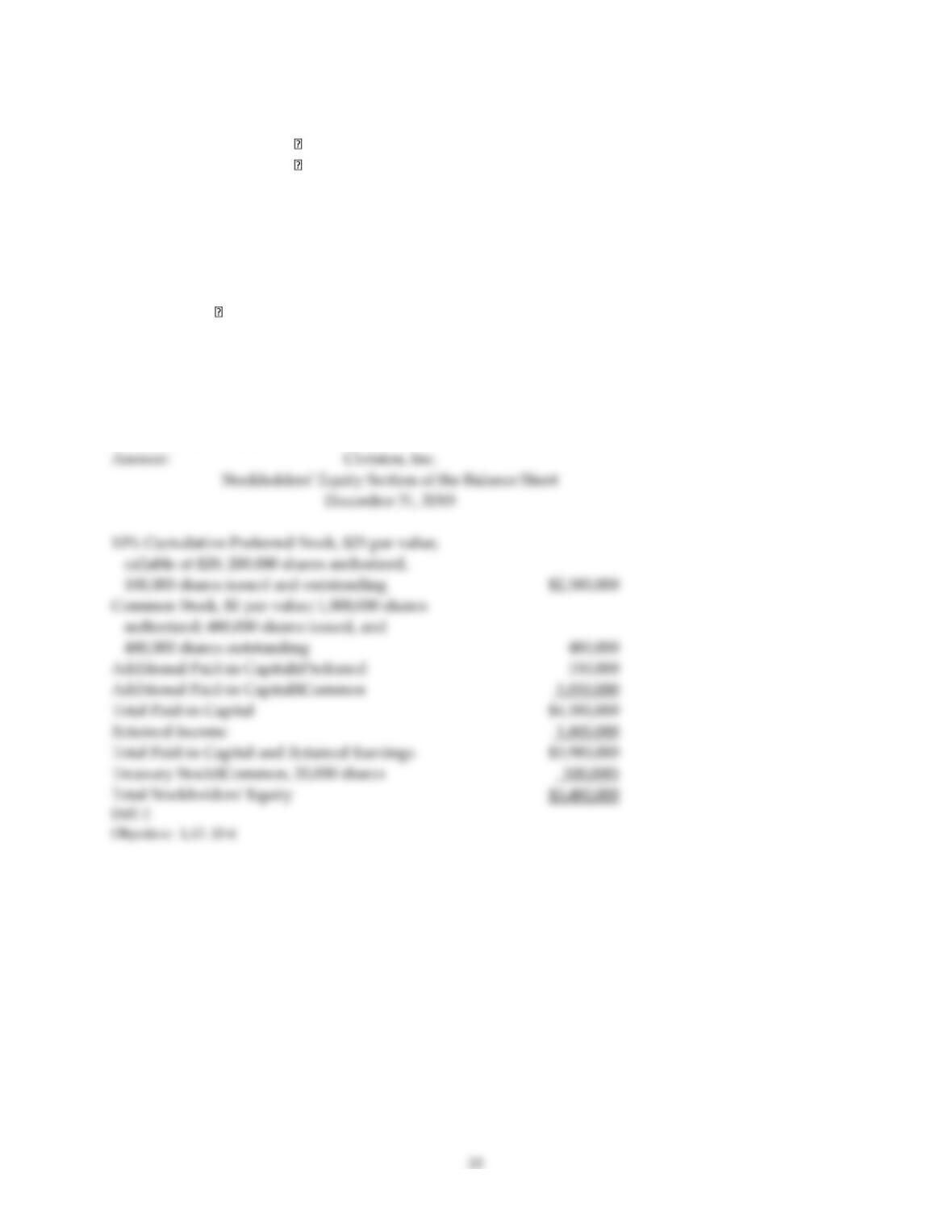
10.6-12) The following selected information is available for Christon, Inc., as of December 31, 20X9:
Additional Paid–in Capital Common $1,050,000
Additional Paid–in Capital Preferred 150,000
Common Stock, $1 par, 1,000,000 shares authorized,
480,000 shares issued ?
Dividends Payable 280,000
Long–term Investment in the Broomfield Company 400,000
Marketable Securities 60,000
Retained Earnings 1,800,000
Treasury Stock Common, 20,000 shares 500,000
10% Cumulative Preferred Stock, $25 par, callable
at $28; 200,000 shares authorized, 100,000
shares issued and outstanding ?
Given the above information, prepare the stockholders’ equity section of the Christon Inc.’s balance sheet
dated December 31, 20X9.
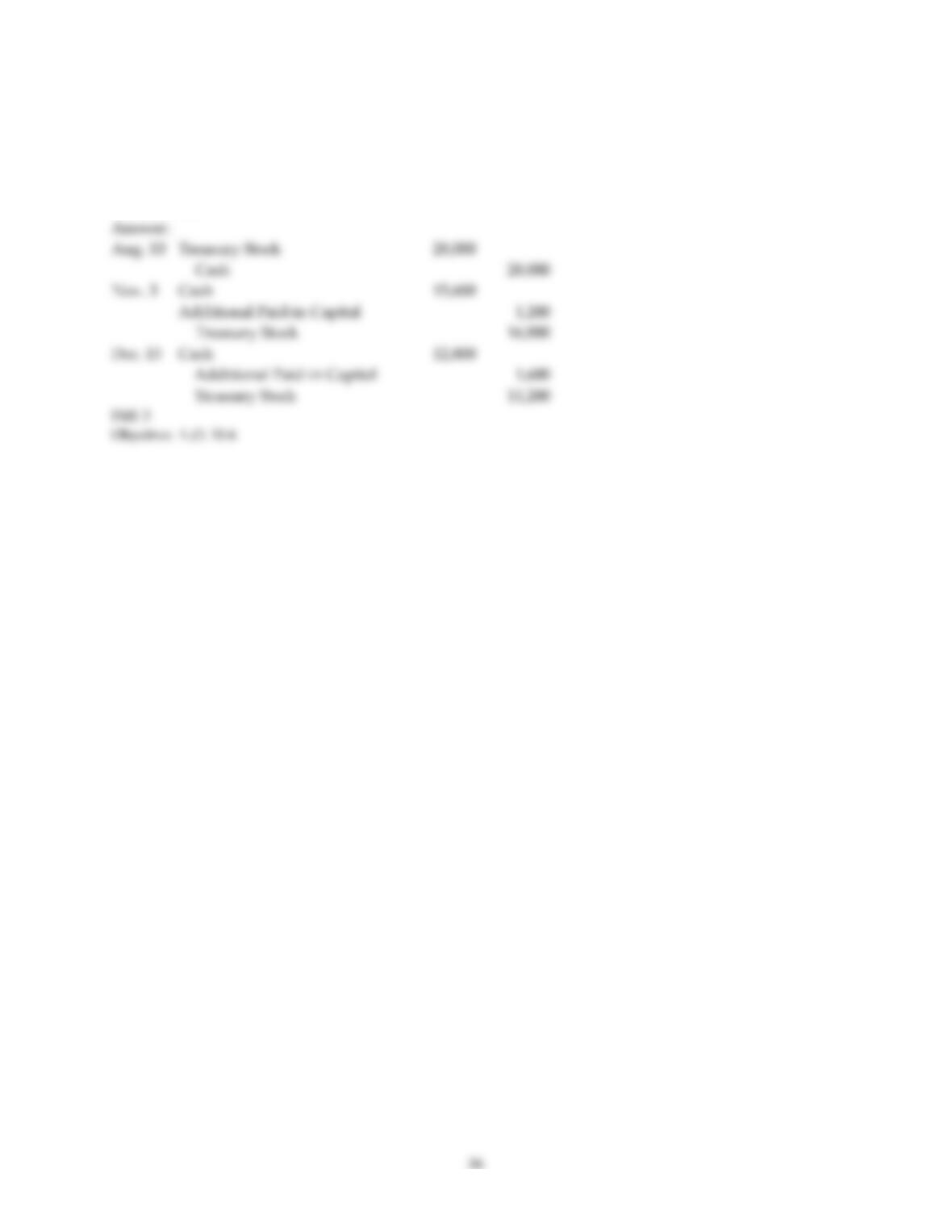
10.6-13) On August 10, 20X9, Steel Wool, Inc., reacquired 1,000 shares of its own $3 par value common
stock at $28 per share. These shares were not permanently retired. On November 3, 20X9, the company
sold 600 of the treasury shares for $26 per share. On December 15, 20X9, the company sold the remaining
400 shares for $32 per share. Prepare journal entries for Steel Wool, Inc., for August 10, November 3, and
December 15.

Learning Objective 10.7 Questions
10.7-1) Urbco Sweeping issued 2,000 shares of $100 par 9% convertible preferred stock for $112 per share.
Each share of preferred stock can be converted into 8 shares of $2 par value common stock. On March 13,
20X9, 300 shares of preferred stock were converted when the market price per share of preferred stock
was $115, and the market price per share for common stock $15. What is the journal entry for Urbco
Sweeping on March 13, 20X9?
A) Preferred Stock 30,000
Additional Paid–in Capital Preferred Stock 3,600
Common Stock 4,800
Additional Paid–in Capital Common 28,800
B) Preferred Stock 30,000
Additional Paid–in Capital Preferred Stock 3,600
Loss on Conversion of Preferred Stock 2,400
Common Stock 4,800
Additional Paid–in Capital Common 31,200
C) Preferred Stock 30,000
Additional Paid–in Capital Preferred Stock 4,500
Loss on Conversion of Preferred Stock 1,500
Common Stock 4,800
Additional Paid–in Capital Common 31,200
D) Preferred Stock 30,000
Additional Paid–in Capital Preferred Stock 4,500
Loss on Conversion of Preferred Stock 1,950
Common Stock 4,800
Additional Paid–in Capital Common 31,650
E) Preferred Stock 30,000
Additional Paid–in Capital Preferred Stock 3,600
Loss on Conversion of Preferred Stock 1,500
Common Stock 4,800
Additional Paid–in Capital Common 30,300

10.7-2) Plasti–Pak Plastics has the following stockholders’ equity accounts and amounts before paying
dividends:
Paid–in Capital $ 75,000
Retained Earnings 25,000
Total $100,000
Deduct: Treasury Stock 10,000
Total Stockholders’ Equity $ 90,000
Assuming that Plasti–Pak Plastics is restricted from declaring dividends that would cause stockholders’
equity to be less than total paid–in capital, what is the maximum amount of dividends Plasti–Pak Plastics’s
board could declare?
A) $70,000
B) $15,000
C) $25,000
D) $65,000
E) $10,000
10.7-3) Which of the following statements does not represent a retained earnings restriction?
A) Dividends cannot be declared if retained earnings is negative.
B) A portion of retained earnings can be restricted or appropriated.
C) The dividends declared in any year cannot exceed the net income generated in that year.
D) Typically, dividends cannot be so large as to reduce total stockholders’ equity below total paid–in
capital.
E) For a dividend to be declared, retained earnings must exceed the cost of treasury stock.
10.7-4) Attributes of appropriated retained earnings or reserves of retained earnings as they are used in
the United States include all of the following except:
A) Appropriated retained earnings or reserves can be purely discretionary so as to disclose specific
intentions of management.
B) Appropriated retained earnings or reserves can mean a restriction on dividend declaring power.
C) Appropriated retained earnings or reserves can be an offset to an asset.
D) Appropriated retained earnings or reserves represent restrictions on retained earnings.
E) Appropriated retained earnings or reserves can be an estimate of a definite liability of an uncertain
amount.
10.7-5) ESOP stands for
A) extra stockholder’s ownership plan.
B) employee stock option plan.
C) essential stock option program.
D) employee stock ownership plan.
E) extra stock option plan.
10.7-6) When a corporation issues common stock on a preferred stock conversion, the common stock
account is credited for the fair market value of the preferred stock on the date of conversion.
10.7-7) Restrictions of retained earnings are also called appropriated retained earnings or reserves.

Learning Objective 10.8 Questions
Table 10–7
Sandstone Company has the following stockholders’ equity section:
Common Stock, 500,000 shares authorized:
400,000 shares issued and outstanding $700,000
Additional Paid–in Capital 4,900,000
Retained Earnings 7,300,000
Total Stockholders’ Equity $ 12,900,000
10.8-1) Referring to Table 10–7, what is the journal entry to be made by Sandstone Company if the
company purchases and retires 15,000 shares of its own common stock when the market price of the stock
is $20 per share?
A) Common Stock 26,250
Retained Earnings 273,750
Cash 300,000
B) Common Stock 26,250
Additional Paid–in Capital 273,750
Cash 300,000
C) Common Stock 26,250
Retained Earnings 90,000
Additional Paid–in Capital 183,750
Cash 300,000
D) Common Stock 26,250
Retained Earnings 136,875
Additional Paid–in Capital 136,875
Cash 300,000
E) Common Stock 26,250
Retained Earnings 163,801
Additional Paid–in Capital 109,949
Cash 300,000
10.8-2) Referring only to Table 10–7, what is the book value per share for the Sandstone Company?
A) $1.40
B) $1.75
C) $25.80
D) $32.25
E) $14.00

10.8-3) ROE
A) stands for return on earnings.
B) focuses on the company’s profitability based on the book value of the common and preferred equity.
C) remains relatively stable among different companies and different industries.
D) is calculated by dividing net income by average common equity.
E) answers the important question, “How effectively does the company use resources provided by the
common shareholders?”
Table 10–8
Iklon, Inc.
Stockholders’ Equity Section of the Balance Sheet
At December 31, 2X10 and 20X9
2X10 20X9
11% Preferred stock, 50,000 shares
authorized; 30,000 shares issued
and outstanding $ 3,000,000 $ 3,000,000
Common stock, $3 par, 2,000,000 shares
authorized 2,700,000 2,700,000
Additional paid–in capital–preferred 180,000 180,000
Additional paid–in capital–common 4,400,000 4,400,000
Total paid–in capital $10,280,000 $10,280,000
Retained Earnings 11,400,000 7,900,000
Total paid–in capital and retained earnings 21,680,000 18,180,000
Treasury stock, 6,000 shares of common (156,000) (156,000)
Total Stockholders’ equity $21,524,000 $18,024,000
Net income in 2X10 was $5,000,000 and the market price was $61.56 per share of common stock.
10.8-4) Referring to Table 10–8, what is the book value per share of common stock for Iklon, Inc., at
December 31, 2X10?
A) $9.17
B) $18.44
C) $18.56
D) $20.38
E) $20.52
10.8-5) Referring to Table 10–8, what is the market–to–book ratio for Iklon, Inc., at December 31, 2X10?
A) 3.34
B) 3.32
C) 3.02
D) 3.00
E) 6.71
10.8-6) Which of the following statements incorrectly describes the relationship between a company’s
book value per share and its market price per share?
A) If the book value per share is below the market value per share, then shareholders are paying for the
future earnings power of the company.
B) If a company has unrecorded assets or appreciated assets, the market value per share is likely to be
greater than the book value per share.
C) Since the book value per share is based on historical costs, the book value per share can never be
greater than the market price per share.
D) Use of the book value per share can be highly questionable for many companies, since it is based on
balance sheet amounts that in turn are based upon historical costs.
E) If the market value of a company’s assets is much greater than the assets’ historical costs, then the
market price per share will likely be greater than the book value per share.
10.8-7) Market value per share divided by book value per share is commonly referred to as earnings per
share.
10.8-8) A company’s market value per share and book value per share are not expected to be equal.
10.8-9) A market value well above book value may be appropriate for a company if it has many
unrecorded assets.
10.8-10) Net income plus preferred dividends divided by average common equity is referred to as rate of
return on common equity.
10.8-11) Caston Company had net income of $5,000,000 for the year ended December 31, 2X10. The
stockholders’ equity section of the Caston Company at December 31, 2X10 and 20X9, is as follows:
Caston Company
Stockholders’ Equity Section of the Balance Sheet
December 31, 2X10 and 20X9
12/31/2X10 12/31/2X09
11% Preferred stock, $100 par,
noncumulative, 75,000 shares authorized;
20,000 shares issued and outstanding $ 2,000,000 $ 2,000,000
Common stock, $1.25 par, 4,000,000 shares
authorized; 1,100,000 and 1,050,000 shares
issued 1,375,000 1,312,500
Additional paid–in capital–preferred 100,000 100,000
Additional paid–in capital–common 15,200,000 14,437,500
Total paid–in capital $18,675,000 $17,850,000
Retained earnings 17,900,000 14,600,000
Total paid–in capital and retained earnings $36,575,000 $32,450,000
Treasury stock, 12,000 and 10,000
shares of common stock (180,000) (150,000)
Total owners’ equity $36,395,000 $32,300,000
Determine
a. the book value per share of common stock at the end of 2X10.
b. the rate of return on common equity for 2X10.
c. the amount of cash dividends on common stock declared during 2X10.