Acquisition and Disposition of Property, Plant, and Equipment
10 – 37
Solution 10-133
EXERCISES
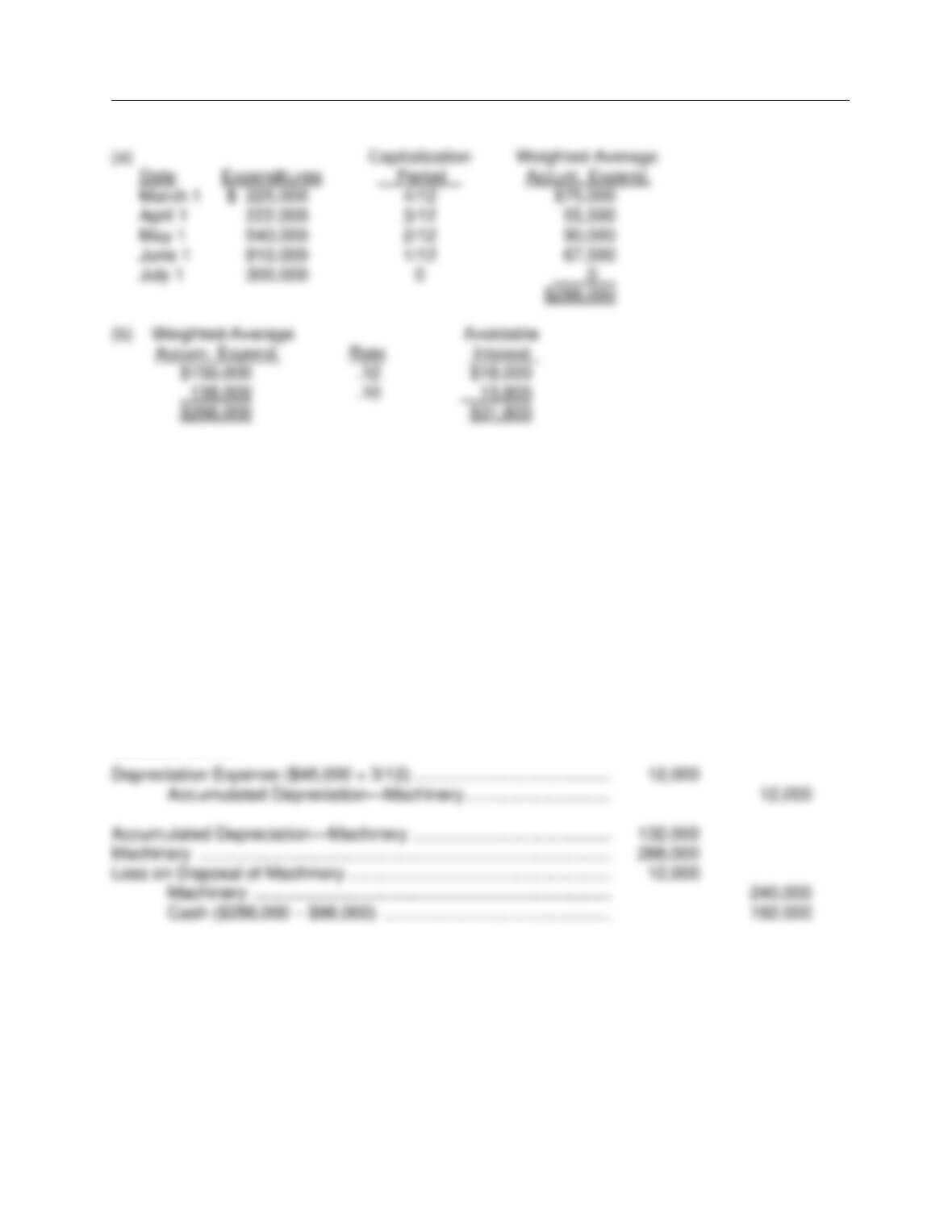
Ex. 10-134—Nonmonetary exchange.
A machine cost $240,000, has annual depreciation expense of $48,000, and has accumulated
depreciation of $120,000 on December 31, 2014. On April 1, 2015, when the machine has a fair
value of $96,000, it is exchanged for a similar machine with a fair value of $288,000 and the
proper amount of cash is paid. The exchange lacked commercial substance.
Instructions
Prepare all entries that are necessary at April 1, 2015.
Solution 10-134
Ex. 10-135—Nonmonetary exchange.
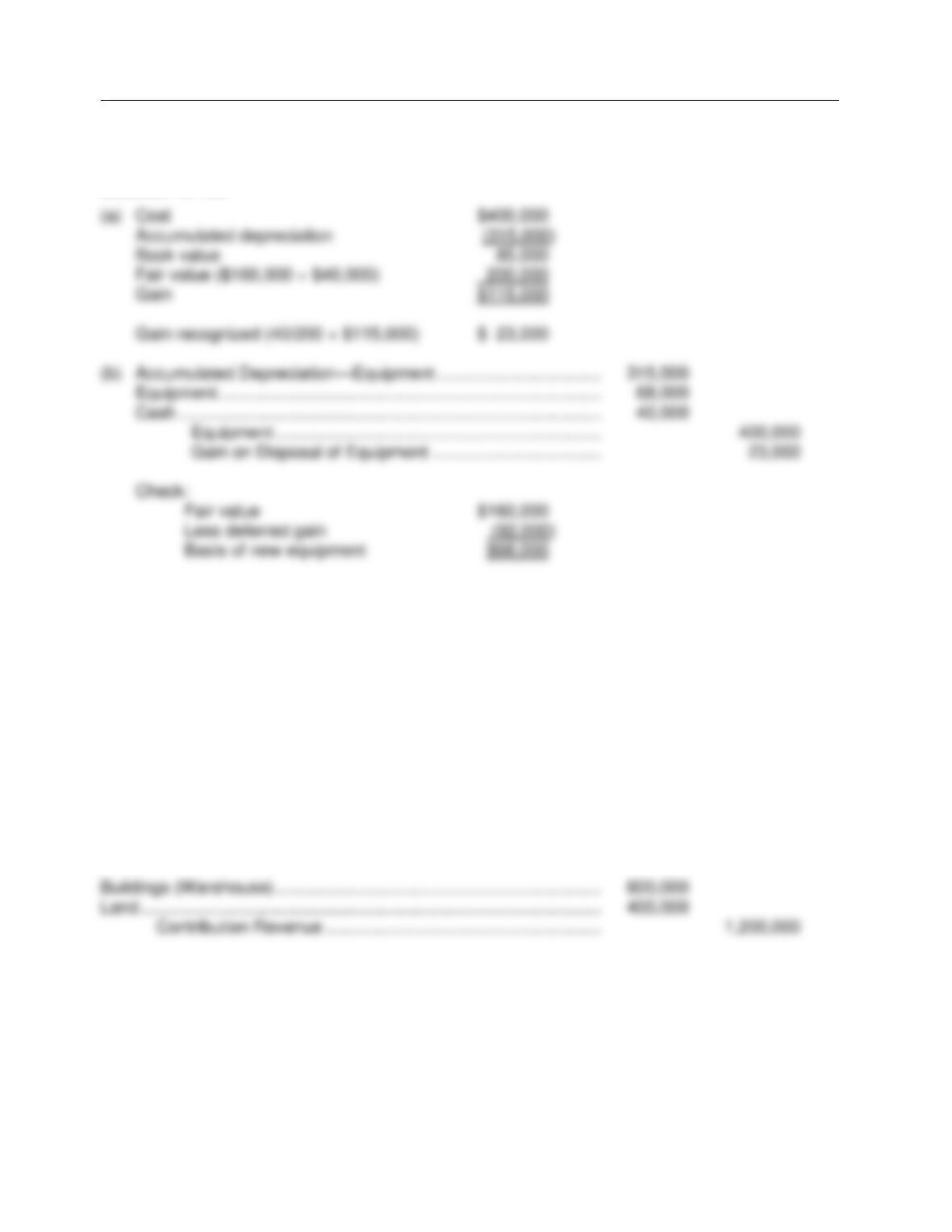
Equipment that cost $400,000 and has accumulated depreciation of $315,000 is exchanged for
equipment with a fair value of $160,000 and $40,000 cash is received. The exchange lacked
commercial substance.
Instructions
Test Bank for Intermediate Accounting, Fifteenth Edition
10 – 38
(a) Show the calculation of the gain to be recognized from the exchange.
(b) Prepare the entry for the exchange. Show a check of the amount recorded for the new
equipment.
Solution 10-135
Ex. 10-136—Donated assets.
Cheng Company has recently decided to accept a proposal from the City of Bel Aire that publicly
owned property with a large warehouse located on it will be donated to Cheng if Cheng will build
a branch plant in Bel Aire. The appraised value of the property is $400,000 and of the warehouse
is $800,000.
Instructions
Prepare the entry by Cheng for the receipt of the properties.
Solution 10-136

Acquisition and Disposition of Property, Plant, and Equipment
10 – 39
Ex. 10-137—Capitalizing vs. Expensing.
Consider each of the items below. Place the proper letter in the blank space provided to indicate
the nature of the account or accounts to be debited when recording each transaction using the
preferred accounting treatment. Prepayments should be recorded in balance sheet accounts.
Disregard income tax considerations unless instructed otherwise.
a. asset(s) only
b. accumulated amortization, depletion, or depreciation only
c. expense only
d. asset(s) and expense
e. some other account or combination of accounts
____ 1. A motor in one of North Company’s trucks was overhauled at a cost of $600. It is
expected that this will extend the life of the truck for two years.
____ 2. Machinery which had originally cost $130,000 was rearranged at a cost of $450,
including installation, in order to improve production.
____ 3. Orlando Company recently purchased land and two buildings for a total cost of
$35,000, and entered the purchase on the books. The $1,200 cost of razing the
smaller building, which has an appraisal value of $6,200, is recorded.
____ 4. Jantzen Company traded its old machine with a net book value of $3,000 plus cash of
$7,000 for a new one which had a fair market value of $9,000.
____ 5. Jim Parra and Mary Lawson, maintenance repair workers, spent five days in unloading
and setting up a new $6,000 precision machine in the plant. The wages earned in this
five-day period, $480, are recorded.
____ 6. On June 1, the Milton Hotel installed a sprinkler system throughout the building at a
cost of $13,000. As a result the insurance rate was decreased by 40%.
____ 7. An improvement, which extended the life but not the usefulness of the asset, cost
$6,000.
____ 8. The attic of the administration building was finished at a cost of $3,000 to provide an
additional office.
____ 9. In March, the Lyon Theatre bought projection equipment on the installment basis. The
contract price was $23,610, payable $5,610 down, and $2,250 a month for the next
eight months. The cash price for this equipment was $22,530.
____ 10. Lambert Company recorded the first year’s interest on 6% $100,000 ten-year bonds
sold a year ago at 94. The bonds were sold in order to finance the construction of a
hydroelectric plant. Six months after the sale of the bonds, the construction of the
hydroelectric plant was completed and operations were begun. (Only cash interest,
and not discount amortization, is to be considered.)

Test Bank for Intermediate Accounting, Fifteenth Edition
10 – 40
Solution 10-137
PROBLEMS
Pr. 10-138—Capitalizing acquisition costs.
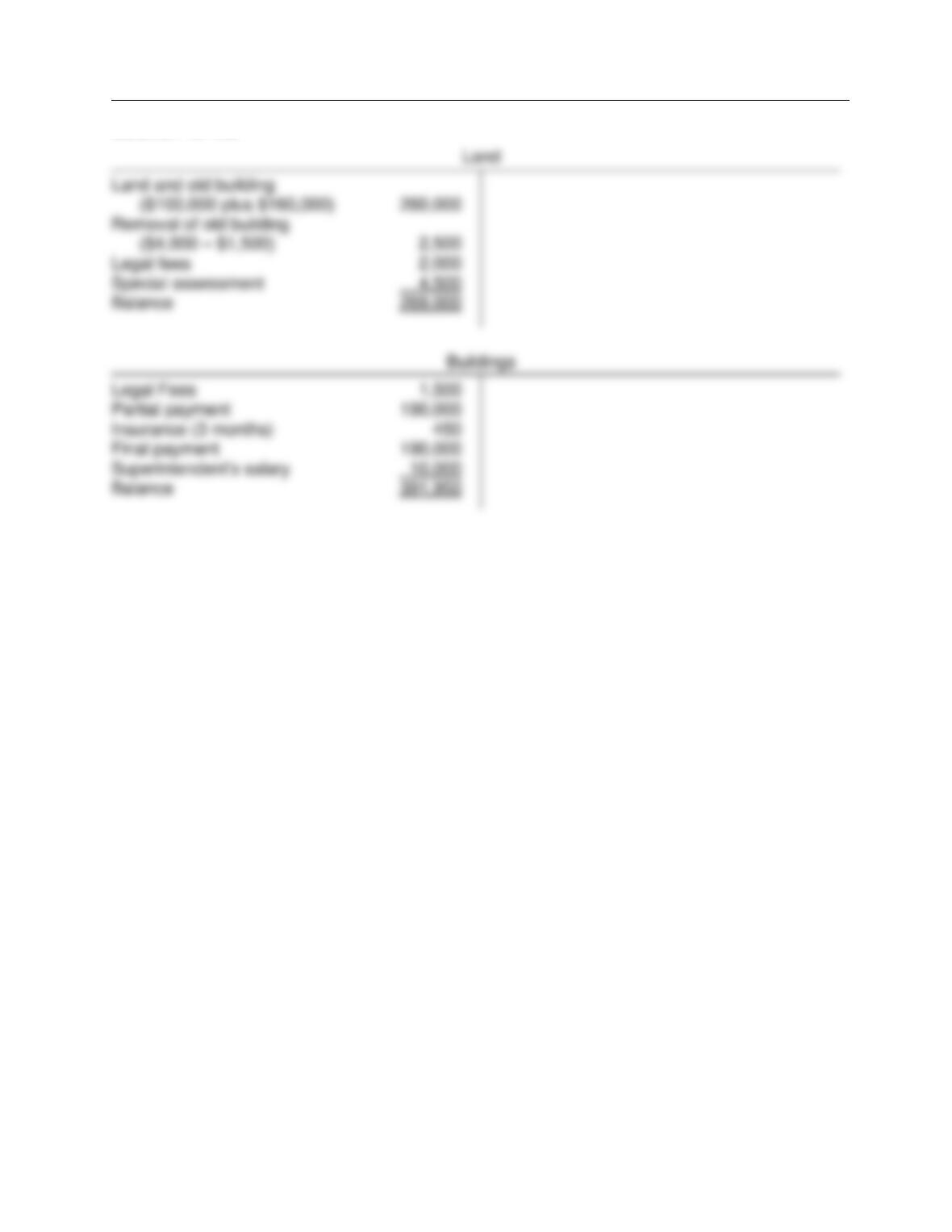
Gibbs Manufacturing Co. was incorporated on 1/2/14 but was unable to begin manufacturing
activities until 8/1/14 because new factory facilities were not completed until that date. The Land
and Buildings account at 12/31/14 per the books was as follows:
Date Item Amount
1/31/14 Land and dilapidated building $200,000
2/28/14 Cost of removing building 4,000
4/1/14 Legal fees 6,000
5/1/14 Fire insurance premium payment 5,400
5/1/14 Special tax assessment for streets 4,500
5/1/14 Partial payment of new building construction 190,000
8/1/14 Final payment on building construction 190,000
8/1/14 General expenses 30,000
12/31/14 Asset write-up 75,000
$704,900
Additional information:
1. To acquire the land and building on 1/31/14, the company paid $100,000 cash and 1,000
shares of its common stock (par value = $100/share) which is very actively traded and had a
fair value per share of $160.
2. When the old building was removed, Gibbs paid Kwik Demolition Co. $4,000, but also
received $1,500 from the sale of salvaged material.
3. Legal fees covered the following:
Cost of organization $2,500
Examination of title covering purchase of land 2,000
Legal work in connection with the building construction 1,500
$6,000
4. The fire insurance premium covered premiums for a three-year term beginning May 1, 2014.
5. General expenses covered the following for the period 1/2/14 to 8/1/14.
President’s salary $20,000
Plant superintendent covering supervision of new building 10,000
$30,000
6. Because of the rising land costs, the president was sure that the land was worth at least
$75,000 more than what it cost the company.
Instructions
Determine the proper balances as of 12/31/14 for a separate land account and a separate
buildings account. Use separate T-accounts (one for land and one for buildings) labeling all the
relevant amounts and disclosing all computations.
Acquisition and Disposition of Property, Plant, and Equipment
10 – 41
Solution 10-138
Pr. 10-139—Capitalization of interest.
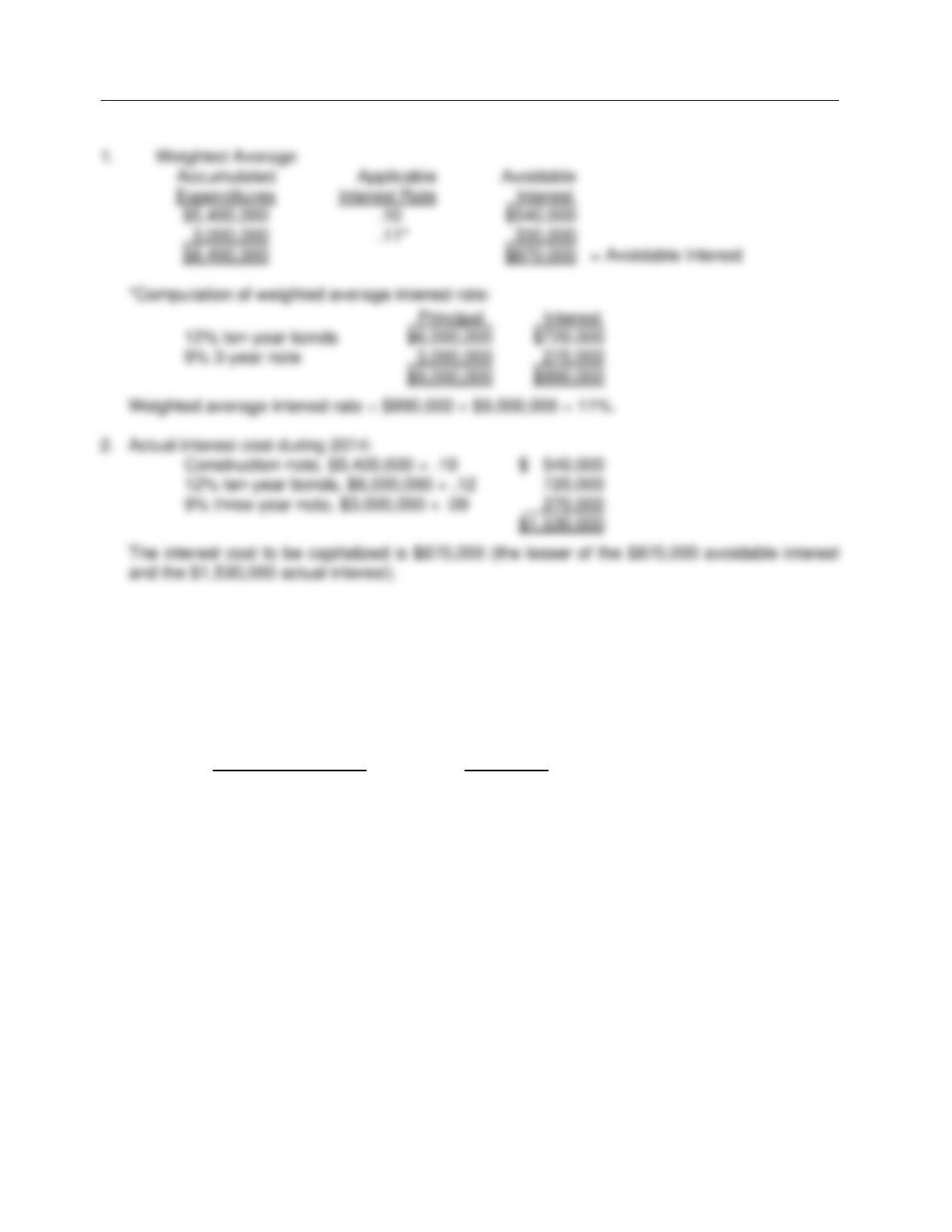
During 2014, Barden Building Company constructed various assets at a total cost of $12,600,000.
The weighted average accumulated expenditures on assets qualifying for capitalization of interest
during 2014 were $8,400,000. The company had the following debt outstanding at December 31,
2014:
1. 10%, 5-year note to finance construction of various assets,
dated January 1, 2014, with interest payable annually on January 1 $5,400,000
2. 12%, ten-year bonds issued at par on December 31, 2008, with interest
payable annually on December 31 6,000,000
3. 9%, 3-year note payable, dated January 1, 2013, with interest payable
annually on January 1 3,000,000
Instructions
Compute the amounts of each of the following (show computations).
1. Avoidable interest.
2. Total interest to be capitalized during 2014.
Test Bank for Intermediate Accounting, Fifteenth Edition
10 – 42
Solution 10-139
Pr. 10-140—Capitalization of interest.
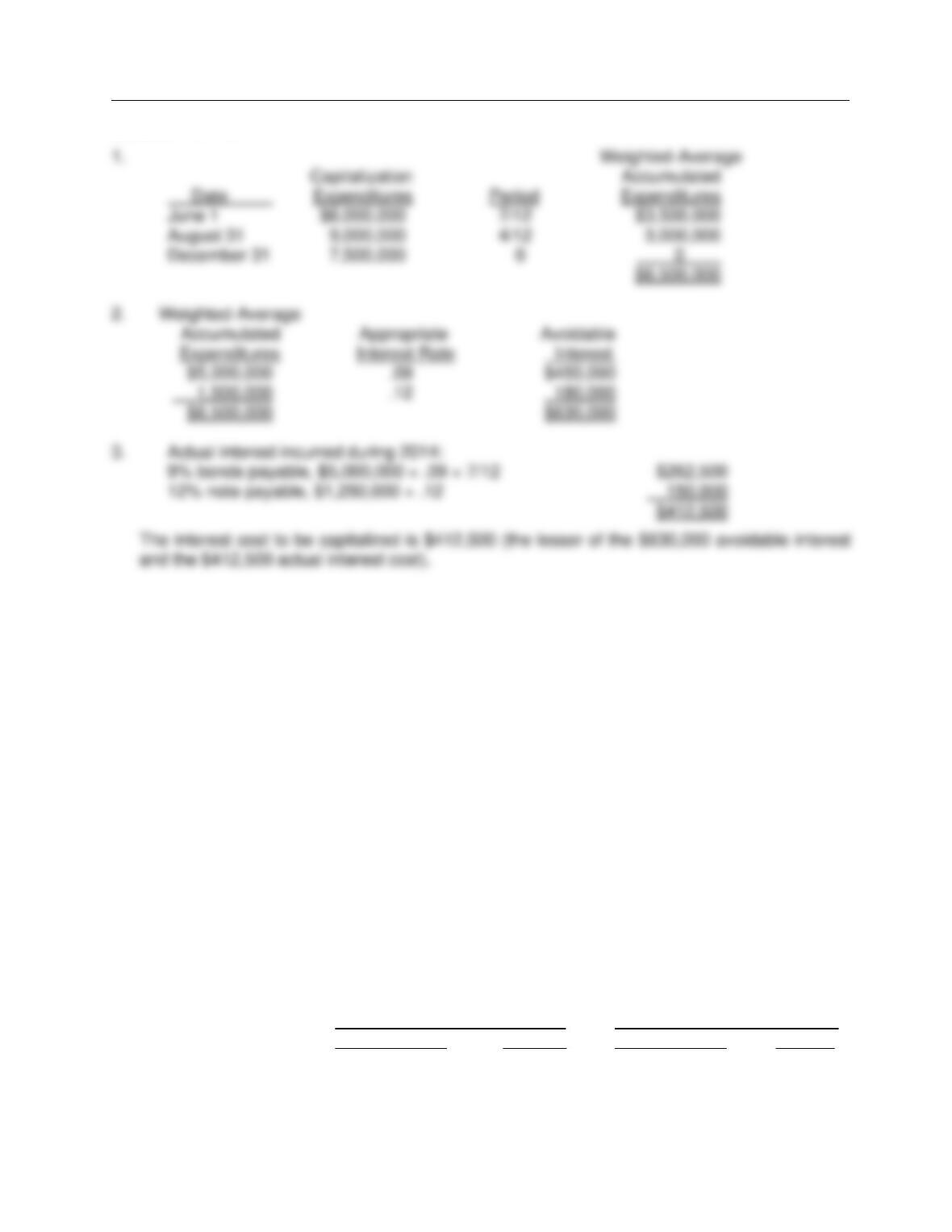
Early in 2014, Dobbs Corporation engaged Kiner, Inc. to design and construct a complete
modernization of Dobbs‘s manufacturing facility. Construction was begun on June 1, 2014 and
was completed on December 31, 2014. Dobbs made the following payments to Kiner, Inc. during
2014:
Date Payment
June 1, 2014 $6,000,000
August 31, 2014 9,000,000
December 31, 2014 7,500,000
In order to help finance the construction, Dobbs issued the following during 2014:
1. $5,000,000 of 10-year, 9% bonds payable, issued at par on May 31, 2014, with interest
payable annually on May 31.
2. 1,000,000 shares of no-par common stock, issued at $10 per share on October 1, 2014.
In addition to the 9% bonds payable, the only debt outstanding during 2014 was a $1,250,000,
12% note payable dated January 1, 2010 and due January 1, 2020, with interest payable
annually on January 1.
Instructions
Compute the amounts of each of the following (show computations):
1. Weighted-average accumulated expenditures qualifying for capitalization of interest cost.
2. Avoidable interest incurred during 2014.
3. Total amount of interest cost to be capitalized during 2014.
Acquisition and Disposition of Property, Plant, and Equipment
10 – 43
Solution 10-140
Pr. 10-141—Asset acquisition.
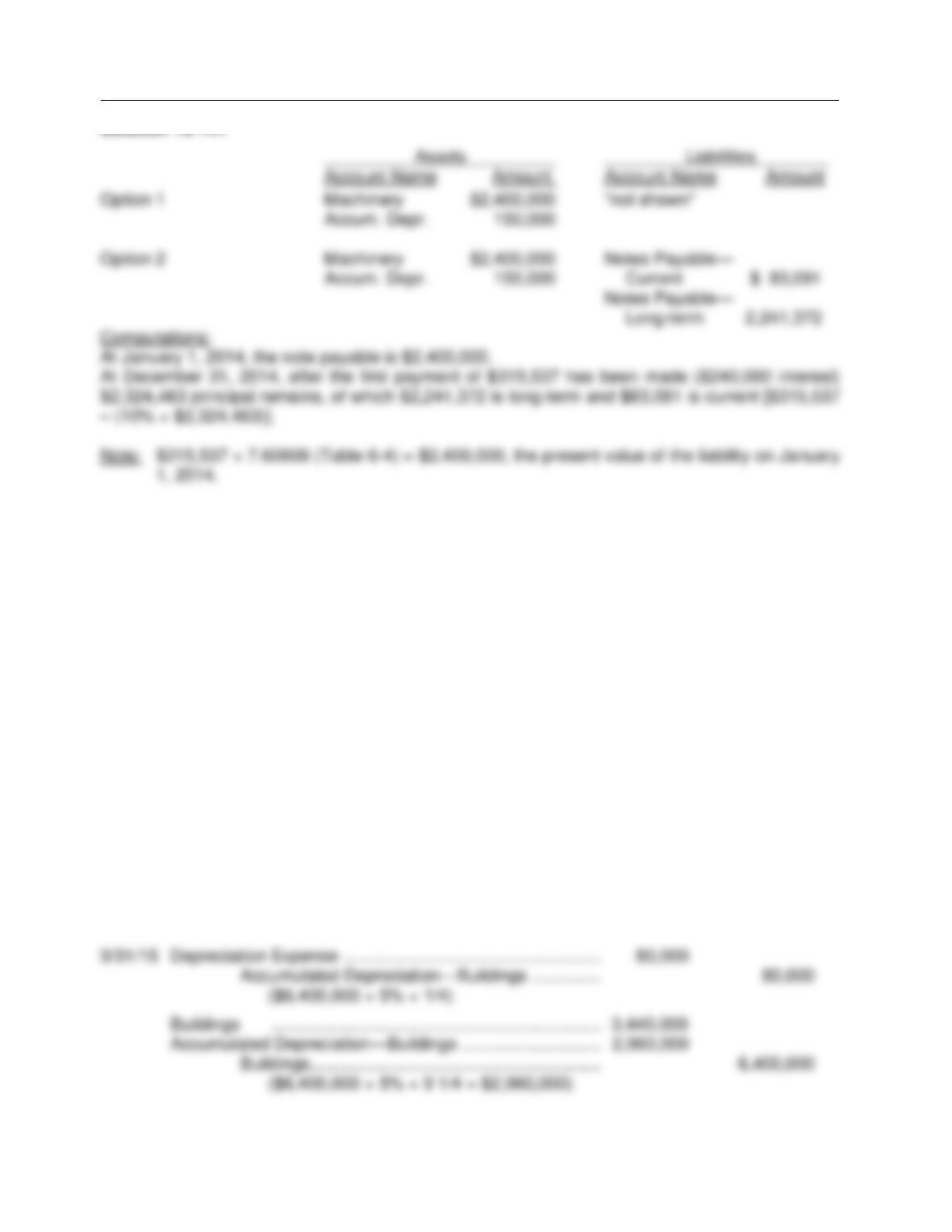
Ford Inc. plans to acquire an additional machine on January 1, 2014 to meet the growing demand
for its product. Stever Company offers to provide the machine to Ford using either of the options
listed below (each option gives Ford exactly the same machine and gives Stever Company
approximately the same net present value cash equivalent at 10%).
Option 1 — Cash purchase $2,400,000.
Option 2 — Installment purchase requiring 15 annual payments of $315,537 due
December 31 each year.
The expected economic life of this machine to Ford is 15 years. Salvage value at that time is
estimated to be $150,000. Straight-line depreciation is used. Interest expense under Option 2 is
computed using the effective interest method.
Instructions
Based upon current generally accepted accounting principles, state how, if at all, the book value
of the machine and the liability should appear on the December 31, 2014 balance sheet of Ford
Inc., for each option. Present your answer on an answer sheet in the following format. If an item
should not appear in the balance sheet, write “not shown” opposite the option.
Assets Liabilities
Account Name Amount Account Name Amount
Option 1
Option 2
Test Bank for Intermediate Accounting, Fifteenth Edition
10 – 44
Pr. 10-142—Nonmonetary exchanges.
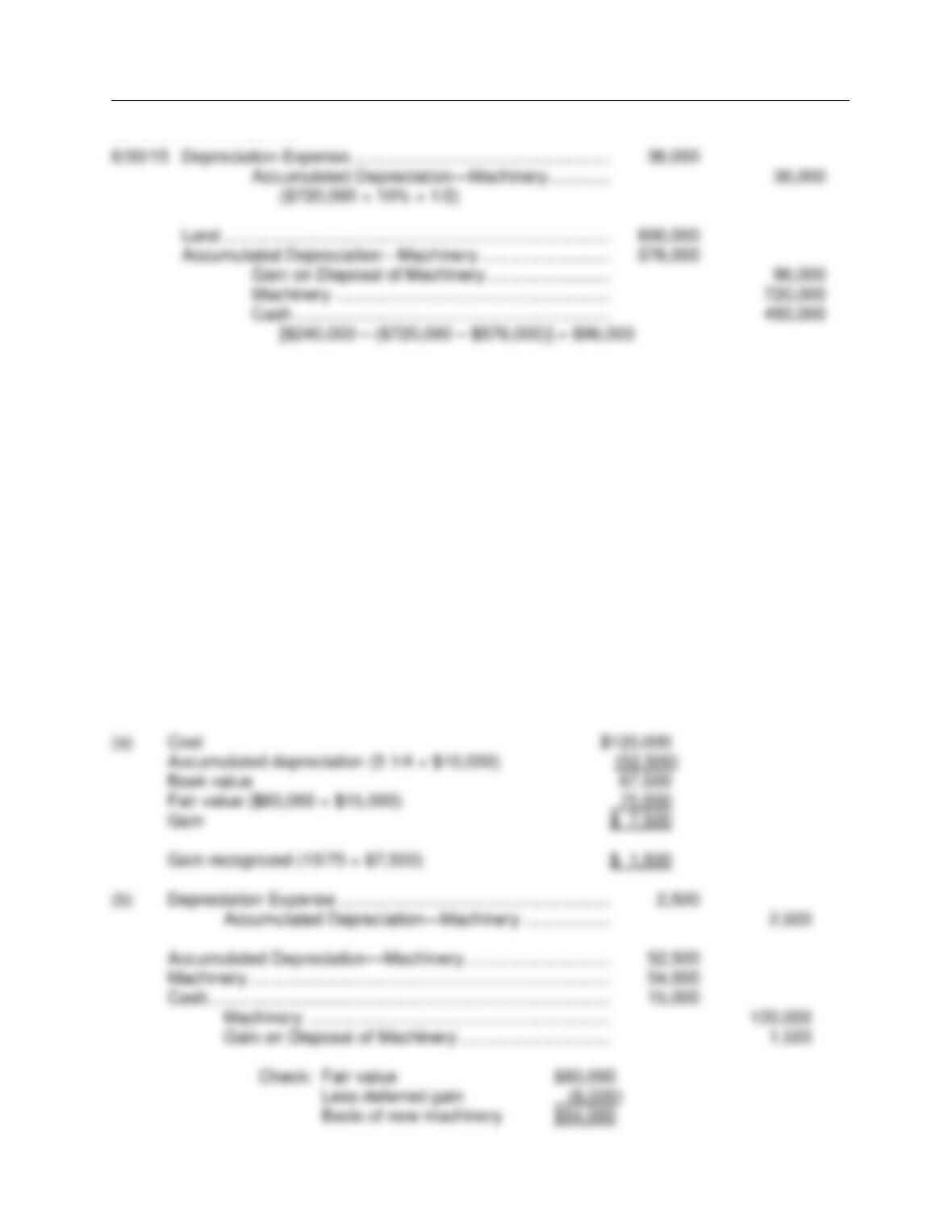
Moore Corporation follows a policy of a 10% depreciation charge per year on all machinery and a
5% depreciation charge per year on buildings. The following transactions occurred in 2015:
March 31, 2015— Negotiations which began in 2014 were completed and a building purchased
1/1/06 (depreciation has been properly charged through December 31, 2014)
at a cost of $6,400,000 with a fair value of $4,000,000 was exchanged for a
second building which also had a fair value of $4,000,000. The exchange had
no commercial substance. Both parcels of land on which the buildings were
located were equal in value, and had a fair value equal to book value.
June 30, 2015— Machinery with a cost of $720,000 and accumulated depreciation through
January 1 of $540,000 was exchanged with $450,000 cash for a parcel of land
with a fair value of $690,000. The exchange had commercial substance.
Instructions
Prepare all appropriate journal entries for Moore Corporation for the above dates.
Solution 10-142
Acquisition and Disposition of Property, Plant, and Equipment
10 – 45
Solution 10-142 (cont.)
Pr. 10-143—Nonmonetary exchange.
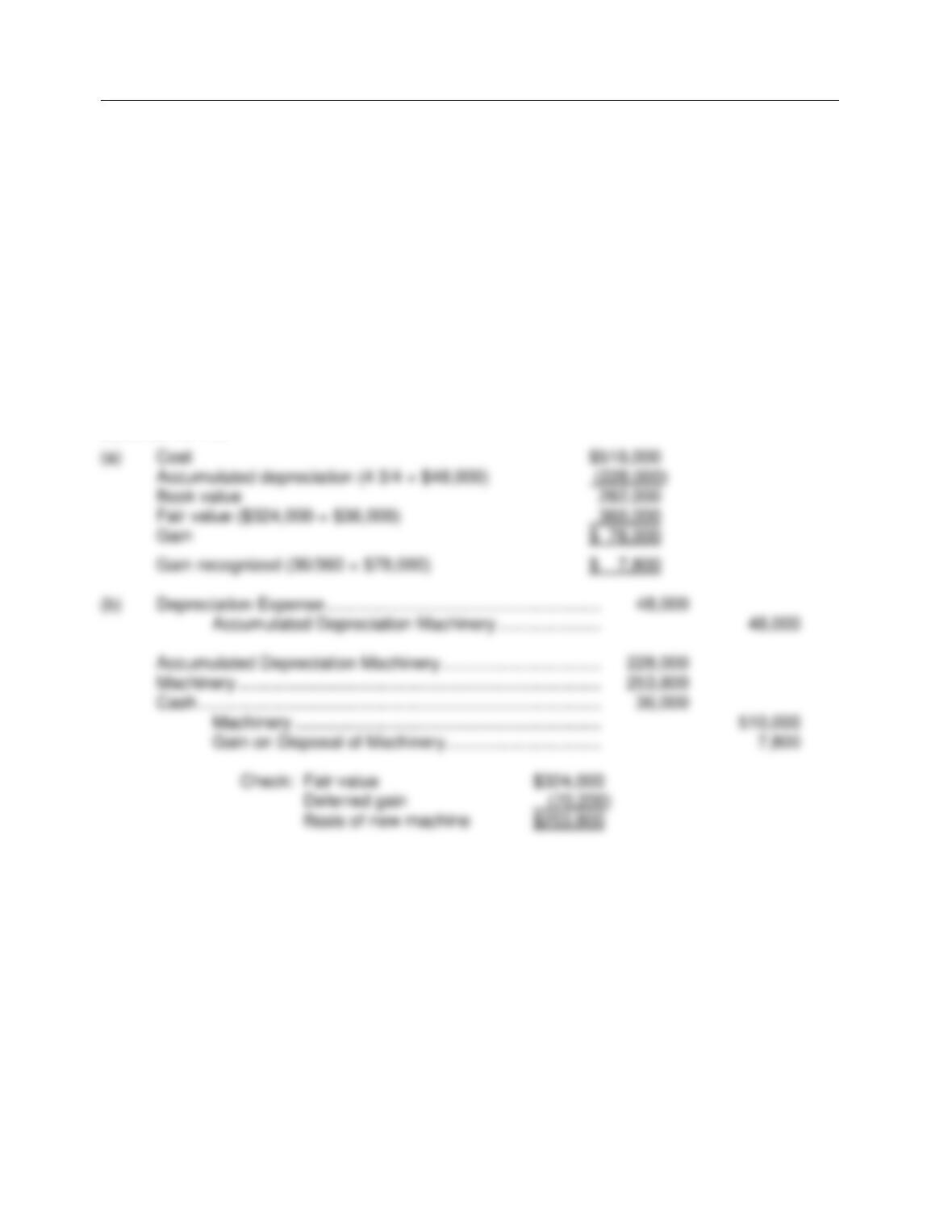
Rogers Co. had a sheet metal cutter that cost $120,000 on January 5, 2010. This old cutter had
an estimated life of ten years and a salvage value of $20,000. On April 3, 2015, the old cutter is
exchanged for a new cutter with a fair value of $60,000. The exchange lacked commercial
substance. Rogers also received $15,000 cash. Assume that the last fiscal period ended on
December 31, 2014, and that straight-line depreciation is used.
Instructions
(a) Show the calculation of the amount of the gain or loss to be recognized by Rogers Co.
(b) Prepare all entries that are necessary on April 3, 2015. Show a check of the amount
recorded for the new cutter.
Solution 10-143
Test Bank for Intermediate Accounting, Fifteenth Edition
10 – 46
Pr. 10-144—Nonmonetary exchange.
Layne Co. has a machine that cost $510,000 on March 20, 2011. This old machine had an
estimated life of ten years and a salvage value of $30,000. On December 23, 2015, the old
machine is exchanged for a new machine with a fair value of $324,000. The exchange lacked
commercial substance. Layne also received $36,000 cash. Assume that the last fiscal period
ended on December 31, 2014, and that straight-line depreciation is used.
Instructions
(a) Show the calculation of the amount of gain or loss to be recognized by Layne Co. from the
exchange.
(b) Prepare all entries that are necessary on December 23, 2015. Show a check of the amount
recorded for the new machine.
Solution 10-144
Pr. 10-145—Nonmonetary exchange.
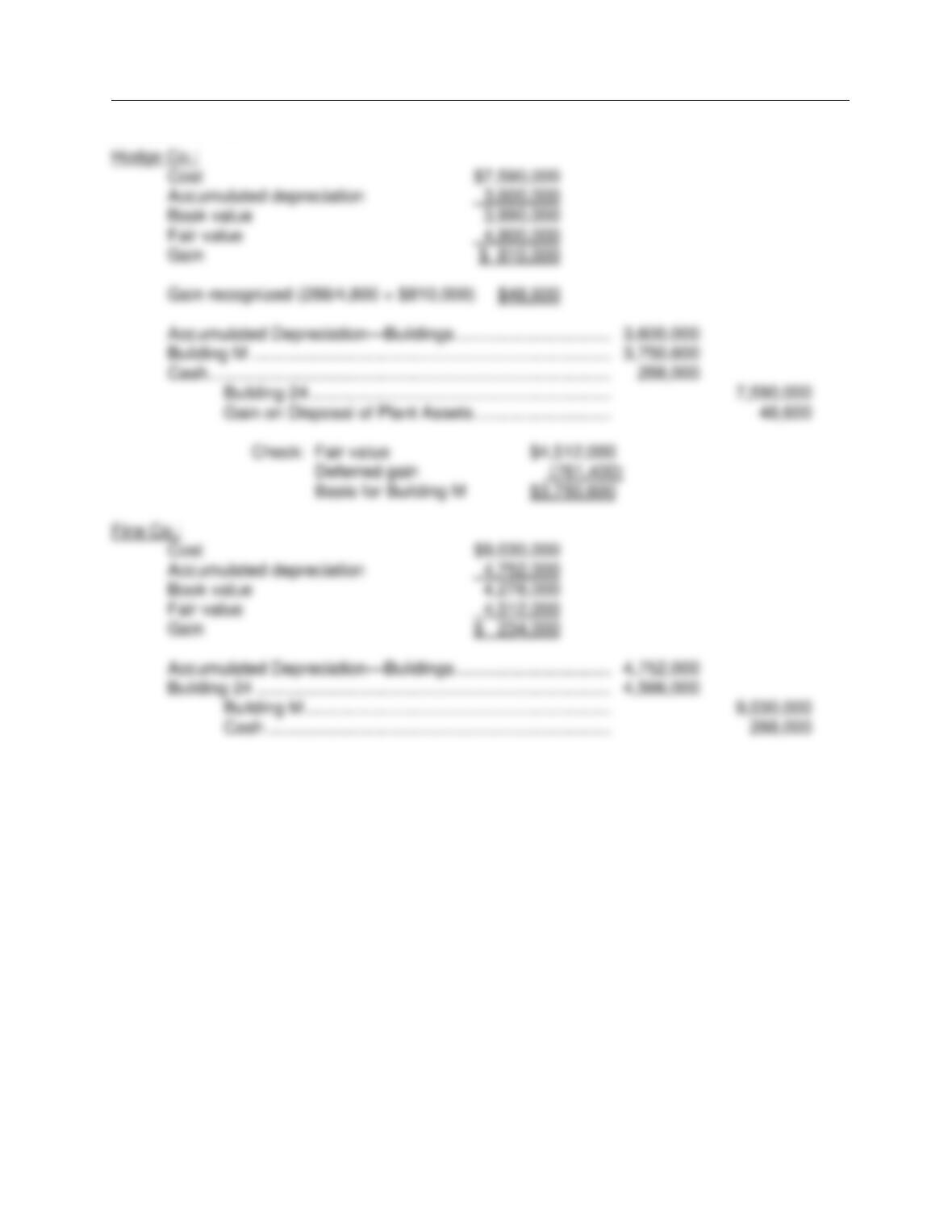
Hodge Co. exchanged Building 24 which has an appraised value of $4,800,000, a cost of
$7,590,000, and accumulated depreciation of $3,600,000 for Building M belonging to Fine Co.
Building M has an appraised value of $4,512,000, a cost of $9,030,000, and accumulated
depreciation of $4,752,000. The correct amount of cash was also paid. Assume depreciation has
already been updated.
Instructions
Prepare the entries on both companies’ books assuming the exchange had no commercial
substance. Show a check of the amount recorded for Building M on Hodge’s books. (Round to
the nearest dollar.)
Acquisition and Disposition of Property, Plant, and Equipment
10 – 47
Solution 10-145
Pr. 10-146—Nonmonetary exchange.
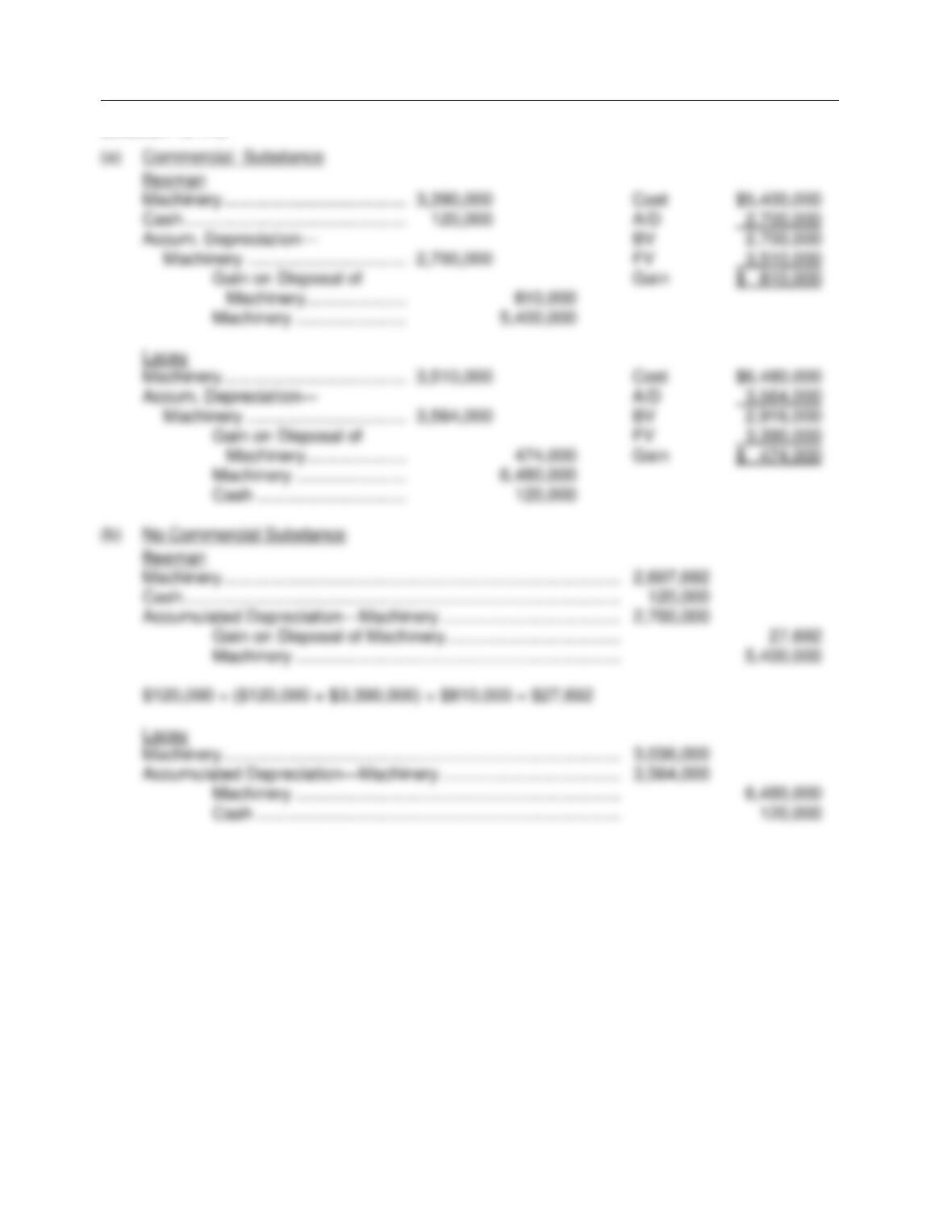
Beeman Company exchanged machinery with an appraised value of $3,510,000, a recorded cost
of $5,400,000 and accumulated depreciation of $2,700,000 with Lacey Corporation for machinery
Lacey owns. The machinery has an appraised value of $3,390,000, a recorded cost of
$6,480,000, and accumulated depreciation of $3,564,000. Lacey also gave Beeman $120,000 in
the exchange. Assume depreciation has already been updated.
Instructions
(a) Prepare the entries on both companies’ books assuming that the exchange had commercial
substance. (Round all computations to the nearest dollar.)
(b) Prepare the entries on both companies’ books assuming that the exchange lacked
commercial substance. (Round all computations to the nearest dollar.)
Test Bank for Intermediate Accounting, Fifteenth Edition
10 – 48
Solution 10-146
Acquisition and Disposition of Property, Plant, and Equipment
10 – 49
Short Answer:
1. What are the major characteristics of plant assets?
2. What interest rates should be used in determining the amount of interest to be capitalized?
How should the amount of interest to be capitalized be determined?
Test Bank for Intermediate Accounting, Fifteenth Edition
10 – 50
IFRS QUESTIONS
True/False
1. Under international accounting standards, historical cost is the preferred treatment for
property, plant, and equipment.
2. Recently changes to IFRS require companies to capitalize borrowing costs related to
qualifying assets.
3. Under IFRS, interest costs incurred during construction of a plant asset cannot be capitalized.
4. Under IFRS, if a company uses the revaluation model for fixed assets, companies must
revalue the class of assets regularly.
5. Under IFRS, assets that qualify for interest capitalization are assets that are in use or ready
for their intended use.
Answers to True/False:
Multiple Choice
1. Under IFRS, Sampson Company, who has a non-current asset which has been classified as
held-for-sale, should
a. test the asset’s value monthly for impairment.
b. value the asset at its depreciated historical cost.
c. depreciate the asset over its remaining life.
d. not depreciate the asset.
2. Miller Company, a company who uses IFRS reporting standards, sells a non-current asset
classified as held-for-sale. Which of the following statements is true regarding the treatment of
a gain on a subsequent increase in the fair value less cost?
a. The gain should not be recognized.
b. The gain should be recognized in full in the income statement.
c. The gain should be recognized but only in retained earnings.
d. The gain should be recognized to the extent that it is not in excess of the cumulative
impairment loss that has been recognized.

Acquisition and Disposition of Property, Plant, and Equipment
10 – 51
3. Danson Company, a company who uses IFRS reporting standards, has a non-current asset
that has been classified as held-for-sale. When the asset no longer meets this definition,
Danson should
a. remove the asset from the statement of financial position.
b. remeasure the asset at fair value.
c. measure the asset at the lower of its carrying value before it was classified as held-for-
sale and its recoverable amount at the date when the company decided not to sell it.
d. leave the non-current asset on the financial statements at the current carrying value.
4. Elton Industries, a company who uses IFRS reporting standards, has assets and liabilities of
a disposal group classified as held-for-sale shown on its statement of financial position. Which
of the following presents the best treatment for these?
a. These assets and liabilities should be netted and presented as a single amount – either a
current asset or a current liability on the statement of financial position.
b. On the balance sheet, the disposal group assets should be shown separately from other
assets, while the disposal group liabilities should be shown separately from other
liabilities.
c. The assets and liabilities should be netted and presented as a deduction from equity on
the statement of financial position.
d. There should be no separate disclosure of these assets and liabilities on the statement of
financial position.
5. Woodson Company, a company who uses IFRS reporting standards, has identified a group of
plant assets for disposal. On January 1, 2014, the carrying value of these assets was
$14.5 million. The assets were revalued to $13.5 million on January 5, 2014, when they were
identified as property for the disposal group. In addition, Woodson thinks that it will cost
$1.5 million to sell these assets. What carrying amount should these assets reflect for
year-end financial statements to be prepared on January 10, 2014?
a. $14.5 million
b. $13.5 million
c. $13.0 million
d. $12.0 million
6. Under IFRS, interest revenue earned on specific borrowings for qualifying assets
a. reduces the cost of the qualifying asset.
b. reduces interest expense reported on the income statement.
c. increases equity in the period earned.
d. increases the cost of the qualifying asset.
7. On January 1, 2014, Jackson Company has a building with a carrying value of $80,000 and a
remaining useful life 5 years that was recently valued at $240,000. Assuming that the
company uses straight-line depreciation, IFRS would show the depreciation as
a. $16,000
b. $48,000
c. $32,000
d. More than one of these answers could be correct.

Test Bank for Intermediate Accounting, Fifteenth Edition
10 – 52
8. Tram Industries, a company who uses IFRS reporting standards, is installing a new plant. The
company has incurred the following costs
1. Operating losses before commercial production $ 200,000
2. Cost of the plant 1,500,000
3. Initial delivery and handling charges 300,000
4. Cost of site preparation 175,000
Which of these costs can Tram capitalize in accordance with IFRS?
a. 1, 2, 3, & 4
b. 2 & 4
c. 2, 3, & 4
d. 1, 2, & 4
9. Icon Industries, a company who uses IFRS reporting standards, is installing a new plant. The
company has incurred the following costs
1. Consultants used for advice on the acquisition of the plant $245,000
2. Interest charges paid to the supplier of plant for deferred credit $275,000
3. Estimated dismantling cost to be incurred after 8 years $400,000
4. Cost of the plant $2,300,000
Which of these costs can Tram capitalize in accordance with IFRS?
a. 1, 2, 3, & 4
b. 4 only
c. 1 & 4
d. 1, 3, & 4
10. All of the following are true regarding the revaluation model allowed under IFRS except
a. once selected, the revaluation policy applies to an entire class of property, plant and
equipment.
b. revaluations must be made regularly to ensure that the carrying value is not materially
different from fair value.
c. after initial recognition, the revalued amount is fair value less subsequent depreciation and
impairment losses.
d. when an asset is revalued, any increase in carrying amount is reported as miscellaneous
revenue.
Answers to Multiple Choice: