64.
On January 1, 2016, Broker Corp. issued $3,000,000 par value 12%, 10-year bonds which pay
interest each December 31. If the market rate of interest was 14%, what was the issue price
of the bonds? (The present value factor for $1 in 10 periods at 12% is .3220 and at 14% is
.2697. The present value of an annuity of $1 factor for 10 periods at 12% is 5.6502 and at 14%
is 5.2161.)
65.
On January 1, 2016, Jason Company issued $5 million of 10-year bonds at a 10% coupon
interest rate to be paid annually. The following present value factors have been provided:
Time
Period
Interest
PV of
$1
PV of a $1
Annuity
10
10%
.386
6.140
10
8%
.463
6.710
10
12%
.322
5.650
What was the issuance price of the bonds if the market rate of interest was 8%?
66.
On January 1, 2016, Jason Company issued $5 million of 10-year bonds at a 10% coupon
interest rate to be paid annually. The following present value factors have been provided:
Time
Period
Interest
PV of
$1
PV of a $1
Annuity
10
10%
.386
6.140
10
8%
.463
6.710
10
12%
.322
5.650
Calculate the issuance price if the market rate of interest is 12%.
67.
On January 1, 2016, Jason Company issued $5 million of 10-year bonds at a 10% coupon
interest rate to be paid annually. The following present value factors have been provided:
Time
Period
Interest
PV of
$1
PV of a $1
Annuity
10
10%
.386
6.140
10
8%
.463
6.710
10
12%
.322
5.650
Calculate the issuance price if the market rate of interest was 10%.
68.
Gammell Company issued $50,000 of 9% bonds with annual interest payments. The bonds
mature in ten years. The bonds were issued at $48,000. Gammell Company uses the straight–
line method of amortization.
What is the amount of the annual interest expense?
69.
Gammell Company issued $50,000 of 9% bonds with annual interest payments. The bonds
mature in ten years. The bonds were issued at $48,000. Gammell Company uses the straight–
line method of amortization.
Which of the following statements is incorrect?
70.
Which of the following statements incorrectly describes the accounting for bonds that were
issued at a premium?
71.
Which of the following statements correctly describes the accounting for bonds that were
issued at a premium?
72.
Assuming no adjusting journal entries have been made during the year, the journal entry on
the due date of the cash interest payment for bonds issued at a premium has just been
prepared. Which of the following is not an effect of the entry?
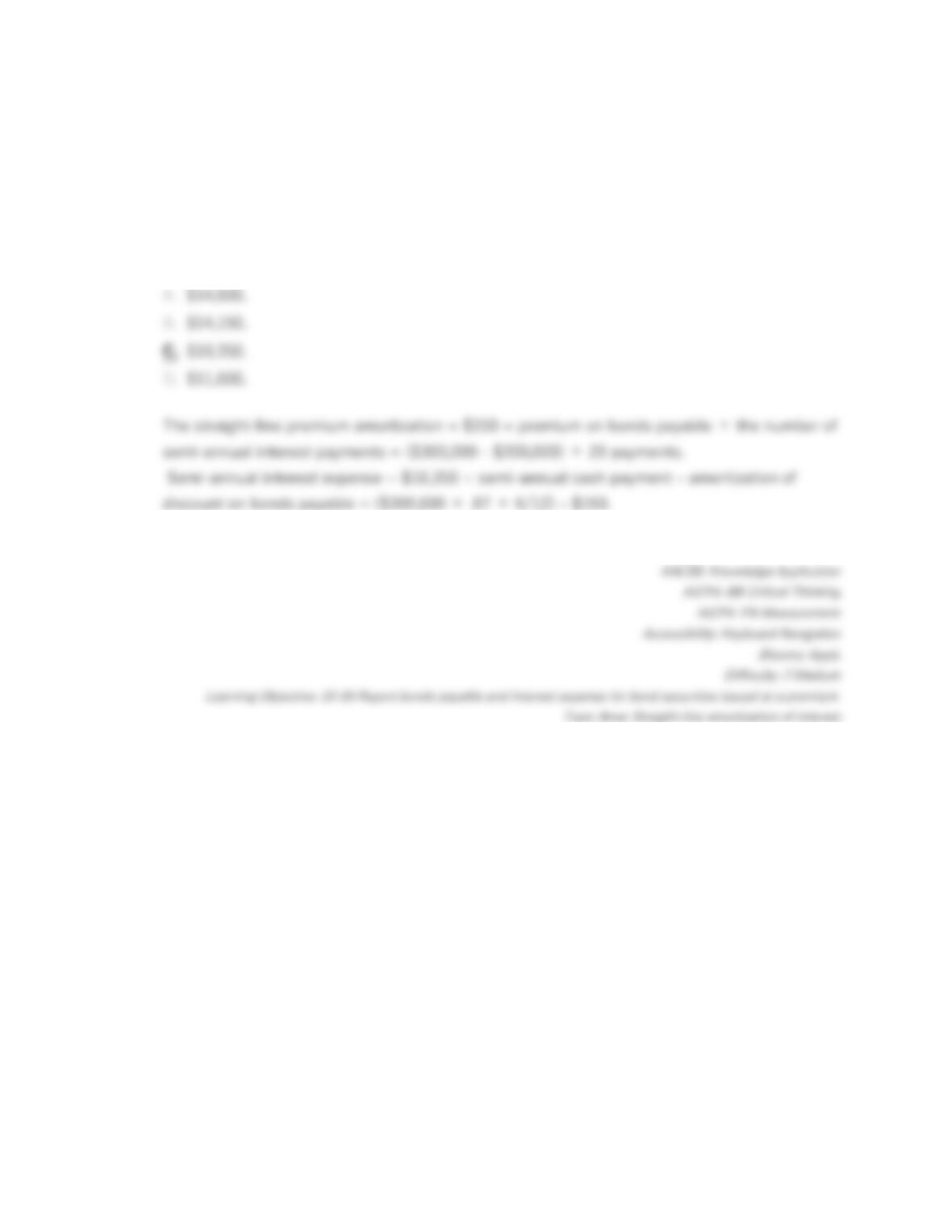
73.
On July 1, 2016, Garden Works, Inc. issued $300,000 of ten-year, 7% bonds for $303,000. The
bonds were dated July 1, 2016, and semi-annual interest will be paid each December 31 and
June 30. Garden Works Inc. uses the straight-line method of amortization.
What is the amount of the semi-annual interest expense?
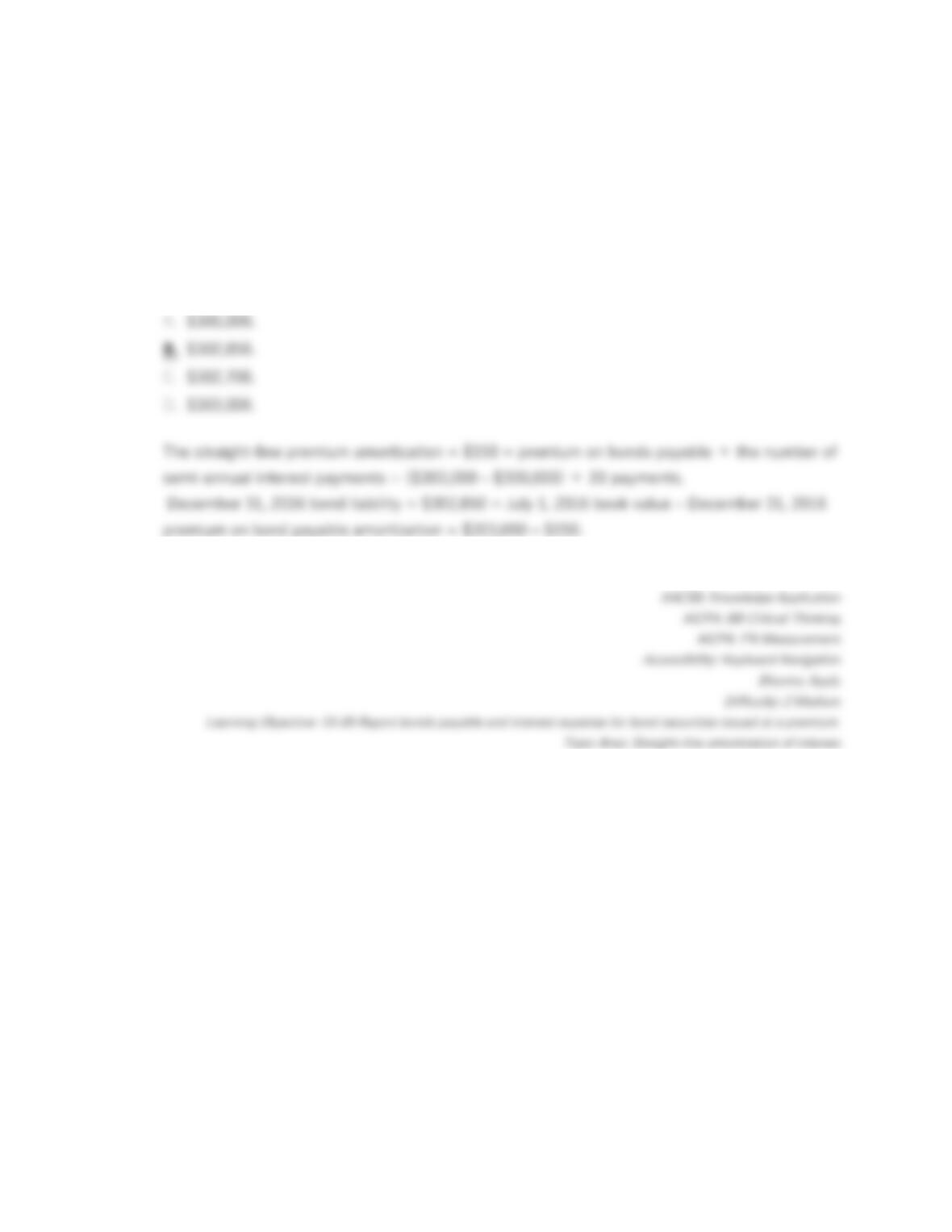
74.
On July 1, 2016, Garden Works, Inc. issued $300,000 of ten-year, 7% bonds for $303,000. The
bonds were dated July 1, 2016, and semi-annual interest will be paid each December 31 and
June 30. Garden Works Inc. uses the straight-line method of amortization.
What is the net amount of the bond liability to be reported on the December 31, 2016 balance
sheet?
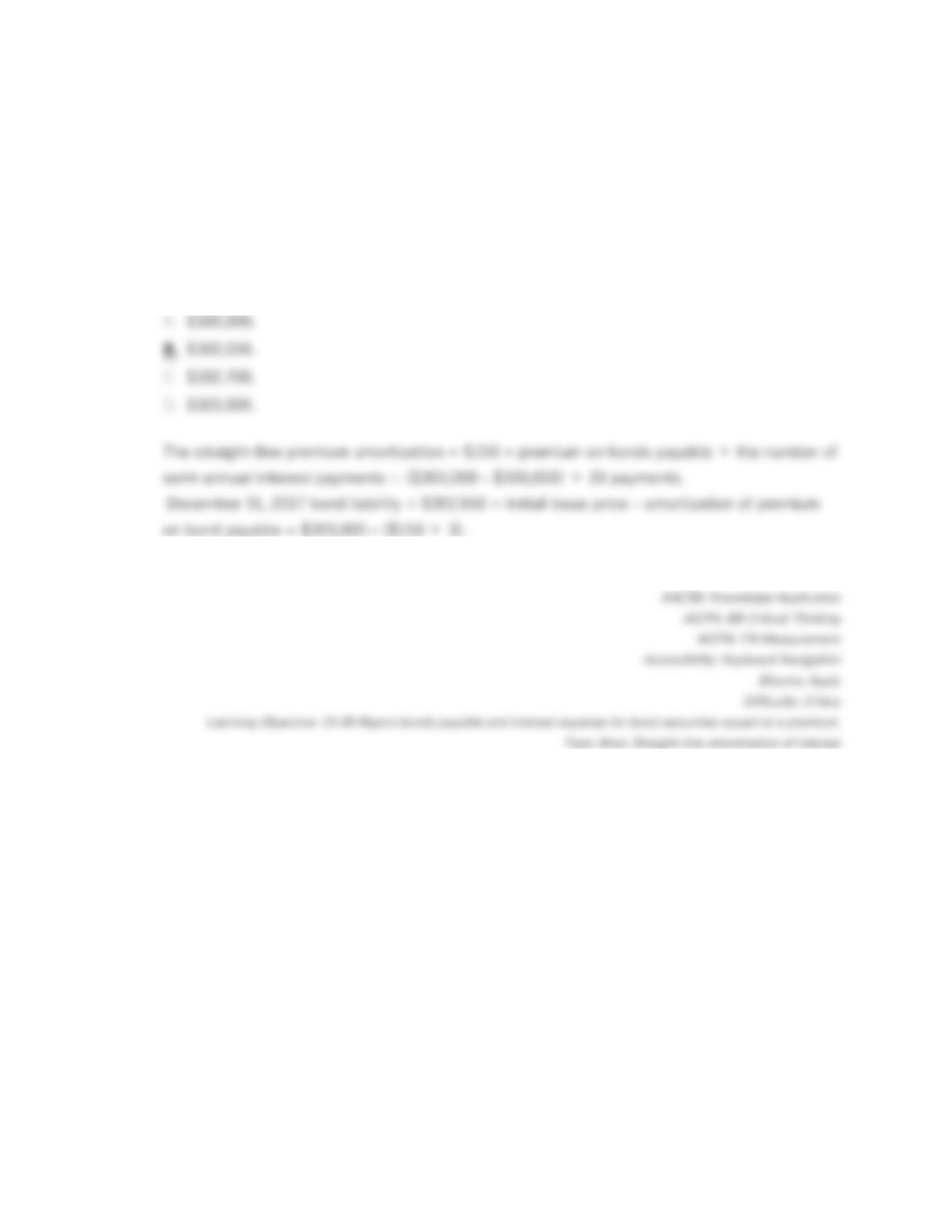
75.
On July 1, 2016, Garden Works, Inc. issued $300,000 of ten-year, 7% bonds for $303,000. The
bonds were dated July 1, 2016, and semi-annual interest will be paid each December 31 and
June 30. Garden Works Inc. uses the straight-line method of amortization.
What is the net amount of the bond liability to be reported on the December 31, 2017 balance
sheet?
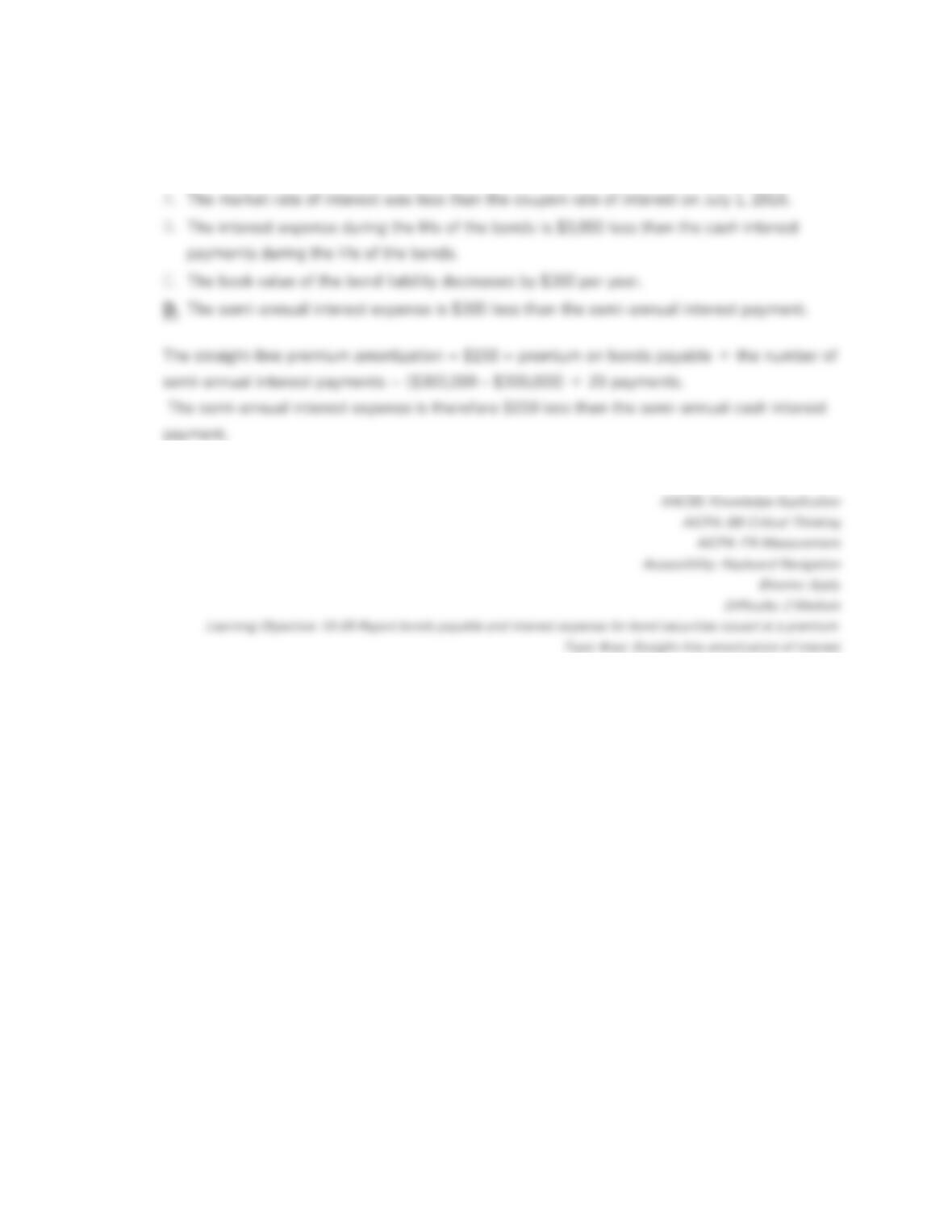
76.
Which of the following statements is incorrect?
77.
Mayberry, Inc., issued $100,000 of 10-year, 12% bonds dated April 1, 2016, for $102,360 on
April 1, 2016. The bonds pay interest annually on April 1, beginning in 2017. Straight-line
amortization is used by the company. What entry is required at April 1, 2017 for the first
interest payment?
78.
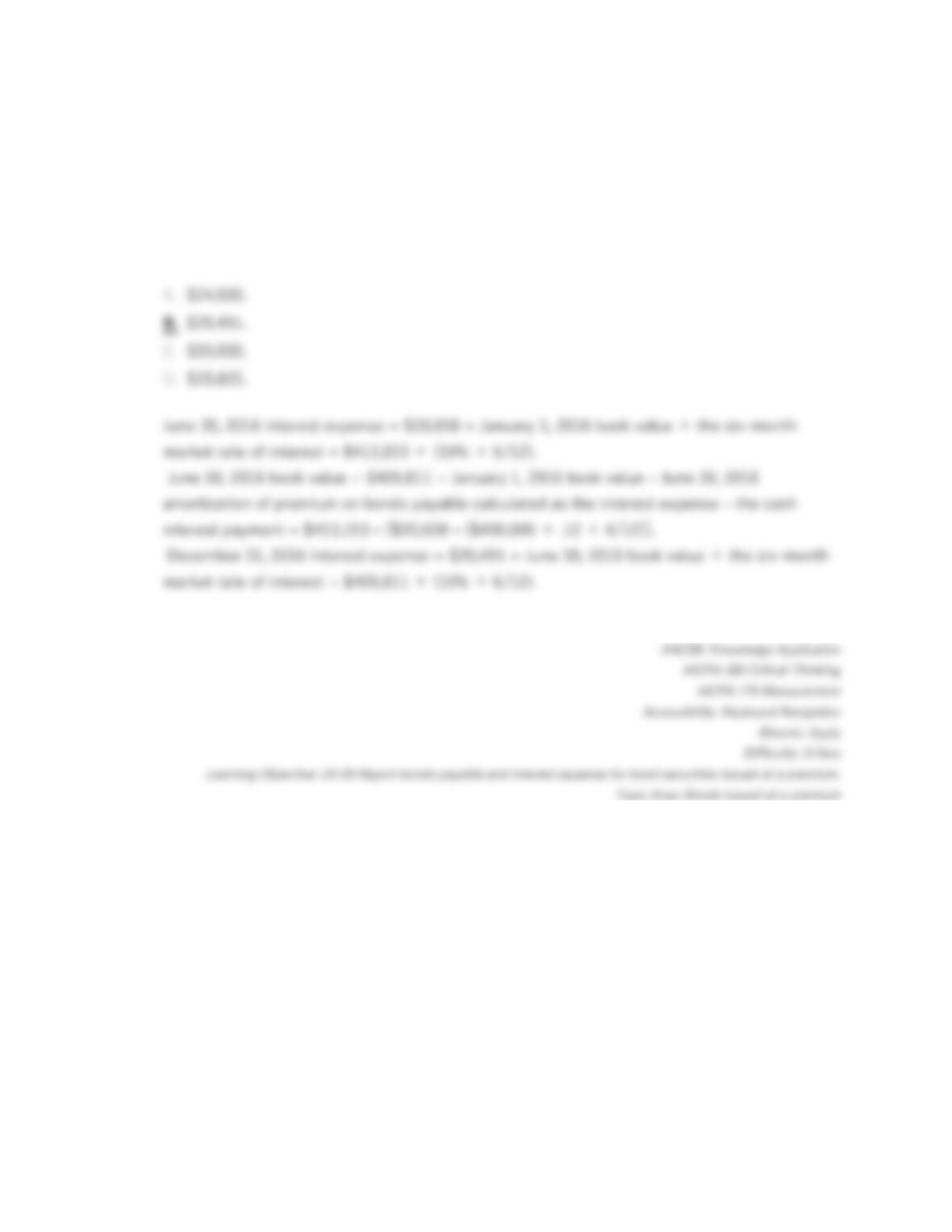
On January 1, 2016, a company issued $400,000 of 10-year, 12% bonds. The interest is
payable semi-annually on June 30 and December 31. The issue price was $413,153 based on
a 10% market interest rate. The effective-interest method of amortization is used.
Rounding all calculations to the nearest whole dollar, what is the interest expense for the six–
month period ending June 30, 2016?
79.
On January 1, 2016, a company issued $400,000 of 10-year, 12% bonds. The interest is
payable semi-annually on June 30 and December 31. The issue price was $413,153 based on
a 10% market interest rate. The effective-interest method of amortization is used.
What is the book value of the bond liability as of June 30, 2016 (to the nearest dollar)?
80.
On January 1, 2016, a company issued $400,000 of 10-year, 12% bonds. The interest is
payable semi-annually on June 30 and December 31. The issue price was $413,153 based on
a 10% market interest rate. The effective-interest method of amortization is used.
Which of the following statements is incorrect?
81.
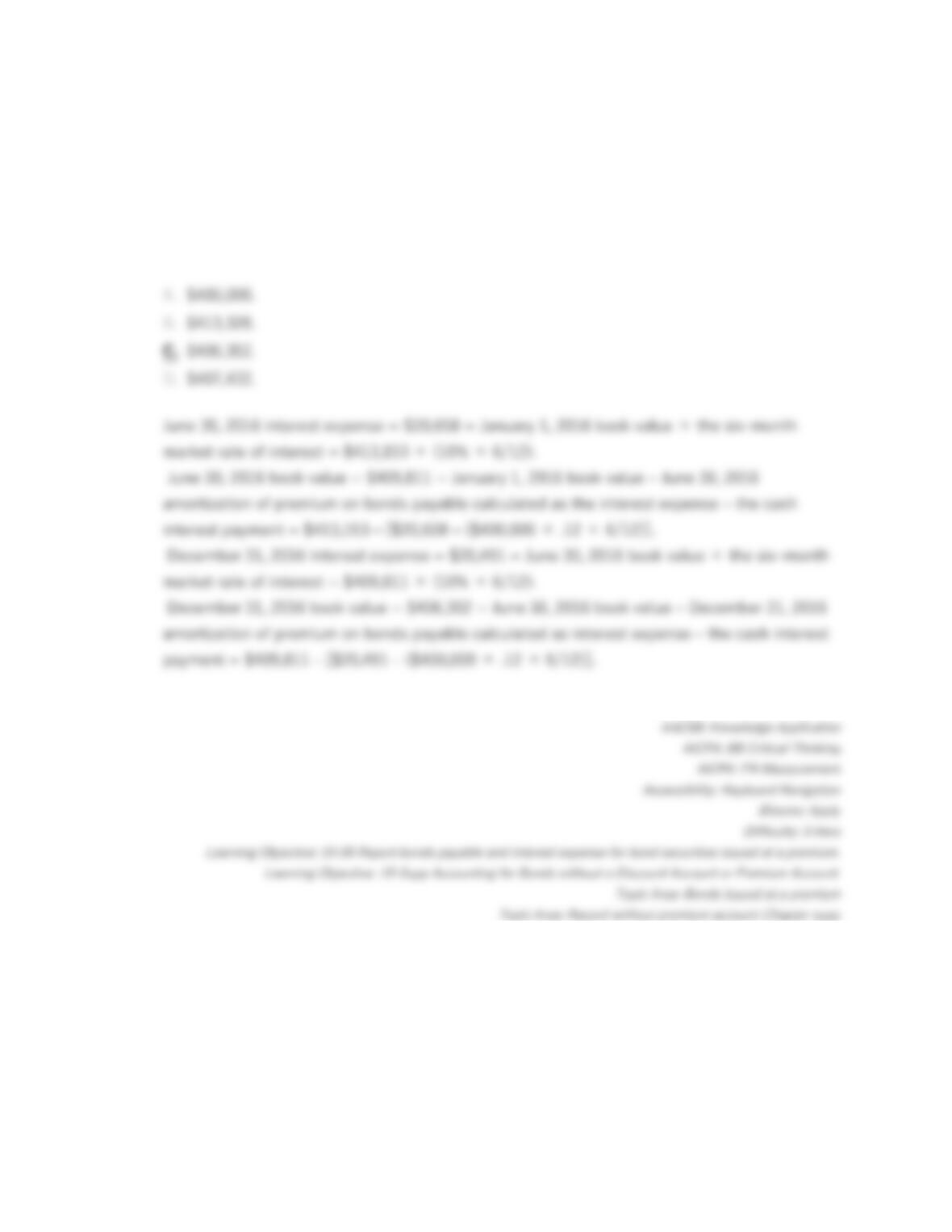
On January 1, 2016, a company issued $400,000 of 10-year, 12% bonds. The interest is
payable semi-annually on June 30 and December 31. The issue price was $413,153 based on
a 10% market interest rate. The effective-interest method of amortization is used.
The interest expense for the six-month period ending December 31, 2016 is closest to:
82.
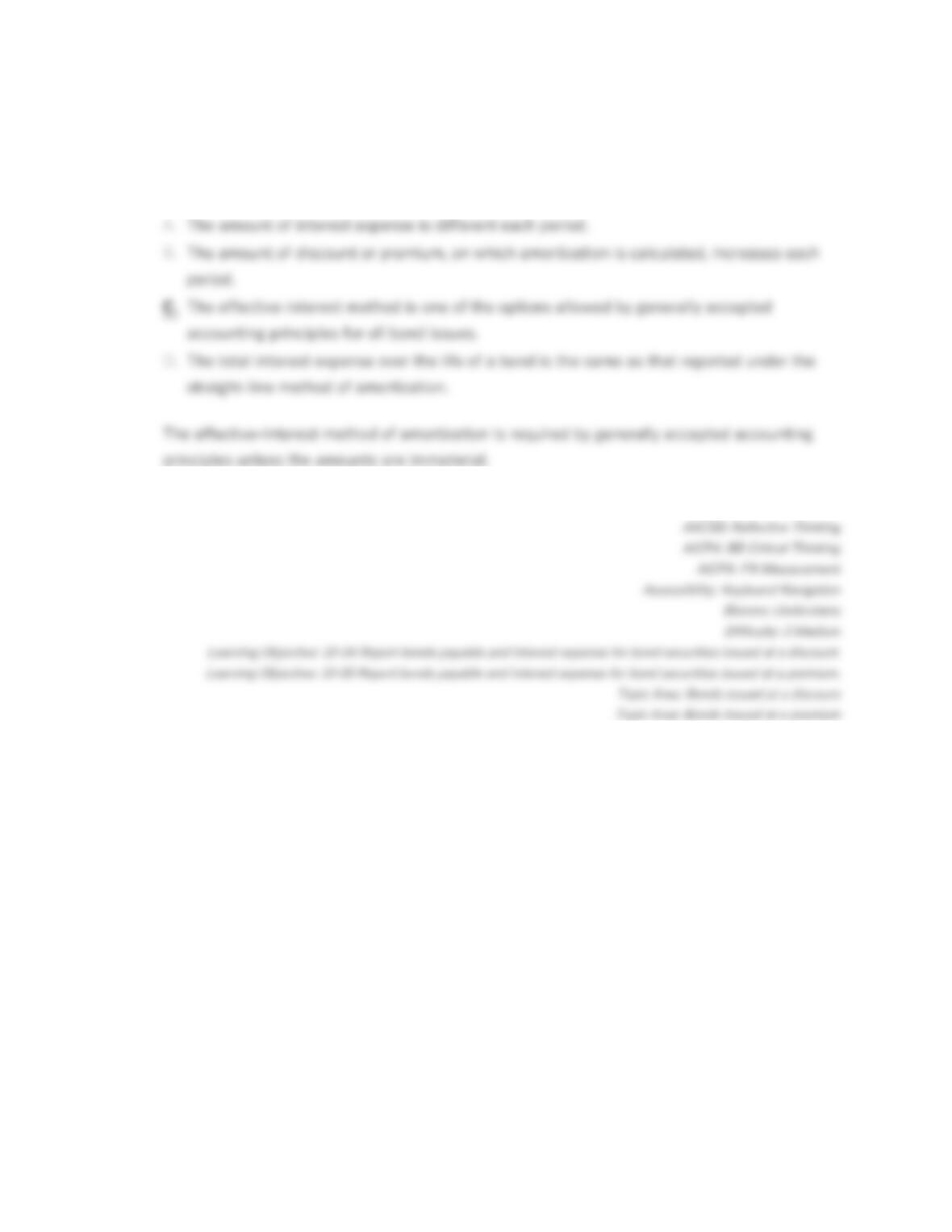
On January 1, 2016, a company issued $400,000 of 10-year, 12% bonds. The interest is
payable semi-annually on June 30 and December 31. The issue price was $413,153 based on
a 10% market interest rate. The effective-interest method of amortization is used.
The book value of the bond liability on December 31, 2016 is closest to:
83.
Which of the following statements regarding the effective-interest method of amortization is
incorrect?
84.
Straight-line amortization of a premium related to a bond issuance would result in which of
the following?
85.
Which of the following statements regarding the debt–to-equity ratio is correct?