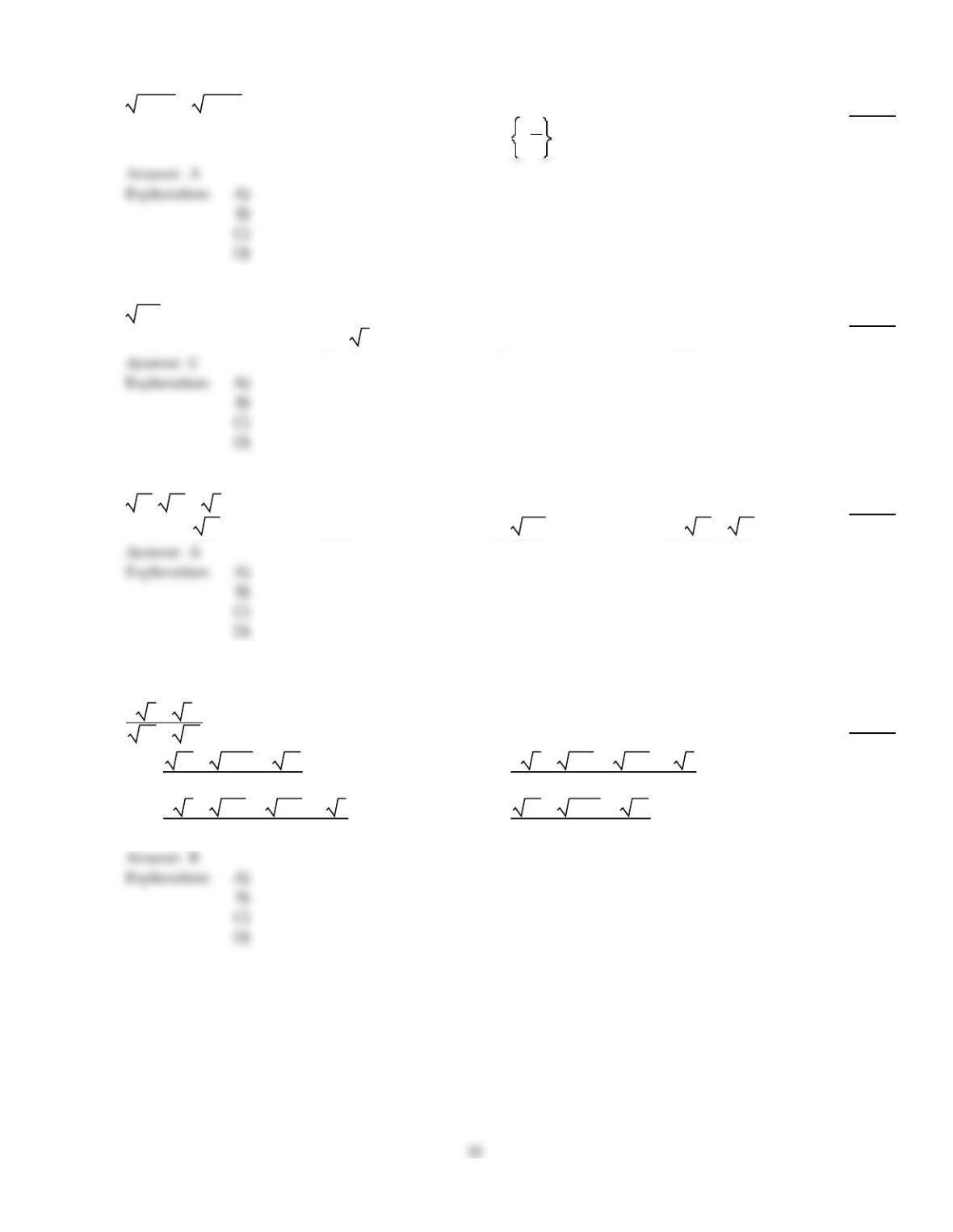
Solve the equation.
159)
3x – 2 +11 + x = – 1
159)
A)
B)
{0}
C)
–5
2
D)
{5}
Write the number as a product of a real number and i. Simplify the radical expression.
160)
–16
160)
A)
–4i
B)
–i 4
C)
4i
D)
±4
Multiply, then simplify the product. Assume that all variables represent positive real numbers.
161)
15(15 +2)
161)
A)
15 +30
B)
45
C)
255
D)
15 +30
Rationalize the denominator. Assume that all variables represent positive real numbers and that the denominator is not
zero.
162)
x–y
7x +6y
162)
A)
7x –13xy +6y
7x +6y
B)
x 7 –6xy –7xy + y 6
7x –6y
C)
x 7 –6xy –7xy + y 6
7x +6y
D)
7x –13xy +6y
7x –6y
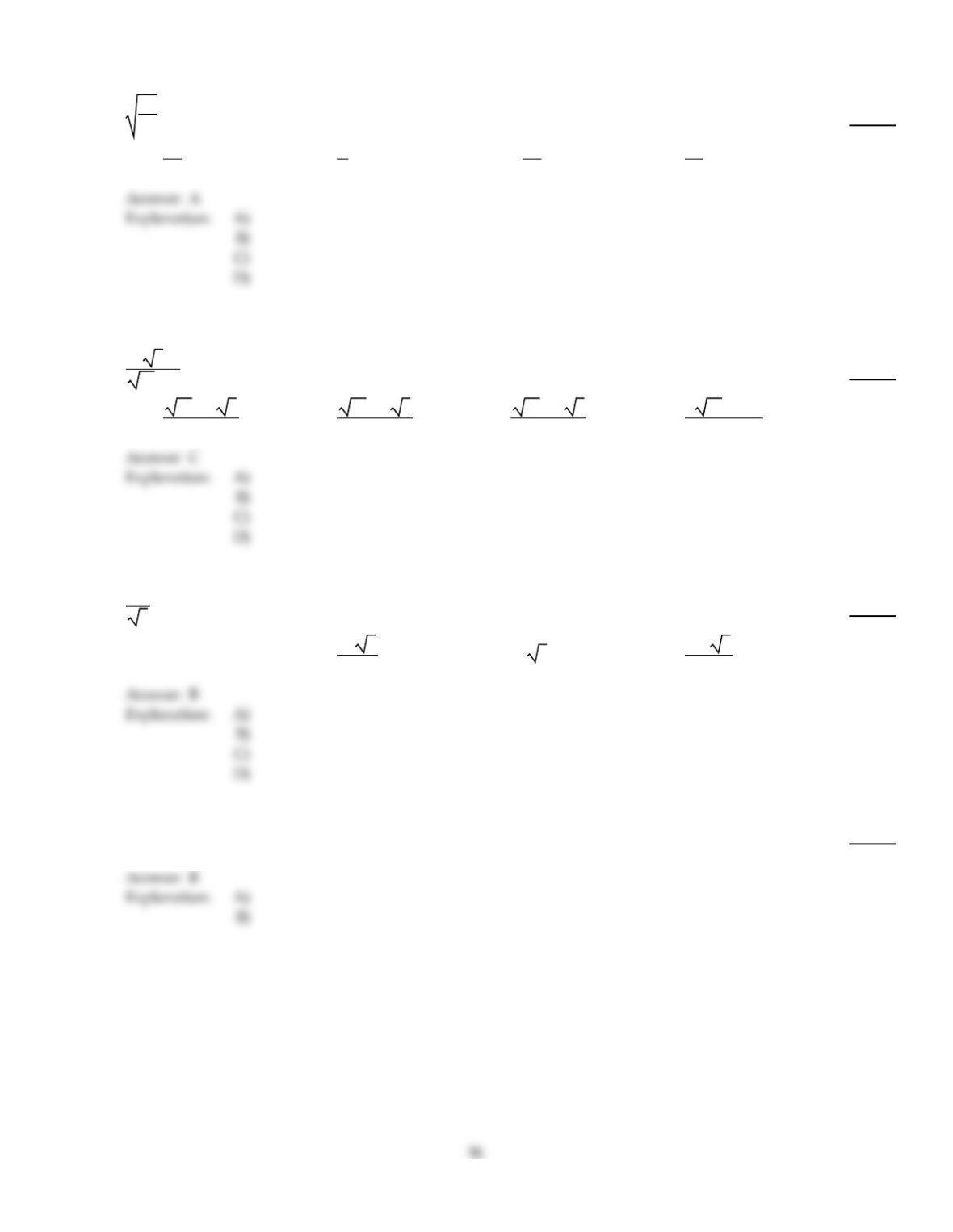
Find the square of the radical expression.
163)
7
10
163)
A)
7
10
B)
4
5
C)
–7
10
D)
12
25
Rationalize the denominator. Assume that all variables represent positive real numbers and that the denominator is not
zero.
164)
3
11 + 2
164)
A)
33 + 2 3
7
B)
33 – 2 3
13
C)
33 – 2 3
7
D)
333 + 113
22
Rationalize the denominator. Assume that all variables represent positive real numbers.
165)
7a
6
165)
A)
43
B)
7a 6
6
C)
7a 6
D)
49a 6
6
Provide an appropriate response.
166)
True or false? i = – 1
166)
A)
True
B)
False
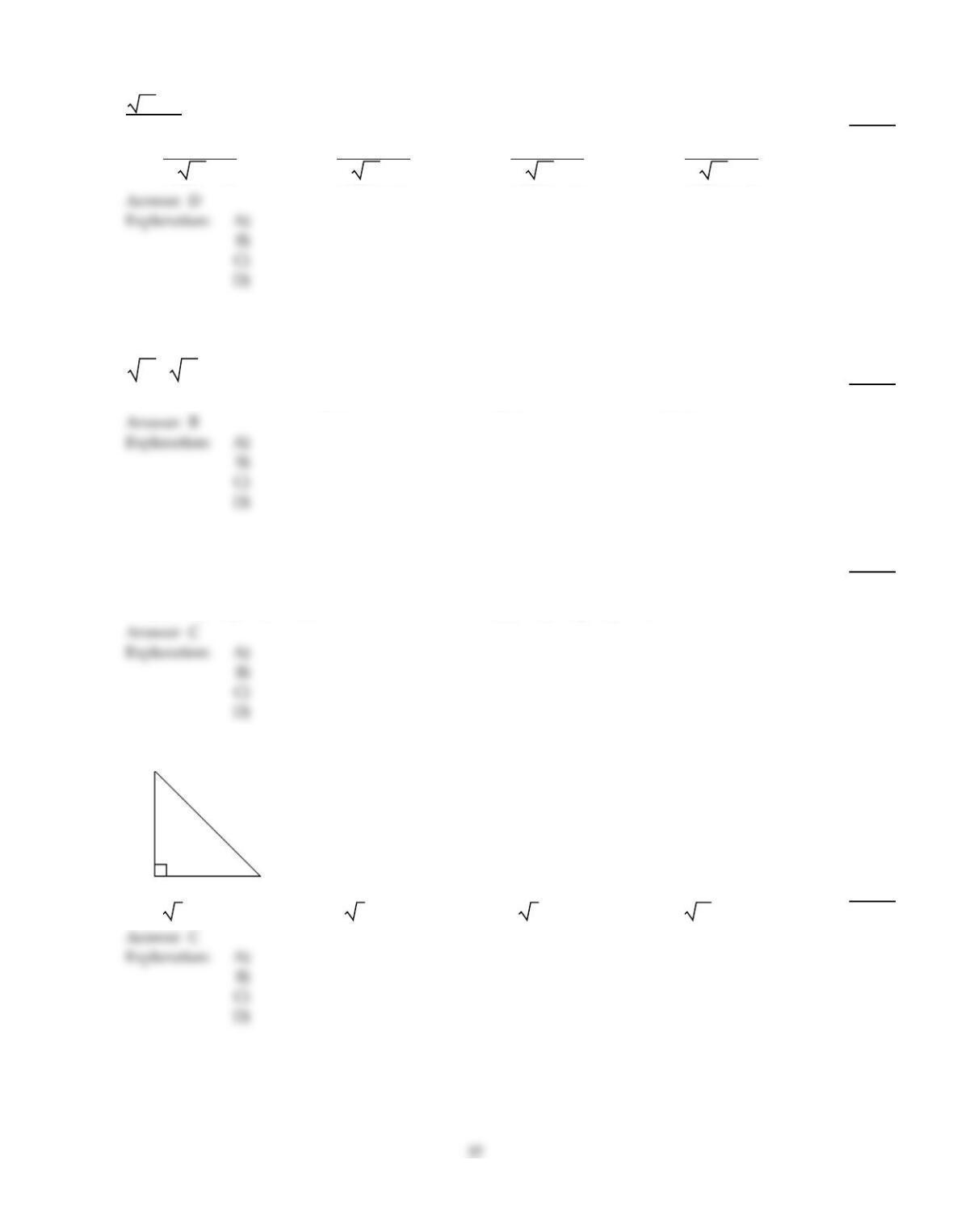
Rationalize the numerator. Assume that all variables represent positive real numbers.
167)
3x –5
5
167)
A)
3x –25
5( 3x –5)
B)
3x –5
5( 3x +5)
C)
3x –5
5( 3x –5)
D)
3x –25
5( 3x +5)
Write with rational exponents and then apply the properties of exponents. Assume that all radicands represent positive
real numbers. Give answers in exponential form.
168)
4x5·5x2
168)
A)
x7/9
B)
x33/20
C)
x10/20
D)
x20/10
Find the equation of a circle satisfying the given conditions.
169)
Center: (–8, 1); radius: 11
169)
A)
(x + 1)2+ (y – 8)2=11
B)
(x – 8)2+ (y + 1)2=121
C)
(x + 8)2+ (y – 1)2=121
D)
(x – 1)2+ (y + 8)2=11
Find the unknown length in the right triangle. Simplify the answer if necessary.
170)
b 7
5
170)
A)
2
B)
2 3
C)
2 6
D)
74
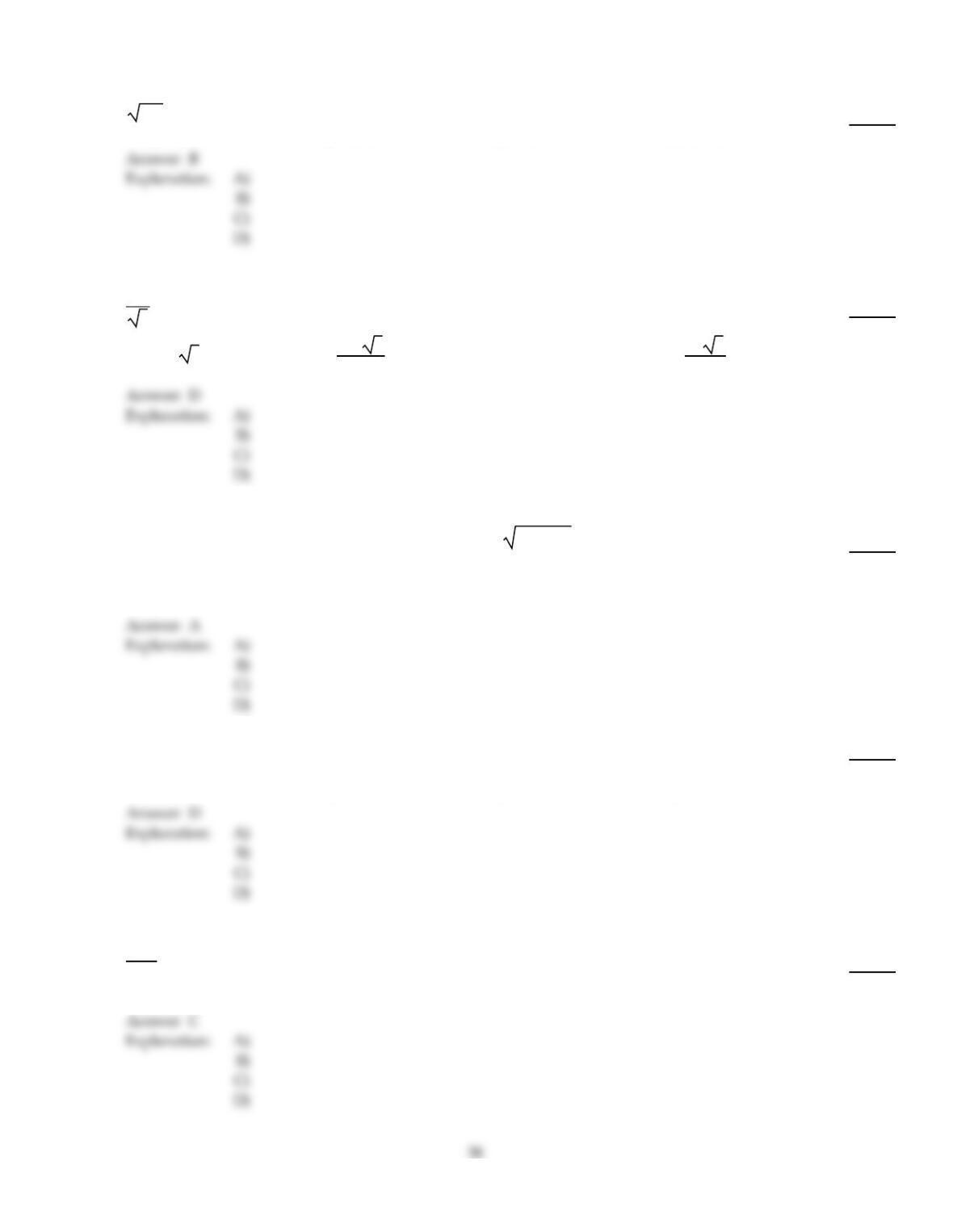
Use a calculator to approximate the root to the nearest thousandth.
171)
3–88
171)
A)
–4.452
B)
–4.448
C)
–4.457
D)
–4.444
Rationalize the denominator. Assume that all variables represent positive real numbers.
172)
7z
3
172)
A)
7z 3
B)
49z 3
3
C)
16
D)
7z 3
3
Solve the problem.
173)
The length of the diagonal of a rectangle is given by D =L2+W2 where L and W are the length
and width of the rectangle. What is the length of the diagonal, D, of a rectangle that is 75 inches
long and 47 inches wide? Round your answer to the nearest tenth of an inch, if necessary.
173)
A)
88.5 in.
B)
58.4 in.
C)
11 in.
D)
59.4 in.
174)
The cost of manufacturing clocks is given by c =25(n +9)1/2, where c is the cost in dollars and n is
the number produced. What is the cost when no clocks are produced?
174)
A)
$15
B)
$25
C)
$225
D)
$75
Perform the indicated operation. Give answer in standard form.
175)
9+ i
1 – i
175)
A)
5+5i
B)
4+10i
C)
4+5i
D)
4+4i
Simplify. Assume that all variables represent positive real numbers.
176)
5 7 + 8 175
176)
A)
45 7
B)
13 7
C)
–45 7
D)
35 7
D)
Simplify the expression involving rational exponents.
177)
–49
4
1/2
177)
A)
Not a real number
B)
–49
8
C)
2
7
D)
–7
2
D)
Rewrite the expressions with rational exponents as radical expressions, and then solve the equation.
178)
(x2– 3)1/2 –(x + 3)1/2 = 0
178)
A)
{2, 3}
B)
{–3, 3}
C)
{–3}
D)
{–2, 3}
D)
Express the radical in simplified form. Assume that all variables represent positive real numbers.
179)
3
–27a8b5
179)
A)
3ab 3a2b2
B)
3ab 3a3b3
C)
33a2b2
D)
–3a2b3a2b2
D)
Simplify the expression involving rational exponents.
180)
9
64
–1/2
180)
A)
3
8
B)
9
128
C)
Not a real number
D)
8
3
Rewrite the expressions with rational exponents as radical expressions, and then solve the equation.
181)
(2x + 5)1/2 –(x – 2)1/2 = 3
181)
A)
{2, 38}
B)
{2}
C)
{–2}
D)
{3, 8}
Write with radicals. Assume that all variables represent positive real numbers.
182)
(mn)1/7
182)
A)
1
7mn
B)
(mn)–7
C)
(mn)7
D)
7mn
Express the radical in simplified form.
183)
480
183)
A)
8
B)
542
C)
245
D)
2
Solve the equation.
184)
2x + 15 – x = 6
184)
A)
{–3}
B)
C)
{–7}
D)
{–7, –3}
Multiply.
185)
(6 – 4i)(2+ 8i)
185)
A)
–32i2+ 40i + 12
B)
44 + 40i
C)
44 – 40i
D)
–20 – 56i
B
Find the distance between the pair of points.
186)
(–1, –2) and (1, –6)
186)
A)
2 5
B)
2 3
C)
6
D)
18
A
Graph the function and give its domain and its range.
187)
f(x) =x + 3
187)
A)
[0, ); [3, )
B)
[3, ); [0, )
41
A
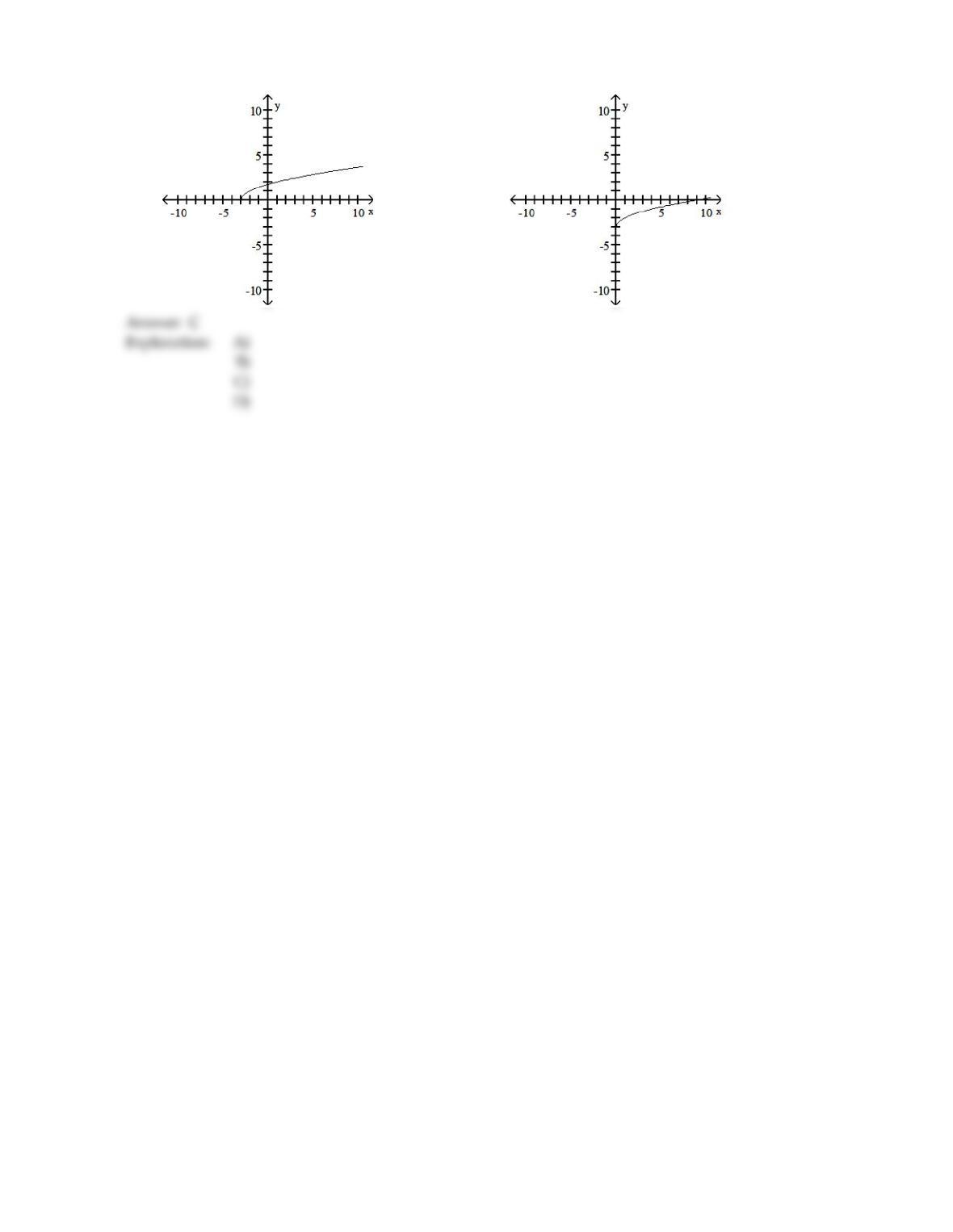
C)
[–3, ); [0, )
D)
[0, ); [–3, )
42
Answer Key
Testname: C10
43
Answer Key
Testname: C10
Answer Key
Testname: C10
Answer Key
Testname: C10

Answer Key
Testname: C10