157. An impairment loss on all intangibles that do not require amortization, except goodwill, arises when
158. An impairment loss on a trademark arises when
159. An impairment loss on a brand name arises when
160. The economic value of a tangible asset may decline below its book value but an impairment loss would not
be recognized when the
161. The economic value of a building may decline below its book value but an impairment loss would not be
recognized when the
162. U.S. GAAP
163. The Allen Company has decided to construct its own warehouse facility. The construction will be partially
financed through a construction loan and the remainder will be financed from internally generated funds. The
company’s accountants have collected the following information concerning the construction.
Average Balance
Construction
Other
Year
Construction Account
Debt @ 14%
Debt @ 10%
1
$1,000,000
$1,000,000
$1,500,000
2
$2,000,000
$1,700,000
$1,700,000
3
$2,500,000
$2,000,000
$1,300,000
Required:
Determine the amount, if any, of capitalized interest cost for each year.
a.
Year 1
b.
Year 2
c.
Year 3
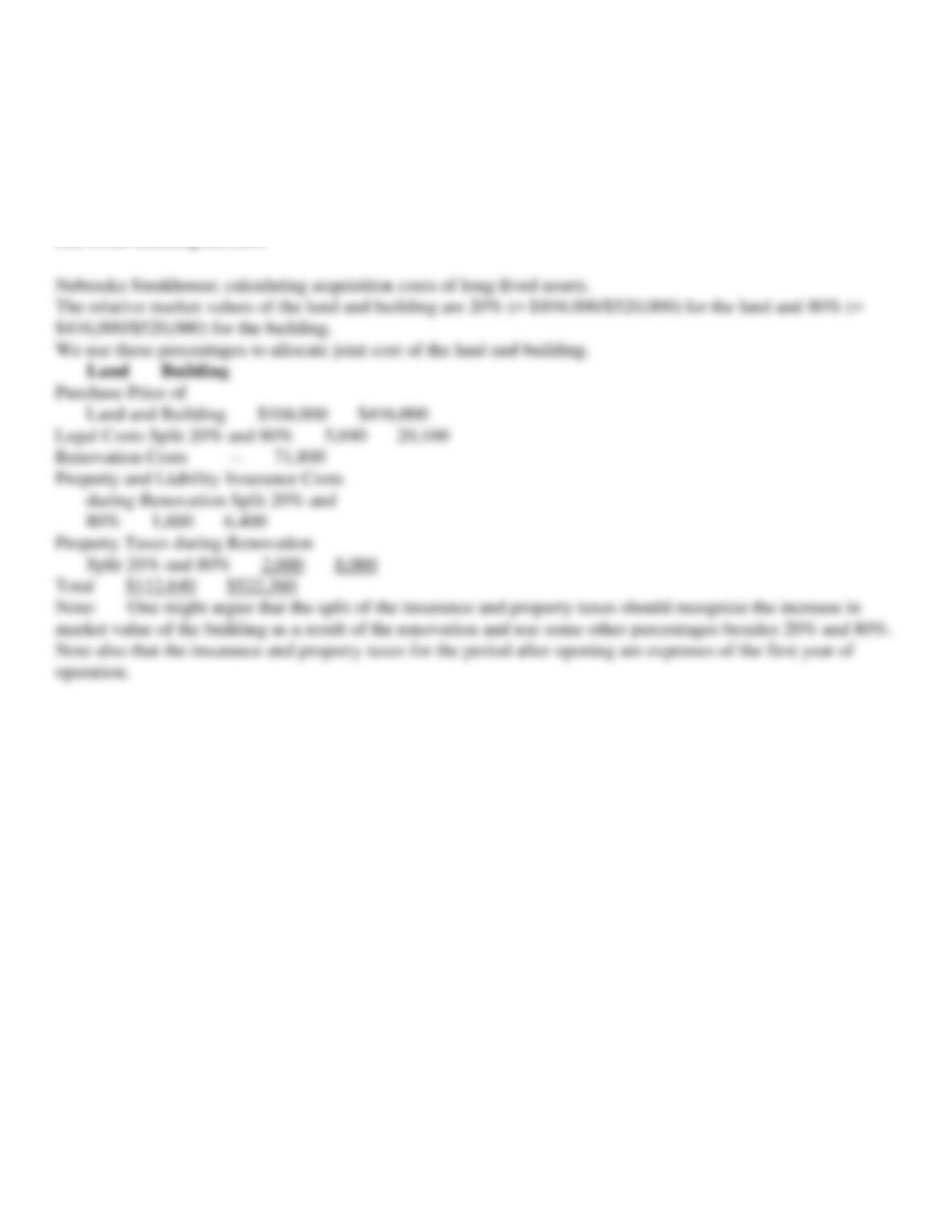
164. Nebraska Steakhouse opened a new restaurant on the site of an existing building. It paid the owner
$520,000 for the land and building, of which it attributes $104,000 to the land and $416,000 to the building.
Nebraska incurred legal costs of $25,200 to conduct a title search and prepare the necessary legal documents for
the purchase. It then paid $71,800 to renovate the building to make it suitable for Nebraska’s use. Property and
liability insurance on the land and building for the first year was $24,000, of which $8,000 applied to the period
during renovation and $16,000 applied to the period after opening. Property taxes on the land and building for
the first year totaled $30,000, of which $10,000 applied to the period during renovation and $20,000 applied to
the period after opening. Calculate the amounts that Nebraska Steakhouse should include in the Land account
and in the Building account.
165. An engineering firm has decided to construct its own office building. The construction will be partially
financed through a construction loan and any remainder will be financed from internally generated funds. The
internal accountants have collected the following information concerning the construction.
Average Balance
Construction
Other
Year
Construction Account
Debt @ 10%
Debt @ 12%
1
$1,000,000
$1,000,000
$500,000
2
$1,500,000
$1,000,000
$250,000
3
$2,000,000
$ 800,000
$200,000
Required:
Determine the amount, if any, of capitalized interest cost for each year.
a.
Year 1
b.
Year 2
c.
Year 3
166. The Barker Company purchased equipment in Year 1 at a cost of $26,000. The equipment was estimated to
last for 8 years and have a salvage value of $2,000. In Year 5, it was determined that the life of the equipment
was really 12 years, and the salvage value was expected to remain unchanged. What amount of depreciation
was recorded for the equipment for years 1 through 12? The firm uses the straight-line method of depreciation.
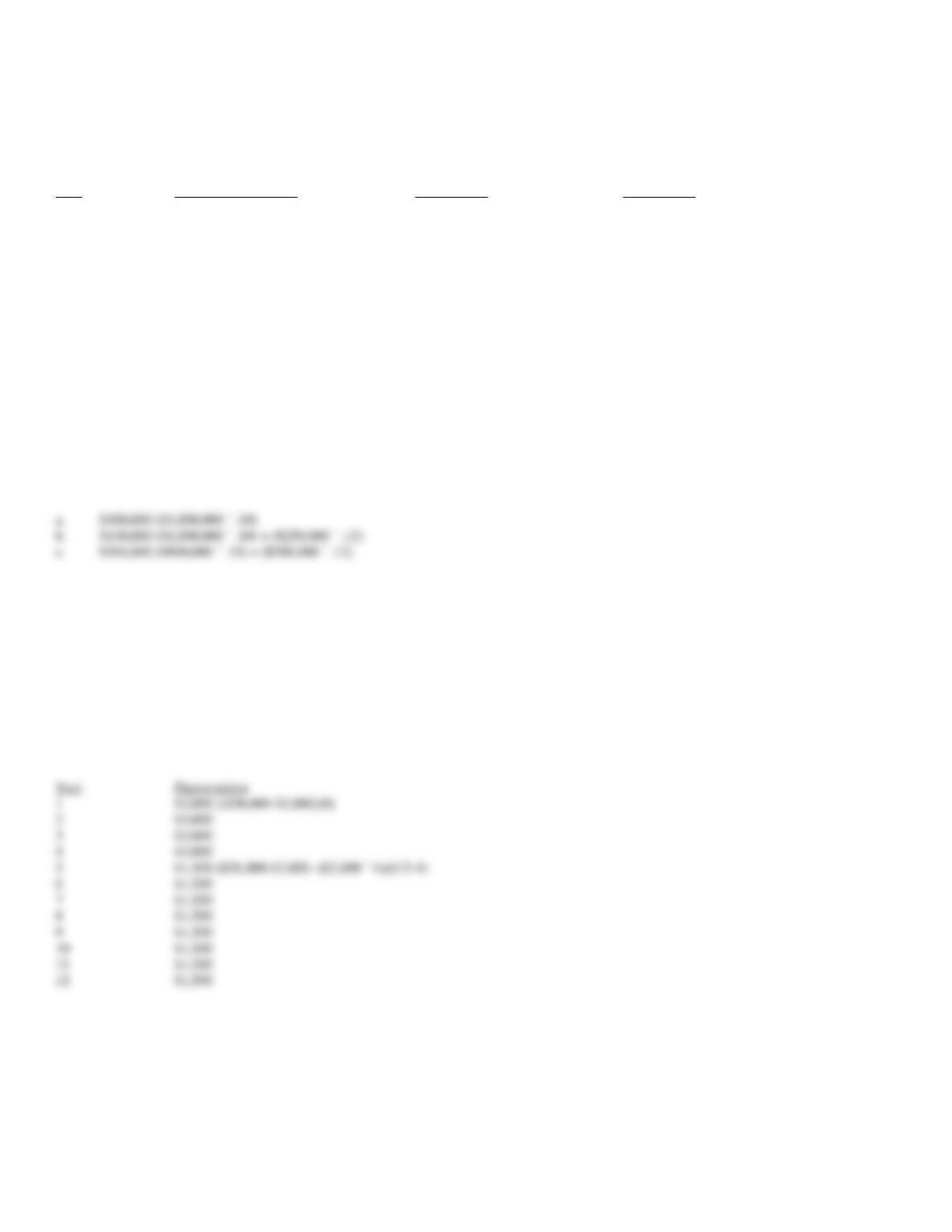
1
$3,000 [($26,000-$2,000)/8]
2
$3,000
3
$3,000
4
$3,000
5
$1,500 ($26,000-$2,000- ($3,000 ´ 4))/(12-4)
6
$1,500
7
$1,500
8
$1,500
9
$1,500
10
$1,500
11
$1,500
$1,500
a.
$100,000 ($1,000,000 ´ .10)
b.
$130,000 ($1,000,000 ´ .10) + ($250,000 ´ .12)
c.
$104,000 ($800,000 ´ .10) + ($200,000 ´ .12)
167. Genesis acquires a machine for $177,600. It expects the machine to last six years and to operate for 30,000
hours during that time. Estimated salvage value is $9,600 at the end of the machine’s useful life. Calculate the
depreciation charge for each of the first three years using each of the following methods:
a. The straight-line (time) method.
b. The straight-line (use) method, with the following operating times: first year, 4,500 hours; second year,
5,000 hours; third year, 5,500 hours.
Genesis calculations for various depreciation methods.
Year 1 Year 2 Year 3
a. Straight-Line (Time) Method $28,000 $28,000 $28,000
($177,600 – $9,600)/6 = $28,000.
b. Straight-Line (Use) Method $25,200 $28,000 $30,800
($177,600 – $9,600)/30,000 = $5.60 per hour.
168. On January 1, Year 1, Young Company purchased a machine for $6,000. It had an estimated salvage value
of $1,200 and a life of six years. The straight-line method of depreciation was used. At midyear in Year 4,
Young sold the machine for $4,500 cash.
Required:
a.
What is the book value of the machine at the time of the sale?
b.
Give the journal entry to record the sale of the machine.
a.
($6,000 – $1,200) / 6 = $800 yearly depreciation
b.
Cash
4,500
Accumulated Depreciation
2,800
Gain on Retirement of Equipment
1,300
169. Describe several issues in the accounting for long-lived assets.
Long-lived assets include both tangible assets, such as land, buildings, and equipment, and intangible assets,
such as patents, brand names, trademarks, customer lists, airport landing rights, and franchise rights. Long-lived
financial assets also include investments in securities. Both U.S. GAAP and IFRS provide guidance in the
following areas of the accounting for long-lived tangible and intangible assets:
170. Discuss the treatment of expenditures as assets versus immediate expenses.
TREATMENT OF EXPENDITURES AS ASSETS VERSUS AS IMMEDIATE EXPENSES
171. When a firm constructs its own buildings or equipment, what costs are capitalized?
Self-Constructed Asset
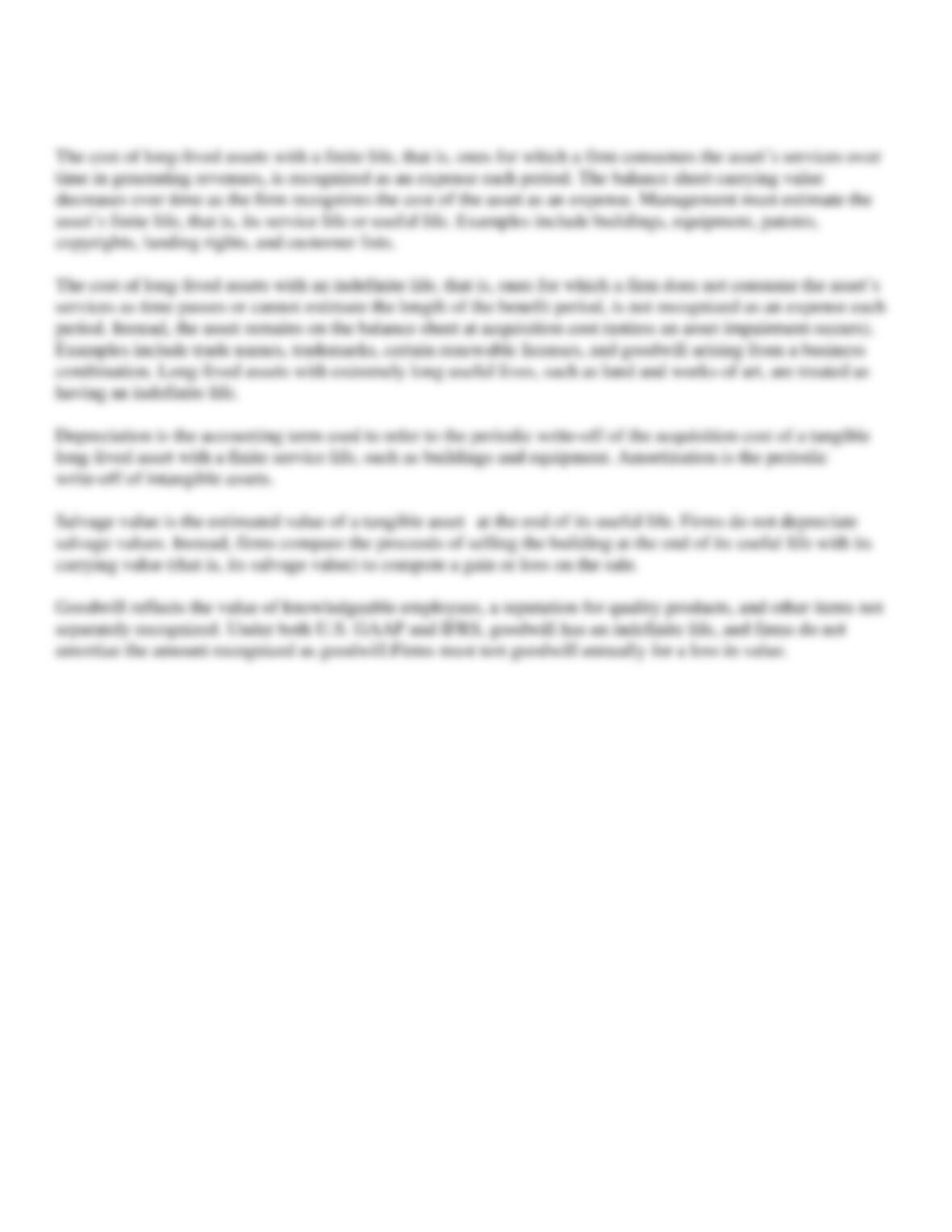
172. How is the acquisition cost treated over the life of tangible and intangible assets?
TREATMENT OF ACQUISITION COST OVER LIFE OF ASSET
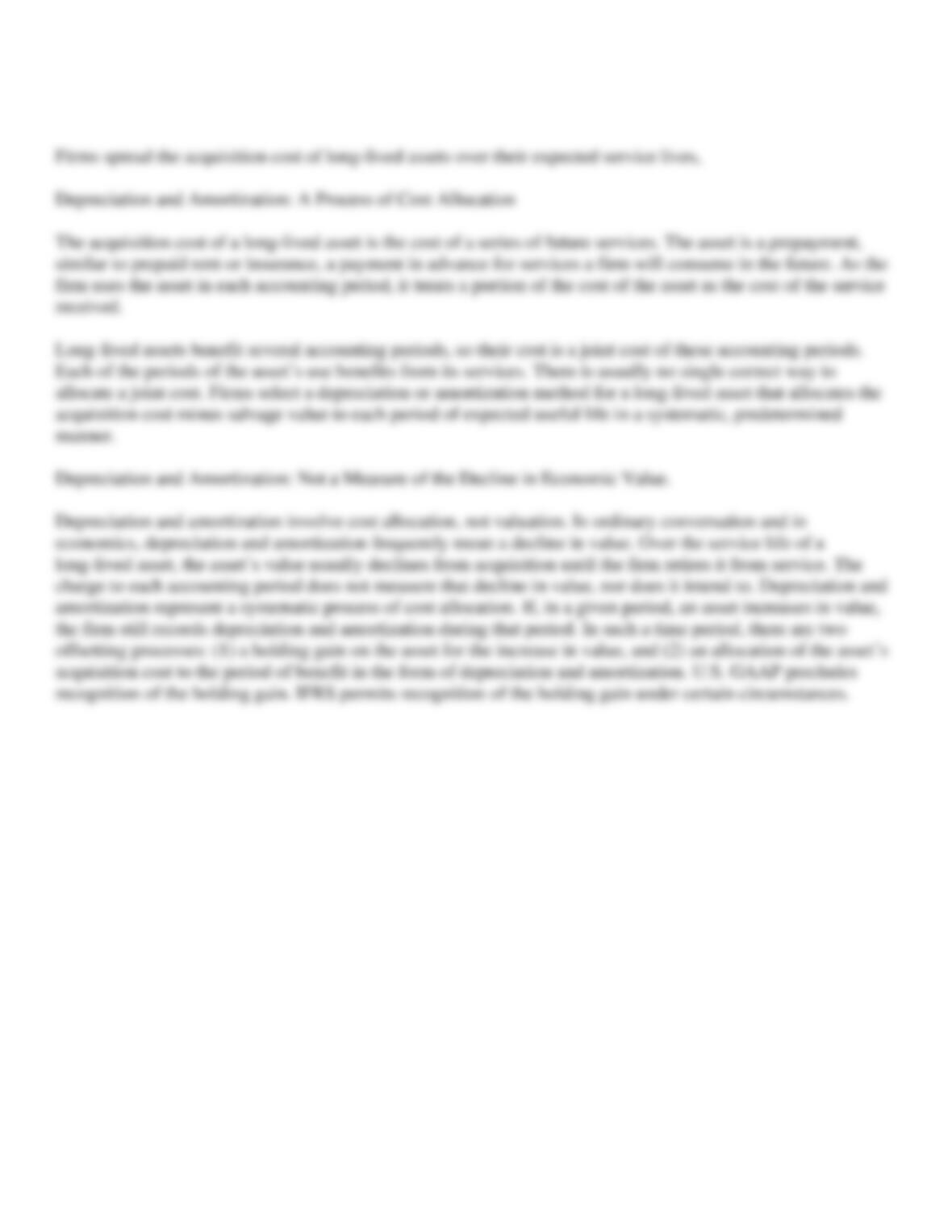
173. Discuss the concepts of depreciation and amortization.
FUNDAMENTAL CONCEPTS OF DEPRECIATION AND AMORTIZATION
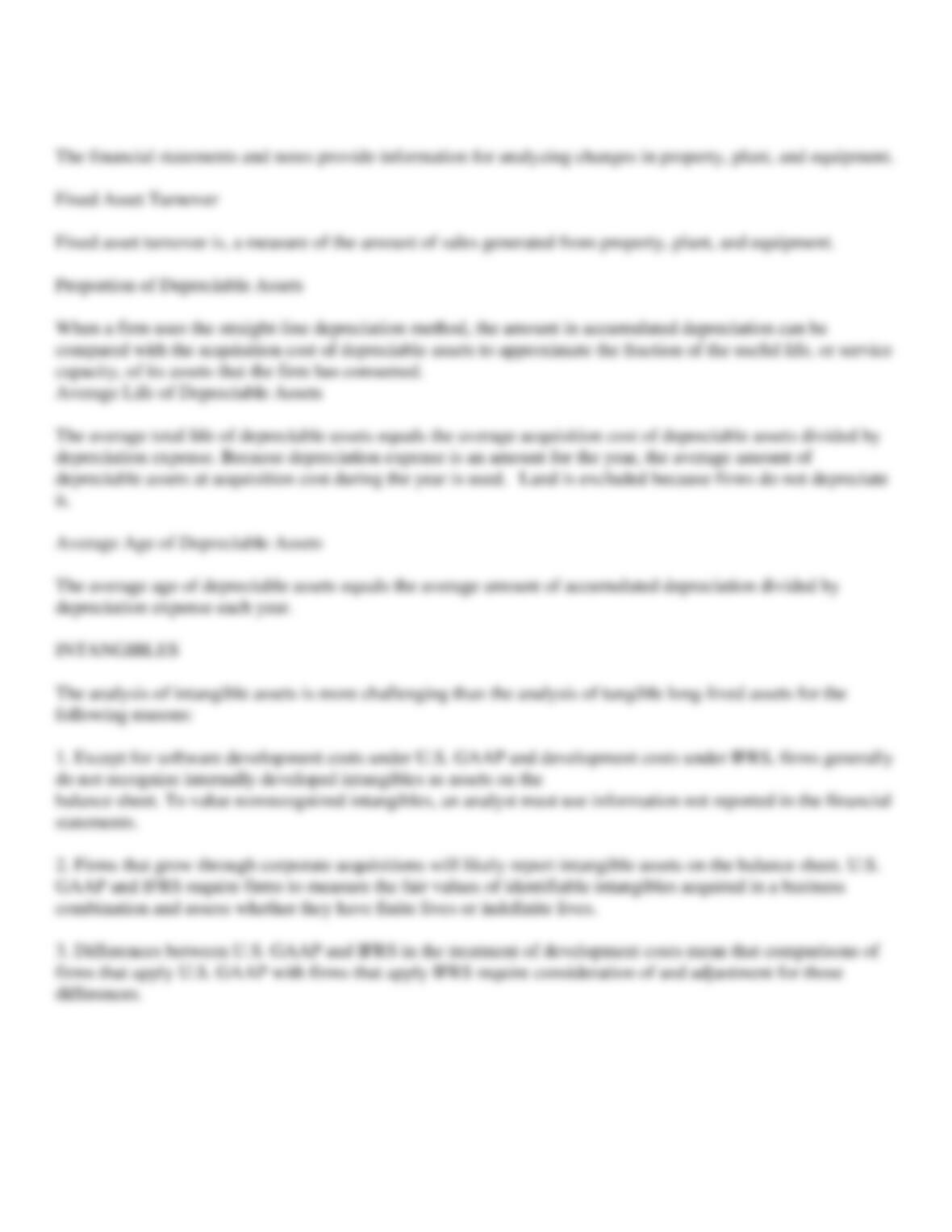
174. How are long-lived assets analyzed?
PROPERTY, PLANT, AND EQUIPMENT
175. Describe the depreciation and amortization methods used in accounting.