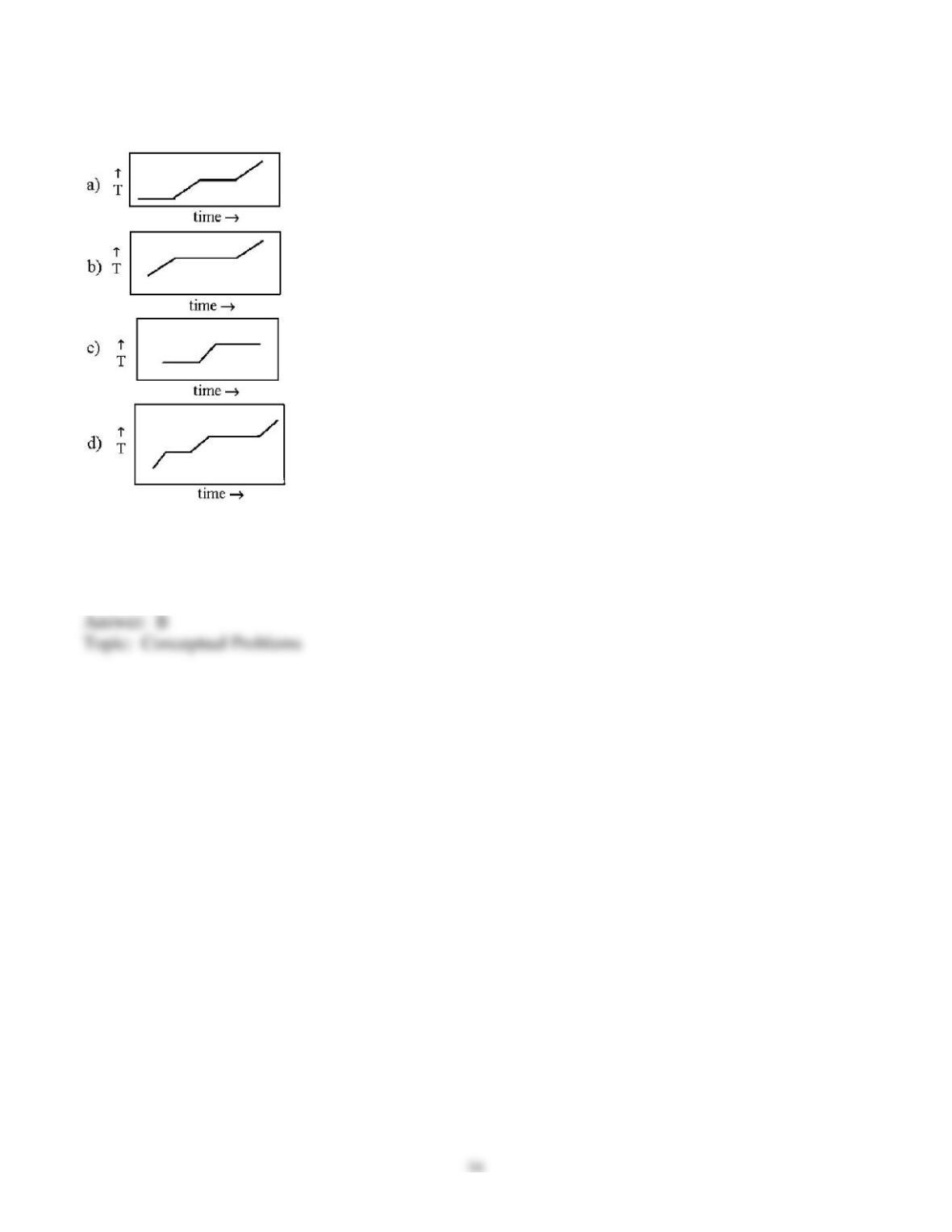
125) Consider a compound that undergoes sublimation at 125°C and a pressure of one atm. Which of the
following could be a heating curve appropriate for heating the compound from 100°C to 150°C?
A) graph a
B) graph b
C) graph c
D) graph d
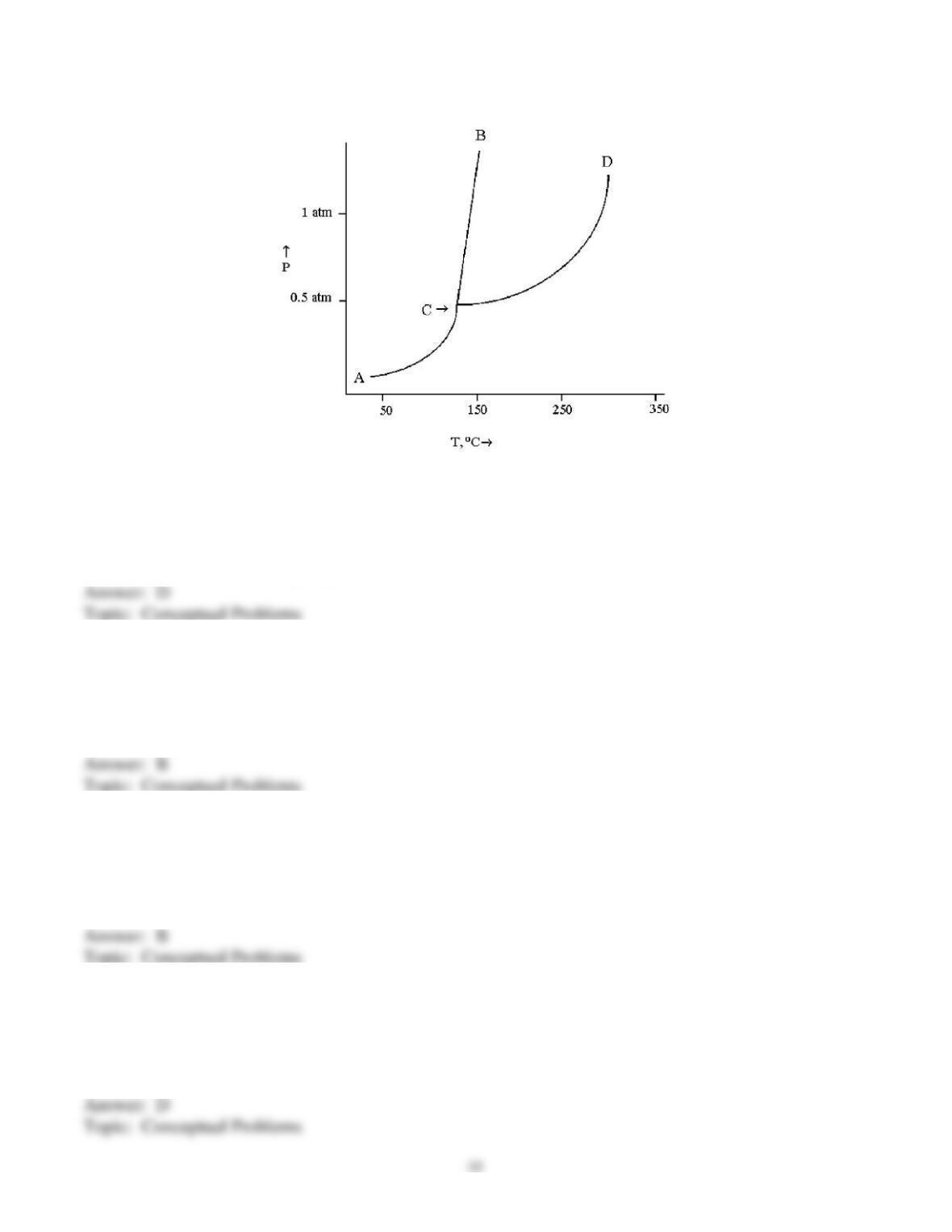
Use the diagram below to answer the following questions.
126) According to the diagram, the solid phase of this substance
A) has the same density as the liquid phase.
B) is less dense than water.
C) is less dense than the liquid phase.
D) is more dense than the liquid phase.
127) Melting occurs along the
A) AC line.
B) CB line.
C) CD line.
D) All of these
128) The solid and liquid phases can exist in equilibrium along line
A) AC.
B) CB.
C) CD.
D) BD.
129) The temperature and pressure at which all three phases can coexist in equilibrium is
A) 0.25 atm and 110°C.
B) 1.0 atm and 140°C.
C) 1.25 atm and 300°C.
D) 0.45 atm and 130°C.
130) From the phase diagram above, the minimum pressure at which this substance can exist in the
liquid phase is
A) 0.25 atm.
B) 0.45 atm.
C) 1.0 atm.
D) 1.2 atm.
131) The normal boiling point of this substance is approximately
A) 25°C.
B) 140°C.
C) 300°C.
D) 350°C.
132) What phases can be present at 200°C and 0.75 atm pressure?
A) only the vapor phase
B) only the liquid phase
C) only the solid phase
D) both the solid and vapor phases
133) What phase changes occur when the temperature is held constant at 140°C and the pressure is
increased from 0.25 atm to 1.4 atm?
A) gas → liquid → solid
B) gas → solid → liquid
C) liquid → solid → gas
D) solid → liquid → vapor
134) What phase changes occur when the pressure is held constant at 0.25 atm and the temperature
increases from 100°C to 300°C?
A) liquid → gas
B) solid → gas
C) solid → liquid
D) solid → liquid → gas
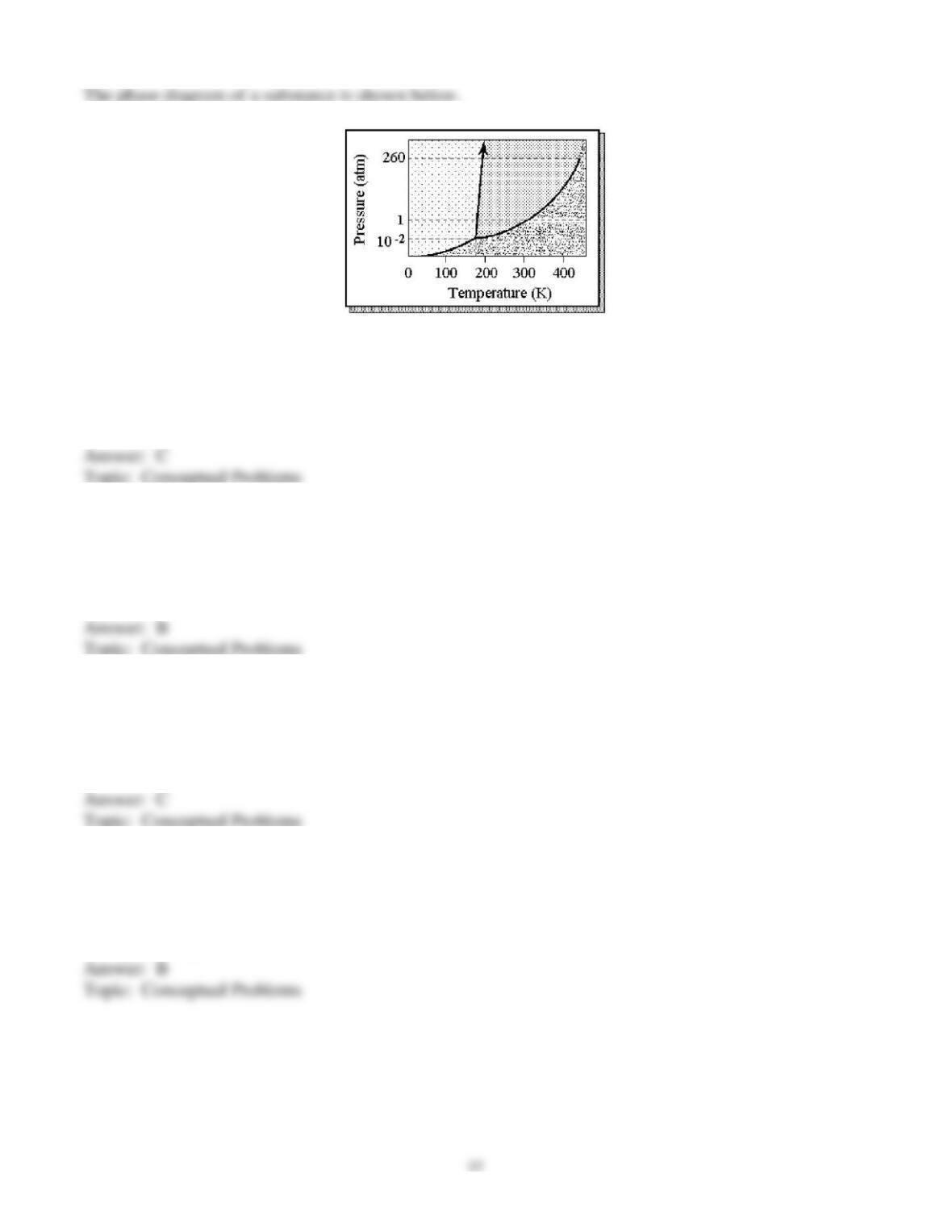
135) The approximate normal boiling point of this substance is
A) 180 K.
B) 190 K.
C) 300 K.
D) 430 K.
136) The approximate normal melting point of this substance is
A) 100 K.
B) 190 K.
C) 300 K.
D) 430 K.
137) What is the physical phase of the substance at T = 100 K and P = 0.1 atm?
A) gas
B) liquid
C) solid
D) supercritical fluid
138) What is the physical phase of the substance at T = 225 K and P = 1.1 atm?
A) gas
B) liquid
C) solid
D) supercritical fluid
139) What is the physical phase of the substance at T = 400 K and P = 2.0 atm?
A) gas
B) liquid
C) solid
D) supercritical fluid
1) Which covalent bond is the most polar?
A) N- F
B) C- F
C) Cl- F
D) F- F
2) Which of the following should have the largest dipole moment?
A) F2(g)
B) BCl3(g)
C) KBr(g)
D) CH3I(g)
3) Which of the following molecules does not have a dipole moment?
A) C2H2
B) H2O
C) CH3CH2OH
D) H I
4) Which has the smallest dipole-dipole forces?
A) CH3Cl
B) HBr
C) O2
D) NO
5) Which is expected to have the largest dispersion forces?
A) C3H8
B) C12H26
C) F2
D) Be Cl2
6) Which of the following compounds exhibits hydrogen bonding?
A) CH3Cl
B) HI
C) CH3OCH3
D) NH3
7) Which of the following compounds has the highest boiling point?
A) H2O
B) H Cl
C) H2S
D) N H3
8) In liquid propanol, CH3CH2CH2OH, which intermolecular forces are present?
A) Dispersion, hydrogen bonding and dipole-dipole forces are present.
B) Only dipole-dipole and ion-dipole forces are present.
C) Only dispersion and dipole-dipole forces are present.
D) Only hydrogen bonding forces are present.
9) Which of the following compounds exhibits only dispersion and dipole-dipole intermolecular
interactions?
A) H2
B) HI
C) CO2
D) CH3NH2
10) The normal boiling point for H2Te is higher than the normal boiling point for H2Se . This can be
explained by
A) larger dipole-dipole forces for H2Te .
B) larger dispersion forces for H2Te .
C) larger hydrogen-bond forces for H2Te .
D) larger dipole-dipole forces, larger dispersion forces, and larger hydrogen-bond forces for H2Te .
11) Ethyl chloride, C2H5Cl, is used as a local anesthetic. It works by cooling tissue as it vaporizes; its
heat of vaporization is 26.4 kJ/mol. How much heat could be removed by 20.0 g of ethyl chloride?
A) 8.18 kJ
B) 341 kJ
C) 528 kJ
D) 3410 kJ
12) How much heat is released when 105 g of steam at 100.0°C is cooled to ice at -15.0°C? The
enthalpy of vaporization of water is 40.67 kJ/mol, the enthalpy of fusion for water is 6.01 kJ/mol, the
molar heat capacity of liquid water is 75.4 J/(mol ∙ °C), and the molar heat capacity of ice is 36.4 J/(mol
∙ °C).
A) 54.8 kJ
B) 273 kJ
C) 319 kJ
D) 347 kJ
13) Which of the following forms a molecular solid?
A) NH4NO3
B) C6H4Cl2
C) SiO2
D) copper
14) Which of the following forms an ionic solid?
A) Ag
B) C7H15NH2
C) Rb I
D) S O3
15) Which type of bonding does Sr form upon solidification?
A) covalent network
B) ionic
C) metallic
D) molecular
16) What is the edge length of a face-centered cubic unit cell made up of atoms having a radius of 128
pm?
A) 181 pm
B) 362 pm
C) 512 pm
D) 1020 pm
17) Nickel has a face-centered cubic structure and has a density of 8.90 g/cm3. What is its atomic
radius?
A) 125 pm
B) 249 pm
C) 353 pm
D) 997 pm
18) A certain metal crystallizes in a face-centered cubic structure. What is the edge length of the unit
cell if the atomic radius of the metal is 144 pm?
A) 204 pm
B) 288 pm
C) 333 pm
D) 407 pm
19) Cesium has a radius of 272 pm and crystallizes in a body-centered cubic structure. What is the edge
length of the unit cell?
A) 314 pm
B) 385 pm
C) 544 pm
D) 628 pm
20) Lithium crystallizes in a body-centered cubic structure. What is the coordination number of each
atom?
A) 4
B) 6
C) 8
D) 12
21) Na Cl crystallizes in a cubic unit cell with Cl– ions on each corner and each face. How many Na+
and Cl– ions are in each unit cell of Na Cl?
A) 1 Na+ ion and 1 Cl– ion
B) 2 Na+ ions and 2 Cl– ions
C) 4 Na+ ions and 4 Cl– ions
D) 8 Na+ ions and 8 Cl– ions
22) How many H– ions are around each Na+ ion in NaH, which has a cubic unit cell with H– ions on
each corner and each face?
A) 1
B) 4
C) 6
D) 8
10.3 Short Answer Questions
1) The bonds in the polyatomic ion NO3– are classified as ________.
2) In the molecule BF3 there is a δ+ charge on the ________ atom and a δ– charge on the ________
atom.
Answer: boron, fluorine
Topic: Section 10.1 Polar Covalent Bonds and Dipole Moments
3) LiH has an experimental dipole moment, μ = 6.00 D. If LiH were 100% ionic, the distance between
positive and negative charges would be 161 pm. What is the percent ionic character in the LiH bond?
4) The Br-Cl bond has 5.05% ionic character and a dipole moment of 0.518 D. What is the distance
between atoms in BrCl?
5) The HBr bond has a length of 141 pm and 12.1% ionic character. What is the dipole moment of HBr?
6) Pt(NH3)2Cl2 is square planar. The isomer of Pt(NH3)2Cl2 that has a non-zero dipole moment has a
Cl–Pt–Cl bond angle of ________ degrees.
7) The intermolecular forces formed when NaCl is dissolved in water are ________ forces.
8) The intermolecular forces responsible for CH3CH2OH being at liquid at 20°C are ________ bonds.
9) Helium can be liquefied when He atoms are attracted to one another by intermolecular ________
forces.
10) The property of a liquid that is a measure of the liquid’s resistance to increase its surface area is
________.
11) Of C2H5OH and C3H5(OH)3 the one expected to have the higher viscosity is ________, and the
one expected to have the higher surface tension is ________.
12) The phase change H2(g) → H2(s) is called ________, and the enthalpy change, ΔH, for this phase
change has a ________ sign.
13) Of C2H5OH and C3H5(OH)3 the one expected to have the higher vapor pressure is ________, and
the one expected to have the higher boiling point is ________.
14) The solids formed by K, K2O2, SiO2, and O2 are classified as ________, ________, ________, and
________, respectively.
15) Rubber is classified as an ________ solid, whereas diamond is classified as a ________ solid.
16) A low-melting crystalline compound that does not conduct electricity in the solid or liquid state is
classified as a ________ solid.
17) First-order diffraction of X-rays with d = 154.2 pm at an angle of 32.5° is caused by layers of atoms
in a crystalline solid with a spacing of ________ pm.
18) Layers of atoms having a spacing of 105 pm will diffract X-rays with d = 154.2 pm at an angle of
________ degrees.
19) The cubic closest-packed arrangement of atoms is the same as which cubic unit cell?
20) The two most efficiently packed unit cells have the hexagonal closest-packed and the ________ the
atomic arrangements.
21) The coordination number of each atom in a simple cubic unit cell is ________.
22) The cubic unit cell in which the radius of an atom is 31/2 d/4, where d is the unit cell edge length, is
the ________ unit cell.
23) A certain metal can exist in two different cubic cells, body-centered cubic and face-centered cubic.
Which unit cell will have the greater density?
24) Ni has a face-centered unit cell. The number of Ni atoms in the unit cell is ________.

25) A compound having A ions on each corner and B ions on each face of a cubic unit cell has the
empirical formula ________.