Solve the problem.
128)
A large boulder is placed in a river to help divert the water. Suppose the rate at which the boulder
erodes is proportional to the product of its current size and the difference between its original size,
B, and 3 times its current size. Give a differential equation that is satisfied by f(t), the height at time
t.
128)
A)
y= kBy(–3y)
B)
y= ky(3y – B)
C)
y=3ky(B – y)
D)
y= ky(B –3y)
129)
The growth rate of a certain stock is modeled by dV
dt = k(45 – V), V = $23 when t = 0, where V = the
value of the stock, per share, after time t (in months), and k = a constant. Find the solution to the
differential equation in terms of t and k.
129)
A)
V =45 –45e–kt
B)
V =45 –22e–kt
C)
V =45 –22ekt
D)
V =23 –22e–kt
130)
A tank contains 2000 L of a solution consisting of 50 kg of salt dissolved in water. Pure water is
pumped into the tank at the rate of 10L/s, and the mixture (kept uniform by stirring) is pumped out
at the same rate. How long will it be until only 5 kg of salt remain in the tank?
130)
A)
approximately 460 seconds
B)
approximately 703 seconds
C)
approximately 689 seconds
D)
approximately 276 seconds
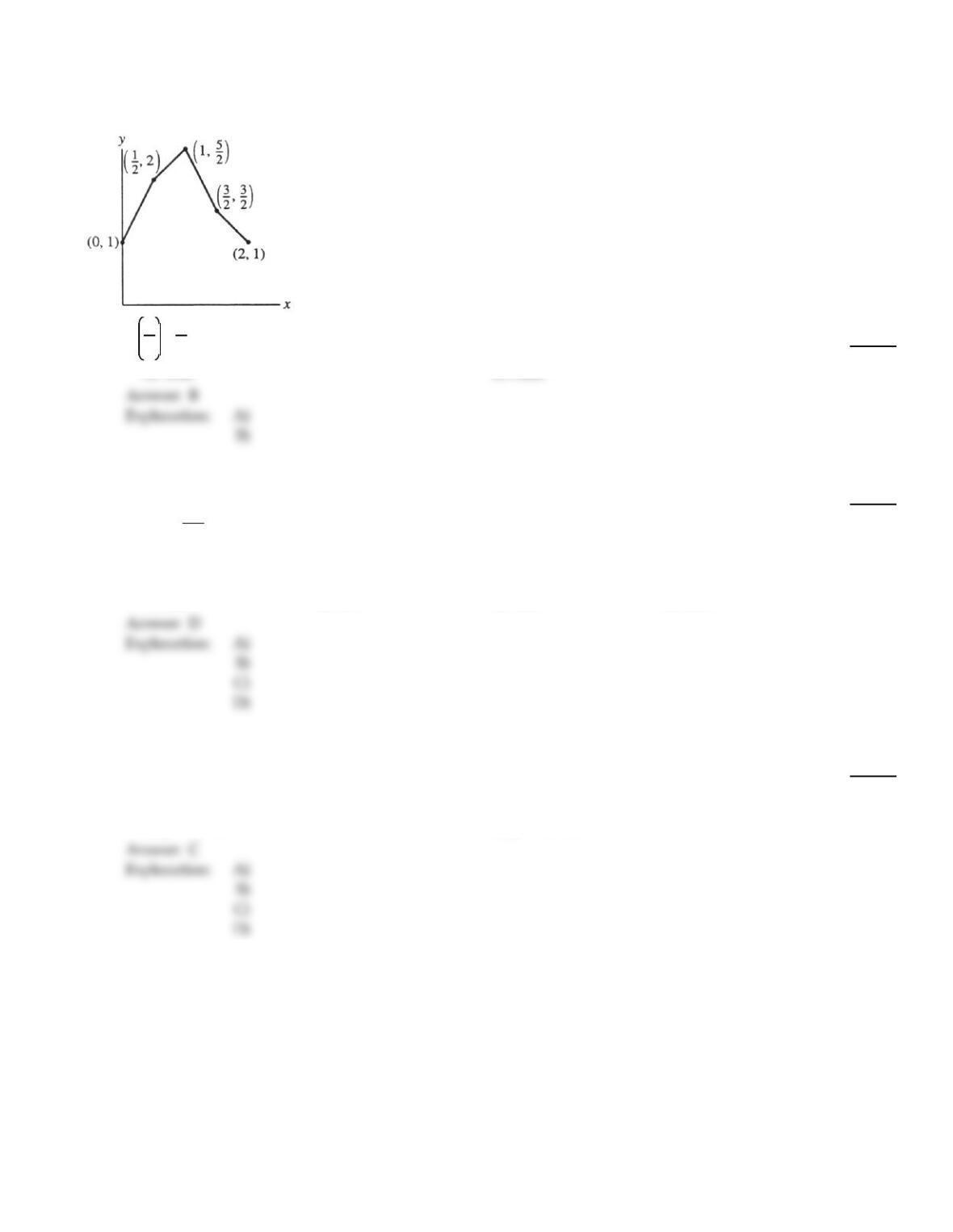
The following is a polygonal path obtained from Euler’s method with n = 4 to approximate a solution f(t) of a differential
equation. Indicate whether the following statements are true or false:
131)
f3
23
2
131)
A)
True
B)
False
Solve the problem.
132)
The logistic differential equation
dP
dt =0.0006P(1100 – P)
describes the growth of a population P, where t is measured in years.
Find the carrying capacity of the population.
132)
A)
2200
B)
550
C)
0.66
D)
1100
Solve the equation using an integrating factor.
133)
y+t2y = 4t2, t > 0
133)
A)
y = 4x + Ce–t2/2
B)
y = 4 + Ce–t2/2
C)
y = 4 + Ce–t3/3
D)
y = 4x + Ce–t3/3
38
Solve the problem.
134)
A population of algae consists of 5000 algae at time t = 0. Conditions will support at most 600,000
algae. Assume that the rate of growth of algae is proportional both to the number present (in
thousands) and to the difference between 600,000 and the number present (in thousands). Write a
differential equation using 0.01 for the constant of proportionality.
134)
A)
dy/dt = 0.01y(600 – y)
B)
dy/dt =5000y(600 – 0.01y)
C)
dy/dt = 0.01(600 – y)
D)
dy/dt = 0.01y(y –600)
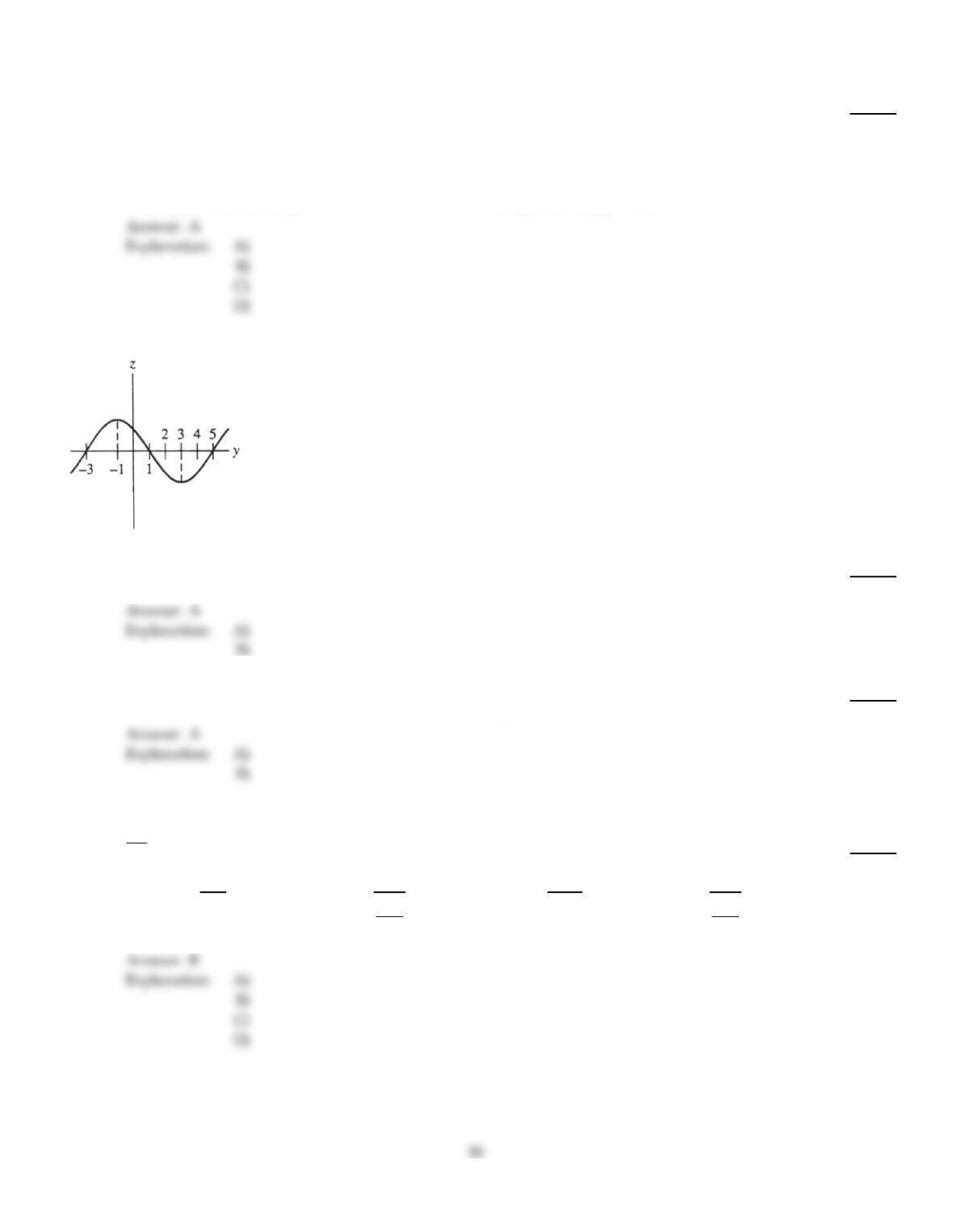
Consider the differential equation y= g(y) where g(y) is the function whose graph is shown below:
Indicate whether the following statements are true or false.
135)
If the initial value of y(0) is 3, then the corresponding solution has an inflection point.
135)
A)
True
B)
False
136)
y = – 3, y = 1, and y = 5 are the constant solutions to y= g(y).
136)
A)
True
B)
False
Find the general solution for the differential equation.
137)
dy
dx =y2e3x
137)
A)
y = – e3x
3+ C
B)
y = – 1
e3x
3
+ C
C)
y = – 1
3e3x + C
D)
y =1
e3x
3
+ C
138)
ydy
dx =x2–6x
138)
A)
y2=2
3x3–6x2+ C
B)
y =1
3x3–6x + C
C)
y =2
3x3–6x2+ C
D)
y2=1
3x3–6x2+ C
Solve the problem.
139)
The logistic differential equation
dN
dt =5N(10 – N)
describes the growth of a population N, where t is measured in years.
Find the intrinsic rate, r.
139)
A)
r =5
B)
r =500
C)
r =50
D)
r =10
C
140)
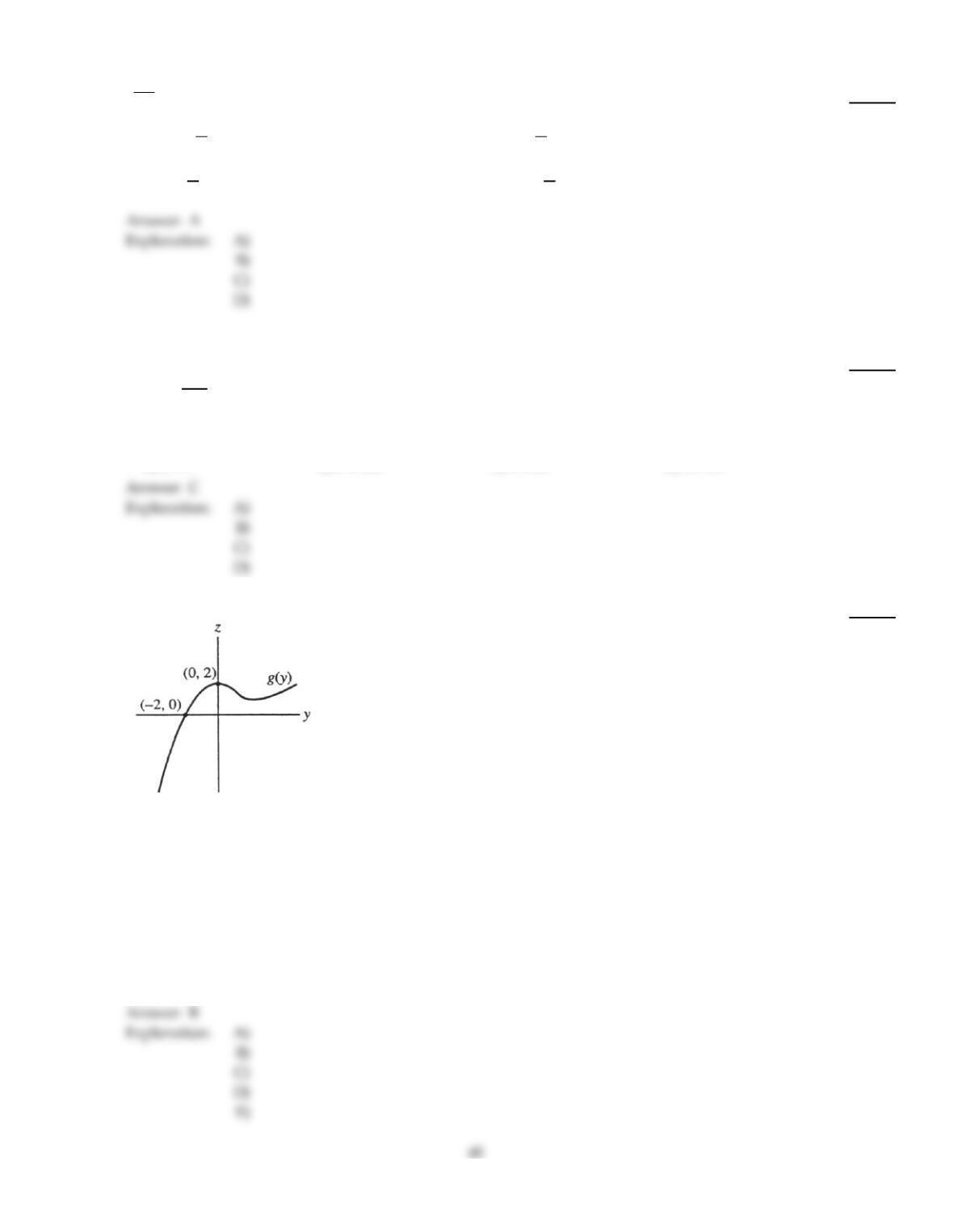
Suppose the following is a graph of z = g(y).
Which of the following can then be said about the solution y = f(t) to the initial value problem
y= g(y); y(0) = – 1?
(I) f(t) is an increasing function
(II) f(t) is always positive
(III) f(t) has an inflection point when y = 2.
140)
A)
I, II, and III
B)
I and III
C)
III only
D)
I only
E)
II only
B
A

Solve the problem.
141)
Write a differential equation that expresses the following description of a rate: When ice cream is
removed from the freezer, it warms up at a rate proportional to the difference between the
temperature of the ice cream and the room temperature of 76°. (Use y for the temperature of the ice
cream, t for the time, and k for an unknown constant.)
141)
A)
y’ = 76t – ky
B)
y’ = k(76 – y)
C)
y’ = k(76 – t)
D)
y’ = 76 – ky
Solve the initial value problem.
142)
y+ ty =5t; y(0) =3
142)
A)
y =5et2/2 – 2
B)
y = – 2et2/2 +5
C)
y = – 2e–t2/2 +5
D)
y =5e–t2/2 – 2
Solve the differential equation with the given initial condition.
143)
dy
dx =6–x4
3y +6; y(0) =3
143)
A)
3
2y2+6y =6x –1
5x5+63
2
B)
3
2y2+6y =6x –1
4x5+ 33
C)
3
2y2+6y =6x –x5+63
2
D)
3
2y2+6y =6x –1
5x5+ 3
Solve the problem.
144)
Suppose an isolated island has a native population of 10,000 and a person from a visiting ship
introduces a disease which has an infection rate of 0.00005. Assume that the rate of spread of the
disease satisfies the following logistic equation:
dy
dt = k 1 –y
Ny,
where N is the size of the population and y is the number infected at time t.
How many individuals are infected after 23 days?
144)
A)
8980
B)
9080
C)
9230
D)
9190
Solve the differential equation with the given initial condition.
145)
y= y + 1, y(0) = 1
145)
A)
y = t + 1
B)
y =et– 2
C)
y = 2et–1
D)
y =t2+ 1
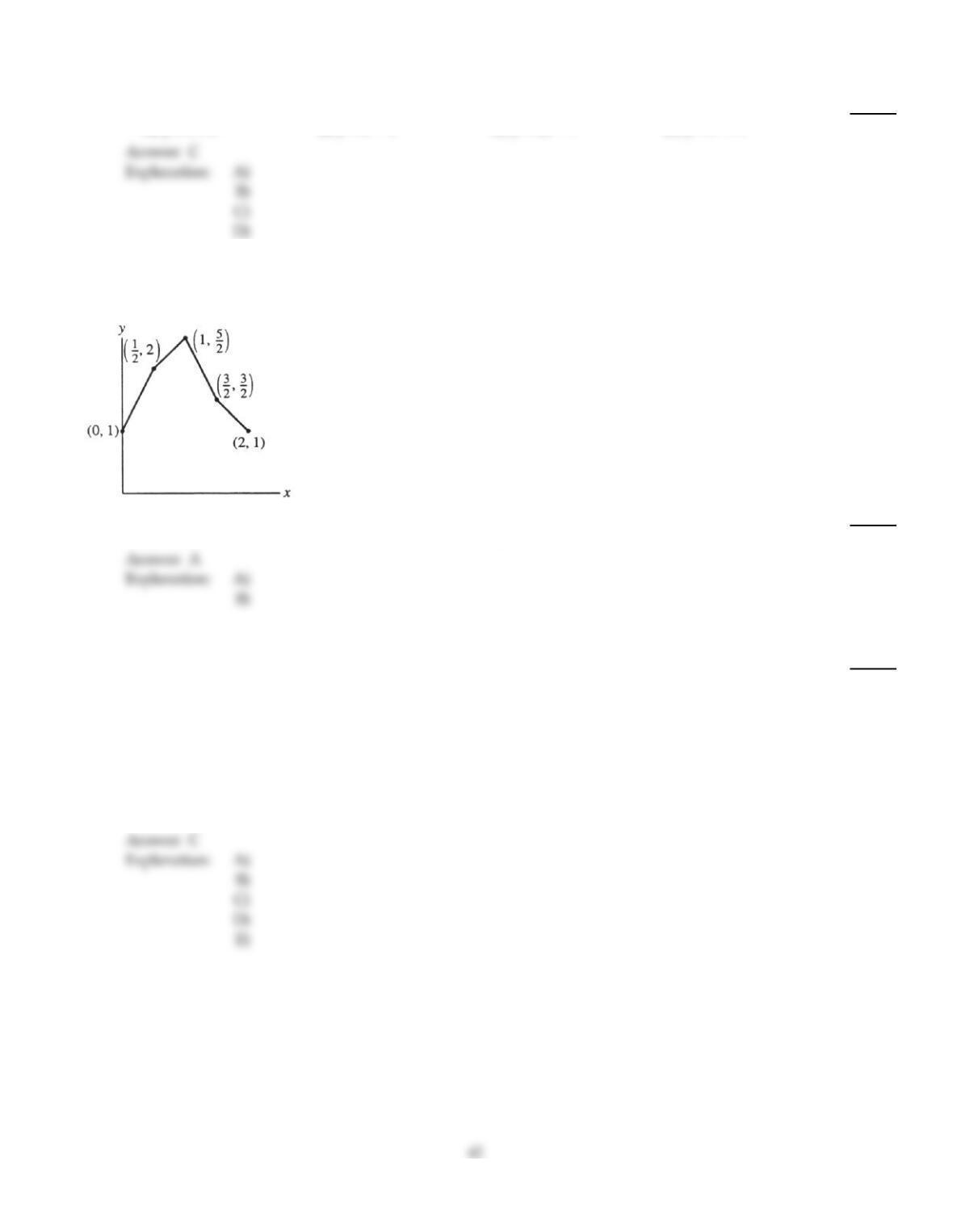
The following is a polygonal path obtained from Euler’s method with n = 4 to approximate a solution f(t) of a differential
equation. Indicate whether the following statements are true or false:
146)
f(0) = 1
146)
A)
True
B)
False
Solve the problem.
147)
Suppose water is seeping from an underground storage facility at a rate that is proportional to the
square amount of water present. If f(t) = y is the amount of water present at time t, find a
differential equation describing the situation.
147)
A)
y=ky2, k > 0; y(0) = 0
B)
y=ky2, k < 0; y(0) =0
C)
y=ky2, k < 0
D)
y=ky2, k > 0
E)
none of these
148)
The logistic differential equation
dP
dt =0.06P(400 – P)
describes the growth of a population P, where t is measured in years.
Find the carrying capacity of the population.
148)
A)
200
B)
400
C)
800
D)
2.4
Solve the differential equation with the given initial condition.
149)
y= y(t – 2); y(0) = 1
149)
A)
y =e[(t2/2) – 2t] – 2t + 1
B)
y =t2
2– 2t
C)
y = 0
D)
y =e[(t2/2) – 2t]
E)
none of these
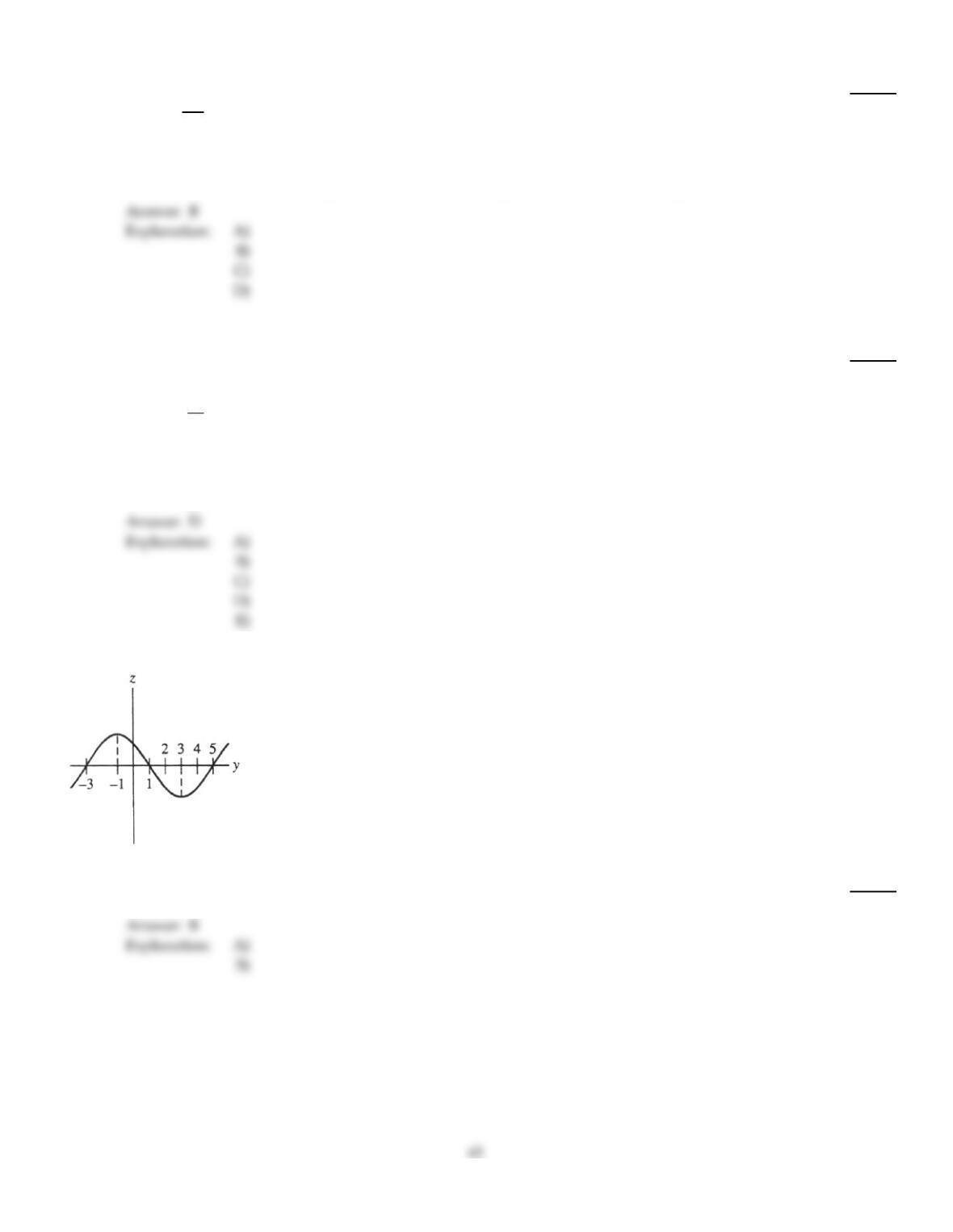
Consider the differential equation y= g(y) where g(y) is the function whose graph is shown below:
Indicate whether the following statements are true or false.
150)
y = 2 is the only constant solution of y= g(y) .
150)
A)
True
B)
False
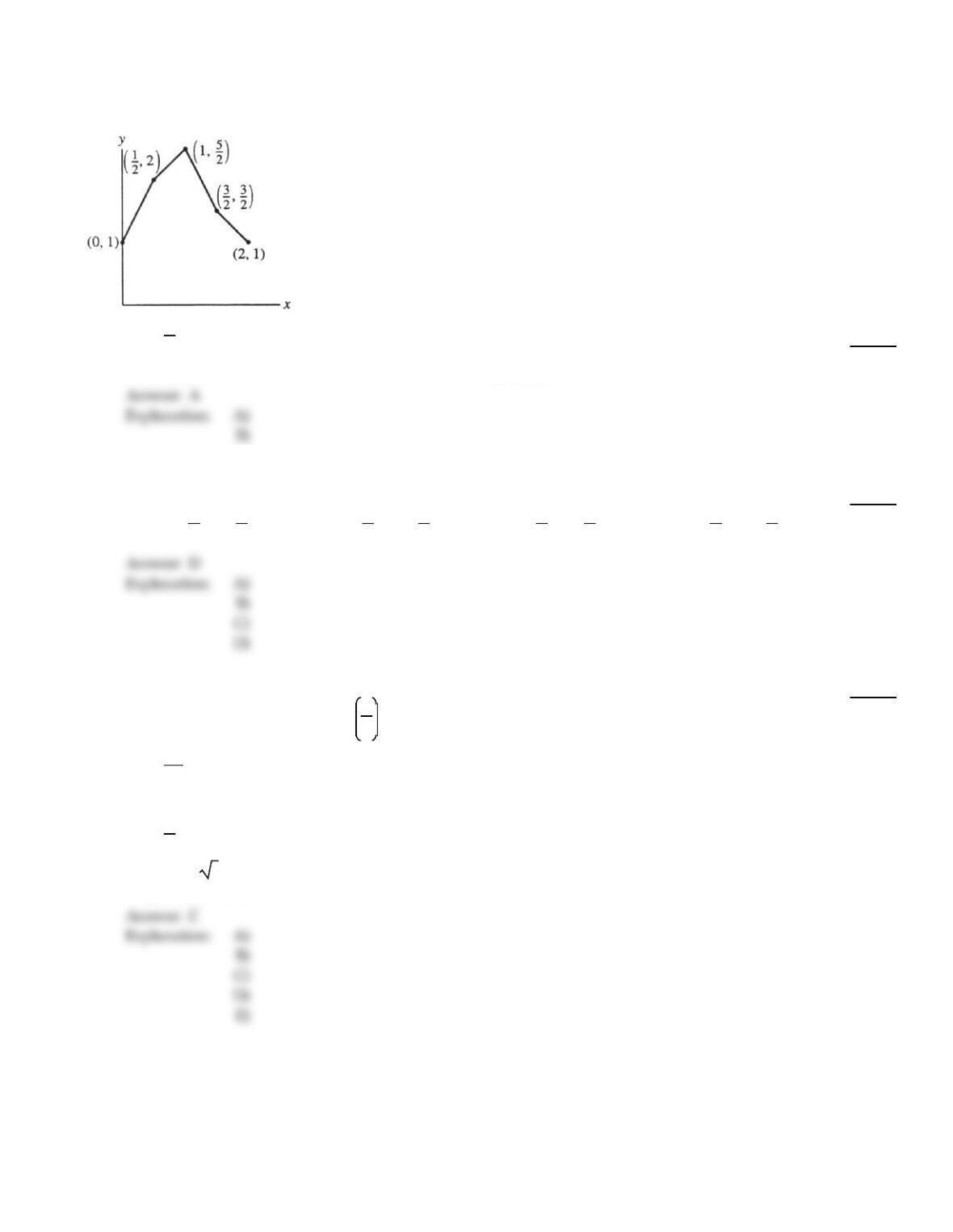
The following is a polygonal path obtained from Euler’s method with n = 4 to approximate a solution f(t) of a differential
equation. Indicate whether the following statements are true or false:
151)
f(1) 5
2
151)
A)
True
B)
False
Solve the initial value problem.
152)
y+9y = 3; y(0) = 1
152)
A)
y =1
3e9t +2
3
B)
y =1
3e–9t +2
3
C)
y =2
3e9t +1
3
D)
y =2
3e–9t +1
3
153)
Let f(t) be the solution of y=y2t + y +et, f(0) = 2. If Euler’s method with n = 4 is used to
approximate f(t) for 0
t
2, find f 1
2.
153)
A)
y2
2+ y +e1/2
B)
3 +e2
C)
7
2
D)
2(4 +e)
E)
none of these
44

Solve the equation using an integrating factor.
154)
y+ 2ty =17t, t > 0
154)
A)
y =17
2+ 2x + Ce–t2
B)
y =17
2+ Ce–t2
C)
y =17 + Cet2
D)
y =17
5+ Cet2
155)
Find the integrating factor, the general solution, and the particular solution satisfying the initial
condition.
2ty– y =6
t; y(1) = – 1, t > 0
155)
A)
integrating factor: t–1/2
general solution: y = – 4 + Ct1/2
particular solution: y = – 4 + 3t1/2
B)
integrating factor: t–1/2
general solution: y = – 2
t+ Ct1/2
particular solution: y = – 2
t+t1/2
C)
integrating factor: 2t
general solution: y = – 3
2t2+C
2t
particular solution: y = – 3
2t2+1
2t
D)
integrating factor: 2t
general solution: y = – 3
4t2+C
2t
particular solution: y = – 3
4t2+1
4t
Solve the differential equation with the given initial condition.
156)
y= – e–y, y(0) = 0
156)
A)
y = – ln t + 1
B)
y =e–1
C)
y = 0
D)
y =et
E)
none of these
Solve the initial value problem.
157)
ty + 3y = 5t; y(1) = 1, t > 0
157)
A)
y =4
3t2+ 1 –4
3
B)
y = 5t2– 4t
C)
y = 5t3– 4t2
D)
y =5
4t –1
4t3
Solve the problem.
158)
Let t represent the number of hours that a packing machine is operated and y(t) represent the
probability that the machine breaks down at least once during the t hours of operation. It has been
observed that the rate of increase of the probability of a breakdown is proportional to the
probability of not having a breakdown. Find a differential equation describing this situation.
158)
A)
y= (1 + y); y(0) =0
B)
y= k(1 – y); y(0) = 0
C)
y= ky; y(0) = 0
D)
y= k(1 – y); There is not enough information given to determine initial conditions.
E)
y= ky; There is not enough information given to determine initial conditions.
B
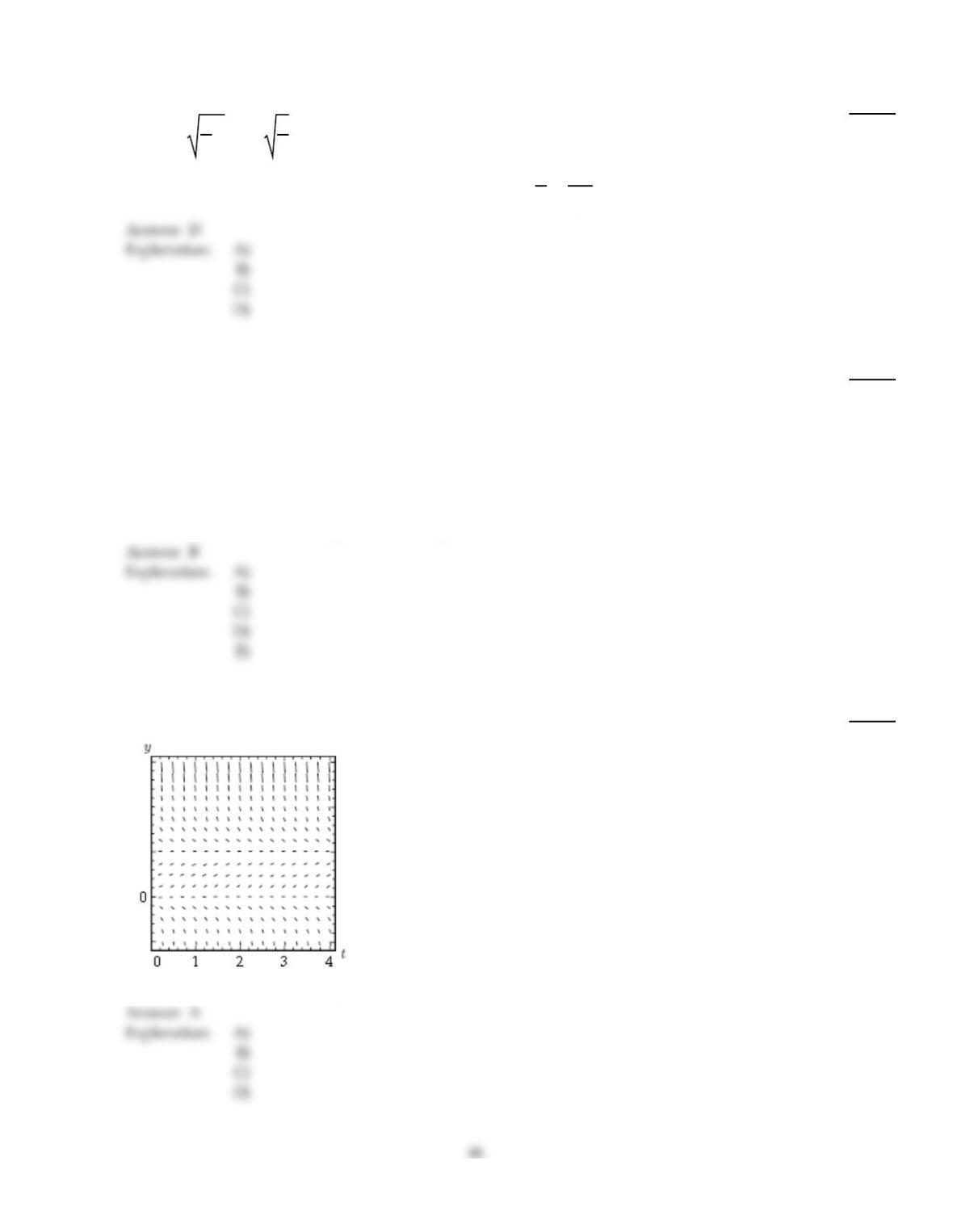
Use the figure to answer the question.
159)
The figure shows a slope field of the differential equation y=4y(9– y). Use the figure to determine
the constant solutions (if any) of the differential equation.
18
9
–9
159)
A)
y = 0, y =9
B)
y = 0
C)
None
D)
y = – 9, y =9
A
D
Solve the equation using an integrating factor.
160)
y+4
ty =t4, t > 0
160)
A)
y = Ct4+t5
B)
y =t–4+t5
C)
y = – t–4+t3+ C
D)
y = Ct–4+1
9t5
161)
y– 3y = 6, t > 0
161)
A)
y = Ce–3t
B)
y = Ce3t
C)
y = Ce3t + C
D)
y = Ce3t – 2
D
162)
ty – 2y –5t = 0, t > 0
162)
A)
y = – 5t + Ct2
B)
y = – 5
t+ C
C)
y = – 5+ Ct
D)
y = – 5t2+ Ct3
A
Solve the differential equation with the given initial condition.
163)
dy
dx + 2x = 3x2; y(0) =10
163)
A)
y = x3+ 2x2+ 10
B)
y = 3x3+ 2x2+ 10
C)
y = 3x3+ x2+ 10
D)
y = x3– x2+ 10
D
D

Solve the problem.
164)
Richard deposits $2000 in an IRA at 10% interest compounded continuously for his retirement in 25
years. He intends to make continuous deposits at the rate of $2500 a year. How much will he have
accumulated in 15 years? Round your answer to the nearest dollar.
164)
A)
$90,006
B)
$94,006
C)
$96,006
D)
$92,006
Answer Key
Testname: C10
Answer Key
Testname: C10
50
Answer Key
Testname: C10
Answer Key
Testname: C10