Topic Area: Characteristics of bonds-Terminology
41.
Which of the following statements is correct?
42.
Skylar Company issued $50,000,000 of its 10% bonds at par on January 1, 2016. On December
31, 2016, the bonds were trading on the bond exchange at 102.5. Since the issue date, what
has happened to the market rate of interest?
43.
Eaton Company issued $5 million of bonds with a 10% coupon rate of interest.
When Eaton issued the bonds, the market rate of interest was 11%. Which of the following
statements is correct?
44.
Eaton Company issued $5 million of bonds with a 10% coupon rate of interest.
When Eaton issued the bonds, the market rate of interest was 8%. Which of the following
statements is incorrect?
45.
Eaton Company issued $5 million of bonds with a 10% coupon rate of interest.
When Eaton issued the bonds, the market rate of interest was 10%. Which of the following
statements is incorrect?
46.
Halverson’s times interest earned ratio was 2.98 in 2016, 2.79 in 2015, and 2.31 in 2014. Which
of the following statements about the ratio is possibly correct?
47.
During 2016, Patty’s Pizza reported net income of $4,212 million, interest expense of $167
million and income tax expense of $1,372 million. During 2015, Patty’s reported net income of
$3,568 million, interest expense of $163 million and income tax expense of $1,424 million. The
times interest earned ratios for 2016 and 2015, respectively, are closest to:
48.
Which of the following statements does not correctly describe the accounting for bonds that
were issued at their face (maturity) value?
49.
The journal entry to record the sale of bonds at their par value results in which of the
following?
50.
Assuming no adjusting journal entries have been made, the journal entry to record the cash
interest payment on the due date for bonds issued at their par value results in which of the
following?
51.
Which of the following statements correctly describes the accounting for bonds that were
issued at a discount?
52.
Which of the following statements does not correctly describe the accounting for bonds that
were issued at a discount?
53.
Assuming no adjusting journal entries have been made, the journal entry to record the cash
interest payment on the due date for bonds issued at a discount results in which of the
following?
54.
Zero coupon bonds are bonds that are issued:
55.
On November 1, 2015, Davis Company issued $30,000, ten-year, 7% bonds for $29,100. The
bonds were dated November 1, 2015, and interest is payable each November 1 and May 1.
Davis uses the straight-line method of amortization.
How much is the amount of discount amortization on each semi–annual interest date?
56.
On November 1, 2015, Davis Company issued $30,000, ten-year, 7% bonds for $29,100. The
bonds were dated November 1, 2015, and interest is payable each November 1 and May 1.
Davis uses the straight-line method of amortization.
How much is the semi-annual interest expense when the straight-line method of amortization
is utilized?
57.
On November 1, 2015, Davis Company issued $30,000, ten-year, 7% bonds for $29,100. The
bonds were dated November 1, 2015, and interest is payable each November 1 and May 1.
Davis uses the straight-line method of amortization.
How much is the book value of the bonds after the November 1, 2016 interest payment was
recorded using the straight-line method of amortization?
58.
On November 1, 2015, Davis Company issued $30,000, ten-year, 7% bonds for $29,100. The
bonds were dated November 1, 2015, and interest is payable each November 1 and May 1.
Davis uses the straight-line method of amortization.
Which of the following is incorrect with regard to the Davis bonds when the straight-line
method of amortization is utilized?
59.
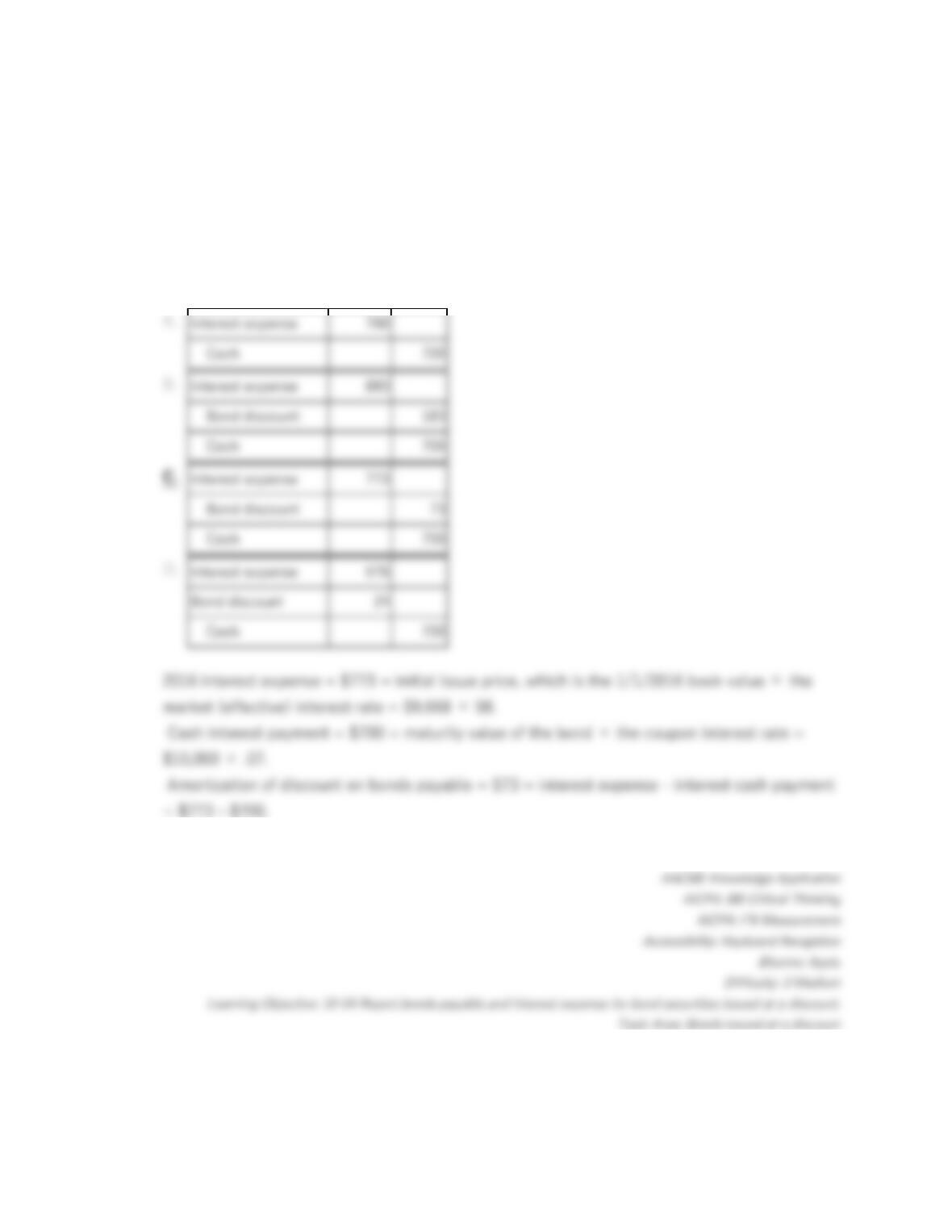
On January 1, 2016, Tonika Company issued a four–year, $10,000, 7% bond. The interest is
payable annually each December 31. The issue price was $9,668 based on an 8% effective
interest rate. Tonika uses the effective-interest amortization method.
The interest expense on the income statement for the year ended December 31, 2016 is
closest to:
60.
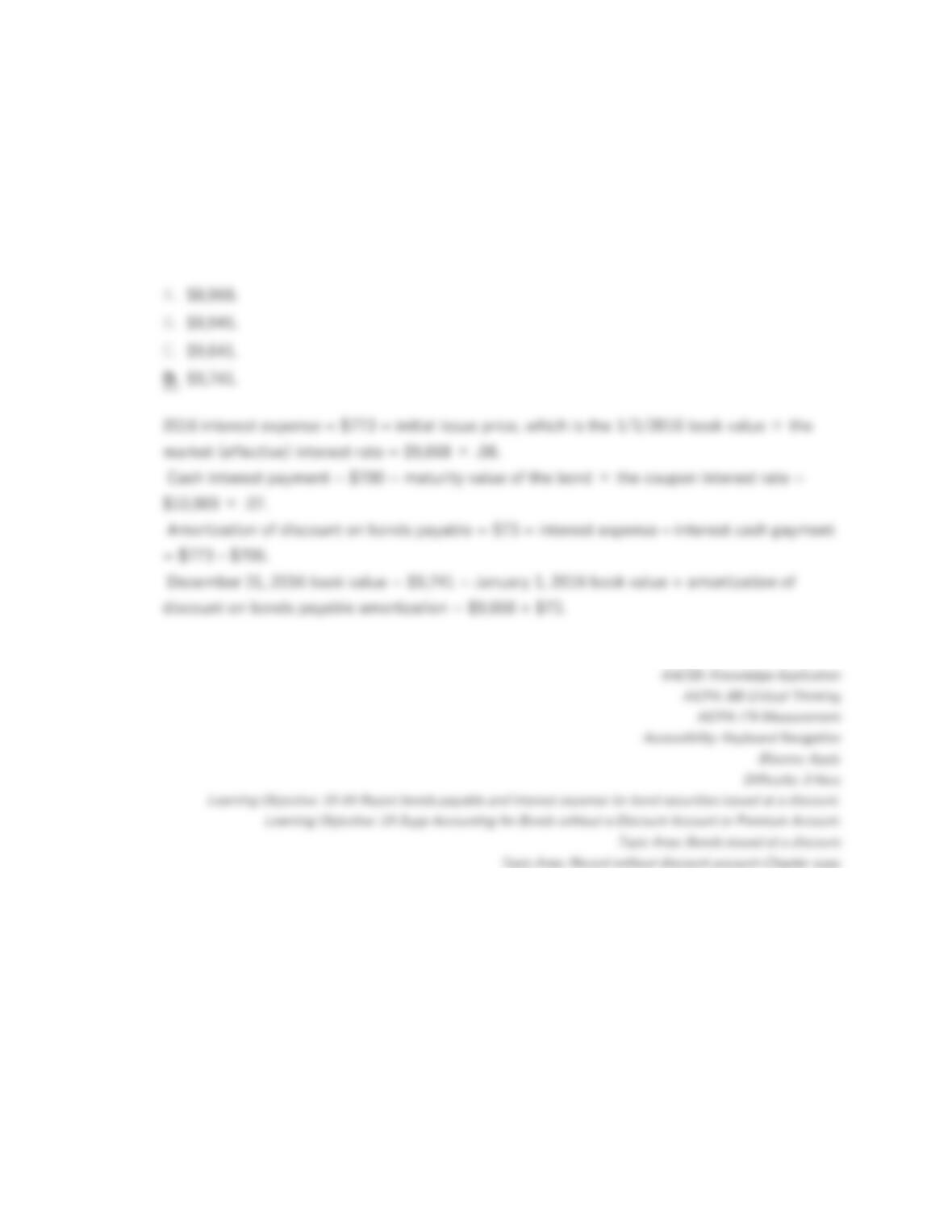
On January 1, 2016, Tonika Company issued a four–year, $10,000, 7% bond. The interest is
payable annually each December 31. The issue price was $9,668 based on an 8% effective
interest rate. Tonika uses the effective-interest amortization method.
Rounding calculations to the nearest whole dollar, which of the following journal entries
correctly records the 2016 interest expense?
61.
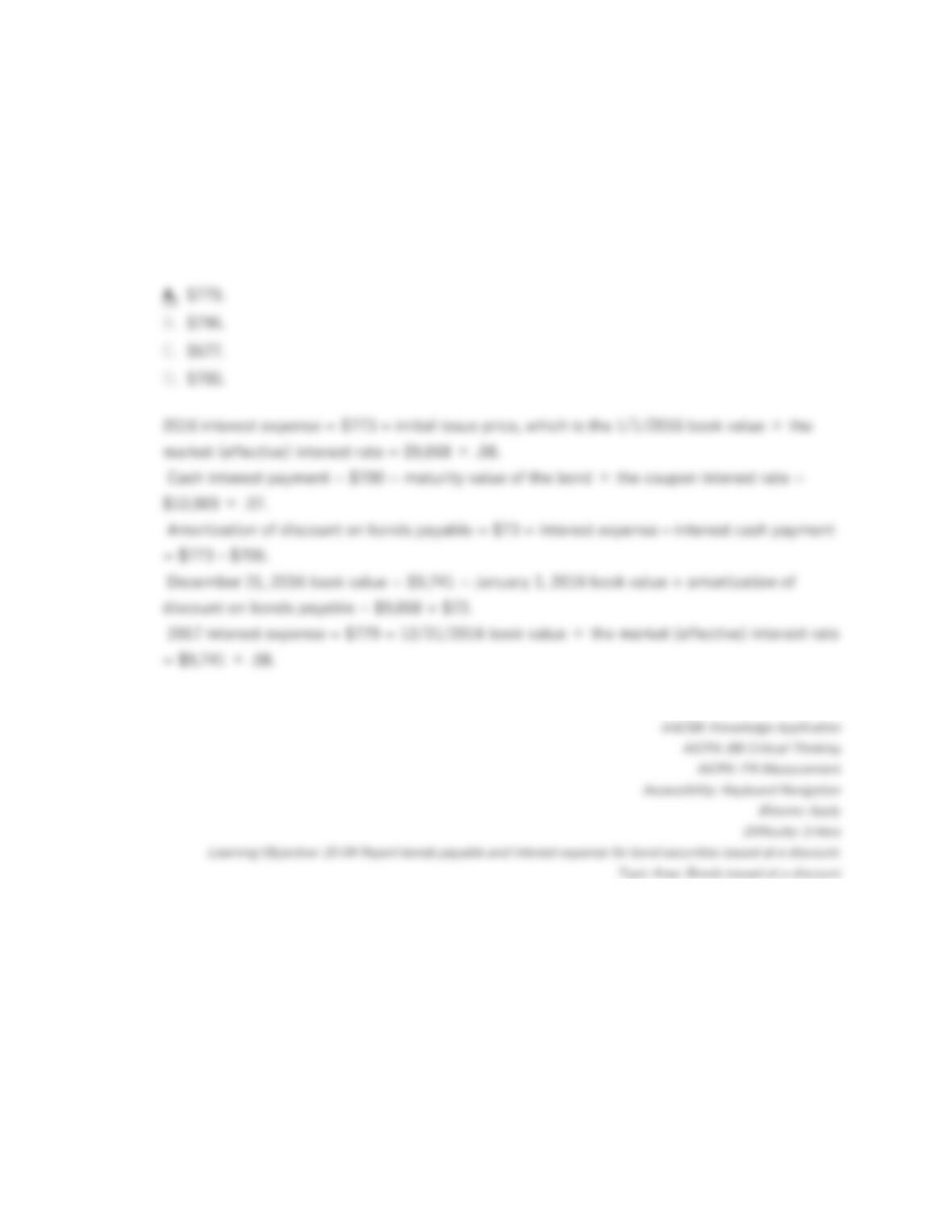
On January 1, 2016, Tonika Company issued a four–year, $10,000, 7% bond. The interest is
payable annually each December 31. The issue price was $9,668 based on an 8% effective
interest rate. Tonika uses the effective-interest amortization method.
The book value of the bonds as of December 31, 2016 is closest to:
62.
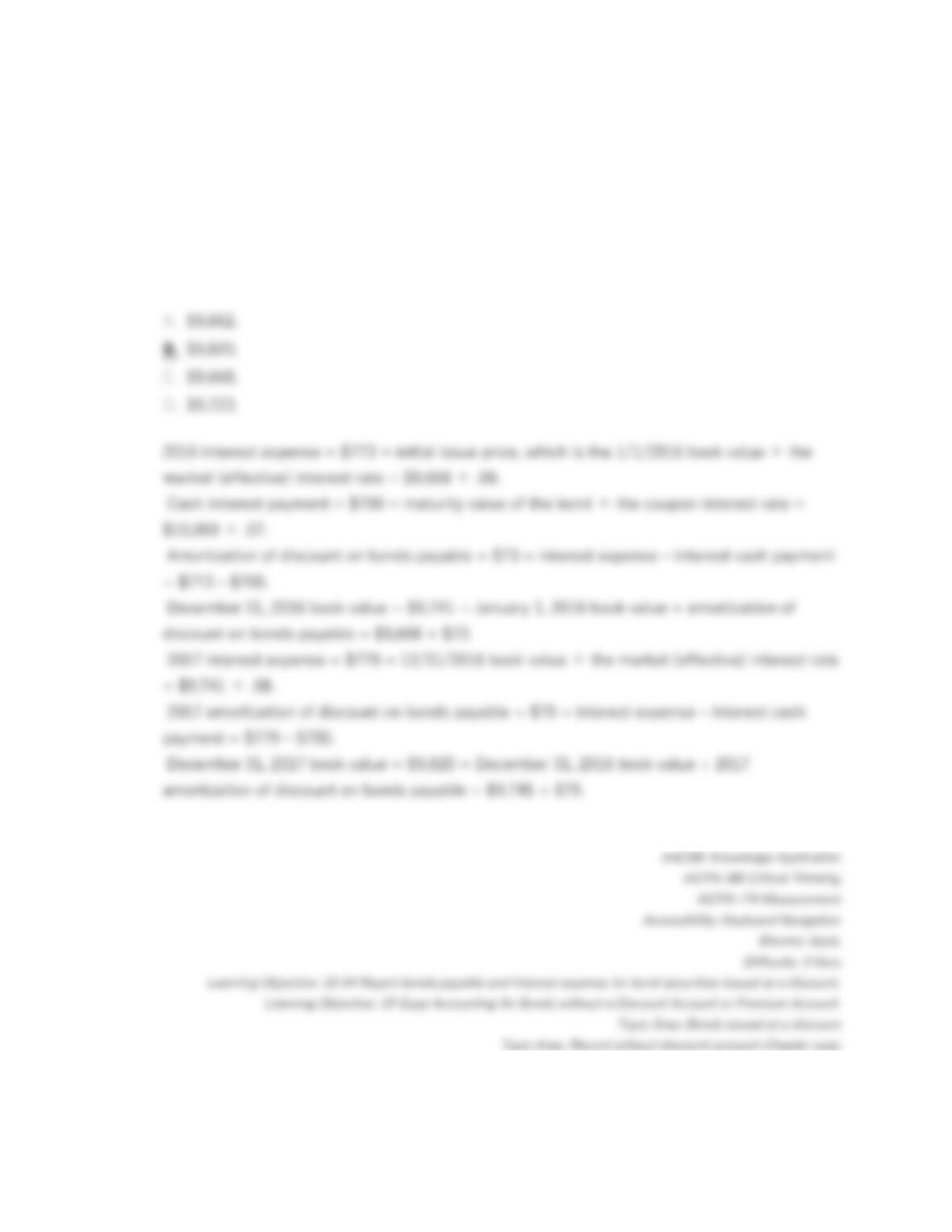
On January 1, 2016, Tonika Company issued a four–year, $10,000, 7% bond. The interest is
payable annually each December 31. The issue price was $9,668 based on an 8% effective
interest rate. Tonika uses the effective-interest amortization method.
The 2017 interest expense is closest to:
63.
On January 1, 2016, Tonika Company issued a four–year, $10,000, 7% bond. The interest is
payable annually each December 31. The issue price was $9,668 based on an 8% effective
interest rate. Tonika uses the effective-interest amortization method.
The December 31, 2017 book value after the December 31, 2017 interest payment was made
is closest to: