
83)
Suppose the graph below gives a solution to the differential equation dP
ds = g(P) where P is the
price of a product and s is the weekly sales.
Which of the following statements is/are true?
(I) g(M) = 0
(II) g(M) =0
(III) gM
2= 0
(IV) g(P0) > 0
83)
A)
I, III, and IV
B)
IV only
C)
I only
D)
I, II, and IV
E)
I and IV
Solve the problem.
84)
When a dead body is discovered, one of the first steps in the ensuing investigation is for a medical
examiner to determine the time of death as closely as possible. If the temperature of the medium
has been fairly constant and less than 48 hours have passed since death, Newton’s law of cooling
can be used. Newton’s law of cooling states, dT
dt = – k(T –TM), where k is a constant, T is the
temperature of the object after t hours, and TM is the (constant) temperature of the surrounding
medium. Assuming the temperature of a body at death is 98.6°F, the temperature of the
surrounding air is 70°F, and at the end of one hour the body temperature is 88°F, when will the
temperature of the body be 76°F? Round to the nearest tenth of an hour.
84)
A)
2.5 hr
B)
3.4 hr
C)
0.5 hr
D)
0.3 hr

Solve the initial value problem.
85)
ty + (1 + t)y =4; y(3) =4
85)
A)
y =4+12 e3– t
t
B)
y =4+10e5– t
t
C)
y =4+8e–3– t
t
D)
y =4+8e3– t
t
Solve the differential equation with the given initial condition.
86)
y= ty, y(0) = – 1
86)
A)
y =et + 1
B)
y = – 1 +et2/2
C)
y =t2
2
D)
y = – et2/2
D
Solve the equation using an integrating factor.
87)
y– 2y = – 2t, t > 0
87)
A)
y = t + 1/2 + Ce2t
B)
y = t – Ce2t
C)
y = Ct +e2t
D)
y = 1/2 + Ce–2t
A
Solve the differential equation with the given initial condition.
88)
(4x +5)y =dy
dx ; y(0) = 1
88)
A)
y =e2x2+5x + 1
B)
y =e2x2+5x
C)
y =e4x2+5x + 1
D)
y =e4x2+5x
B
22
D

Solve the initial value problem.
89)
2y – 4ty = 8t; y(0) =3
89)
A)
y = – 2 + 5et2
B)
y = – 2 + 5e–t2
C)
y = 2 + 3et2
D)
y = – 1 + 4et2
Solve the differential equation with the given initial condition.
90)
x dy
dx –4y x = 0; y(0) = 1
90)
A)
y =e8x–1/2
B)
y =e8x1/2 + 1
C)
y =e8x1/2
D)
y =e4x–1/2 + 1
C
Solve the problem.
91)
Earth’s atmospheric pressure p is often modeled by assuming that the rate dp/dh at which p
changes with the altitude h above sea level is proportional to p. Suppose that the pressure at sea
level is 1013 millibars and that the pressure at an altitude of 14 km is 186 millibars.
What is the atmospheric pressure at an altitude of 18 km? Round to the nearest millibar.
(You will first need to solve the initial value problem
Differential equation: dp
dh = kp,
Initial condition: p =p0 when h = 0
and determine the values of p0 and k from the given altitude–pressure data).
91)
A)
115 millibars
B)
118 millibars
C)
111 millibars
D)
121 millibars
A
Solve the initial value problem.
92)
y+ y = 3; y(0) = 0.
92)
A)
y = 3t
B)
y = 3 – 3e–t
C)
y =6t
D)
y =e–t(3t –e–t)
B
23
A

Solve the problem.
93)
Solve the differential equation model of radioactive decay:
dQ
dt = – 0.7Q.
93)
A)
Q(t) =Q0e–0.7t
B)
Q(t) =–1
0.7t+Q0
C)
Q(t) = – Q0ln 0.7t + c
D)
Q(t) =Q0e–t
94)
Suppose that y = f(t) satisfies the differential equation y=t2+ 3y, f(0) = 2. If Euler’s method with
n = 10 is used to construct an approximation p(t) to f(t) for 0
t 1, find p(0.1).
94)
A)
2.2
B)
6.0
C)
3.1
D)
2.6
E)
none of these
Solve the differential equation with the given initial condition.
95)
y=y2, y(0) = 1
95)
A)
t + 1
B)
1
1 – t
C)
t – 1
D)
1
t + 1

Consider the differential equation y= g(y) where g(y) is the function whose graph is shown below:
Indicate whether the following statements are true or false.
96)
If the initial value of y(0) is 2, then the corresponding solution has an inflection point.
96)
A)
True
B)
False
Solve the differential equation with the given initial condition.
97)
dy
dx =x4
y; y(0) =4
97)
A)
y2=x5
5+16
B)
y2=2x5
5+4
C)
y2=x5
5+4
D)
y2=2x5
5+16
Solve the problem.
98)
A nutritionist proposes the following model for weight loss on a program she is developing:
dw
dt + 0.006w =1
3600 C
where w(t) is a person’s weight (in pounds) after t days of consuming exactly C calories per day. A
person weighing 180 pounds goes on this diet program consuming 2400 calories per day. Use the
above model to predict how long will it take this person to lose 15 pounds.
98)
A)
39 days
B)
41 days
C)
37 days
D)
35 days

99)
For what y value(s) does a solution of y=y2– 3y + 2 have inflection points?
99)
A)
y = 2
B)
y = 2 and y = 1
C)
y =3
2
D)
y = 0
E)
none of these
Solve the problem.
100)
A man opens a savings account that earns interest at an annual rate of 6% compounded
continuously. He plans to make continuous withdrawals at a rate of $300 per year. What will
happen if his initial deposit is $5000? [Hint: Let f(x) be the savings account balance at time t, and
determine the differential equation satisfied by f(t).]
100)
A)
The balance will increase at an increasing rate until it reaches $18,000, at which point it will
increase at a decreasing rate.
B)
The balance will remain at $5000 as long as the interest and withdrawals remain the same.
C)
The balance will increase indefinitely.
D)
The balance will decrease until it runs out.
E)
none of these
Solve the equation using an integrating factor.
101)
y+ 2y =17, t > 0
101)
A)
y =17
2+ e2t + Ce–2t
B)
y =17 + Ce2t
C)
y =17
5+ Ce2t
D)
y =17
2+ Ce–2t
26
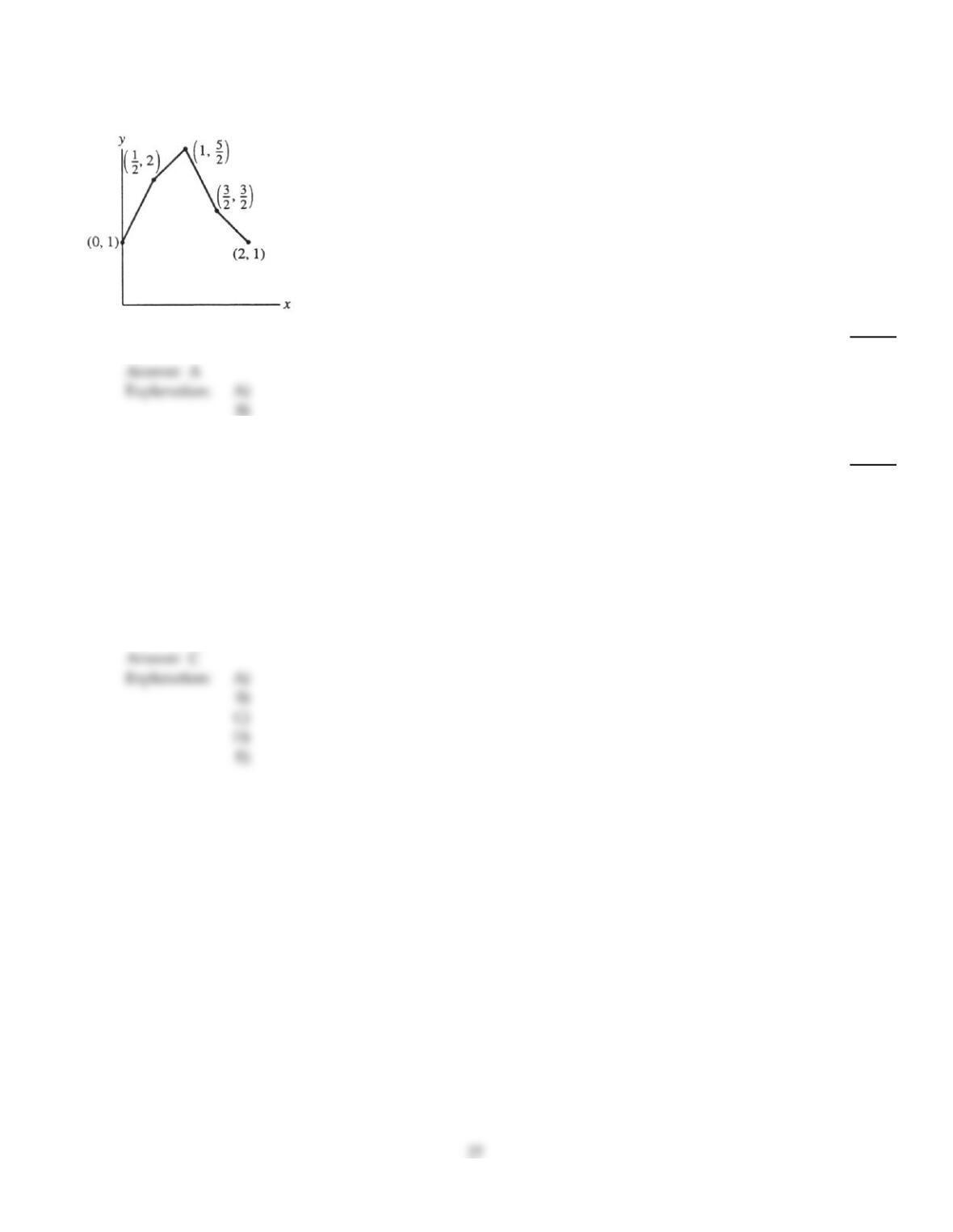
The following is a polygonal path obtained from Euler’s method with n = 4 to approximate a solution f(t) of a differential
equation. Indicate whether the following statements are true or false:
102)
f(0) = 2
102)
A)
True
B)
False
103)
Let y=y3. Which of the following properties hold for the solution y = f(t) determined by the initial
condition y(0) = – 2?
(I) It is always increasing.
(II) It has an inflection point.
(III) It is always concave down.
103)
A)
I and II
B)
II only
C)
III only
D)
I only
E)
none of these
C
A

Consider the differential equation y= g(y) where g(y) is the function whose graph is shown below:
Indicate whether the following statements are true or false.
104)
If the initial value of y(0) is greater than 6, then the corresponding solution will be an increasing
function.
104)
A)
True
B)
False
105)
Solve the differential equation: y’ =ey sin t.
105)
A)
y = – ln(cos t + C)
B)
y = cos(ln t) + C
C)
y =e–cos t + C
D)
y = ln(–sin t) + C
E)
none of these

106)
Suppose y= ky + b and the graphs of several solutions of the differential equation are as below:
Then
(I) k is negative.
(II) k is positive.
(III) b is positive.
(IV) b is negative.
106)
A)
I and IV
B)
II and III
C)
II and IV
D)
I and III
E)
not enough information given
Solve the problem.
107)
When a dead body is discovered, one of the first steps in the ensuing investigation is for a medical
examiner to determine the time of death as closely as possible. If the temperature of the medium
has been fairly constant and less than 48 hours have passed since death, Newton’s law of cooling
can be used. Newton’s law of cooling states, dT
dt = – k(T –TM), where k is a constant, T is the
temperature of the object after t hours, and TM is the (constant) temperature of the surrounding
medium. Assuming the temperature of a body at death is 98.6°F, the temperature of the
surrounding air is 66°F, and at the end of one hour the body temperature is 93°F, what is the
temperature of the body after 3 hours? Round to the nearest tenth of a degree.
107)
A)
18.5°F
B)
93°F
C)
67.6°F
D)
84.5°F

108)
A certain developing country has a population of 500,000. The yearly rate of increase of literacy
among the people is proportional to the number of illiterate people in the population. Letting f(t)
represent the number of literate people, determine the differential equation that f(t) satisfies. (Let k
represent a positive constant.)
108)
A)
f(t) = 500,000 – kf( t)
B)
f(t) = k(500,000 – f(t))
C)
f(t) =kf(t)
500,000
D)
f(t) = 500,000(1 – f(t))
E)
none of these
109)
Sales (in thousands) of a certain product are declining at a rate proportional to the amount of sales,
with a decay constant of 14% per year. Write a differential equation to express the rate of sales
decline.
109)
A)
dy/dt = – 0.14t
B)
dy/dt = – 0.86y
C)
dy/dt =e–0.14t
D)
dy/dt = – 0.14y
110)
The logistic differential equation
dN
dt = – 0.06N2+6N
describes the growth of a population N, where t is measured in years.
Find the intrinsic rate, r.
110)
A)
r =0.06
B)
r = – 0.06
C)
r =6
D)
r =100
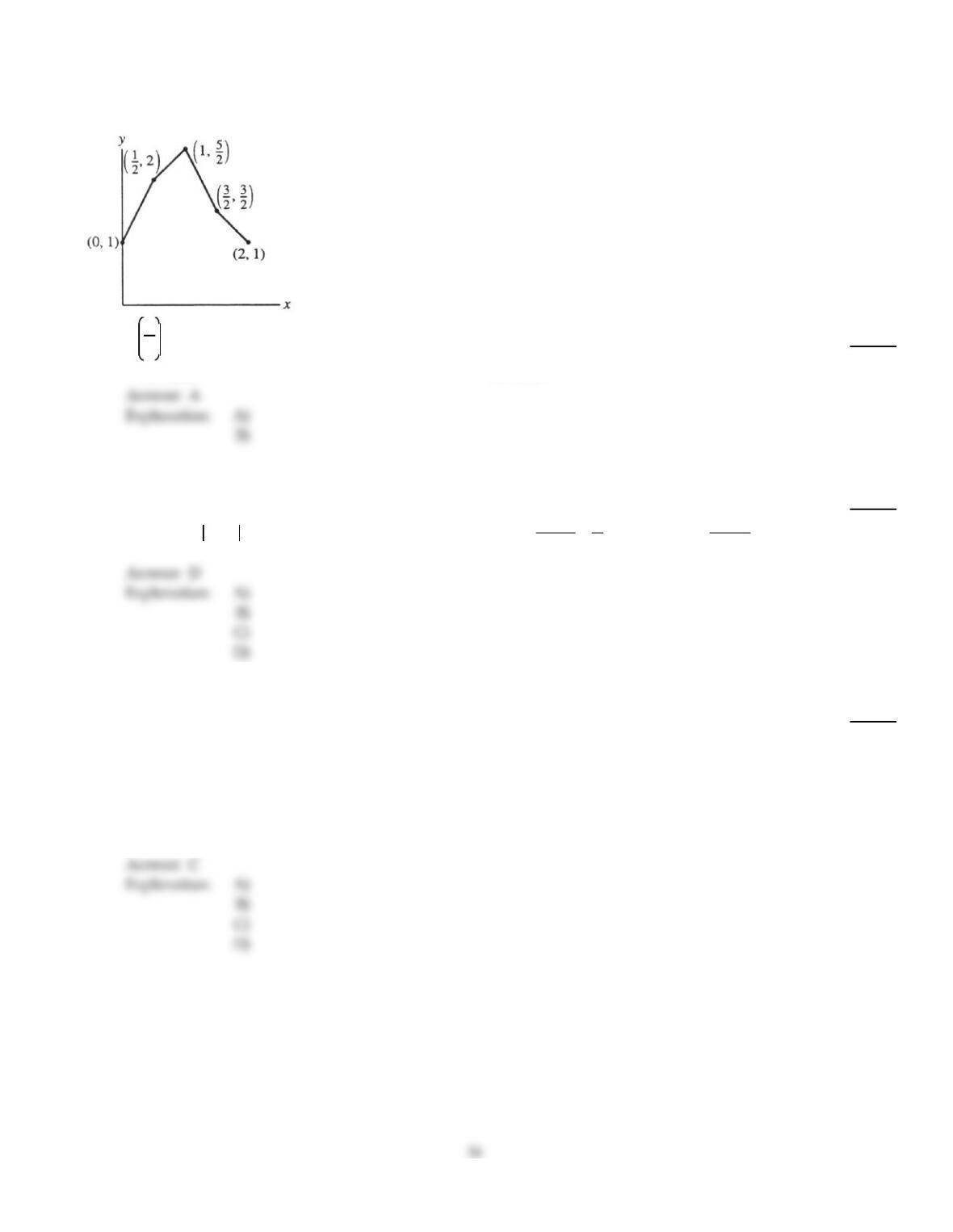
The following is a polygonal path obtained from Euler’s method with n = 4 to approximate a solution f(t) of a differential
equation. Indicate whether the following statements are true or false:
111)
f1
2
1
111)
A)
True
B)
False
Solve the differential equation with the given initial condition.
112)
y= tan t sec2 t; y(0) = 1
112)
A)
y = ln tan t + 1
B)
y = tan t + 1
C)
y =sec2 t
3+2
3
D)
y =tan2 t
2+ 1
Solve the problem.
113)
An initial deposit of $24,000 is made into an account that earns 5% compounded continuously.
Money is then withdrawn at a constant rate of $4000 a year until the amount in the account is 0.
Find the equation for the amount in the account at any time t. When is the amount 0?
113)
A)
A = 60,000 – 36,000e0.05t
10.017 years
B)
A = 60,000 – 36,000e0.05t
8.352 years
C)
A = 80,000 – 56,000e0.05t
7.134 years
D)
A = 80,000 – 56,000e0.05t
8.352 years

114)
Suppose an isolated island has a native population of 9000 and a person from a visiting ship
introduces a disease which has an infection rate of 0.00004. Assume that the rate of spread of the
disease satisfies the following logistic equation:
dy
dt = k 1 –y
Ny,
where N is the size of the population and y is the number infected at time t.
Write an equation for the number of infected natives after t days.
114)
A)
y =9000
1 +8999e–0.36t
B)
y =8999
1 +9000e–0.00004t
C)
y =8999
1 +9000e–0.36t
D)
y =9000
1 +8999e–0.00004t
115)
An initial deposit of $8,000 is made into an account earning 6.5% compounded continuously.
Thereafter, money is deposited into the account at a constant rate of $2600 per year. Find the
amount in this account at any time t. How much is in this account after 5 years?
115)
A)
A = 44,000e0.065t – 36,000
$24,897.34
B)
A = 48,000e0.065t – 40,000
$26,433.47
C)
A = 60,000e0.065t – 52,000
$31,041.84
D)
A = 52,000e0.065t – 44,000
$27,969.59
Solve the equation using an integrating factor.
116)
ty +4ty –t2= 0, t > 0
116)
A)
y =t
4–1
16 + Ce–4t
B)
y =t
4–1
16 + Ce4t
C)
y =t
4+1
4+ Ce4t
D)
y =t
4–1
4+ Ce–4t
32
Solve the differential equation with the given initial condition.
117)
y= sin t cos3 t, y
3= 0
117)
A)
y = 64 –cos4 t
B)
y =cos4 t
4
C)
y =1
64 –cos4 t
4
D)
y = 16 +cos4 t
4
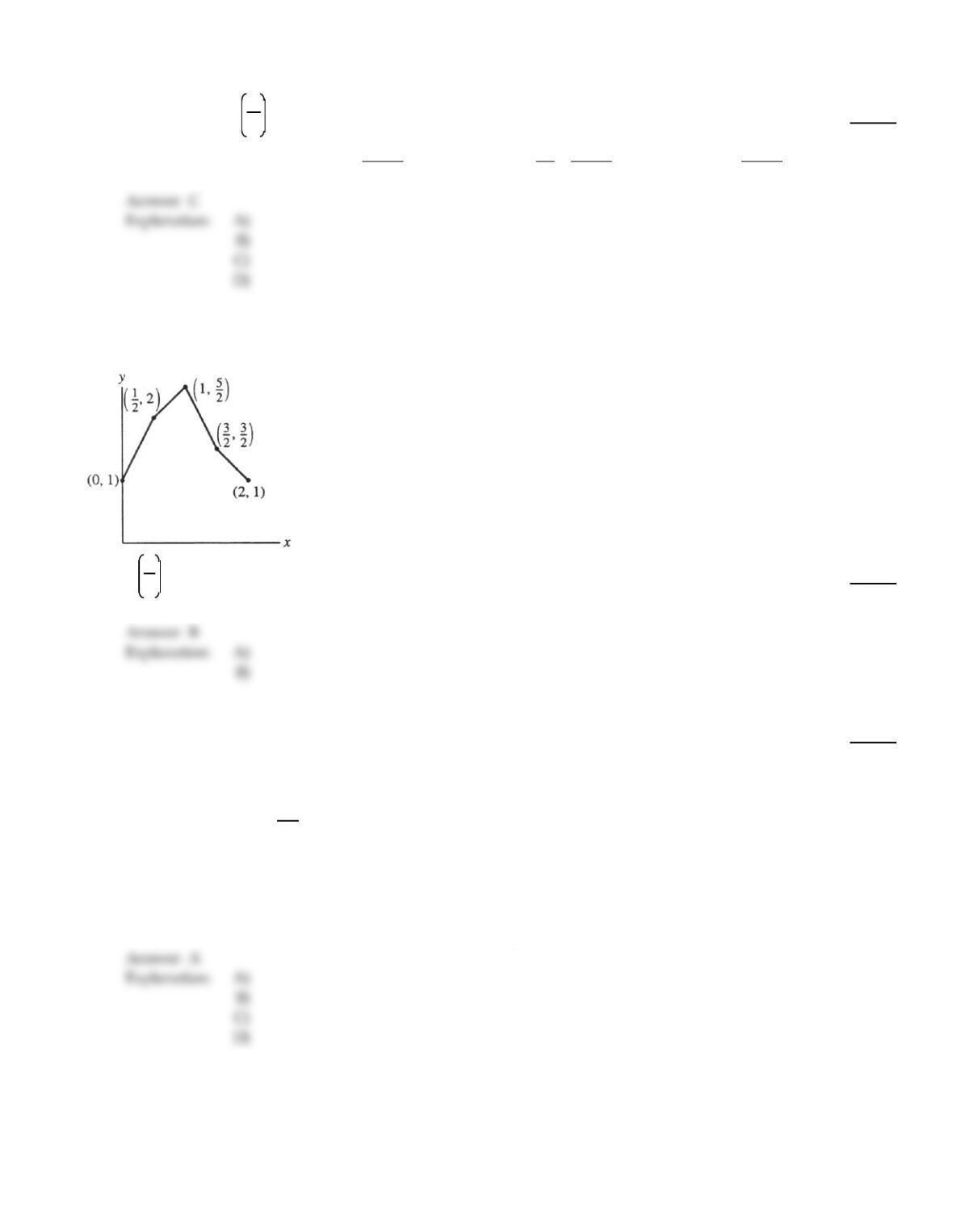
The following is a polygonal path obtained from Euler’s method with n = 4 to approximate a solution f(t) of a differential
equation. Indicate whether the following statements are true or false:
118)
f5
2= 1
118)
A)
True
B)
False
Solve the problem.
119)
Earth’s atmospheric pressure p is often modeled by assuming that the rate dp/dh at which p
changes with the altitude h above sea level is proportional to p. Suppose that the pressure at sea
level is 1013 millibars and that the pressure at an altitude of 13 km is 210 millibars.
Solve the initial value problem
Differential equation: dp
dh = kp,
Initial condition: p =p0 when h = 0
to express p in terms of h. Determine the values of p0 and k from the given altitude–pressure data.
119)
A)
p = 1013e–0.121h
B)
p = 1013e–0.046h
C)
p = 1013e–0.128h
D)
p = 1013e–0.094h
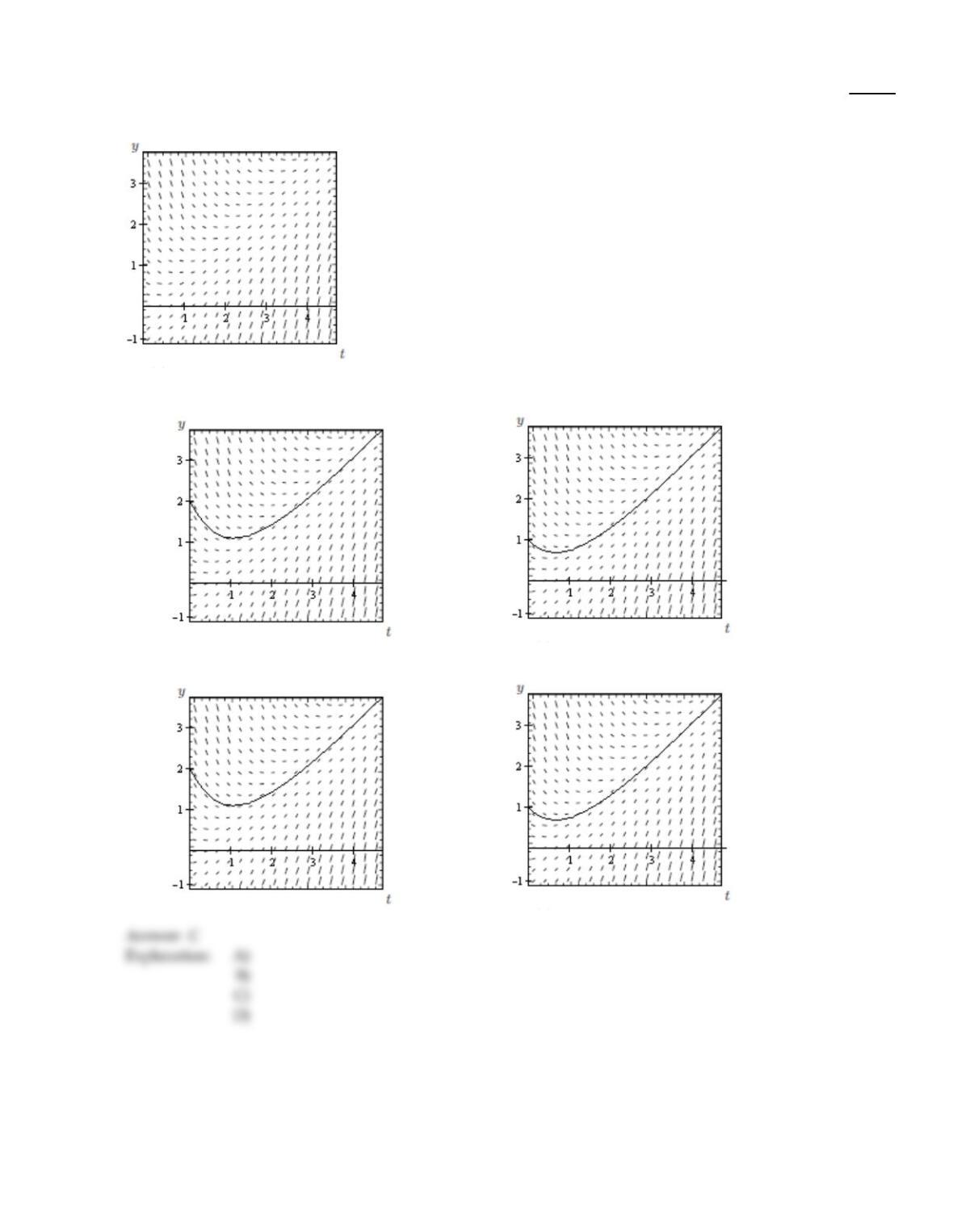
Use the figure to answer the question.
33
120)
The figure shows a slope field for the differential equation y= t – y. Draw an approximation of a
portion of the solution curve for y= t – y that goes through the point (0, 2). Based on the slope
field, can this solution pass through the point (1.1, 0.4)?
120)
A)
Yes
B)
No
C)
No
D)
Yes
34

Solve the initial value problem.
121)
y+ y = 2et; y(0) =2
121)
A)
y = et+ 1e–t
B)
y = 2et– 1e–t
C)
y =2et
D)
y = 4e2+ 20e–t
122)
Let y= 2 – y. Which of the following properties hold for the solution y = f(t) determined by the
initial condition y(0) = 1?
(I) It is always concave down.
(II) It is a constant solution.
(III) It is always decreasing.
122)
A)
I and III
B)
II only
C)
I only
D)
III only
E)
none of these
C
123)
Find the integrating factor, the general solution, and the particular solution satisfying the initial
condition.
y– 4y = – 2e2t ; y(0) = – 1
123)
A)
integrating factor: e4t
general solution: y =1
3e6t + Ce4t
particular solution: y =1
3e6t –4
3e4t
B)
integrating factor: e4t
general solution: y = – 2t + Ce4t
particular solution: y = – 2t –e4t
C)
integrating factor: e–4t
general solution: y =e2t + Ce4t
particular solution: y =e2t – 2e4t
D)
integrating factor: e–4t
general solution: y = – e–2t + Ce4t
particular solution: y = – e–2t – 2e4t
C
A

Solve the differential equation with the given initial condition.
124)
y=x
y, y(3) = 5
124)
A)
y =x2+ 16
B)
y = ± x2+ 16
C)
y =x2+ 9
D)
y = ± x2+ 9
Solve the equation using an integrating factor.
125)
y+5y =10, t > 0
125)
A)
y =2+ Ce–5t
B)
y =1
2+ Ce5t
C)
y =10 + Ce–5t
D)
y =2+ Ce–10t
Solve the problem.
126)
A skydiver’s terminal velocity is 51 meters per second. That is, no matter how long the skydiver
falls, his or her speed will not exceed 51 meters per second but will get arbitrarily close to that
value. The velocity in meters per second, v(t), after t seconds satisfies the differential equation
v(t) =49
5– kv(t). What is the value of k?
126)
A)
255
49
B)
98
255
C)
98
5
D)
49
255
Solve the initial value problem.
127)
y+8ty –e–4t2= 0; y(0) =3
127)
A)
y = te–4t2+3
B)
y = te–4t +3
C)
y = (t +3)e–4t
D)
y = (t +3)e–4t2
36