Liabilities ♦ 483
24. Zero coupon bonds pay interest at a contract rate much lower than the market rate.
25. If the bonds are redeemed at a price higher than the carrying amount, a loss must be recognized.
26. If the carrying amount of bonds is greater than the redemption price, a loss must be recognized the
by issuers.
27. Income tax based on the tax return is usually different from the income tax reported in the income
statement.
28. Deferred taxes appear on the balance sheet as a current liability if it will not be reversed within the
next year.
29. When deferred income tax expense is recorded, income tax expense reflects the income tax on the
income statement.
30. Although temporary differences are prevalent, all differences between tax expense and deferred
tax expense will self correct within a year.
31. Contingent liabilities are always recorded when they can be reasonably estimated.
32. Litigation is a common example of a contingent liability disclosed in the notes to the financial
statements.
484 ♦ Chapter 10
33. The current ratio is calculated by dividing current assets by current liabilities.
34. The total liabilities to total assets ratio can be used to measure the relationship between a
company’s income and its interest expense on debt.
ESSAY
1. Explain the difference between a current liability compared to a long-term liability.
2. Are the proceeds the same or different for a discounted note versus an interest bearing note?
3. List the three types of payroll taxes employers must pay and indicate which of these employees
must also pay.
4. Explain what is meant by fringe benefits and list some examples.
Liabilities ♦ 485
5. Describe how term bonds differ from serial bonds.
6. Describe how the contract rate differs from the market rate.
7. If bonds are sold at a discount, describe the relationship between the contract and market rates and
explain why the bonds would sell at a discount.
8. If bonds are sold at a premium, describe the relationship between the contract and market rates and
explain why the bonds would sell at a premium.
9. What effect does discount amortization have on interest expense and the carrying amount of the
bonds?
486 ♦ Chapter 10
10. What effect does premium amortization have on interest expense and the carrying amount of the
bonds?
11. Discuss accounting for deferred taxes.
12. Define a contingent liability and list the two conditions that must be met before they are recorded
in the accounts.
13. Explain how the current ratio and the quick ratio are calculated and indicate what they measure.
Liabilities ♦ 487
14. Explain how the “number of times interest charges are earned” ratio is calculated and indicate
what it measures.
PROBLEM
1. A company issues a 90-day note for $110,000 to a supplier of merchandise inventory. The supplier
discounts the note at 12%.
(a)
Prepare the entry to record the issuance of the note.
(b)
Prepare the entry to record the payment of the note at maturity.
General Journal
Merchandise Inventory
Interest Expense
Note Payable
Note Payable
Cash
488 ♦ Chapter 10
2. A company issues a 60-day, 12% note for $90,000 to a supplier of merchandise inventory.
(a)
Prepare the entry to record the issuance of the note.
(b)
Prepare the entry to record the payment of the note at maturity.
General Journal
3. An employee earns $22 per hour and 1 1/2 times that rate for all hours worked in excess of 40
hours per week. Assume the employee works 52 hours during the week and the FICA tax rate of
7.5% and federal income tax withheld is $275 and state income tax withheld is $40.
(a)
Determine the gross pay.
(b)
Determine the net pay.
(c)
Prepare the entry to record the payroll expense and withholdings.
General Journal
Merchandise Inventory
Note Payable
Note Payable
Interest Expense
Cash
Liabilities ♦ 489
4. A company has $458,000 of payroll subject to a 7.5% FICA tax rate. Also $180,000 of the payroll
is subject to a state unemployment rate of 5.4% and a federal unemployment tax rate of .8%.
(a)
Prepare the entry to record the accrual of payroll taxes.
(b)
Which tax is also paid by employees.
(c)
On what statement and where does the account debited in your entry to Part (a) appear.
General Journal
Payroll Tax Expense
FICA Tax Payable
SUTA Tax Payable
FUTA Tax Payable
$1,276 = ($22 40) + ($33 12)
$865.30 = 1,276 – (1,275 7.5%) – 275 – 40
Wages Expense
FICA Tax Payable
Federal Income Tax Payable
State Income Tax Payable
Cash
490 ♦ Chapter 10
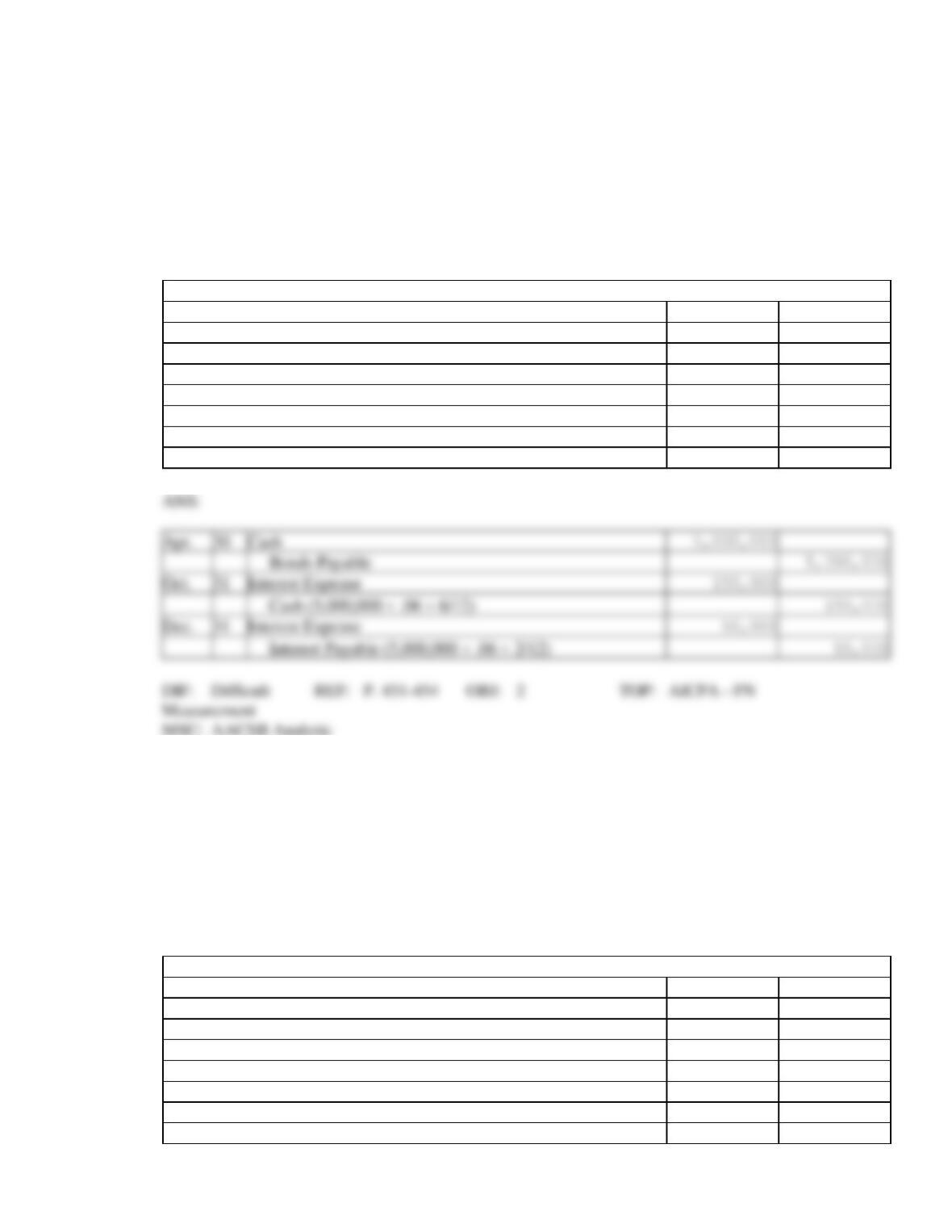
5. A company has a gross payroll for the month of $846,000. The entire payroll is subject to a FICA
tax rate of 7.5% and $365,000 of the payroll is subject to a state unemployment tax rate of 5.4%
and a federal unemployment tax rate of .8%. Also, federal income tax of $176,000 and state
income tax of $18,500 are withheld.
(a)
Record the payroll entry for the month.
(b)
Record the payroll tax entry for the month.
General Journal
Salary Expense
FICA Tax Payable
Federal Income Tax Payable
State Income Tax Payable
Payroll Tax Expense
FICA Tax Payable
SUTA Tax Payable
FUTA Tax Payable
Liabilities ♦ 491
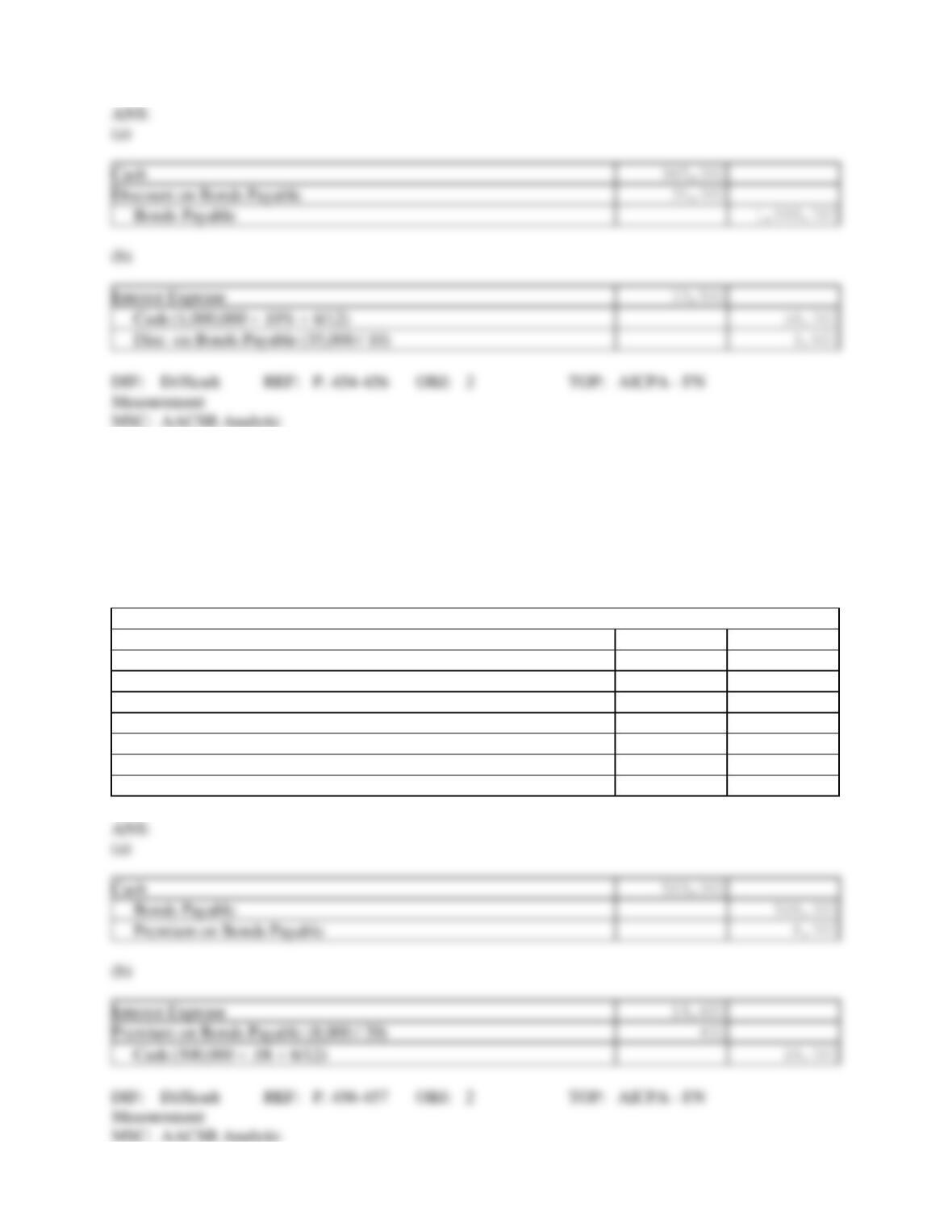
6. A company issued $5,000,000 of 10 year, 6% bonds on April 30 of this year, with interest payable
on April 30 and October 31. Prepare entries for the following transactions assuming the company’s
fiscal year end is December 31.
April 30
Issued the bonds at face amount for cash
October 31
Paid the interest on the bonds
December 31
Accrued unpaid interest
General Journal
7. At the beginning of the fiscal year a company issued $1,000,000 of 5 year 10% bonds. Interest is
paid semi-annually. The effective interest rate at the date of issue was 12% resulting in the
company receiving cash of $965,000.
(a)
Prepare the entry to record the sale of the bonds.
(b)
Prepare the semiannual entry to record the first interest payment and amortization of any bond
premium or discount using the straight-line method.
General Journal
Apr.
30
Cash
Bonds Payable
Oct.
31
Interest Expense
Cash (5,000,000 .06 6/12)
Dec.
31
Interest Expense
Interest Payable (5,000,000 .06 2/12)
492 ♦ Chapter 10
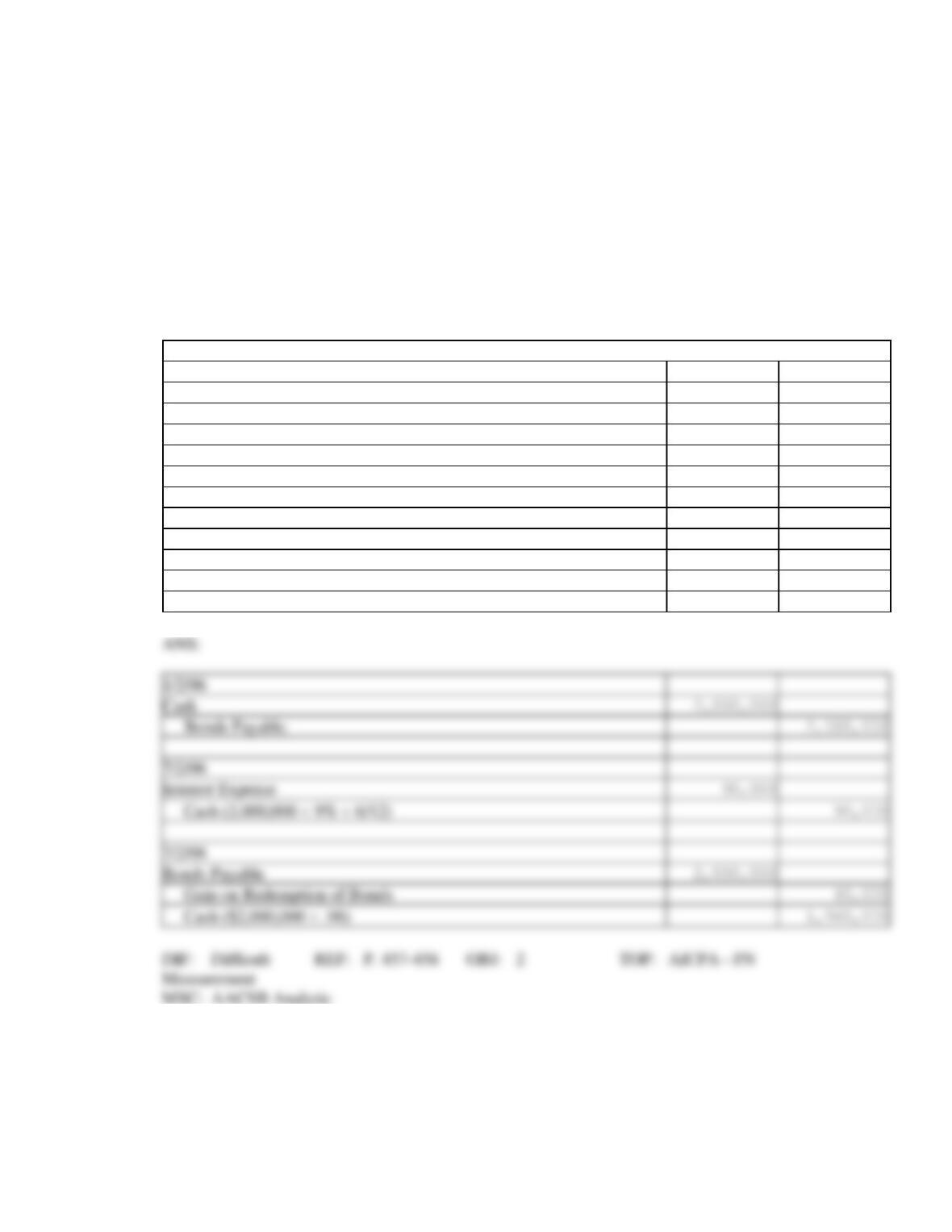
8. At the beginning of the fiscal year a company issued $500,000 of 10 year, 8% bonds. Interest is
paid semi-annually. The effective interest rate at the date of issue was 7% resulting in the
company receiving cash of $508,000.
(a)
Prepare the entry to record the sale of the bonds.
(b)
Prepare the semiannual entry to record the first interest payment and amortization of any bond
premium or discount using the straight-line method.
General Journal
Cash
Bonds Payable
Premium on Bonds Payable
Interest Expense
Premium on Bonds Payable (8,000 / 20)
Cash (500,000 .08 6/12)
Cash
Discount on Bonds Payable
Bonds Payable
Interest Expense
Cash (1,000,000 10% 6/12)
Disc. on Bonds Payable (35,000 / 10)
Liabilities ♦ 493
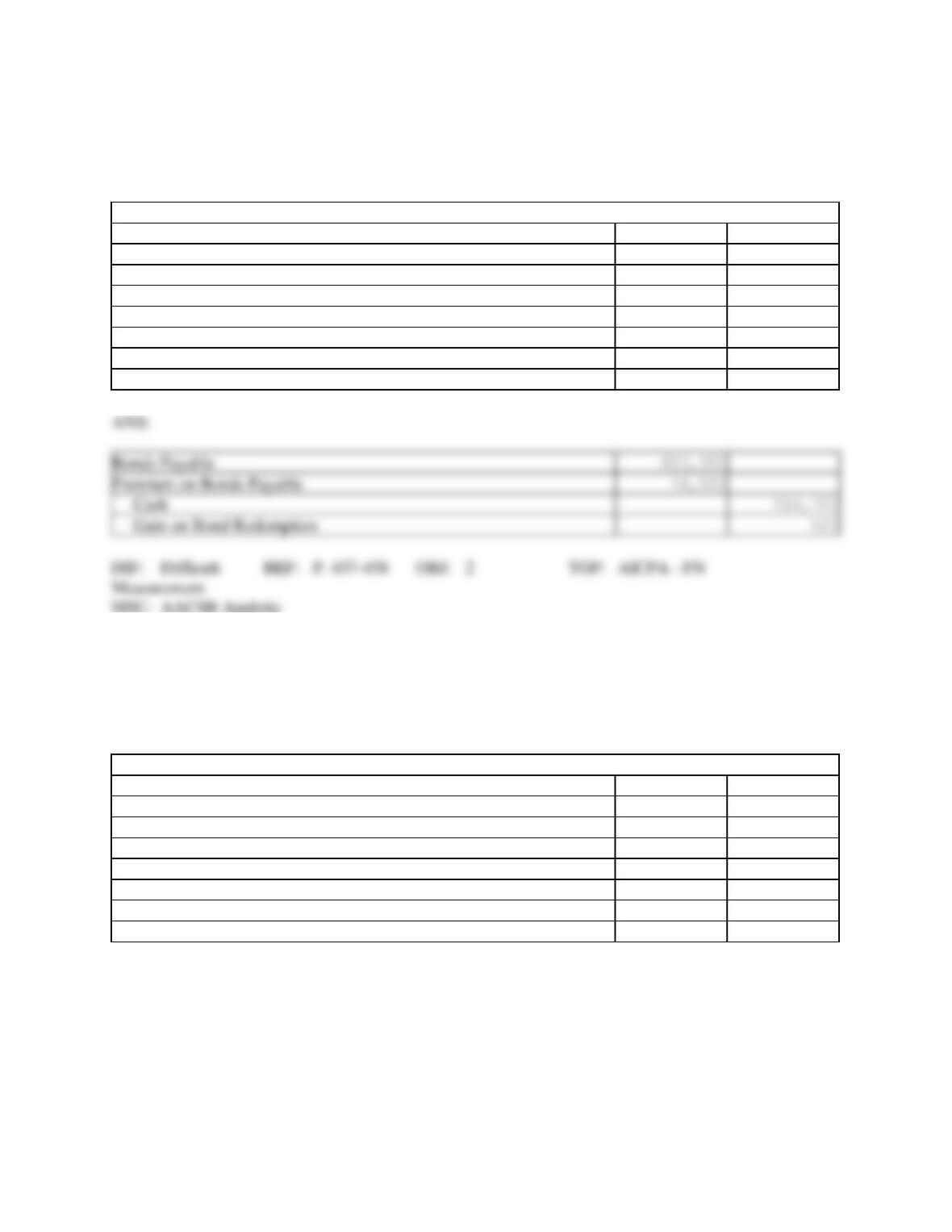
9. A company issued $2,000,000 of 10 year, 9% callable bonds on January 2, 2006 with interest
payable on January 2 and July 2. Prepare entries for the following transactions:
2006
January 2
Issued the bonds for cash at their face amount
July 2
Paid the interest on the bonds
2008
July 2
Called the bond issue at 98 (omit entry for payment of interest)
General Journal
1/2/06
Cash
Bonds Payable
7/2/06
Interest Expense
Cash (2,000,000 9% 6/12)
7/2/08
Bonds Payable
Gain on Redemption of Bonds
Cash ($2,000,000 .98)
494 ♦ Chapter 10
10. On August 31, a company has a bond issue of $800,000 outstanding on which there is an
unamortized premium of $16,500. The company called the bond issue at 102. Prepare the entry to
record the bond redemption (assume interest has been paid).
General Journal
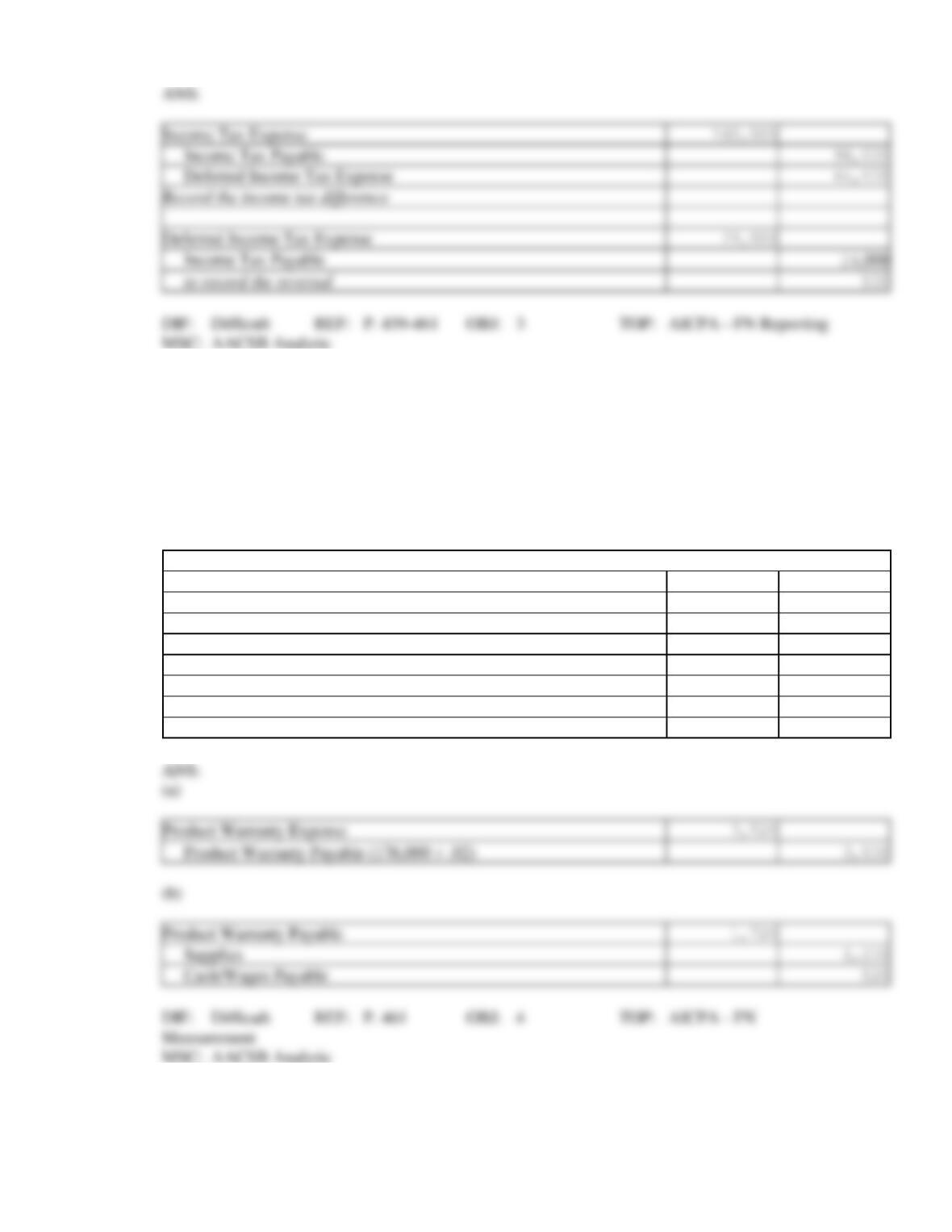
11. If Jom Co. has $400,000 income before taxes on the income statement, $240,000 of taxable
income on the tax return, and a 40% tax rate, prepare the journal entries to report the income tax
difference and a $24,000 reversal in the following year.
General Journal
Bonds Payable
Premium on Bonds Payable
Cash
Gain on Bond Redemption
Liabilities ♦ 495
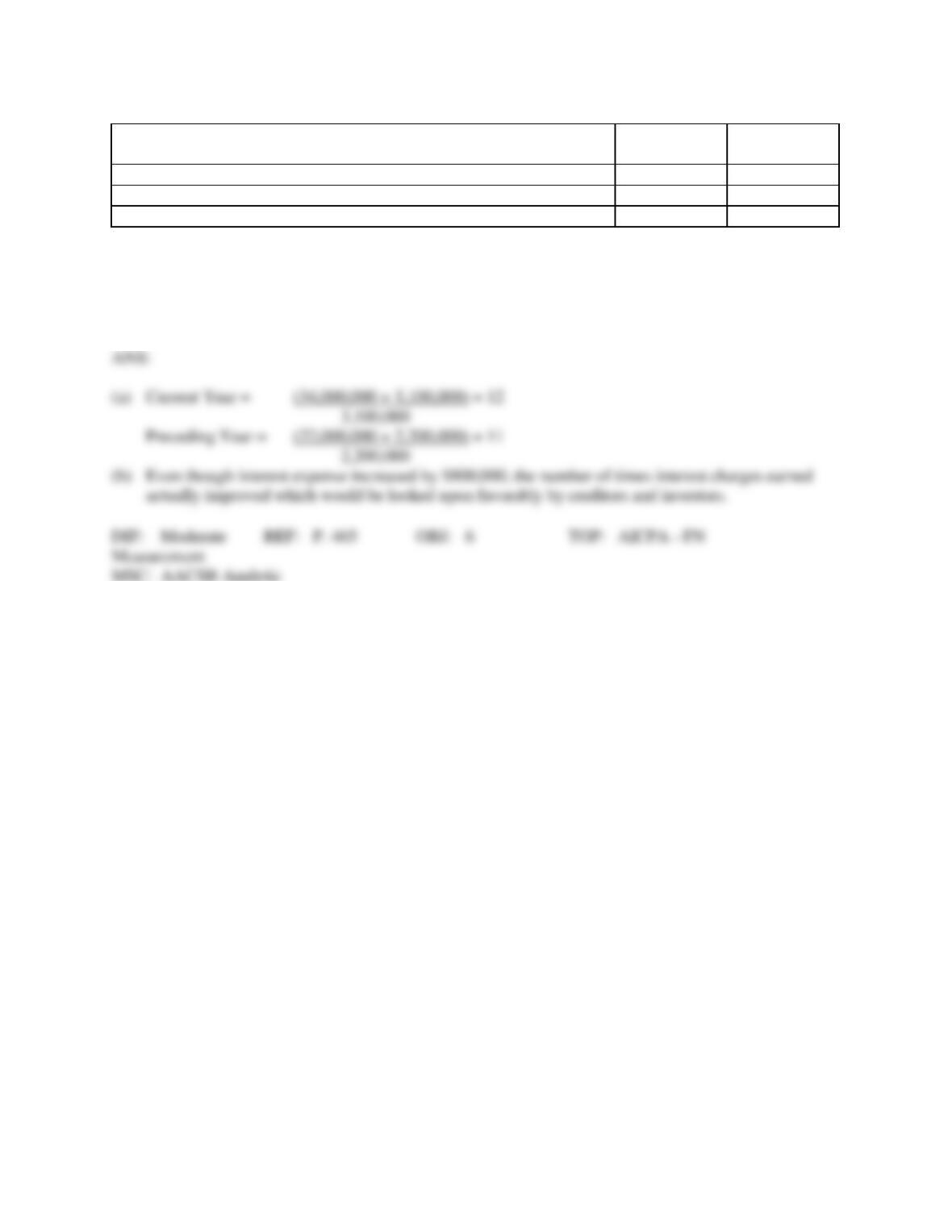
12. A company offers customers a one year product warranty and sales for June totaled $176,000. The
estimated product warranty is 2% of sales and the company incurred warranty repair cost during
July requiring $1,200 of parts and $520 of labor.
(a)
Prepare the adjusting entry at June 30 to record the accrued product warranty.
(b)
Prepare the entry for the warranty work provided in July.
General Journal
Product Warranty Expense
Product Warranty Payable (176,000 .02)
Product Warranty Payable
Supplies
Cash/Wages Payable
Income Tax Expense
Income Tax Payable
Deferred Income Tax Expense
Deferred Income Tax Expense
to record the reversal
496 ♦ Chapter 10
13. The following data appear in the annual report.
Current
Year
Preceding
Year
Interest Expense
$ 3,100,000
$ 2,200,000
Income before income tax
$34,000,000
$22,000,000
Net Income
$20,500,000
$13,400,000
(a)
Determine the number of times interest charges were earned for the current and preceding years
(round to one decimal place).
(b)
Interpret the results.
(a)
Current Year =
(34,000,000 + 3,100,000) = 12
3,100,000
Preceding Year =
(22,000,000 + 2,200,000) = 11
2,200,000
(b)
Even though interest expense increased by $900,000, the number of times interest charges earned
actually improved which would be looked upon favorably by creditors and investors.
Liabilities ♦ 497
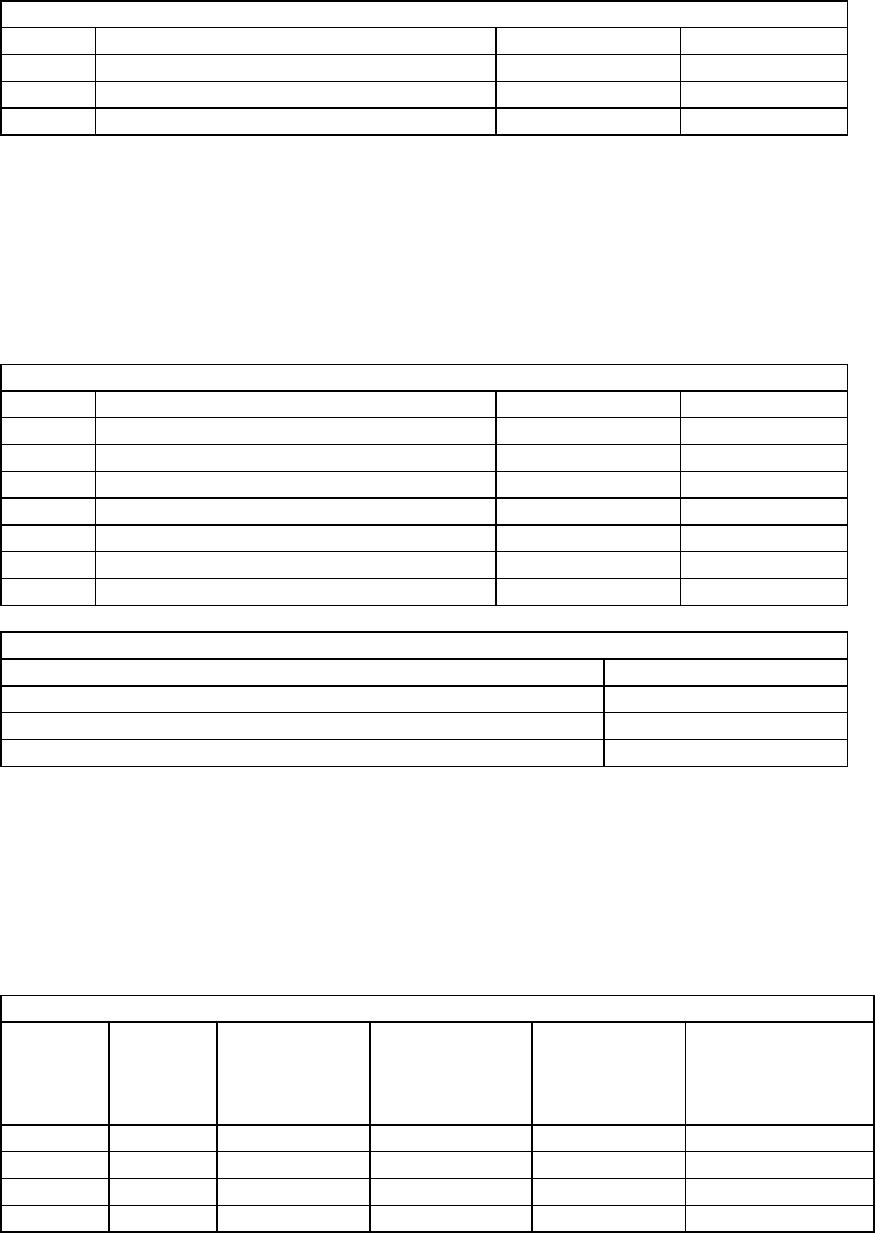
14. Martin Motors, Inc. produces and sells specialized motors to the aircraft industry. On July 1, 2006,
Martin Motors, Inc. issued $15,000,000 of 5-year, 12% bonds priced to yield an effective interest
rate of 11%. Interest on the bonds is payable semiannually on December 31 and June 30. The
fiscal year of the company is the calendar year.
The following are excerpts from the present value tables.
Present Value of $1 at Compound Interest Due in n Periods
n\ i
5.5%
6%
6.5%
11%
12%
13%
1
0.94787
0.94334
0.93897
0.90090
0.89286
0.88496
2
0.89845
0.89000
0.88166
0.81162
0.79719
0.78315
3
0.85161
0.83962
0.82785
0.73119
0.71178
0.69305
4
0.80722
0.79209
0.77732
0.65873
0.63552
0. 61332
5
0.76513
0.74726
0.72988
0.59345
0.56743
0. 54276
6
0.72525
0.70496
0.68533
0.53464
0.50663
0.48032
7
0.68744
0.66506
0.64351
0.48166
0.45235
0.42506
8
0.65160
0.62741
0.60423
0.43393
0.40388
0.37616
9
0. 61763
0.59190
0.56735
0.39092
0.35061
0.33288
10
0.58543
0.55840
0.53273
0.35218
0.32197
0.29459
Present Value of an Ordinary Annuity of $1 per Period
n\ i
5.5%
6%
6.5%
11%
12%
13%
1
0.94787
0.94340
0.93897
0.90090
0.89286
0.88496
2
1.84632
1.83339
1.82063
1.71252
1.69005
1.66810
3
2.69793
2.67301
2.64848
2.44371
2.40183
2.36115
4
3.50515
3.46511
3.42580
3.10245
3.03735
2.97447
5
4.27028
4.21236
4.15568
3.69590
3.60478
3.51723
6
4.99553
4.91732
4.84101
4.23054
4.11141
3.99755
7
5.68297
5.58238
5.48452
4.71220
4.56376
4.42261
8
6.33457
6.20979
6.08875
5.14612
4.96764
4.79677
9
6.95220
6.80169
6.65610
5.53705
5.32825
5.13166
10
7.53763
7.36009
7.18883
5.88923
5.65022
5.42624
Round answers to the nearest whole dollar.
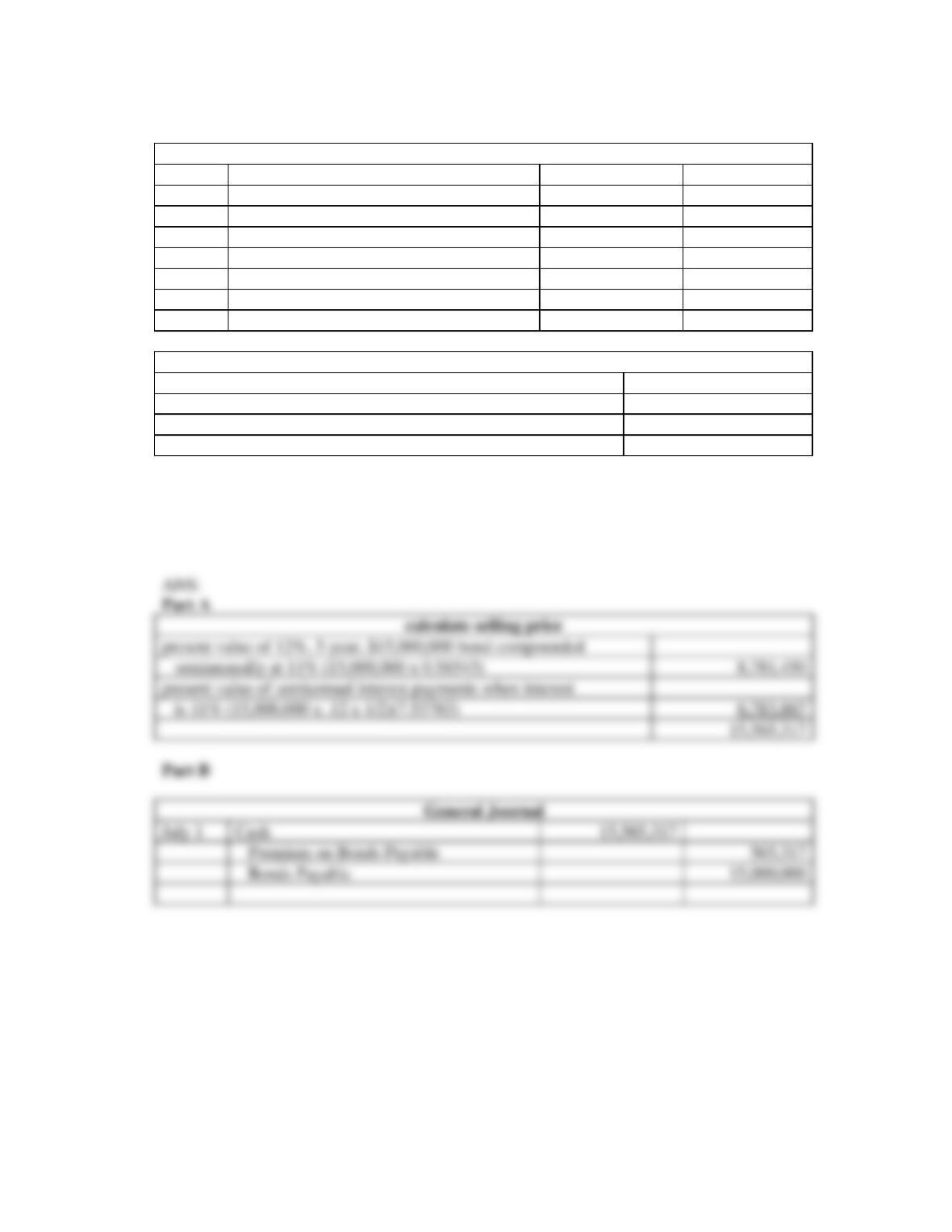
Part A
Calculate the selling price of the bonds and the amount of bond premium or discount upon
issuance.
calculate selling price
498 ♦ Chapter 10
Part B
Record the journal entry in the General Journal for the amount of cash proceeds from the sale of
the bonds.
General Journal
Part C
Using the straight-line method,
a) record the entries for the first semiannual interest payment on December 31, 2006,
including the amortization of the bond premium.
b) record the interest payment on June 30, 2007, and the amortization of the bond
premium.
c) determine the total interest expense for 2006.
General Journal
calculate interest expense
Part D
Using the effective interest method,
a) record the entries for the first semiannual interest payment on December 31, 2006,
including the amortization of the bond premium.
b) record the interest payment on June 30, 2007, and the amortization of the bond
premium.
c) determine the total interest expense for 2006.
Effective Interest Worksheet
Interest
Payment
A
Interest
Paid
B
Interest
Expense
C
Premium
Amortization
D
Unamortized
Premium
E
Bond Carrying
Amount
Liabilities ♦ 499
General Journal
calculate interest expense
Part E
Will the bond proceeds always be greater than the face amount of the bonds when the contract rate
is greater than the market rate of interest? Explain