72) The lowest atmospheric temperatures are found at the
A) earths surface.
B) troposphere/stratosphere junction.
C) stratosphere/mesosphere junction.
D) mesosphere/thermosphere junction.
73) Which of the following regions of the earth’s atmosphere is closest to the surface of the earth?
A) mesosphere
B) stratosphere
C) thermosphere
D) troposphere
74) Which of the following regions of the earth‘s atmosphere contains the ozone layer?
A) mesosphere
B) stratosphere
C) thermosphere
D) troposphere
75) One reaction that contributes to photochemical smog is shown below. Which of the species involved
contains one or more unpaired electrons?
NO2(g) + hυ →NO(g) + O(g)
A) only NO2(g)
B) only NO2(g) and NO(g)
C) only O(g)
D) All of the these contain unpaired electrons.
76) Which of the following is the principal cause of global warming?
A) acid rain
B) air pollution
C) greenhouse effect
D) ozone depletion
77) Which of the following substances has increased markedly due to the use of fossil fuels and
contributes to the greenhouse effect?
A) CO2
B) SO2
C) NO2
D) O3
78) A greenhouse gas is a gas that can experience a change in dipole moment. Which of the following can
be greenhouse gases?
A) O2
B) H2
C) N2
D) CH3F
23
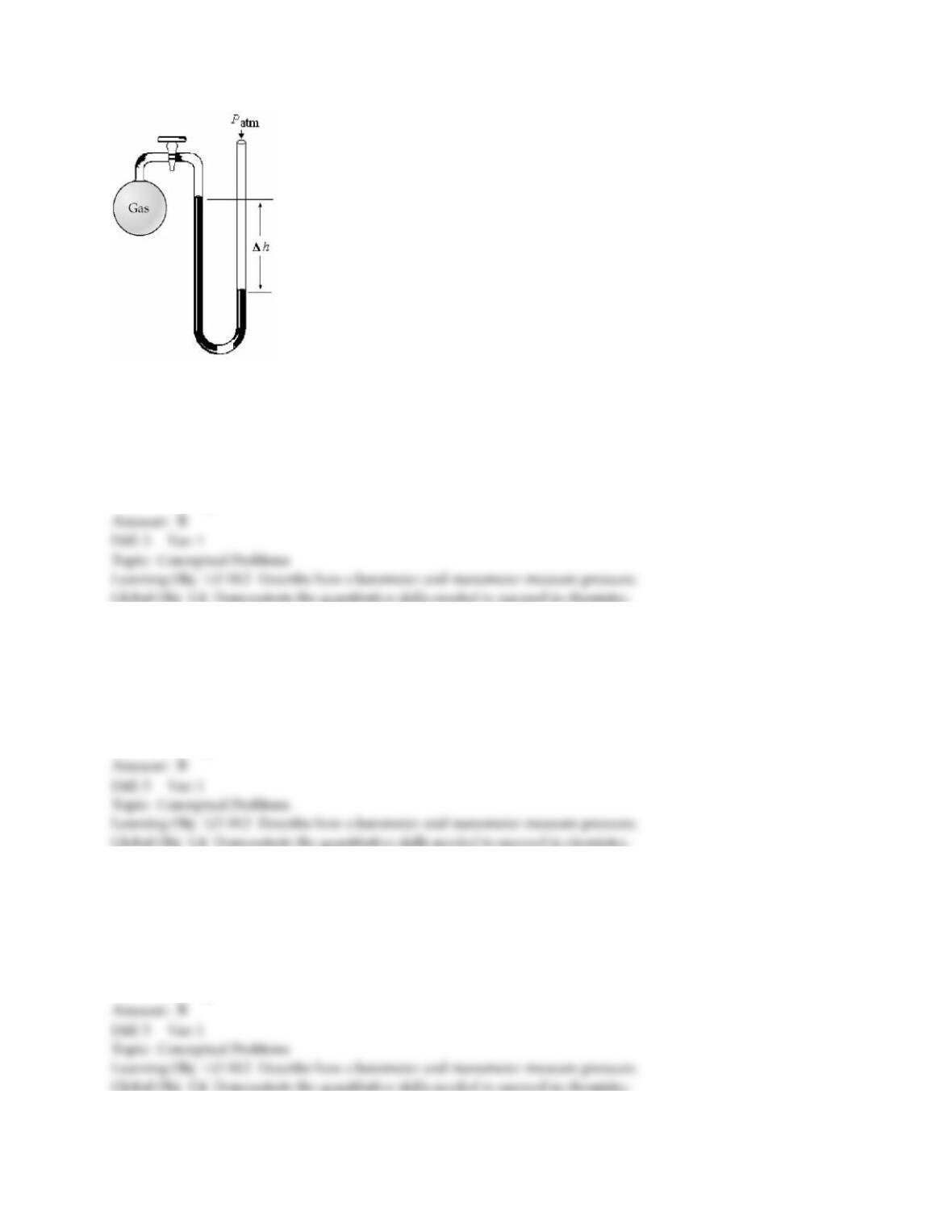
79) What is the pressure (in mm Hg) of the gas inside the above apparatus if the outside pressure, Patm,
is 740 mm Hg and the difference in mercury levels, Δh, is 30 mm Hg?
A) 30 mm Hg
B) 710 mm Hg
C) 740 mm Hg
D) 770 mm Hg
80) What is the pressure (in mm Hg) of the gas inside the above apparatus if the outside pressure, Patm,
is 750 mm Hg and the difference in mercury levels, Δh, is 50 mm Hg?
A) 50 mm Hg
B) 700 mm Hg
C) 750 mm Hg
D) 800 mm Hg
81) What is the pressure (in mm Hg) of the gas inside the above apparatus if the outside pressure, Patm,
is 736 mm Hg and the difference in mercury levels, Δh, is 18 mm Hg?
A) 18 mm Hg
B) 718 mm Hg
C) 736 mm Hg
D) 754 mm Hg
82) What is the pressure (in mm Hg) of the gas inside the above apparatus if the outside pressure, Patm,
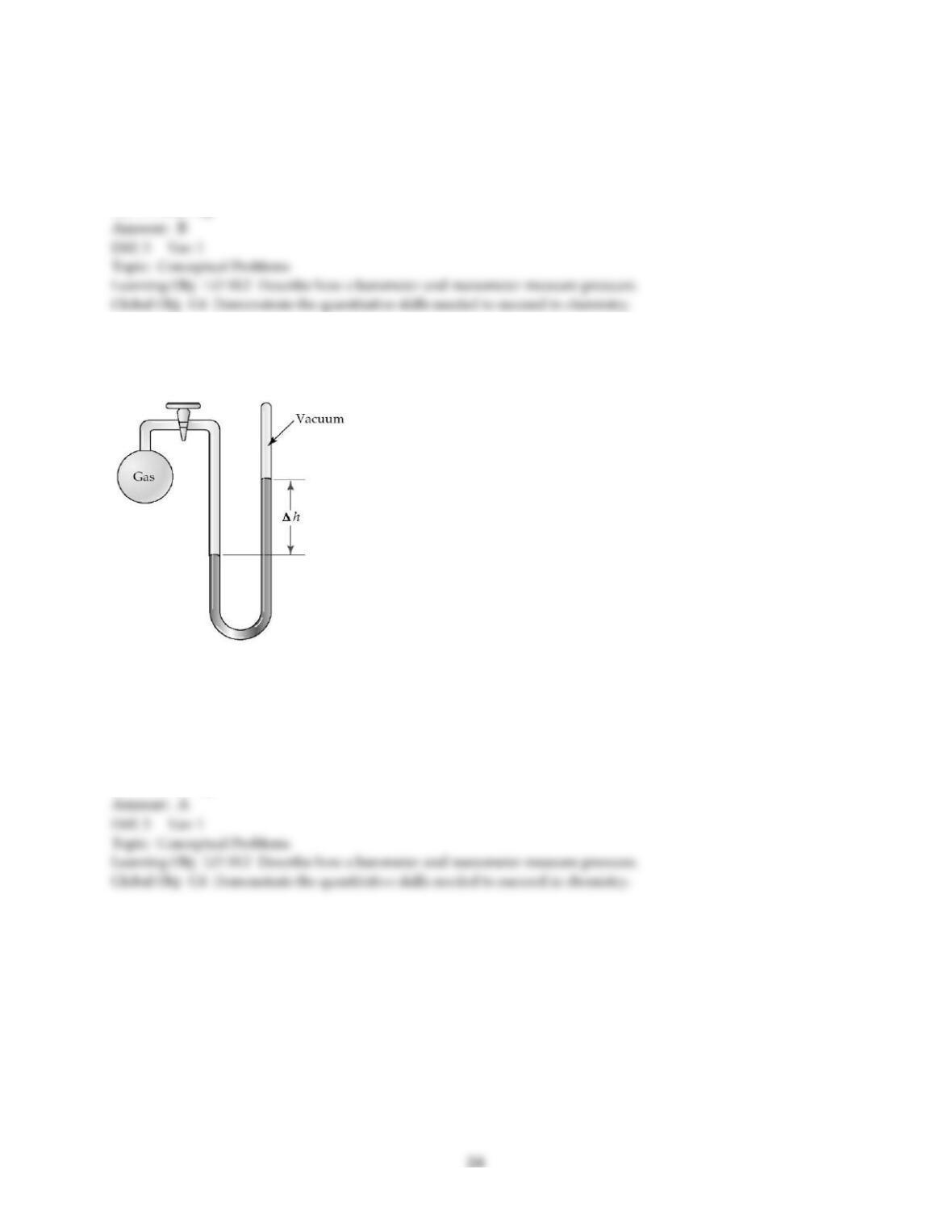
is 745 mm Hg and the difference in mercury levels, Δh, is 25 mm Hg?
A) 25 mm Hg
B) 720 mm Hg
C) 745 mm Hg
D) 770 mm Hg
The apparatus shown is called a closed-end manometer because the arm not connected to the gas sample is
closed to the atmosphere and is under vacuum.
83) What is the pressure (in mm Hg) of the gas inside the above apparatus if the outside pressure, Patm,
is 745 mm Hg and the difference in mercury levels, Δh, is 25 mm Hg?
A) 25 mm Hg
B) 720 mm Hg
C) 745 mm Hg
D) 770 mm Hg
84) What is the pressure (in mm Hg) of the gas inside the above apparatus if the outside pressure, Patm,
is 750 mm Hg and the difference in mercury levels, Δh, is 25 mm Hg?
A) 25 mm Hg
B) 725 mm Hg
C) 750 mm Hg
D) 775 mm Hg
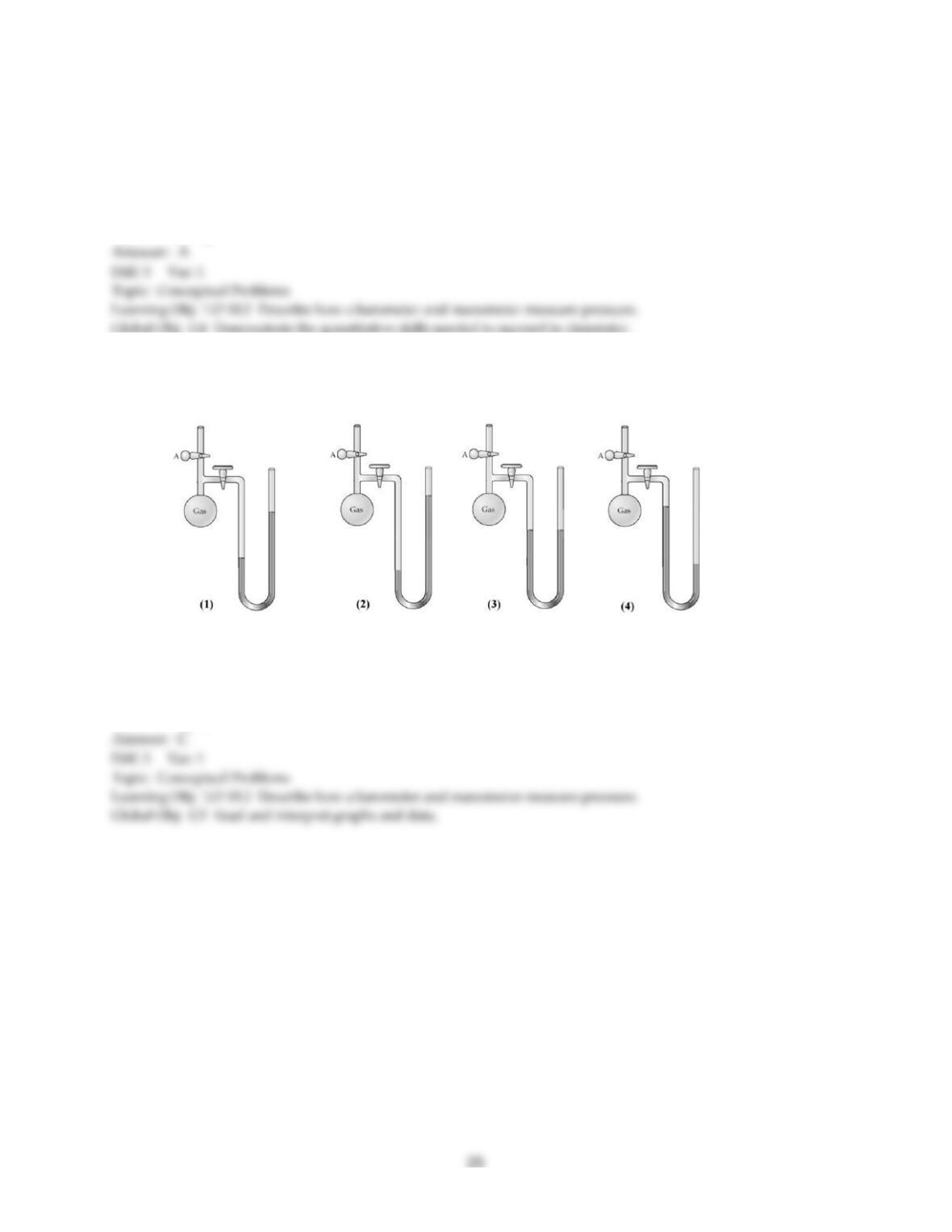
85) When stopcock A of the open-end manometer shown below is opened, which drawing best represents
the result?
A) drawing (1)
B) drawing (2)
C) drawing (3)
D) drawing (4)
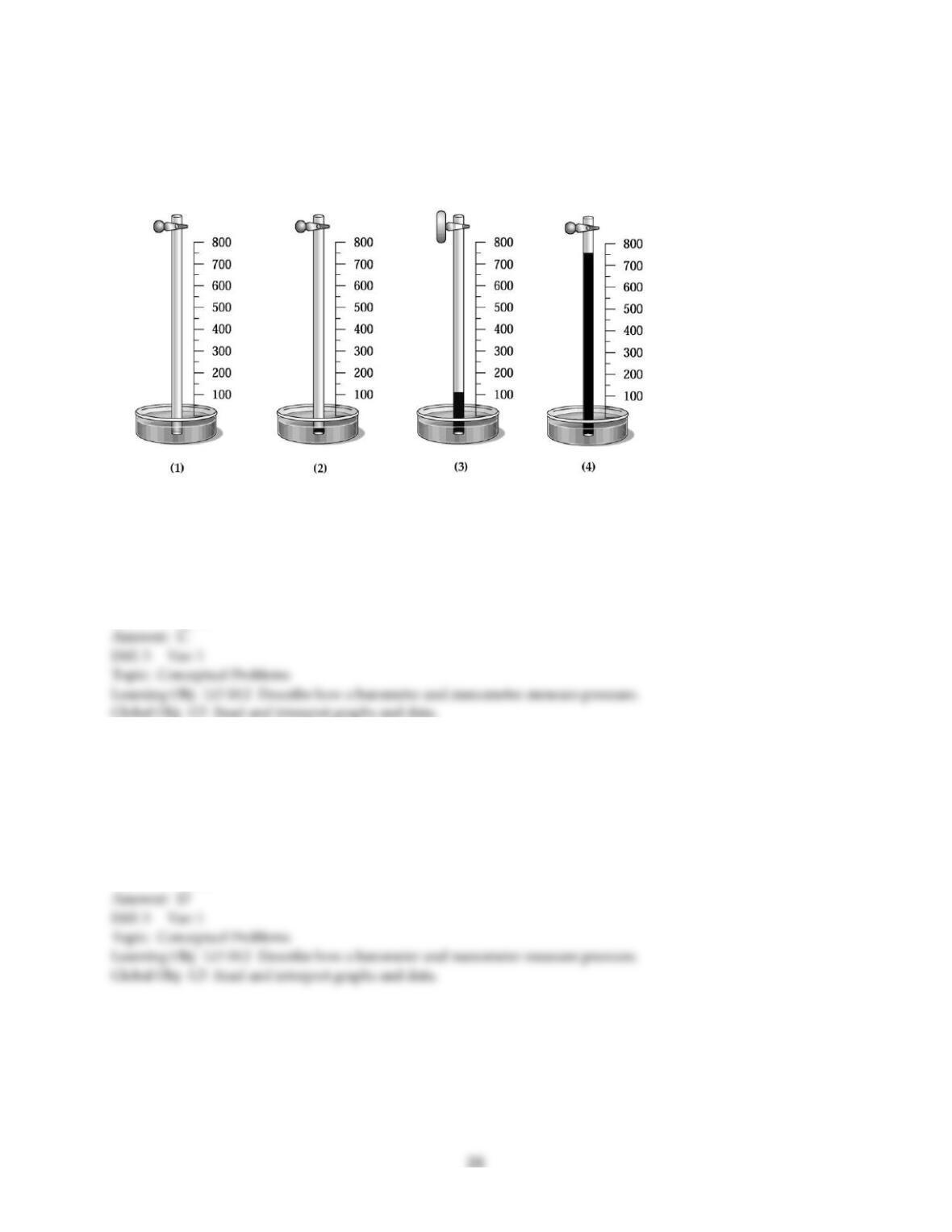
A glass tube has one end in a dish of mercury and the other end closed by a stopcock. The distance from
the surface of the mercury to the bottom of the stopcock is 800 mm, as indicated by the meter stick shown
in the drawing below. The apparatus is at 20°C, and the mercury level in the tube is the same as that in
the dish.
86) Which drawing best shows the approximate level of the mercury in the tube when the temperature of
the entire apparatus is lowered from +20°C to -20°C?
A) drawing (1)
B) drawing (2)
C) drawing (3)
D) drawing (4)
87) Which drawing best shows the approximate level of the mercury in the tube when a vacuum pump is
connected to the top of the tube, the stopcock opened, the tube is evacuated, the stopcock is closed, and
the pump is removed?
A) drawing (1)
B) drawing (2)
C) drawing (3)
D) drawing (4)
88) Which drawing best shows the approximate level of the mercury in the tube when a vacuum pump is
connected to the top of the tube, the stopcock opened, the tube is evacuated, the stopcock is closed, and
the pump is removed, and the stopcock is reopened?
A) drawing (1)
B) drawing (2)
C) drawing (3)
D) drawing (4)
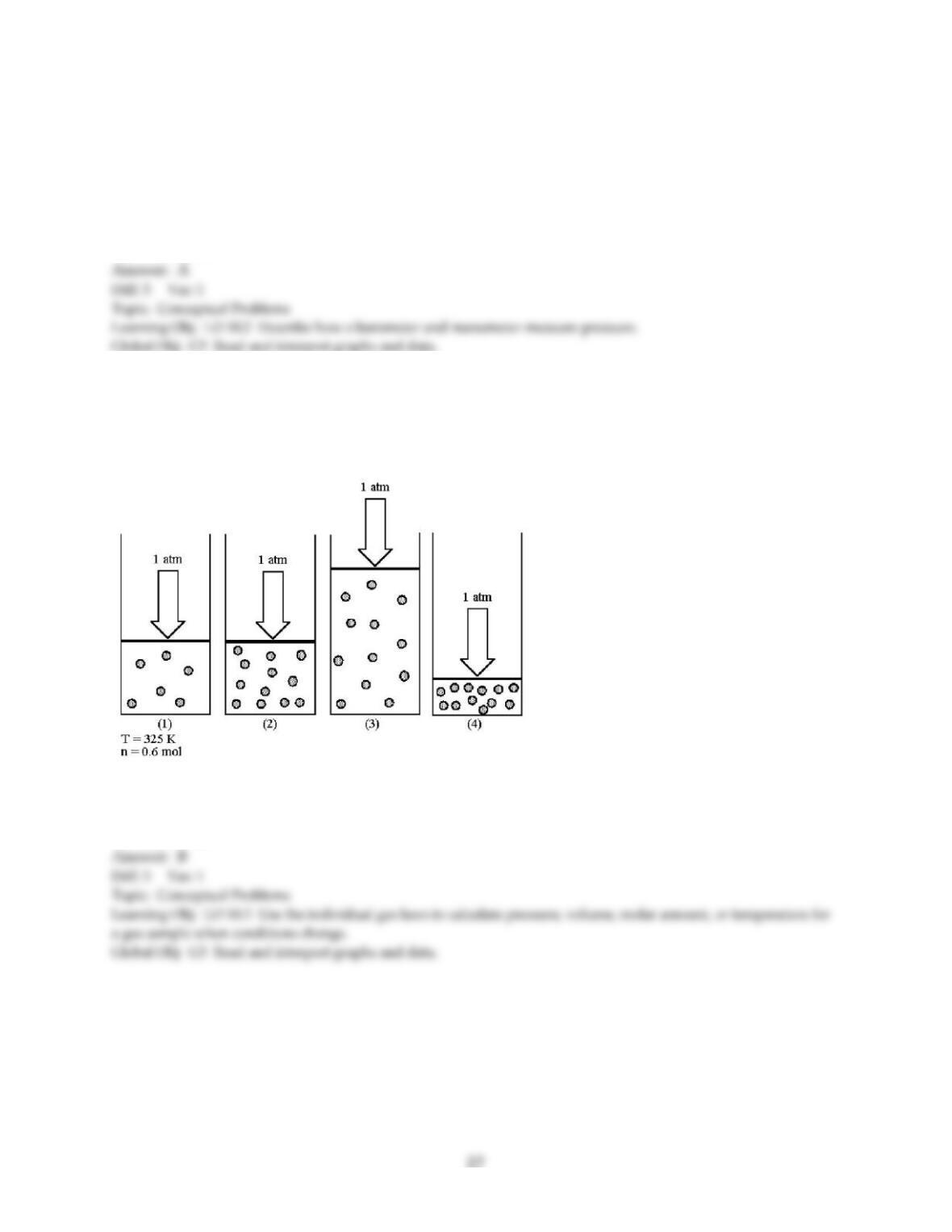
89) Assume that you have a sample of gas in a cylinder with a moveable piston, as shown in diagram (1).
The initial pressure, number of moles, and temperature of the gas are noted on the diagram. Which
diagram (2)-(4) most closely represents the result of doubling the number of moles of gas while keeping
the pressure and temperature constant?
A) diagram (2)
B) diagram (3)
C) diagram (4)
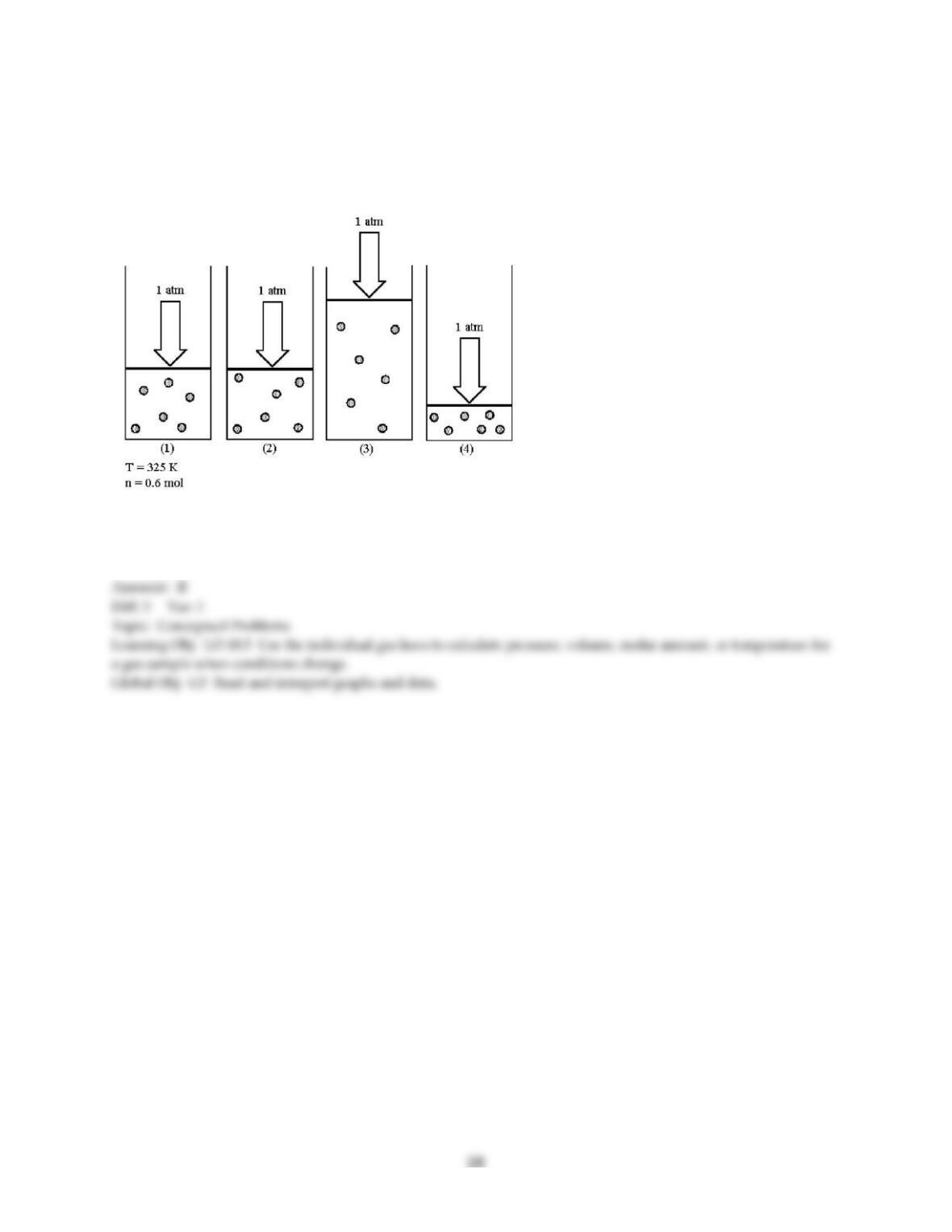
90) Assume that you have a sample of gas in a cylinder with a moveable piston, as shown in diagram (1).
The initial pressure, number of moles, and temperature of the gas are noted on the diagram. Which
diagram (2)-(4) most closely represents the result of doubling the temperature while keeping the pressure
and number of moles of gas constant?
A) diagram (2)
B) diagram (3)
C) diagram (4)
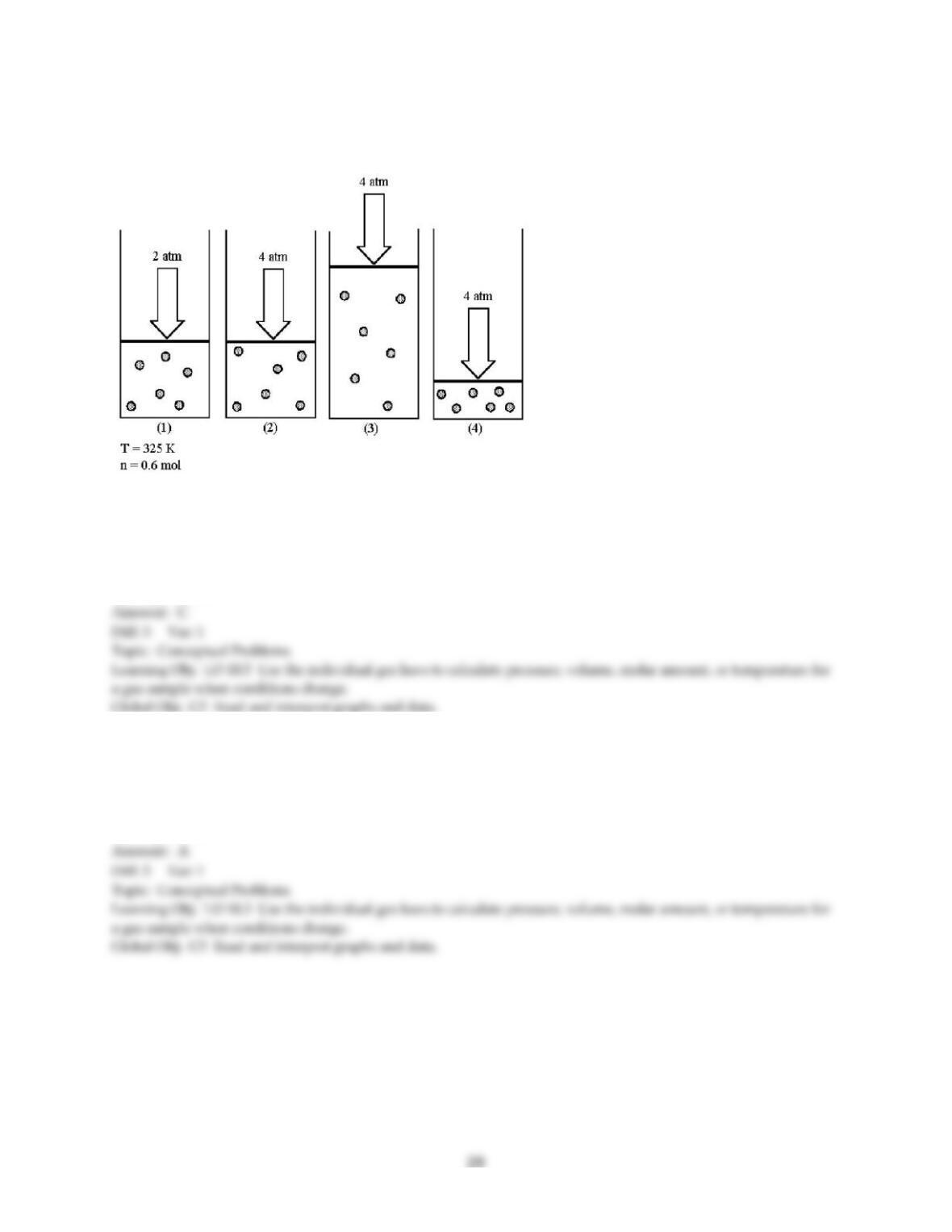
Assume that you have a sample of gas in a cylinder with a moveable piston, as shown in diagram (1). The
initial pressure, number of moles, and temperature of the gas are noted on the diagram.
91) Which diagram (2)-(4) most closely represents the result of doubling the pressure while keeping the
temperature and number of moles of gas constant?
A) diagram (2)
B) diagram (3)
C) diagram (4)
92) Which diagram (2)-(4) most closely represents the result of doubling the pressure and doubling the
temperature while keeping the number of moles of gas constant?
A) diagram (2)
B) diagram (3)
C) diagram (4)
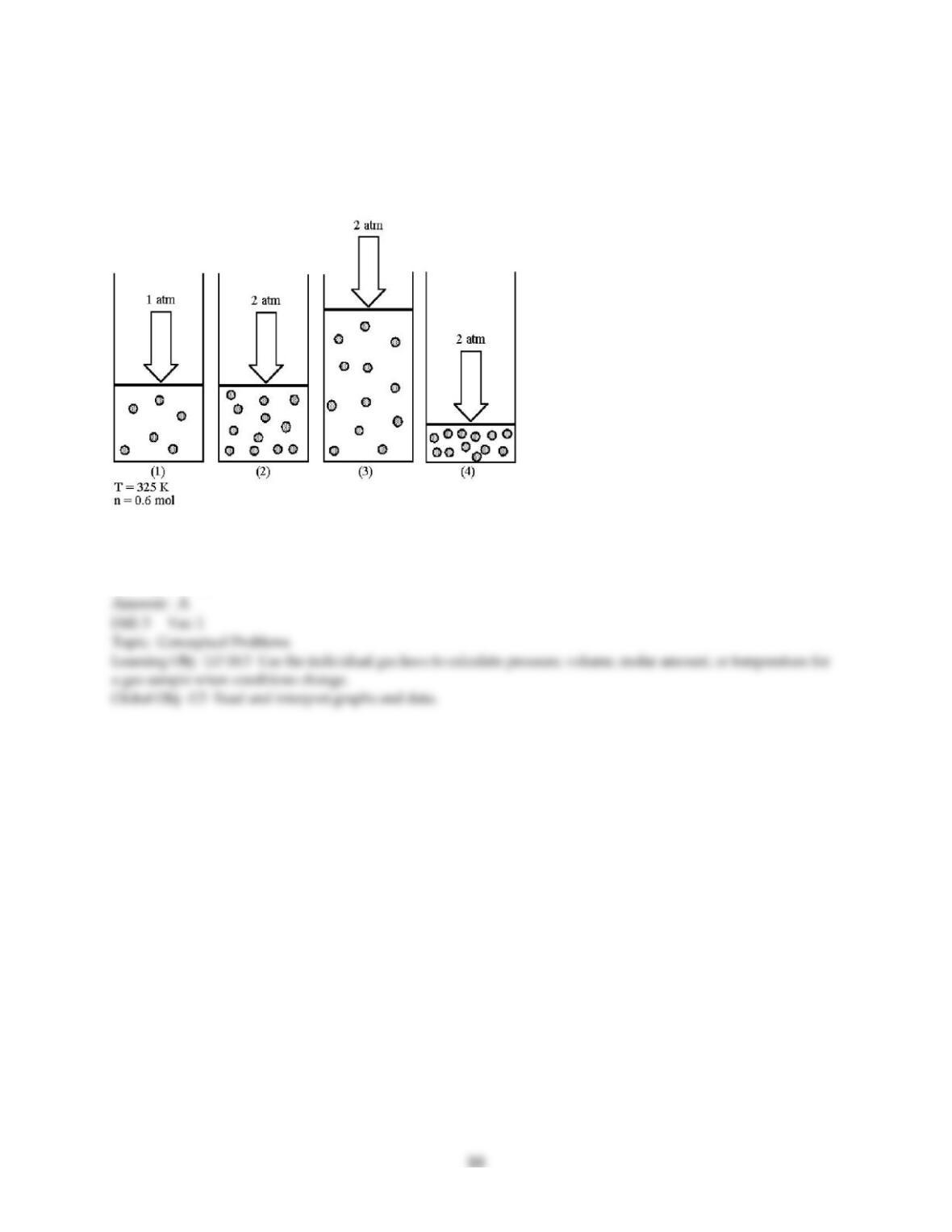
93) Assume that you have a sample of gas in a cylinder with a moveable piston, as shown in diagram (1).
The initial pressure, number of moles, and temperature of the gas are noted on the diagram. Which
diagram (2)-(4) most closely represents the result of doubling the pressure and number of moles of gas
while keeping the temperature constant?
A) diagram (2)
B) diagram (3)
C) diagram (4)
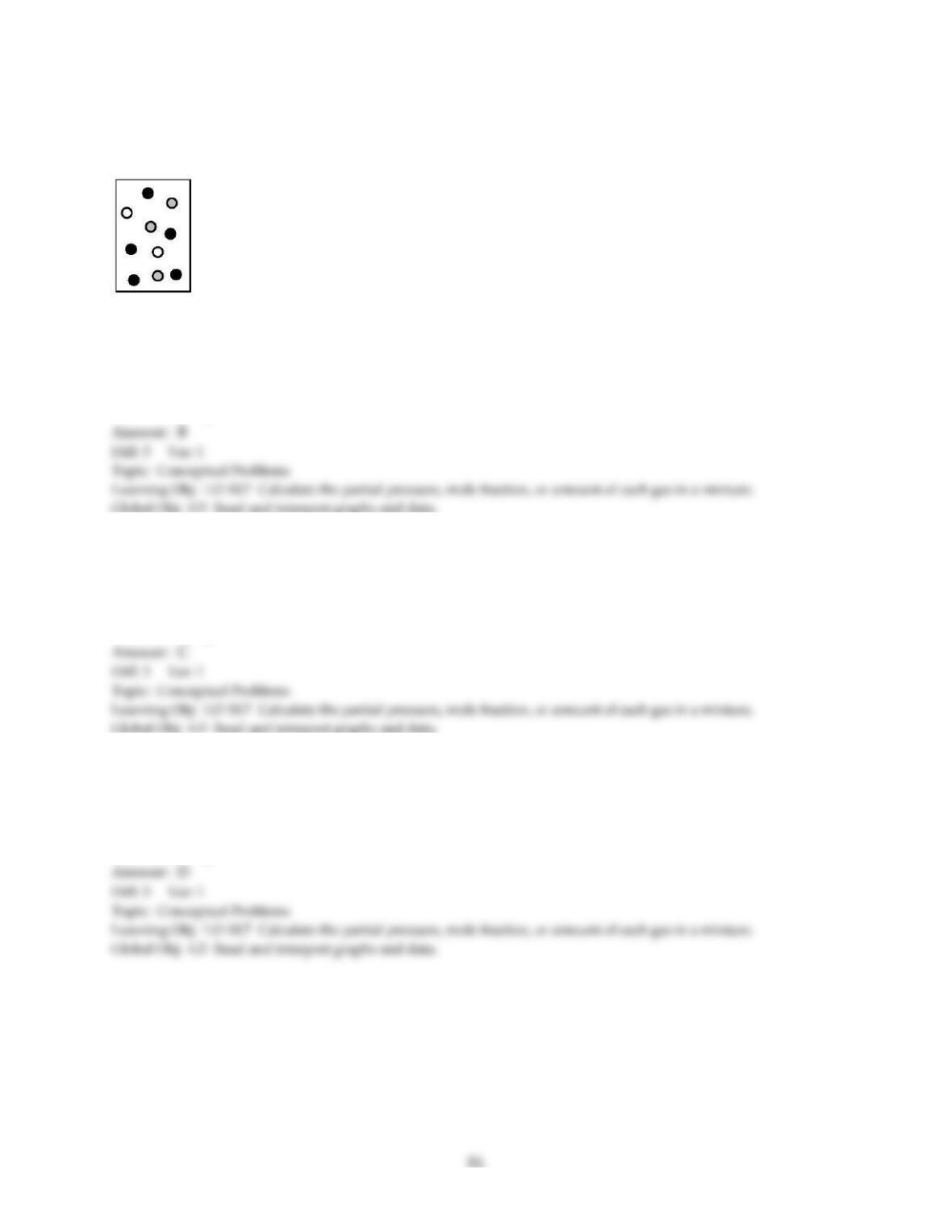
In the diagram below, helium atoms are represented by unshaded spheres, neon atoms by gray spheres,
and argon atoms by black spheres.
94) If the total pressure in the container is 900 mm Hg, what is the partial pressure of helium?
A) 90 mm Hg
B) 180 mm Hg
C) 270 mm Hg
D) 450 mm Hg
95) If the total pressure in the container is 900 mm Hg, what is the partial pressure of neon?
A) 90 mm Hg
B) 180 mm Hg
C) 270 mm Hg
D) 450 mm Hg
96) If the total pressure in the container is 900 mm Hg, what is the partial pressure of argon?
A) 90 mm Hg
B) 180 mm Hg
C) 270 mm Hg
D) 450 mm Hg
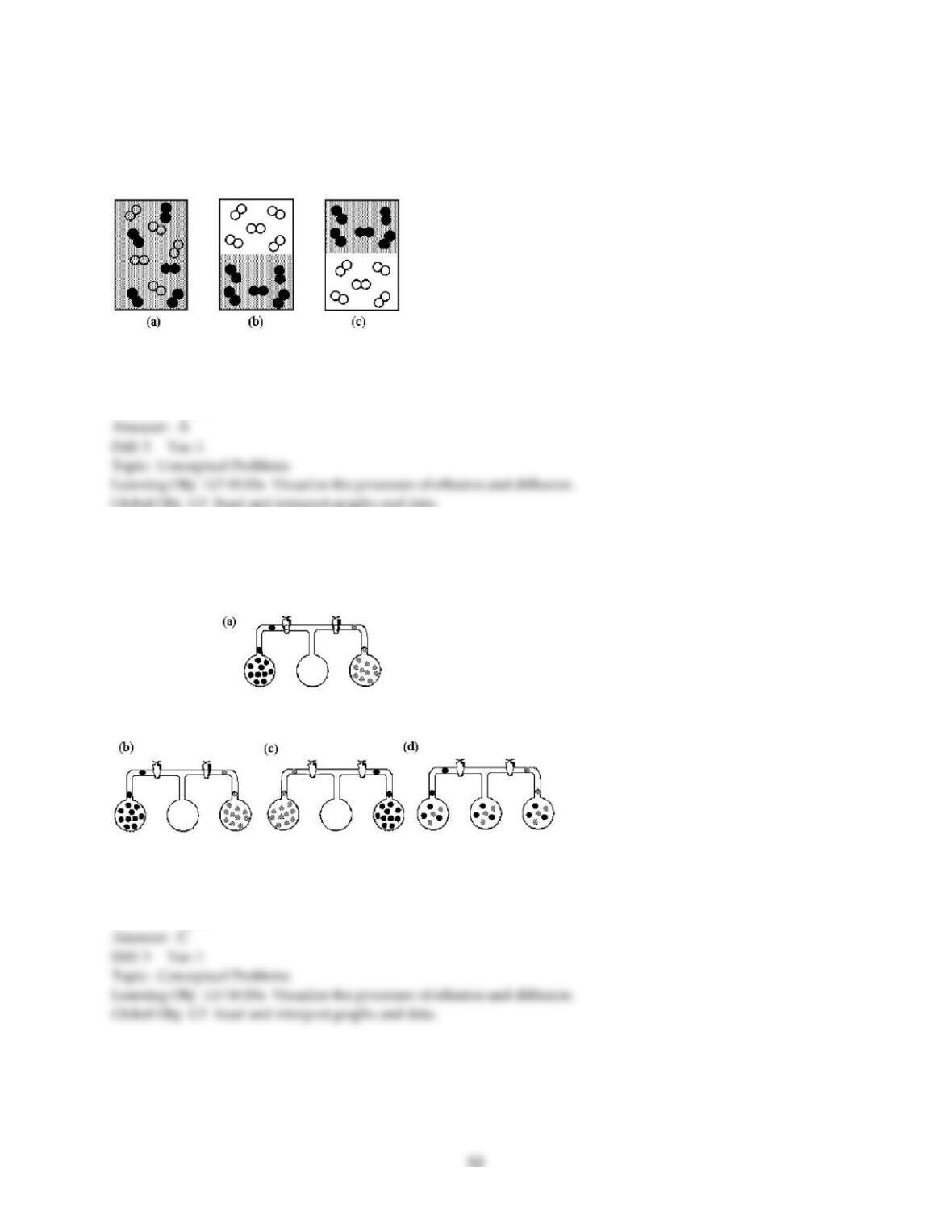
97) Assume that you have a mixture of nitrogen (molecular mass = 28 amu), represented by unshaded
spheres, and chlorine (molecular mass = 71 amu), represented by shaded spheres at 300 K. Which of the
drawings best represents the mixture?
A) drawing (a)
B) drawing (b)
C) drawing (c)
98) Three bulbs, two of which contain different gases and one of which is empty, are connected as shown
in drawing (a). Which drawing (b) – (d) best represents the system after the stopcocks are opened and the
system is allowed to come to equilibrium?
A) drawing (b)
B) drawing (c)
C) drawing (d)
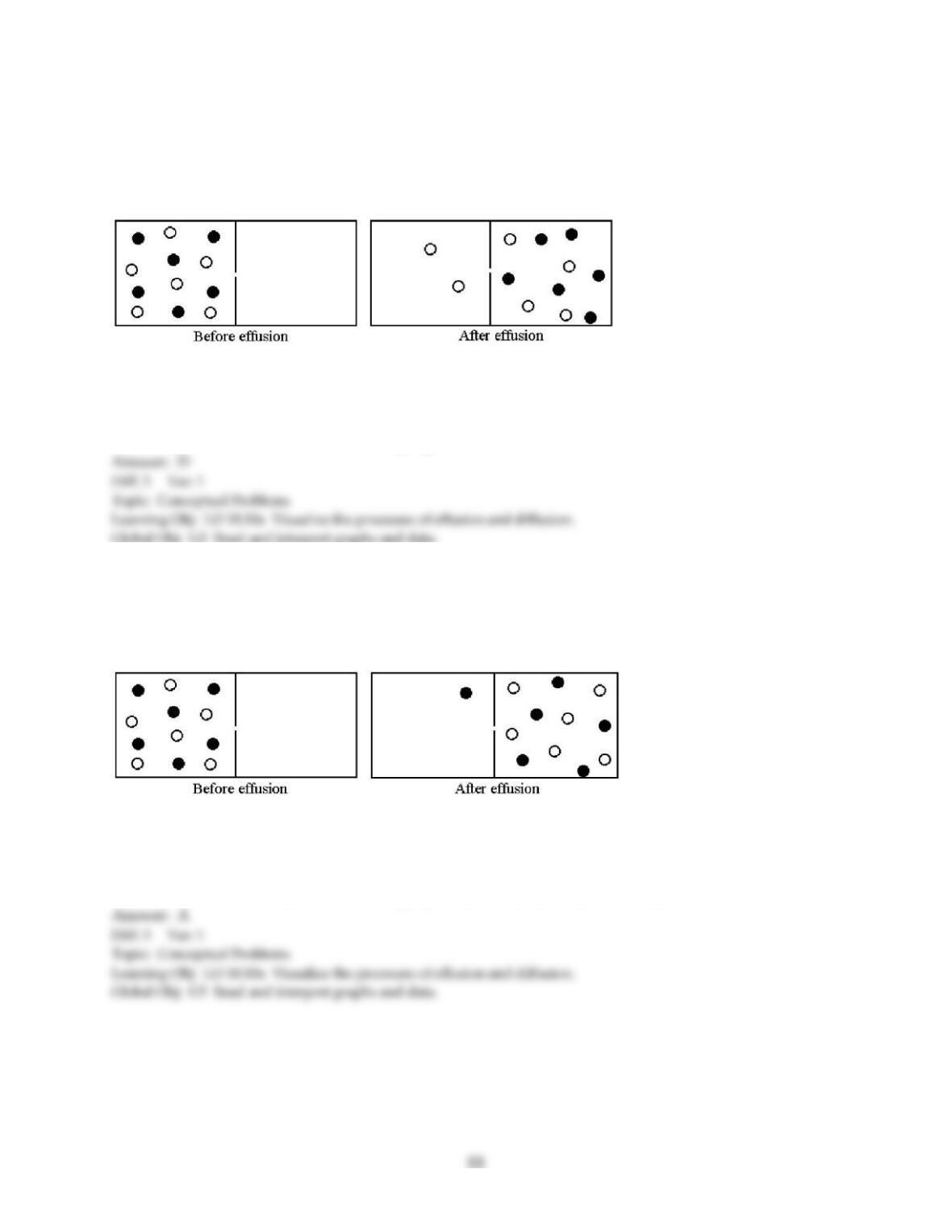
99) Effusion of a 1:1 mixture of two gases, represented by unshaded and shaded spheres in the diagram
below, through a small pinhole produces the result shown below. The shaded spheres have a molecular
mass of 32 amu. Which gas molecules have the higher average speed and what is the molecular mass of
the unshaded molecules?
A) Unshaded molecules have higher average speed and molecular mass = 14 amu.
B) Unshaded molecules have higher average speed and molecular mass = 21 amu.
C) Unshaded molecules have lower average speed and molecular mass = 48 amu.
D) Unshaded molecules have lower average speed and molecular mass = 72 amu.
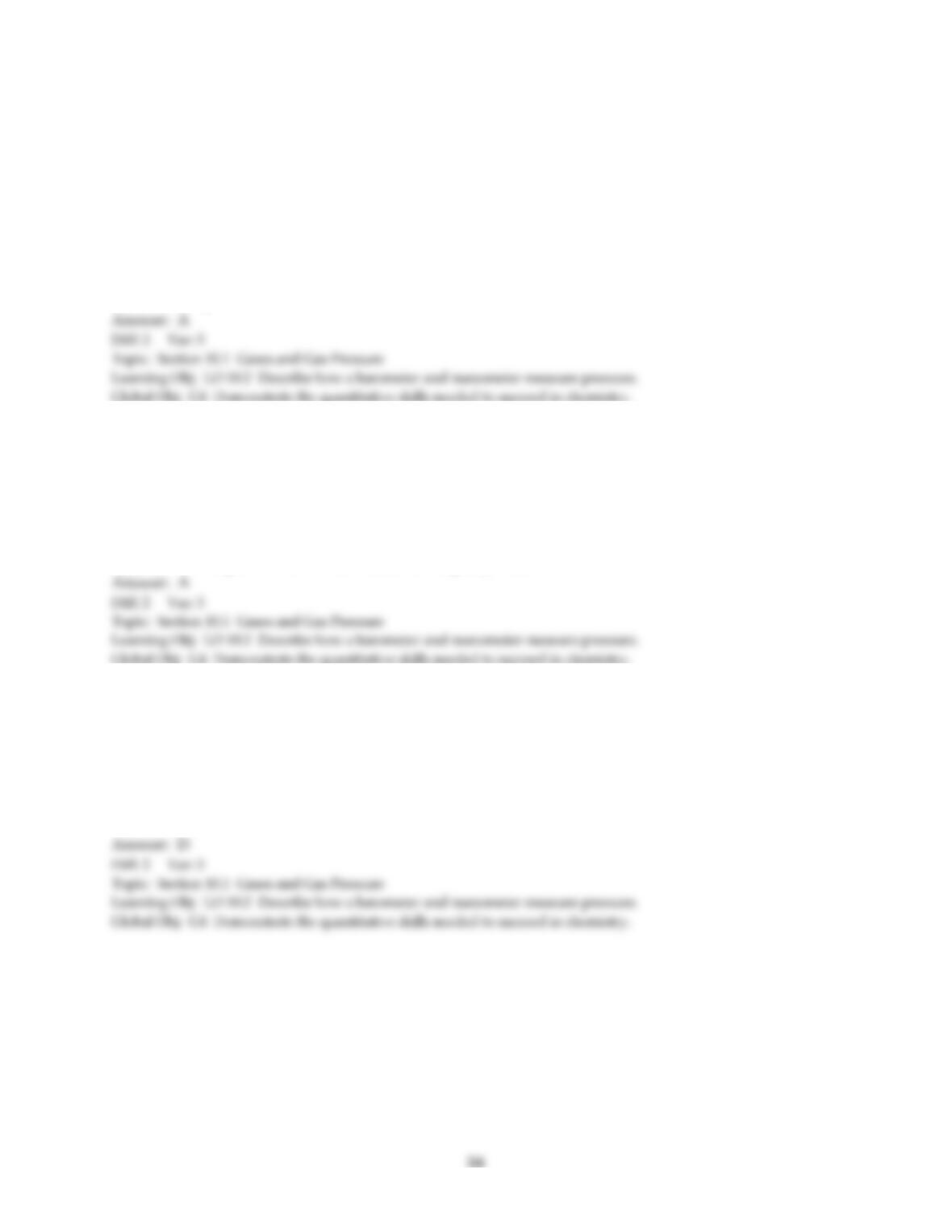
100) Effusion of a 1:1 mixture of two gases, represented by unshaded and shaded spheres in the diagram
below, through a small pinhole produces the result shown below. The shaded spheres have a molecular
mass of 20 amu. Which gas molecules have the higher average speed and what is the molecular mass of
the unshaded molecules?
A) Unshaded molecules have higher average speed and molecular mass = 14 amu.
B) Unshaded molecules have higher average speed and molecular mass = 17 amu.
C) Unshaded molecules have lower average speed and molecular mass = 24 amu.
D) Unshaded molecules have lower average speed and molecular mass = 29 amu.
10.2 Algorithmic Questions
1) What is the pressure in a gas container that is connected to an open-end U-tube manometer if the
pressure of the atmosphere is 722 torr and the level of mercury in the arm connected to the container is
8.60 cm higher than the level of mercury open to the atmosphere?
A) 636 mm Hg
B) 713 mm Hg
C) 731 mm Hg
D) 808 mm Hg
2) If the pressure in a gas container that is connected to an open-end U-tube manometer is 126 kPa and
the pressure of the atmosphere at the open end of the tube is 732 mm Hg, the level of mercury in the tube
will
A) be 213 mm higher in the arm open to the atmosphere.
B) be 213 mm higher in the arm connected to the gas cylinder.
C) be 945 mm higher in the arm open to the atmosphere.
D) be 945 mm higher in the arm connected to the gas cylinder.
3) A container filled with gas is connected to an open-end manometer that is filled with mineral oil. The
pressure in the gas container is 763 mm Hg and atmospheric pressure is 734 mm. How high will the level
rise in the manometer if the densities of Hg and mineral oil are 13.6 g/mL and 0.822 g/mL respectively?
A) 1.75 mm
B) 23.8 mm
C) 29.0 mm
D) 480 mm
4) Carbon dioxide is a gas which causes environmental concern because of the greenhouse effect. What is
the approximate percentage (by volume) of CO2 in the atmosphere?
A) 0.040%
B) about 3%
C) about 8%
D) more than 15%
5) Which of the following is equivalent to 1 atm pressure?
A) 1.101325 bar
B) 1.00 bar
C) 20 psi
D) 740 mm Hg
6) The pressure in the eye of a hurricane is less than atmospheric pressure. Which one of the following
pressure readings could not have been taken in the eye of a hurricane?
A) 16 lbs/in2
B) 66 cm Hg
C) 660 mm Hg
D) 9.45 × 10⁴ Pa
7) A basketball is inflated to a pressure of 1.80 atm in a 23.0°C garage. What is the pressure of the
basketball outside where the temperature is –2.00°C?
A) 1.65 atm
B) 1.70 atm
C) 1.90 atm
D) 1.97 atm
36
8) A gas bottle contains 0.450 mol of gas at 730 mm Hg pressure. If the final pressure is 1.15 atm, how
many moles of gas were added to the bottle?
A) 0.0471 mol
B) 0.0888 mol
C) 0.497 mol
D) 0.539 mol
9) The volume of 350. mL of gas at 25°C is decreased to 125 mL at constant pressure. What is the final
temperature of the gas?
A) -167°C
B) 8.9°C
C) 70°C
D) 561°C
10) A balloon filled with helium gas at 20°C occupies 3.91 L at 1.00 atm. The balloon is immersed in liquid
nitrogen at -196°C, raising the pressure to 5.20 atm. What is the volume of the balloon in the liquid
nitrogen?
A) 0.20 L
B) 2.6 L
C) 5.3 L
D) 77 L
11) Which one of the following is not used to describe the condition of a gas?
A) number of moles
B) electronic configuration
C) temperature
D) pressure
12) An “empty” aerosol can at 25°C still contains gas at 1.00 atmosphere pressure. If an “empty” can is
thrown into a 450°C fire, what is the final pressure in the heated can?
A) 5.56 × 10⁻² atm
B) 0.413 atm
C) 2.42 atm
D) 18.0 atm
13) Three identical flasks contain three different gases at standard temperature and pressure. Flask A
contains flask B contains SO2, and flask C contains He. Which flask contains the largest number of
molecules?
A) flask A
B) flask B
C) flask C
D) All contain same number of molecules.
14) How many molecules of N2 are in a 300.0 mL container at 780 mm Hg and 135°C?
A) 5.26 × 10²¹ molecules
B) 5.54 × 10²¹ molecules
C) 1.59 × 10²² molecules
D) 1.67 × 10²² molecules
15) A 1.75-L container filled with CO2 gas at 25°C and 225 kPa pressure springs a leak. When the
container is re-sealed, the pressure is 185 kPA and the temperature is 10°C. How many moles of gas were
lost?
A) 0.0213 mol
B) 0.463 mol
C) 0.561 mol
D) 2.16 mol
16) A 55.0-L steel tank at 20.0°C contains acetylene gas, C2H2, at a pressure of 1.39 atm. Assuming ideal
behavior, how many grams of acetylene are in the tank?
A) 3.17 g
B) 8.20 g
C) 82.9 g
D) 1210 g
17) A 5.00-L flask contains nitrogen gas at 25°C and 1.00 atm pressure. What is the final pressure in the
flask if an additional 2.00 g of N2 gas is added to the flask and the flask cooled to –55°C?
A) 0.255 atm
B) 0.987 atm
C) 1.35 atm
D) 1.84 atm