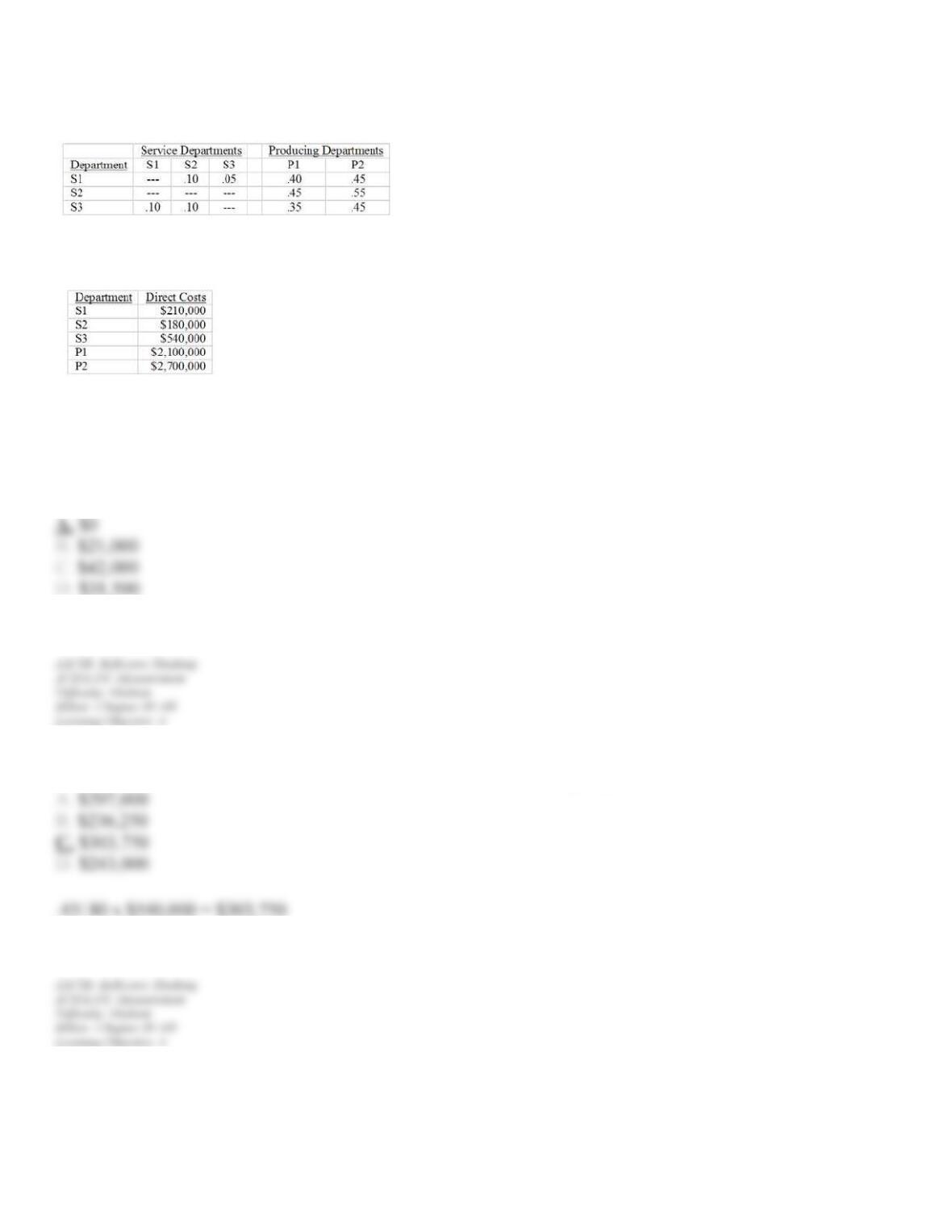
Use the following to answer questions 68-76:
A summary of the usage of the service department services by other services departments as well as by two
producing departments is as follows:
Direct costs in the various departments are as follows:
Hilton – Chapter 10
68. If the direct-method is used, how much of S1’s costs would be allocated to S2?
69. If the direct–method of allocation is used, how much of S3’s occupancy cost would be allocated to P2?
70. Assuming the direct-method of allocation is used, what will be the total costs in production department 1
after all allocations have been made?
71. In what order should the three service departments be allocated, assuming the step–method is used?
72. If the step-method of allocation is used, how much would be allocated from S1 to P1?
73. If the step-method of allocation is used, how much would be allocated from S1 to S3?
74. If the step-method of allocation is used, the total cost after allocation in P1 would be:
75. If the step-method of allocation is used, the amount allocated from S2 to P2 would be:
76. If the reciprocal-method of allocation is used, what equation would represent service department S1?
(Appendix)
77. Which of the following statements about the choice of cost–allocation method is false?
78. Which of the following would be the most effective combination of cost-driver bases?

79. Island Credit Checks Company produces two styles of credit reports: Individual and Corporate. The
difference between the two is the amount of background information and data collection required. The
Corporate report uses more skilled personnel because additional checking and data are required. The relevant
figures for the year just completed follow. Total support service costs to be allocated are $3,200,000.
Required: For each of the four potential allocation bases, determine the amount of support-service cost
allocated to each type of report. Round all percentages to two decimal places.
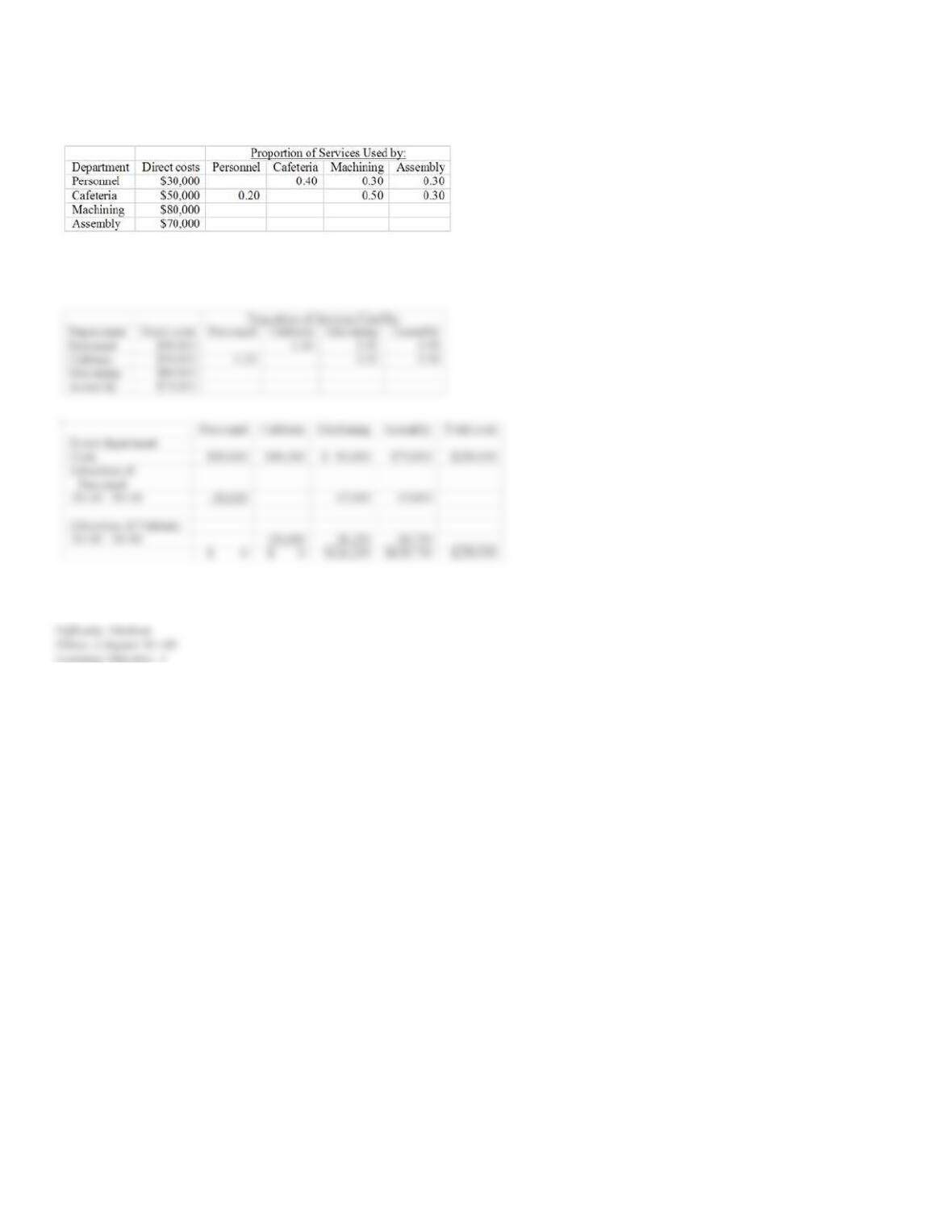
80. New London Corporation has two production Departments: Assembly and Machining and two service
departments: Personnel and Cafeteria. Direct costs for each department and the proportion of service costs used
by the various departments for the month of July, 2006 are as follows:
Required: Compute the allocation of service department costs to producing departments for July, 2006 using
the direct-method.
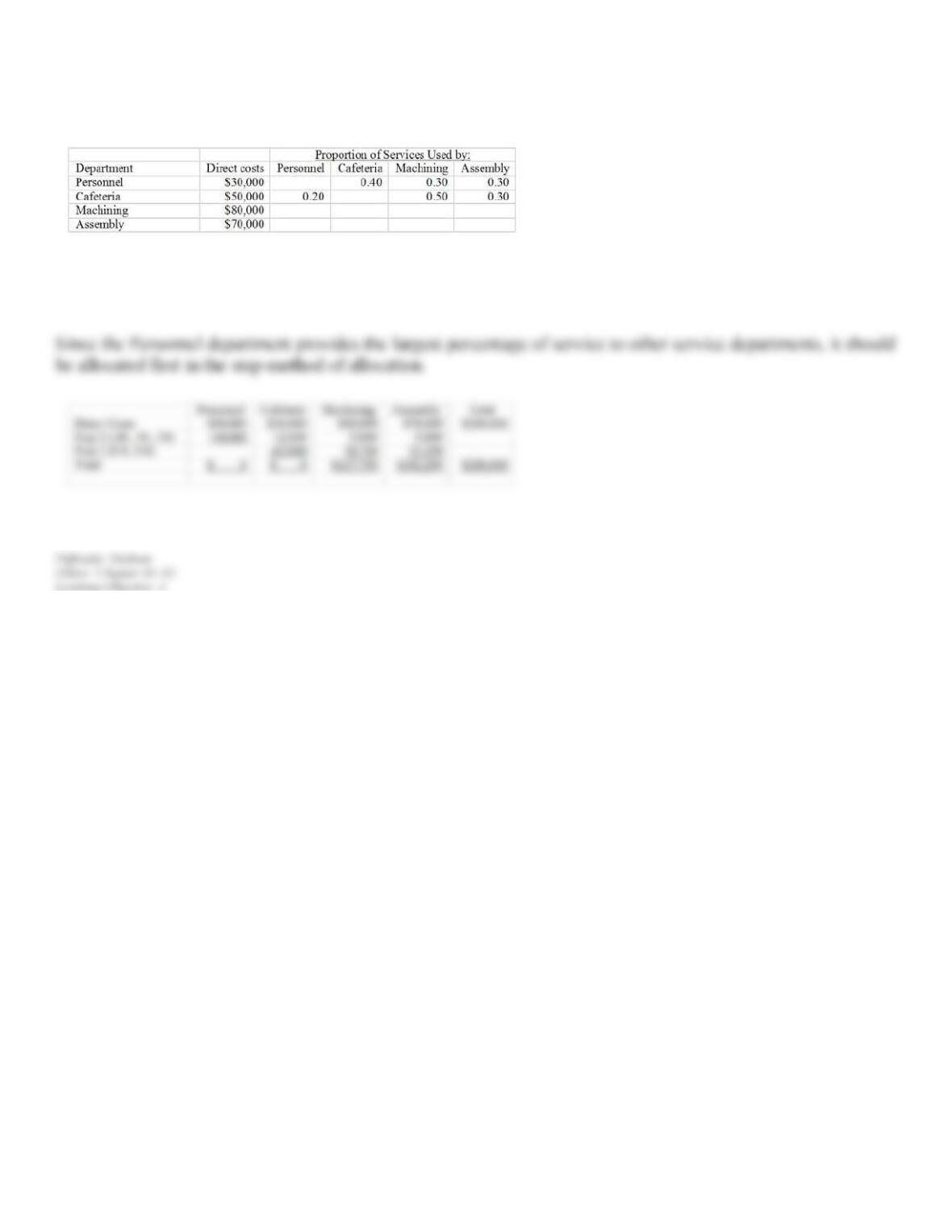
81. Tulis Corporation has two production Departments: Assembly and Machining and two service departments:
Personnel and Cafeteria. Direct costs for each department and the proportion of service costs used by the
various departments for the month of July, 2006 are as follows:
Required: Compute the allocation of service department costs to producing departments for July, 2006 using
the step -method.
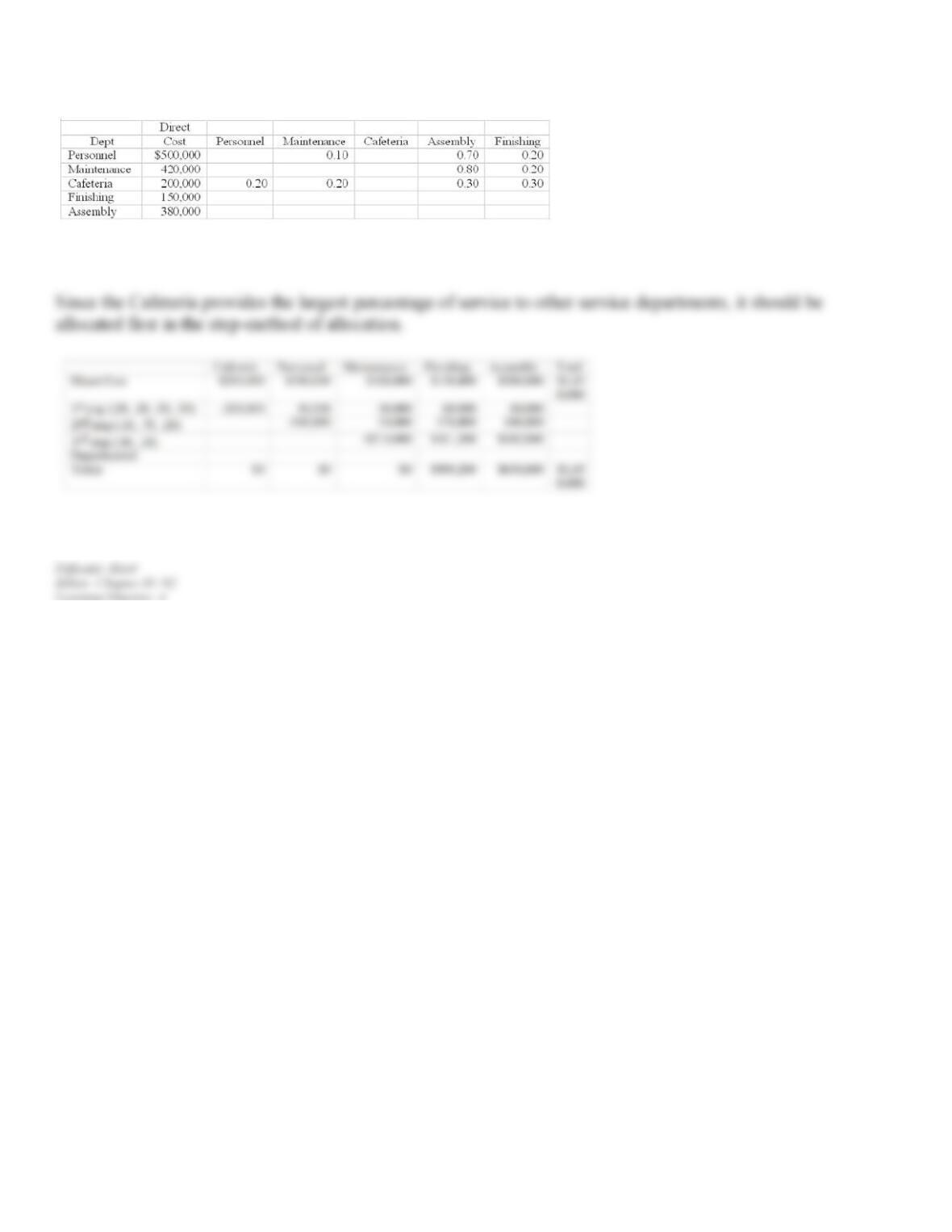
82. Amherst Corporation has two production departments, Assembly and Finishing and three Service
Departments, Personnel, Maintenance and Cafeteria. Data relevant to Amherst are:
Required: Allocate the service department costs of Amherst Corporation using the step-method of cost
allocation.
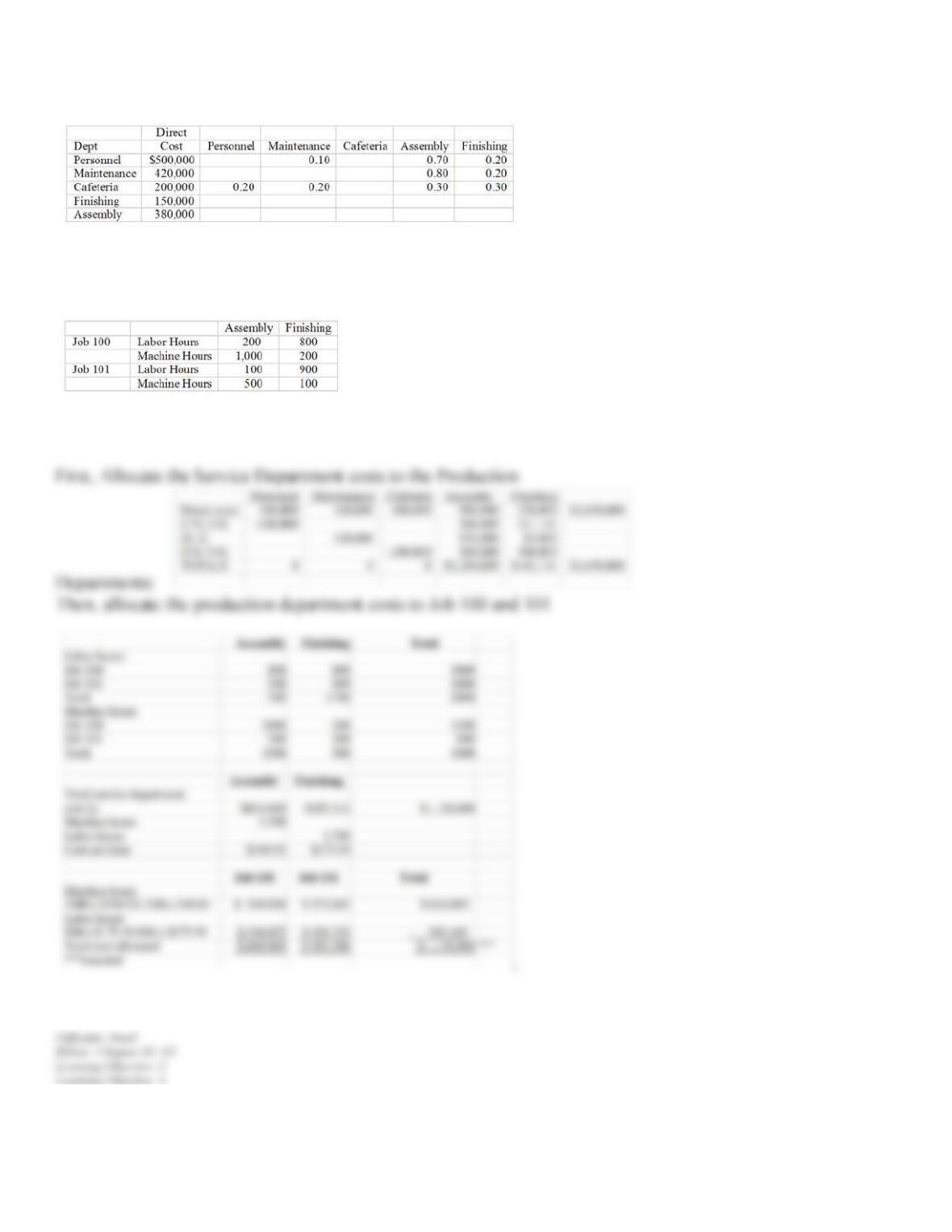
83. Rogers Corporation has two production departments, Assembly and Finishing and three service departments,
Personnel, Maintenance and Cafeteria. Data relevant to Rogers are:
Assembly and Finishing work on two jobs during the month: Job 100 and 101. Costs are allocated to jobs based
on machine hours in assembly and labor hours in Finishing. The machine and labor hours worked in each
department are as follows:
Required: Determine the amount of service department costs to be allocated to Jobs 100 and 101. Rogers
allocates service department costs to production departments using the direct–method of allocation.
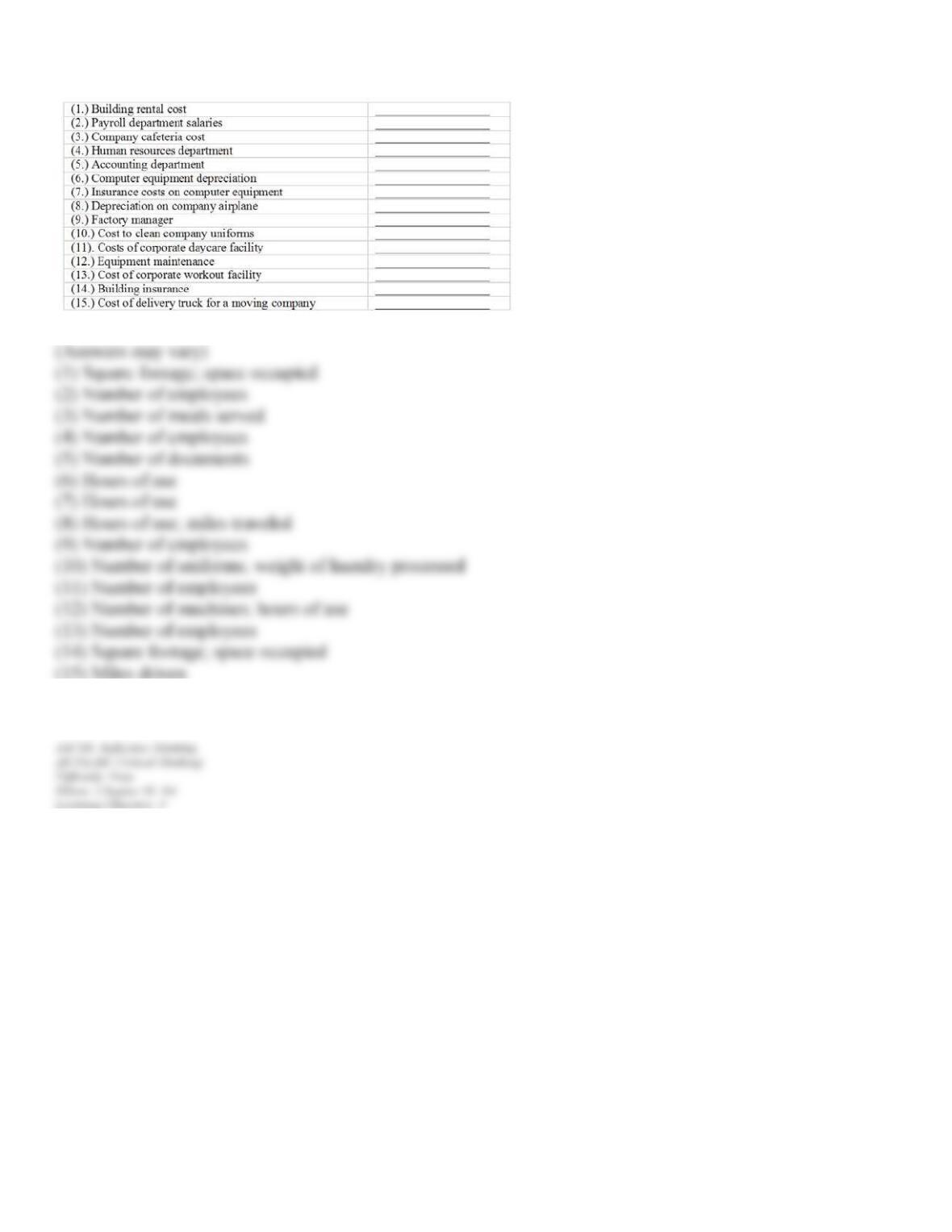
84. For each of the support service costs listed below, name an appropriate cost allocation base:
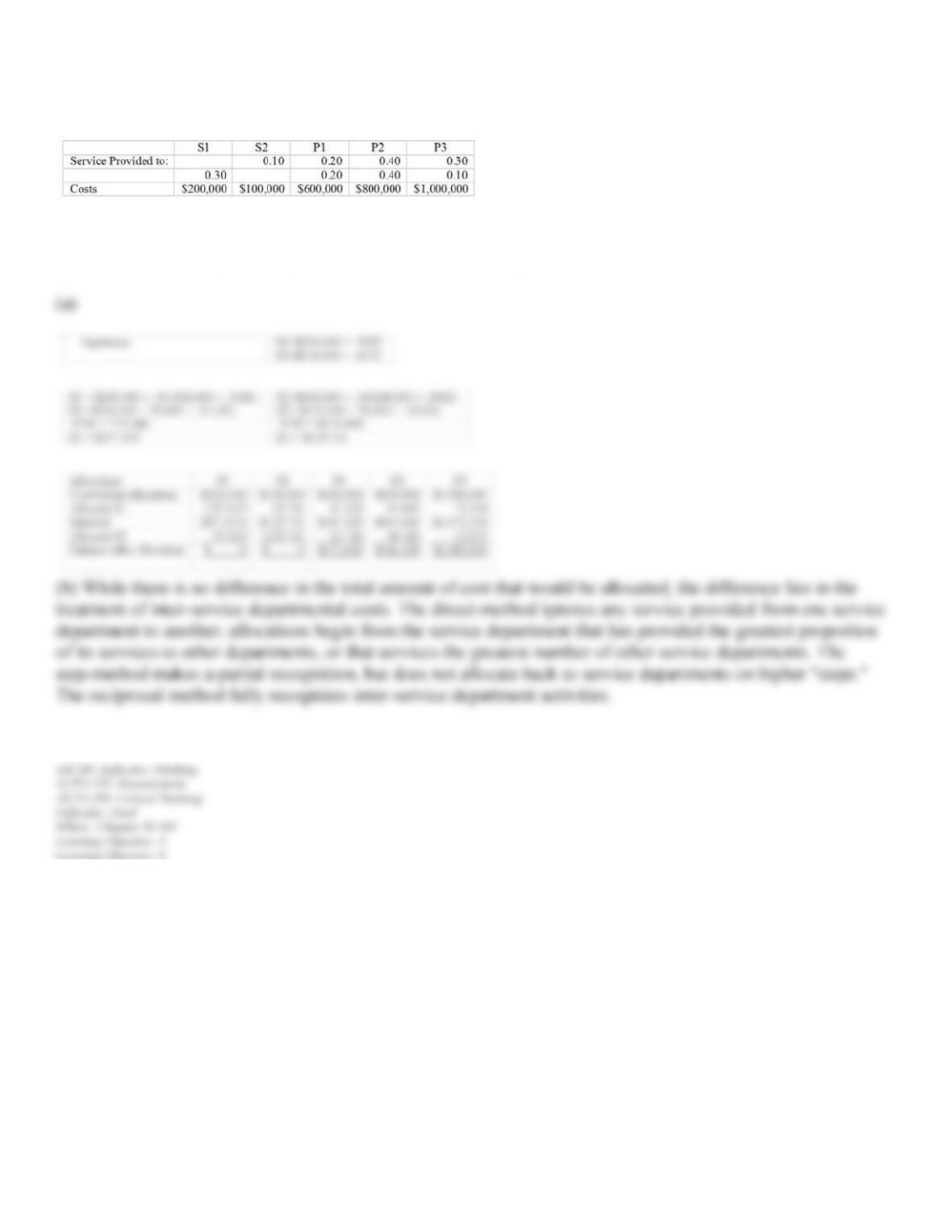
85. (Appendix)
Bruce Consulting has two service departments: S1 and S2 and three production departments:
P1, P2, and P3. Data for a recent month follow:
Required:
a) Determine the allocations to the production departments when the reciprocal method is used.
b) Briefly describe why the reciprocal method is theoretically preferable to other methods of allocation.
86. Goldberg and Rogal Consultants is a large, international consulting organization. The company provides
consulting services in the computer and Internet areas. The company also has several divisions that provide
manufacturing of various computer parts. The company has five divisions which are all profit centers. Each
division includes allocated corporate costs in its annual budget. The budget for the coming year for the Building
and Grounds Service department is $6,000,000. Included in this budget is the maintenance of all corporate
buildings, depreciation, cleaning, insurance and all other facility-related maintenance costs. The company uses a
weighted method of allocating facility costs based on the type of space maintained by each division. Space
ranges from manufacturing warehouses, which are least expensive to maintain, to computer mainframe space,
which requires specialized temperature controls, air conditioning and maintenance. The company has decided to
use a weighting system assigning the following relative weights to each type of space: 1 for warehouse, 3 for
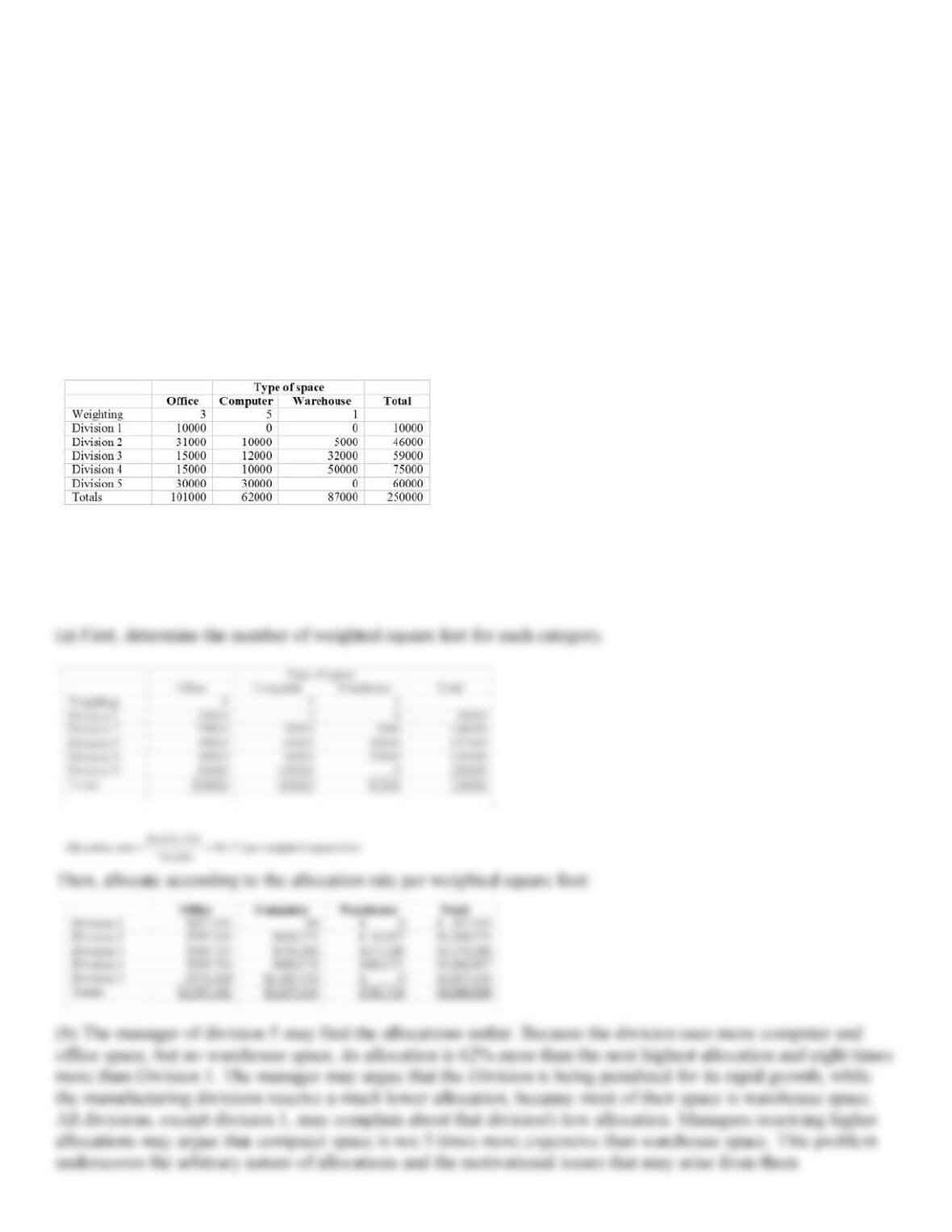
office and 5 for computer space. Below find data relating to the five divisions and the square footage of each
type of space. Currently, Division 5, the Internet consulting division, is the largest in sales volume and profits
for the company, which has been growing at the rate of 20% per year, while divisions 3 and 4 have been
struggling due to declining margins on technology products.
Required:
(a) As director of corporate budgeting, you are required to send to each division its facility allocation for the
coming year. Prepare a schedule showing how the budget of $6,000,000 will be allocated to each division.
(b) Describe potential motivational problems brought on by these allocations. (Based on an actual company)

87. Barletta Corporation has one service department and three producing departments. The budget for the
following year allocates the service department costs to the producing departments based on the number of
employees in each department. Currently, the budget for the service department is $2,400,000 and the number
of employees in each department is as follows:
Department 1: 100
Department 2: 50
Department 3: 150
During the year, due to sudden expanded growth, Department 2 has had to add 50 new employees; however the
service department costs have not increased due to budget constraints.
Required:
a) What were the expected service department allocations at the beginning of the year to each production
department?
b) What will be the actual allocations based on the number of employees each department has at year end?
c) Comment on the reasonableness of the situation. What are the potential causes of any problems created by
this allocation method?
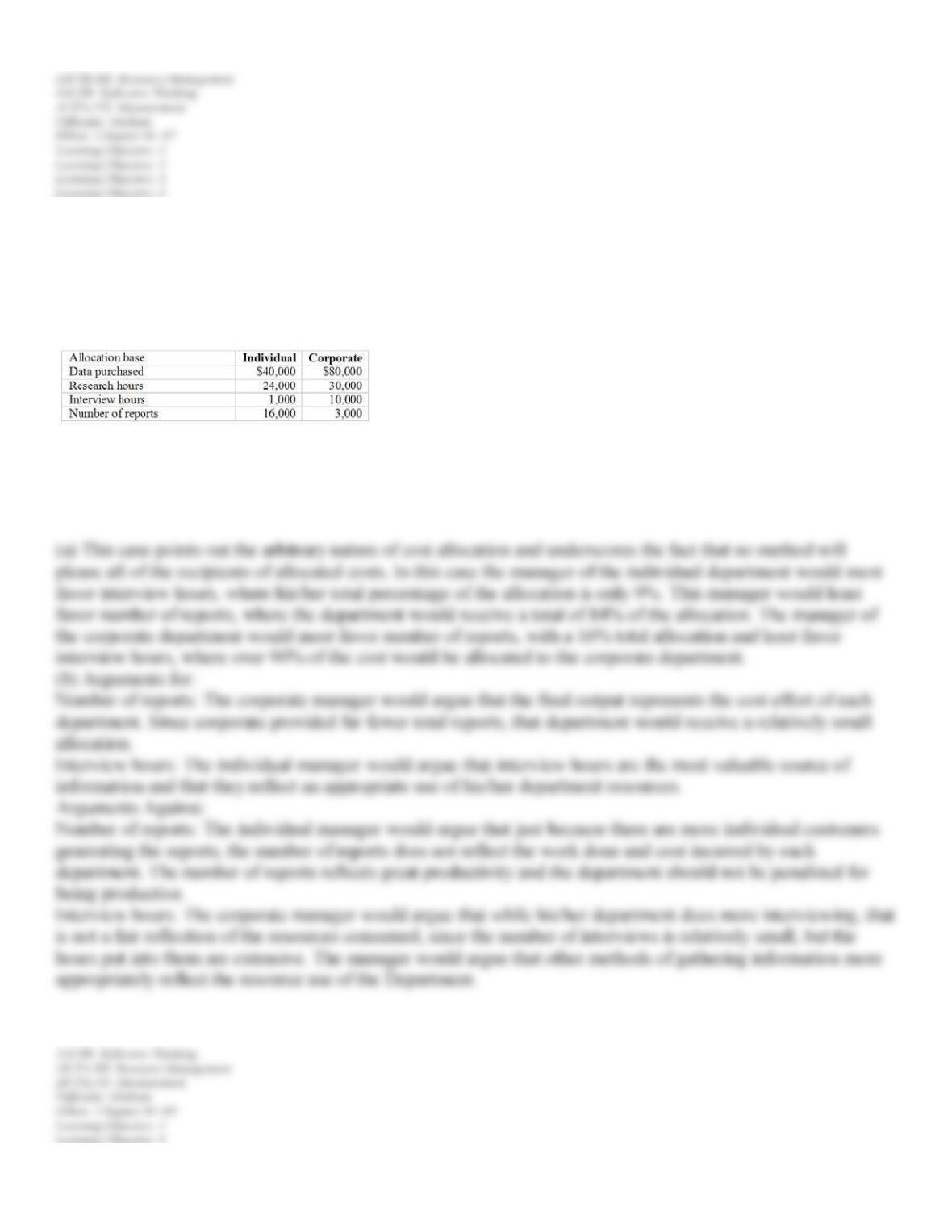
88. Quick Credit Checks produces two styles of credit reports: personal and corporate. The difference between
the two is the amount of background information and data collection required. The corporate report uses more
skilled personnel because additional checking and data are required. The relevant figures for the year just
completed follow: Total support service costs to be allocated are $3,200,000.
Required:
(a) Which method would be preferred by each manager? Which method would be least preferred?
(b) Provide arguments that each manager would make for his/her preferred method. How would each manager
argue against his/her least preferred method?

89. What are the similarities and differences among the direct-method, the step-method and the
reciprocal-method of allocating service costs? Is there any difference in the total amount of service department
costs that will be allocated among the three methods?
90. Bancroft, Fellouris, and Tanner, Inc. is a large multinational consulting company. The company has eight
divisions and five service departments: Facilities, Printing, Library, Human Resources, and Accounting/Finance.
The facilities department handles all building maintenance, cost of heat, water, insurance and other
facility–related costs. The company has three types of space: office space, computer space which is the most
expensive due to special conditioning required at all times and warehouse space for its manufacturing division.
The print shop prints all proposals, job bids, special advertising materials, accounting and finance documents
and any materials requested by the divisions. The library, staffed by two full time librarians, maintains research
materials and personal computers, purchases periodicals and books requested by the consulting divisions.
Human resources handles all job applications, on–the-job training and payroll for both corporate and division
employees, while accounting and finance performs corporate budgeting, allocations, billing for all divisions,
maintains travel and petty cash desks for the extensive travel performed by the consulting divisions. Cost
allocations and budgets, which are used to determine overhead rates for the divisions, are very important due to
the high percentage of government contracts.
Required:
(a) The company wishes to use a step-method of allocation. Suggest how you would go about determining
which service department should be the first step and which should be the last. What considerations would go
into your decision?
(b) Suggest appropriate cost allocation bases for the five service departments. (Based on an actual publicly held
company)
91. It is now common for many companies to outsource some or all of their internal support services,
particularly those that require routine, straightforward procedures. Many companies are also outsourcing human
resources, legal, tax and internal audit functions. Several factors affect a company’s decision to outsource. Name
four factors management must consider when making the decision to outsource and provide an argument for
and against outsourcing related to each factor.
92. Cost allocation bases are factors that cost management analysts use to assign indirect costs to cost objects.
Ideally, cost-allocation bases should reflect a cause-and-effect relationship between resource spending and use.
Ideally, an Activity–Based-Costing (ABC. approach will provide a more accurate and useful accounting for an
organization’s resources. Recent studies have found that, in spite of increasing costs and diminishing resources,
very few Higher Education Institutions use the tools and techniques of an ABC cost allocation system to assign
costs to academic departments. While direct costs, such as faculty salaries, are traceable to individual academic
departments or courses, many indirect costs, such as facility use, computer use, and student support services, are
more difficult to assign. In a traditional approach, many higher education institutions assign such costs based on
a single factor, such as the number of courses taught in the university. (Source: Activity-Based Costing for
Higher Education Institutions, Management Accounting Quarterly, Winter, 2001)
Required:
(a) Explain why the use of a single-cost driver such as the number of courses may result in inaccurate
management information as to the cost of running courses in individual academic departments.
(b) For each of the indirect costs listed below, identify an appropriate cost–driver that might be used to allocate
costs to determine the cost of offering a single course in an academic department if an Activity-Based-Costing
model were used.
Ⴠ Computer use
Ⴠ Facility use
Ⴠ Student services
Ⴠ Course design
Ⴠ Lecturing/class meeting time
Ⴠ Assignment grading