
Table 10.1
23) The cash flow pattern depicted is associated with a capital investment and may be
characterized as ________. (See Table 10.1)
A) an annuity and a conventional cash flow
B) a mixed stream and a nonconventional cash flow
C) an annuity and a nonconventional cash flow
D) a mixed stream and a conventional cash flow
24) The cash flow pattern depicted is associated with a capital investment and may be
characterized as ________. (See Table 10.2)
A) an annuity and a conventional cash flow
B) a mixed stream and a nonconventional cash flow
C) an annuity and a nonconventional cash flow
D) a mixed stream and a conventional cash flow

25) Payback is considered an unsophisticated capital budgeting because it ________.
A) gives explicit consideration to the timing of cash flows and therefore the time value of money
B) gives explicit consideration to risk exposure due to the use of the cost of capital as a discount
rate
C) does not gives explicit consideration on the recovery of initial investment and possibility of a
calamity
D) it does not explicitly consider the time value of money
26) A firm is evaluating a proposal which has an initial investment of $35,000 and has cash
flows of $10,000 in year 1, $20,000 in year 2, and $10,000 in year 3. The payback period of the
project is ________.
A) 1 year
B) 2 years
C) between 1 and 2 years
D) between 2 and 3 years
27) A firm is evaluating a proposal which has an initial investment of $50,000 and has cash
flows of $15,000 per year for five years. The payback period of the project is ________.
A) 1.5 years
B) 2 years
C) 3.3 years
D) 4 years

28) Which of the following statements is true of payback period?
A) If the payback period is less than the maximum acceptable payback period, management
should be indifferent.
B) If the payback period is greater than the maximum acceptable payback period, accept the
project.
C) If the payback period is less than the maximum acceptable payback period, accept the project.
D) If the payback period is greater than the maximum acceptable payback period, management
should be indifferent.
29) What is the payback period for Tangshan Mining company’s new project if its initial after-tax
cost is $5,000,000 and it is expected to provide after-tax operating cash inflows of $1,800,000 in
year 1, $1,900,000 in year 2, $700,000 in year 3, and $1,800,000 in year 4?
A) 4.33 years
B) 3.33 years
C) 2.33 years
D) 1.33 years

30) Should Tangshan Mining company accept a new project if its maximum payback is 3.5 years
and its initial after-tax cost is $5,000,000 and it is expected to provide after-tax operating cash
inflows of $1,800,000 in year 1, $1,900,000 in year 2, $700,000 in year 3, and $1,800,000 in
year 4?
A) Yes, since the payback period of the project is less than the maximum acceptable payback
period.
B) No, since the payback period of the project is more than the maximum acceptable payback
period.
C) Yes, since the risk exposure of the project is less than the maximum acceptable risk exposure.
D) No, since the risk exposure of the project is more than the maximum acceptable risk
exposure.
31) Should Tangshan Mining company accept a new project if its maximum payback is 3.25
years and its initial after-tax cost is $5,000,000 and it is expected to provide after-tax operating
cash inflows of $1,800,000 in year 1, $1,900,000 in year 2, $700,000 in year 3, and $1,800,000
in year 4?
A) Yes, since the payback period of the project is less than the maximum acceptable payback
period.
B) No, since the payback period of the project is more than the maximum acceptable payback
period.
C) Yes, since the risk exposure of the project is less than the maximum acceptable risk exposure.
D) No, since the risk exposure of the project is more than the maximum acceptable risk
exposure.

32) Evaluate the following projects using the payback method assuming a rule of 3 years for
payback.
Year
Project A
Project B
0
-10,000
-10,000
1
4,000
4,000
2
4,000
3,000
3
4,000
2,000
4
0
1,000,000
A) Project A can be accepted because the payback period is 2.5 years but Project B cannot be
accepted because it’s payback period is longer than 3 years.
B) Project B should be accepted because even though the payback period is 2.5 years for Project
A and 3.001 for project B, there is a $1,000,000 payoff in the 4th year in Project B.
C) Project B should be accepted because you get more money paid back in the long run.
D) Both projects can be accepted because the payback is less than 3 years.
33) Which of the following is a disadvantage of payback period approach?
A) It does not examine the size of the initial outlay.
B) It does not use net profits as a measure of return.
C) It does not explicitly consider the time value of money.
D) It does not take into account an unconventional cash flow pattern.

34) Which of the following is a strength of payback period?
A) a disregard for cash flows after the payback period
B) only an implicit consideration of the timing of cash flows
C) merely a subjectively determined number
D) a measure of risk exposure
35) Which of the following is a reason for firms not using the payback method as a guideline in
capital investment decisions?
A) It gives an explicit consideration to the timing of cash flows.
B) It cannot be specified in light of the wealth maximization goal.
C) It is a measure of risk exposure and projects the possibility of a calamity.
D) It is easy to calculate and has intuitive appeal.
36) Some firms use the payback period as a decision criterion or as a supplement to sophisticated
decision techniques, because ________.
A) it explicitly considers the time value of money
B) it can be viewed as a measure of risk exposure due to its focus on liquidity
C) the determination of the required payback period is an objectively determined criteria
D) it considers the timing of cash flows and therefore the time value of money

10.3 Calculate, interpret, and evaluate the net present value (NPV) and economic value added
(EVA).
1) Net present value is considered a sophisticated capital budgeting technique since it gives
explicit consideration to the time value of money.
2) The discount rate is the minimum return that must be earned on a project to leave a firm’s
market value unchanged.
3) The net present value is found by subtracting a project’s initial investment from the present
value of its cash inflows discounted at a rate equal to the project’s internal rate of return.
4) A sophisticated capital budgeting technique that can be computed by subtracting a project’s
initial investment from the present value of its cash inflows discounted at a rate equal to a firm’s
cost of capital is called net present value.

5) A sophisticated capital budgeting technique that can be computed by subtracting a project’s
initial investment from the present value of its cash inflows discounted at a rate equal to a firm’s
cost of capital is called profitability index.
6) The NPV of a project with an initial investment of $1,000 that provides after-tax operating
cash flows of $300 per year for four years where the firm’s cost of capital is 15 percent is
$856.49.
7) The NPV of a project with an initial investment of $2,500 that provides after-tax operating
cash flows of $500 per year for four years where the firm’s cost of capital is 15 percent is
$427.49.
8) If net present value of a project is greater than zero, the firm will earn a return greater than its
cost of capital. The acceptance of such a project would enhance the wealth of the firm’s owners.

9) If the NPV is greater than the initial investment, a project should be rejected.
10) If the NPV is less than the initial investment, a project should be rejected.
11) If the NPV is greater than $0, a project should be accepted.
12) For a project that has an initial cash outflow followed by cash inflows, the profitability index
(PI) is equal to the present value of cash inflows divided by the cost of capital.
13) Economic value added is the difference between an investment’s net operating profit after
taxes and the accounting profit.

14) The NPV of a project is the difference between an investment’s net operating profit after
taxes and the cost of funds used to finance the investment, which is found by multiplying the
dollar amount of the funds used to finance the investment by the firm’s weighted average cost of
capital.
15) Which of the following is an advantage of NPV?
A) It measures the risk exposure.
B) It takes into account the time value of investors’ money.
C) It is highly sensitive to the discount rates.
D) It measures how quickly a firm can breakeven.
16) The minimum return that must be earned on a project in order to leave the firm’s value
unchanged is ________.
A) the internal rate of return
B) the interest rate
C) the cost of capital
D) the compound rate

17) A firm can accept a project with a net present value of zero because ________.
A) the project would maintain the wealth of the firm’s owners
B) the project would enhance the wealth of the firm’s owners
C) the project would maintain the earnings of the firm
D) the project would enhance the earnings of the firm
18) A firm is evaluating an investment proposal which has an initial investment of $5,000 and
cash flows presently valued at $4,000. The net present value of the investment is ________.
A) -$1,000
B) $9,000
C) $4,000
D) -$4,000
19) What is the NPV for a project whose cost of capital is 15 percent and initial after-tax cost is
$5,000,000 and is expected to provide after-tax operating cash inflows of $1,800,000 in year 1,
$1,900,000 in year 2, $1,700,000 in year 3, and $1,300,000 in year 4?
A) $1,700,000
B) $371,764
C) -$137,053
D) -$4,862,947

20) What is the NPV for a project if its cost of capital is 0 percent and its initial after-tax cost is
$5,000,000 and it is expected to provide after-tax operating cash inflows of $1,800,000 in year 1,
$1,900,000 in year 2, $1,700,000 in year 3, and $1,300,000 in year 4?
A) $1,700,000
B) $371,764
C) $137,053
D) $6,700,000
21) What is the NPV for a project if its cost of capital is 12 percent and its initial after-tax cost is
$5,000,000 and it is expected to provide after-tax operating cash flows of $1,800,000 in year 1,
$1,900,000 in year 2, $1,700,000 in year 3, and ($1,300,000) in year 4?
A) -$1,494,336
B) $158,011
C) -$158,011
D) $3,505,664

22) A firm is evaluating three capital projects. The net present values for the projects are as
follows:
The firm should ________.
A) accept Projects 1 and 2, and reject Project 3
B) accept Projects 1 and 3, and reject Project 2
C) accept Project 3, and reject Projects 1 and 2
D) accept all projects
23) What is the profitability index of a project that has an initial cash outflow of $600, an inflow
of $250 for the next 3 years and a cost of capital of 10 percent?
A) 0.667
B) 2.036
C) 1.036
D) 2.739

Table 10.1
24) Given the information in Table 10.1 and 15 percent cost of capital,
(a) compute the net present value.
(b) should the project be accepted?
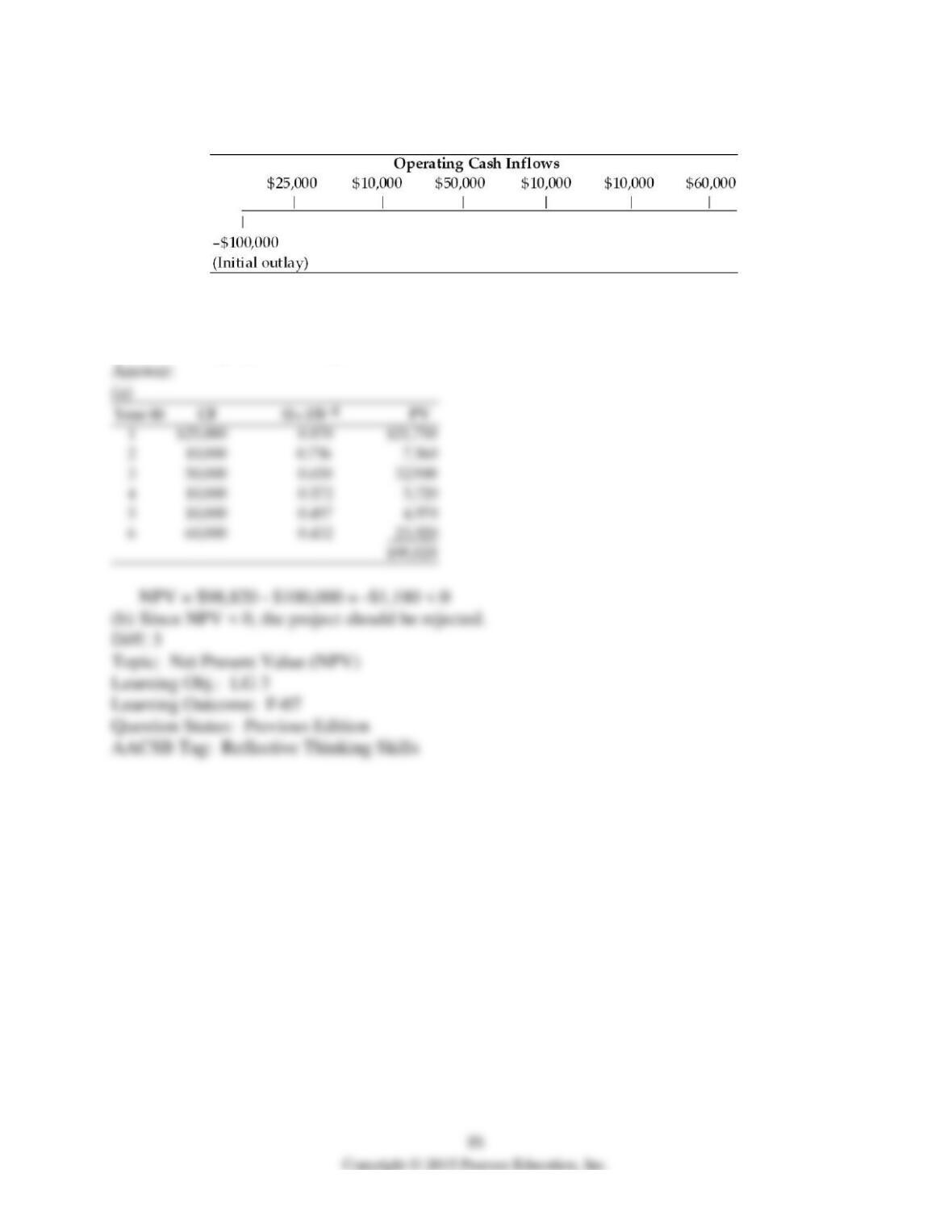
Table 10.2
25) Given the information in Table 10.2 and 15 percent cost of capital,
(a) compute the net present value.
(b) should the project be accepted?

10.4 Calculate, interpret, and evaluate the internal rate of return (IRR).
1) The internal rate of return (IRR) is defined as the discount rate that equates the net present
value with the initial investment associated with a project.
2) The IRR is the discount rate that equates the NPV of an investment opportunity with $0.
3) The IRR is the compounded annual rate of return that a firm will earn if it invests in a project
and receives the estimated cash inflows.
4) An internal rate of return greater than the cost of capital guarantees that the firm will earn at
least its required return.

5) A sophisticated capital budgeting technique that can be computed by solving for the discount
rate that equates the present value of a project’s inflows to the present value of its outflows is
called net present value.
6) A sophisticated capital budgeting technique that can be computed by solving for the discount
rate that equates the present value of a project’s inflows to the present value of its outflows is
called internal rate of return.
7) If a project’s IRR is greater than zero, the project should be accepted.
8) If a project’s IRR is greater than 0 percent, the project should be accepted.