54) The substitution effect of a price increase causes a decrease in the quantity demanded of an
inferior good.
55) What is marginal utility and what is the law of diminishing marginal utility?
56) Eliza consumes 12 cappuccinos and 8 apple turnovers per week. The price of cappuccino is
$4 each and apple turnovers are $1 each.
a. What is the amount of income allocated to cappuccino and apple turnover consumption?
b. What is the price ratio (the price of cappuccino relative to the price of apple turnovers)?
c. Explain the meaning of the price ratio you computed.
d. If Eliza maximize utility, what is the ratio of the marginal utility of cappuccino to the
marginal utility of apple turnovers?
e. If the price of apple turnovers falls, will Eliza consume more apple turnovers, fewer apple
turnovers or the same amount of apple turnovers? Explain your answer using the rule of equal
marginal utility per dollar.
57) After getting an A on your economics exam, you decide to go to your favorite Mexican
restaurant to celebrate. You are having trouble deciding whether to order the chipotle chicken
chimichanga or the cilantro seafood enchiladas. Use the rule of equal marginal utility per dollar
to determine which one to purchase: (a) the chimichanga for $8 which gives you 120 units of
utility, or (b) the enchiladas for $15 which gives you 195 units of utility?
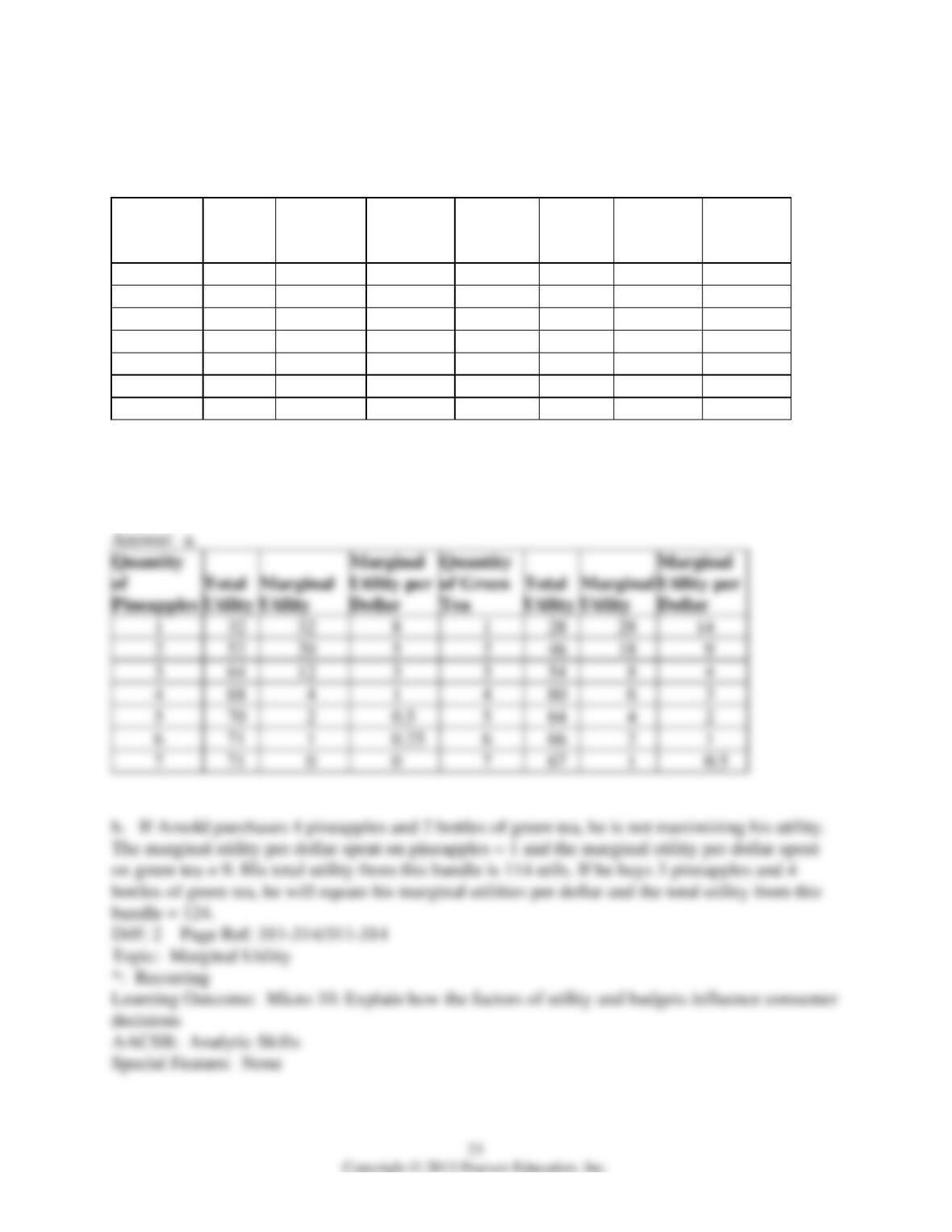
58) Arnie Ziffel has $20 per week to spend on any combination of pineapples and green tea. The
price of a pineapple is $4 and the price of a bottle of green tea is $2. The table below shows
Arnie’s utility values. Use the table to answer the questions that follow the table.
Quantity
of
Pineapples
Total
Utility
Marginal
Utility
Marginal
Utility per
Dollar
Quantity
of Green
Tea
Total
Utility
Marginal
Utility
Marginal
Utility per
Doll
1
32
1
28
2
52
2
46
3
64
3
54
4
68
4
60
5
70
5
64
6
71
6
66
7
71
7
67
a. Complete the table by filling in the blank spaces.
b. Suppose Arnold purchases 4 pineapples and 2 bottles of green tea. Is he consuming the
optimal consumption bundle? If so, explain why. If not, what combination should he buy and
why?
Quantity
of
Pineapples
Total
Utility
Marginal
Utility
Marginal
Utility per
Dollar
Quantity
of Green
Tea
Total
Utility
Marginal
Utility
Marginal
Utility per
Dollar
1
32
32
8
1
28
28
14
2
52
20
5
2
46
18
9
3
64
12
3
3
54
8
4
4
68
4
1
4
60
6
3
5
70
2
0.5
5
64
4
2
6
71
1
0.25
6
66
2
1
7
71
0
0
7
67
1
0.5
10.2 Where Demand Curves Come From
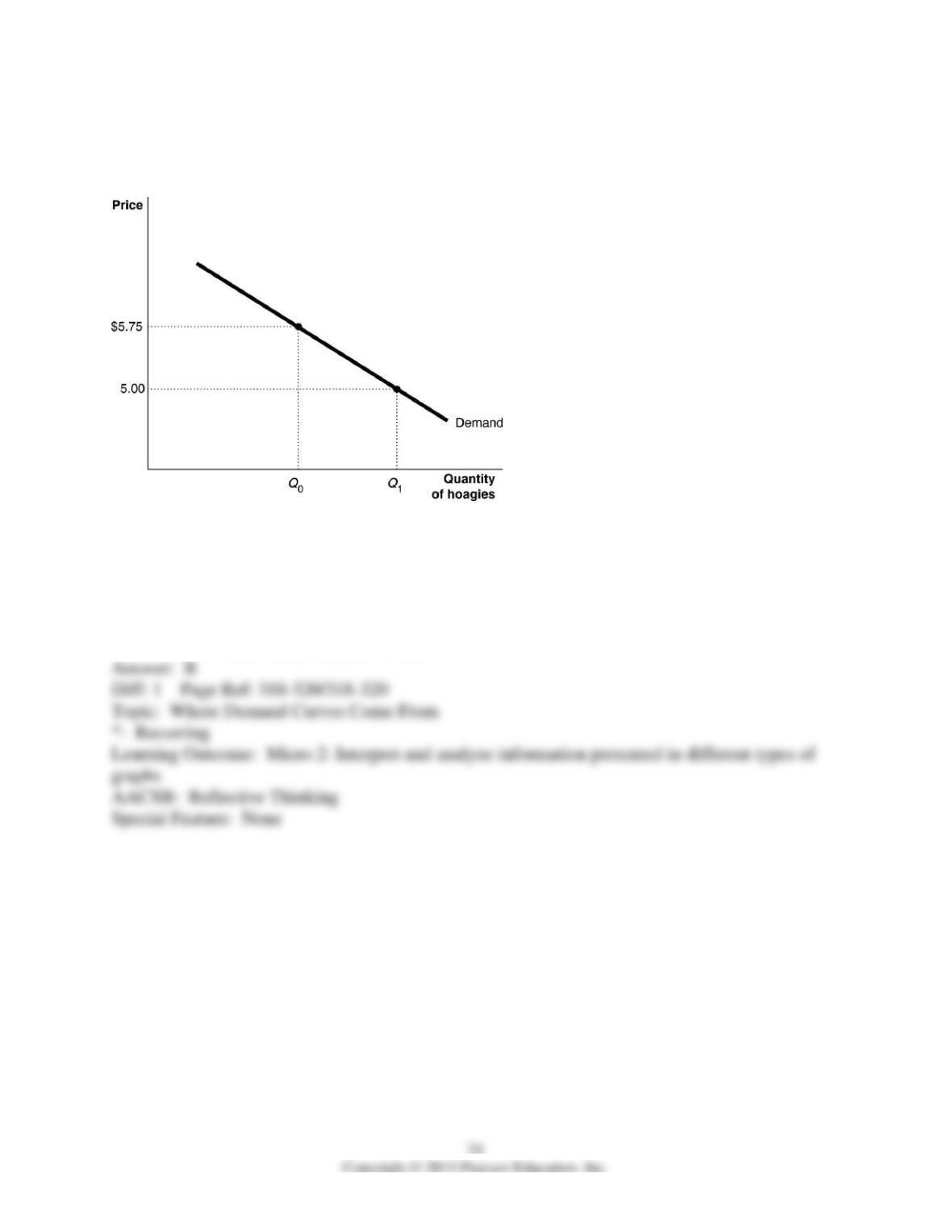
Figure 10-1
1) Refer to Figure 10-1. When the price of hoagies increases from $5.00 to $5.75, quantity
demanded decreases from Q1 to Q0. This change in quantity demanded is due to
A) the price and output effects.
B) the income and substitution effects.
C) the fact that marginal willingness to pay falls.
D) the law of diminishing marginal utility.
2) Refer to Figure 10-1. Which of the following statements is true?
A) Quantities Q0 and Q1 are the utility-maximizing quantities of hoagies at two different prices
of hoagies.
B) Quantities Q0 and Q1 may not necessarily be the utility-maximizing quantities of hoagies at
two different prices because we have no information on the consumer’s budget or the price of
other goods.
C) Quantity Q0 could be a utility-maximizing choice if the price is $5.75, but quantity Q1 may
not be because we have no information on the marginal utility per dollar when price changes.
D) Quantities Q0 and Q1 are derived independently of the utility-maximizing model.
3) In order to derive an individual’s demand curve for salmon, we would observe what happens
to the utility-maximizing bundle when we change
A) income and hold everything else constant.
B) tastes and preferences and hold everything else constant.
C) the price of the product and hold everything else constant.
D) the price of a close substitute and hold everything else constant.
4) Along a downward-sloping linear demand curve,
A) the marginal utility from the consumption of each unit of the good and the total utility from
consuming larger quantities increase.
B) the marginal utility from the consumption of each unit of the good and the total utility from
consuming larger quantities remain constant.
C) the marginal utility from the consumption of each unit of the good falls and the total utility
from consuming larger quantities increases.
D) the marginal utility from the consumption of each unit of the good rises and the total utility
from consuming larger quantities remain constant.
5) Economists Robert Jensen and Nolan Miller reasoned that to be a Giffen good, with an
income effect larger than its substitution effect, a good must be ________ and make up a
________ portion of a consumer’s budget.
A) a normal good; very small
B) an inferior good; very small
C) a normal good; very large
D) an inferior good; very large
6) The demand curve for a Giffen good is
A) non-linear but downward-sloping.
B) vertical.
C) upward-sloping.
D) non-existent.
7) Giffen goods
A) are theoretical and have never been discovered in the real world.
B) have not existed since prior to the Industrial Revolution.
C) were proven to exist in the 1890s by Sir Robert Giffen.
D) were not shown to actually exist until 2006.
8) Each price-quantity combination on a consumer’s demand curve shows the utility-maximizing
quantity at the given price.
9) A Giffen good could be either a normal good or an inferior good.
10) The income effect of a price increase for a Giffen good outweighs the substitution effect.
11) The demand curve for an inferior good can never be downward-sloping.
12) The demand curve for a luxury good is upward-sloping.
13) What is a Giffen good?
14) What must be true in terms of the income effect, the substitution effect, and the type of good
for the good’s demand curve to be upward sloping?
10.3 Social Influences on Decision Making
1) Consider the following factors:
a. culture
b. religion
c. customs
d. prices
e. income
Which of the factors above are likely to influence the choices consumers make?
A) a, d, and e only
B) all the factors except b
C) all the factors except c
D) d and e only
E) all the factors listed
2) What is the common feature displayed by the following items?
a. eating in a newly opened “fusion” cuisine restaurant
b. attending a Red Sox game in Fenway Park
c. wearing Lucky Brand designer jeans
A) They are all highly inelastic goods.
B) The consumption of these goods takes place privately.
C) The consumption of these goods takes place publicly.
D) They tend to be consumed by better educated people.
3) Consider a good whose consumption takes place publicly. Your decision to buy that good
depends
A) both on the characteristics of the product and on how many other people are buying the good.
B) only on the characteristics of the good.
C) only on how many other people buy the good.
D) only on the price of the good.
4) Which of the following does not explain why consumers buy products that many other
consumers are already buying?
A) technology
B) the satisfaction people derive by being viewed as “fashionable”
C) cost-effective way to gather information about a product
D) differences in tastes and preferences
5) Identify the one statement that does not demonstrate how social effects influence consumer
choice.
A) Students in an Economics class are required to purchase a textbook assigned by the professor.
B) There is utility gained from consuming goods or services that others are consuming.
C) Some products that people consume are determined by the social popularity of the products.
D) Companies such as Zappos.com and Netflix invite their consumers to write reviews about
their experience with their products which are then posted on the internet for others to see.
6) Firms pay famous individuals to endorse their products because
A) apparently demand is affected not just by the number of people who use a product but also by
the type of person that uses the product.
B) the firms are irrational and are wasting advertising expenditures.
C) famous people obviously know what are the best goods and services.
D) famous people only consume high quality products.
7) By hiring Justin Bieber to advertise its electronics Buy Back program, Best Buy is hoping to
change its image and reach a new, younger target market. By using celebrities such as Bieber to
endorse products, companies are hoping that its customers will respond positively and business
will increase. All of the following are reasons why celebrity endorsements may increase sales for
advertised products except
A) consumers may believe that celebrities have more information than they do about the
advertised product.
B) consumers may feel closer to celebrities if they purchase the products being endorsed.
C) consumers can be sure that a company would not pay a large sum for a celebrity to endorse its
product unless the product is the best available in the market.
D) consumers may believe they will appear more fashionable if they purchase products endorsed
by certain celebrities.
8) A network externality occurs when
A) there is production cost savings from being networked with suppliers.
B) there is production cost savings from being networked with buyers.
C) the usefulness of a good is affected by how many others use the good.
D) the usefulness of a good is affected by celebrities who use the good.
9) Once a product becomes established, network externalities may create ________ costs that
make consumers reluctant to buy a new product with better technology.
A) external
B) implicit
C) switching
D) marginal
10) A significant downside to network externalities is that
A) there may be large switching costs to consumers of changing products so that consumers end
up using products with inferior technologies.
B) firms may network with unethical suppliers or distributors.
C) the costs of hiring celebrity endorsements may be very high.
D) there may be large switching costs to firms changing technologies.
11) All of the following products are most likely to have significant network externalities except
A) cat food.
B) cell phones.
C) popular board games.
D) fax machines.
12) Which of the following is used to explain why a consumer’s willingness to buy Microsoft
Office increases as the number of other people who use Microsoft Office increases?
A) network externalities
B) market failure
C) diminishing marginal utility
D) the income effect of a price change
13) A good is path dependent when
A) consumers get utility from consuming goods that others are consuming, such as restaurants.
B) the first technology that was adopted has an advantage over a better technology that came
later.
C) people who move location follow the path of people who moved before them.
D) it can only be used in one way.
14) A standard which came to the market first, such as the QWERTY letter layout in typewriters,
can become entrenched (this layout is still used in computer keyboards today). What is this
phenomenon called?
A) network externalities
B) path dependency
C) sunk cost
D) comparative advantage
15) Many economists do not believe that network externalities lock consumers into the use of
products that have technology inferior to other, similar products. These economists believe that
A) consumers are always rational.
B) in practice, the gains from using a superior technology exceed the losses consumers incur
from switching costs.
C) there is no good evidence that switching costs exist.
D) the government will prevent products with inferior technology from being sold to consumers.
16) Economists would refer to the increase in product sales because of celebrity endorsements
as being the result of
A) network externalities.
B) the endowment effect.
C) social influence.
D) the ultimatum game.
17) One explanation for the increase in product sales because of celebrity endorsements is that
people seem to receive ________ from goods they believe are popular.
A) more utility
B) diminishing utility
C) greater network externalities
D) increased path dependency
18) Many airlines have not reduced or eliminated fuel surcharges despite the price of oil
dropping. A logical reason for this is that the decline in fuel prices
A) shifted the supply curve for airline tickets to the left, and at the same time an increase in
demand for airline tickets shifted the demand curve to the right, so prices did not decline.
B) shifted the supply curve for airline tickets to the right, and at the same time a decrease in
demand for airline tickets shifted the demand curve to the left, so prices still increased.
C) shifted the supply curve for airline tickets to the right, and at the same time an increase in
demand for airline tickets shifted the demand curve to the right, so prices still increased.
D) shifted the supply curve for airline tickets to the left, and at the same time a decrease in
demand for airline tickets shifted the demand curve to the left, so prices did not decline.
19) Research by Daniel Kahneman, Jack Knetch, and Richard Thaler has shown that companies
like airlines were explicitly able to include a fuel surcharge in their prices because
A) consumers had no choice but to pay the price of the surcharges due to the lack of competition
in the industry.
B) a government-imposed price ceiling on airline ticket prices left the airlines not other way to
cover the increase in costs.
C) adding a separate fuel surcharge to the price of airline tickets did not actually increase the
price of the tickets.
D) consumers see it as fair for firms to raise prices after an increase in costs.
20) For which of the following products is social influence likely to have the greatest impact?
A) toothpaste
B) restaurants
C) high-blood pressure medication
D) school textbook
21) Jamal, Lawson and Kyle have been standing in line for almost an hour waiting to be served
at Kirala, a popular new Japanese restaurant. It is possible that some of the people in line won’t
be served at all before the restaurant closes. Which of the following could explain why the
restaurant does not simply raise prices high enough to eliminate the lines?
a. In situations where consumption takes place publicly, demand for the product is also
influenced by how many other people are buying the product. Consequently, a popular restaurant
that increased its prices enough to eliminate lines might find that it had also eliminated its
popularity.
b. Firms may sometimes not raise their prices for fear that it violates people’s sense of fairness
and might alienate customers.
c. The demand for restaurant meals is relatively elastic and if the firm raise prices it will lower
its profits.
A) a only
B) a and b only
C) a and c only
D) a, b, and c
22) Which of the following is an experiment which tests whether fairness is important in
consumer decision making?
A) the fair trade principle
B) the ultimatum game
C) the preferential treatment game
D) the behavioral experiment
23) In the ultimatum game, allocators usually offer recipients at least a 40 percent share of the
money, and recipients almost always reject offers of less than a 10 percent share. Which of the
following does not explain why allocators offer recipients a relatively generous share and why
recipients reject meager offers?
A) Fear of arousing outrage and abhorrence could influence economic decisions.
B) People can and often do reject offers that offend their sense of fairness even if doing so means
taking a monetary loss.
C) Some people are careful not to engage in economic behavior that might offend and alienate
others.
D) Allocators can count on recipients to ignore all considerations except financial benefit.
24) Economists have used ________ and ________ in experiments designed to determine
whether consumers care about fairness when they make decisions.
A) Giffen goods; luxury goods
B) the income effect; the substitution effect
C) the ultimatum game; the dictator game
D) network externalities; the endowment effect
25) A network externality refers to a situation in which the usefulness of a product decreases
with the number of consumers who use it.
26) Economists have shown that when the ultimatum game experiment is carried out, both
allocators and recipients act as if fairness is important.
27) The iPod is a product without any significant network externalities.
28) Why might network externalities result in products that contain inferior technologies?
29) List three reasons why demand for a product will often increase if the product is endorsed by
a celebrity.
30) Professor Parallax chooses two students in his economics class, Jasmine and Cassandra, to
participate in the ultimatum game. He chooses Jasmine to be the allocator and Cassandra to be
the recipient. He gives Jasmine $50 and as the allocator, she gets to decide how to split the
money with Cassandra. If Cassandra decides to accept the amount allocated to her by Jasmine,
both students get to keep the money. If Cassandra decides to reject her allocation, neither student
gets to keep the money. How much will each student end up with if each student acts as if
fairness is important? How much will each student end up with if only Cassandra acts as if
fairness is important? How much will each student end up with if neither student cares about
fairness?
31) Music writer Anthony Kuzminski praised rock star Tom Petty in a 2007 article in the online
Unrated Magazine. Kuzminski wrote: “Something Petty never can get enough credit for is his
fan-friendly attitude. He kept ticket prices for [his concerts] at $50 when other acts this summer
are charging upwards of $100 for stadium gigs. Petty could charge more, but he doesn’t see the
point. He has stated time and time again he still makes millions when he’s on the road, regardless
of his ticket prices. He is the last of the fan friendly rock stars out there.” Use economic
reasoning to write a rationale for Tom Petty’s decision to charge prices for his band’s (“Tom
Petty and the Heartbreakers”) concerts that are less than market clearing prices.
Source: Anthony Kuzminski, “Tom Petty & The Heartbreakers at the Vic Theater”
http://www.unratedmagazine.com/
10.4 Behavioral Economics: Do People Make Their Choices Rationally?
1) What is behavioral economics?
A) the study of how people make wealth-maximizing decisions
B) the study of how people behave in the face of scarcity
C) the study of situations in which people act in ways that are not economically rational
D) the study of how people make decisions at the margin