17
59) Draw the molecular orbital diagram shown to determine which of the following is paramagnetic.
A) O22⁻
B) Ne22⁺
C) O22⁺
D) F22⁺
E) None of the above are paramagnetic.
60) Draw the molecular orbital diagram shown to determine which of the following is most stable.
A) C22⁺
B) N22⁺
C) B2
D) C22⁻
E) B22⁺
61) Draw the molecular orbital diagram shown to determine which of the following is paramagnetic.
A) B22⁺
B) B22⁻
C) N22⁺
D) C22⁻
E) B2
Algorithmic Questions
1) What geometric arrangement of charge clouds is expected for an atom that has four charge clouds?
A) trigonal bipyramidal
B) octahedral
C) tetrahedral
D) square planar
2) Give the approximate bond angle for a molecule with a trigonal planar shape.
A) 109.5°
B) 180°
C) 120°
D) 107°
E) 90°
3) Give the approximate bond angle for a molecule with a tetrahedral shape.
A) 109.5°
B) 180°
C) 120°
D) 105°
E) 90°
4) Give the approximate bond angle for a molecule with a linear shape.
A) 109.5°
B) 180°
C) 120°
D) 105°
E) 90°
5) Determine the electron geometry (eg) and molecular geometry (mg) of the underlined carbon in
CH3F.
A) eg=tetrahedral, mg=tetrahedral
B) eg=linear, mg=trigonal planar
C) eg=trigonal planar, mg=tetrahedral
D) eg=linear, mg=linear
E) eg=trigonal planar, mg=trigonal planar
6) What is the molecular geometry of ClF4 –?
A) seesaw
B) square planar
C) square pyramidal
D) tetrahedral
7) What is the molecular geometry of SbCl3?
A) T-shaped
B) tetrahedral
C) trigonal planar
D) trigonal pyramidal
8) What is the molecular geometry of SF5–?
A) octahedral
B) seesaw
C) square pyramidal
D) trigonal bipyramidal
9) Which of the following best describes ClF2–? It has a molecular geometry that is
A) linear with no lone pairs on the Cl atom.
B) linear with lone pairs on the Cl atom.
C) nonlinear with no lone pairs on the Cl atom.
D) nonlinear with lone pairs on the Cl atom.
10) What is the molecular geometry of SBr4?
A) seesaw
B) square planar
C) square pyramidal
D) tetrahedral
11) Using the VSEPR model, the electron-domain geometry of the central atom in BrF4– is ________.
A) linear
B) trigonal planar
C) tetrahedral
D) trigonal bipyramidal
E) octahedral
12) Using the VSEPR model, the molecular geometry of the central atom in XeF2 is ________.
A) linear
B) trigonal planar
C) tetrahedral
D) bent
E) trigonal pyramidal
13) Using the VSEPR model, the molecular geometry of the central atom in BF3 is ________.
A) linear
B) trigonal planar
C) tetrahedral
D) bent
E) trigonal pyramidal
14) Using the VSEPR model, the molecular geometry of the central atom in CF4 is ________.
A) linear
B) trigonal planar
C) tetrahedral
D) bent
E) trigonal pyramidal
15) Using the VSEPR model, the molecular geometry of the central atom in SO2 is ________.
A) linear
B) trigonal planar
C) tetrahedral
D) bent
E) trigonal pyramidal
16) Using the VSEPR model, the molecular geometry of the central atom in NCl3 is ________.
A) linear
B) trigonal planar
C) tetrahedral
D) bent
E) trigonal pyramidal
17) Using the VSEPR model, the molecular geometry of the central atom in XeF4 is ________.
A) tetrahedral
B) seesaw
C) square planar
D) trigonal bipyramidal
E) square pyramidal
18) Using the VSEPR model, the electron-domain geometry of the central atom in BF3 is ________.
A) linear
B) trigonal planar
C) tetrahedral
D) trigonal bipyramidal
E) octahedral
19) Using the VSEPR model, the electron-domain geometry of the central atom in SF2 is ________.
A) linear
B) trigonal planar
C) tetrahedral
D) trigonal bipyramidal
E) octahedral
20) Using the VSEPR model, the electron-domain geometry of the central atom in SF4 is ________.
A) linear
B) trigonal planar
C) tetrahedral
D) trigonal bipyramidal
E) octahedral
21) What is the O-B-O bond angle in BO33-?
A) less than 109.5°
B) 109.5°
C) 120°
D) greater than 120°
22) What are the F-Po-F bond angles in PoF6 ?
A) 60°
B) 90°
C) 109.5°
D) 120°
23) The VSEPR model predicts the H–O–H bond angle in H3O+ to be
A) 60°.
B) 90°.
C) less than 109.5° but greater than 90°.
D) 109.5°.
24) A pilot checks for water in the gas before flying a small airplane. How does she do it?
A) Drain a little bit of gas from the bottom and look for two layers.
B) Taste it.
C) Shake the wings.
D) Pipet a sample from the top of the tank and look for two layers.
E) Check the oil.
25) How many of the following molecules are polar?
XeCl2 COF2 PCl4F SF6
A) 0
B) 3
C) 1
D) 2
E) 4
26) How many of the following molecules are polar?
XeO2 SiCl2Br2 C2Cl2 SeBr6
A) 1
B) 4
C) 2
D) 3
E) 0
27) Determine the electron geometry, molecular geometry and polarity of TeCl6.
A) eg=octahedral, mg=octahedral, nonpolar
B) eg=trigonal bipyramidal, mg=trigonal bipyramidal, nonpolar
C) eg=octahedral, mg=tetrahedral, polar
D) eg=trigonal bipyramidal, mg=T-shaped, nonpolar
E) eg=tetrahedral, mg=trigonal pyramidal, polar
28) Determine the electron geometry, molecular geometry and polarity of XeF4.
A) eg=trigonal bipyramidal, mg=trigonal bipyramidal, nonpolar
B) eg=tetrahedral, mg=trigonal bipyramidal, polar
C) eg=trigonal bipyramidal, mg=see-saw, polar
D) eg=octahedral, mg=trigonal pyramidal, nonpolar
E) eg=octahedral, mg=square planar, nonpolar
29) Choose the compound below that contains at least one polar covalent bond, but is nonpolar.
A) HCN
B) CCl4
C) SeF4
D) ICl3
E) Both B and C are nonpolar and contain a polar covalent bond.
30) Choose the compound below that contains at least one polar covalent bond, but is nonpolar.
A) GeH2Br2
B) SBr2
C) AsCl5
D) CBr2Cl2
E) All of the above are nonpolar and contain a polar covalent bond.
31) Determine the electron geometry, molecular geometry and polarity of N2O (N central).
A) eg=linear, mg=linear, nonpolar
B) eg=tetrahedral, mg=linear, polar
C) eg=tetrahedral, mg=bent, polar
D) eg= linear, mg=linear, polar
E) eg=trigonal planar, mg=bent, nonpolar
32) The orbital hybridization on the carbon atoms in C2H2 is
A) sp.
B) sp2.
C) sp3.
D) sp3d2.
33) The hybrid orbital set used by the central atom in NO3– is ________.
A) sp
B) sp2
C) sp3
D) sp3d
E) sp3d2
34) The hybrid orbital set used by the central atom in NCl3 is ________.
A) sp
B) sp2
C) sp3
D) sp3d
E) sp3d2
35) The hybrid orbital set used by the central atom in KrF2 is ________.
A) sp
B) sp2
C) sp3
D) sp3d
E) sp3d2
36) Describe a pi bond.
A) side by side overlap of p orbitals
B) end to end overlap of p orbitals
C) s orbital overlapping with the end of a d orbital
D) overlap of two s orbitals
E) p orbital overlapping with a f orbital
37) Describe a sigma bond.
A) side by side overlap of f orbitals
B) end to end overlap of p orbitals
C) s orbital overlapping with the side of a p orbital
D) overlap of two f orbitals
E) p orbital overlapping with a f orbital
38) A molecule containing a central atom with sp hybridization has a(n) ________ electron geometry.
A) linear
B) trigonal bipyramidal
C) square planar
D) tetrahedral
E) bent
39) A molecule containing a central atom with sp2 hybridization has a(n) ________ electron geometry.
A) linear
B) trigonal bipyramidal
C) trigonal planar
D) octahedral
E) bent
40) A molecule containing a central atom with sp3 hybridization has a(n) ________ electron geometry.
A) linear
B) trigonal planar
C) octahedral
D) tetrahedral
E) bent
41) A molecule containing a central atom with sp3d hybridization has a(n) ________ electron geometry.
A) tetrahedral
B) bent
C) octahedral
D) square planar
E) trigonal bipyramidal
42) A molecule containing a central atom with sp3d2 hybridization has a(n) ________ electron
geometry.
A) octahedral
B) trigonal pyramidal
C) tetrahedral
D) linear
E) tirgonal planar
43) Determine the electron geometry (eg) and molecular geometry (mg) of the underlined carbon in
CH3CN.
A) eg=tetrahedral, mg=linear
B) eg=linear, mg=bent
C) eg=trigonal planar, mg=linear
D) eg=linear, mg=linear
E) eg=bent, mg=tetrahedral
44) Determine the electron geometry (eg) and molecular geometry (mg) of H2CO.
A) eg=tetrahedral, mg=linear
B) eg=linear, mg=trigonal planar
C) eg=trigonal planar, mg=linear
D) eg=linear, mg=linear
E) eg=trigonal planar, mg=trigonal planar
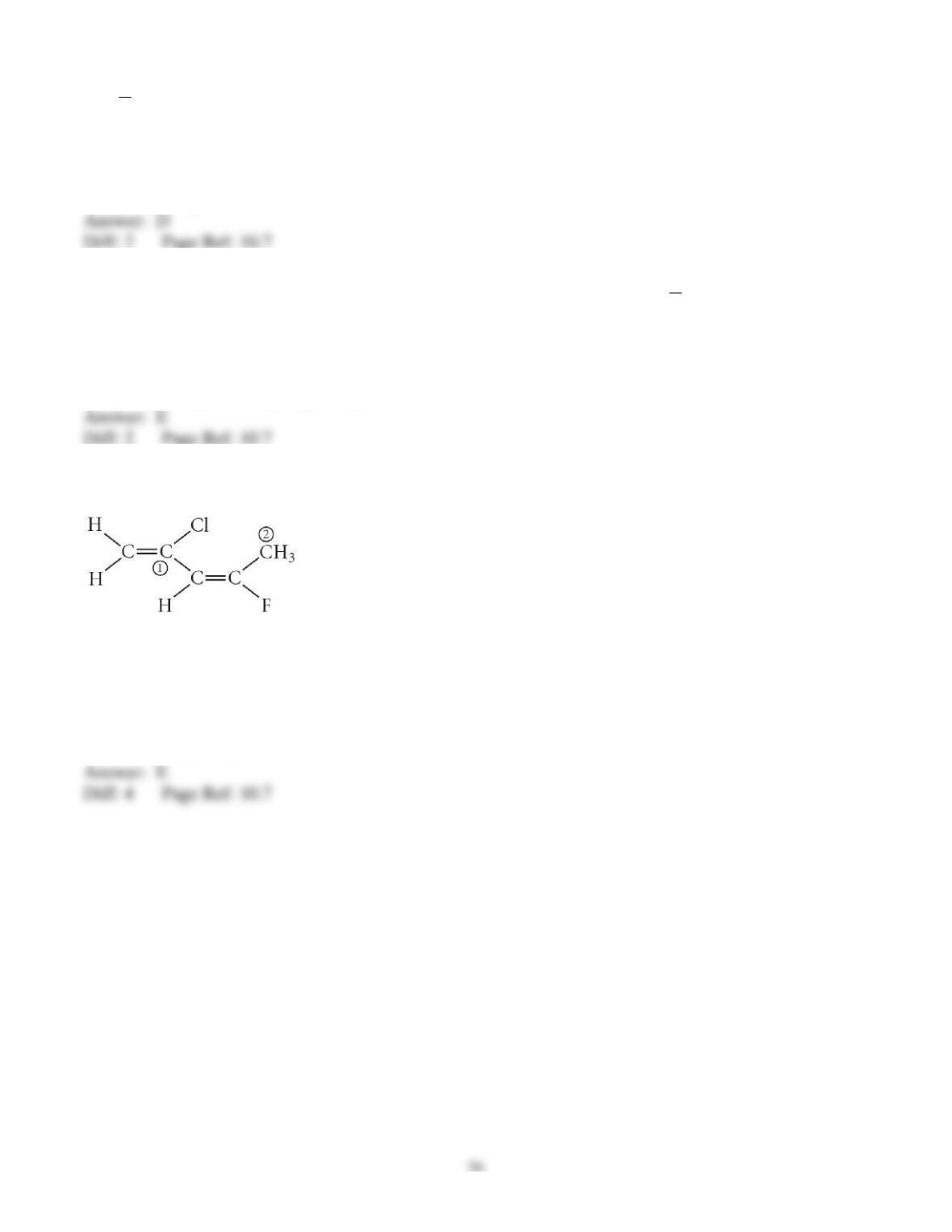
45) Consider the molecule below. Determine the hybridization at each of the 2 labeled carbons.
A) C1 = sp3, C2 = sp2
B) C1 = sp2, C2 = sp2
C) C1 = sp2, C2 = sp3d
D) C1 = sp3d2, C2 = sp3d2
E) C1 = sp2, C2 = sp3
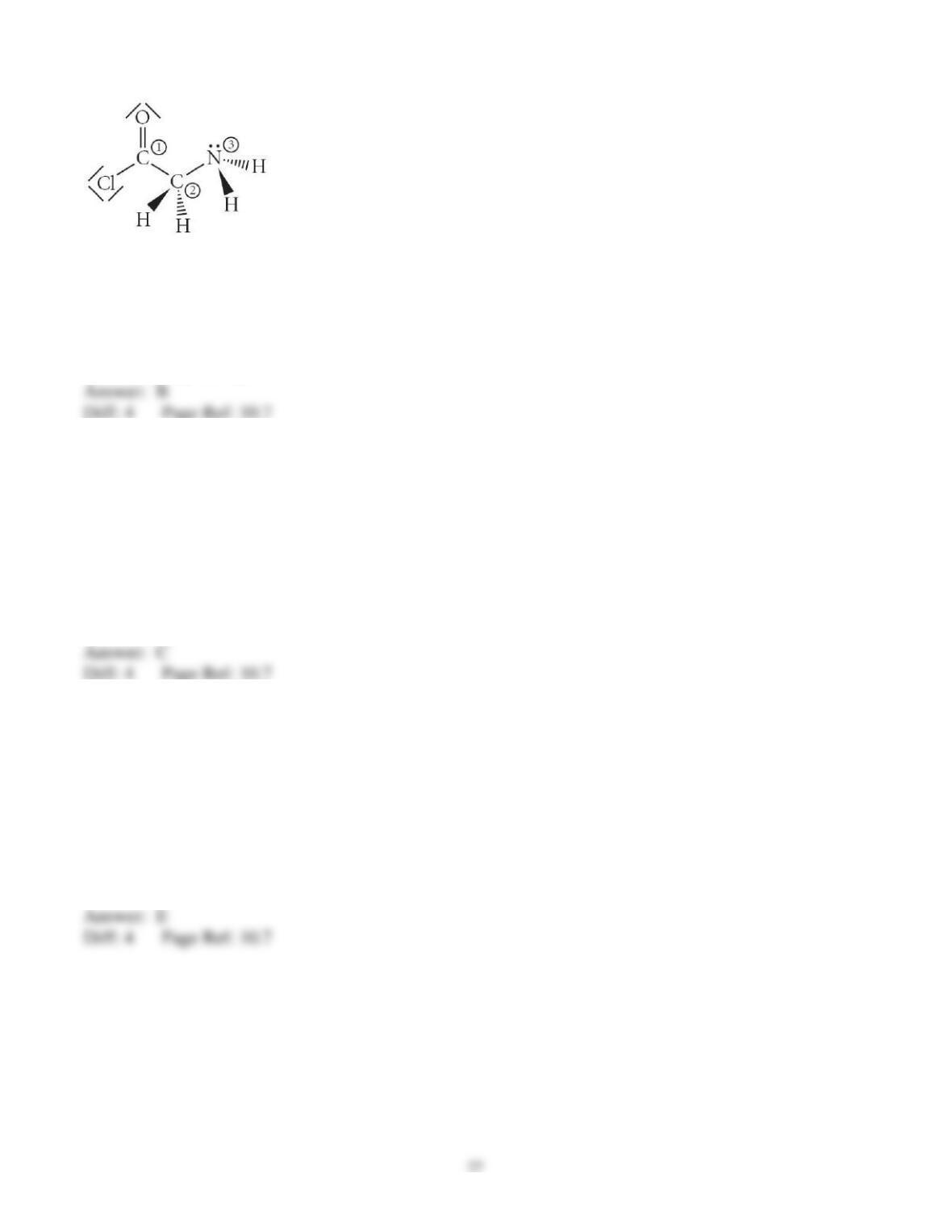
46) Consider the molecule below. Determine the hybridization at each of the 3 labeled atoms.
A) 1=sp2, 2=sp3, 3=sp2
B) 1=sp2, 2=sp3, 3=sp3
C) 1=sp3, 2=sp3, 3=sp3
D) 1=sp3, 2=sp3, 3=sp2
E) 1=sp , 2=sp2, 3=sp2
47) How many of the following molecules have sp hybridization on the central atom?
C2Br2 CS2 O3 H2S
A) 0
B) 1
C) 2
D) 3
E) 4
48) How many of the following molecules have sp3 hybridization on the central atom?
XeCl4 CH4 SF4 C2Cl2
A) 0
B) 4
C) 3
D) 2
E) 1
49) How many of the following molecules have sp3d hybridization on the central atom?
CBr4 BrF5 AsCl5 BrF3
A) 2
B) 0
C) 4
D) 1
E) 3
50) How many of the following molecules have sp3d2 hybridization on the central atom?
SeF6 XeF4 IF5 AsCl5
A) 1
B) 3
C) 0
D) 2
E) 4
51) Give the electron geometry, molecular geometry, and hybridization for CH3–.
A) eg = tetrahedral; mg = trigonal pyramidal; sp3
B) eg = tetrahedral; mg = trigonal planar; sp3
C) eg = trigonal pyramidal; mg = linear; sp3
D) eg = trigonal planar; mg = trigonal planar; sp2
52) List the number of sigma bonds and pi bonds in a single bond.
A) 1 sigma, 0 pi
B) 0 sigma, 0 pi
C) 1 sigma, 1 pi
D) 3 sigma, 2 pi
53) List the number of sigma bonds and pi bonds in a double bond.
A) 1 sigma, 1 pi
B) 2 sigma, 1 pi
C) 2 sigma, 2 pi
D) 1 sigma, 0 pi
29
54) List the number of sigma bonds and pi bonds in a triple bond.
A) 0 sigma, 1 pi
B) 2 sigma, 1 pi
C) 3 sigma, 0 pi
D) 1 sigma, 2 pi
55) Draw the Lewis structure for the molecule CH2CHCH3. How many sigma and pi bonds does it
contain?
A) 8 sigma, 1 pi
B) 9 sigma, 0 pi
C) 9 sigma, 1 pi
D) 7 sigma, 1 pi
E) 8 sigma, 2 pi
56) Draw the Lewis structure for the molecule CH3CH2CCH. How many sigma and pi bonds does it
contain?
A) 11 sigma, 2 pi
B) 9 sigma, 1 pi
C) 8 sigma, 3 pi
D) 9 sigma, 2 pi
E) 8 sigma, 0 pi
57) Consider the following compound. How many sigma and pi bonds does it contain?
CH3CHCHCO2H
A) 9 sigma, 4 pi
B) 11 sigma, 2 pi
C) 9 sigma, 2 pi
D) 12 sigma, 0 pi
E) 6 sigma, 2 pi
58) Draw the Lewis structure for the molecule C3H4. How many sigma and pi bonds does it contain?
A) 7 sigma, 0 pi
B) 8 sigma, 0 pi
C) 6 sigma, 2 pi
D) 10 sigma, 2 pi
E) 8 sigma, 2 pi
59) How many of the following molecules contain at least one pi bond?
C2H6 Cl2CO C2Cl4 HCN
A) 0
B) 1
C) 3
D) 4
E) 2

Matching Questions
Match the following.
A) tetrahedral
B) trigonal bipyramidal
C) nonpolar, but contains a polar covalent bond
D) polar, but contains no polar bonds
E) see-saw molecular geometry
F) octahedral electron geometry
G) sp2 hybridized central atom
H) linear
I) octahedral
J) sp hybridized central atom
K) trigonal planar
1) SF4
Diff: 3 Page Ref: 10.4
2) XeCl4
Diff: 3 Page Ref: 10.4
3) CH2F2
Diff: 2 Page Ref: 10.5
4) BCl3
Diff: 2 Page Ref: 10.5
5) sp
Diff: 1 Page Ref: 10.7
6) sp2
Diff: 1 Page Ref: 10.7
7) sp3
Diff: 1 Page Ref: 10.7
8) sp3d L) polar
Diff: 1 Page Ref: 10.7
9) sp3d2
Diff: 1 Page Ref: 10.7
10) BeF2
Diff: 2 Page Ref: 10.7
Short Answer Questions
1) Is it possible for a molecule to be nonpolar even though it contains polar bonds? Explain your answer
and give an example.
2) Explain why oil and water do not mix.
3) Determine the molecular geometry about each interior atom in the following structure. Sketch the
three-dimensional structure and label the interior atoms with the corresponding molecular geometry.
CH2CHCCCH3
4) Give the electron geometry, molecular geometry, and hybridization for both carbons in CH3COOH.
5) Determine the hybridization about each interior atom in the following structure. Sketch the three-
dimensional structure and label the interior atoms with their corresponding hybridization.
CH2CHCCCH3
6) According to molecular orbital theory, what is an antibonding orbital?
7) Use molecular orbital theory to determine whether He22⁺ or He2⁺ is more stable. Draw the molecular
orbital diagram for each and explain your answer.