
Acquisition and Disposition of Property, Plant, and Equipment
10 – 21
88. What is the avoidable interest for Arlington Company?
a. $288,000
b. $927,615
c. $328,562
d. $704,415
89. What is the actual interest for Arlington Company?
a. $1,758,000
b. $1,782,000
c. $1,470,000
d. $704,415
90. What amount of interest should be charged to expense?
a. $765,584
b. $1,470,000
c. $1,053,585
d. $830,384
91. Dodson Company traded in a manual pressing machine for an automated pressing
machine and gave $24,000 cash. The old machine cost $279,000 and had a net book
value of $213,000. The old machine had a fair value of $180,000.
Which of the following is the correct journal entry to record the exchange?
a. Equipment 204,000
Loss on Disposal 33,000
Accumulated Depreciation 66,000
Equipment 279,000
Cash 24,000
b. Equipment 204,000
Equipment 120,000
Cash 24,000
c. Cash 24,000
Equipment 180,000
Loss on Disposal 33,000
Accumulated Depreciation 66,000
Equipment 303,000
d. Equipment 369,000
Accumulated Depreciation 66,000
Equipment 279,000
Cash 24,000
Use the following information to answer questions 92 & 93.
Below is the information relative to an exchange of assets by Stanton Company. The exchange
lacks commercial substance.
Old Equipment
Book Value
Fair Value
Cash Paid
Case I
$300,000
$340,000
$60,000
Case II
$200,000
$180,000
$28,000

Test Bank for Intermediate Accounting, Fifteenth Edition
10 – 22
92. Which of the following would be correct for Stanton to record in Case I?
Record Equipment at:
Record a gain of (loss) of:
a.
$360,000
$0
b.
$400,000
$40,000
c.
$300,000
$(20,000)
d.
$360,000
$40,000
93. Which of the following would be correct for Stanton to record in Case II?
Record Equipment at:
Record a gain of (loss) of:
a.
$228,000
$20,000
b.
$200,000
$8,000
c.
$208,000
$(20,000)
d.
$200,000
$(8,000)
Use the following information for questions 94 and 95.
Glen Inc. and Armstrong Co. have an exchange with no commercial substance. The asset given
up by Glen Inc. has a book value of $36,000 and a fair value of $45,000. The asset given up by
Armstrong Co. has a book value of $60,000 and a fair value of $57,000. Boot of $12,000 is
received by Armstrong Co.
94. What amount should Glen Inc. record for the asset received?
a. $45,000
b. $48,000
c. $57,000
d. $60,000
95. What amount should Armstrong Co. record for the asset received?
a. $45,000
b. $48,000
c. $57,000
d. $60,000
96. Hardin Company received $80,000 in cash and a used computer with a fair value of
$240,000 from Page Corporation for Hardin Company’s existing computer having a fair
value of $320,000 and an undepreciated cost of $300,000 recorded on its books. The
transaction has no commercial substance. How much gain should Hardin recognize on
this exchange, and at what amount should the acquired computer be recorded,
respectively?
a. $0 and $220,000
b. $1,537 and $221,537
c. $20,000 and $240,000
d. $80,000 and $300,000
Use the following information to answer questions 97 & 98.
Jamison Company purchased the assets of Booker Company at an auction for $4,200,000. An
independent appraisal of the fair value of the assets is listed below:
Land $1,425,000
Building 2,100,000
Equipment 1,575,000
Trucks 2,550,000

Acquisition and Disposition of Property, Plant, and Equipment
10 – 23
97. Assuming that specific identification costs are impracticable and that Jamison allocates
the purchase price on the basis of the relative fair values, what amount would be allocated
to the Trucks?
a. $1,400,000
b. $2,100,000
c. $2,520,000
d. $2,550,000
98. Assuming that specific identification costs are impracticable and that Jamison allocates
the purchase price on the basis of the relative fair values, what amount would be allocated
to the Building?
a. $1,589,190
b. $2,100,000
c. $3,825,000
d. $1,152,941
99. On December 1, Miser Corporation exchanged 4,000 shares of its $25 par value common
stock held in treasury for a parcel of land to be held for a future plant site. The treasury
shares were acquired by Miser at a cost of $40 per share, and on the exchange date the
common shares of Miser had a fair value of $50 per share. Miser received $12,000 for
selling scrap when an existing building on the property was removed from the site. Based
on these facts, the land should be capitalized at
a. $148,000.
b. $160,000.
c. $188,000.
d. $200,000.
100. Storm Corporation purchased a new machine on October 31, 2014. A $2,400 down
payment was made and three monthly installments of $7,200 each are to be made
beginning on November 30, 2014. The cash price would have been $23,200. Storm paid
no installation charges under the monthly payment plan but a $400 installation charge
would have been incurred with a cash purchase. The amount to be capitalized as the cost
of the machine on October 31, 2014 would be
a. $24,400.
b. $24,000.
c. $23,600.
d. $23,200.
101. Horner Company buys a delivery van with a list price of $60,000. The dealer grants a 15%
reduction in list price and an additional 2% cash discount on the net price if payment is
made in 30 days. Sales taxes amount to $800 and the company paid an extra $600 to
have a special device installed. What should be the recorded cost of the van?
a. $49,980.
b. $51,290.
c. $51,380.
d. $50,780.

Test Bank for Intermediate Accounting, Fifteenth Edition
10 – 24
102. On August 1, 2014, Hayes Corporation purchased a new machine on a deferred payment
basis. A down payment of $12,000 was made and 4 monthly installments of $10,000 each
are to be made beginning on September 1, 2014. The cash equivalent price of the
machine was $48,000. Hayes incurred and paid installation costs amounting to $2,000.
The amount to be capitalized as the cost of the machine is
a. $48,000.
b. $50,000.
c. $52,000.
d. $54,000.
103. On April 1, Mooney Corporation purchased for $1,624,500 a tract of land on which a
warehouse and office building was located. The following data were collected concerning
the property:
Current Assessed Valuation Vendor’s Original Cost
Land $600,000 $560,000
Warehouse 400,000 360,000
Office building 800,000 680,000
$1,800,000 $1,600,000
What are the appropriate amounts that Mooney should record for the land, warehouse,
and office building, respectively?
a. Land, $560,000; warehouse, $360,000; office building, $680,000.
b. Land, $600,000; warehouse, $400,000; office building, $800,000.
c. Land, $568,575; warehouse, $365,513; office building, $345,206.
d. Land, $541,500; warehouse, $361,000; office building, $722,000.
104. On August 1, 2014, Mendez Corporation purchased a new machine on a deferred payment
basis. A down payment of $2,000 was made and 4 annual installments of $12,000 each are
to be made beginning on September 1, 2014. The cash equivalent price of the machine was
$46,000. Due to an employee strike, Mendez could not install the machine immediately, and
thus incurred $600 of storage costs. Costs of installation (excluding the storage costs)
amounted to $1,600. The amount to be capitalized as the cost of the machine is
a. $46,000.
b. $47,600.
c. $48,200.
d. $52,000.

Acquisition and Disposition of Property, Plant, and Equipment
10 – 25
105. Siegle Company exchanged 1,000 shares of Guinn Company common stock, which
Siegle was holding as an investment, for equipment from Mayo Company. The Guinn
Company common stock, which had been purchased by Siegle for $50 per share, had a
quoted market value of $58 per share at the date of exchange. The equipment had a
recorded amount on Mayo’s books of $52,500. What journal entry should Siegle make to
record this exchange?
a. Equipment ………………………………………………………………. 50,000
Investment in Guinn Co. Common Stock ………………. 50,000
b. Equipment ………………………………………………………………. 52,500
Investment in Guinn Co. Common Stock ………………. 50,000
Gain on Disposal of Investment ………………………….. 2,500
c. Equipment ………………………………………………………………. 52,500
Loss on Disposal of Investment ………………………………….. 5,500
Investment in Guinn Co. Common Stock ………………. 58,000
d. Equipment ………………………………………………………………. 58,000
Investment in Guinn Co. Common Stock ………………. 50,000
Gain on Disposal of Investment ………………………….. 8,000
106. On January 2, 2014, Rapid Delivery Company traded in an old delivery truck for a newer
model. The exchange lacked commercial substance. Data relative to the old and new
trucks follow:
Old Truck
Original cost $30,000
Accumulated depreciation as of January 2, 2014 20,000
Average published retail value 9,000
New Truck
List price $50,000
Cash price without trade-in 45,000
Cash paid with trade–in 37,500
What should be the cost of the new truck for financial accounting purposes?
a. $37,500.
b. $45,000.
c. $47,500.
d. $50,000.
107. On December 1, 2014, Kelso Company acquired new equipment in exchange for old
equipment that it had acquired in 2011. The old equipment was purchased for $140,000
and had a book value of $53,200. On the date of the exchange, the old equipment had a
fair value of $56,000. In addition, Kelso paid $182,000 cash for the new equipment, which
had a list price of $252,000. The exchange lacked commercial substance. At what amount
should Kelso record the new equipment for financial accounting purposes?
a. $182,000.
b. $235,200.
c. $238,000.
d. $252,000.
Use the following information for questions 108 and 109.
A machine cost $600,000, has annual depreciation of $100,000, and has accumulated
depreciation of $450,000 on December 31, 2014. On April 1, 2015, when the machine has a fair
value of $137,500, it is exchanged for a machine with a fair value of $675,000 and the proper
amount of cash is paid. The exchange had commercial substance.

Test Bank for Intermediate Accounting, Fifteenth Edition
10 – 26
108. The gain to be recorded on the exchange is
a. $0.
b. $12,500
c. $25,000
d. $75,000
109. The new machine should be recorded at
a. $537,500.
b. $612,500.
c. $662,500.
d. $675,000.
Use the following information for questions 110 and 111.
Equipment that cost $220,000 and has accumulated depreciation of $100,000 is exchanged for
equipment with a fair value of $160,000 and $40,000 cash is received. The exchange lacked
commercial substance.
110. The gain to be recognized from the exchange is
a. $16,000
b. $20,000
c. $60,000
d. $80,000
111. The new equipment should be recorded at
a. $160,000.
b. $120,000.
c. $100,000.
d. $96,000.
Use the following information for questions 112 through 114.
Two independent companies, Hager Co. and Shaw Co., are in the home building business. Each
owns a tract of land held for development, but each would prefer to build on the other’s land.
They agree to exchange their land. An appraiser was hired, and from her report and the
companies’ records, the following information was obtained:
Hager’s Land Shaw’s Land
Cost and book value $384,000 $240,000
Fair value based upon appraisal 480,000 420,000
The exchange was made, and based on the difference in appraised fair values, Shaw paid
$60,000 to Hager. The exchange lacked commercial substance.
112. For financial reporting purposes, Hager should recognize a pre-tax gain on this exchange
of
a. $0.
b. $12,000.
c. $60,000.
d. $96,000.

Acquisition and Disposition of Property, Plant, and Equipment
10 – 27
113. The new land should be recorded on Hager’s books at
a. $336,000.
b. $384,000.
c. $420,000.
d. $480,000.
114. The new land should be recorded on Shaw’s books at
a. $240,000.
b. $300,000.
c. $420,000.
d. $480,000.
115. Timmons Company traded machinery with a book value of $360,000 and a fair value of
$600,000. It received in exchange from Lewis Company a machine with a fair value of
$540,000 and cash of $60,000. Lewis’s machine has a book value of $570,000. What
amount of gain should Timmons recognize on the exchange (assuming lack of
commercial substance)?
a. $ -0-
b. $24,000
c. $60,000
d. $240,000
116. Lewis Company traded machinery with a book value of $760,000 and a fair value of
$720,000. It received in exchange from Timmons Company a machine with a fair value of
$800,000. Lewis also paid cash of $80,000 in the exchange. Timmons’s machine has a
book value of $760,000. What amount of gain or loss should Lewis recognize on the
exchange (assuming lack of commercial substance)?
a. $80,000 gain
b. $ -0-.
c. $4,000 loss
d. $40,000 loss
117. Durler Company traded machinery with a book value of $720,000 and a fair value of
$1,200,000. It received in exchange from Hoyle Company a machine with a fair value of
$1,080,000 and cash of $120,000. Hoyle’s machine has a book value of $1,140,000. What
amount of gain should Durler recognize on the exchange (assuming lack of commercial
substance)?
a. $ -0-
b. $48,000
c. $120,000
d. $480,000
118. Hoyle Company traded machinery with a book value of $475,000 and a fair value of
$450,000. It received in exchange from Durler Company a machine with a fair value of
$500,000. Hoyle also paid cash of $50,000 in the exchange. Durler’s machine has a book
value of $475,000. What amount of gain or loss should Hoyle recognize on the exchange
(assuming lack of commercial substance)?
a. $50,000 gain
b. $ -0-
c. $2,500 loss
d. $25,000 loss
Test Bank for Intermediate Accounting, Fifteenth Edition
10 – 28
119. Peterson Company purchased machinery for $800,000 on January 1, 2011. Straight-line
depreciation has been recorded based on a $50,000 salvage value and a 5-year useful
life. The machinery was sold on May 1, 2015 at a gain of $15,000. How much cash did
Peterson receive from the sale of the machinery?
a. $115,000
b. $135,000
c. $165,000
d. $215,000
120. Sutherland Company purchased machinery for $960,000 on January 1, 2011. Straight-line
depreciation has been recorded based on a $60,000 salvage value and a 5-year useful
life. The machinery was sold on May 1, 2015 at a gain of $18,000. How much cash did
Sutherland receive from the sale of the machinery?
a. $138,000.
b. $162,000.
c. $198,000.
d. $258,000.
121. Ecker Company purchased a new machine on May 1, 2006 for $352,000. At the time of
acquisition, the machine was estimated to have a useful life of ten years and an estimated
salvage value of $16,000. The company has recorded monthly depreciation using the
straight-line method. On March 1, 2015, the machine was sold for $48,000. What should
be the loss recognized from the sale of the machine?
a. $0.
b. $7,200.
c. $16,000.
d. $23,200.
122. On January 1, 2006, Mill Corporation purchased for $608,000, equipment having a useful
life of ten years and an estimated salvage value of $32,000. Mill has recorded monthly
depreciation of the equipment on the straight-line method. On December 31, 2014, the
equipment was sold for $112,000. As a result of this sale, Mill should recognize a gain of
a. $0.
b. $22,400.
c. $54,400.
d. $112,000.
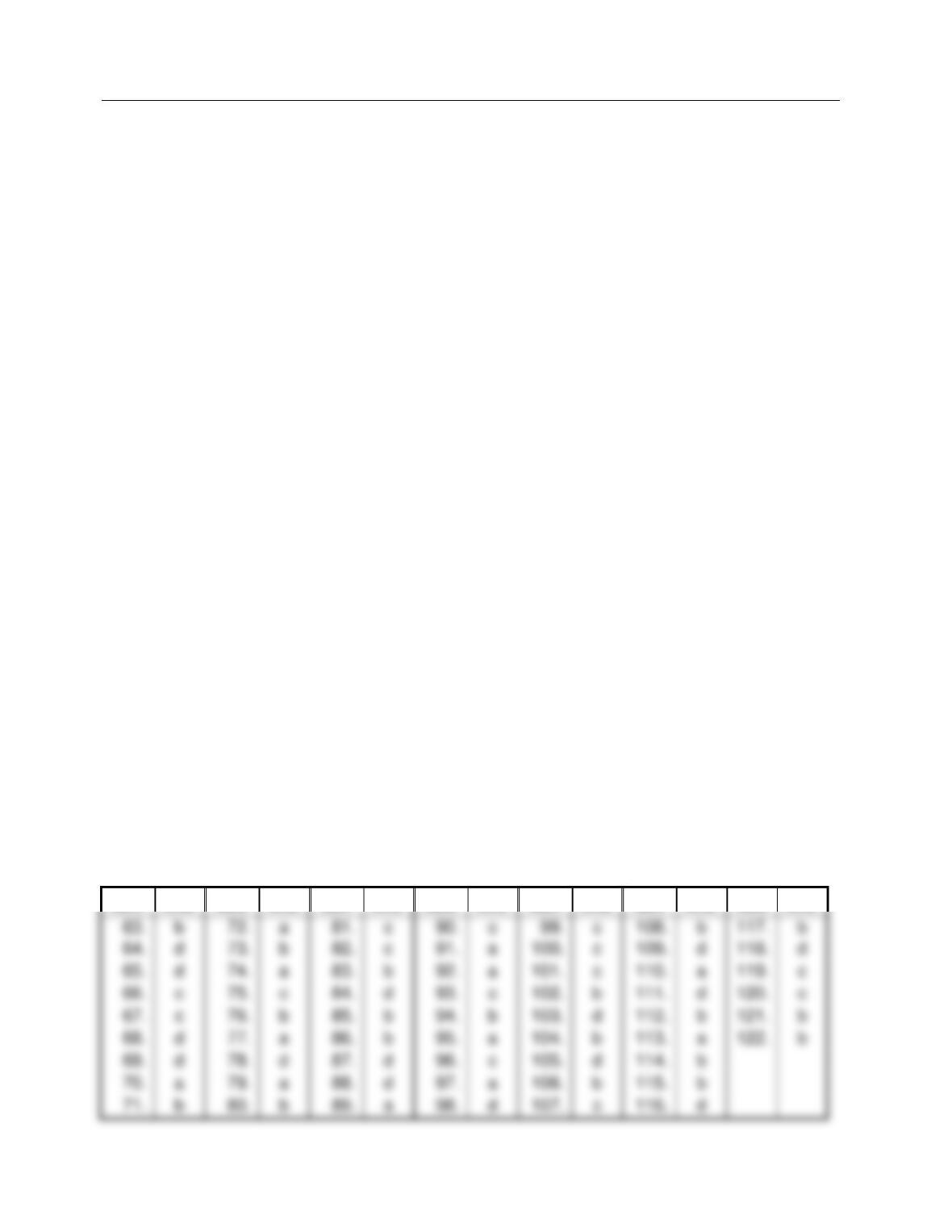
Multiple Choice Answers—Computational
Item
Ans.
Item
Ans.
Item
Ans.
Item
Ans.
Item
Ans.
Item
Ans.
Item
Ans.

Acquisition and Disposition of Property, Plant, and Equipment
10 – 29
MULTIPLE CHOICE—CPA Adapted
123. On December 1, 2014, Hogan Co. purchased a tract of land as a factory site for $750,000.
The old building on the property was razed, and salvaged materials resulting from
demolition were sold. Additional costs incurred and salvage proceeds realized during
December 2014 were as follows:
Cost to raze old building $70,000
Legal fees for purchase contract and to record ownership 10,000
Title guarantee insurance 16,000
Proceeds from sale of salvaged materials 8,000
In Hogan ‘s December 31, 2014 balance sheet, what amount should be reported as land?
a. $776,000.
b. $812,000.
c. $838,000.
d. $846,000.
124. Land was purchased to be used as the site for the construction of a plant. A building on
the property was sold and removed by the buyer so that construction on the plant could
begin. The proceeds from the sale of the building should be
a. classified as other income.
b. deducted from the cost of the land.
c. netted against the costs to clear the land and expensed as incurred.
d. netted against the costs to clear the land and amortized over the life of the plant.
125. A company is constructing an asset for its own use. Construction began in 2014. The
asset is being financed entirely with a specific new borrowing. Construction expenditures
were made in 2014 and 2015 at the end of each quarter. The total amount of interest cost
capitalized in 2015 should be determined by applying the interest rate on the specific new
borrowing to the
a. total accumulated expenditures for the asset in 2014 and 2015.
b. weighed-average accumulated expenditures for the asset in 2014 and 2015.
c. weighed-average expenditures for the asset in 2015.
d. total expenditures for the asset in 2015.
126. Colt Football Co. had a player contract with Watts that is recorded in its books at
$5,600,000 on July 1, 2014. Day Football Co. had a player contract with Kurtz that is
recorded in its books at $7,000,000 on July 1, 2014. On this date, Colt traded Watts to
Day for Kurtz and paid a cash difference of $700,000. The fair value of the Kurtz contract
was $8,400,000 on the exchange date. The exchange had no commercial substance.
After the exchange, the Kurtz contract should be recorded in Colt’s books at
a. $6,300,000.
b. $7,000,000.
c. $7,700,000.
d. $8,400,000.

Test Bank for Intermediate Accounting, Fifteenth Edition
10 – 30
127. Huff Co. exchanged nonmonetary assets with Sayler Co. No cash was exchanged and the
exchange had no commercial substance. The carrying amount of the asset surrendered
by Huff exceeded both the fair value of the asset received and Sayler’s carrying amount of
that asset. Huff should recognize the difference between the carrying amount of the asset
it surrendered and
a. the fair value of the asset it received as a loss.
b. the fair value of the asset it received as a gain.
c. Sayler’s carrying amount of the asset it received as a loss.
d. Sayler’s carrying amount of the asset it received as a gain.
128. Chase County owned an idle parcel of real estate consisting of land and a factory building.
Chase gave title to this realty to Patton Co. as an incentive for Patton to establish
manufacturing operations in the County. Patton paid nothing for this realty, which had a
fair market value of $250,000 at the date of the grant. Patton should record this
nonmonetary transaction as a
a. memo entry only.
b. credit to Contribution Revenue for $250,000.
c. credit to Extraordinary Income for $250,000.
d. credit to Donated Capital for $250,000.
129. On September 10, 2014, Jenks Co. incurred the following costs for one of its printing
presses:
Purchase of attachment $45,000
Installation of attachment 5,000
Replacement parts for renovation of press 18,000
Labor and overhead in connection with renovation of press 7,000
Neither the attachment nor the renovation increased the estimated useful life of the press.
However, the renovation resulted in significantly increased productivity. What amount of
the costs should be capitalized?
a. $0.
b. $57,000.
c. $68,000.
d. $75,000.
130. On January 2, 2014, York Corp. replaced its boiler with a more efficient one. The following
information was available on that date:
Purchase price of new boiler $140,000
Carrying amount of old boiler 10,000
Fair value of old boiler 4,000
Installation cost of new boiler 20,000
The old boiler was sold for $4,000. What amount should York capitalize as the cost of the
new boiler?
a. $160,000.
b. $154,000.
c. $150,000.
d. $140,000.
Acquisition and Disposition of Property, Plant, and Equipment
10 – 31
Multiple Choice Answers—CPA Adapted
Item
Ans.
Item
Ans.
Item
Ans.
Item
Ans.
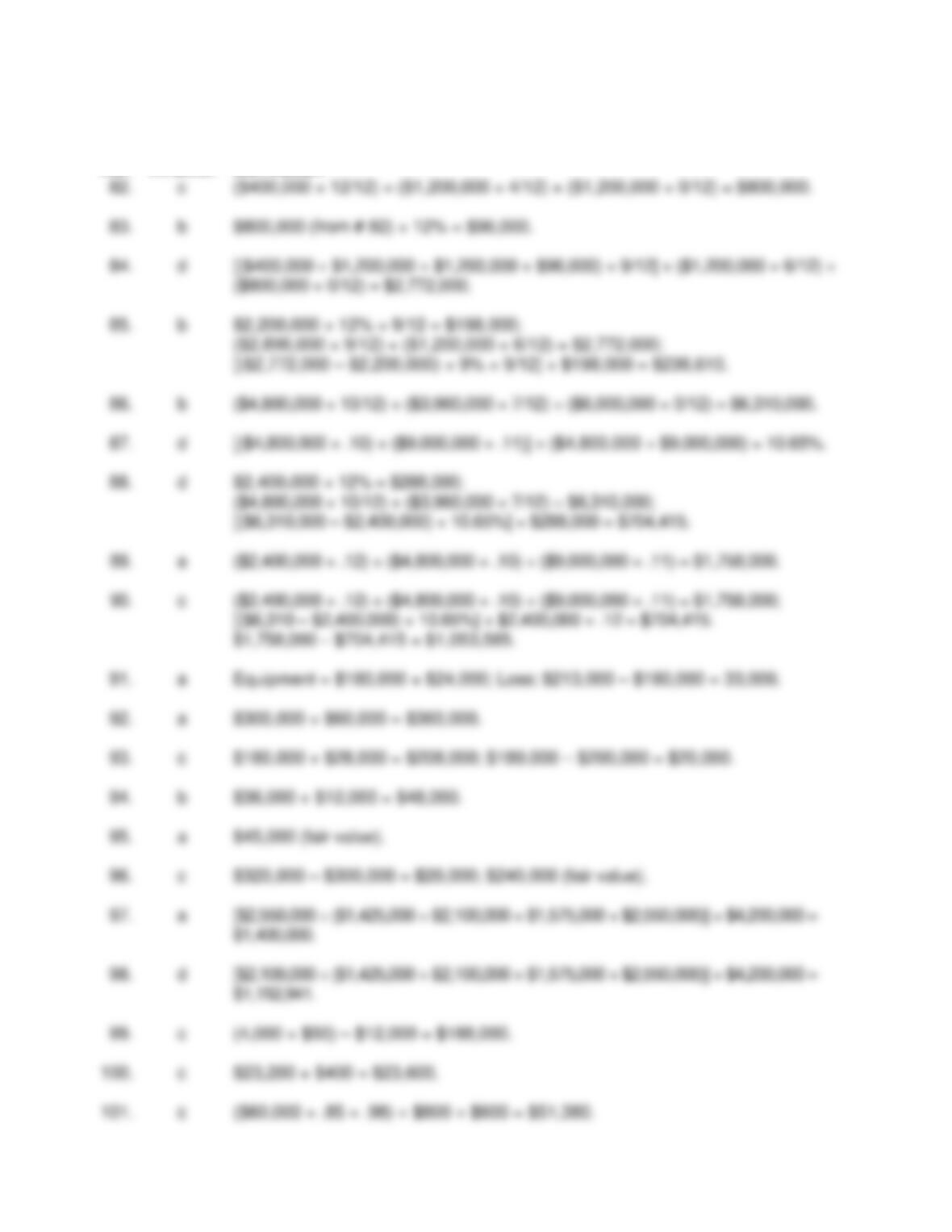
DERIVATIONS — Computational
No. Answer Derivation
Test Bank for Intermediate Accounting, Fifteenth Edition
10 – 32
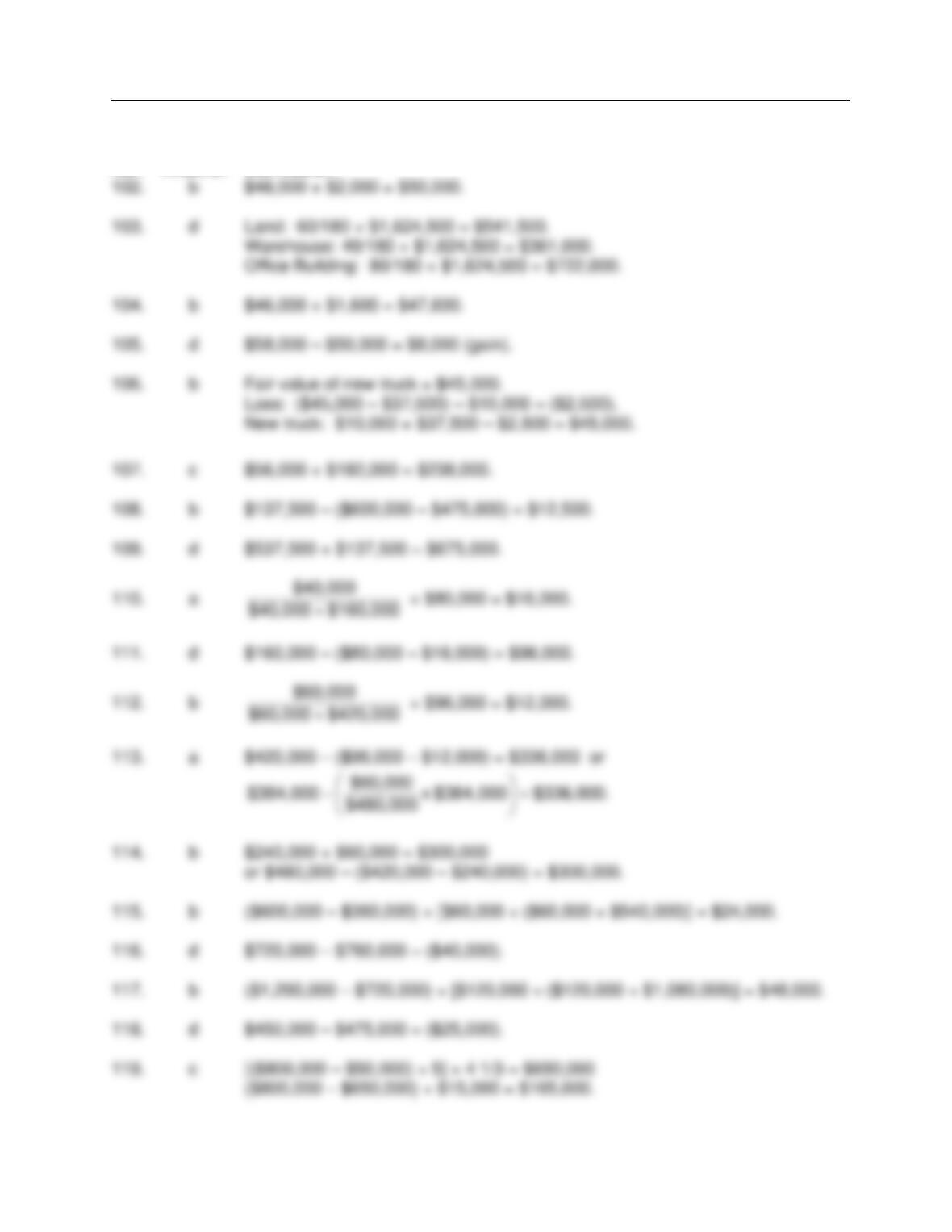
DERIVATIONS — Computational (cont.)
No. Answer Derivation
Acquisition and Disposition of Property, Plant, and Equipment
10 – 33
DERIVATIONS — Computational (cont.)
No. Answer Derivation
Test Bank for Intermediate Accounting, Fifteenth Edition
10 – 34
DERIVATIONS — Computational (cont.)
DERIVATIONS — CPA Adapted
No. Answer Derivation

Acquisition and Disposition of Property, Plant, and Equipment
10 – 35
BRIEF EXERCISES
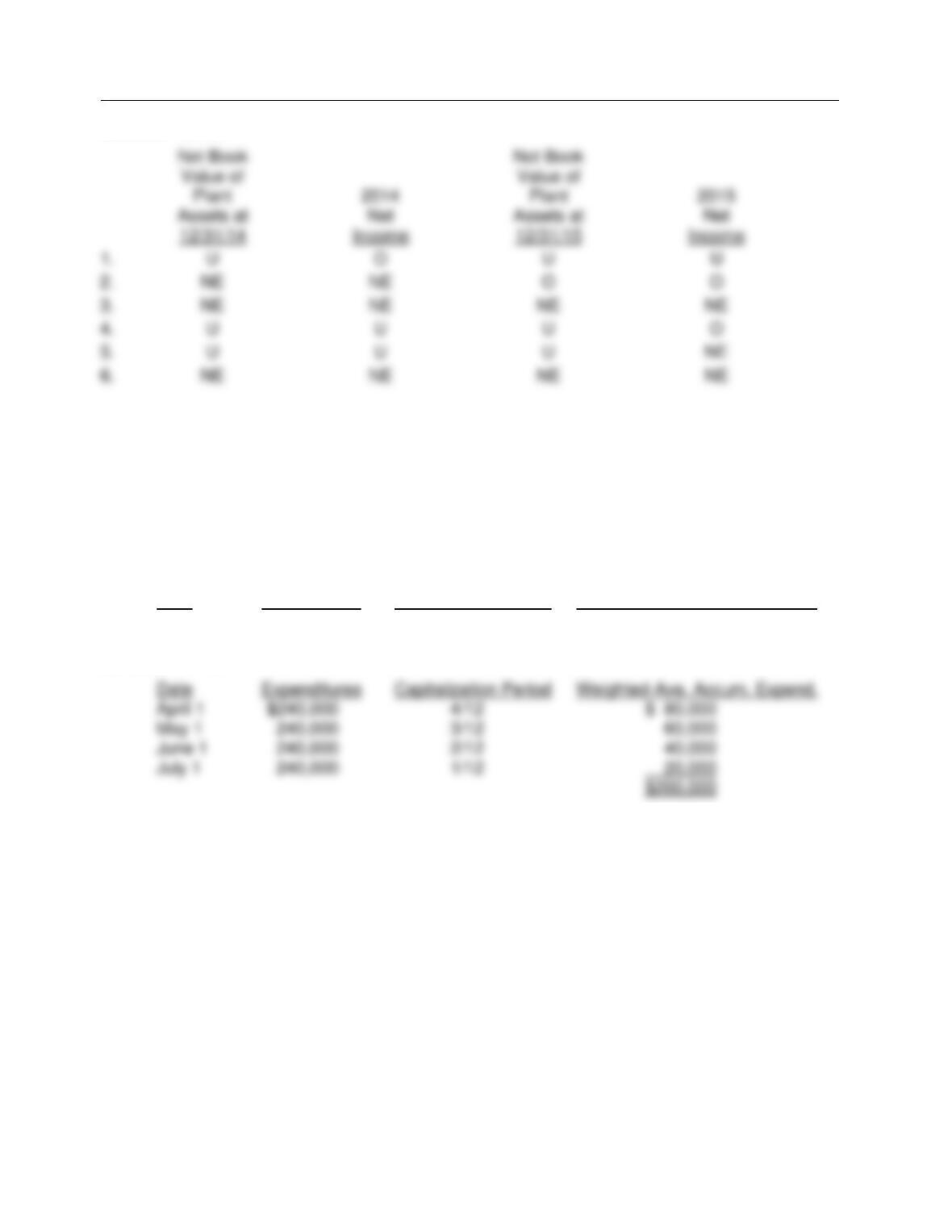
BE. 10-131—Plant asset accounting.
During 2014 and 2015, Sawyer Corporation experienced several transactions involving plant
assets. A number of errors were made in recording some of these transactions. For each item
listed below, indicate the effect of the error (if any) in the blanks provided by using the following
codes:
O = Overstate; U = Understate; NE = No Effect
If no error was made, write NE in each of the four columns.
2014 2015
Net Book Net Book
Value of Value of
Plant 2014 Plant 2015
Assets at Net Assets at Net
Transaction 12/31/14 Income 12/31/15 Income
1. The cost of installing a new computer
system in 2014 was not recorded in 2014.
It was charged to expense in 2015.
2. In 2015 clerical workers were trained to
use the new computer system at a cost of
$15,000, which was erroneously capital-
ized. The cost is to be written off over the
expected life of the new computer system.
3. A major overhaul of factory machinery in
2014, which extended its useful life by 5
years, was charged to accumulated
depreciation in 2014.
4. Interest cost qualifying for capitalization in
2014 was charged to interest expense in
2014.
5. In 2014 land was bought for an employee
parking lot. The $2,000 title search fee
was charged to expense in 2014.
6. The cost of moving several manufacturing
facilities from metropolitan locations to
suburban areas in 2014 was capitalized.
The cost was written off over a 10–year
period beginning in 2014.
______ _______ _______ ______
______ _______ _______ ______
______ _______ _______ ______
______ _______ _______ ______
______ _______ _______ ______
______ _______ _______ ______
Test Bank for Intermediate Accounting, Fifteenth Edition
10 – 36
Solution 10-131
BE. 10-132—Weighted-Average Accumulated Expenditures.
On April 1, Paine Co. began construction of a small building. Payments of $240,000 were made
monthly for four months beginning on April 1. The building was completed and ready for
occupancy on August 1. For the purpose of determining the amount of interest cost to be
capitalized, calculate the weighted-average accumulated expenditures on the building by
completing the schedule below:
Date Expenditures Capitalization Period Weighted-Ave. Accum. Expend.
Solution 10-132
BE. 10-133—Capitalization of interest.
On March 1, Mocl Co. began construction of a small building. The following expenditures were
incurred for construction:
March 1 $ 225,000 April 1 $ 222,000
May 1 540,000 June 1 810,000
July 1 300,000
The building was completed and occupied on July 1. To help pay for construction $150,000 was
borrowed on March 1 on a 12%, three-year note payable. The only other debt outstanding during
the year was a $1,500,000, 10% note issued two years ago.
Instructions
(a) Calculate the weighted-average accumulated expenditures.
(b) Calculate avoidable interest.