63) In order for a synthetic polymer to be used as a binder in water-base latex paints, it must have
________ properties.
A) reactive
B) inert
C) rubberlike
D) aromatic
64) Silicone is a(n)
A) polyester.
B) plasticizer.
C) conducting polymer.
D) None of the above.
65) One example of a condensation polymer is
A) polyvinyl chloride.
B) nylon.
C) Plexiglass.
D) polyvinyl acetate.
66) When polyester is formed as a film as opposed to a fiber, it is used in
A) party balloons.
B) floor tile.
C) bulletproof vests.
D) artificial limbs.
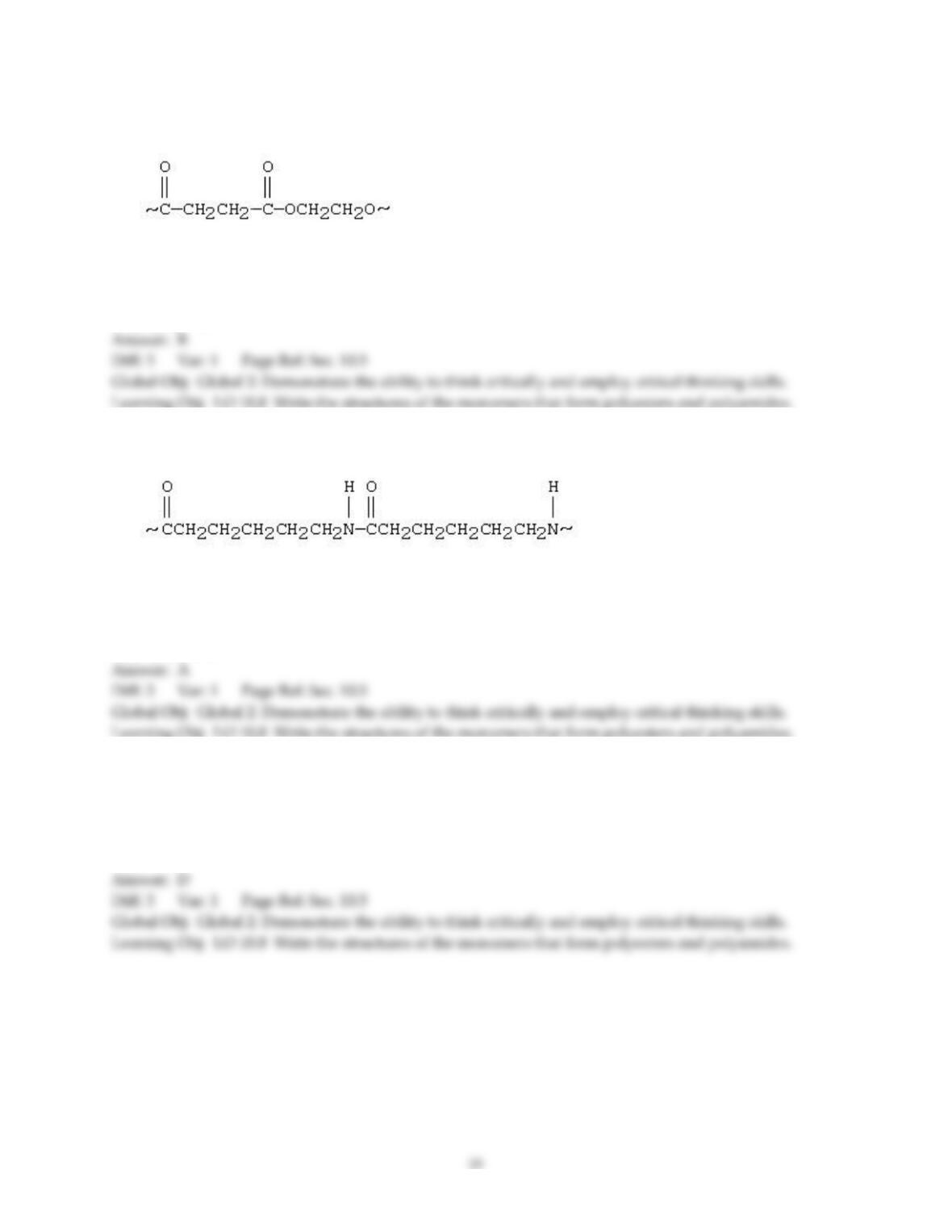
67) The segment of a polymer shown below represents a
A) polyamide.
B) polyester.
C) polyethylene.
D) polystyrene.
68) The segment of a polymer shown below represents a
A) polyamide.
B) polyester.
C) polyethylene.
D) polystyrene.
69) Nylons are named according to the number of ________ atoms in each monomer unit.
A) hydrogen
B) nitrogen
C) oxygen
D) carbon
70) Composite materials are used for
A) paint.
B) disposable cups.
C) thread.
D) automobile panels.
71) Silicons are NOT used for
A) lubricants.
B) garbage bags.
C) hydraulic fluids.
D) shoe polish.
72) Which of the following is NOT a condensation polymer?
A) polypropylene
B) polyester
C) Dacron
D) polyurethane
73) Which of the following natural polymers is a polyamide?
A) nylon
B) plant fibers
C) wool
D) amylopectin
74) Which of the following statements about addition and condensation polymers is true?
A) Both addition polymers and condensation polymers contain all of the atoms of the monomers.
B) Both addition polymers and condensation polymers lose some atoms from the original monomers
when the polymer is formed.
C) Addition polymers contain all of the atoms of the original monomers, but condensation polymers do
not.
D) Condensation polymers contain all of the atoms of the original monomers, but addition polymers do
not.
75) Which of the following is NOT true of composite materials?
A) They contain high-strength fibers, often made from glass, graphite or ceramics.
B) The fibers provide support to the composite material.
C) The fibers are usually held together by a thermosetting condensation polymer.
D) The composite materials are not very strong.
76) The temperature in many parts of the world can range between 0°C and 40°C, therefore we want the
Tg of car tires to be
A) greater than 40°C.
B) less than 40°C but greater than 0°C.
C) exactly 0°C.
D) less than 0°C.
77) An object will be used in an environment that has a temperature range of -20°C to 10°C. The object
must remain flexible and rubbery. It should have a Tg that is
A) greater than 10°C.
B) less than 10°C but greater than –20°C.
C) exactly –20°C.
D) less than –20°C.
78) The temperature in many parts of the world can range between 0°C and 40°C, therefore we want the
Tg of PVC used as seat covers in cars to be
A) greater than 40°C.
B) less than 40°C but greater than 0°C.
C) exactly 0°C.
D) less than 0°C.
79) The temperature inside the mouth is about 37°C. Polyvinyl acetate, a polymer used in chewing gum,
has a Tg
A) above 37°C.
B) below 37°C.
C) exactly 37°C.
D) above 100°C.
80) Amorphous polymers are composed of
A) randomly organized polymer chains.
B) highly organized polymer chains.
C) a mixture of random and highly organized polymer chains.
D) one monomer.
81) Crystalline polymers are composed of
A) randomly organized polymer chains.
B) highly organized polymer chains.
C) a mixture of random and highly organized polymer chains.
D) one monomer.
82) Lycra bicycle shorts and exercise clothing contain fibers that have great strength and rigidity as well
as the ability to stretch. These fibers are probably composed of
A) natural rubber.
B) amorphous polymers.
C) crystalline polymers.
D) a creative combination of amorphous and crystalline polymers.
83) Plexiglas is a polymethyl methacrylate polymer that is used as a glass substitute. The Tg of Plexiglas
is
A) low.
B) high.
C) moderate.
D) not important.
84) Which of the following statements about crystalline and amorphous polymers is correct?
A) Crystalline polymers tend to be stronger, while amorphous polymers tend to have great elasticity.
B) Crystalline polymers tend to have greater elasticity, while amorphous polymers tend to be stronger.
C) Both crystalline and amorphous polymers are strong but have little elasticity.
D) Both crystalline and amorphous polymers have great elasticity but have little strength.
85) The glass transition temperature (Tg) for a material is
A) the temperature that the polymer is unusable.
B) the temperature that the polymer melts.
C) the temperature above which the material is hard and brittle and the temperature below which the
material is tough and rubbery.
D) the temperature below which the material is hard and brittle and the temperature above which the
material is tough and rubbery.
86) Plastics make up ________ percent by mass of solid waste.
A) 12
B) 5
C) 25
D) 30
87) One of the advantages of incinerating plastics is
A) the high fuel value.
B) no air pollution.
C) all polymers burn efficiently.
D) All of the above are advantages of incinerating plastics.
88) Which of the following characteristics of synthetic polymers is NOT a problem?
A) They frequently are neither biodegradable nor photodegradable.
B) They frequently give off poisonous gases when they are burned.
C) They generally have a high energy content and can be burned.
D) They make up a large volume of the waste which goes into landfills.
89) Which of the following is currently the most desirable method to minimize the problem of disposal of
plastics?
A) Deposit them in a landfill.
B) Incinerate them.
C) Recycle them.
D) Use biodegradable plastics.
90) Toxic hydrogen cyanide (HCN) is generated by burning
A) polyacrylonitrile.
B) rubber.
C) bullet-proof vests.
D) polystyrene.
91) The greatest hazard in using plastics in home building materials and furnishings is that some
A) poison children who eat them.
B) cause cancer.
C) are slippery.
D) form poisonous gases when burned.
92) Production of PCBs was discontinued in 1977, yet PCBs are still found in the environment. The
reason for this is
A) PCBs are formed naturally by plants and animals.
B) PCBs are very stable molecules.
C) PCBs are very reactive molecules.
D) PCBs are imported from other countries where their production is not banned.
93) Which of the following will result from adding a plasticizer to a polymer?
A) They will have a higher glass transition temperature, Tg.
B) They will be more rigid.
C) They will be more transparent.
D) They will be less brittle.
94) Polychlorinated biphenyls (PCBs) have been banned because they are an environmental hazard.
Which of the following was NOT a reason for banning them?
A) PCBs degrade slowly in nature.
B) PCBs are nonpolar compounds and do not dissolve readily in water.
C) PCBs have high electrical resistance and are excellent insulating materials.
D) They lower the glass transition temperature, Tg, when they are added to a polymer.
95) The source of starting materials for synthetic polymers is primarily
A) wood.
B) petroleum and natural gas.
C) water.
D) metals.
96) Which of the following is a problem with the use of plastics?
A) They have a low density.
B) They can conduct electricity.
C) They are made from petroleum and natural gas.
D) They can be made from renewable plant resource.
97) The most commonly recycled plastics are
A) HDPE and PET.
B) PET and PS.
C) HDPEand PS.
D) PET and styrene-butadiene.
98) All of the following statements about biodegradable polymers are true EXCEPT
A) some can biodegrade by composting.
B) the most sustainable approach is to use renewable resources, especially non-food crops, as a monomer
source.
C) their glass transition temperatures are very high.
D) many require microorganisms to degrade them.
99) Flame-retardant fabrics often have ________ atoms incorporated into the fabric’s fibers.
A) Br or O
B) Cr or Br
C) Br or Cl
D) F or Br
100) Which of the following statements about biodegradable polymers is true?
A) They will degrade quickly in a landfill.
B) Thermosetting polymers are biodegradable, but thermoplastics are not.
C) They often require specific temperatures or the presence of microorganisms in order to undergo
degradation.
D) Polyvinyl chloride is a biodegradable polymer.
10.2 True/False Questions
1) All polymers are made from synthetic sources.
2) All polymers made from polyethylene will have the same density.
3) Thermosetting polymers can be melted and reformed into different shapes.
4) Polyethylene has double bonds, but ethylene does not.
5) Thermosetting resins will decompose rather than melt when they are heated to a high temperature.
6) A large number of polymers are synthesized from monomers that are derived from ethylene.
Replacing one or more of the hydrogen atoms on the ethylene monomer does not change the properties
of the polymer.
7) Neoprene is an elastomer that shows better resistance to oil and gasoline than other elastomers.
8) Polyester is an example of a condensation polymer.
29
9) A silicone polymer has a series of alternating silicon and oxygen atoms in the polymer chain.
10) Amorphous polymers tend to have great strength and rigidity while crystalline polymers tend to have
greater elasticity.
11) Chewing gum is easier to remove from clothing if ice is applied to the gum. This works because
applying ice lowers the temperature of the gum to below its glass transition temperature (Tg), so the gum
becomes brittle and can be removed more easily.
12) Crystalline polymers tend to have great strength while amorphous polymers tend to have greater
elasticity.
13) The glass transition temperature, Tg, is the temperature above which the polymer becomes brittle.
14) Approximately 50% of the plastic currently used in the United States is recycled each year.
15) Fire-retardant fabrics often have nitrogen or zinc atoms incorporated into the fibers of the polymers
from which the cloth is made.
16) A plasticizer makes a material more flexible and less brittle by raising its glass transition temperature
(Tg).
17) Polychlorinated biphenyls (PCBs) are no longer used as plasticizers because they are considered to be
an environmental hazard.
18) Plasticizers are liquids of low volatility which can be lost by diffusion or evaporation as a plastic
material ages.
19) Plasticizers, such as biphenyls, are very soluble in water.
20) The wings of some airplanes are made from composite materials.
21) Polymers can be made from corn, soybeans, and sugarcane.
10.3 Short Answer Questions
1) What is polymerization?
2) What is a macromolecule?
3) What is the connection between polyethylene and the “Battle of Britain” in the second World War?
4) What type of polymer is used for silly putty?
5) Name three advantages of acrylic fiber yarns over wool.
10.4 Essay Questions
1) Compare and contrast the molecular structure and performance characteristics of LDPE and HDPE.
2) Compare thermoplastic and thermosetting polymers.
3) Polyvinyl chloride is used for drain pipe in plumbing applications. It has replaced traditional cast iron
pipe for this purpose. List the advantages of PVC for plumbers, the plumbing industry and homeowners.
4) Draw part of the repeating structure of polymethyl methacrylate.
5) Draw part of the repeating structure of polyvinyl acetate.
6) Sulfur acts as a cross-linker when rubber is vulcanized. Explain why this cross-linking improves the
performance of rubber.
7) Distinguish between a polymer like polyethylene and a copolymer like styrene-butadiene rubber
8) Explain how an addition polymer differs from a condensation polymer.
9) What are composite materials? What are their advantages? Give two examples of products that use
composite materials.
10) How are polymers linked to the earth’s petroleum reserves?