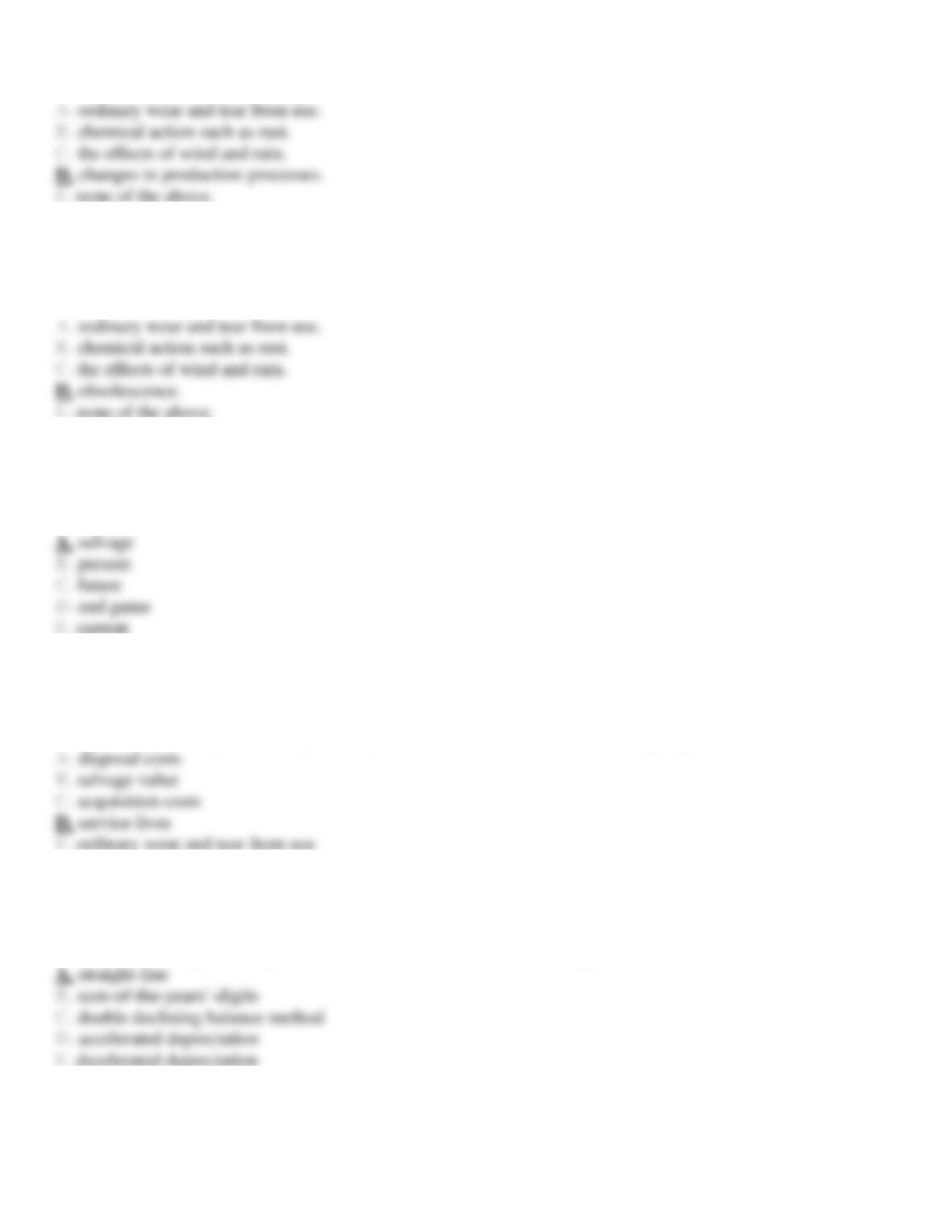
98. In calculating depreciation and amortization for tangible assets, physical factors that limit service lives
include all of the following except:
99. In calculating depreciation and amortization for tangible assets, functional factors that limit service lives
include:
100. The term _____ value refer to the estimated proceeds on the disposition of an asset less all removal and
selling costs.
101. Estimating _____ presents the most difficult task in the depreciation and amortization calculation. A
change in this estimate will change the depreciation and amortization amounts going forward.
102. The _____ method divides the acquisition cost of an asset (including the cost to dismantle and retire) less
its estimated salvage value by the estimated service life to calculate depreciation or amortization.
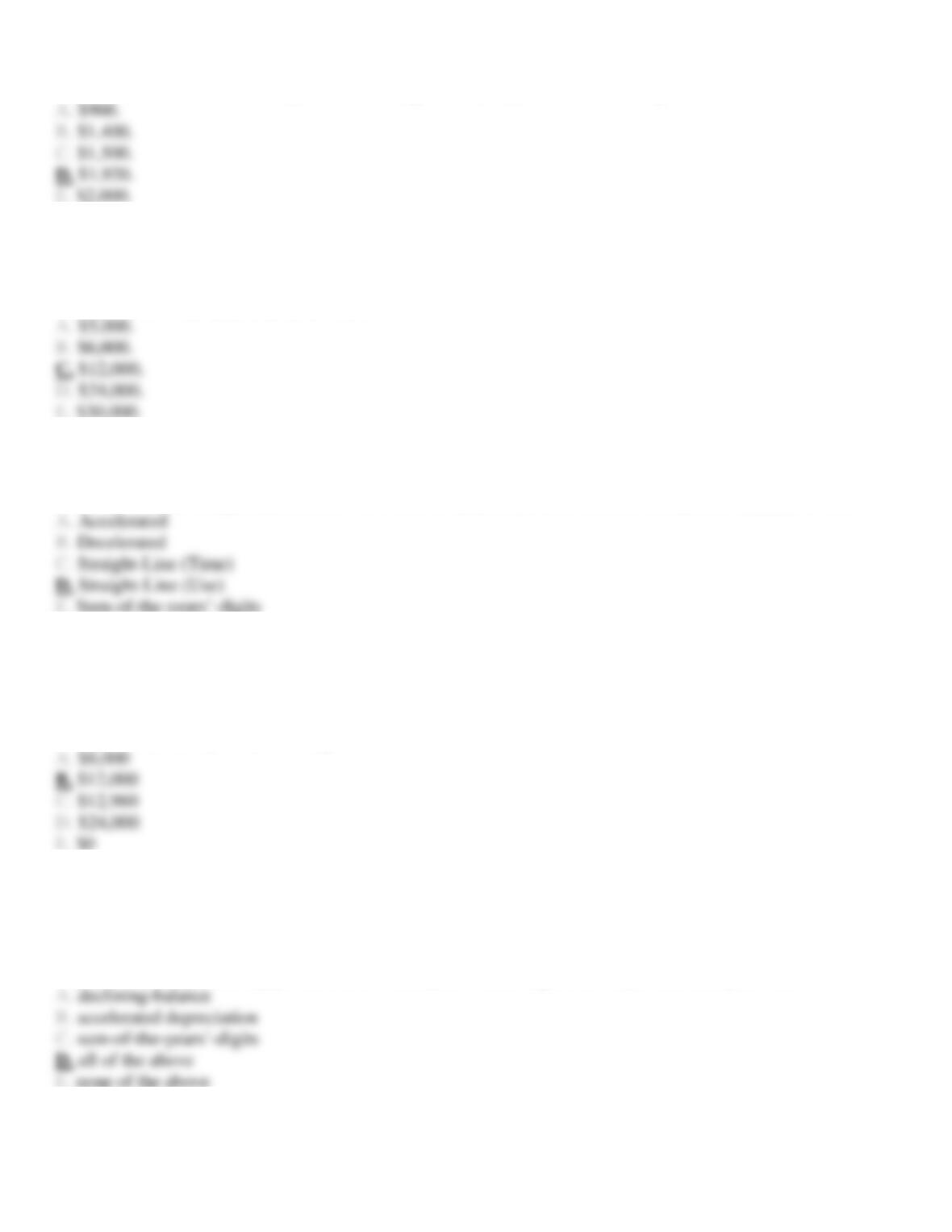
103. Marley Corporation has a machine which costs $10,000, has an estimated salvage value of $400, and has
an expected service life of five years. The straight-line (time) method annual depreciation is
104. Alpha Corporation acquired a patent for $60,000 which has an expected service life of five years and zero
salvage value. The annual amortization is
105. The method of depreciation for assets whose utilization is not uniform over time is the _____ method.
106. Dickinson Company owns a delivery truck that costs $108,000, has an estimated salvage value of $8,000,
and will provide 200,000 miles of use before retirement. If the truck operates 24,000 miles in a given year, the
straight-line (use) depreciation charge is
107. Eaton Company has some assets that provide more and better services in the early years of their lives and
require increasing amounts of maintenance as they grow older. The _____ method(s), which recognize larger
depreciation charges in early years and smaller depreciation charges in later years, can be justified.
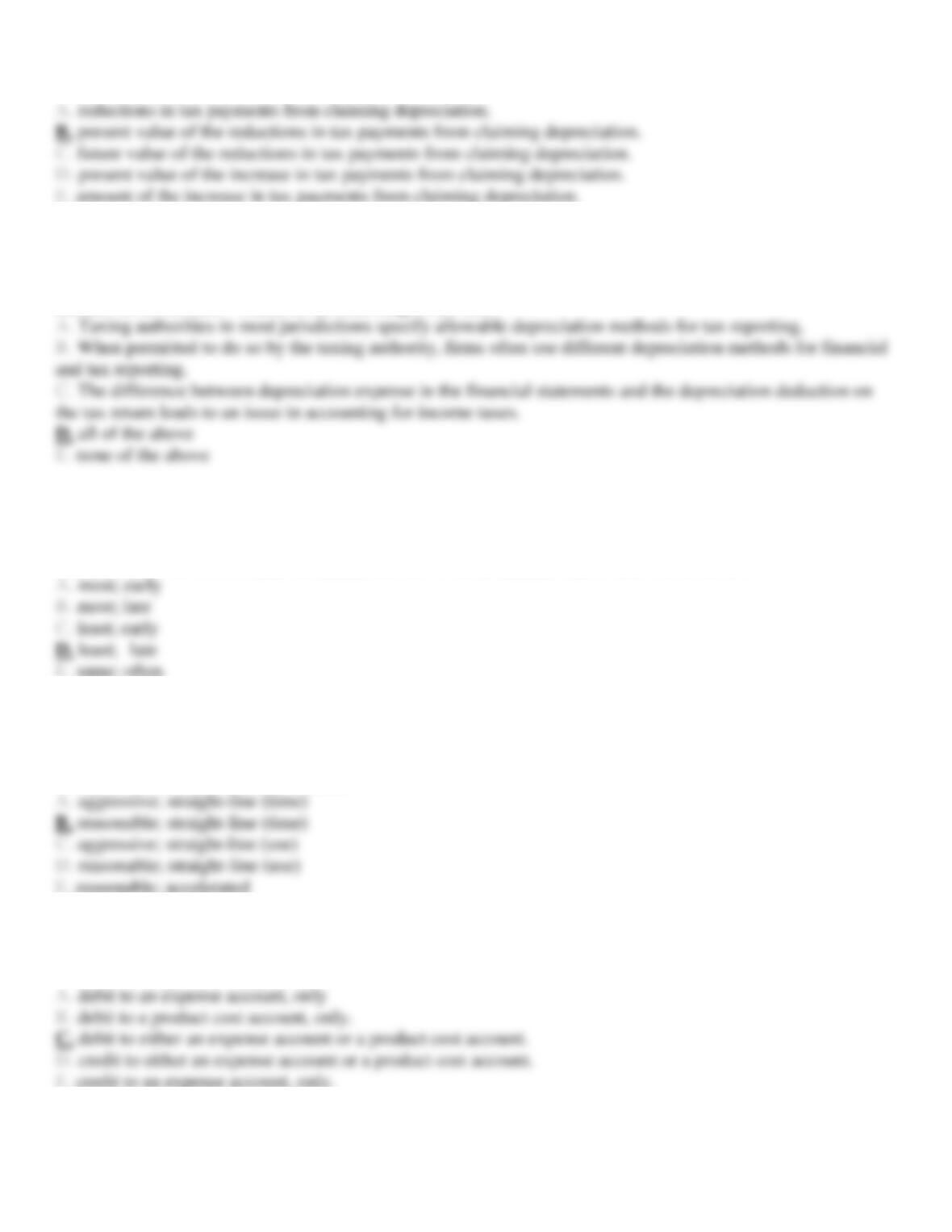
108. If permitted a choice of depreciation methods for tax reporting, a firm should try to maximize the amount
of the
109. Depreciation and amortization affect both net income reported in the financial statements and taxable
income on tax returns. Which of the following is /are true?
110. When taxing authorities permit a choice among alternative depreciation methods, a firm should choose the
alternative that allows it to pay the _____ amount of tax, as _____ as possible, within the law.
111. U.S. GAAP authoritative guidance requires that financial statements report depreciation charges based on
_____ estimates; in practice, the _____ method is the most common.
112. Recording periodic depreciation and amortization results in a
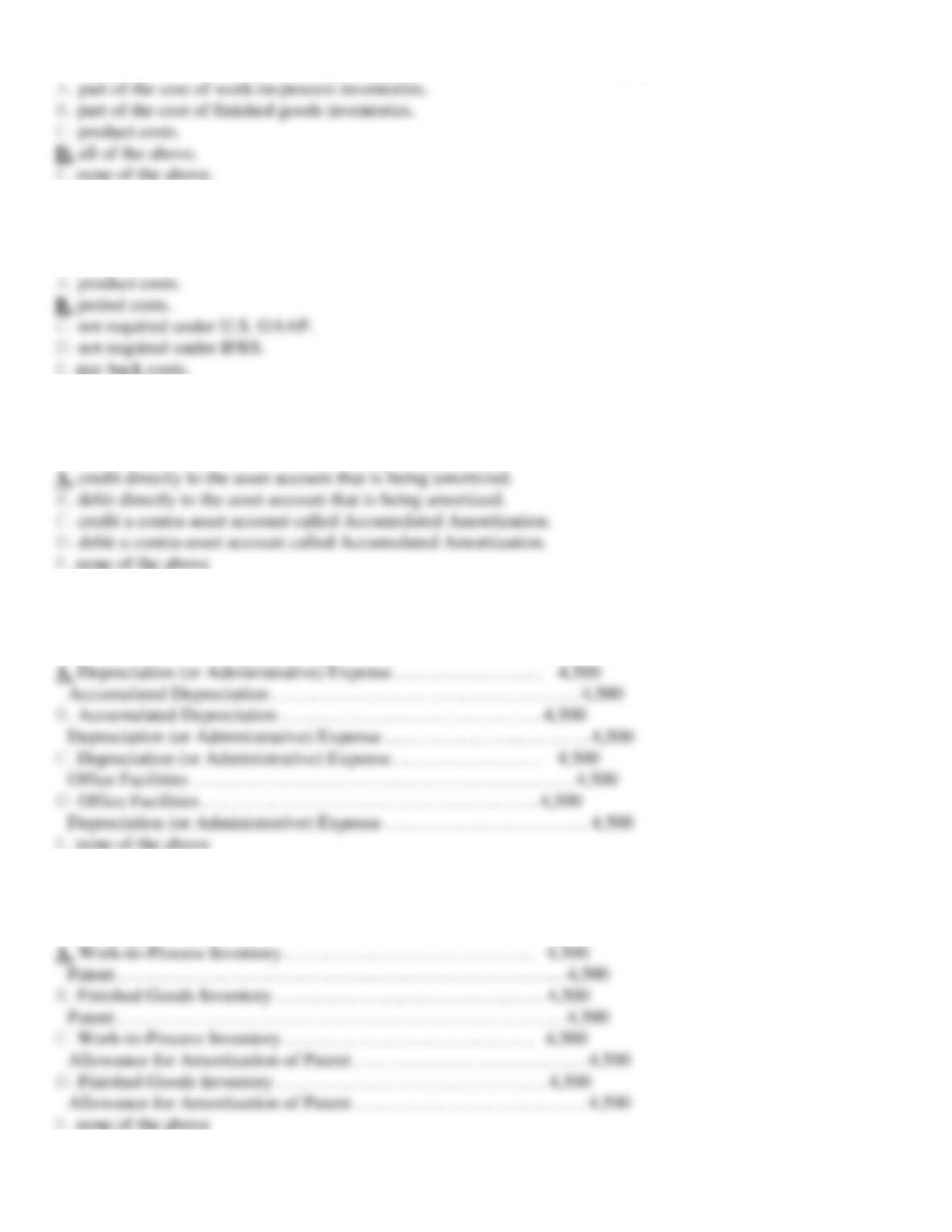
113. Depreciation of factory buildings and equipment used in manufacturing operations become(s)
114. The amortization of a customer list are
115. The recording of amortization of intangibles generally results in a
116. The entry to record periodic depreciation of $4,500 on office facilities is as follows:
117. The entry to record patent amortization of $4,500 embedded in a product is as follows:
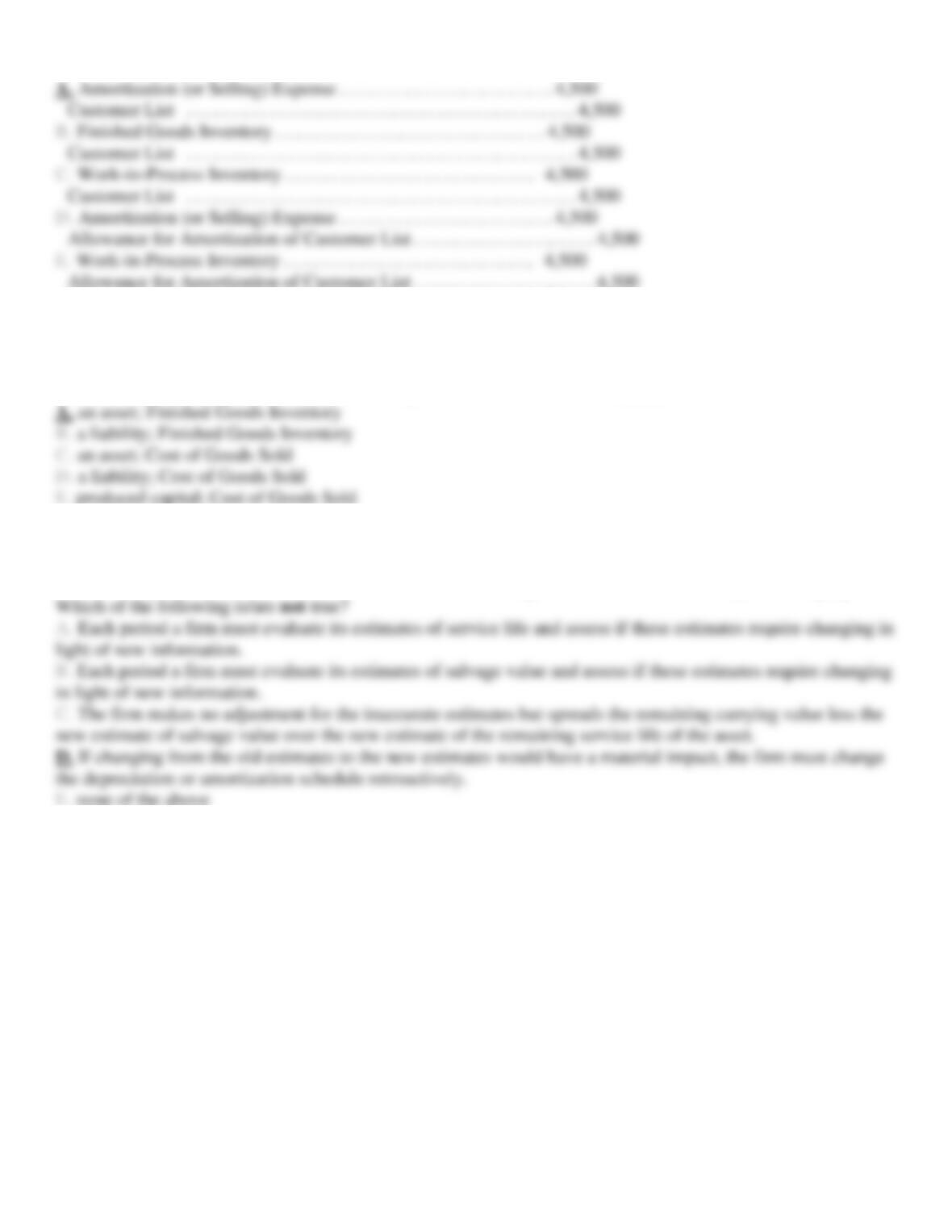
118. The entry to record amortization of a customer list in the amount of $4,500 is as follows:
119. The Work-in-Process Inventory account is _____. Product costs accumulate in the Work-in–Process
Inventory account until the firm completes the goods and transfers them to _____.
120. The original depreciation or amortization schedule for long-lived assets sometimes requires changing.
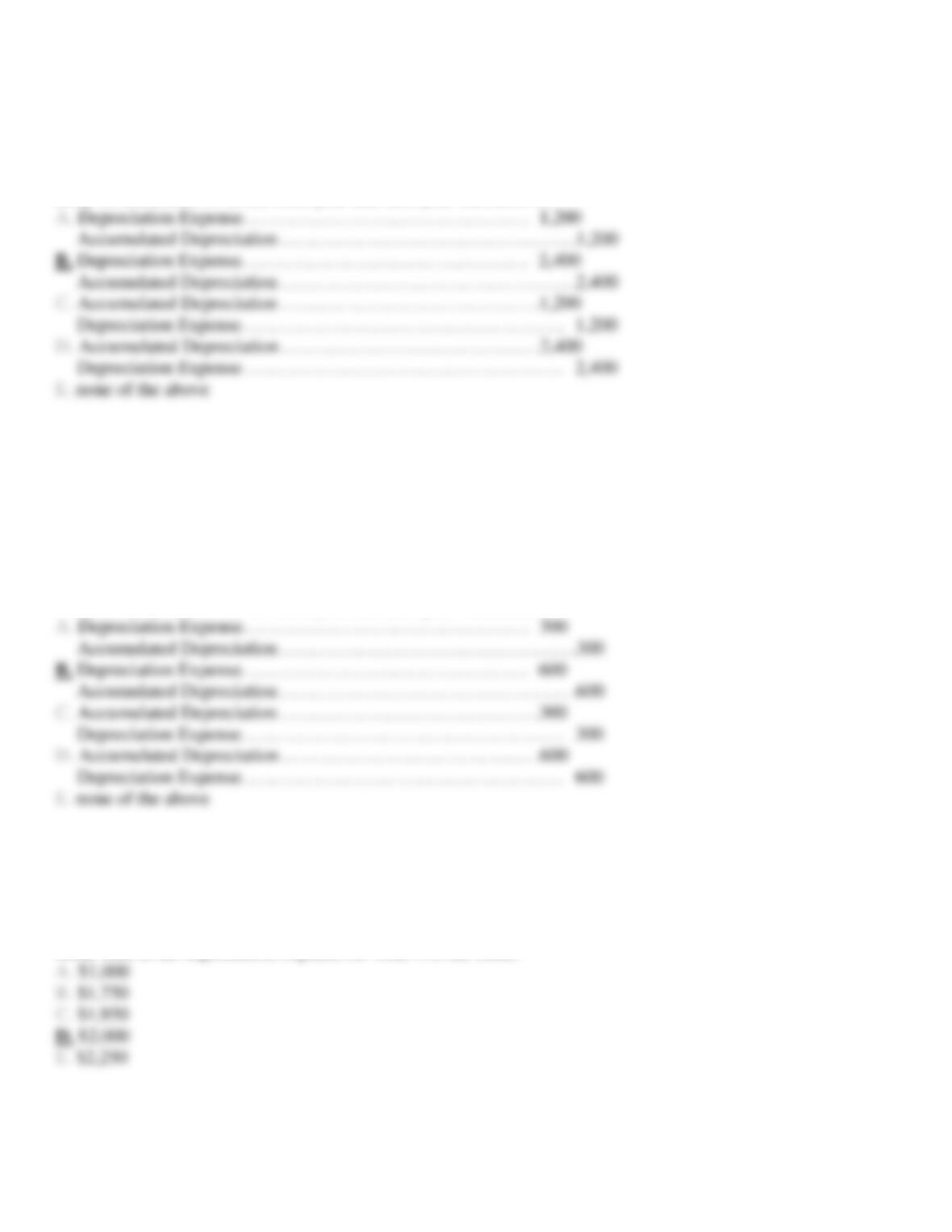
121. A firm purchased an office machine for $18,400, estimated that it will use the machine for 15 years, and
estimated a salvage value of $400. On December 31 of the sixth year, before closing the books for the year, the
firm analyzed its estimates of useful life and salvage value. In light of new information, the firm estimated that
the machine will have a total useful life of only 10 years, and the salvage estimate of $400 remains reasonable.
The new estimate of the remaining life is five years (the year just ended plus the next four). The depreciation
entry on December 31 of the sixth year and each year thereafter is:
122. A firm purchased an office machine for $4,600, estimated that it will use the machine for 15 years, and
estimated a salvage value of $100. On December 31 of the sixth year, before closing the books for the year, the
firm analyzed its estimates of useful life and salvage value. In light of new information, the firm estimated that
the machine will have a total useful life of only 10 years, and the salvage estimate of $100 remains reasonable.
The new estimate of the remaining life is five years (the year just ended plus the next four). The depreciation
entry on December 31 of the sixth year and each year thereafter is:
123. In Year 1, a firm purchased a truck for $12,000. The estimated salvage value was $2,000 and the estimated
useful life was 10 years. In Year 4, it was determined that the salvage value would only be $1,000 and that the
truck would have a total estimated useful life of 7 years rather than 10. Assuming the straight-line method is
used, what is the depreciation expense for Year 4 of the truck?
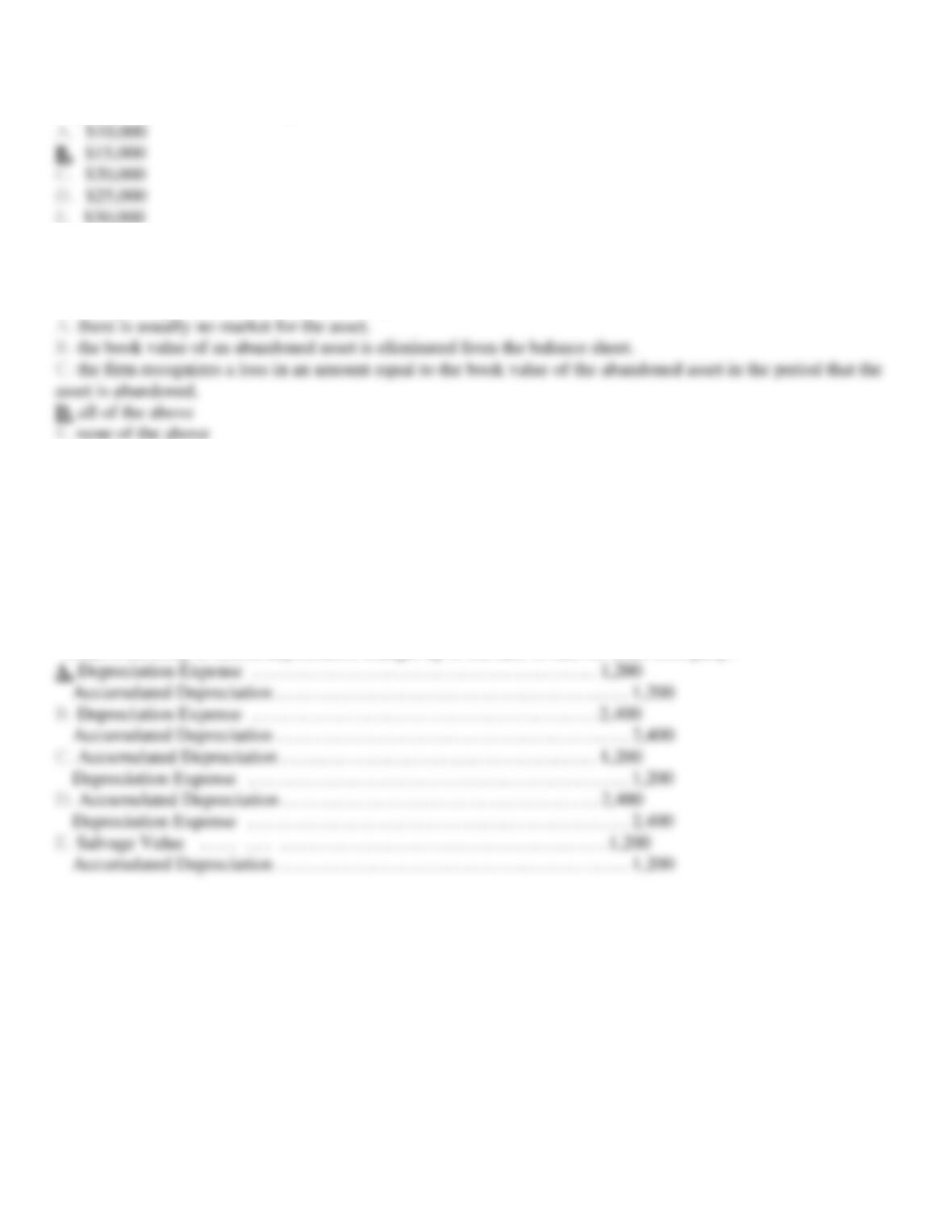
124. Assume a firm has acquired an asset for $100,000 on January 1, Year 1. The asset has a 6-year life and a
salvage value of $10,000. The firm calculates the depreciation expense using the straight-line
depreciation. What was the depreciation for Year 4?
125. Regarding a firm that abandons an asset,
126. Chen Company
Chen Company office equipment costs $10,000, has an expected life of four years and a salvage value of $400.
The firm has depreciated this asset on a straight-line basis. The firm has recorded depreciation for two years and
then sells the equipment at midyear in the third year.
What is the entry to record depreciation charges up to the date of sale for Chen Company?
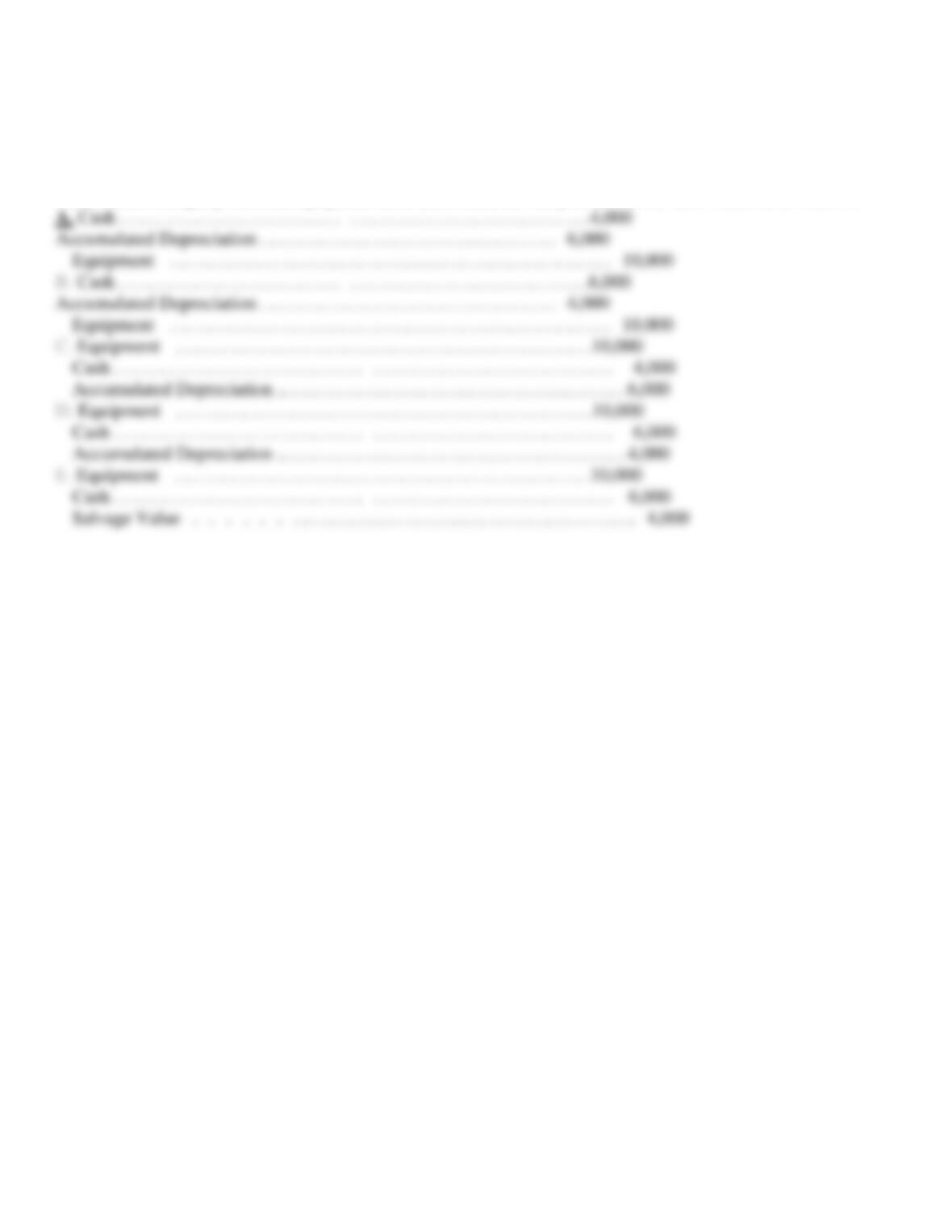
127. Chen Company
Chen Company office equipment costs $10,000, has an expected life of four years and a salvage value of $400.
The firm has depreciated this asset on a straight-line basis. The firm has recorded depreciation for two years and
then sells the equipment at midyear in the third year.
If the Chen Company sells the equipment for $4,000 cash, the entry to record the sale would be as follows:
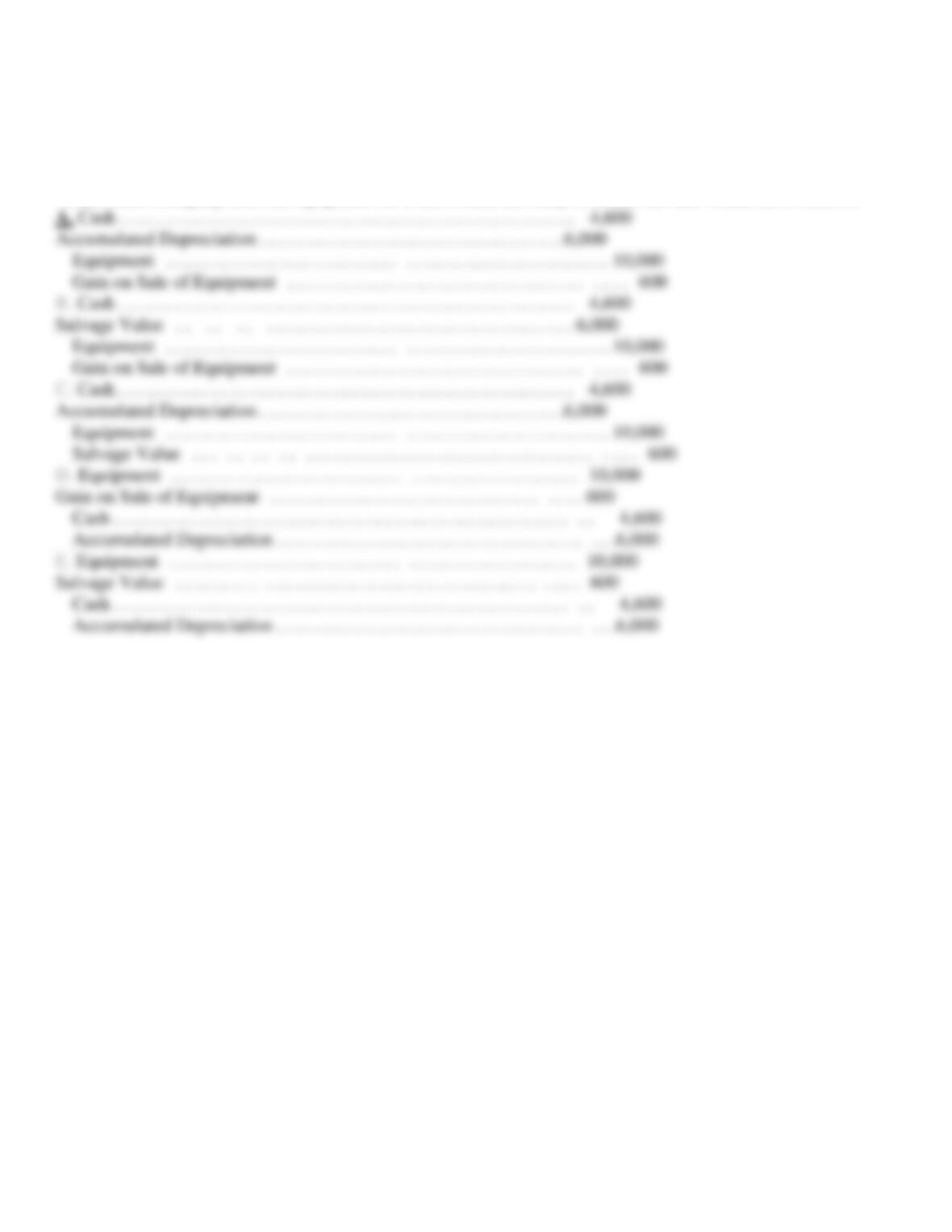
128. Chen Company
Chen Company office equipment costs $10,000, has an expected life of four years and a salvage value of $400.
The firm has depreciated this asset on a straight-line basis. The firm has recorded depreciation for two years and
then sells the equipment at midyear in the third year.
If the Chen Company sells the equipment for $4,600 cash, the entry to record the sale would be as follows:
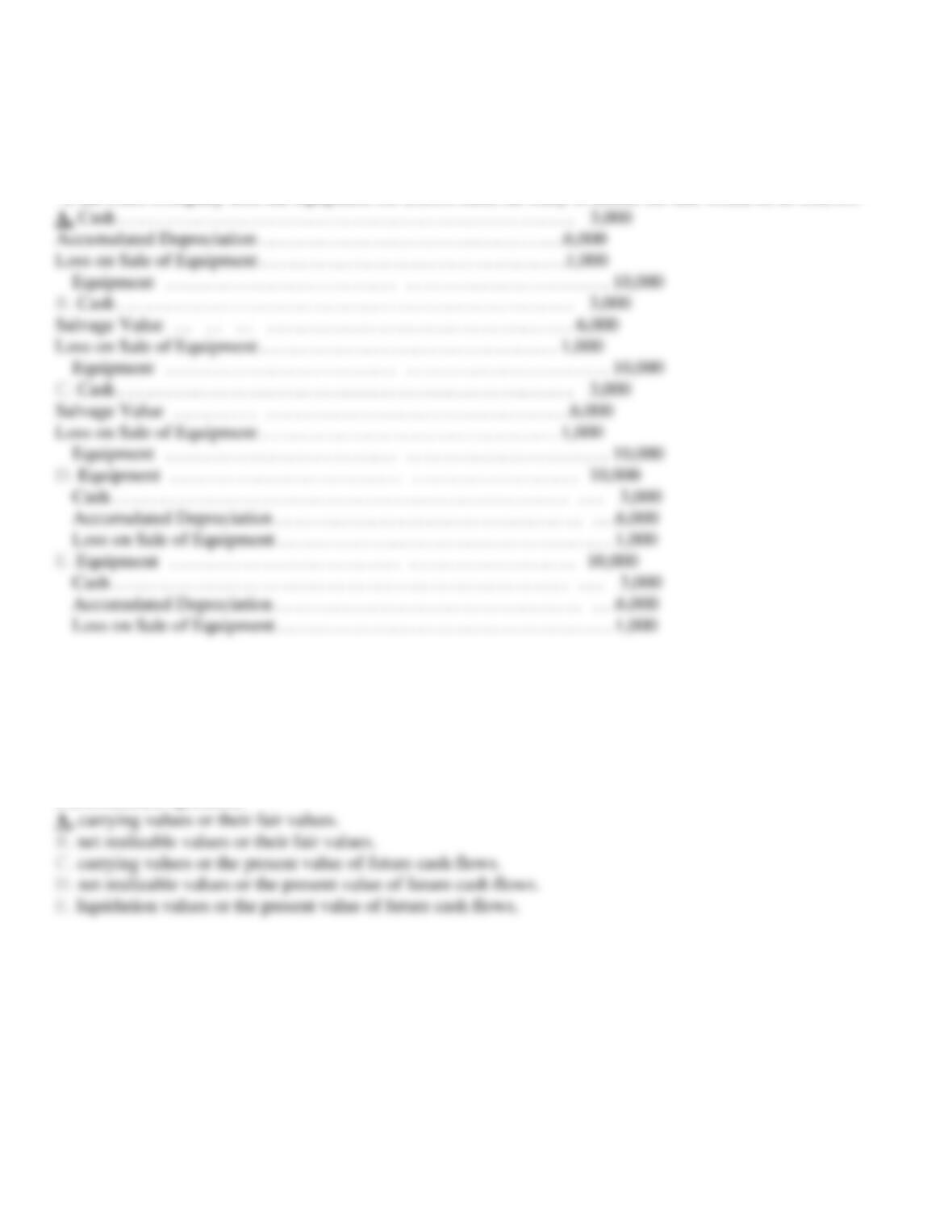
129. Chen Company
Chen Company office equipment costs $10,000, has an expected life of four years and a salvage value of $400.
The firm has depreciated this asset on a straight-line basis. The firm has recorded depreciation for two years and
then sells the equipment at midyear in the third year.
If the Chen Company sells the equipment for $3,000 cash, the entry to record the sale would be as follows:
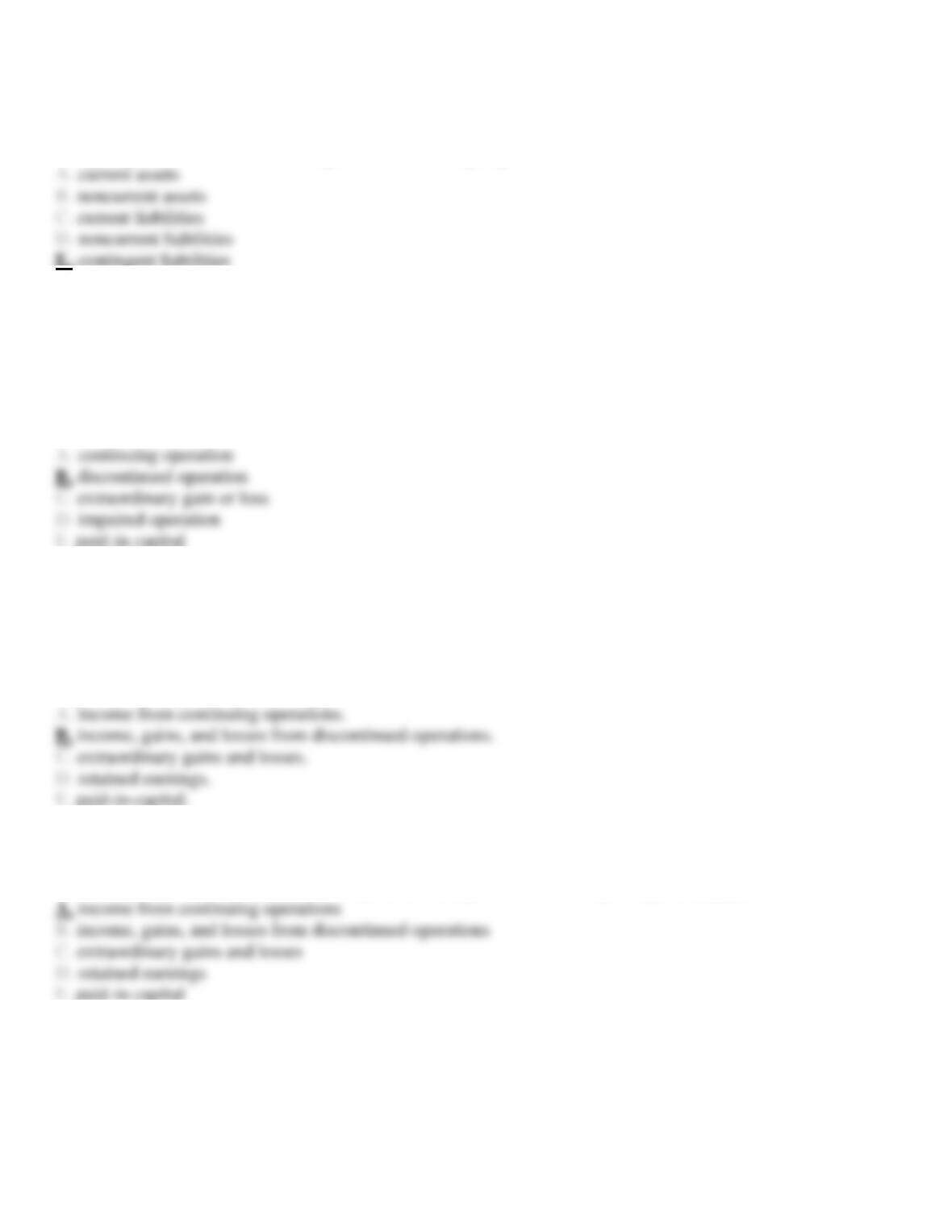
130. Under U.S. GAAP and IFRS, the firm measures the assets and liabilities of a discontinued operation at the
lower of their _____ It reports any gain or loss that results in the Discontinued Operations section of the
income statement. The Discontinued Operations section also includes income or loss from operating the unit for
that year. Financial statements for prior years included for comparative purposes classify those amounts also as
a discontinued operation.
131. IFRS uses the idea of a disposal group, a group of assets and directly associated liabilities that a firm will
dispose of as a group in a single transaction. The disposal group notion of IFRS envisions a larger unit than the
component notion of U.S. GAAP. In the year that a firm decides to sell or otherwise dispose of a unit that
qualifies as a discontinued operation, it aggregates the assets and liabilities of that unit on the balance sheet into
four groups. Which of the following is not one of the groups?
132. IFRS uses the idea of a disposal group, a group of assets and directly associated liabilities that a firm will
dispose of as a group in a single transaction. The disposal group notion of IFRS envisions a larger unit than the
component notion of U.S. GAAP. In the year that a firm decides to sell or otherwise dispose of a unit that
qualifies as a(n) _____ it aggregates the assets and liabilities of that unit on the balance sheet into four groups:
current assets, noncurrent assets, current liabilities, and noncurrent liabilities.
133. Under U.S. GAAP, sometimes a firm sells or otherwise disposes of a major division or segment of its
business during the year or contemplates its sale or disposal within a foreseeable time after the end of the
accounting period. If so, it must disclose separately any income, gains, and losses related to that division or
segment. The separate disclosure appears in the
134. Firms almost always report asset impairment charges or restructuring charges in _____.
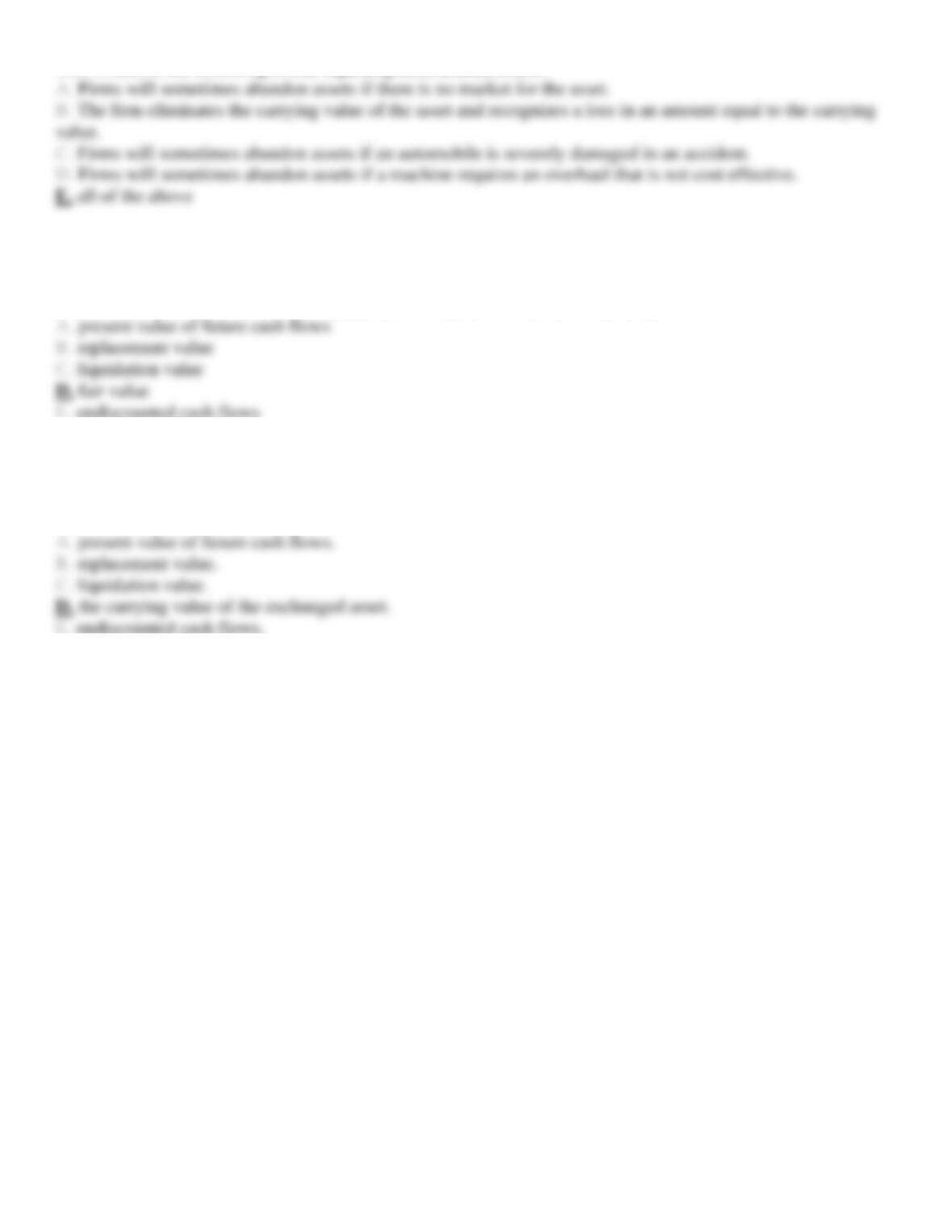
135. Which of the following is true regarding asset abandonment?
136. A firm may retire an asset from service by trading it in on a new asset. U.S. GAAP and IFRS require that
firms record trade-in transactions at _____ unless they lack commercial substance.
137. A firm may retire an asset from service by trading it in on a new asset. U.S. GAAP and IFRS require that
firms record a trade-in that lacks commercial substance at
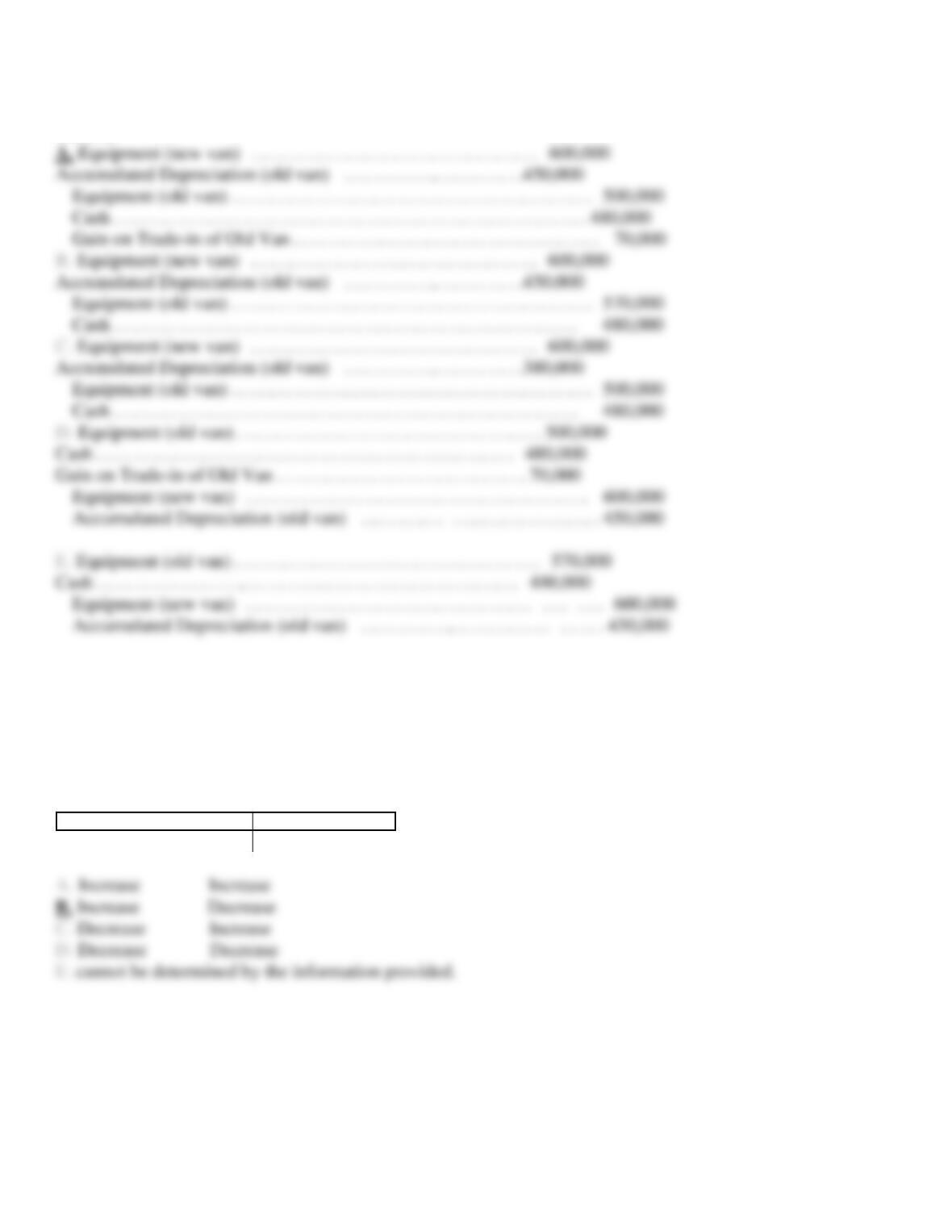
138. Warrior Dash Express Inc. owns a moving van that originally cost $500,000 and currently has $450,000 of
accumulated depreciation. The fair value of the moving van is $120,000. Warrior Dash Express Inc. exchanges
the van plus $480,000 in cash for a new moving van costing $600,000. The entry to record the transaction is as
follows:
139. (CMA adapted, Jun 90 #27) When a fixed plant asset with a five-year estimated useful life is sold during
the second year, how would the use of a double declining balance method of depreciation instead of the
straight-line method affect the gain or loss on the sale of the fixed plant asset?
Gain
Loss
140. A firm acquires a car for company business. The car costs $12,000, has a useful life of 5 years, and a
salvage value of $2,000. The straight-line method of depreciation is used. What is the gain or loss on retirement
if the car is sold for $5,000 after three years of use?
141. U.S. GAAP and IFRS distinguish three categories of long-lived assets for purposes of measuring and
recognizing impairment losses. The second category addresses intangibles, other than goodwill, not subject to
amortization. This category does not include:
142. Under U.S. GAAP and IFRS reporting standards, management assesses the firm’s assets for impairment at
each reporting date by determining if impairment indicators are present. Impairment indicators include
143. Under U.S. GAAP and IFRS reporting standards, management assesses the firm’s assets for impairment at
each reporting date by determining if impairment indicators are present. Impairment indicators do not include
144. U.S. GAAP provisions require a three-step procedure for measuring and recording impairments for
long-lived assets other than nonamortized intangibles and goodwill. An asset impairment loss arises when the
carrying values of the assets
145. Applying IFRS, the test for an impairment loss for long-lived assets other than nonamortized intangibles
and goodwill compares the balance sheet carrying value with the asset’s
146. Macon Company
Macon Company owns an apartment building that originally cost $40 million and by the end of the current
period has accumulated depreciation of $10 million, with net carrying value of $30 million. Macon Company
had originally expected to collect rentals of $3.34 million each year for 30 years before selling the building for
$16 million. Unanticipated placement of a new shopping center has caused Macon Company to reassess the
future rentals. Macon Company expects the building to provide rentals for only 15 more years before Macon
will sell it. Macon Company uses a discount rate of 8% per year in discounting expected rentals from the
building.
Macon now expects to receive annual rentals of $2.7 million per year for 15 years and to sell the building for
$10.0 million after 15 years; these payments, in total, have a present value of $26.2 million when discounted at
8% per year. The building’s fair value is $25 million today. Costs to sell are estimated at $1,000,000.
Using the Macon Company data, under U.S. GAAP:
147. Macon Company
Macon Company owns an apartment building that originally cost $40 million and by the end of the current
period has accumulated depreciation of $10 million, with net carrying value of $30 million. Macon Company
had originally expected to collect rentals of $3.34 million each year for 30 years before selling the building for
$16 million. Unanticipated placement of a new shopping center has caused Macon Company to reassess the
future rentals. Macon Company expects the building to provide rentals for only 15 more years before Macon
will sell it. Macon Company uses a discount rate of 8% per year in discounting expected rentals from the
building.
Macon now expects to receive annual rentals of $2.7 million per year for 15 years and to sell the building for
$10.0 million after 15 years; these payments, in total, have a present value of $26.2 million when discounted at
8% per year. The building’s fair value is $25 million today. Costs to sell are estimated at $1,000,000.
Using the Macon Company data, the application of IFRS indicates:
148. Wheaton Company
Wheaton Company owns an apartment building that originally cost $40 million and by the end of the current
period has accumulated depreciation of $10 million, with net carrying value of $30 million. Wheaton Company
had originally expected to collect rentals of $3.34 million each year for 30 years before selling the building for
$16 million. Unanticipated placement of a new shopping center has caused Wheaton Company to reassess the
future rentals. Wheaton Company expects the building to provide rentals for only 15 more years before
Wheaton will sell it. Wheaton Company uses a discount rate of 8% per year in discounting expected rentals
from the building.
Wheaton now expects to receive annual rentals of $1,200,000 per year for 15 years and to sell the building for
$6.0 million after 15 years; these payments, in total, have a present value of $12.2 million when discounted at
8% per year. The building’s fair value is $11.0 million today and costs to sell are $600,000.
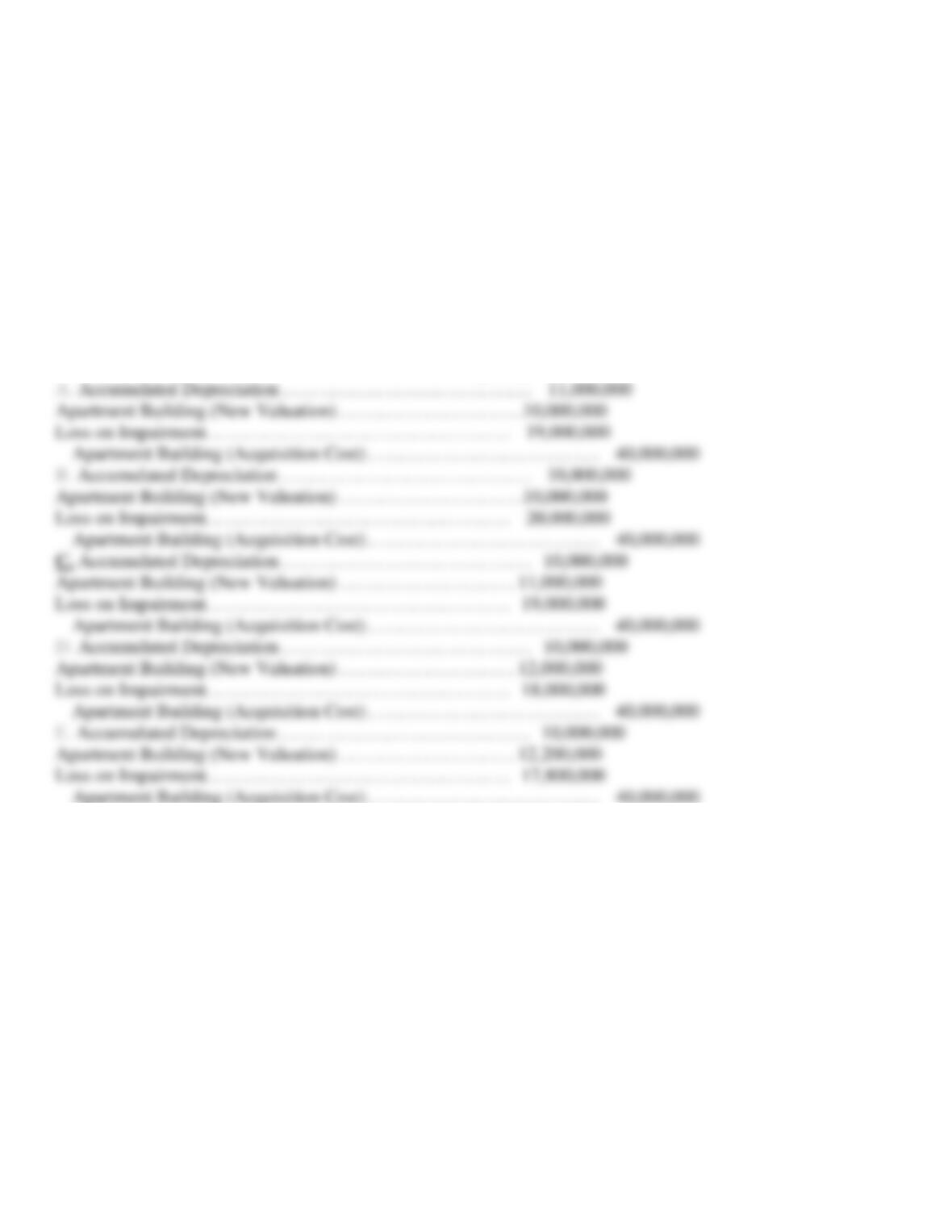
Under U.S. GAAP, Wheaton recognizes
149. Wheaton Company
Wheaton Company owns an apartment building that originally cost $40 million and by the end of the current
period has accumulated depreciation of $10 million, with net carrying value of $30 million. Wheaton Company
had originally expected to collect rentals of $3.34 million each year for 30 years before selling the building for
$16 million. Unanticipated placement of a new shopping center has caused Wheaton Company to reassess the
future rentals. Wheaton Company expects the building to provide rentals for only 15 more years before
Wheaton will sell it. Wheaton Company uses a discount rate of 8% per year in discounting expected rentals
from the building.
Wheaton now expects to receive annual rentals of $1,200,000 per year for 15 years and to sell the building for
$6.0 million after 15 years; these payments, in total, have a present value of $12.2 million when discounted at
8% per year. The building’s fair value is $11.0 million today and costs to sell are $600,000.
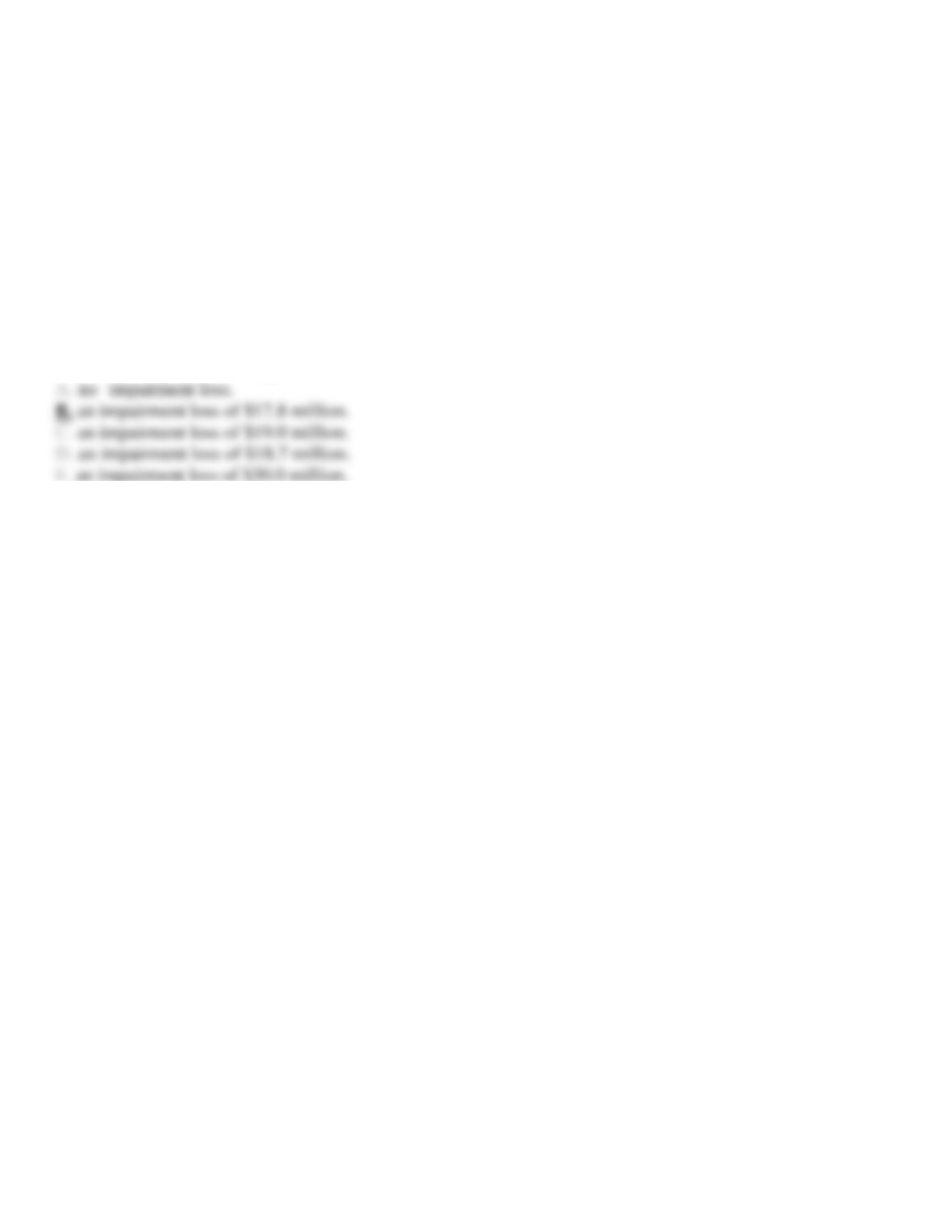
Under U.S. GAAP, Wheaton would record the following entry
150. Wheaton Company
Wheaton Company owns an apartment building that originally cost $40 million and by the end of the current
period has accumulated depreciation of $10 million, with net carrying value of $30 million. Wheaton Company
had originally expected to collect rentals of $3.34 million each year for 30 years before selling the building for
$16 million. Unanticipated placement of a new shopping center has caused Wheaton Company to reassess the
future rentals. Wheaton Company expects the building to provide rentals for only 15 more years before
Wheaton will sell it. Wheaton Company uses a discount rate of 8% per year in discounting expected rentals
from the building.
Wheaton now expects to receive annual rentals of $1,200,000 per year for 15 years and to sell the building for
$6.0 million after 15 years; these payments, in total, have a present value of $12.2 million when discounted at
8% per year. The building’s fair value is $11.0 million today and costs to sell are $600,000.
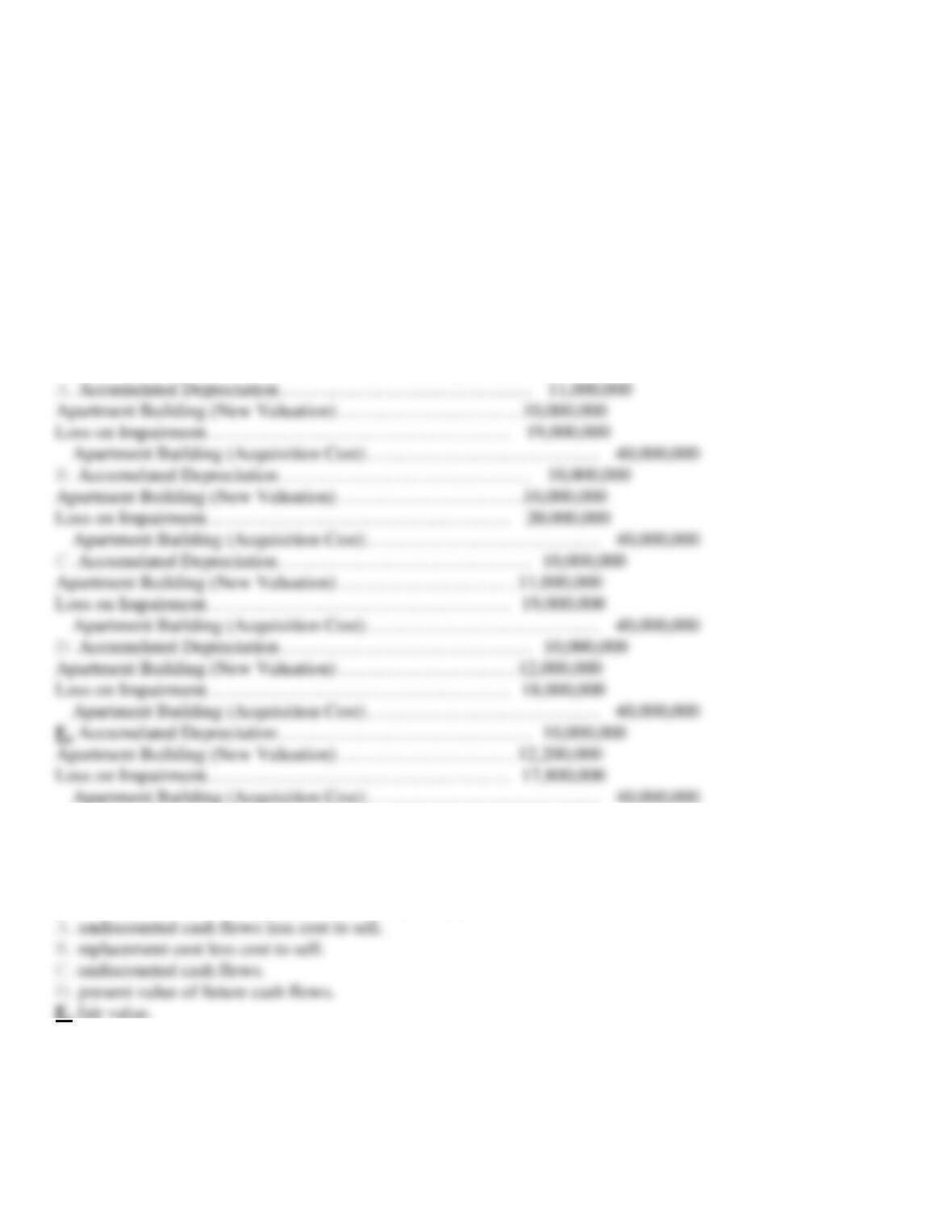
Under IFRS, Wheaton recognizes
151. Wheaton Company
Wheaton Company owns an apartment building that originally cost $40 million and by the end of the current
period has accumulated depreciation of $10 million, with net carrying value of $30 million. Wheaton Company
had originally expected to collect rentals of $3.34 million each year for 30 years before selling the building for
$16 million. Unanticipated placement of a new shopping center has caused Wheaton Company to reassess the
future rentals. Wheaton Company expects the building to provide rentals for only 15 more years before
Wheaton will sell it. Wheaton Company uses a discount rate of 8% per year in discounting expected rentals
from the building.
Wheaton now expects to receive annual rentals of $1,200,000 per year for 15 years and to sell the building for
$6.0 million after 15 years; these payments, in total, have a present value of $12.2 million when discounted at
8% per year. The building’s fair value is $11.0 million today and costs to sell are $600,000.
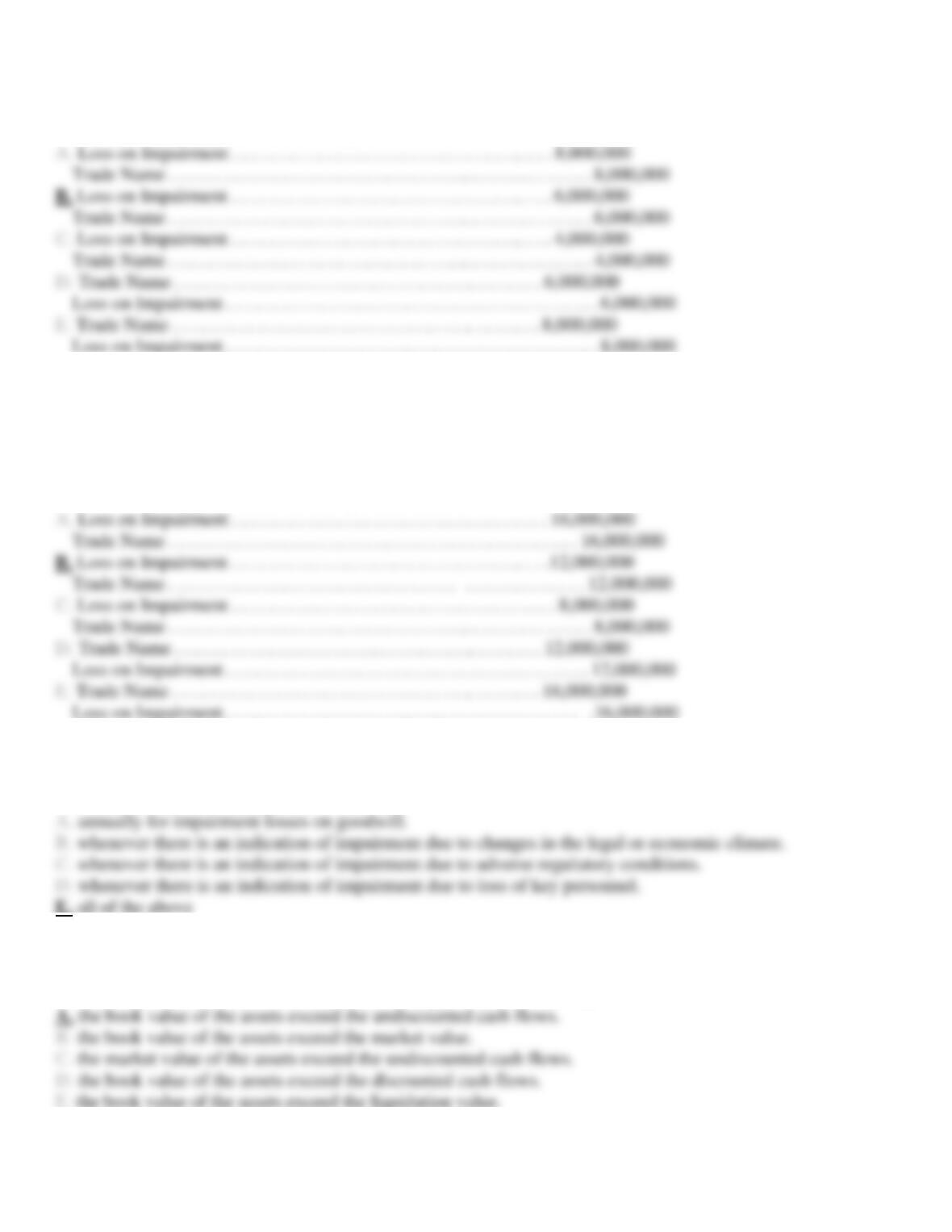
Applying IFRS, Wheaton would record the following entry
152. U.S. GAAP requires firms to recognize an impairment loss on a nonamortized intangible other than
goodwill whenever the carrying value of the asset exceeds its
153. Loren Company’s balance sheet shows a trade name acquired as part of a business combination with a
carrying value of $30 million. The trade name has an indefinite life and therefore Loren does not amortize it.
Negative publicity regarding the product carrying the trade name has reduced its fair value to $24 million and
its value in use to $22 million. The entry is as follows:
154. Evers Company’s balance sheet shows a trade name acquired as part of a business combination with a
carrying value of $60 million. The trade name has an indefinite life and therefore Evers does not amortize it.
Negative publicity regarding the product carrying the trade name has reduced its fair value to $48 million and
its value in use to $44 million. The entry is as follows:
155. U.S. GAAP or IFRS require firms to test
156. An impairment loss on all assets except intangibles that do not require amortization arises when