3) You carry a 7.0-kg bag of groceries above the ground at constant speed across a
room. How much work do you do on the bag in the process?
A) 0.00 J
B) 82 J
C) 185 J
D) 157 J
4) It requires 0.30 kJ of work to fully drive a stake into the ground. If the average resistive force
on the stake by the ground is how long is the stake?
A) 0.36 m
B) 0.23 m
C) 0.31 m
D) 0.41 m
5) A crane lifts a 425 kg steel beam vertically upward a distance of How much work does
the crane do on the beam if the beam accelerates upward at 1.8 m/s2? Neglect frictional forces.
A) 4.7 × 10⁵ J
B) 2.7 × 10⁵J
C) 3.2 × 10⁵ J
D) 4.0 × 10⁵ J
6) A traveler pulls on a suitcase strap at an angle 36° above the horizontal. If of work are
done by the strap while moving the suitcase a horizontal distance of what is the tension in
the strap?
A) 46 N
B) 37 N
C) 52 N
D) 56 N
7) A 500-kg elevator is pulled upward with a constant force of 5500 N for a distance of 50.0 m.
(a) What is the work done by the 5500-N force?
(b) What is the work done by gravity?
(c) What is the net work done on the elevator?
8) A 30-N box is pulled upward 6.0 m along the surface of a ramp that rises at 37° above the
horizontal. How much work does gravity do on the box during this process?
A) -1100 J
B) -110 J
C) -140 J
D) -180 J
E) 120 J
9) Matthew pulls his little sister Sarah along the horizontal ground in a wagon. He exerts a force
on the wagon of 60.0 N at an angle of 37.0° above the horizontal. If he pulls her a distance of
12.0 m, how much work does Matthew do?
A) 185 J
B) 433 J
C) 575 J
D) 720 J
10) Find the net work done by friction on a box that moves in a complete circle of radius
on a uniform horizontal floor. The coefficient of kinetic friction between the floor and the box is
0.25, and the box weighs
A) 190 J
B) 0 J
C) 1800 J
D) 370 J
11) A 2.0-kg object is lifted vertically through 3.00 m by a 150-N force. How much work is done
on the object by gravity during this process?
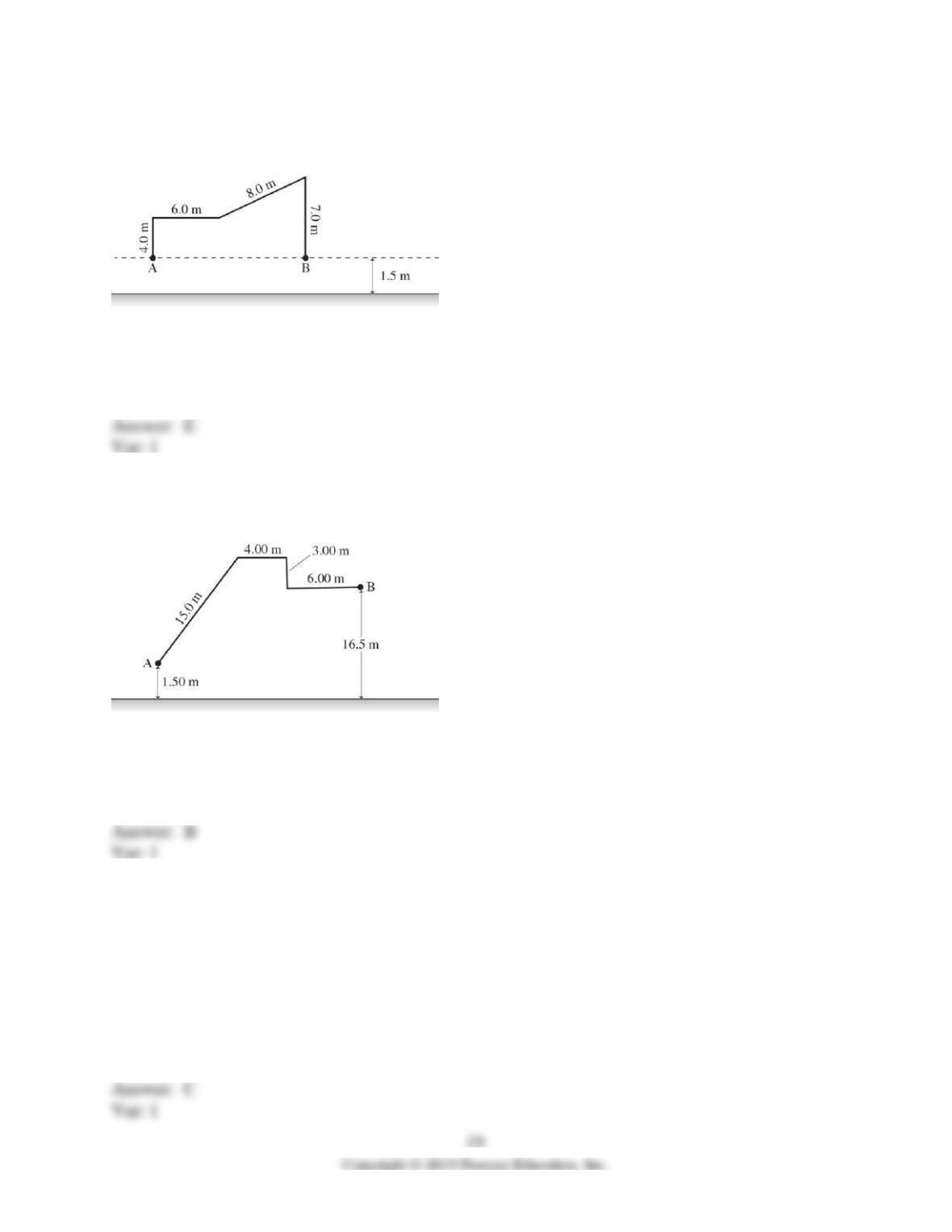
12) A person carries a 25.0-N rock through the path shown in the figure, starting at point A and
ending at point B. The total time from A to B is 1.50 min. How much work did gravity do on the
rock between A and B?
A) 625 J
B) 20.0 J
C) 275 J
D) 75 J
E) 0 J
13) A person carries a 2.00-N pebble through the path shown in the figure, starting at point A
and ending at point B. The total time from A to B is 6.75 min. How much work did gravity do on
the rock between A and B?
A) 30.0 J
B) -30.0 J
C) -56.0 J
D) 56.0 J
E) -36.0 J
14) A stone with a mass of 1.0 kg is tied to the end of a light string which keeps it moving in a
circle with a constant speed of 4.0 m/s on a perfectly smooth horizontal tabletop. The radius of
the path is 0.60 m. How much work does the tension in the string do on the stone as it makes
one-half of a complete circle?
A) 100 J
B) 3.8 J
C) 0 J
D) 40 J
E) 80 J
15) How fast must a 6.0-kg cat run to have a kinetic energy of 150 J?
16) How much kinetic energy does a 0.30-kg stone have if it is thrown at
A) 290 J
B) 580 J
C) 440 J
D) 510 J
17) An object hits a wall and bounces back with half of its original speed. What is the ratio of
the final kinetic energy to the initial kinetic energy of the object?
A) 1/2
B) 1/4
C) 1/8
D) 1/16
18) A 1000-kg car is moving at 15 km/h. If a 2000-kg truck has 23 times the kinetic energy of
the car, how fast is the truck moving?
A) 51 km/h
B) 72 km/h
C) 61 km/h
D) 41 km/h
19) What is the minimum energy needed to change the speed of a 1600-kg sport utility vehicle
from 15.0 m/s to 40.0 m/s?
A) 1.10 MJ
B) 10.0 kJ
C) 20.0 kJ
D) 40.0 kJ
E) 0.960 MJ
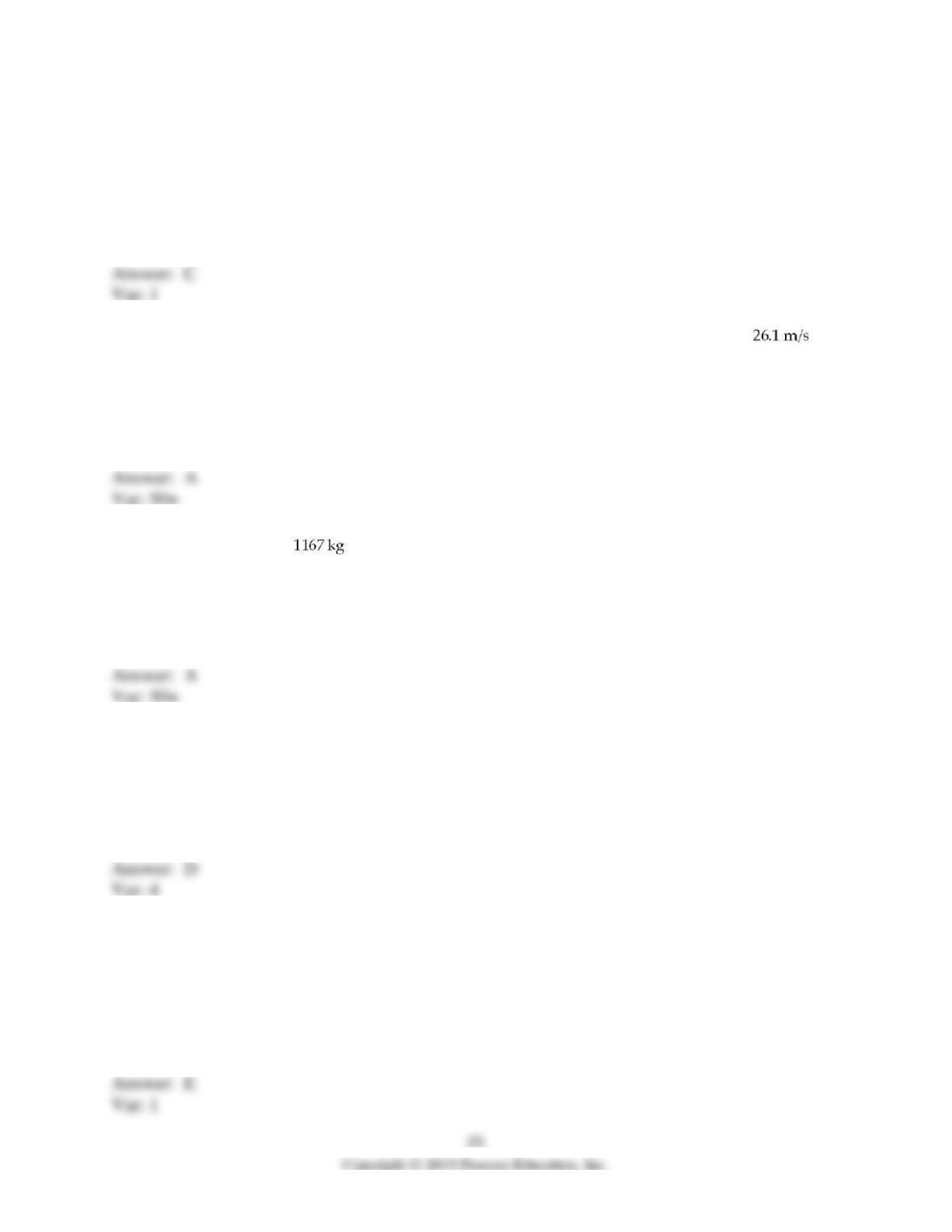
20) A 1.0-kg object moving in a certain direction has a kinetic energy of 2.0 J. It hits a wall and
comes back with half its original speed. What is the kinetic energy of this object at this point?
A) 2.0 J
B) 1.0 J
C) 0.50 J
D) 0.25 J
E) 4.0 J
21) How much work must be done by frictional forces in slowing a 1000-kg car from to
rest?
A) 3.41 × 10⁵ J
B) 2.73 × 10⁵ J
C) 4.09 × 10⁵ J
D) 4.77 × 10⁵ J
22) When a car of mass accelerates from 10.0 m/s to some final speed, 4.00 × 10⁵ J of
work are done. Find this final speed.
A) 28.0 m/s
B) 22.4 m/s
C) 25.2 m/s
D) 30.8 m/s
23) A 10-kg dog is runnng with a speed of 5.0 m/s. What is the minimum work required to stop
the dog in 2.40 s?
A) 50 J
B) 75 J
C) 100 J
D) 125 J
24) How large a net force is required to accelerate a 1600-kg SUV from rest to a speed of 25 m/s
in a distance of 200 m?
A) 1600 N
B) 0 N
C) 200 N
D) 400 N
E) 2500 N
25) A 100-N force has a horizontal component of 80 N and a vertical component of 60 N. The
force is applied to a cart on a level frictionless floor. The cart starts from rest and moves 2.0 m
horizontally along the floor due to this force. What is the cart’s final kinetic energy?
A) 200 J
B) 160 J
C) 120 J
D) zero
26) A 1000-kg car experiences a net force of 9500 N while slowing down from 30 m/s to
How far does it travel while slowing down?
A) 34 m
B) 31 m
C) 37 m
D) 41 m
27) A stone initially moving at 8.0 m/s on a level surface comes to rest due to friction after it
travels 11 m. What is the coefficient of kinetic friction between the stone and the surface?
A) 0.13
B) 0.25
C) 0.30
D) 0.43
E) 0.80
28) A sled having a certain initial speed on a horizontal surface comes to rest after traveling 10
m. If the coefficient of kinetic friction between the object and the surface is 0.20, what was the
initial speed of the object?
A) 9.8 m/s
B) 6.3 m/s
C) 3.6 m/s
D) 7.2 m/s
E) 8.9 m/s
29) On an alien planet, an object moving at 4.0 m/s on the horizontal ground comes to rest after
traveling a distance of 10 m. If the coefficient of kinetic friction between the object and the
surface is 0.20, what is the value of g on that planet?
A) 4.0 m/s2
B) 6.0 m/s2
C) 8.0 m/s2
D) 10 m/s2
E) 12 m/s2
30) A driver, traveling at 22 m/s, slows down her 2000 kg truck to stop for a red light. What
work is done on the truck by the friction force of the road?
A) -2.2 × 10⁴ J
B) -4.4 × 10⁴ J
C) -4.8 × 10⁵ J
D) -9.7 × 10⁵ J
31) The kinetic friction force that a horizontal surface exerts on a 60.0-kg object is 50.0 N. If the
initial speed of the object is 25.0 m/s, what distance will it slide before coming to a stop?
A) 15.0 m
B) 30.0 m
C) 375 m
D) 750 m
32) A stone is moving on a rough level surface. It has 24 J of kinetic energy, and the friction
force on it is a constant 0.50 N. What is the maximum distance it can slide?
A) 2.0 m
B) 12 m
C) 24 m
D) 48 m
33) In a ballistics test, a 28-g bullet pierces a sand bag that is thick. If the initial bullet
velocity was and it emerged from the sandbag moving at what was the magnitude
of the friction force (assuming it to be constant) that the bullet experienced while it traveled
through the bag?
A) 130 N
B) 38 N
C) 13 N
D) 1.3 N
34) A certain car traveling at 34.0 mph skids to a stop in 29 meters from the point where the
brakes were applied. In approximately what distance would the car have stopped had it been
going 105.4 mph?
A) 279 m
B) 158 m
C) 90 m
D) 51 m
E) 29 m
35) How high a hill would a 75-kg hiker have to climb to increase her gravitational potential
energy by 10,000 J?
36) You do 116 J of work while pulling your sister back on a fritctionless swing, whose chain is
long, until the swing makes an angle of 32.0° with the vertical. What is your sister’s mass?
A) 15.3 kg
B) 13.0 kg
C) 17.6 kg
D) 19.0 kg
37) A tennis ball bounces on the floor three times, and each time it loses 23.0% of its energy due
to heating. How high does it bounce after the third time, if we released it from the floor?
A) 180 cm
B) 18 cm
C) 180 mm
D) 240 cm
38) A 10-kg mass, hung by an ideal spring, causes the spring to stretch 2.0 cm. What is the
spring constant (force constant) for this spring?
A) 5.0 N/cm
B) 49 N/cm
C) 0.20 N/cm
D) 20 N/m
E) 0.0020 N/cm
39) An ideal spring stretches by 21.0 cm when a 135-N object is hung from it. If instead you
hang a fish from this spring, what is the weight of a fish that would stretch the spring by
A) 199 N
B) 91 N
C) 145 N
D) 279 N
40) An ideal spring has a spring constant (force constant) of 2500 N/m. is stretched 4.0 cm. How
much work is required to stretch the spring by 4.0 cm?
A) 4.0 J
B) 0.00 J
C) 1.0 J
D) 3.0 J
E) 2.0 J
41) You want to store 1,000 J of energy in an ideal spring when it is compressed by only 2.5 cm.
What should be the force constant (spring constant) of this spring?
42) If 4.0 J of work are performed in stretching an ideal spring with a spring constant (force
constant) of 2500 N/m, by what distance is the spring stretched?
A) 3.2 cm
B) 3.2 m
C) 0.3 cm
D) 5.7 m
E) 5.7 cm
43) If the work done to stretch an ideal spring by 4.0 cm is 6.0 J, what is the spring constant
(force constant) of this spring?
A) 300 N/m
B) 3000 N/m
C) 3500 N/m
D) 7500 N/m
E) 6000 N/m
44) An ideal spring has a spring constant (force constant) of 60 N/m. How much energy does it
store when it is stretched by 1.0 cm?
A) 0.0030 J
B) 0.30 J
C) 60 J
D) 600 J
45) How much work is required to stretch an ideal spring of spring constant (force constant) 40
N/m from x = 0.20 m to x = 0.25 m if the unstretched position is at x = 0.00 m?
A) 0.45 J
B) 0.80 J
C) 1.3 J
D) 0.050 J
46) An ideal spring with a force constant (spring constant) of 15 N/m is initially compressed by
3.0 cm from its uncompressed position. How much work is required to compress the spring an
additional 4.0 cm?
A) 0.0068 J
B) 0.012 J
C) 0.024 J
D) 0.030 J
47) It takes 87 J of work to stretch an ideal spring from 1.4 m to 2.9 m from equilibrium. What is
the value of the spring constant (force constant) of this spring?
A) 27 N/m
B) 77 N/m
C) 52 N/m
D) 39 N/m
48) An ideal spring with a spring constant (force constant) of is stretched from
equilibrium to 2.9 m. How much work is done in the process?
A) 93 J
B) 186 J
C) 47 J
D) 121 J
49) A rock falls from a vertical cliff that is 4.0 m tall and experiences no significant air resistance
as it falls. At what speed will its gravitational potential energy (relative to the base of the cliff) be
equal to its kinetic energy?
A) 3.1 m/s
B) 4.4 m/s
C) 6.3 m/s
D) 8.9 m/s
E) 13 m/s
50) A block slides down a frictionless inclined ramp and experiences no significant air
resistance. If the ramp angle is 17.0° above the horizontal and the length of the surface of the
ramp is find the speed of the block as it reaches the bottom of the ramp, assuming it
started sliding from rest at the top.
A) 10.7 m/s
B) 114 m/s
C) 7.57 m/s
D) 19.6 m/s
51) A prankster drops a water balloon from the top of a building. If the balloon is traveling at
29.1 m/s when it strikes a window ledge that is 1.5 m above the ground, how tall is the building?
Neglect air resistance.
A) 45 m
B) 43 m
C) 46 m
D) 47 m
52) A spring-loaded dart gun is used to shoot a dart straight up into the air, and the dart reaches a
maximum height of 24 meters. The same dart is shot up a second time from the same gun, but
this time the spring is compressed only half as far (compared to the first shot). How far up does
the dart go this time (neglect all friction and assume the spring is ideal)?
A) 6.0 m
B) 12 m
C) 3.0 m
D) 48 m
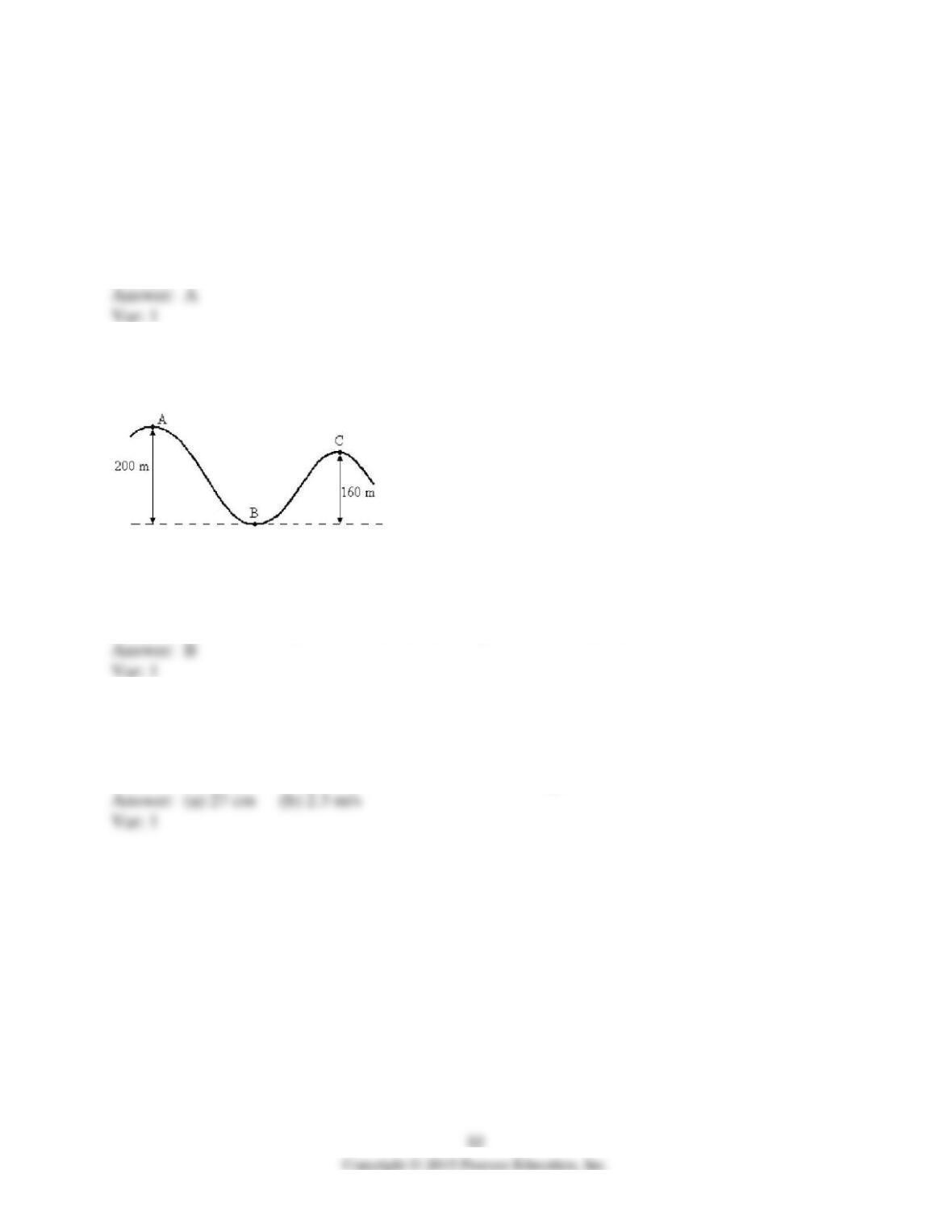
53) A bead is moving with a speed of 20 m/s at position A on the track shown in the figure. This
track is friction-free, and there is no appreciable air resistance. What is the speed of the bead at
point C?
A) 0 m/s
B) 34 m/s
C) 69 m/s
D) 20 m/s
E) We cannot solve this problem without knowing the mass of the bead.
54) A frictionless simple pendulum, with a small but dense 4.4-kg mass at the end and a length
of 75 cm, is released from rest at an angle of 50° with the vertical.
(a) To what height above its lowest point does the mass swing on the other side?
(b) What is the speed of the mass at the bottom of the swing?
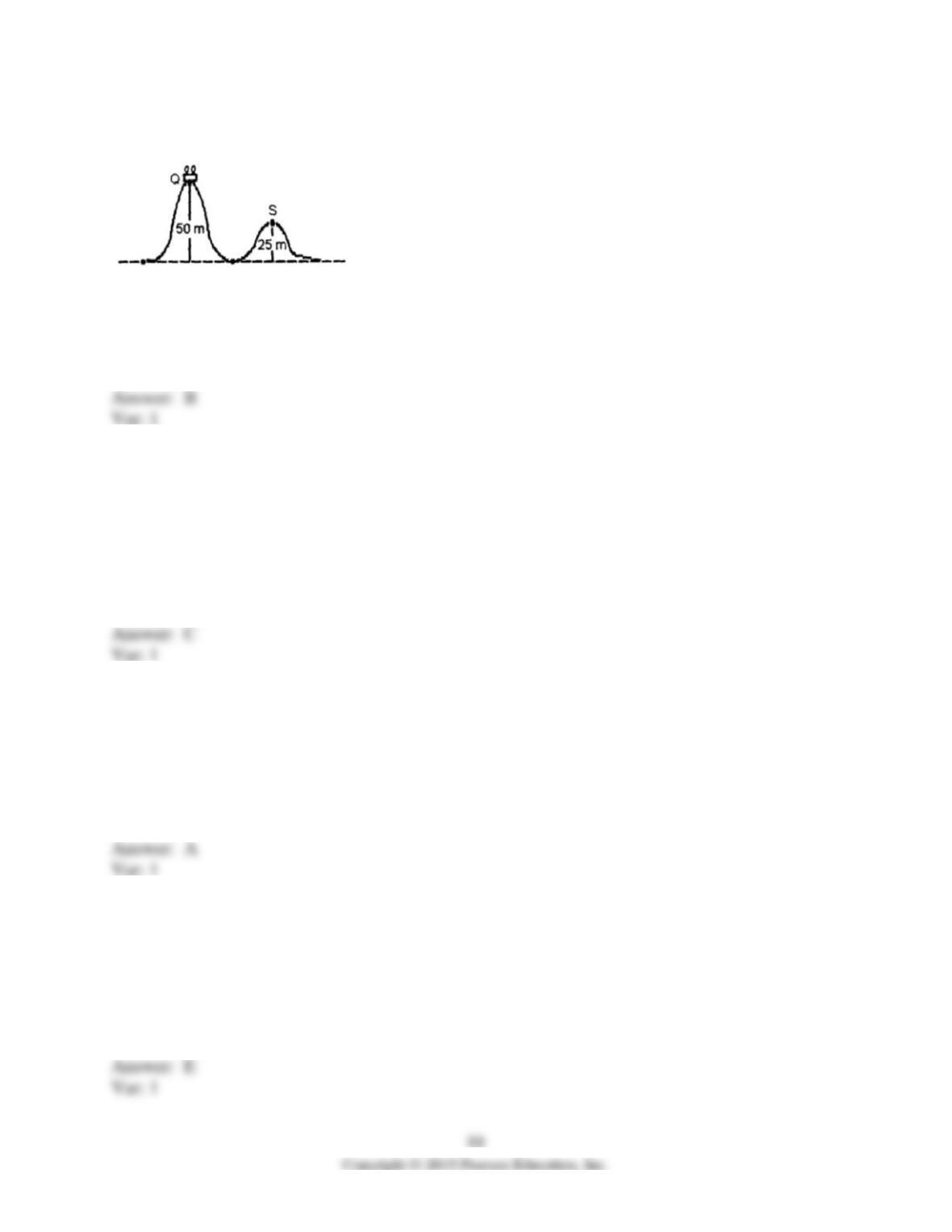
55) The figure shows a famous roller coaster ride. You can ignore friction. If the roller coaster
leaves point Q from rest, what is its speed at the top of the 25-m peak (point S)?
A) 10 m/s
B) 22 m/s
C) 44 m/s
D) 62 m/s
E) 120 m/s
56) What is the minimum energy needed to lift a 1.0-kg rocket to a height of 200 km and to give
it a speed of 8.0 km/s at that height? (Neglect air resistance and the small decrease in g over that
distance.)
A) 34 TJ
B) 34 kJ
C) 34 MJ
D) 34 GJ
E) 34 J
57) Assuming negligible friction, what spring constant (force constant) would be needed by the
spring in a “B-B gun” to fire a 10-g pellet to a height of 100 m if the spring is initially
compressed by 0.10 m?
A) 20 N/cm
B) 200 N/m
C) 2000 N/cm
D) 0.0020 N/m
58) If a spring-operated gun can shoot a pellet to a maximum height of 100 m on Earth, how high
could the pellet rise if fired on the Moon, where g = 1.6 m/s2?
A) 17 m
B) 160 m
C) 3.6 km
D) 100 m
E) 610 m
59) A 60-kg skier pushes off the top of a frictionless hill with an initial speed of 4.0 m/s. How
fast will she be moving after dropping 10 m in elevation? Air resistance is negligible.
A) 0.20 km/s
B) 15 m/s
C) 10 m/s
D) 0.15 km/s
E) 49 m/s
60) A toy rocket that weighs 10 N blasts straight up from ground level with an initial kinetic
energy of 40 J. At the exact top of its trajectory, its total mechanical energy is 140 J. To what
vertical height above the ground does it rise, assuming no air resistance?
A) 1.0 m
B) 10 m
C) 14 m
D) 24 m
61) A 5.0-N projectile leaves the ground with a kinetic energy of 220 J. At the highest point in
its trajectory, its kinetic energy is 120 J. To what vertical height, relative to its launch point, did
it rise if there was no air resistance?
A) 44 m
B) 24 m
C) 20 m
D) 10 m
E) It is impossible to determine the height without knowing the angle of launch.
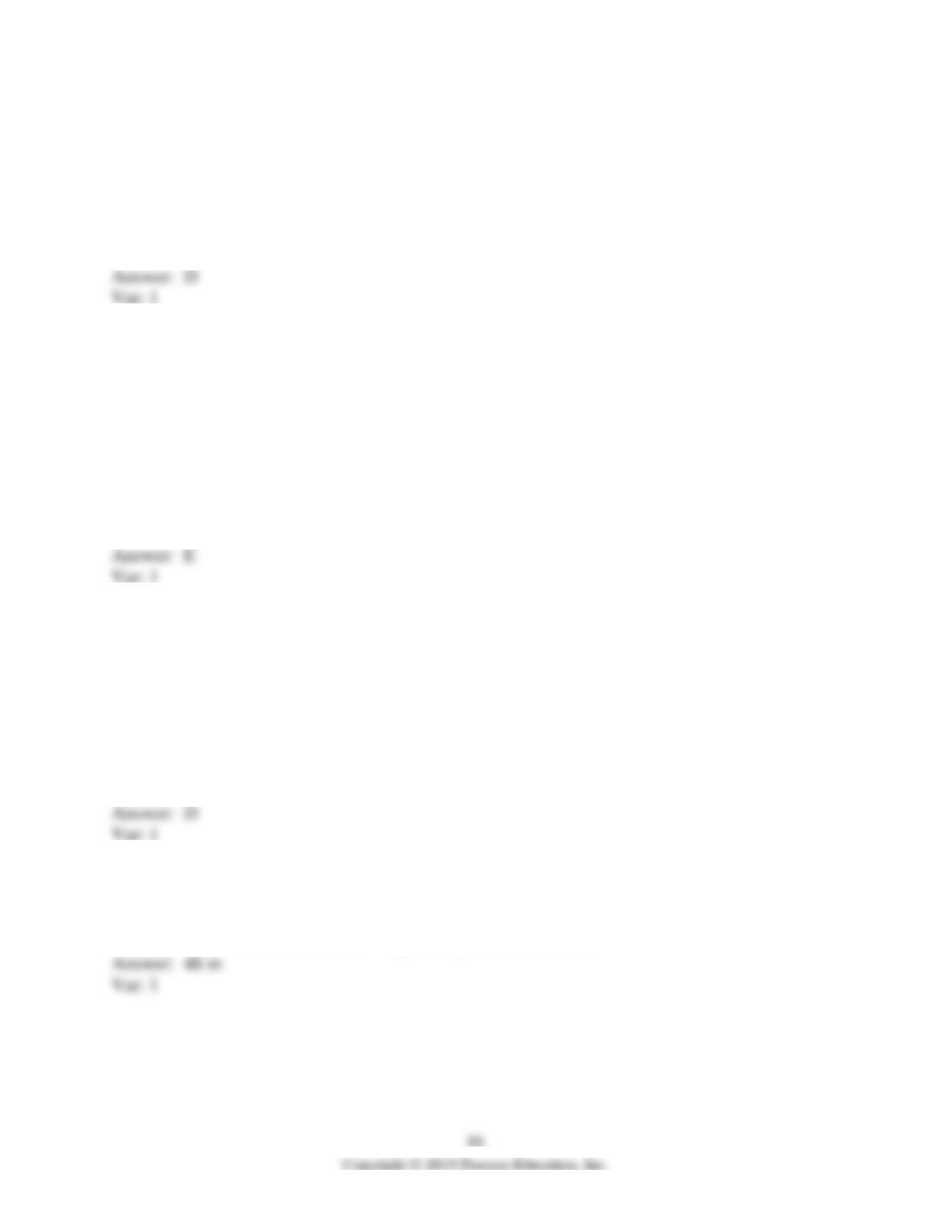
62) In the figure, a ball hangs by a very light string. What is the minimum speed of the ball at the
bottom of its swing (point B) in order for it to reach point A, which is 1.0 m above the bottom of
the swing?
A) 2.2 m/s
B) 3.1 m/s
C) 4.4 m/s
D) 4.9 m/s
63) A 1500-kg car moving at 25 m/s hits an initially uncompressed horizontal ideal spring with
spring constant (force constant) of 2.0 × 10⁶ N/m. What is the maximum distance the spring
compresses?
A) 0.17 m
B) 0.34 m
C) 0.51 m
D) 0.68 m
64) A small but dense 2.0-kg stone is attached to one end of a very light rod that is 1.2 m long.
The other end of the rod is attached to a frictionless pivot. The rod is raised until it is vertical,
with the stone above the pivot. The rod is released and the stone moves in a vertical circle with
no air resistance. What is the tension in the rod as the stone moves through the bottom of the
circle?
A) 20 N
B) 40 N
C) 60 N
D) 80 N
E) 100 N
65) In a museum exhibit of a simple pendulum, a very small but dense 6.0-kg ball swings from a
very light 2.5-m wire. The ball is released from rest when the pendulum wire makes a 65° angle
with the vertical, and it swings in a circular arc with no appreciable friction or air resistance.
What is the tension in the wire just as the ball swings through its lowest position?
A) 11 N
B) 59 N
C) 68 N
D) 130 N
E) 0 N
66) A roller coaster starting from rest descends 35 meters in its initial drop and then rises 23
meters when it goes over the first hill, which has a circular shape over the top. If a passenger at
the top of the hill feels an apparent weight equal to one-half of her normal weight, what is the
radius of curvature of the first hill? Neglect any frictional losses.
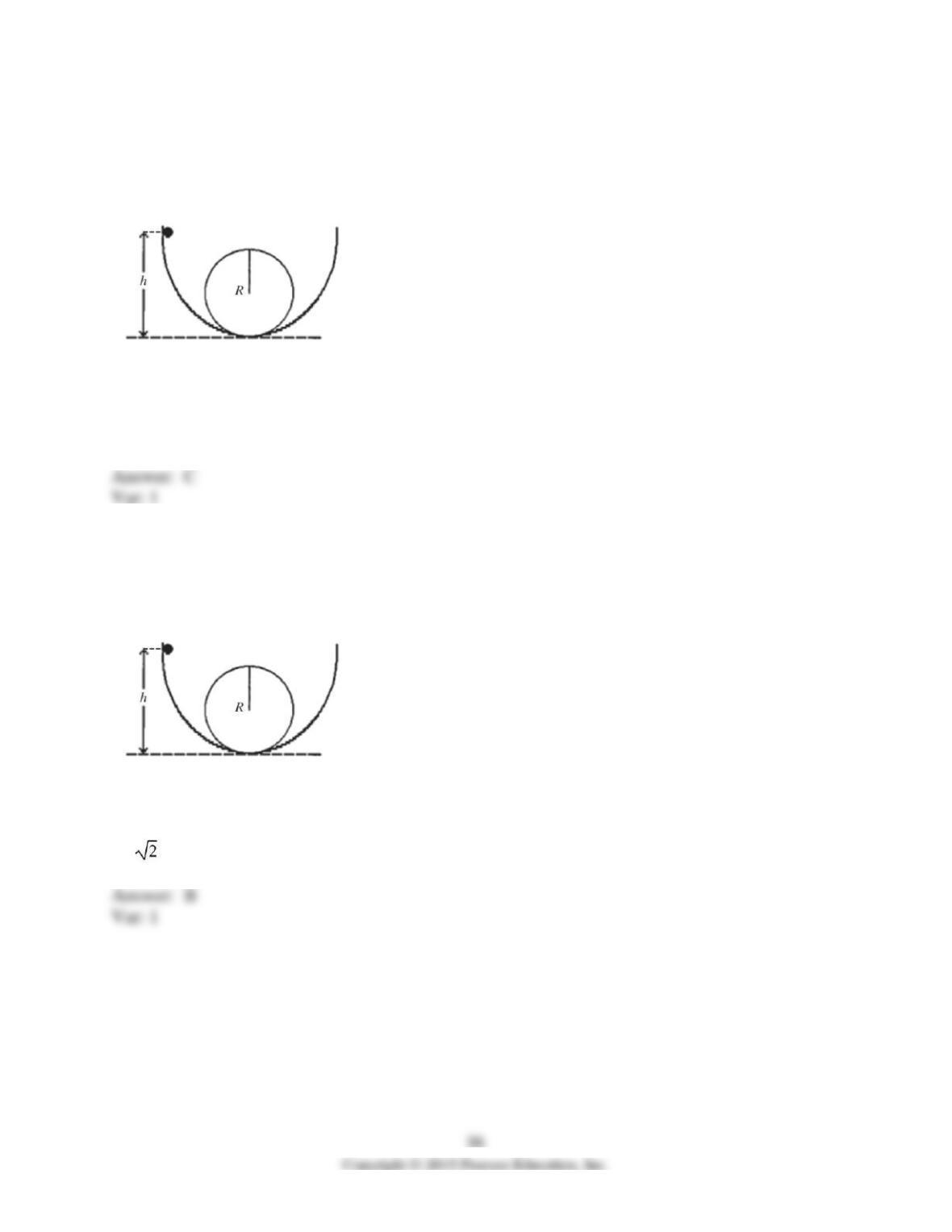
67) A roller coaster starts from rest at a height h at the left side of a loop-the-loop, as shown in
the figure. It is not attached to the track in anyway, and there is no friction from the track or from
air resistance. If the radius of the loop is R = 6.0 m, what is the minimum height h for which the
roller coaster will not fall off the track at the top of the loop?
A) 21 m
B) 18 m
C) 15 m
D) 12 m
E) 8.5 m
68) A stone is released from rest at a height h at the left side of a loop-the-loop, as shown in the
figure. There is no appreciable friction from the track or from air resistance. If the radius of the
loop is R, what is the minimum height h for which the stone will not fall off the track at the top
of the loop?
A) 3.5 R
B) 2.5 R
C) 2.0 R
D) R
E) 3.0 R
69) A small 1.4-N stone slides down a frictionless bowl, starting from rest at the rim. The bowl
itself is a hemisphere of radius 75 cm. Just as the stone reaches the bottom of the bowl, how hard
is the bowl pushing on it?
A) 0.70 N
B) 1.4 N
C) 2.8 N
D) 4.2 N
E) 5.6 N
70) A 30-N stone is dropped from a height of 10 m and strikes the ground with a speed of 13
m/s. What average force of air friction acted on the stone as it fell?
A) 4.1 N
B) 2.9 N
C) 0.13 kN
D) 7.2 N
E) 1.2 N
71) A 60-kg skier starts from rest from the top of a 50-m high slope. If the work done by friction
is -6.0 kJ, what is the speed of the skier on reaching the bottom of the slope?
A) 17 m/s
B) 24 m/s
C) 28 m/s
D) 31 m/s
72) A 7.5-kg otter slides down a hill, starting from rest at the top. The sloping surface of the hill
is 8.8 m long, and the top is 6.5 m above the base. If the speed of the otter at the bottom of the
hill is 9.2 m/s, how much energy was lost to nonconservative forces on the hill?
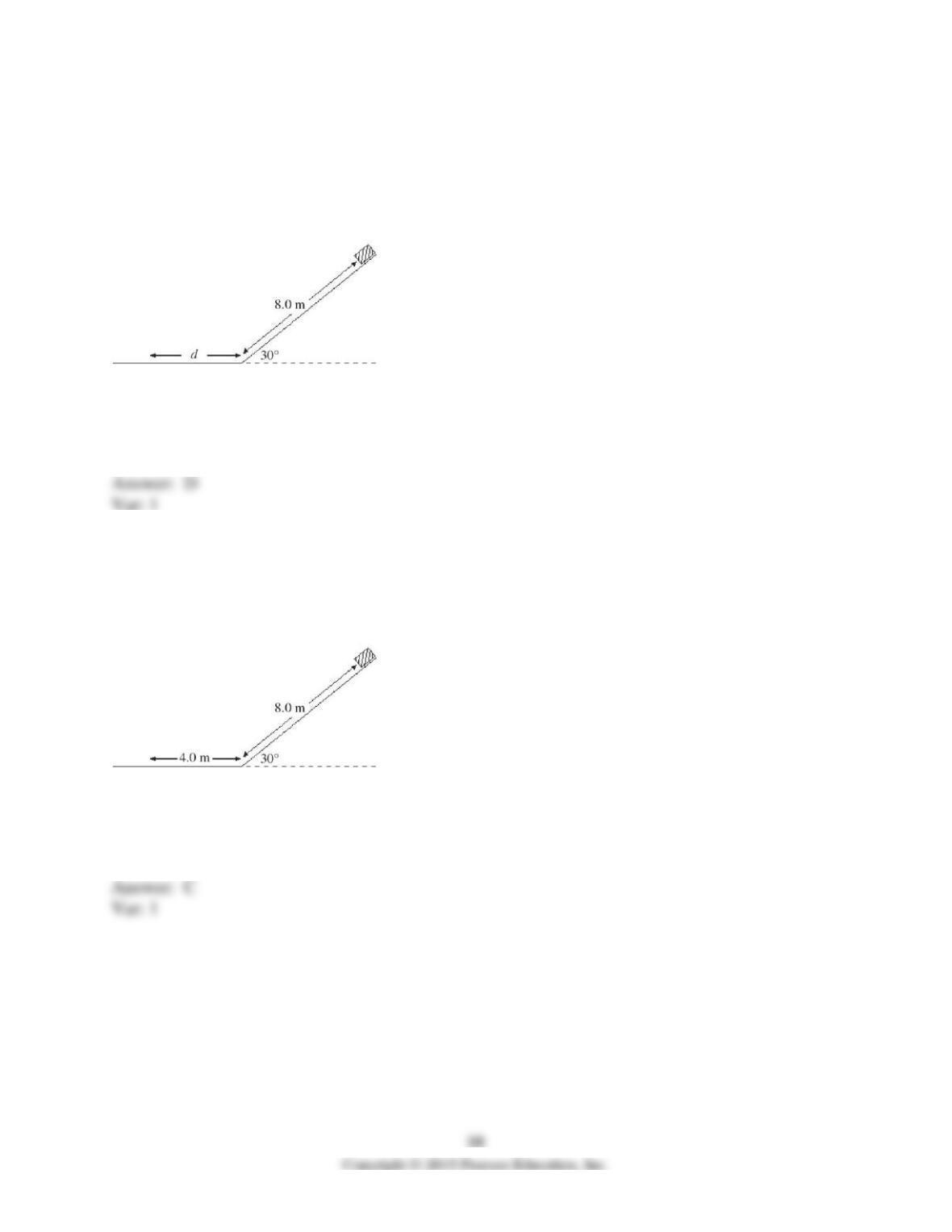
73) An object with a mass of 10 kg is initially at rest at the top of a frictionless inclined plane
that rises at 30° above the horizontal. At the top, the object is initially 8.0 m from the bottom of
the incline, as shown in the figure. When the object is released from this position, it eventually
stops at a distance d from the bottom of the inclined plane along a horizontal surface, as shown.
The coefficient of kinetic friction between the horizontal surface and the object is 0.20, and air
resistance is negligible. Find the distance d.
A) 5.0 m
B) 10 m
C) 15 m
D) 20 m
E) 25 m
74) On a planet where g = 10.0 m/s2 and air resistance is negligible, a sled is at rest on a rough
inclined hill rising at 30° as shown in the figure. The object is allowed to move and it stops on a
rough horizontal surface, at a distance of 4.0 m from the bottom of the hill. The coefficient of
kinetic friction on the hill is 0.40. What is the coefficient of kinetic friction between the
horizontal surface and the sled?
A) 0.10
B) 0.20
C) 0.31
D) 0.40
E) 0.60
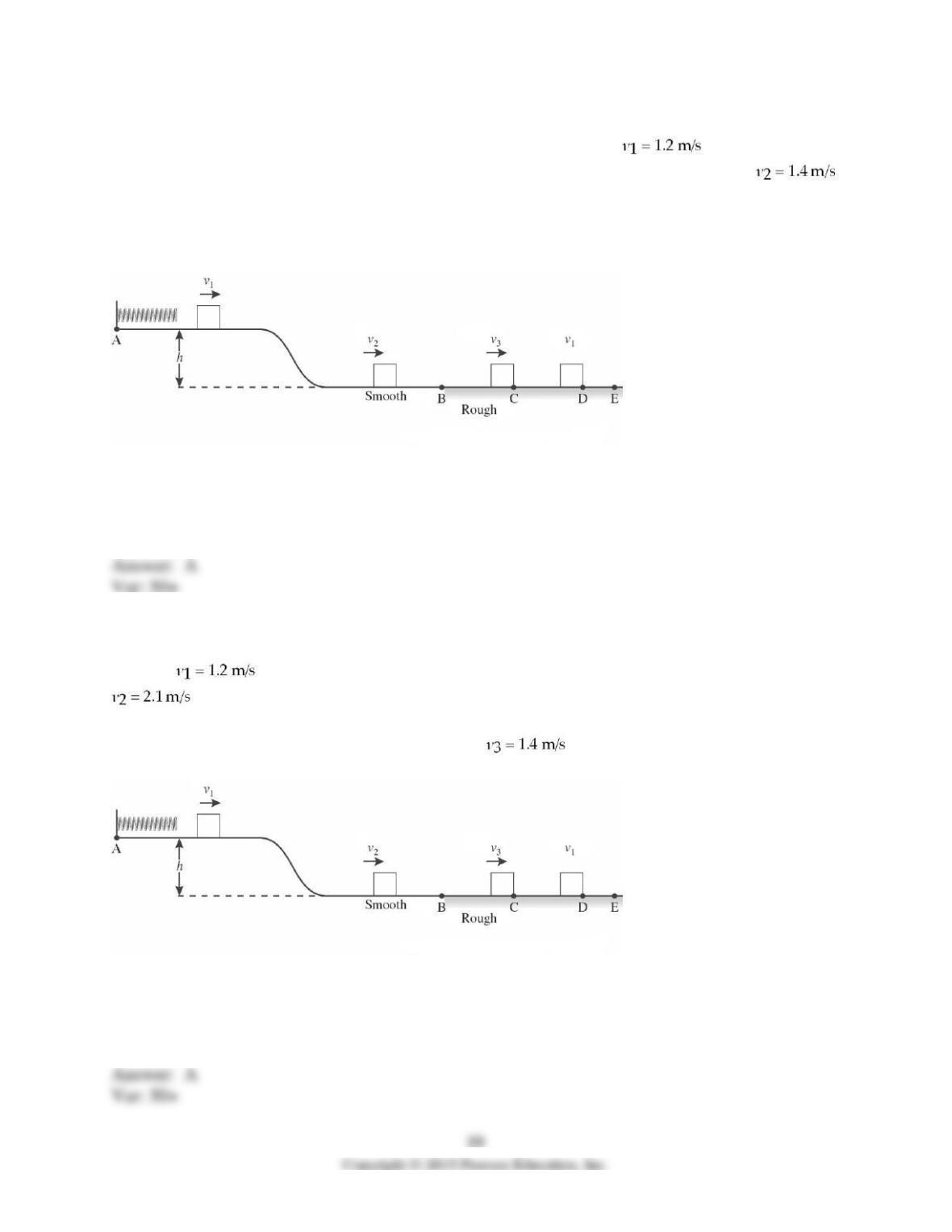
75) A 0.12-kg block is held in place against the spring by a 35-N horizontal external force. The
external force is removed, and the block is projected with a velocity when it separates
from the spring, as shown in the figure. The block descends a ramp and has a velocity
at the bottom of the ramp. The track is frictionless between points A and B. The block enters a
rough section at B, extending to E. The coefficient of kinetic friction between the block and the
rough surface is 0.26. The block moves on to D, where it stops. By how many centimeters was
the spring initially compressed?
A) 0.49 cm
B) 0.26 cm
C) 0.18 cm
D) 0.99 cm
E) 0.67 cm
76) As shown in the figure, a 1.45-kg block is held in place against the spring by a 21-N
horizontal external force. The external force is removed, and the block is projected with a
velocity as it separates from the spring. The block descends a ramp and has a velocity
at the bottom. The track is frictionless between points A and B. The block enters a
rough section at B, extending to E. The coefficient of kinetic friction between the block and the
rough surface is 0.29. The velocity of the block is at C. The block moves on to D,
where it stops. How much work is done by friction between points B and C?
A) -1.8 J
B) -3.6 J
C) -14 J
D) -6.4 J
E) -7.0 J
77) A 0.46-kg block is held in place against the spring by a 30-N horizontal external force. The
external force is removed, and the block is projected with a velocity upon separation
from the spring, as shown in the figure. The block descends a ramp and has a velocity
at the bottom. The track is frictionless between points A and B. The block enters a rough section
at point B, extending to E. The coefficient of kinetic friction between the block and the rough
surface is 0.38. The velocity of the block is at point C. The block moves on to D,
where it stops. What distance does the block travel between points B and D?
A) 0.30 m
B) 0.039 m
C) 0.26 m
D) 0.40 m
E) 0.60 m
78) A sled is moving along a horizontal surface with a speed of 5.7 m/s. It then slides up a rough
hill having a slope of 11° above the horizontal. The coefficient of kinetic friction between the
sled and the surface of the hill is 0.26. How far along the surface does the block travel up the
incline?
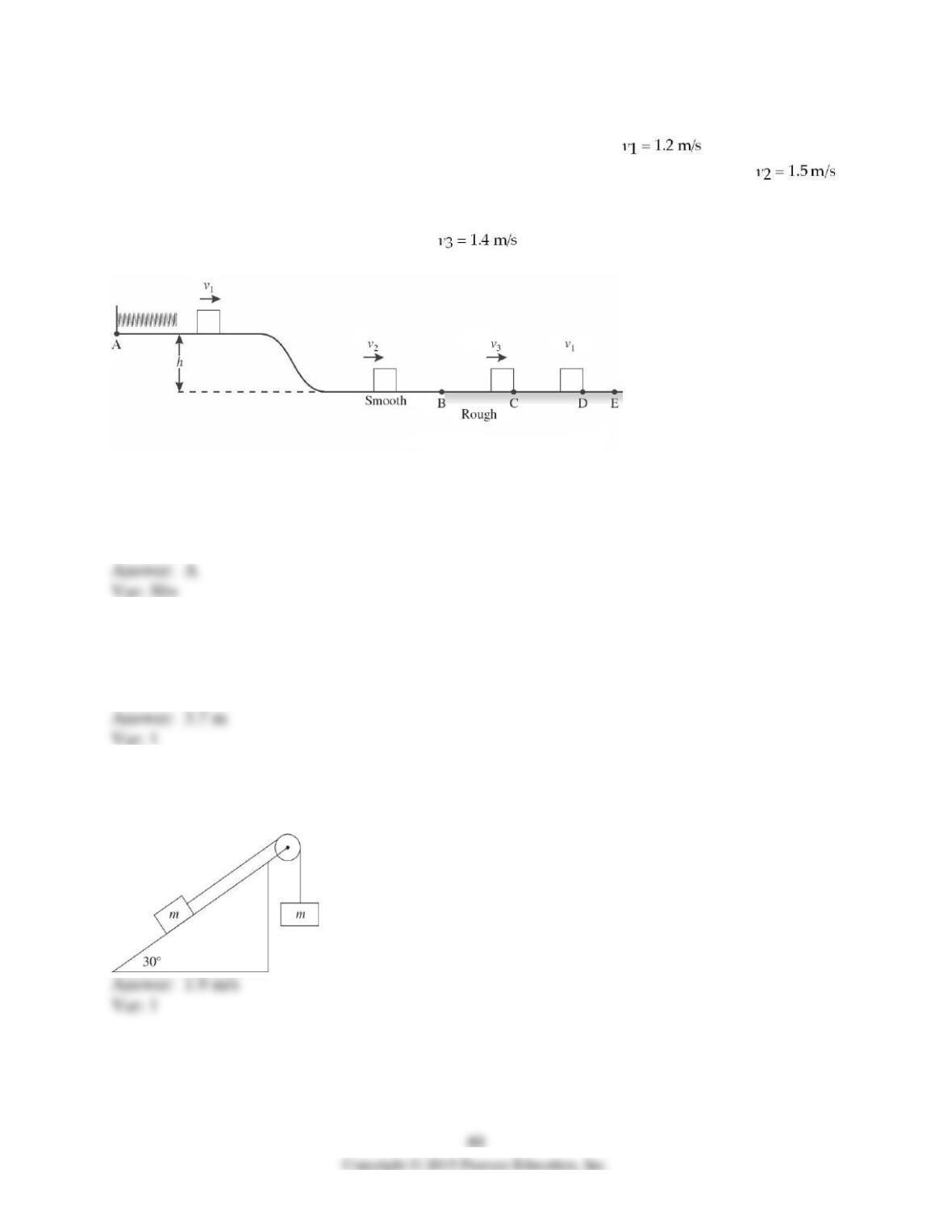
79) The figure shows two crates, each of mass m = 24 kg, that are connected by a very light wire.
The coefficient of kinetic friction between the crate on the inclined surface and the surface itself
is 0.31. Find the speed of the crates after they have moved 1.6 m starting from rest.