Ch. 10 Counting and Probability
10.1 Counting
1 Find All the Subsets of a Set
MULTIPLE CHOICE. Choose the one alternative that best completes the statement or answers the question.
Write down all the subsets of the given set.
1) {2
,
4
,
9
,
10}
A) {2}, {4}, {9}, {10}, {2
,
4}, {2
,
9}, {2
,
10}, {4
,
9},
{4, 10}, {9, 10}, {2, 4, 9}, {2, 4, 10}, {2, 9, 10}, {4, 9, 10}, {2, 4, 9, 10}, ∅
B) {2}, {4}, {9}, {10}, {2
,
4}, {2
,
9}, {2
,
10}, {4
,
9},
{4, 10}, {2, 4, 9}, {2, 4, 10}, {2, 9, 10}, {4, 9, 10},
{2, 4, 9, 10}, ∅
C) {2}, {4}, {9}, {10}, {2
,
4}, {2
,
9}, {2
,
10}, {4
,
9},
{4, 10}, {9, 10}, {2, 4, 9}, {2, 4, 10}, {2, 9, 10}, {4, 9, 10}, {2, 4, 9, 10}
D) {2}, {4}, {9}, {10}, {2
,
4}, {2
,
9}, {2
,
10}, {4
,
9},
{4, 10}, {9, 10}, {2, 4, 9}, {2, 4, 10}, {2, 9, 10},
{4, 9, 10}, ∅
2) {2
,
α
,
10
,
π}
A) {2}, {α}, {10}, {π}, {2
,
α}, {2
,
10}, {2
,
π}, {α
,
10},
{α, π}, {10, π}, {2, α, 10}, {2, α, π}, {2, 10, π}, {α, 10, π},
{2, α, 10, π}, ∅
B) {2}, {α}, {10}, {π}, {2
,
α}, {2
,
10}, {2
,
π}, {α
,
10},
{α, π}, {10, π}, {2, α, 10}, {2, α, π}, {2, 10, π}, {α, 10, π}, ∅
C) {2}, {α}, {10}, {π}, {2
,
α}, {2
,
10}, {2
,
π}, {α
,
10},
{α, π}, {10, π}, {2, α, 10}, {2, α, π}, {2, 10, π}, {α, 10, π},
{2, α, 10, π}
D) {2}, {α}, {10}, {π}, {2
,
α}, {2
,
10}, {2
,
π}, {α
,
10},
{α, π}, {10, π}, {2, α, π}, {2, 10, π}, {α, 10, π},
{2, α, 10, π}, ∅
3) {a}
A) ∅
,
{a} B) {a} C) {a, b} D) a
4) {p, q, r}
A) ∅
,
{p}, {q}, {r}, {p, q}, {p, r}, {q, r}, {p, q, r}
B) {p}, {q}, {r}, {p, q}, {p, r}, {q, r}, {p, q, r}
C) ∅
,
{p}, {q}, {r}, {p, q}, {p, r}, {q, r}
D) ∅
,
{p}, {q}, {r}, {p, q}, {p, r}, {q, r}, {p, p}, {q, q}, {r, r}, {p, q, r}
2 Count the Number of Elements in a Set
MULTIPLE CHOICE. Choose the one alternative that best completes the statement or answers the question.
Solve the problem.
1) If n(A) = 21
,
n(B) = 24
,
and n(A ∩ B) =11
,
find n(A ∪B).
A) 34 B) 23 C) 45 D) 56
2) If n(A) = 56
,
n(B) = 35
,
and n(A ∪ B) =72
,
find n(A ∩B).
A) 19 B) 53 C) 38 D) 91
Page 1
3) If n(B) = 12
,
n(A ∩ B) = 3
,
and n(A ∪ B) =21
,
find n(A).
A) 12 B) 10 C) 14 D) 9
4) If n(A) = 15
,
n(A ∪ B) =43
,
and n(A ∩B) =11
,
find n(B).
A) 39 B) 40 C) 38 D) 28
5) If n(A ∪ B) = 50
,
n(A ∩ B) = 18
,
and n(A) =n(B), find n(A).
A) 34 B) 16 C) 25 D) 9
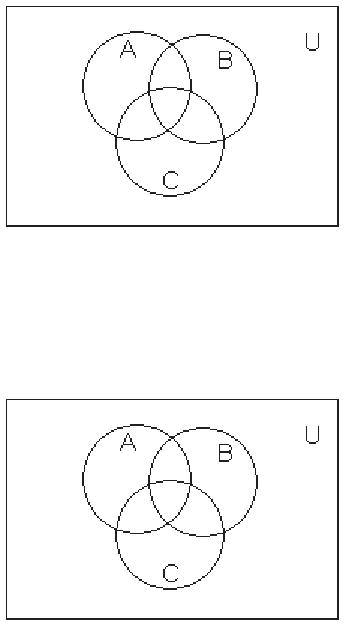
Use the information given in the figure.
6)
1
22 2 30
21
27 15
How many are in set A?
A) 27 B) 25 C) 42 D) 22
7)
5
30 3 21
25
25 5
How many are in B or C?
A) 61 B) 58 C) 51 D) 8
Page 2
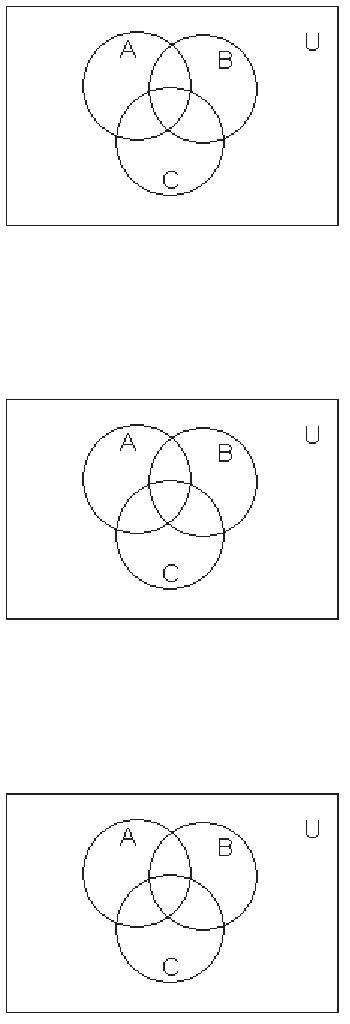
8)
5
26 3 22
51
24 1
How many are in B and C?
A) 4 B) 3 C) 47 D) 60
9)
3
29 5 17
51
24 5
How many are in B but not in A?
A) 18 B) 26 C) 23 D) 17
10)
3
17 2 22
43
23 11
How many are not in C?
A) 53 B) 42 C) 51 D) 50
Page 3
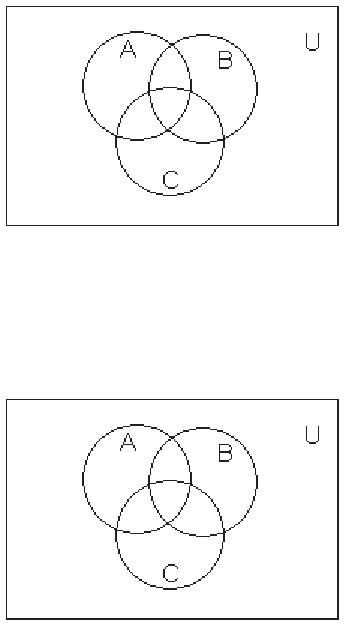
11)
1
18 3 22
42
25 5
How many are in A and B and C?
A) 3 B) 10 C) 65 D) 75
12)
3
22 4 26
13
25 10
How many are in A or B or C?
A) 84 B) 94 C) 4 D) 11
Solve the problem.
13) In a survey of 57 hospital patients, 22 said they were satisfied with the nursing care, 26 said they were
satisfied with the medical treatment, and 6 said they were satisfied with both. How many patients were
satisfied with neither? How many were satisfied with only the medical treatment?
A) 15; 20 B) 21; 26 C) 15; 26 D) 16; 20
14) In a survey of 392 computer buyers, 222 put price as a main consideration, 170 put performance as a main
consideration, and 60 listed both price and performance. How many computer buyers listed other
considerations? How many looked only for performance?
A) 60; 110 B) 120; 170 C) 60; 170 D) 162; 110
15) In survey of 50 households, 25 responded that they have an HDTV television, 35 responded that they had
a multimedia personal computer and 15 responded they had both. How many households had neither an
HDTV television nor a multimedia personal computer?
A) 5 B) 35 C) 15 D) 25
16) In a student survey, 119 students indicated that they speak Spanish, 36 students indicated that they speak
French, 12 students indicated that they speak both Spanish and French, and 137 students indicated that
they speak neither. How many students participated in the survey?
A) 280 B) 292 C) 268 D) 143
Page 4

17) Among a group of 80 investors, 20 owned shares of Stock A, 30 owned shares of Stock B, 46 owned shares
of Stock C, 9 owned shares of both Stock A and Stock B, 12 owned shares of Stock A and Stock C, 17
owned shares of Stock B and Stock C, and 7 owned shares of all three. How many investors did not have
shares in any of the three? How many owned shares of either Stock A or Stock C but not Stock B?
A) 15; 35 B) 22; 30 C) 15; 30 D) 15; 37
18) In a survey of 158 vacationers in a popular beach resort town, 70 indicated they would consider buying a
home there, 41 would consider buying a beach villa, 49 would consider buying a lot, 20 would consider
both a home and a villa, 17 would consider both a home and a lot, 18 would consider both a villa and a lot,
and 7 would consider all three. How many vacationers would not consider any of the three? How many
would consider only a home?
A) 46; 40 B) 53; 53 C) 46; 21 D) 46; 10
19) A survey of 2244 credit card users indicated that 730 had bought books online, 1295 had bought music
online, 453 had bought pet supplies online, 114 had bought both books and music, 168 had bought both
books and pet supplies, 121 had bought both music and pet supplies, and 67 had bought all three. How
many credit card users did not buy any of the three? How many bought either books or pet supplies but
not music?
A) 102; 847 B) 169; 746 C) 102; 746 D) 102; 813
20) The following data represent the marital status of females 18 years and older in a certain U.S. city.
Marital Status Number (in thousands)
Married 310
Widowed 55
Divorced 63
Never married 109
Determine the number of females 18 years old and older who are married or widowed.
A) 365,000 B) 310,000 C) 428,000 D) 373,000
3 Solve Counting Problems Using the Multiplication Principle
MULTIPLE CHOICE. Choose the one alternative that best completes the statement or answers the question.
Solve the problem.
1) A man has 7 shirts and 10 ties. How many different shirt and tie arrangements can he wear?
A) 70 B) 49 C) 140 D) 100
2) A restaurant offers a choice of 5 salads, 10 main courses, and 2 desserts. How many possible 3–course
meals are there?
A) 100 possible meals B) 17 possible meals
C) 50 possible meals D) 200 possible meals
3) Lisa has 4 skirts, 9 blouses, and 2 jackets. How many 3–piece outfits can she put together assuming any
piece goes with any other?
A) 72 possible outfits B) 15 possible outfits
C) 36 possible outfits D) 144 possible outfits
4) How many 7–symbol codes can be formed using 5 different symbols? Repeated symbols are allowed.
A) 78,125 B) 42 C) 21 D) 2520
Page 5
5) A certain mathematics test consists of 20 questions. Goldie decides to answer the questions withou
t
reading them. In how many ways can Goldie fill in the answer sheet if the possible answers are true and
false?
A) 1,048,576 B) 400 C) 40 D) 190
6) A student must choose 1 of 5 mathematics electives, 1 of 6 science electives, and 1 of 7 programming
electives. How many possible course selections are there?
A) 210 course selections B) 18 course selections
C) 30 course selections D) 420 course selections
7) How many arrangements of answers are possible in a multiple–choice test with 7 questions, each of which
has 5 possible answers?
A) 78,125 B) 42 C) 21 D) 2520
8) How many 4–letter codes can be formed using the letters A, B, C, D, E, F, G, H, and I. Repeated letters are
allowed.
A) 6561 B) 3024 C) 126 D) 262,144
9) How many 3–digit numbers can be formed using the digits 0, 1, 2, 3, 4, 5, 6, 7, 8, and 9 if the first digit
cannot be 0? Repeated digits are allowed.
A) 900 B) 504 C) 810 D) 729
10) How many different license plates can be made using 3 letters followed by 3 digits selected from the digits
0 through 9, if letters and digits may be repeated?
A) 17,576,000 B) 9 C) 36 D) 260
10.2 Permutations and Combinations
1 Solve Counting Problems Using Permutations Involving n Distinct Objects
MULTIPLE CHOICE. Choose the one alternative that best completes the statement or answers the question.
Find the value of the permutation.
1) P(7
,
2)
A) 42 B) 2520 C) 21 D) 240
2) P(7
,
0)
A) 1 B) 5040 C) 4 D) 10,080
3) P(5
,
1)
A) 5 B) 120 C) 1 D) 24
4) P(5
,
5)
A) 120 B) 1 C) 60 D) 2
Page 6
Solve the problem.
5) List all the ordered arrangements of 6 objects a, b, c, d, e, and f choosing 2 at a time without repetition.
What is P(6, 2)?
A) ab, ac, ad, ae, af, ba, bc, bd, be, bf, ca, cb, cd, ce, cf, da, db, dc, de, df, ea, eb, ec, ed, ef, fa, fb, fc, fd, fe
P(6, 2) = 30
B) ab, ac, ad, ae, af, bc, bd, be, bf, cd, ce, cf, de, df, ef
P(6, 2) = 15
C) aa, ab, ac, ad, ae, af, ba, bb, bc, bd, be, bf, ca, cb, cc, cd, ce, cf, da, db, dc, dd, de, df, ea, eb, ec, ed, ee, ef,
fa, fb, fc, fd, fe, ff
P(6, 2) = 36
D) ab, ac, ad, ae, af, ba, bc, bd, be, bf, ca, cb, cd, ce, cf, da, db, dc, de, df, ea, eb, ec, ed, ef
P(6, 2) = 25
6) List all the ordered arrangements of 4 objects 1, 2, 3, and 4 choosing 3 at a time without repetition. What is
P(4, 3)?
A) 123, 124, 132, 134, 142, 143, 213, 214, 231, 234, 241, 243, 312, 314, 321, 324, 341, 342, 412, 413, 421,
423, 431, 432
P(4, 3) = 24
B) 123, 124, 134, 234
P(4, 3) = 4
C) 123, 124, 132, 142, 143, 213, 214, 231, 241, 243, 312, 314, 321, 341, 342, 412, 413, 421, 423, 431
P(4, 3) = 20
D) 111, 112, 113, 114, 121, 122, 123, 124, 131, 132, 133, 134, 141, 142, 143, 144, 211, 212, 213, 214, 221, 222,
223, 224, 231, 232, 233, 234, 241, 242, 243, 244, 311, 312, 313, 314, 321, 322, 323, 324, 331, 332, 333, 334,
341, 342, 343, 344, 411, 412, 413, 414, 421, 422, 423, 424, 431, 432, 433, 434, 441, 442, 443, 444
P(4, 3) = 64
7) In how many ways can 11 people be lined up?
A) 39,916,800 B) 11 C) 19,958,400 D) 1
8) 7 different books are to be arranged on a shelf. How many different arrangements are possible?
A) 5040 B) 7 C) 2520 D) 720
9) How many different 8–letter codes are there if only the letters A, B, C, D, E, F, G, H, and I can be used and
no letter can be used more than once?
A) 362,880 B) 43,046,721 C) 9 D) 8
10) How many 4–digit numbers can be formed using the digits 1, 2, 3, 4, 5, 6, 7, 8, 9, and 0? No digit can be
used more than once.
A) 5040 B) 151,200 C) 210 D) 302,400
11) How many different license plates can be made using 3 letters followed by 2 digits selected from the digits
0 through 9, if neither letters nor digits may be repeated?
A) 1,404,000 B) 1,757,600 C) 117,000 D) 1,123,200
12) How many different license plates can be made using 3 letters followed by 4 digits selected from the digits
0 through 9, if digits may be repeated but letters may not be repeated?
A) 156,000,000 B) 216,666.667 C) 88,583,040 D) 175,760,000
13) In how many ways can 7 people each have different birth months?
A) 3,991,680 B) 792 C) 35,831,808 D) 84
Page 7
14) A group of 11 friends goes bowling. How many different possibilities are there for the order in which they
play if the youngest person is to bowl first?
A) 3,628,800 B) 39,916,800 C) 10 D) 11
2 Solve Counting Problems Using Combinations
MULTIPLE CHOICE. Choose the one alternative that best completes the statement or answers the question.
Find the value of the combination.
1) C(9
,
3)
A) 84 B) 60,480 C) 252 D) 1440
2) C(8
,
8)
A) 1 B) 40,320 C) 10,080 D) 0.5
Solve the problem.
3) List all the combinations of 6 objects a, b, c, d, e, and f taken 2 at a time. What is C(6, 2)?
A) ab, ac, ad, ae, af, bc, bd, be, bf, cd, ce, cf, de, df, ef
C(6, 2) = 15
B) ab, ac, ad, ae, af, ba, bc, bd, be, bf, ca, cb, cd, ce, cf, da, db, dc, de, df, ea, eb, ec, ed, ef, fa, fb, fc, fd, fe
C(6, 2) = 30
C) aa, ab, ac, ad, ae, af, ba, bb, bc, bd, be, bf, ca, cb, cc, cd, ce, cf, da, db, dc, dd, de, df, ea, eb, ec, ed, ee, ef,
fa, fb, fc, fd, fe, ff
C(6, 2) = 36
D) ab, ac, ad, ae, bc, bd, be, cd, ce, cf, de, df
C(6, 2) = 12
4) List all the combinations of 4 objects 1, 2, 3, and 4 taken 3 at a time. What is C(4, 3)?
A) 123, 124, 134, 234
C(4, 3) = 4
B) 123, 124, 132, 134, 142, 143, 213, 214, 231, 234, 241, 243, 312, 314, 321, 324, 341, 342, 412, 413, 421,
423, 431, 432
C(4, 3) = 24
C) 123, 124, 134, 234, 321, 432
C(4, 3) = 6
D) 111, 112, 113, 114, 121, 122, 123, 124, 131, 132, 133, 134, 141, 142, 143, 144, 211, 212, 213, 214, 221, 222,
223, 224, 231, 232, 233, 234, 241, 242, 243, 244, 311, 312, 313, 314, 321, 322, 323, 324, 331, 332, 333, 334,
341, 342, 343, 344, 411, 412, 413, 414, 421, 422, 423, 424, 431, 432, 433, 434, 441, 442, 443, 444
C(4, 3) = 64
5) From 8 names on a ballot, a committee of 3 will be elected to attend a political national convention. Ho
w
many different committees are possible?
A) 56 B) 336 C) 6720 D) 168
6) A hot dog stand sells hot dogs with cheese, relish, chili, tomato, onion, mustard, or ketchup. How many
different hot dogs can be concocted using any 5 of the extras?
A) 21 B) 2520 C) 42 D) 1260
7) An exam consists of 9 multiple–choice questions and 6 essay questions. If the student must answer 7 of the
multiple–choice questions and 3 of the essay questions, in how many ways can the questions be chosen?
A) 720 B) 1134 C) 261,273,600 D) 21,772,800
Page 8
8) Mary finds 8 fish at a pet store that she would like to buy, but she can afford only 5 of them. In how many
ways can she make her selection? How many ways can she make her selection if he decides that one of the
fish is a must?
A) 56; 35 B) 6720; 840 C) 336; 210 D) 3360; 420
9) How many 5–card poker hands consisting of three 10’s and two cards that are not 10’s are possible in a
52–card deck?
A) 4512 B) 2256 C) 5304 D) 2652
10) A committee is to be formed consisting of 5 men and 2 women. If the committee members are to be chosen
from 8 men and 14 women, how many different committees are possible?
A) 5096 B) 170,544 C) 1,223,040 D) 147
11) How many ways are there to choose a soccer team consisting of 3 forwards, 4 midfield players, and 3
defensive players, if the players are chosen from 7 forwards, 10 midfield players, and 9 defensive players?
A) 617,400 B) 5,311,735 C) 533,433,600 D) 329
3 Solve Counting Problems Using Permutations Involving n Nondistinct Objects
MULTIPLE CHOICE. Choose the one alternative that best completes the statement or answers the question.
Solve the problem.
1) How many different 10–letter words (real or imaginary) can be formed from the letters in the word
IMMUNOLOGY?
A) 907,200 B) 3,628,800 C) 1,814,400 D) 90,720
SHORT ANSWER. Write the word or phrase that best completes each statement or answers the question.
2) How many different 11–letter words (real or imaginary) can be formed from the letters of the word
MISSISSIPPI? Leave your answer in factorial form.
MULTIPLE CHOICE. Choose the one alternative that best completes the statement or answers the question.
3) How many different vertical arrangements are there of 6 flags if 3 are white, 2 are blue, and 1 is red?
A) 60 B) 6 C) 11 D) 20
4) An environmental organization has 24 members. Each member will be placed on exactly 1 of 4 teams.
Each team will work on a different issue. The first team has 5 members, the second has 6, the third has 10,
and the fourth has 3. In how many ways can these teams be formed?
A) 3.298204990 × 10¹¹ B) 6.204484017 × 10²³
C) 2.270945699 × 10¹⁹ D) 9.894614970 × 10¹¹
Page 9

10.3 Probability
1 Construct Probability Models
MULTIPLE CHOICE. Choose the one alternative that best completes the statement or answers the question.
Solve the problem.
1) In a probability model, which of the following numbers could be the probability of an outcome:
0, 0.2, –0.01, – 1
3, 1
2, 5
4, 1, 1.5
A) 0, 0.2, 1
2, 1 B) 0.2, 1
2, 1
C) 0, 0.2, –0.01, 1, 1.5 D) 0, 0.2, –0.01, – 1
3, 1
2, 1
Determine whether the following is a probability model.
2)
Outcome Probability
Red 0.16
Blue 0.20
Green 0.28
White 0.36
A) Yes B) No
3)
Outcome Probability
Red 0.16
Blue 0.24
Green 0.27
White 0.50
A) Yes B) No
4)
Outcome Probability
Red 0.19
Blue 0.23
Green 0.29
White 0.14
A) Yes B) No
5)
Outcome Probability
Red –0.20
Blue 0.24
Green 0.30
White 0.26
A) Yes B) No
Page 10
6)
Outcome Probability
Jim 0
Tom 0
Bill 1
Carl 0
A) Yes B) No
7)
Outcome Probability
Golfing 0.07
Skiing 0.10
Swimming 0.09
Biking 0.24
Hiking 0.50
A) Yes B) No
SHORT ANSWER. Write the word or phrase that best completes each statement or answers the question.
Construct a probability model for the experiment.
8) Tossing two fair coins once
9) Tossing one fair coin three times
10) Rolling a 6–sided fair die once
11) Rolling a 6–sided fair die once and tossing a fair coin once.
12) Rolling a 6–sided fair die twice
13) Tossing a fair coin twice given that the coin is weighted so that heads is three times as likely as tails to
occur.
14) Spinner I has 4 sections of equal area, numbered 1, 2, 3, and 4, and Spinner II has 4 sections of equal area,
labeled Red, Yellow, Green, and Blue. Spin Spinner I and then spin Spinner II.
What is the probability of getting a 1 or 3 followed by Red?
15) Spinner I has 4 sections of equal area, numbered 1, 2, 3, and 4. Spinner II has 3 sections of equal area,
labeled Red, Yellow, and Green. Spinner III has 2 sections of equal area labeled A and B. Spin Spinner I,
then Spinner II, then Spinner III.
What is the probability of getting a 2, followed by Yellow or Green, followed by B?
16) Spinner I has 3 sections of equal area, numbered 1, 2, and 3. Spinner II has 3 sections of equal area,
labeled Red, Yellow, and Green. Spin Spinner I twice, then Spinner II.
What is the probability of getting a 2, followed by a 1, followed by Yellow or Red?
Solve the problem.
17) A twelve–sided die is weighted so that only the numbers 1 through 6 will appear and they will occur with
the same probability. What probability should be assigned to each face?
18) A die is weighted so that an even–numbered face is three times as likely to occur as an odd–numbered
face. What probability should be assigned to each face?
Page 11
19) A coin is weighted so that heads is 13 times as likely as tails to occur. What probability should be assigned
to heads? to tails?
2 Compute Probabilities of Equally Likely Outcomes
MULTIPLE CHOICE. Choose the one alternative that best completes the statement or answers the question.
Solve the problem.
1) A bag contains 9 red marbles, 7 blue marbles, and 2 green marbles. If one marble is selected at random,
determine the probability that it is blue.
A) 7
18 B) 1
2C) 1
9D) 7
16
2) A 6–sided die is rolled. What is the probability of rolling a number less than 2?
A) 1
6B) 1
3C) 5
6D) 1
9
3) Two 6–sided dice are rolled. What is the probability the sum of the two numbers on the dice will be 4?
A) 1
12 B) 2
3C) 11
12 D) 3
4) A bag contains 15 balls numbered 1 through 15. What is the probability of selecting a ball that has an even
number when one ball is drawn from the bag?
A) 7
15 B) 15
7C) 2
15 D) 7
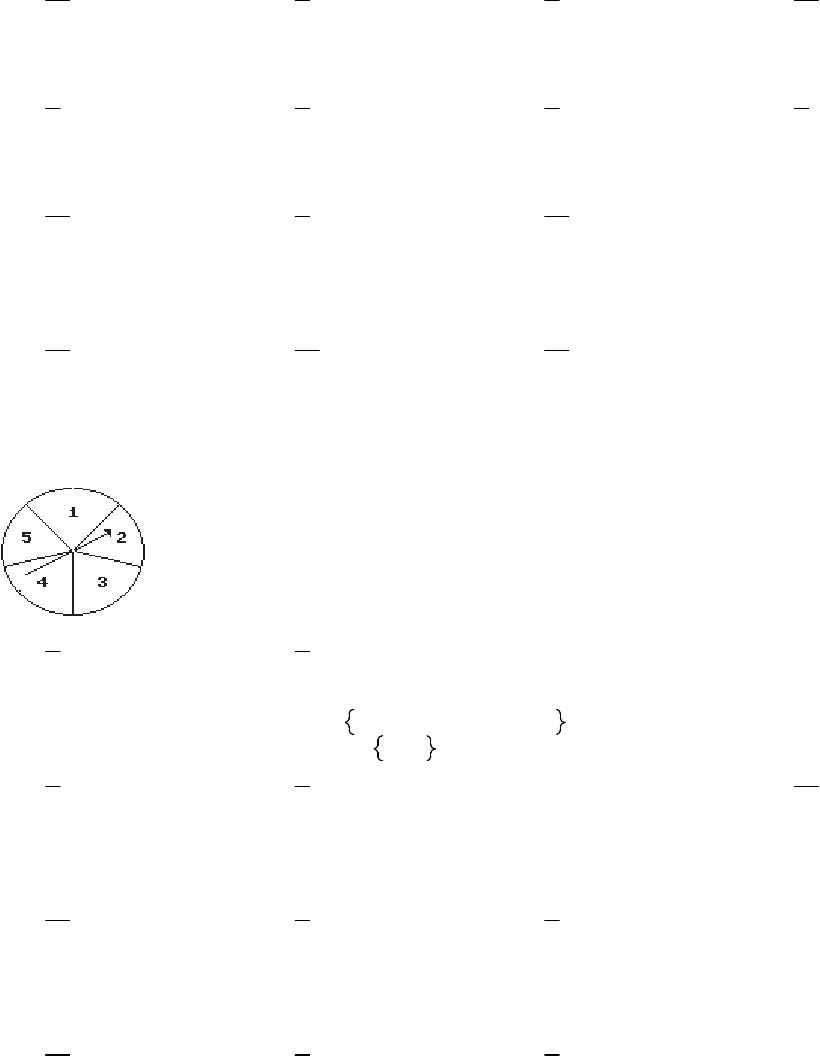
5) What is the probability that the arrow will land on an odd number? Assume that all sectors have equal
area.
A) 3
5B) 2
5C) 1 D) 0
6) Suppose that the sample space is S = 1, 2, 3, 4, 5, 6, 7, 8, 9, 10 and that outcomes are equally likely.
Compute the probability of the event E = 2, 10 .
A) 1
5B) 2
9C) 2 D) 1
10
7) Suppose that the sample space is S = {1, 2, 3, 4, 5, 6, 7, 8, 9, 10} and that outcomes are equally likely.
Compute the probability of the event E = {1, 2, 4, 5, 7, 9, 10}.
A) 7
10 B) 7
9C) 4
5D) 7
8) Suppose that the sample space is S = {1, 2, 3, 4, 5, 6, 7, 8, 9, 10} and that outcomes are equally likely.
Compute the probability of the event E: “a number divisible by 3”.
A) 3
10 B) 2
5C) 1
3D) 3
Page 12

9) Find the probability of getting 2 tails when 3 fair coins are tossed.
A) 3
8B) 1
4C) 2
3D) 1
2
10) Find the probability of having 4 girls in a 4–child family.
A) 1
16 B) 1
8C) 1
4D) 1
32
3 Find Probabilities of the Union of Two Events
MULTIPLE CHOICE. Choose the one alternative that best completes the statement or answers the question.
Solve the problem.
1) Given that P(A) = 0.20
,
P(B) = 0.53
,
and P(A ∩B) =0.10
,
find P(A ∪B).
A) 0.63 B) 0.73 C) 0.83 D) 0.53
2) Given that P(A) = 0.22
,
P(B) = 0.58
,
and P(A ∪B) =0.68
,
find P(A ∩B).
A) 0.12 B) 0.56 C) 0.8 D) 0.1276
3) Given that P(A) = 0.20 and P(B) = 0.20
,
find P(A ∪B) if A and B are mutually exclusive.
A) 0.4 B) 0.04 C) 0 D) 0.36
4) Given that P(A) = 0.28 and P(B) = 0.12
,
find P(A ∩B) if A and B are mutually exclusive.
A) 0 B) 0.0336 C) 0.4 D) 0.3664
5) Given that P(A) = 0.47
,
P(A ∪ B) = 0.66
,
and P(A ∩B) =0.18
,
find P(B).
A) 0.37 B) 0.19 C) 0.55 D) 0.29
6) The table below shows the results of a consumer survey of annual incomes in 100 households.
Income Number of households
$0 – 14,999 6
$15,000 – 24,999 21
$25,000 – 34,999 26
$35,000 – 44,999 26
$45,000 or more 21
What is the probability that a household has an annual income of $25,000 or more?
A) 0.73 B) 0.26 C) 0.47 D) 0.53
7) The table below shows the results of a consumer survey of annual incomes in 100 households.
Income Number of households
$0 – 14,999 8
$15,000 – 24,999 24
$25,000 – 34,999 30
$35,000 – 44,999 27
$45,000 or more 11
What is the probability that a household has an annual income less than $25,000?
A) 0.32 B) 0.68 C) 0.24 D) 0.62
Page 13
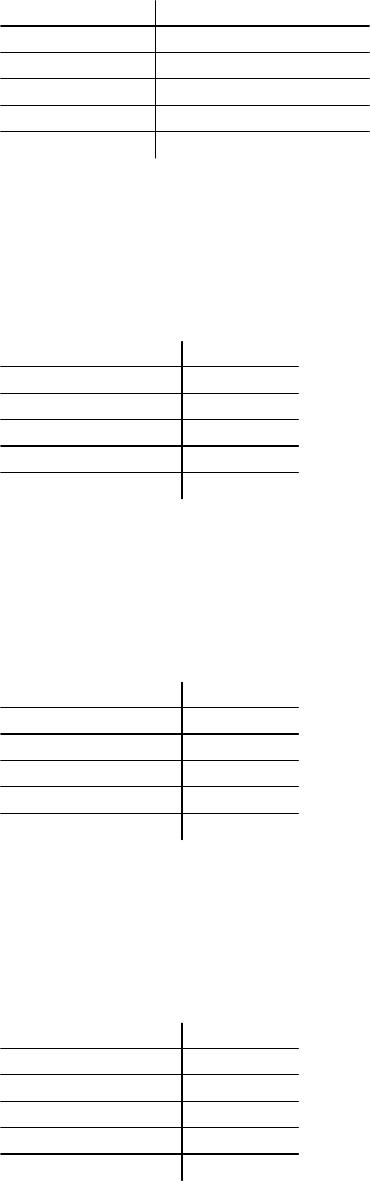
8) The table below shows the results of a consumer survey of annual incomes in 100 households.
Income Number of households
$0 – 14,999 5
$15,000 – 24,999 23
$25,000 – 34,999 30
$35,000 – 44,999 29
$45,000 or more 13
What is the probability that a household has an annual income between $15,000 and $44,999 inclusive?
A) 0.82 B) 0.3 C) 0.52 D) 0.53
9) In a survey about the number of siblings of college students, the following probability table was
constructed:
Number of Siblings Probability
0 0.24
1 0.33
2 0.19
3 0.13
4 or more 0.11
What is the probability that a student has at least 2 siblings?
A) 0.43 B) 0.24 C) 0.76 D) 0.57
10) In a survey about the number of siblings of college students, the following probability table was
constructed:
Number of Siblings Probability
0 0.27
1 0.30
2 0.18
3 0.11
4 or more 0.14
What is the probability that a student has at most 2 siblings?
A) 0.75 B) 0.25 C) 0.43 D) 0.57
11) In a survey about the number of siblings of college students, the following probability table was
constructed:
Number of Siblings Probability
0 0.24
1 0.32
2 0.21
3 0.13
4 or more 0.10
What is the probability that a student 3 or more siblings?
A) 0.23 B) 0.13 C) 0.1 D) 0.77
Page 14

12) In a survey about the number of siblings of college students, the following probability table was
constructed:
Number of Siblings Probability
0 0.27
1 0.30
2 0.20
3 0.13
4 or more 0.10
What is the probability that a student has less than 2 siblings?
A) 0.57 B) 0.23 C) 0.77 D) 0.2
13) In a survey about the number of siblings of college students, the following probability table was
constructed:
Number of Siblings Probability
0 0.27
1 0.33
2 0.18
3 0.13
4 or more 0.09
What is the probability that a student has 1, 2, or 3 siblings?
A) 0.64 B) 0.51 C) 0.31 D) 0.91
14) A bag contains 7 red marbles, 3 blue marbles, and 1 green marble. What is the probability of choosing a
marble that is red or green when one marble is drawn from the bag?
A) 8
11 B) 11
8C) 3
11 D) 8
15) Each of ten tickets is marked with a different number from 1 to 10 and put in a box. If you draw a ticket
from the box, what is the probability that you will draw 4, 8, or 5?
A) 3
10 B) 1
4C) 1
10 D) 1
8
16) A lottery game has balls numbered 1 through 17. What is the probability of selecting an even numbered
ball or a 7?
A) 9
17 B) 8
17 C) 7
17 D) 8
9
17) A spinner has regions numbered 1 through 21. What is the probability that the spinner will stop on an
even number or a multiple of 3?
A) 2
3B) 10
9C) 1
3D) 17
18) The psychology lab at a college is staffed by 8 male doctoral students, 9 female doctoral students, 14 male
undergraduates, and 11 female undergraduates. If a person is selected at random from the group, find the
probability that the selected person is an undergraduate or a female.
A) 17
21 B) 23
42 C) 25
42 D) 10
21
Page 15

19) The faculty at a college consists of 90 full–time teachers and 51 part–time teachers. Of the 90 full–time
teachers, 50 are female. Of the 51 part–time teachers, 29 are female. Find the probability that a randomly
selected teacher is male or works part–time.
A) 91
141 B) 113
141 C) 23
47 D) 22
141
4 Use the Complement Rule to Find Probabilities
MULTIPLE CHOICE. Choose the one alternative that best completes the statement or answers the question.
Solve the problem.
1) A bag contains 8 red marbles, 3 blue marbles, and 1 green marble. What is the probability of choosing a
marble that is not blue when one marble is drawn from the bag?
A) 3
4B) 4
3C) 1
4D) 9
2) During July in Jacksonville, Florida, it is not uncommon to have afternoon thunderstorms. On average,
11.6 days have afternoon thunderstorms. What is the probability that a randomly selected day in July will
not have a thunderstorm? Round to two decimal places, if necessary.
A) 0.63 B) 0.61 C) 0.37 D) 0.88
3) In the city of Gloomville, the probability of rain on New Year’s Day is 53%. What is the probability that
next New Year’s Day it will not rain in Gloomville?
A) 47% B) 53% C) –53% D) 28.09%
4) Sam estimates that if he leaves his car parked outside his office all day on a weekday, the chance that he
will get a parking ticket is 34%. If Sam leaves his car parked outside his office all day next Tuesday, what
is the chance that he will not get a parking ticket?
A) 66% B) 34% C) –34% D) 11.56%
5) What is the probability that at least 2 people have the same birth month in a group of 8 people?
A) 0.954 B) 0.046 C) 0.956 D) 0.044
Page 16

Ch. 10 Counting and Probability
Answer Key
10.1 Counting
1 Find All the Subsets of a Set
2 Count the Number of Elements in a Set
3 Solve Counting Problems Using the Multiplication Principle
10.2 Permutations and Combinations
1 Solve Counting Problems Using Permutations Involving n Distinct Objects
Page 17
2 Solve Counting Problems Using Combinations
3 Solve Counting Problems Using Permutations Involving n Nondistinct Objects
10.3 Probability
1 Construct Probability Models
Page 18
2 Compute Probabilities of Equally Likely Outcomes
3 Find Probabilities of the Union of Two Events
Page 19

4 Use the Complement Rule to Find Probabilities
Page 20