
ch10 Key
1. Support-service department costs are usually facility-level resource decisions.
2. Without allocation of service department costs to users, service departments will tend to grow
uncontrollably.
3. Few companies allocate the cost of corporate headquarters to divisions because the allocations cause low
morale for employees.
4. If internal customers are required to use internal services, they might spend valuable time negotiating and
lobbying over fair prices, resulting in internal inefficiencies.

5. Using multiple cost pools usually results in better decisions about the use of service resources than single cost
pools.
6. Using fewer cost pools will generally result in cost allocations that match resource use better than using
multiple cost pools.
7. An advantage of the Activity-Based-Costing approach to developing cost pools is that it is cheaper and easier
to apply than traditional methods.
8. In order for allocations to be fair to all departments, all resources should be allocated to user departments,
whether or not they were consumed by the departments.
9. The use of support-service department resources is not necessarily the same as the supply of those resources.
10. The space occupied by a department would be an appropriate cost allocation base for allocating the cost of
the accounting department to other departments.
11. The number of employees in a department would be an appropriate cost allocation base of allocating the
Personnel Department cost to other departments.
12. Square footage occupied would be an appropriate way to allocate building insurance cost to user
departments.
13. Occupancy related support-service costs are most appropriately allocated using a space occupied type of
cost-allocation base.
14. The value of equipment would be an appropriate cost allocation base for allocating the cost of insurance on
equipment.
15. The number of machine hours would be an appropriate cost allocation base for allocating the cost of
maintenance on equipment.
16. The direct method of cost allocation allocates the cost of support–service departments to all departments
including other service departments.
17. The direct method of cost allocation charges cost of support-service departments to internal customers
without making allocations among service departments.
18. The direct method ignores services provided by one support service department to another.

19. The step method of allocation ignores services provided by one support service department to another.
20. Step method allocations usually begin with the service department with the largest proportion of its total
allocation base in other service departments.
21. The step method ignores any services provided to the largest service department from other service
departments.
22. The step order in the step method is from least general service department to most general service
department.
23. The step method considers all interactions among service departments.

24. The direct–method ignores interactions among service departments.
25. When using the step-method of allocation, once the organization makes an allocation from a support-service
department, no subsequent allocations are made back to that department.
26. Under-the step method of allocation, the final amount allocated to any user department depends on the order
in which the allocation is made from the service departments.
27. Activity-Based-Costing (ABC. cost drivers should reflect cause and effect relations between resource
spending and use.
28. Accuracy should be the only consideration in choosing the appropriate approach for allocating support
service costs.
29. While costly to set up, once implemented, a complex cost allocation system is inexpensive to maintain.
30. The reciprocal method of cost allocation recognizes and allocates costs of all services provided by any
support-service department, including those provided to other service departments. (Appendix)
31. The equation used to represent total departmental costs using the reciprocal method is: total department
costs equals direct costs of the department minus the service costs to be allocated to the department.
(Appendix)
32. Which of the following is not an appropriate justification for allocating support-service costs?
33. Which of the following is the first step in the process of allocating service costs?
34. Which of the following is not a reason to justify the allocation of support services?
35. Which of the following is not a benefit of cost allocation?
36. Allocation of factory service department costs to the production departments is necessary to:
37. Which of the following statements is false regarding the use of multiple cost pools?
38. Which of the following statements is true regarding the use of multiple cost-pools?
39. Which of the following would be an appropriate cost-allocation base for allocating the cost of the company
cafeteria?
40. Which of the following would not be an appropriate cost–allocation base for the Personnel department
costs?
41. Which of the following would not be an appropriate cost-allocation base for allocating the cost of the
corporate library in a consulting company with multiple divisions?
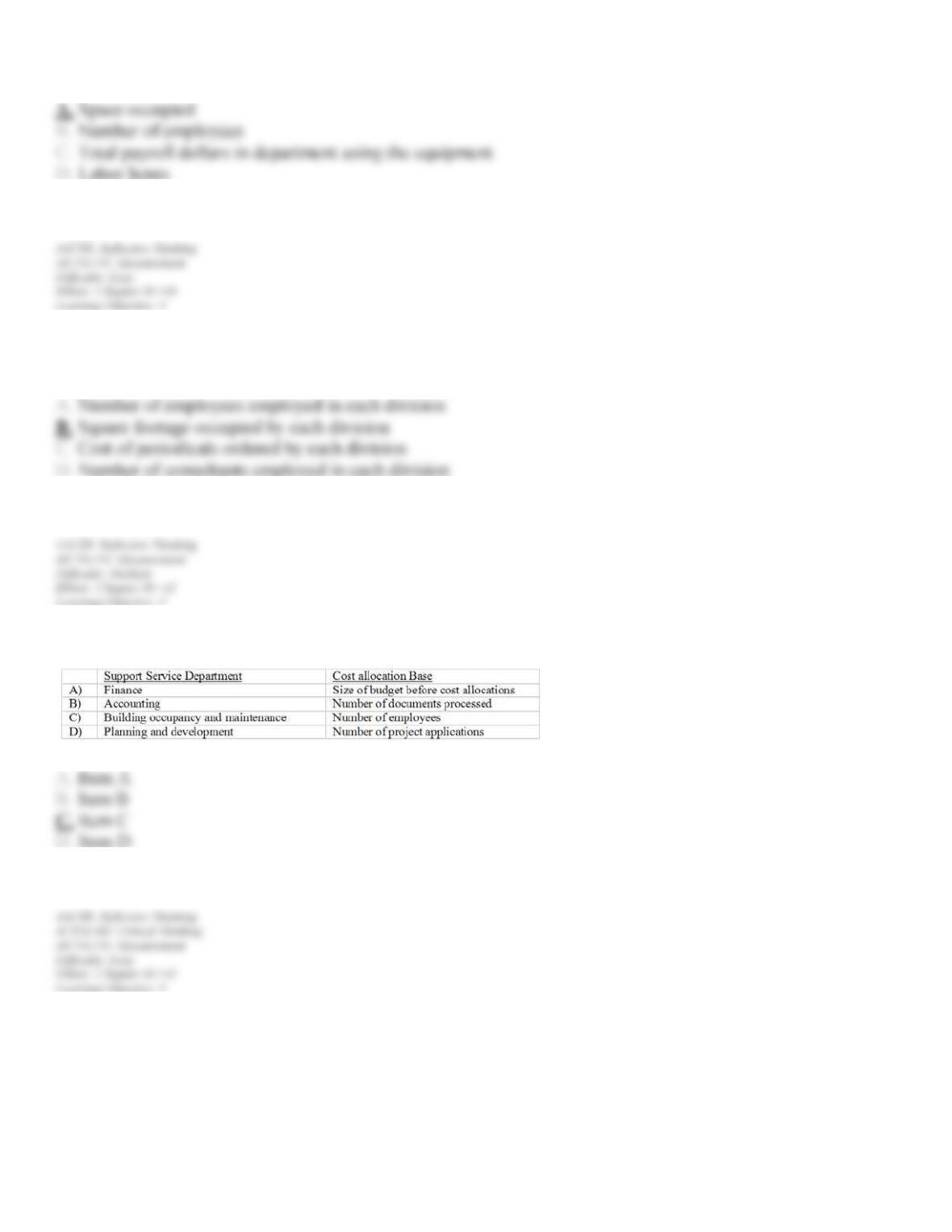
42. Which of the following shows an inappropriate cost allocation base?
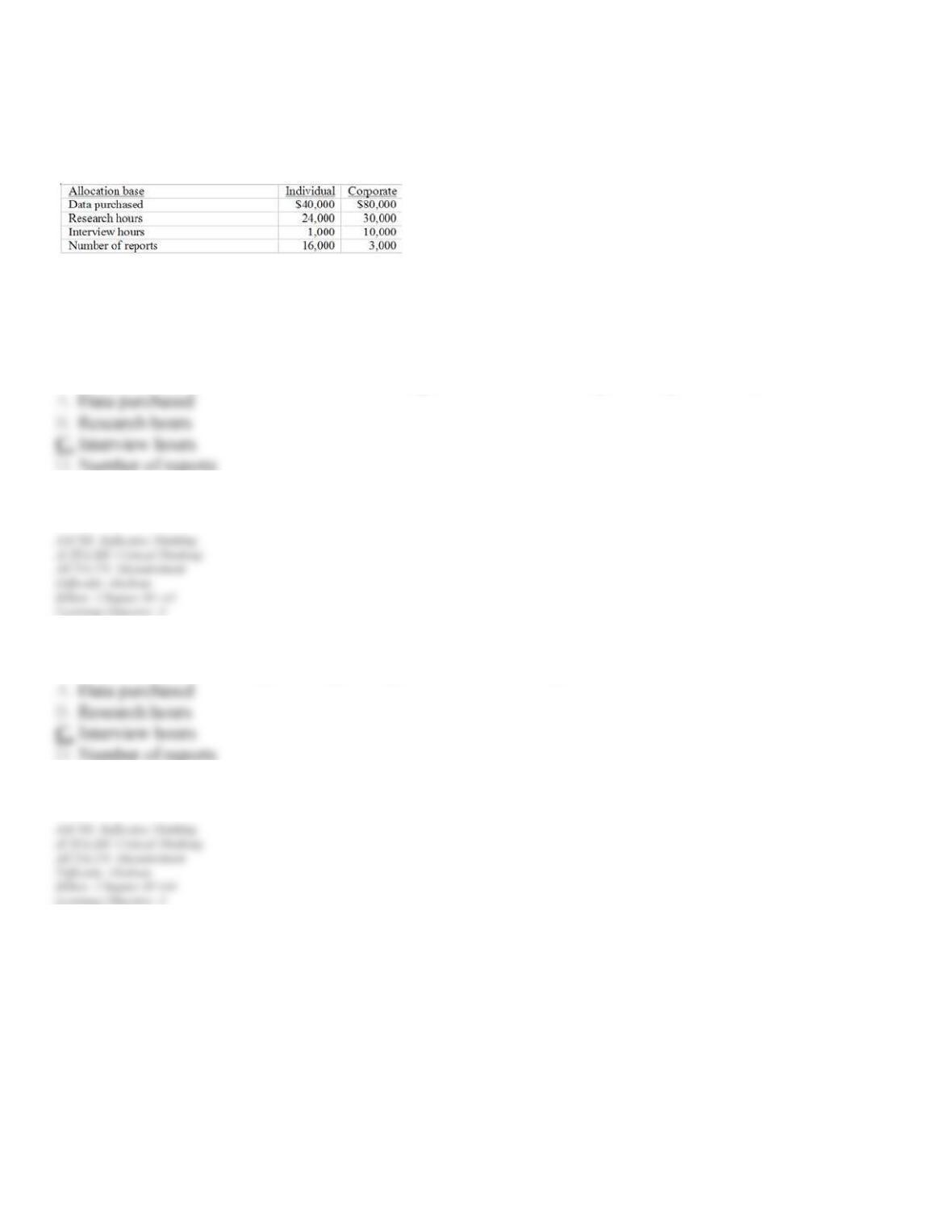
Use the following to answer questions 43-46:
Sovereign Credit Checks produces two styles of credit reports: Individual and Corporate. The difference
between the two is the amount of background information and data collection required. The Corporate report
uses more skilled personnel because additional checking and data are required. The relevant figures for the year
just completed follow: Total support service costs to be allocated are $3,200,000.
Hilton – Chapter 10
43. Which cost–allocation based would the manager of the Individual Department prefer the most?
44. The manager of the Corporate Report Department would least prefer which method of allocation?
45. If service costs are allocated according to the number of reports, the service department cost to be allocated
to the Individual report department will be:
46. If service department costs are allocated by data purchased, the Corporate report department will receive an
allocation of:
47. Mansfield River Corporation maintains computer equipment and provides services in all 50 states and in 20
countries. The Corporation has a fleet of 3 Corporate Jets and 2 Helicopters and employs 6 full time pilots who
receive salary and benefits. The most appropriate way to allocate the total cost of the corporate jets, helicopters
and pilots to individual user departments would be:
48. Which of the following is not a recognized method of allocating costs of service departments to user
departments?
49. Which of the following statements regarding cost allocations isFalse?
Use the following to answer questions 50-55:
Brandeis Corporation has two production Departments: P1 and P2 and two service departments: S1 and S2.
Direct costs for each department and the proportion of service costs used by the various departments for the
month of July are as follows:
Hilton – Chapter 10
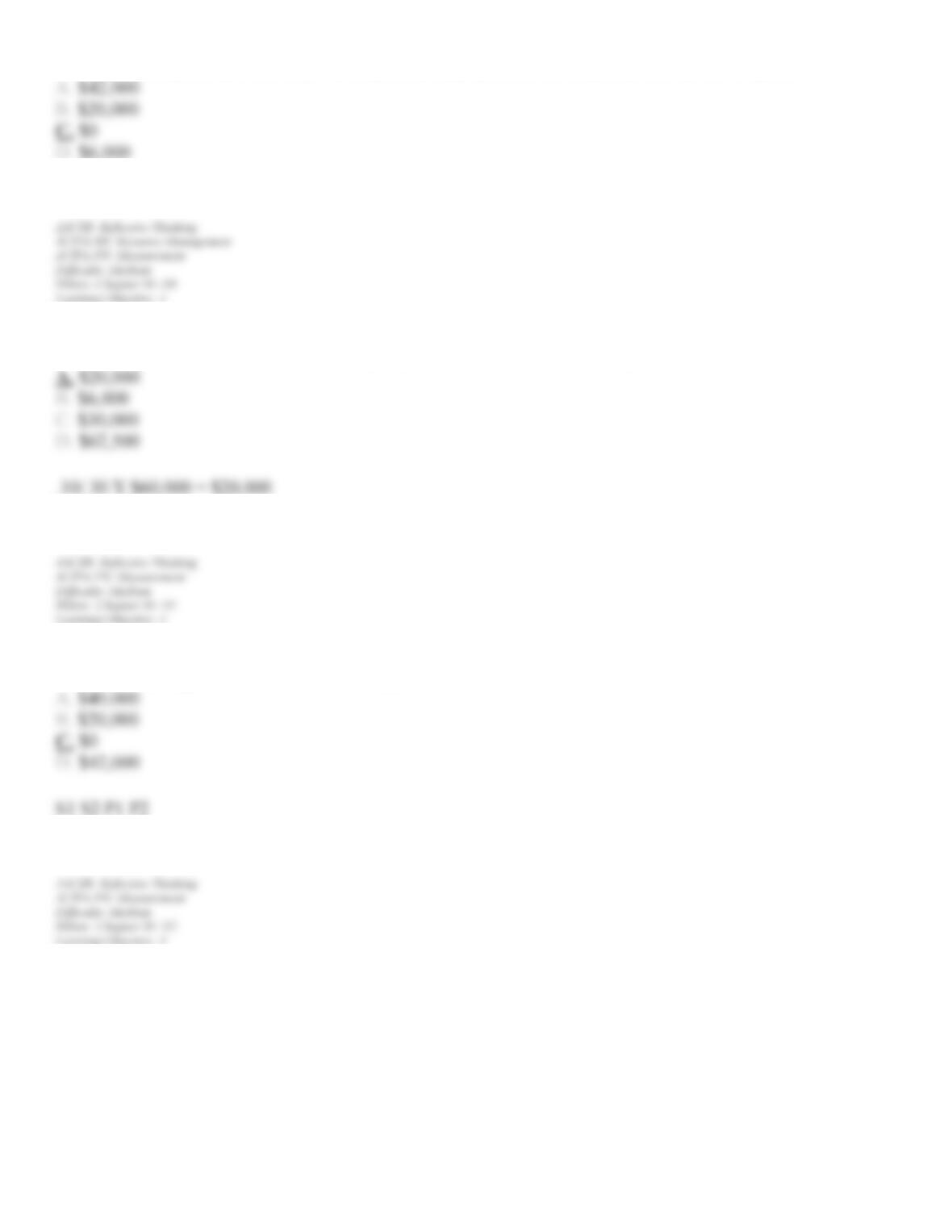
50. Under the direct–method of cost allocation, the amount of S1 costs allocated to the S2 would be:
51. Under the direct–method of cost allocation, the amount of S1 costs allocated to P1 would be:
52. Under the step-method of cost allocation, the amount of S2 costs allocated to S1 would be:
53. Under the step-method of cost allocation, the amount of costs allocated from S2 to P2 would be:
54. Under the step-method of allocation, the total amount of service costs allocated to producing departments
would be:
55. Under the step-method of allocation, the total departmental budget for P2 after all allocations have been
made will be:

56. What is the amount of maintenance that would be allocated to the machining department, assuming
Hampton uses the step-method to allocate the costs of service departments?
57. What is the amount of total service costs allocated to the assembly department, assuming Hampton uses the
step-method to allocate the costs of service departments?
58. What will be the total costs of the machining department, assuming Hampton uses the step-method to
allocate the costs of service departments?
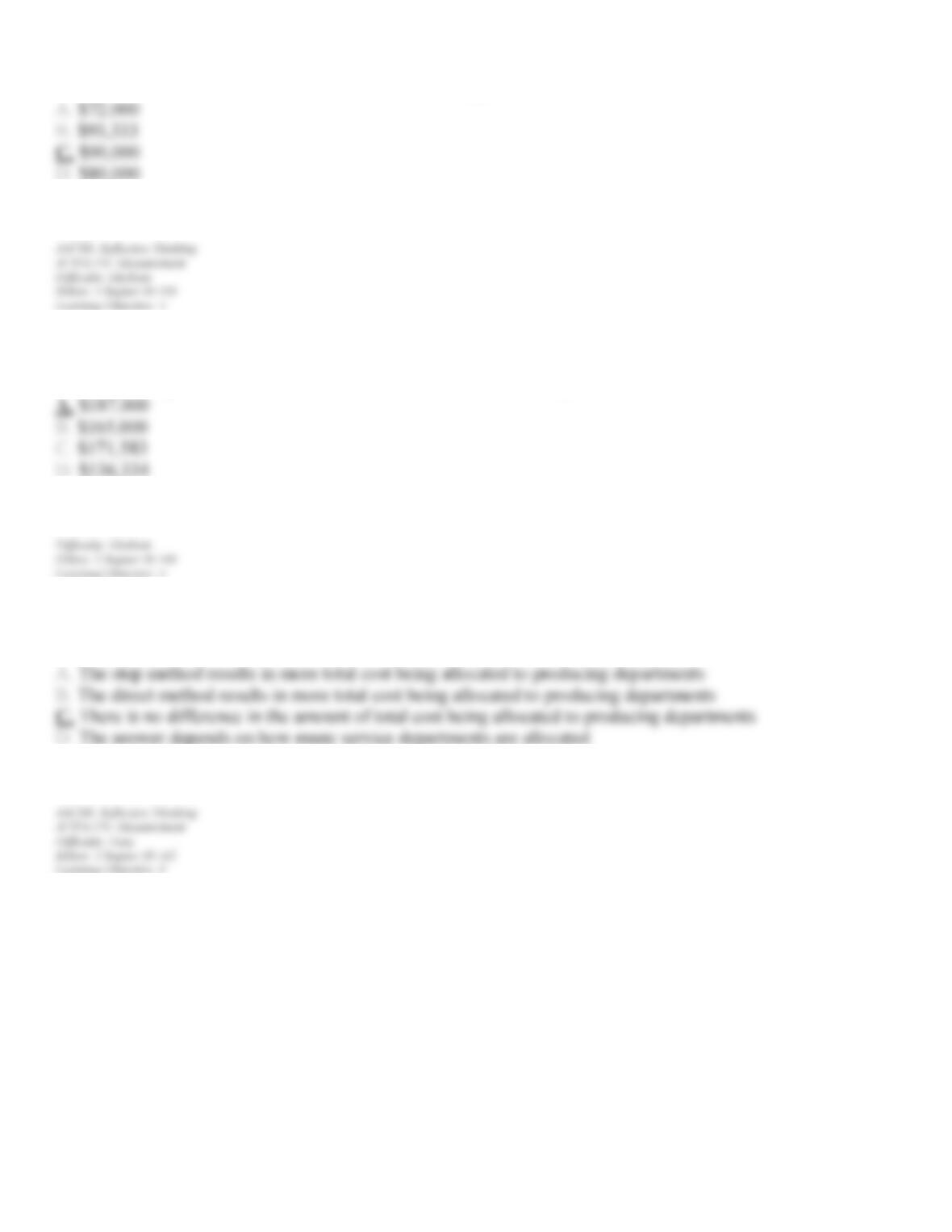
59. What is the amount of supervision that would be allocated to the machining department, assuming Hampton
uses the direct–method to allocate the costs of service departments?
60. What is the total amount of service department costs that would be allocated to the assembly department,
assuming Hampton uses the direct-method to allocate the service department costs?
61. What will be the difference in the total service department costs allocated between the step–method and the
direct-method?
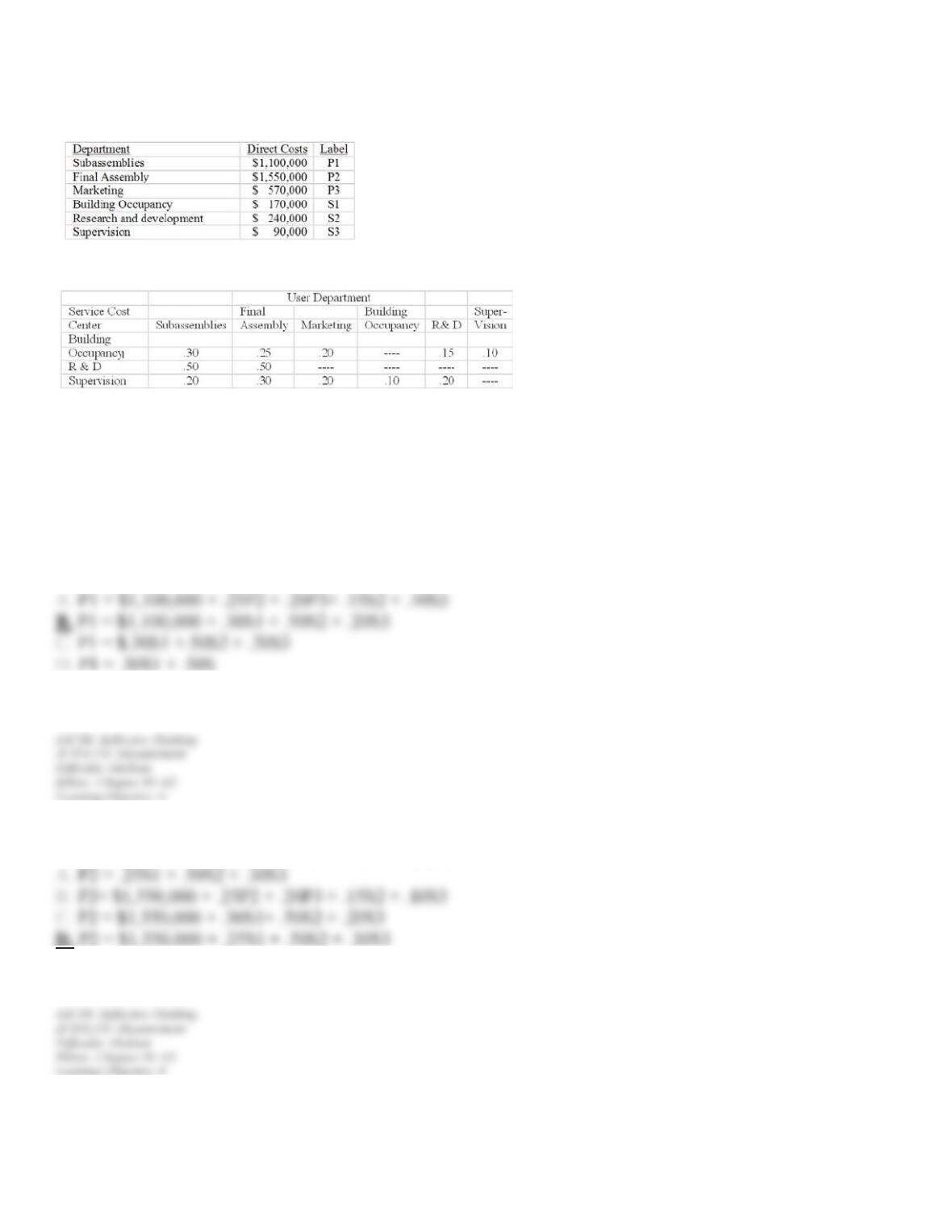
Use the following to answer questions 62-66:
The following costs were incurred in three operating departments and three service departments in Gagetown
Molding Company:
The use of services by other departments is as follows:
The following questions refer to a system of simultaneous linear equations that allocate costs using the
reciprocal method. (Appendix)
Hilton – Chapter 10
62. The equation for department P1 (subassemblies) is
63. The equation for department P2 (final assembly) is:
64. The equation for Department P3 (marketing) is:
65. The equation for Department S1 (Building occupancy) is:
66. The equation for Department S2 (Research and Development) is:
67. The equation for Department S3 (Supervision) is: