Chapter 10 Estimating Risk and Return Answer Key
Multiple Choice Questions
1.
Which of the following is a true statement?
A.
The risk and return that a firm experienced in the past is also the risk level for its
future.
Firms can quite possibly change their stocks’ risk level by substantially changing their
business.
2.
Which of the following is the average of the possible returns weighted by the likelihood of
those returns occurring?
A.
Efficient return
3.
Which of these is the set of probabilities for all possible occurrences?
A.
Probability
Probability distribution
Stock market bubble
Market probabilities
Expected return

4.
Which of the following is typically considered the return on U.S. government bonds and
bills and equals the real interest plus the expected inflation premium?
A.
Required return
5.
Which of the following is the reward investors require for taking risk?
A.
Required return
Risk-free rate
Risk premium
Market risk premium
Risk-free rate
Risk premium
Market risk premium
6.
Which of these is the reward for taking systematic stock market risk?
A.
Required return
7.
Which of the following is a model that includes an equation that relates a stock’s required
return to an appropriate risk premium?
Risk-free rate
Risk premium
8.
Which of the following is the asset pricing theory based on a beta, a measure of market
risk?
9.
In theory, which of these is a combination of securities that places the portfolio on the
efficient frontier and on a line tangent from the risk-free rate?
10.
Which of the following is the use of debt to increase an investment position?
11.
Which of these is the line on a graph of return and risk (standard deviation) from the risk–
free rate through the market portfolio?
12.
Which of these is a measure of the sensitivity of a stock or portfolio to market risk?
13.
Which of these is similar to the Capital Market Line, except that risk is characterized by
beta instead of standard deviation?
A.
Market risk line
Probability market line
A.
Behavioral finance
14.
Which of these is the measurement of risk for a collection of stocks for an investor?
A.
Beta
15.
Which of the following is NOT a necessary condition for an efficient market?
A.
Many buyers and sellers
No prohibitively high barriers to entry
Free and readily available information available to all participants
No trading or transaction costs
Efficient market
Expected return
16.
Which of the following are the stocks of small companies that are priced below $1 per
share?
A.
Bargain stocks
17.
Which of these is a theory that describes the types of information that are reflected in
current stock prices?
A.
Asset pricing
Behavioral finance
Efficient market hypothesis
Hedge fund stocks
Penny stocks
18.
Which of the following is data that includes past stock prices and volume, financial
statements, corporate news, analyst opinions, etc.?
A.
Audited financial statements
19.
Which of these refers to something that has not been released to the public, but is known
by few individuals, likely company insiders?
A.
Audited financial statements
Restricted stock
Privately held information
Generally accepted accounting principles
Privately held information
Public information
20.
Investor enthusiasm causes an inflated bull market that drives prices too high, ending in a
dramatic collapse in prices is known as:
A.
behavior finance.
21.
The study of the cognitive processes and biases associated with making financial and
economic decisions is known as:
A.
asset pricing model.
behavioral finance.
efficient market.
privately held information.
stock market bubble.
22.
Shares of stock issued to employees that have limitations on when they can be sold are
known as:
A.
executive stock options.
23.
Special rights given to some employees to buy a specific number of shares of the company
stock at a fixed price during a specific period of time are known as:
executive stock options.
privately held information.
restricted stock.
24.
The constant growth model assumes which of the following?
25.
Expected Return Compute the expected return given these three economic states, their
likelihoods, and the potential returns:
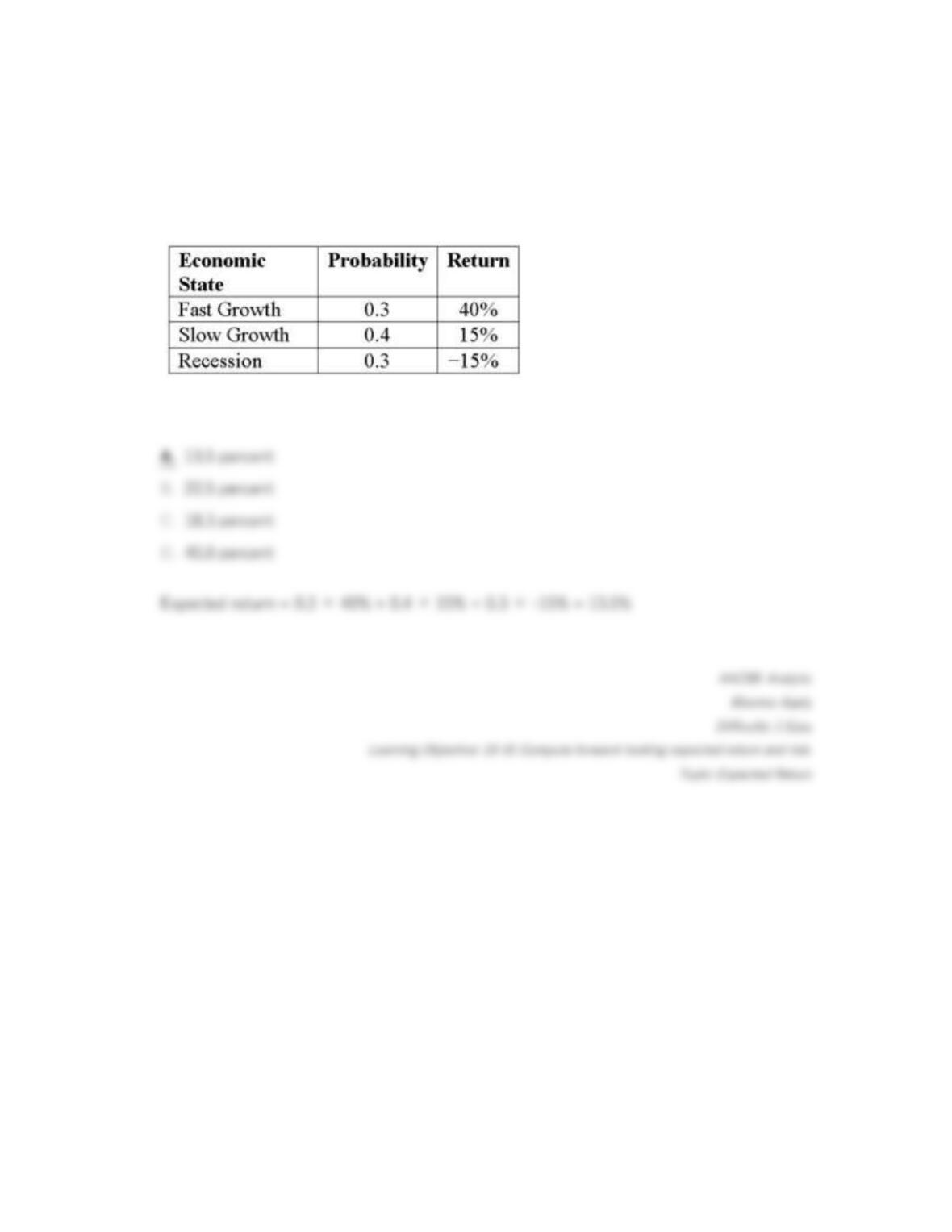
Topic: Expected Return
26.
Expected Return Compute the expected return given these three economic states, their
likelihoods, and the potential returns:
27.
Required Return If the risk-free rate is 8 percent and the market risk premium is 2
percent, what is the required return for the market?
28.
Required Return If the risk-free rate is 10 percent and the market risk premium is 4
percent, what is the required return for the market?
29.
Risk Premium The annual return on the S&P 500 Index was 12.4 percent. The annual T–
bill yield during the same period was 5.7 percent. What was the market risk premium
during that year?
30.
Risk Premium The annual return on the S&P 500 Index was 18.1 percent. The annual T–
bill yield during the same period was 6.2 percent. What was the market risk premium
during that year?
31.
CAPM Required Return A company has a beta of 0.50. If the market return is expected to
be 12 percent and the risk-free rate is 5 percent, what is the company’s required return?
32.
CAPM Required Return A company has a beta of 3.25. If the market return is expected to
be 14 percent and the risk-free rate is 5.5 percent, what is the company’s required return?
Blooms: Apply
Difficulty: 1 Easy
Learning Objective: 10-03 Know and apply the Capital Asset Pricing Model (CAPM).
Topic: CAPM
33.
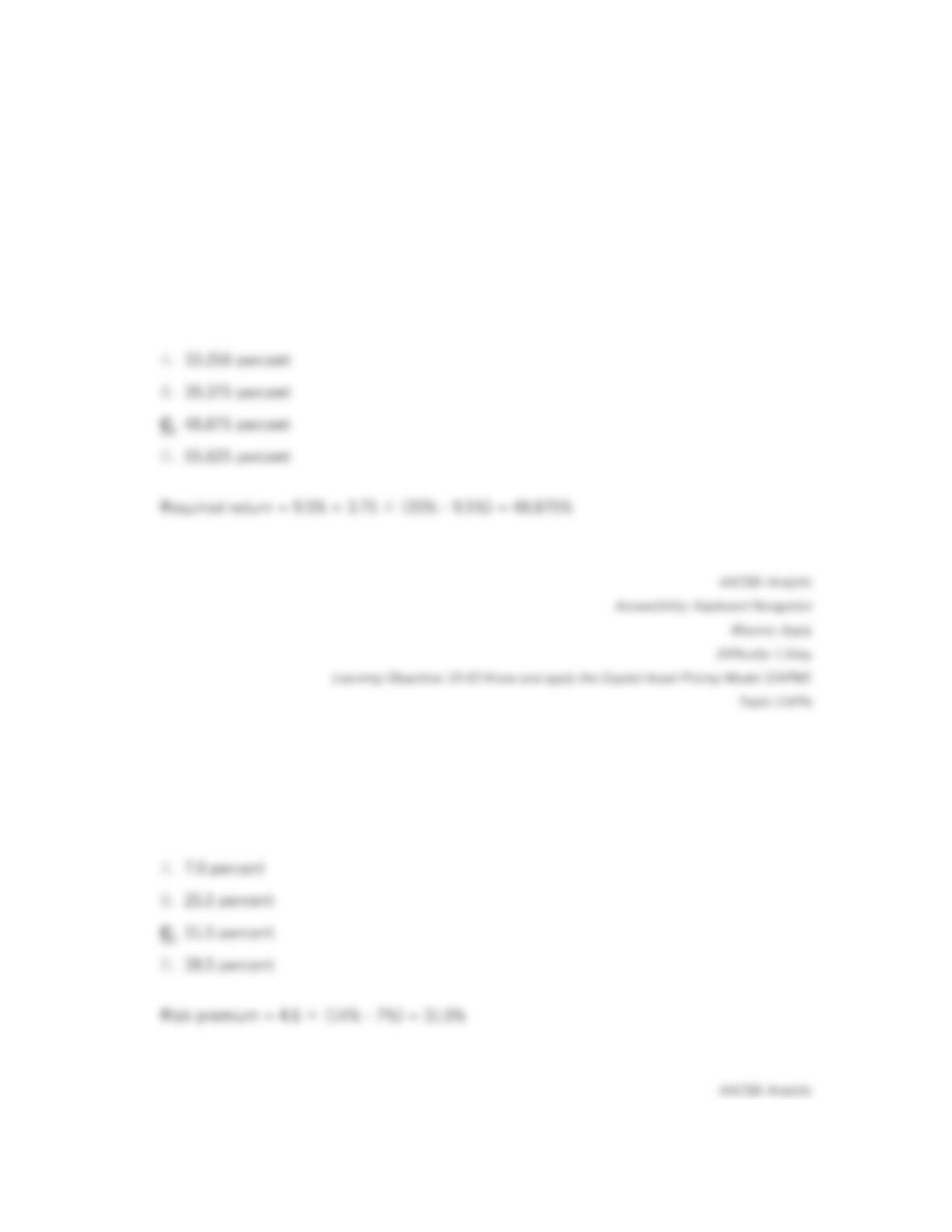
CAPM Required Return A company has a beta of 3.75. If the market return is expected to
be 20 percent and the risk-free rate is 9.5 percent, what is the company’s required return?
34.
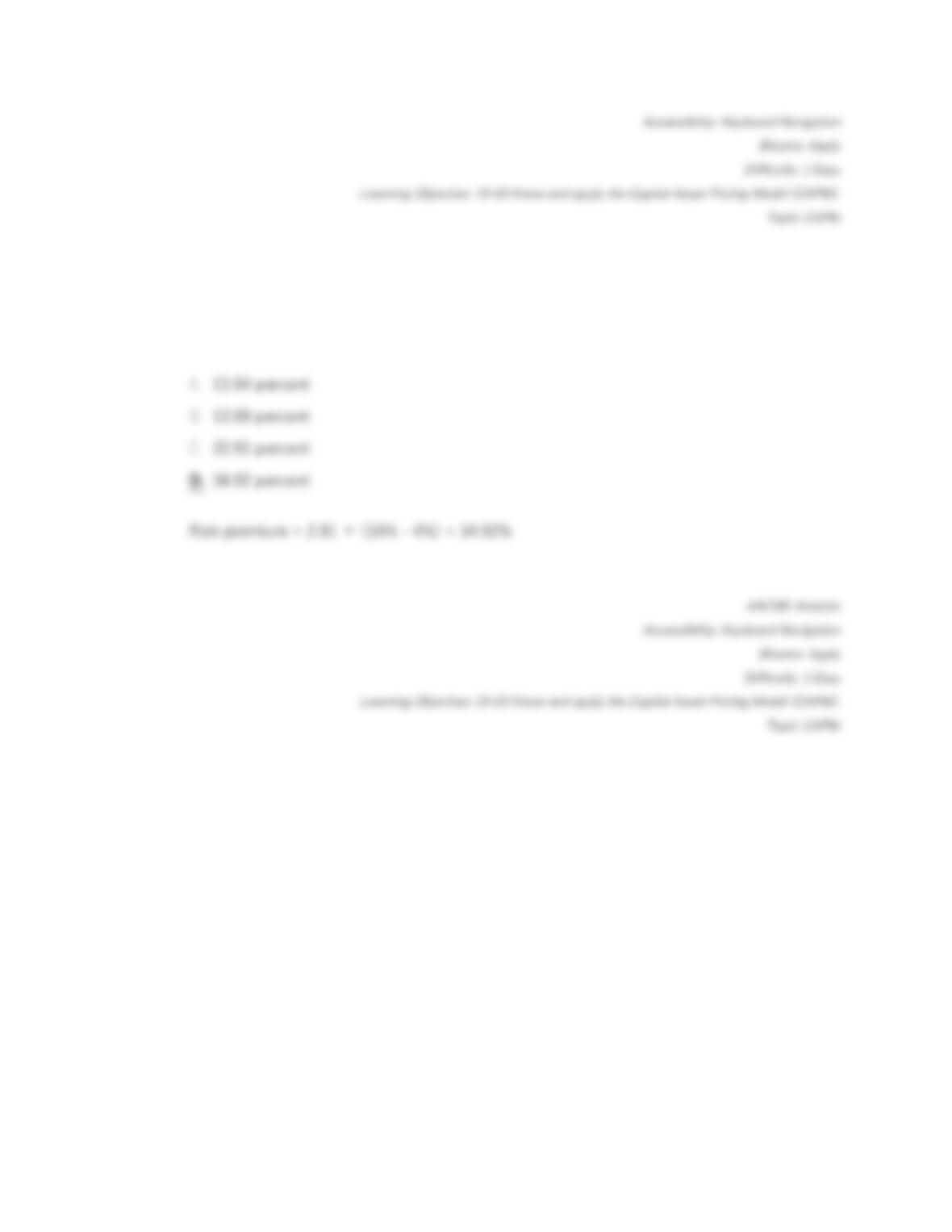
Company Risk Premium A company has a beta of 4.5. If the market return is expected to
be 14 percent and the risk-free rate is 7 percent, what is the company’s risk premium?
Difficulty: 1 Easy
35.
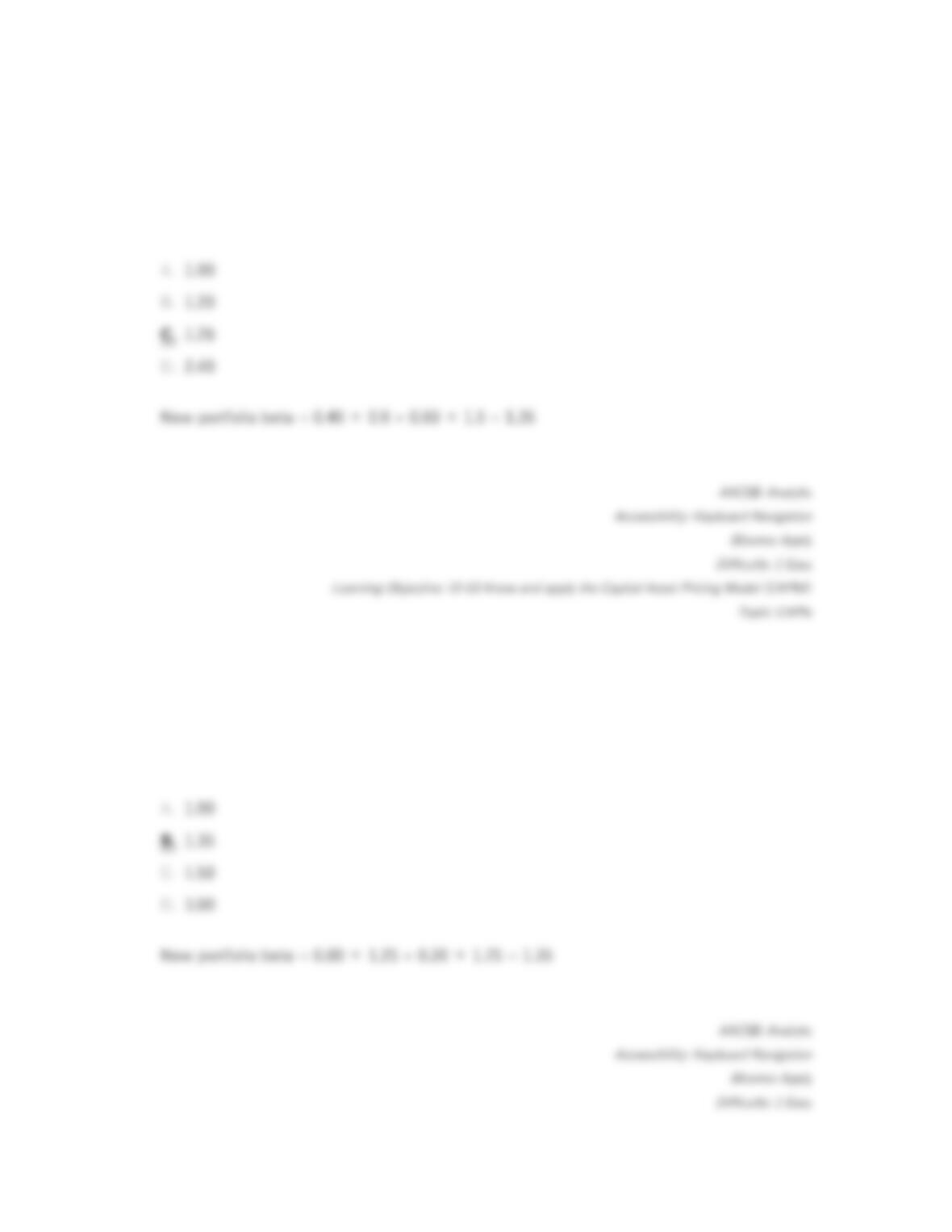
Company Risk Premium A company has a beta of 2.91. If the market return is expected to
be 16 percent and the risk-free rate is 4 percent, what is the company’s risk premium?
36.
Portfolio Beta You have a portfolio with a beta of 0.9. What will be the new portfolio beta
if you keep 40 percent of your money in the old portfolio and 60 percent in a stock with a
beta of 1.5?
37.
Portfolio Beta You have a portfolio with a beta of 1.25. What will be the new portfolio beta
if you keep 80 percent of your money in the old portfolio and 20 percent in a stock with a
beta of 1.75?