463
Chapter 10—Liabilities
Multiple
Choice
Learning
Goal(s)
Level of
Difficulty
AACSB
Tag
AICPA
Tag
Multiple
Choice
Learning
Goal
(s)
Level of
Difficulty
AACSB
Tag
AICPA
Tag
1
1
Moderate
Analytic
Measure
35
2
Moderate
Analytic
Measure
2
1
Moderate
Analytic
Measure
36
2
Moderate
Analytic
Reporting
3
1
Moderate
Analytic
Measure
37
2
Easy
Analytic
Reporting
4
1
Moderate
Analytic
Measure
38
2
Easy
Analytic
Reporting
5
1
Difficult
Analytic
Measure
39
2
Easy
Analytic
Reporting
6
1
Moderate
Analytic
Measure
40
2
Moderate
Analytic
Measure
7
1
Moderate
Analytic
Reporting
41
2
Moderate
Analytic
Measure
8
1
Difficult
Analytic
Measure
42
3
Moderate
Analytic
Reporting
9
1
Moderate
Analytic
Measure
43
3
Moderate
Analytic
Measure
10
1
Moderate
Analytic
Reporting
44
3
Moderate
Analytic
Measure
11
1
Easy
Analytic
Reporting
45
3
Moderate
Analytic
Measure
12
2
Easy
Analytic
Reporting
46
3
Moderate
Analytic
Measure
13
2
Easy
Analytic
Reporting
47
3
Moderate
Analytic
Measure
14
2
Moderate
Analytic
Measure
48
3
Moderate
Analytic
Measure
15
2
Moderate
Analytic
Reporting
49
3
Moderate
Analytic
Measure
16
2
Easy
Analytic
Reporting
50
3
Moderate
Analytic
Measure
17
2
Easy
Analytic
Measure
51
4
Moderate
Analytic
Measure
18
2
Easy
Analytic
Measure
52
4
Difficult
Analytic
Measure
19
2
Easy
Analytic
Measure
53
4
Easy
Analytic
Reporting
20
2
Moderate
Analytic
Measure
54
4
Difficult
Analytic
Reporting
21
2
Easy
Analytic
Measure
55
5
Easy
Analytic
Reporting
22
2
Moderate
Analytic
Measure
56
5
Moderate
Analytic
Reporting
23
2
Moderate
Analytic
Measure
57
5
Moderate
Analytic
Reporting
24
2
Moderate
Analytic
Measure
58
5
Easy
Analytic
Reporting
25
2
Moderate
Analytic
Measure
59
6
Difficult
Analytic
Measure
26
2
Difficult
Analytic
Measure
60
6
Moderate
Analytic
Risk
27
2
Moderate
Analytic
Measure
61
6
Easy
Analytic
Risk
28
2
Moderate
Analytic
Measure
62
6
Easy
Analytic
Measure
29
2
Moderate
Analytic
Reporting
63
6
Moderate
Analytic
Measure
30
2
Difficult
Analytic
Reporting
64
6
Difficult
Analytic
Measure
31
2
Moderate
Analytic
Measure
65
6
Difficult
Analytic
Reporting
32
2
Moderate
Analytic
Reporting
66
2, Append
Difficult
Analytic
Measure
33
2
Difficult
Analytic
Reporting
67
2, Append
Difficult
Analytic
Measure
34
2
Difficult
Analytic
Reporting
68
2, Append
Difficult
Analytic
Measure
464 ♦ Chapter 10
True/
False
Learning
Goal(s)
Level of
Difficulty
AACSB
Tag
AICPA
Tag
1
1
Moderate
Analytic
Reporting
2
1
Moderate
Analytic
Reporting
3
1
Moderate
Analytic
Reporting
4
1
Moderate
Analytic
Reporting
5
1
Difficult
Analytic
Reporting
6
1
Difficult
Analytic
Reporting
7
1
Moderate
Analytic
Measure
8
1
Moderate
Analytic
Measure
9
1
Moderate
Analytic
Measure
10
1
Moderate
Analytic
Measure
11
1
Moderate
Analytic
Measure
12
2
Moderate
Analytic
Measure
13
2
Moderate
Analytic
Measure
14
2
Moderate
Analytic
Measure
15
2
Moderate
Analytic
Measure
16
2
Moderate
Analytic
Measure
17
2
Moderate
Analytic
Measure
18
2
Moderate
Analytic
Measure
19
2
Moderate
Analytic
Measure
20
2
Moderate
Analytic
Measure
21
2
Moderate
Analytic
Measure
22
2
Moderate
Analytic
Measure
23
2
Moderate
Analytic
Measure
24
2
Moderate
Analytic
Measure
25
2
Moderate
Analytic
Measure
26
2
Moderate
Analytic
Measure
27
3
Moderate
Analytic
Reporting
28
3
Moderate
Analytic
Reporting
29
3
Moderate
Analytic
Reporting
30
3
Moderate
Analytic
Reporting
31
4
Moderate
Analytic
Reporting
32
5
Moderate
Analytic
Reporting
33
5
Moderate
Analytic
Measure
34
6
Moderate
Analytic
Reporting
Case
Learning
Goal(s)
Level of
Difficulty
AACSB
Tag
AICPA
Tag
1
1,2
Moderate
Analytic
Reporting
2
2
Difficult
Analytic
Reporting
3
6
Difficult
Analytic
Measure
4
6
Difficult
Analytic
Measure
Problem
(s)
Learning
Goal
(s)
Level of
Difficulty
AACSB
Tag
AICPA
Tag
1
1
Difficult
Analytic
Reporting
2
1
Difficult
Analytic
Reporting
3
1
Difficult
Analytic
Measure
4
1
Difficult
Analytic
Measure
5
1
Difficult
Analytic
Measure
6
2
Difficult
Analytic
Measure
7
2
Difficult
Analytic
Measure
8
2
Difficult
Analytic
Measure
9
2
Difficult
Analytic
Measure
10
2
Difficult
Analytic
Measure
11
3
Difficult
Analytic
Reporting
12
4
Difficult
Analytic
Measure
13
6
Difficult
Analytic
Reporting
14
2, Append
Difficult
Analytic
Reporting
15
2, Append
Difficult
Analytic
Reporting
16
2, Append
Difficult
Analytic
Reporting
17
2, Append
Difficult
Analytic
Reporting
Essay
Learning
Goal(s)
Level of
Difficulty
AACSB
Tag
AICPA
Tag
1
1
Moderate
Analytic
Reporting
2
1
Difficult
Analytic
Measure
3
1
Moderate
Analytic
Reporting
4
1
Moderate
Analytic
Reporting
5
2
Moderate
Analytic
Reporting
6
2
Moderate
Analytic
Reporting
7
2
Difficult
Analytic
Reporting
8
2
Difficult
Analytic
Reporting
9
2
Difficult
Analytic
Measure
10
2
Difficult
Analytic
Measure
11
3
Difficult
Analytic
Reporting
12
4,5
Moderate
Analytic
Reporting
13
6
Moderate
Analytic
Measure
14
6
Moderate
Analytic
Measure
Difficulty Ratings
Guide:
Easy
Taken nearly verbatim from the text
Moderate
Using different expression or application of concept
Difficult
Several reasoning steps

Liabilities ♦ 465
MULTIPLE CHOICE
1. For many companies, the largest current liability is
a.
accounts payable
b.
accounts receivable
c.
payroll taxes
d.
bonds payable
2. Which of the following is an activity that does not give rise to an accounts payable?
a.
purchasing merchandise for resale
b.
purchasing goods or services used in operations
c.
purchasing stock investments
d.
each of these is correct
3. A company issues a $2,000, 7% note due in 120-days.How much interest will be due at maturity?
(Round answers to two decimal places.)
a.
$46.03
b.
$46.67
c.
$140
d.
cannot be determined from the facts given
4. If a company issues a $10,000, 60-day note for inventory and the seller discounts the note at a rate
of 9%, the seller’s entry will include a __________.
a.
Debit to interest expense for $150
b.
Debit to merchandise inventory for $10,000
c.
Credit to note payable for $9,850
d.
Debit to note payable for $10,000
5. A company issues a 60-day note for $100,000 to a supplier for inventory. If the supplier discounts
the note at 6%, what journal entry would be made upon issuance of the note?
a.
Merchandise Inventory 94,000
Interest Expense 6,000
Notes Payable 100,000
b.
Merchandise Inventory 99,000
Notes Payable 99,000
c.
Merchandise Inventory 100,000
Notes Payable 100,000
d.
Merchandise Inventory 99,000
Interest Expense 1,000
Notes Payable 100,000

466 ♦ Chapter 10
6. If a company issues a $5,000, 90-day note for inventory and the seller discounts the note at a rate
of 12%, the inventory buyer’s entry on the date of payment will include a __________.
a.
Debit to interest expense for $150
b.
Credit to cash for $4,850
c.
Credit to cash for $5,000
d.
Debit to note payable for $4,850
7. Which of the following taxes are NOT withheld from employees?
a.
FICA tax
b.
Federal unemployment tax
c.
State income tax
d.
each of these is correct are withheld
8. A company has a total payroll of $315,000 which is subject to a 7% FICA tax. Assuming $85,000
was subject to state and federal unemployment tax rates of 4% and .8% respectively, the entry to
accrue payroll taxes would include a __________.
a.
Debit to payroll tax expense for $47,170
b.
Debit to FICA tax expense for $22,050
c.
Credit to SUTA tax payable for $12,600
d.
Credit to FUTA tax payable for $680
9. An employee earns $18 per hour and 1 1/2 times that rate for all hours worked in excess of 40
hours per week. Assume that the employee works 46 hours during the week and the FICA tax rate
is 7% and federal income tax withheld is $185. The employee’s net pay is __________.
a.
$635.26
b.
$586.04
c.
$882.00
d.
None of the above
10. All of the following are payroll taxes incurred by employers except __________.
a.
FICA tax
b.
Federal income tax payable
c.
State unemployment tax payable
d.
each of these is correct are examples of payroll taxes

Liabilities ♦ 467
11. All of the following are examples of fringe benefits except __________.
a.
Pension plans
b.
Medical benefits
c.
Compensated absences
d.
each of these is correct are fringe benefits
12. Bonds with maturities spread over several years are referred to as __________.
a.
Convertible bonds
b.
Debenture bonds
c.
Serial bonds
d.
Callable bonds
13. Callable bonds may be __________.
a.
Retired early at the option of the issuer
b.
Retired early at the option of the investor
c.
Converted into common stock
d.
Called in by either the issuer or investor if market rates decline
14. If a bond is issued at 105, the market rate of interest was __________.
a.
Lower than the contract rate
b.
Higher than the contract rate
c.
Equal to the market rate
d.
Cannot be determined from the facts given
15. Bonds payable are usually classified under __________.
a.
Current liabilities
b.
Contingent liabilities
c.
Long-term liabilities
d.
Only in the notes to the financial statements
16. Because of the ability to earn interest,
a.
money received in the future is worth more than it is today.
b.
money received in the future is not worth as much as it is today.
c.
money received in the future is worth the same as it is today.
d.
money is a fringe benefit.

468 ♦ Chapter 10
17. A(n) _____________ is a series of cash payments or receipts spaced equally in time.
a.
present value
b.
discount
c.
annuity
d.
premium
18. The periodic interest rate to be paid on the bonds, which is identified in the bond indenture, is
termed __________.
a.
Discount rate
b.
Contract rate
c.
Effective rate
d.
Yield rate
19. If the contract rate equals the market rate, the bonds will sell __________.
a.
Above face amount
b.
Below face amount
c.
At face amount
d.
Cannot be determined from the facts given
20. If the market rate is lower than the contract rate, the bonds will sell at __________.
a.
A premium
b.
A discount
c.
Face amount
d.
Cannot be determined from the facts given
21. If the contract rate is lower than the market rate, the bonds will sell at __________.
a.
A discount
b.
A premium
c.
Face amount
d.
Cannot be determined from facts given
22. A company issues $500,000 10% bonds due in 10 years for $480,000, the company uses the
straight-line method of amortization of the discount. The entry to record semiannual interest will
include a __________.
a.
Debit to premium on bonds payable for $2,000
b.
Credit to discount on bonds payable for $2,000
c.
Debit to interest expense for $26,000
d.
Debit to interest expense for $25,000

Liabilities ♦ 469
23. A company issues $200,000, 8% bonds due in 5 years for $208,000, the company uses the
straight-line method of amortization of the premium. The entry to record semi-annual interest will
include a __________.
a.
Debit to premium on bonds payable for $1,600
b.
Debit interest expense for $7,200
c.
Debit interest expense for $17,600
d.
Credit to premium on bonds payable for $1,600
24. A company issued $100,000, 9% bonds due in 10 years for $97,000, the company uses the
straight-line method of amortization of the discount. The entry to record the semi-annual interest
will include a __________.
a.
Credit to cash for $4,650
b.
Credit to discount on bonds payable for $300
c.
Credit to discount on bonds payable for $150
d.
Debit to interest expense for $4,500
25. A company issues $800,000, 10% bonds due in 15 years for $809,000, the company uses the
straight-line method of amortization of the premium. The entry to record the semi-annual interest
will include a __________.
a.
Debit to premium on bonds payable for $300
b.
Debit to interest expense for $80,000
c.
Debit to interest expense for $40,000
d.
Credit to cash for $80,000
26. If a company purchased $500,000 of bonds at 98 plus accrued interest of $2,500 and pays broker’s
commissions of $200, the amount debited to Investment in Bonds would be __________.
a.
$492,700
b.
$500,200
c.
$490,200
d.
$490,000
27. If a company issues $500,000, 6% bonds for $490,000, the entry will include a __________.
a.
Debit to cash for $500,000
b.
Credit to bonds payable for $490,000
c.
Debit to interest expense for $10,000
d.
Debit to discount on bonds payable for $10,000

470 ♦ Chapter 10
28. The method of amortizing and bond discount or premium that is required by generally accepted
accounting principles is
a.
the effective interest rate method
b.
the present value method
c.
the straight-line method
d.
the declining balance method
29. Amortizing a discount on bonds payable will __________.
a.
Have no effect on interest expense
b.
Increase interest expense
c.
Decrease interest expense
d.
Increase or decrease interest expense depending on interest rates
30. If a company fails to amortize a discount on bonds payable __________.
a.
Interest expense will be overstated
b.
Interest expense will be understated
c.
Liabilities will be understated
d.
Both b and c
31. Amortizing a premium on bonds payable will __________.
a.
Have no effect on interest expense
b.
Increase interest expense
c.
Decrease interest expense
d.
Increase or decrease interest expense depending on interest rates
32. Bonds which can be redeemed by the issuing company prior to the maturity date are termed
__________.
a.
Zero-coupon bonds
b.
Debenture bonds
c.
Callable bonds
d.
Term bonds
33. Amortizing a premium on bonds payable __________.
a.
Has no effect on cash flows
b.
Increases cash flows
c.
Decreases cash flows
d.
Can increase or decrease cash flows depending upon interest rates

Liabilities ♦ 471
34. If a company fails to amortize a premium on bonds payable __________.
a.
Net income and liabilities will be understated
b.
Net income and liabilities will be overstated
c.
Net income will be understated and liabilities will be overstated
d.
Net income will be overstated and liabilities will be understated
35. If a company issues $2 million, 8% bonds for $2,056,000, the entry will include a __________.
a.
Debit to cash for $2,000,000
b.
Credit to bonds payable for $2,056,000
c.
Debit to a discount on bonds payable for $56,000
d.
Credit to a premium on bonds payable for $56,000
36. Amortizing a discount on bonds payable __________.
a.
Has no effect on cash flows
b.
Increases cash flows
c.
Decreases cash flows
d.
Can increase or decrease cash flows depending upon interest rates
37. When a company issues zero-coupon bonds __________.
a.
No interest expense is recorded
b.
Interest expense is recorded on the date of issue
c.
Interest expense is recorded on the maturity date
d.
Interest expense is recorded over the life of the bonds
38. If the carrying amount of bonds is greater than the redemption price, the company would record a
__________.
a.
Gain
b.
Loss
c.
Gain or loss depending upon interest rates
d.
Cannot be determined from the facts given
39. If the redemption price is greater than the carrying amount of the bonds, the company would
record a __________.
a.
Gain
b.
Loss
c.
Gain or loss depending upon interest rates
d.
Cannot be determined from the facts given

472 ♦ Chapter 10
40. A company called a $400,000, 8% bond issue at 102. If the unamortized premium is $1,000, the
entry will include a __________.
a.
Debit to bonds payable for $408,000
b.
Debit to loss on bond redemption of $8,000
c.
Credit to gain on bond redemption for $8,000
d.
Debit to premium on bonds payable for $1,000
41. A company called a $500,000, 7% bond issue at 98. If the unamortized discount is $4,000, the
entry will include a __________.
a.
Credit to gain on bond redemption for $6,000
b.
Debit to loss on bond redemption for $10,000
c.
Credit to gain on bond redemption for $10,000
d.
Debit to loss on bond redemption for $4,000
42. When cash is received from a transaction prior to recording revenue, the transaction creates a(n)
a.
deferred expense
b.
accrued revenue
c.
accrued expense
d.
deferred revenue
43. Which of the following is NOT an example of a deferred revenue?
a.
airline tickets
b.
college tuition
c.
magazine subscriptions
d.
inventory
44. When an expense is recorded prior to the related cash payment, a __________ is created.
a.
deferred revenue
b.
accrued revenue
c.
accrued expense
d.
deferred expense
45. A corporation has $500,000 income before income taxes. Assume a 40% tax rate, and $200,000
taxable income. What is the amount of deferred taxes?
a.
$80,000
b.
$200,000
c.
$120,000
d.
zero

Liabilities ♦ 473
46. The income tax reported in the income tax expense is the total tax for a corporation. Income tax
payable is the amount to be remitted to the IRS. Which other account is used for timing
differences?
a.
accrued income tax payable
b.
cash
c.
none, these two accounts balance each other
d.
deferred income tax expense
47. If income tax expense is $100,000 and income tax payable is $60,000, how much is the deferred
income tax expense?
a.
$60,000
b.
$100,000
c.
$160,000
d.
$40,000
48. The balance in the deferred income tax expense account is reported as what type of account at the
end of the year?
a.
asset
b.
liability
c.
stockholders’ equity
d.
revenue
49. Amounts in deferred income tax expense will be transferred to which account in future years when
timing differences reverse?
a.
income tax expense
b.
income tax payable
c.
both a and b
d.
neither a nor b, it goes away over time
50. A balance in deferred tax expense due within three years would be reported as what on the balance
sheet?
a.
income tax payable
b.
current liability
c.
long term liability
d.
income tax expense

474 ♦ Chapter 10
51. If a company sells a product with a warranty for repairing defects, it should __________.
a.
Record warranty expense as incurred
b.
Estimate warranty expense based on past experience
c.
Disclose the warranty obligation in the notes to the financial statement
d.
Record the expense in future years when claims are made
52. A company offers customers a one year warranty and sales totaled $950,000 for the year. The
estimated product warranty is 2% of sales and the company incurred repair costs of $14,000 this
year. Which entry would be made to record accrued product warranty.
a.
Warranty Expense 14,000
Cash, Supplies, etc. 14,000
b.
Warranty Expense 14,000
Warranty Payable 14,000
c.
Warranty Expense 19,000
Cash, Supplies, etc. 19,000
d.
Warranty Expense 19,000
Warranty Payable 19,000
53. Potential obligations that will result in liabilities if certain events occur in the future are termed
__________.
a.
Current liabilities
b.
Estimated liabilities
c.
Contingent liabilities
d.
Long-term liabilities
54. If a company fails to estimate product warranty expense __________.
a.
Liabilities will be understated
b.
Net income will be overstated
c.
Expenses will be understated
d.
each of these is correct
55. A contingent liability should be recorded in the accounts if it __________.
a.
Is probable
b.
Reasonably possible
c.
Can be reasonably estimated
d.
Both a and c

Liabilities ♦ 475
56. Which of the following is NOT an example of a liability disclosure placed in the notes to the
financial statements?
a.
prepaid expenses
b.
current maturities of long-term debt
c.
long-term liability disclosures
d.
contingent liabilities
57. Which of the following is NOT an example of a contingent liability disclosed in the notes to the
financial statements?
a.
sales of receivables
b.
deferred taxes
c.
guarantees
d.
environmental matters
58. If a contingent liability is probable and cannot be reasonably estimated, the company should
__________.
a.
Disclose the contingency in the notes to the financial statements
b.
Make an entry to record the expense and liability
c.
Make no entry or note disclosure until next year
d.
None of the above
59. A company’s current assets include $200,000 cash, $400,000 accounts receivable, $800,000
inventory and $200,000 prepaid expenses. If current liabilities are $400,000, what are the current
and quick ratios?
a.
3.5, 1.5
b.
4.0, .5
c.
3.5, .5
d.
4.0, 1.5
60. Which ratio would measure instant debt paying ability?
a.
Current ratio
b.
quick ratio
c.
Debt ratio
d.
Interest coverage ratio
476 ♦ Chapter 10
61. The current ratio measures __________.
a.
Solvency
b.
Profitability
c.
Liquidity
d.
Past performance
62. The number of times the interest charges are earned is calculated as __________.
a.
Net income
Interest expense
b.
Net income + interest expense
Interest expense
c.
Income before income tax + interest expense
Interest expense
d.
Income before income tax + interest revenue
Interest expense
63. The following data were taken from the annual report.
Current
Year
Preceding
Year
Interest expense
$ 84,500
$ 72,800
Income before income tax
$278,000
$267,000
What is the number of times interest charges were earned for the current year? (Round answer to
one decimal place.)
a.
3.3
b.
4.3
c.
4.7
d.
None of the above
64. Which of the following combinations would be viewed as most favorable by long-term creditors?
a.
High number of times interest charges earned and total liabilities to total assets ratios
b.
Low number of times interest charges earned and total liabilities to total assets ratios
c.
High number of times interest charges earned ratio and low total liabilities assets ratio
d.
Low number of times interest charges earned ratio and high total liabilities to total assets
ratio

Liabilities ♦ 477
65. Proceeds from and repayment of long-term debt would appear on the statement of cash flows
under __________.
a.
Operating activities
b.
Investing activities
c.
Financing activity
d.
Would not appear on the statement of cash flows
66. Apex, Inc. issued a $100,000, five-year, 13% bond on January 1, 2006. The effective interest was
11%. Interest is paid semiannually on June 30 and December 31. What are the cash proceeds from
the issuance of the bonds? (Round to the nearest dollar.)
The following are excerpts from the present value tables.
Present Value of $1 at Compound Interest Due in n Periods
n\ i
5.5%
6%
6.5%
11%
12%
13%
1
0.94787
0.94334
0.93897
0.90090
0.89286
0.88496
2
0.89845
0.89000
0.88166
0.81162
0.79719
0.78315
3
0.85161
0.83962
0.82785
0.73119
0.71178
0.69305
4
0.80722
0.79209
0.77732
0.65873
0.63552
0. 61332
5
0.76513
0.74726
0.72988
0.59345
0.56743
0. 54276
6
0.72525
0.70496
0.68533
0.53464
0.50663
0.48032
7
0.68744
0.66506
0.64351
0.48166
0.45235
0.42506
8
0.65160
0.62741
0.60423
0.43393
0.40388
0.37616
9
0. 61763
0.59190
0.56735
0.39092
0.35061
0.33288
10
0.58543
0.55840
0.53273
0.35218
0.32197
0.29459
Present Value of an Ordinary Annuity of $1 per Period
n\ i
5.5%
6%
6.5%
11%
12%
13%
1
0.94787
0.94340
0.93897
0.90090
0.89286
0.88496
2
1.84632
1.83339
1.82063
1.71252
1.69005
1.66810
3
2.69793
2.67301
2.64848
2.44371
2.40183
2.36115
4
3.50515
3.46511
3.42580
3.10245
3.03735
2.97447
5
4.27028
4.21236
4.15568
3.69590
3.60478
3.51723
6
4.99553
4.91732
4.84101
4.23054
4.11141
3.99755
7
5.68297
5.58238
5.48452
4.71220
4.56376
4.42261
8
6.33457
6.20979
6.08875
5.14612
4.96764
4.79677
9
6.95220
6.80169
6.65610
5.53705
5.32825
5.13166
10
7.53763
7.36009
7.18883
5.88923
5.65022
5.42624
Round answers to the nearest whole dollar.
a.
$ 100,000
b.
$ 107,538
c.
$ 165,000
d.
$ 83,129
478 ♦ Chapter 10
67. Apex, Inc. issued a $100,000, five-year, 13% bond on January 1, 2006. The effective interest was
11%. Interest is paid semiannually on June 30 and December 31. What is the interest expense on
June 30, 2006 using the effective interest method? (Round to the nearest dollar.)
The following are excerpts from the present value tables.
Present Value of $1 at Compound Interest Due in n Periods
n\ i
5.5%
6%
6.5%
11%
12%
13%
1
0.94787
0.94334
0.93897
0.90090
0.89286
0.88496
2
0.89845
0.89000
0.88166
0.81162
0.79719
0.78315
3
0.85161
0.83962
0.82785
0.73119
0.71178
0.69305
4
0.80722
0.79209
0.77732
0.65873
0.63552
0. 61332
5
0.76513
0.74726
0.72988
0.59345
0.56743
0. 54276
6
0.72525
0.70496
0.68533
0.53464
0.50663
0.48032
7
0.68744
0.66506
0.64351
0.48166
0.45235
0.42506
8
0.65160
0.62741
0.60423
0.43393
0.40388
0.37616
9
0. 61763
0.59190
0.56735
0.39092
0.35061
0.33288
10
0.58543
0.55840
0.53273
0.35218
0.32197
0.29459
Present Value of an Ordinary Annuity of $1 per Period
n\ i
5.5%
6%
6.5%
11%
12%
13%
1
0.94787
0.94340
0.93897
0.90090
0.89286
0.88496
2
1.84632
1.83339
1.82063
1.71252
1.69005
1.66810
3
2.69793
2.67301
2.64848
2.44371
2.40183
2.36115
4
3.50515
3.46511
3.42580
3.10245
3.03735
2.97447
5
4.27028
4.21236
4.15568
3.69590
3.60478
3.51723
6
4.99553
4.91732
4.84101
4.23054
4.11141
3.99755
7
5.68297
5.58238
5.48452
4.71220
4.56376
4.42261
8
6.33457
6.20979
6.08875
5.14612
4.96764
4.79677
9
6.95220
6.80169
6.65610
5.53705
5.32825
5.13166
10
7.53763
7.36009
7.18883
5.88923
5.65022
5.42624
Round answers to the nearest whole dollar.
a.
$ 6,500
b.
$ 5,915
c.
$ 13,000
d.
none of the above answers is correct
present value of 13%, 5-year, $100,000 bond compounded
semiannually at 11% (100,000 x 0.58543)
present value of semiannual interest payments when interest
is 11% (100,000 x .13 x 1/2)(7.53763)
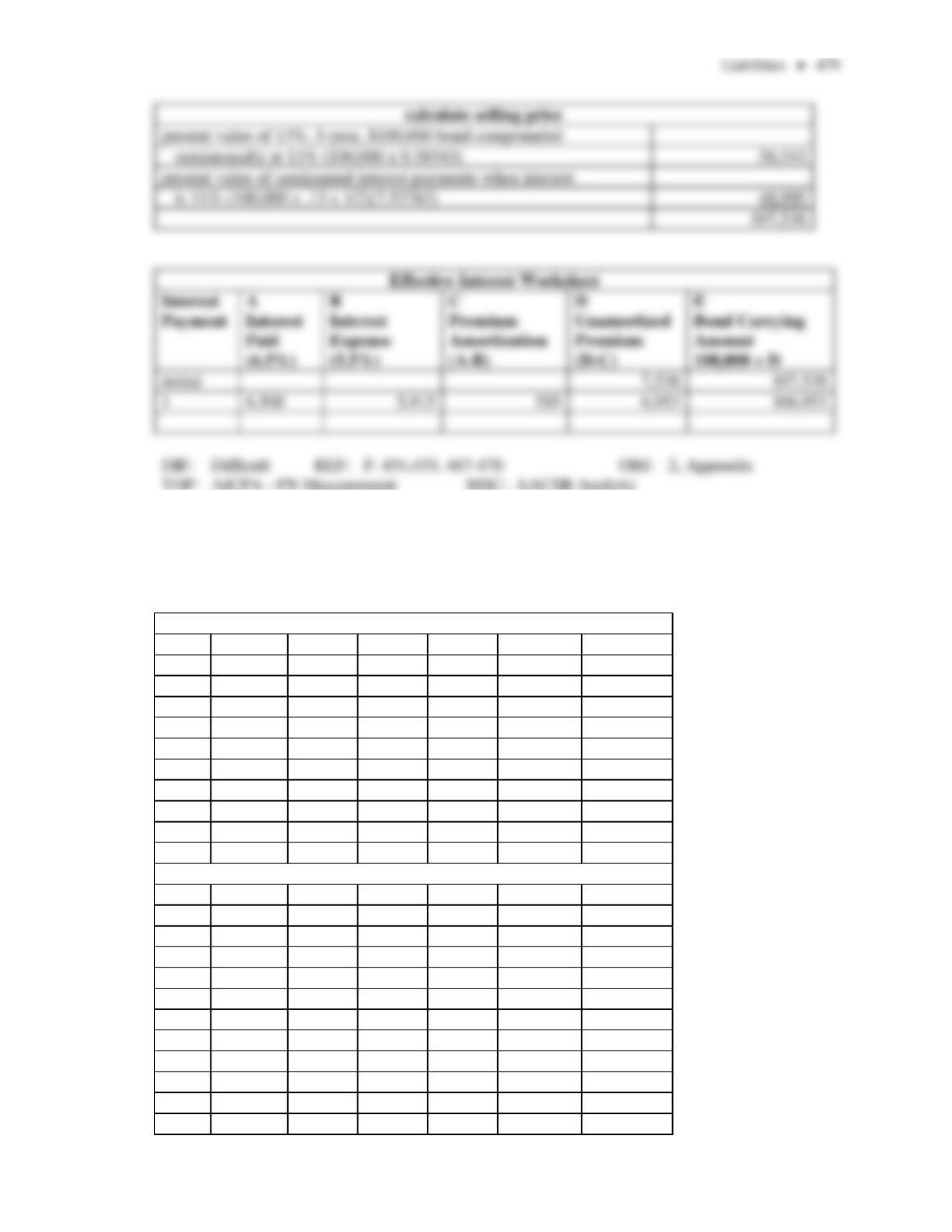
68. Apex, Inc. issued a $100,000, five-year, 12% bond on January 1, 2006. The effective interest was
13%. Interest is paid semiannually on June 30 and December 31. What is the interest expense
recorded on June 30, 2006? (Round to the nearest dollar.)
The following are excerpts from the present value tables.
Present Value of $1 at Compound Interest Due in n Periods
n\ i
5.5%
6%
6.5%
11%
12%
13%
1
0.94787
0.94334
0.93897
0.90090
0.89286
0.88496
2
0.89845
0.89000
0.88166
0.81162
0.79719
0.78315
3
0.85161
0.83962
0.82785
0.73119
0.71178
0.69305
4
0.80722
0.79209
0.77732
0.65873
0.63552
0. 61332
5
0.76513
0.74726
0.72988
0.59345
0.56743
0. 54276
6
0.72525
0.70496
0.68533
0.53464
0.50663
0.48032
7
0.68744
0.66506
0.64351
0.48166
0.45235
0.42506
8
0.65160
0.62741
0.60423
0.43393
0.40388
0.37616
9
0. 61763
0.59190
0.56735
0.39092
0.35061
0.33288
10
0.58543
0.55840
0.53273
0.35218
0.32197
0.29459
Present Value of an Ordinary Annuity of $1 per Period
n\ i
5.5%
6%
6.5%
11%
12%
13%
1
0.94787
0.94340
0.93897
0.90090
0.89286
0.88496
2
1.84632
1.83339
1.82063
1.71252
1.69005
1.66810
3
2.69793
2.67301
2.64848
2.44371
2.40183
2.36115
4
3.50515
3.46511
3.42580
3.10245
3.03735
2.97447
5
4.27028
4.21236
4.15568
3.69590
3.60478
3.51723
6
4.99553
4.91732
4.84101
4.23054
4.11141
3.99755
7
5.68297
5.58238
5.48452
4.71220
4.56376
4.42261
8
6.33457
6.20979
6.08875
5.14612
4.96764
4.79677
9
6.95220
6.80169
6.65610
5.53705
5.32825
5.13166
10
7.53763
7.36009
7.18883
5.88923
5.65022
5.42624
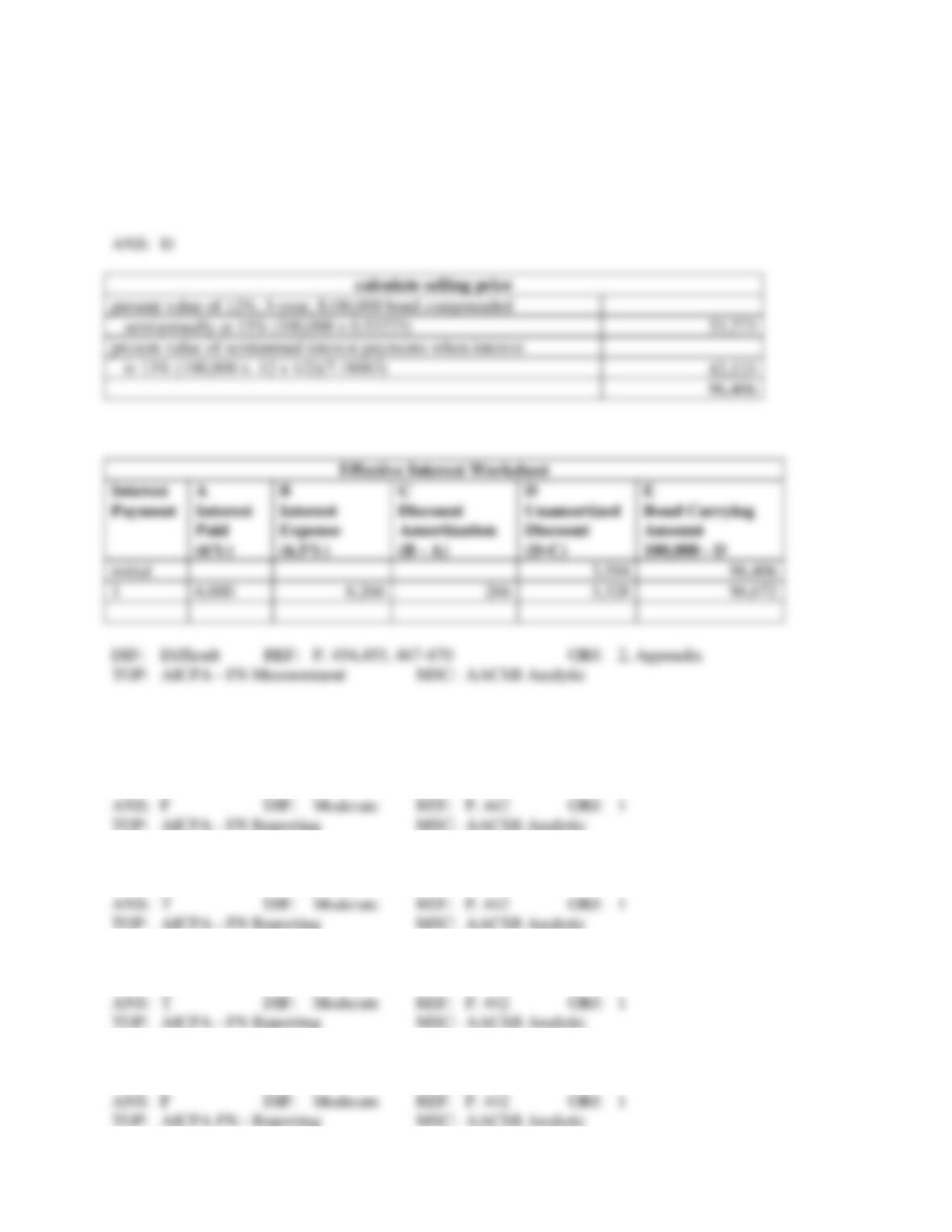
present value of 13%, 5-year, $100,000 bond compounded
semiannually at 11% (100,000 x 0.58543)
present value of semiannual interest payments when interest
is 11% (100,000 x .13 x 1/2)(7.53763)
1
6,500
480 ♦ Chapter 10
Round answers to the nearest whole dollar.
a.
$ 3,594
b.
$ 6,000
c.
$ 6,406
d.
$ 6,266
TRUE/FALSE
1. A debtor is a person making a loan.
2. Long-term liabilities are obligations due for a period of time greater than one year.
3. Current liabilities are obligations that will be paid out of current assets.
4. An account payable results from receiving payment prior to delivering goods or services.

Liabilities ♦ 481
5. Notes payable that become due in less than a year are considered a current liability.
6. The borrower’s proceeds will be less than the face amount of the note if it issues a discounted note.
7. The total earnings of an employee for the period is termed net pay.
8. Employers must match the employee’s contribution for federal unemployment compensation tax.
9. Companies must guard against fraudulent creation and cashing of payroll checks by requiring
employees to take drug tests.
10. Salary and wages are an important fringe benefit to employees.
11. If employees are required to take all their vacation time within one year, the vacation pay payable
is reported as a current liability on the income statement.
12. The price of a bond is compute by adding the present value of the face amount and the future
value of the interest payments.
13. The market rate is expressed as a percentage of the face amount of the bond.
14. The effective rate of interest is synonymous with the market rate of interest.

482 ♦ Chapter 10
15. If the contract rate of interest is 10 percent and the market rate of interest is 11 percent, the bonds
will sell at a premium.
16. If the contract rate is higher than the market rate, the bonds will sell at discount.
17. Interest expense will increase when a discount on bonds payable is amortized.
18. Generally accepted accounting principles require that bond discount amortization use the effective
interest rate method.
19. Amortization of a bond discount allocates a portion of the bond discount to each interest payment
period.
20. A bond premium means that investors are willing to pay less for the bond than its face value.
21. A bond premium must be amortized and reflected in the periodic interest payable.
22. One reason a bond may be redeemed before it matures, would be that the interest rate has
increased.
23. Callable bonds are more risky for investors.