
Exam
Name___________________________________
MULTIPLE CHOICE. Choose the one alternative that best completes the statement or answers the question.
1)
Which of the following functions solves the differential equation: y=y2?
1)
A)
y = ln 1 + x
B)
y = – 1
x2
C)
y =1
3x3
D)
y = – 1
x + 1
Solve the problem.
2)
Suppose the relationship between the price p, of a product and the weekly sales, s, of the product is
given by the differential equation dp
ds = – 1
10 (s + 3). Then
2)
A)
as sales increase, the price increases.
B)
as the price increases the rate of change of the price also increases.
C)
the rate of the decrease of the price is proportional to the sales.
D)
s = 0 is a constant solution to this differential equation.
E)
all of these
3)
The annual sales y (in millions of dollars) of a company satisfy the differential equation
dy
dt = 0.2(10 – y); y(0) = 2. Which of the following is a verbal description of the rate of change of
annual sales.
3)
A)
The annual sales are increasing at a rate proportional to the difference between the annual
sales and an upper limit of $10 million.
B)
The annual sales are decreasing at a rate proportional to the annual sales.
C)
The annual sales are increasing at $0.2 million ($200,000) per year to an upper limit of $5
million.
D)
The annual sales are increasing at a rate proportional to $0.2 million ($200,000) per year.
4)
The annual sales y (in millions of dollars) of a company satisfy the differential equation
dy
dt = 0.2y; y(0) = 2. Which of the following is a verbal description of the rate of change of annual
sales ?
4)
A)
The annual sales are increasing at a rate proportional to the annual sales.
B)
The annual sales are decreasing at a rate proportional to the annual sales.
C)
The annual sales are increasing at $0.2 million ($200,000) per year.
D)
The annual sales are increasing at a rate proportional to $0.2 million ($200,000) per year.
5)
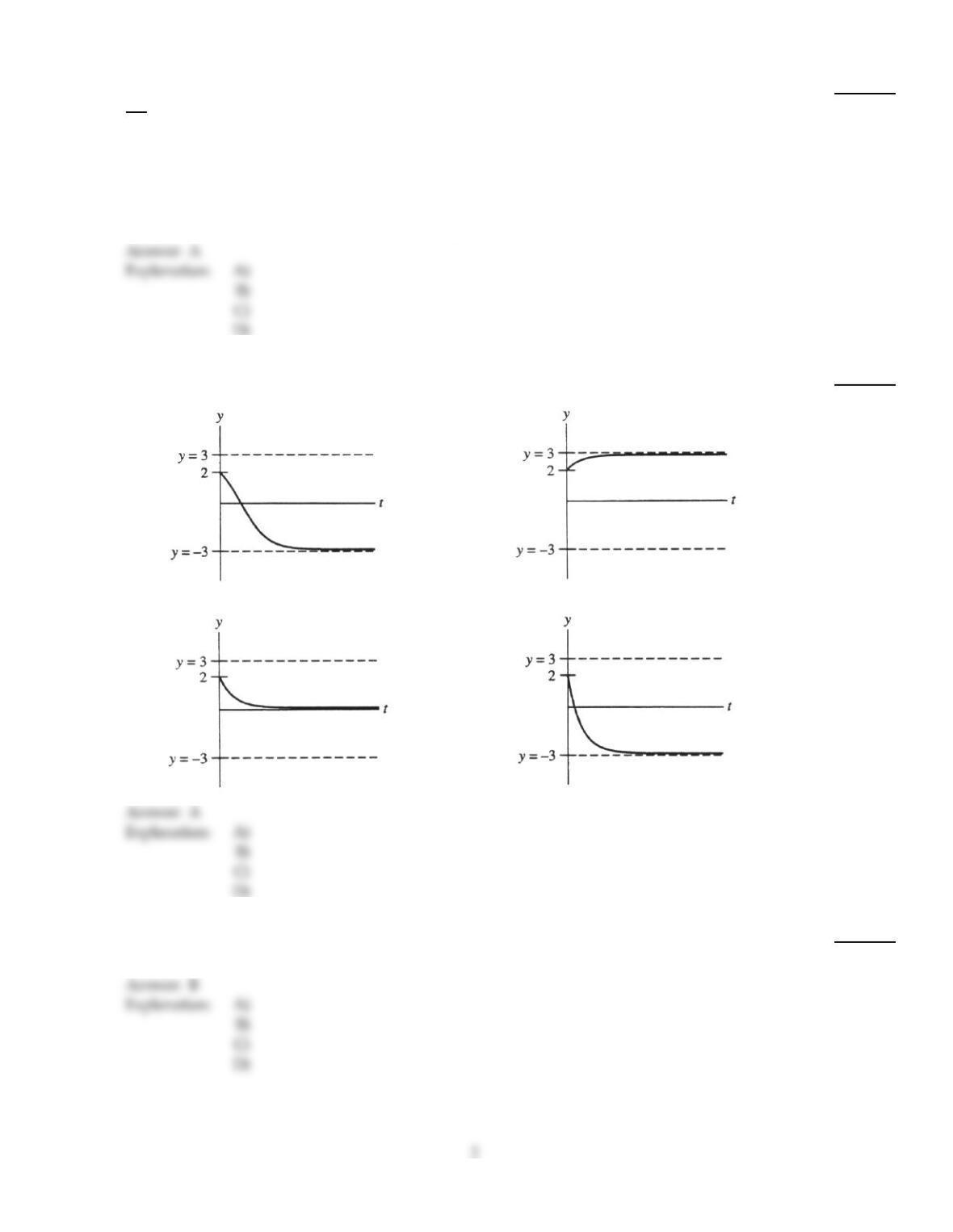
Which of the following is a sketch of the solution of y=y2– 9; y(0) = 2 ?
5)
A)
B)
C)
D)
6)
Which of the following functions solves the differential equation: y= – 6xy?
6)
A)
y =e–x2
B)
y = 7e–3x2
C)
y = e –3x2
D)
y = 7e–x2
7)
Let f(t) be the solution to of y=y2t – y, y(0) = 1. Which of the following statements is true?
7)
A)
f is increasing at the origin.
B)
f‘(1) = 0
C)
f(t) will be a constant solution of the differential equation.
D)
f is decreasing at the origin.
8)
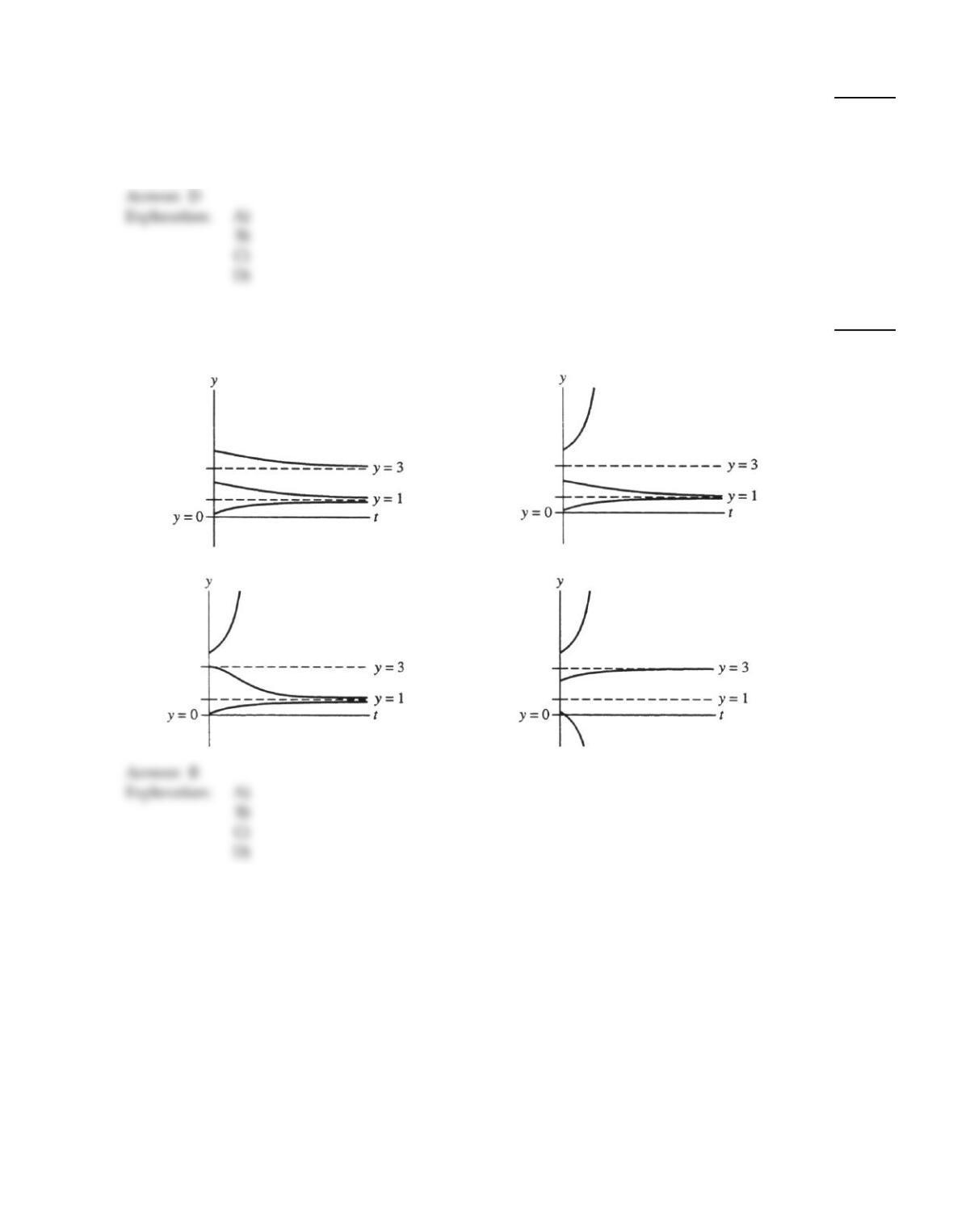
Consider the differential equation y=y2– 4y + 3. Which of the following could be a graph of
solutions to this differential equation?
8)
A)
B)
C)
D)
3
Solve the problem.
9)
Suppose that a substance A is converted to substance B at a rate that is proportional to the cube of
the amount of B present. The amount of A and B together is always constant, say M. If f( t) = y is
the amount of A present at time t, then which of the following differential equation describes the
situation?
9)
A)
y=k(M – y)3; k > 0
B)
y=k(M – y)3; k < 0
C)
y=ky3; k > 0
D)
y=ky3; k < 0
E)
none of these
10)
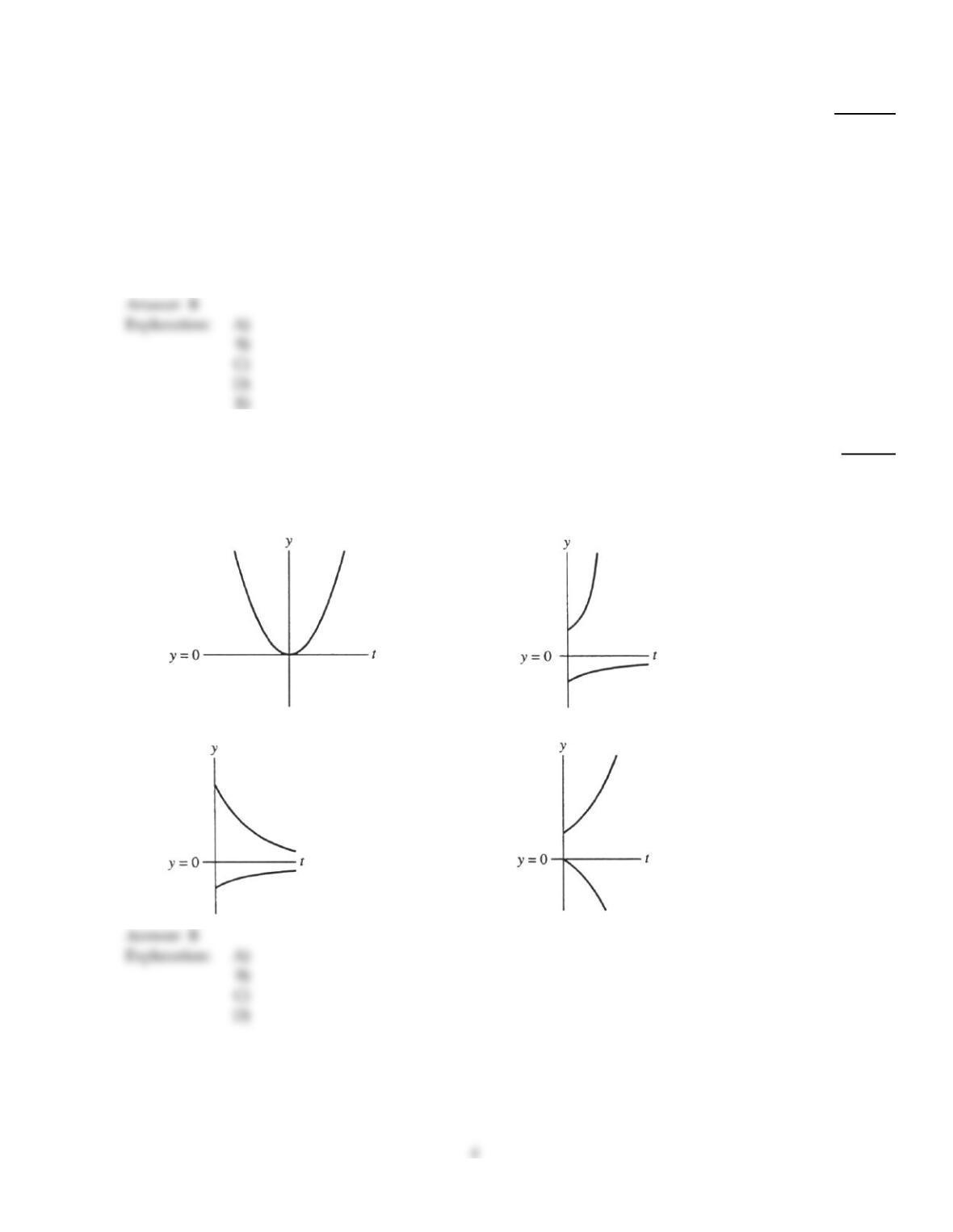
Suppose that an epidemic is spreading at a rate proportional to the square of the infected
population. Let f(t) be the number of infected people at time t, and suppose y = f(t) satisfies a
differential equation y= g(y). Which of the following sets of curves could represent solutions of
y= g(y)? [Hint: First determine the differential equation y= g(y) .]
10)
A)
B)
C)
D)
11)
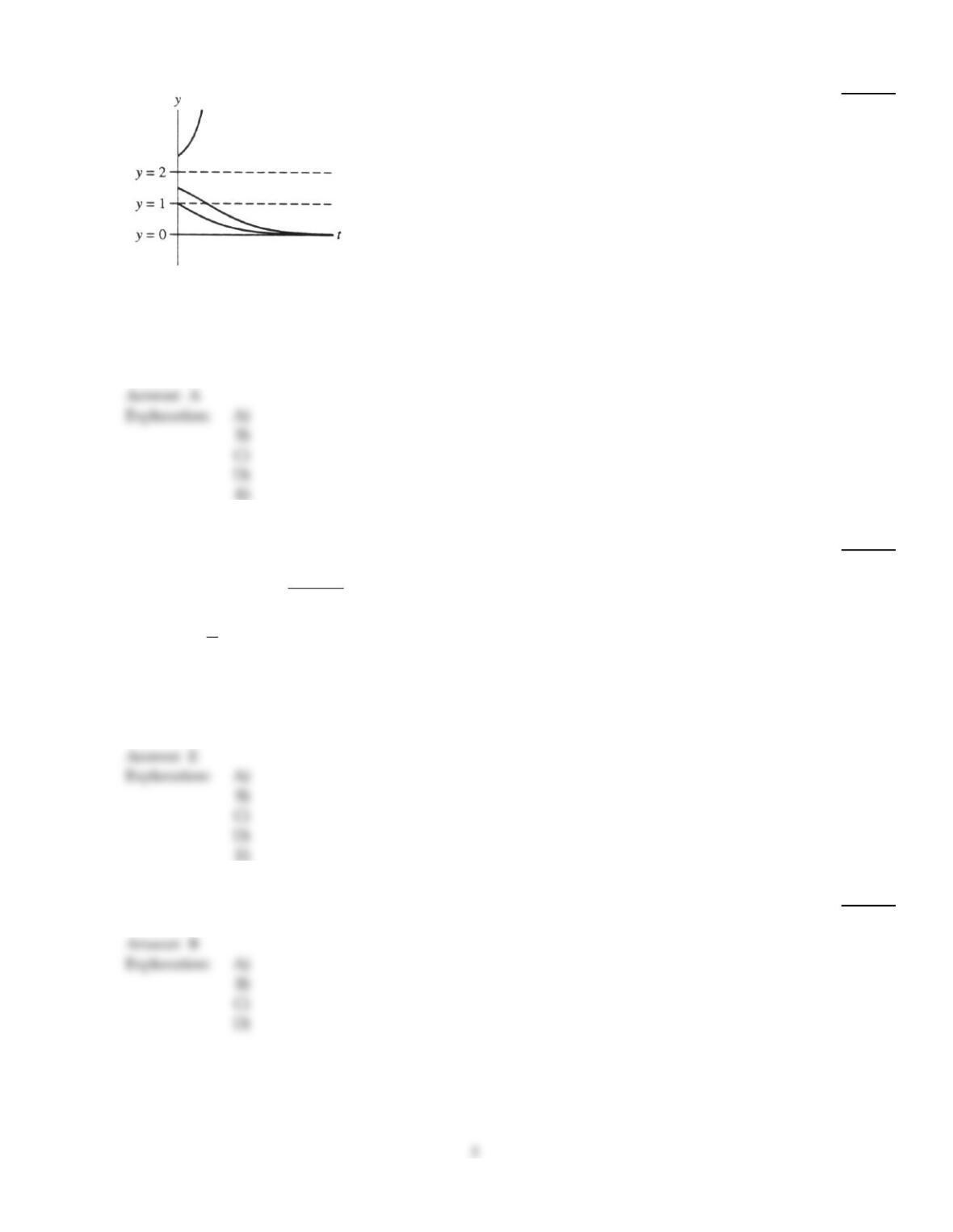
The following could be graphs of solutions to which of the following differential equations?
11)
A)
y= 3y(y – 2)
B)
y=y2+ 2
C)
y= y(y + 2)
D)
y= (y – 2)ey
E)
none of these
12)
Consider the differential equation y’ = y –y2. Which of the following statements is/are true?
12)
A)
The constant function f(t) = 1 is a solution to this differential equation.
B)
The function f(t) =1
(1 +e–t) is a solution to this differential equation with initial condition
y(0) =1
2.
C)
If f(t) is a solution to the differential equation satisfying the initial condition y(0) = 0, then
f(0) = 0.
D)
This differential equation has infinitely many solutions.
E)
All of these statements are true.
13)
Which of the following functions solves the differential equation: y= – 4y?
13)
A)
y = – e–4t
B)
y =e–4t
C)
y = ln 4t
D)
none of these
14)
Which of the following functions solves the differential equation: y=e–2x + 3?
14)
A)
y =e–2x + 3
B)
y =1
2e–2x + 3
C)
y = – 1
2e–2x + 3x
D)
none of these
SHORT ANSWER. Write the word or phrase that best completes each statement or answers the question.
15)
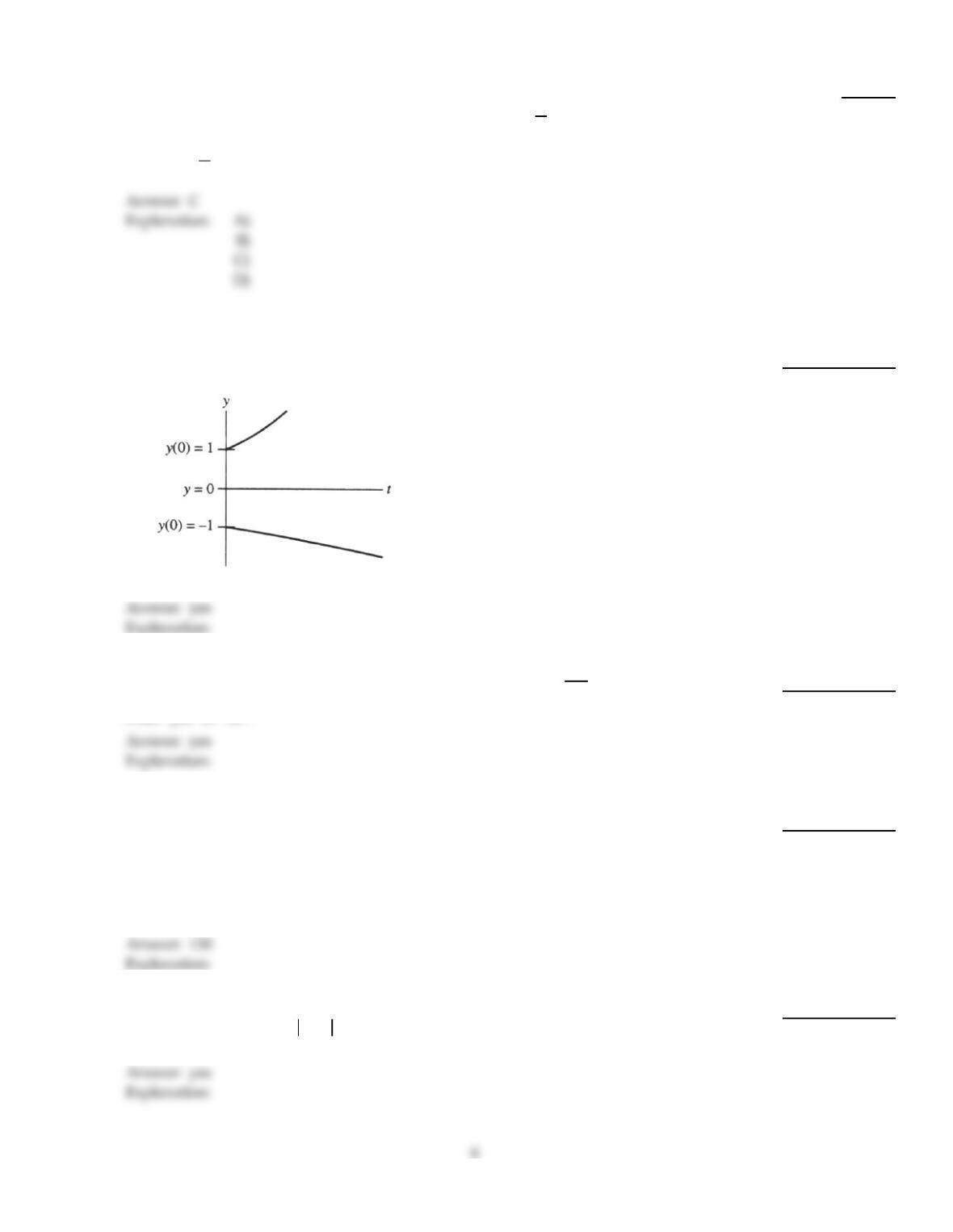
Given y=ey– 1. On a ty–coordinate system sketch the solutions corresponding to the
initial conditions y(0) = – 1 and y(0) = 1. Does this graph represent the situation?
Enter “yes” or “no”.
15)
16)
Given the differential equation: y‘=e2t –1, is this the solution y =e2t
2– t + C?
Enter “yes” or “no”.
16)
Solve the problem.
17)
A patient is receiving a steady infusion of glucose. Let y denote the concentration of
glucose in the blood at time t , measured in milligrams of glucose per 100 cubic centimeters
of blood, and suppose that y satisfies the differential equation y= 48 – 0.4y. What will be
the approximate concentration of glucose in the blood after a long period of time, provided
the glucose infusion is continued at the same rate?
Enter just an integer representing the number of mg glucose per 100cc blood (no units)
17)
18)
Given the differential equation with the given initial condition: y‘=e–y ; y(0)= 0
is this the solution y = ln t + 1 ?
Enter “yes” or “no”.
18)
19)
Combine the terms y and y into the derivative of a product: (3t + 7)y+ 3y = 4t.
Is this derivative correct: d
dt [(3t + 7)y] = 4t?
Enter “yes” or “no”.
19)
20)
Combine the terms y and y into the derivative of a product: y tan t+ y sec2 t = 1.
Is this derivative correct: d
dt [y tan t] = 1?
Enter “yes” or “no”.
20)
21)
Find a constant solution of y= 10 y – 7.
Enter just a reduced fraction of form a
b.
21)
22)
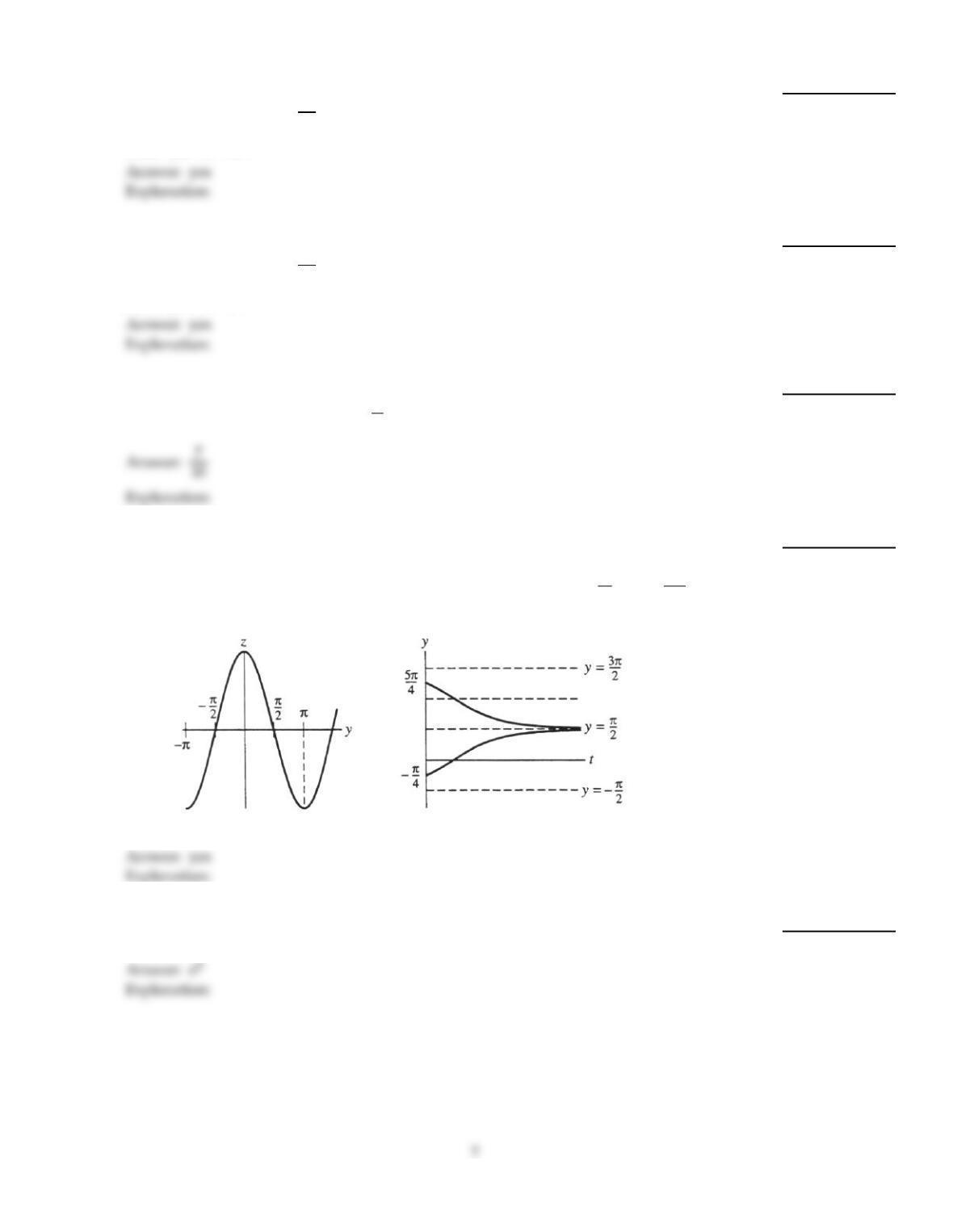
One or more initial conditions are given for the differential equation. Use the qualitative
theory of autonomous differential equations to sketch the graphs of the corresponding
solution. Include a yz–graph as well as a ty–graph. y= cos y; y(0) = –
4; y(0) =5
4
Do these graphs represent the situation?
Enter just “yes” or “no”.
22)
23)
Find f'(1) if f(t) is a solution to the initial value problem: y‘ =e2t – y, y(1) = 0.
Enter just a real number (no approximations).
23)

24)
Given the differential equation: ty’ = ln t, is this the solution y =(ln t)2
2+ C?
Enter “yes” or “no”.
24)
25)
Use Euler’s method with n = 5 to approximate f(1) if y = f(t) satisfies the differential
equation y= y, y(0) = 1. Compare this answer with the exact value of f(1). Is the following
the correct answer?
Euler’s method: f(1)
2.488; Actual value: f(t) = e
2.718
Enter “yes” or “no”.
25)
Solve the problem.
26)
A certain chemical vaporizes when exposed to the air. Suppose f(t) is the amount of
chemical present. It is found that the rate of vaporization of the chemical is proportional to
the amount of chemical present squared. Write a differential equation satisfied by f(t) .
Does this equation accurately represent this situation: y= ky2; k < 0 ?
Enter “yes” or “no”.
26)
27)
Given the differential equation: y‘=t sin t2
y, is this the solution y = ± C – cos t2?
Enter “yes” or “no”
27)
28)
Given the differential equation with the given initial condition: dy
dt =y2 ln t; y(1) =1
3
is this the solution y =1
2 – t ln t + t ?
Enter “yes” or “no”.
28)
Solve the problem.
29)
Suppose an infectious disease spreads through an elementary school at a rate proportional
to the product of the percentage of pupils who have the disease and the percentage of
pupils who have not yet contracted the disease. Suppose that at the beginning of the
epidemic 5% of the pupils have the disease. Let f(t) be the percentage of pupils who have
the disease at time t; give the differential equation satisfied by f(t). Does the following
accurately describe this situation: y= ky(100 – y); y(0) = 0.05, where k is a positive
constant?
Enter “yes” or “no”.
29)
30)
Use Euler’s method with n = 5 on the interval 0
t 1
2 to approximate the solution f(t) to
y= 3y, y(0) =1. Is the following the correct answer?
t0= 0; y0= 1
t1= 0.1; y1= 1.3
t2= 0.2; y2= 1.69
t3= 0.3; y3= 2.197
t4= 0.4; y4= 2.8561
t5= 0.5; y5= 3.71293
Enter just “yes” or “no”.
30)
31)
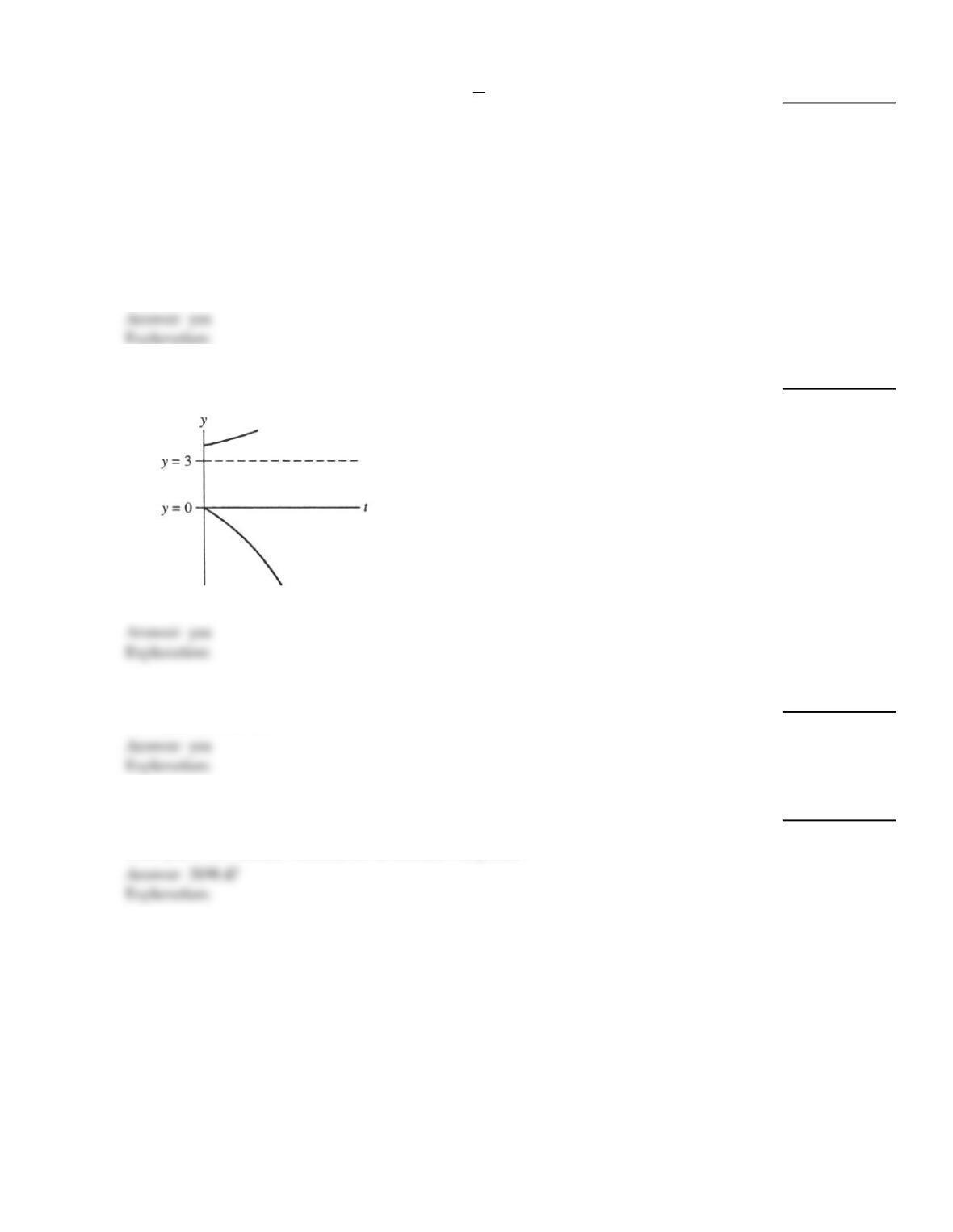
Given y= y – 3. On a ty–coordinate system sketch the solutions corresponding to the
initial conditions y(0) = 0 and y(0) = 4. Does this graph represent the situation?
Enter “yes” or “no”.
31)
32)
Given the differential equation: y‘=3t2(y – 7), is this the solution y = 7 + cet3?
Enter just “yes” or “no”
32)
33)
Use Euler’s method with n = 4 to approximate the solution f(t) to y=y2+ ty – 3, y(1) = 2
for 1 t 3. Estimate f(3).
Enter just a real number rounded off to two decimal places.
33)
9
34)
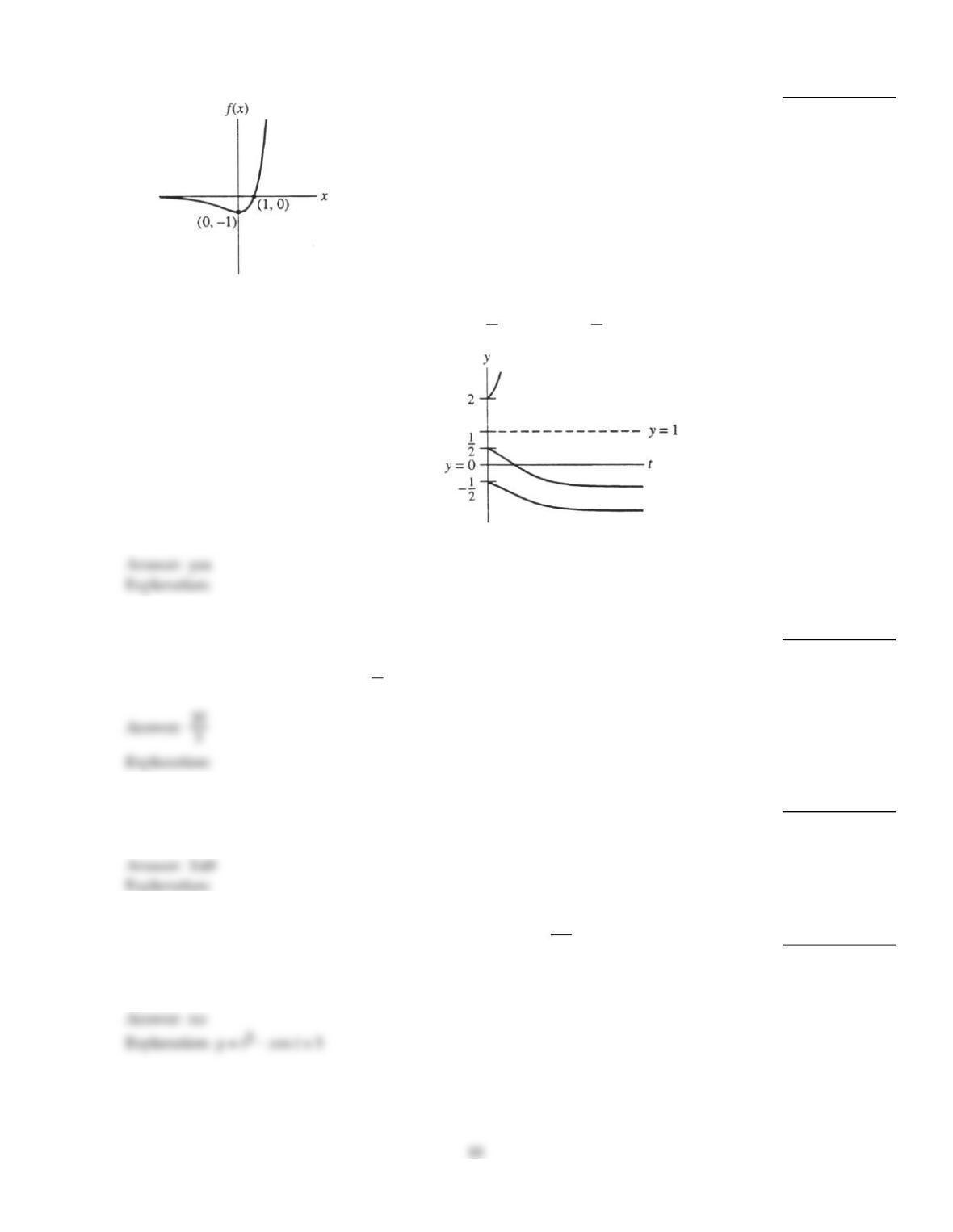
Below is a sketch of f(x) = (x – 1) ex .
On a ty–coordinate system, sketch the solutions to the differential equation y= (y – 1)ey
corresponding to the initial conditions y(0) = 2, y(0) =1
2, and y(0) = – 1
2. Does the
following graph represent this situation?
Enter “yes” or “no”.
34)
35)
Use Euler’s method with n = 3 to approximate the solution f(t) to y= 9t +y2, y(0) = 0.
Estimate f(1).
Enter just a reduced fraction of form a
b.
35)
36)
Use Euler’s method with n = 5 to approximate the solution f(t) to y= 5 – y, y(0) = 1 for
0 t 1. Estimate f(1).
Enter just a real number rounded off to two decimal places.
36)
37)
Given the differential equation with the given initial condition: dy
dt = 3t2+ sin t; y(0) = 2
is this the solution y =t3– cos t + 1 ?
Enter “yes” or “no”.
37)
Solve the problem.
38)
How much would you need to invest per month – in effect, continuously – in an
investment account that pays an annual interest rate of 9%, compounded continuously, in
order for the account to be worth $100,000 after 20 years? Enter just an integer
representing dollars to the nearest dollar (no units)
38)
39)
Given the differential equation: (t2+ 1)y’ = yt, is this the solution y = c t2+ 1?
Enter “yes” or “no”
39)
40)
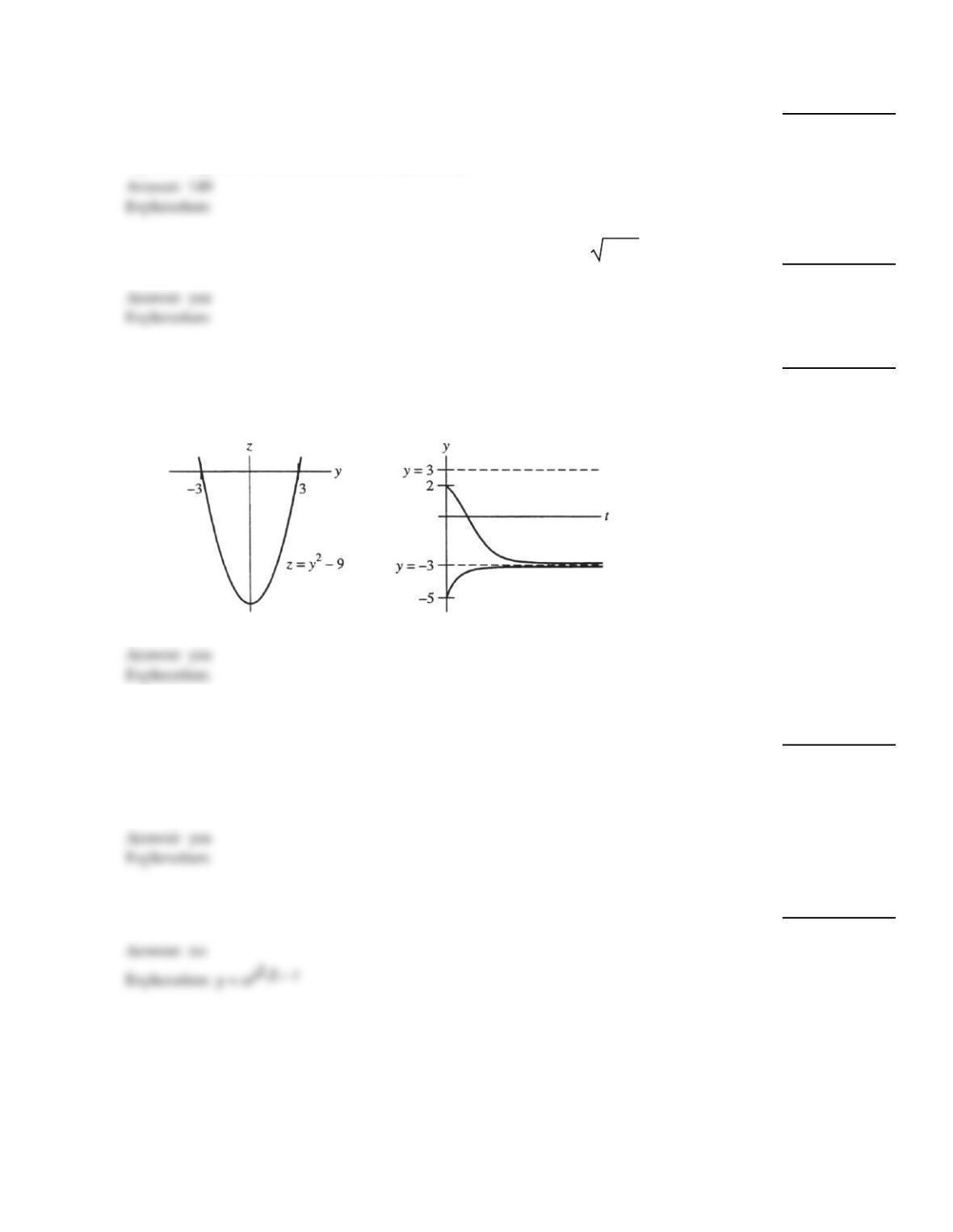
One or more initial conditions are given for the differential equation. Use the qualitative
theory of autonomous differential equations to sketch the graphs of the corresponding
solution. Include a yz–graph as well as a ty–graph.. y=y2– 9; y(0) = – 5; y(0) = 2
Do these graphs represent the situation?
Enter just “yes” or “no”.
40)
Solve the problem.
41)
A sports enthusiast drinks 2 liters of water per hour. Water is eliminated from the body at
a rate proportional to the amount of water in the body (due to perspiration). Write a
differential equation satisfied by f(t), the amount of water in the body. Does this equation
accurately describe this situation: y= 2 – ky ?
Enter “yes” or “no”.
41)
42)
Given the differential equation: (t + 1)y’ =yt2– y, is this the solution y = cet2/2 ?
Enter just “yes” or “no”.
42)
11
Solve the problem.
43)
A savings account earns 6% annual interest, compounded continuously. An initial deposit
of $8500 is made, and thereafter money is withdrawn continuously at the rate of $480 per
year. Does the following accurately represent this situation: y‘= 0.06y – 480; y(0) = 8500?
Enter “yes” or “no”.
43)
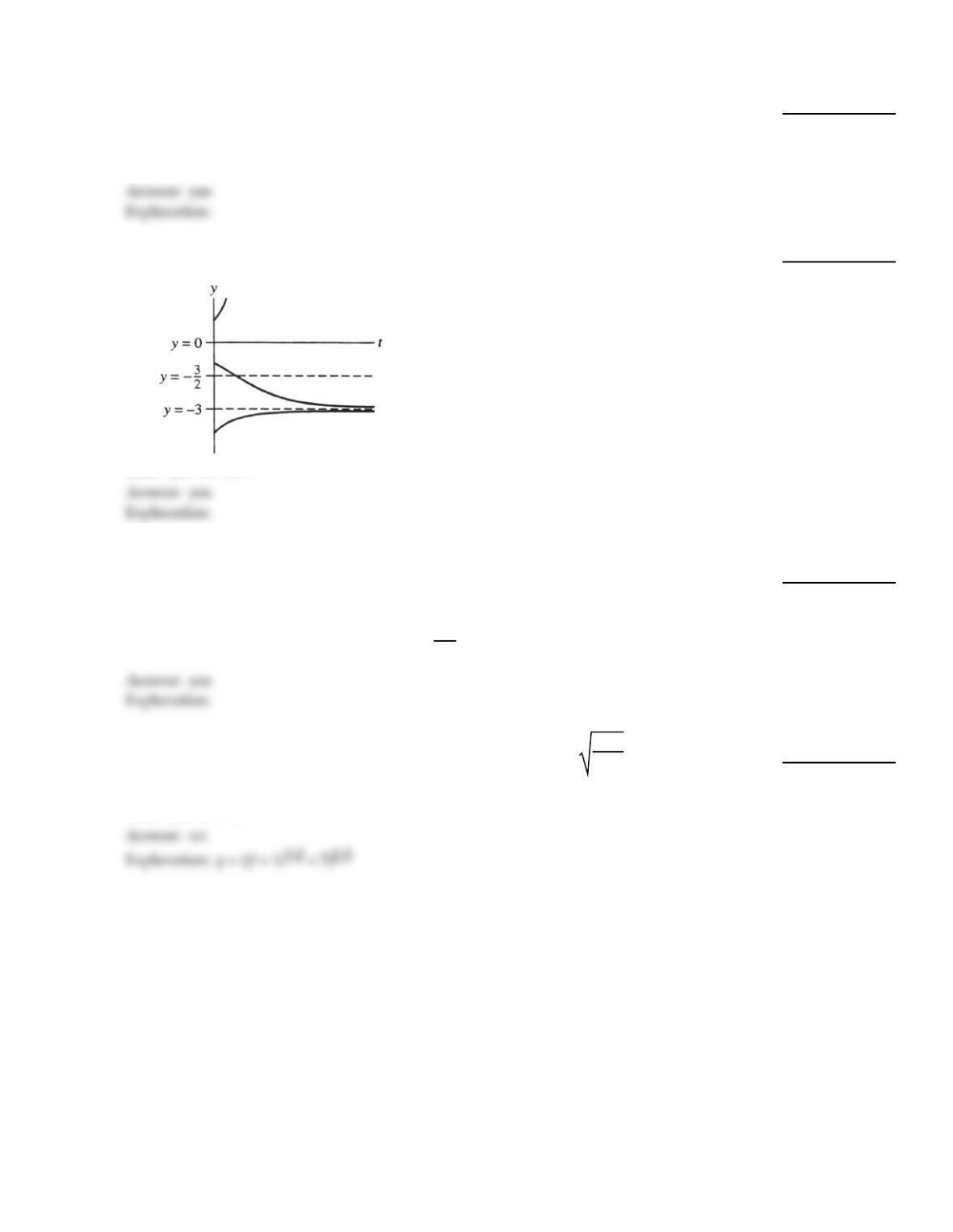
44)
Given y= y(y + 3). On a ty–coordinate system sketch the solutions corresponding to the
initial conditions y(0) = – 4, y(0) = – 1, and y(0) = 1. Does this graph represent the situation?
Enter “yes” or “no”.
44)
Solve the problem.
45)
There is a differential equation that is a mathematical model of the situation in which the
time rate of change in the population of a certain organism is proportional to the product
of the current population and the difference between the current population and the
limiting factor of 100,000. Is this the equation dP
dt = kP(100,000 – P)? Enter “yes” or “no”.
45)
46)
Given the differential equation with the given initial condition: y=t + 1
y ; y(0) = 4
is this the solution y = ((t + 1)3/2 + 4)2/3 ?
Enter “yes” or “no”.
46)
12
47)
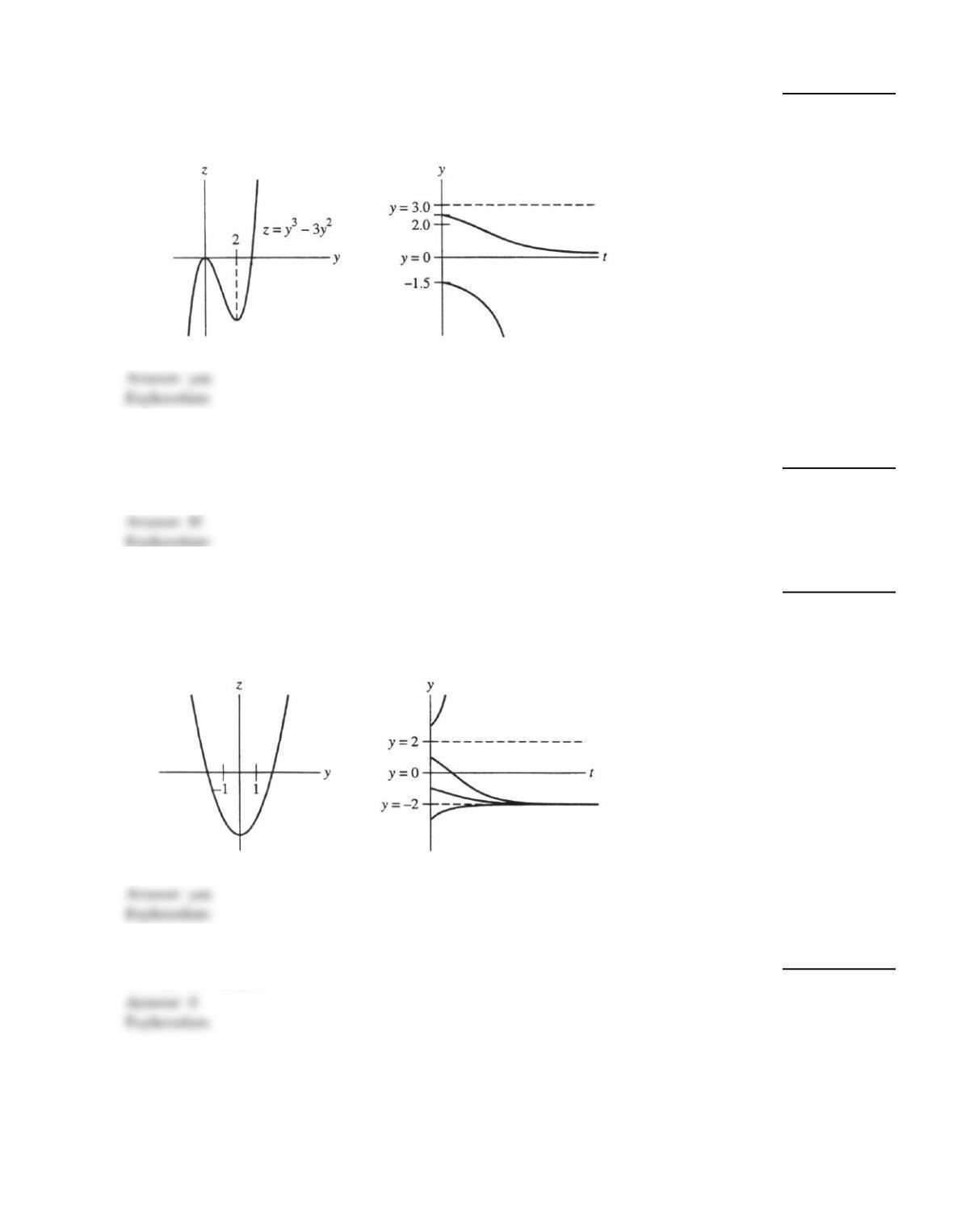
One or more initial conditions are given for the differential equation. Use the qualitative
theory of autonomous differential equations to sketch the graphs of the corresponding
solution. Include a yz–graph as well as a ty–graph. y=y3– 3y2; y(0) = – 1.5; y(0) = 2.5
Do these graphs represent the situation?
Enter just “yes” or “no”.
47)
Solve the problem.
48)
Suppose that $1000 is deposited in a savings account that pays 6% annual interest
compounded continuously. At what rate (in dollars per year) is it earning interest after 5
years? Enter just an integer representing the amount to the nearest dollar (no units).
48)
49)
One or more initial conditions are given for the differential equation. Use the qualitative
theory of autonomous differential equations to sketch the graphs of the corresponding
solution. Include a yz–graph as well as a ty–graph.
y=y2– 4; y(0) = – 3; y(0) = – 1; y(0) =1; y(0) = 3
Do these graphs represent the situation?
Enter just “yes” or “no”.
49)
50)
Find f'(0) if f(t) is a solution to the initial value problem: y‘ =e2t + y, y(0) = – 1.
Enter just an integer.
50)
13
51)
Use Euler’s method with n = 5 on the interval 0
t 1
2 to approximate the solution
f(t) to y= – (y + t), y(0) = – 1. Is the following the correct answer?
t0= 0; y0= – 1
t1= 0.1; y1= – 0.9
t2= 0.2; y2= – 0.82
t3= 0.3; y3= – 0.758
t4= 0.4; y4= – 0.7122
t5= 0.5; y5= – 0.68098
Enter “yes” or “no”.
51)
52)
Find a constant solution of y= t(y – 1).
Enter just an integer.
52)
Solve the problem.
53)
A certain drug is introduced into a person’s bloodstream. Suppose that the rate of decrease
of the concentration of the drug in the blood is directly proportional to the product of two
quantities: (a) the amount of time elapsed since the drug was introduced, and (b) the
square of the concentration. Let y = f(t) denote the concentration of the drug in the blood at
time t. Set up a differential equation satisfied by f(t). Does the following accurately
describe this situation: y=kty2, where k is a negative constant ?
Enter “yes” or “no”.
53)
54)
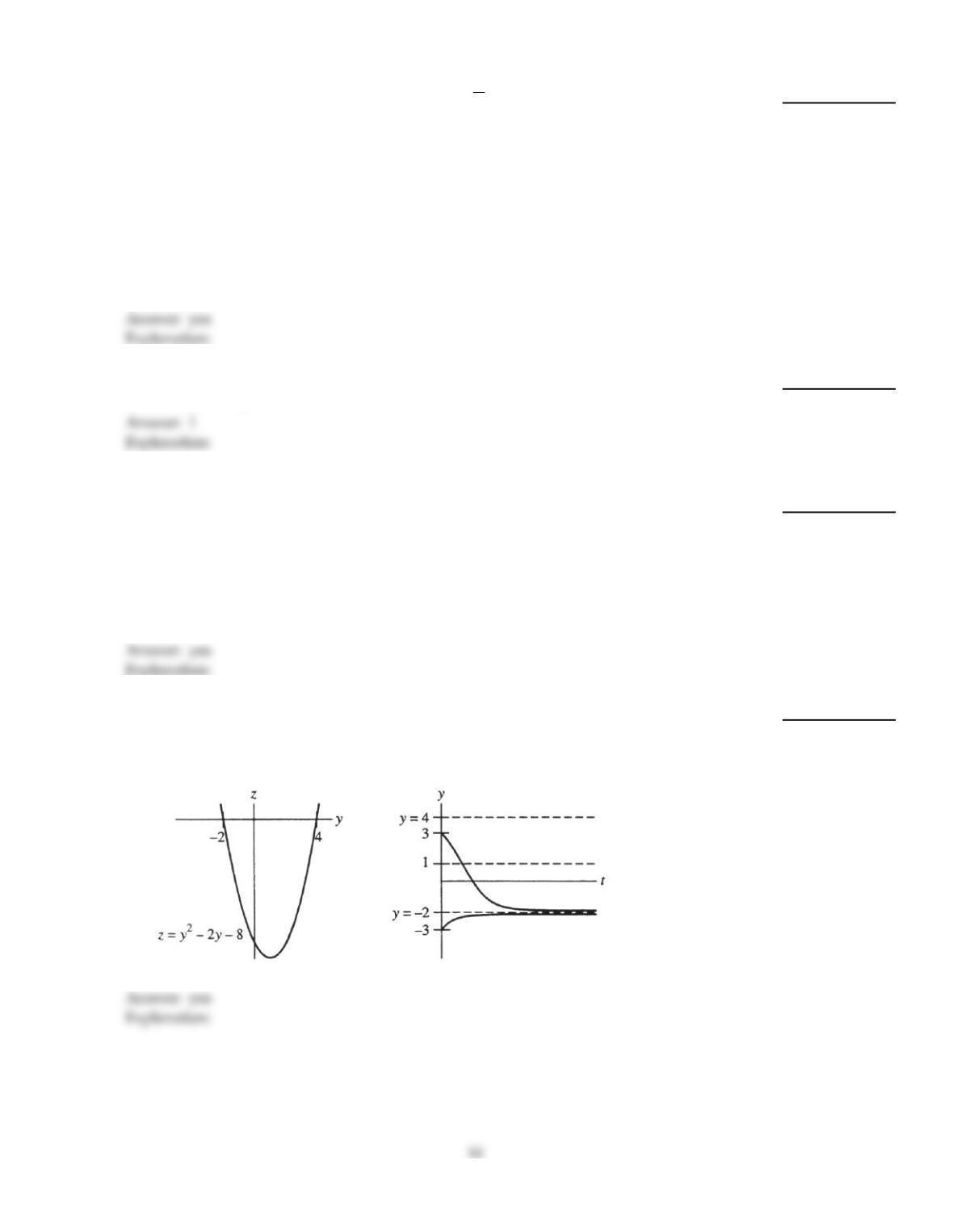
One or more initial conditions are given for the differential equation. Use the qualitative
theory of autonomous differential equations to sketch the graphs of the corresponding
solution. Include a yz–graph as well as a ty–graph. y=y2– 2y – 8; y(0) = – 3; y(0) = 3
Do these graphs represent the situation?
Enter just “yes” or “no”.
54)
55)
Let f(t) be the solution of y= ty + 0.2, y(0) = 3. Use Euler’s method on 0
t 1 with n = 2 to
estimate f(1). Is f(1)
3.875 the correct answer?
Enter “yes” or “no”.
55)
Solve the problem.
56)
An investment earns 25% interest per year. Every year $10,000 is withdrawn in order to
pay dividends to the investors. Set up a differential equation satisfied by f(t), the amount
of money invested at time t. Does this equation accurately describe this situation:
y= 0.25y – 10,000?
Enter “yes” or “no”.
56)
57)
Given the differential equation with the given initial condition: y=3t2+ 1
2y ; y(1) = – 5
is this the solution y = – t3+ t +2 ?
Enter “yes” or “no”.
57)
58)
Given the differential equation: y‘=y2–t2y2, is this the solution: y =1
1
3t3– t + C
?
Enter your answer as just “yes” or “no”.
58)
Solve the problem.
59)
A jug of milk at 50° is placed outdoors at a temperature of 100°. If after 5 minutes the
temperature of the milk is 60°, write the equation giving the temperature of the milk as a
function of time. Enter your answer exactly as: T = aeb+ c
59)
60)
Find the constant solutions to the differential equation: y’ =y2et– 2yet.
Enter just one integer or two separated by a comma (no label).
60)
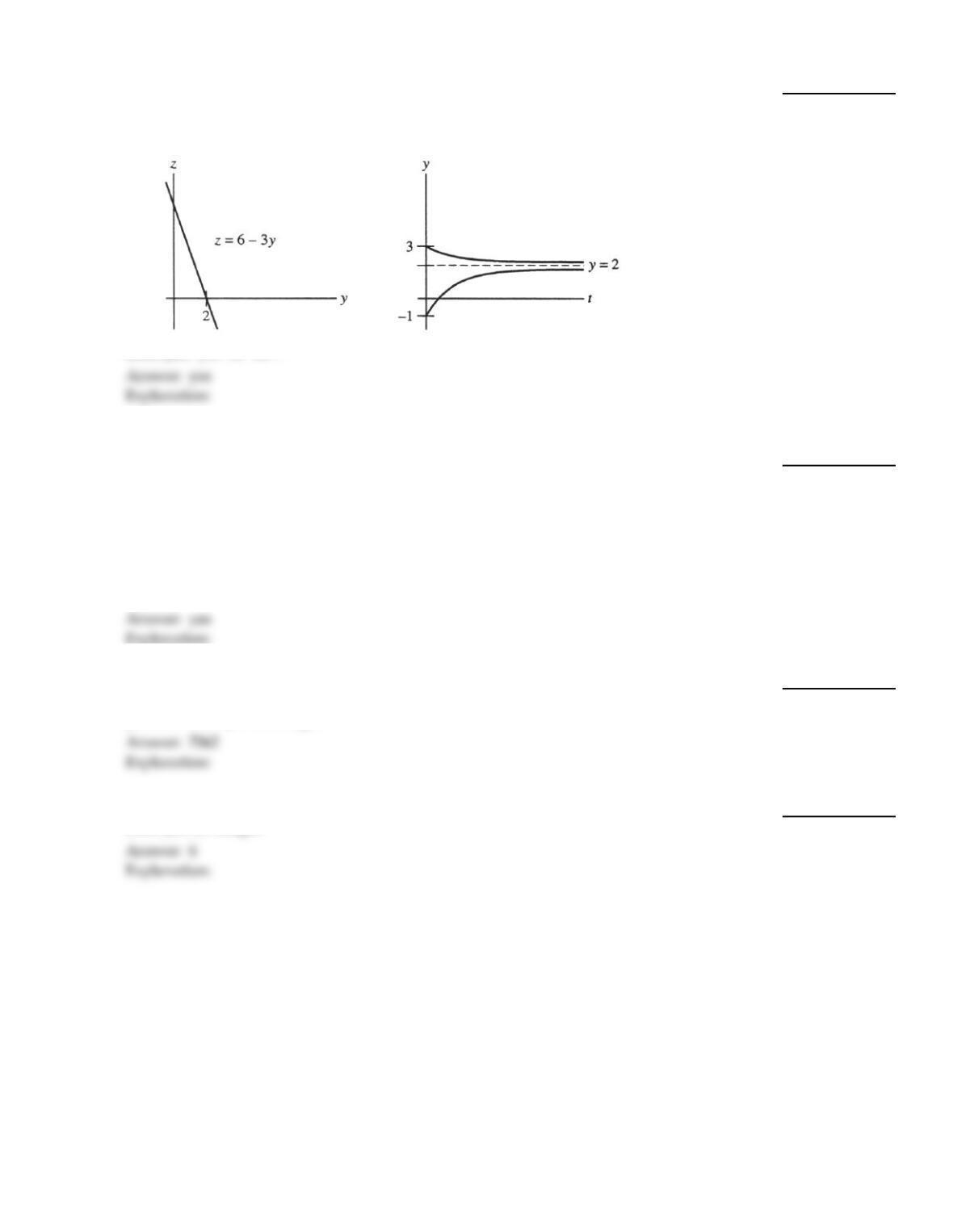
61)
One or more initial conditions are given for the differential equation. Use the qualitative
theory of autonomous differential equations to sketch the graphs of the corresponding
solution. Include a yz–graph as well as a ty–graph. Do these graphs represent:
y= 6 – 3y; y(0) = – 1; y(0) = 3?
Enter just “yes” or “no”.
61)
Solve the problem.
62)
After a baby whale is born, its weight gain at any time is proportional to the product of its
weight and the difference between its weight and its weight at maturity. Give a
differential equation satisfied by f(t), its weight at time t. Does the following accurately
describe this situation?
y= ky(M – y);
M = weight at maturity;
k > 0
Enter “yes” or “no”.
62)
63)
A fly population increases at a rate proportional to the amount present. After two years
the population has doubled. After three years it is 20,000. Find the number of flies initially
present. Enter just an integer.
63)
64)
Find f'(1) if f(t) is a solution to the initial value problem: y‘ = ty2+ 5, y(1) = 1.
Enter just an integer.
64)
16
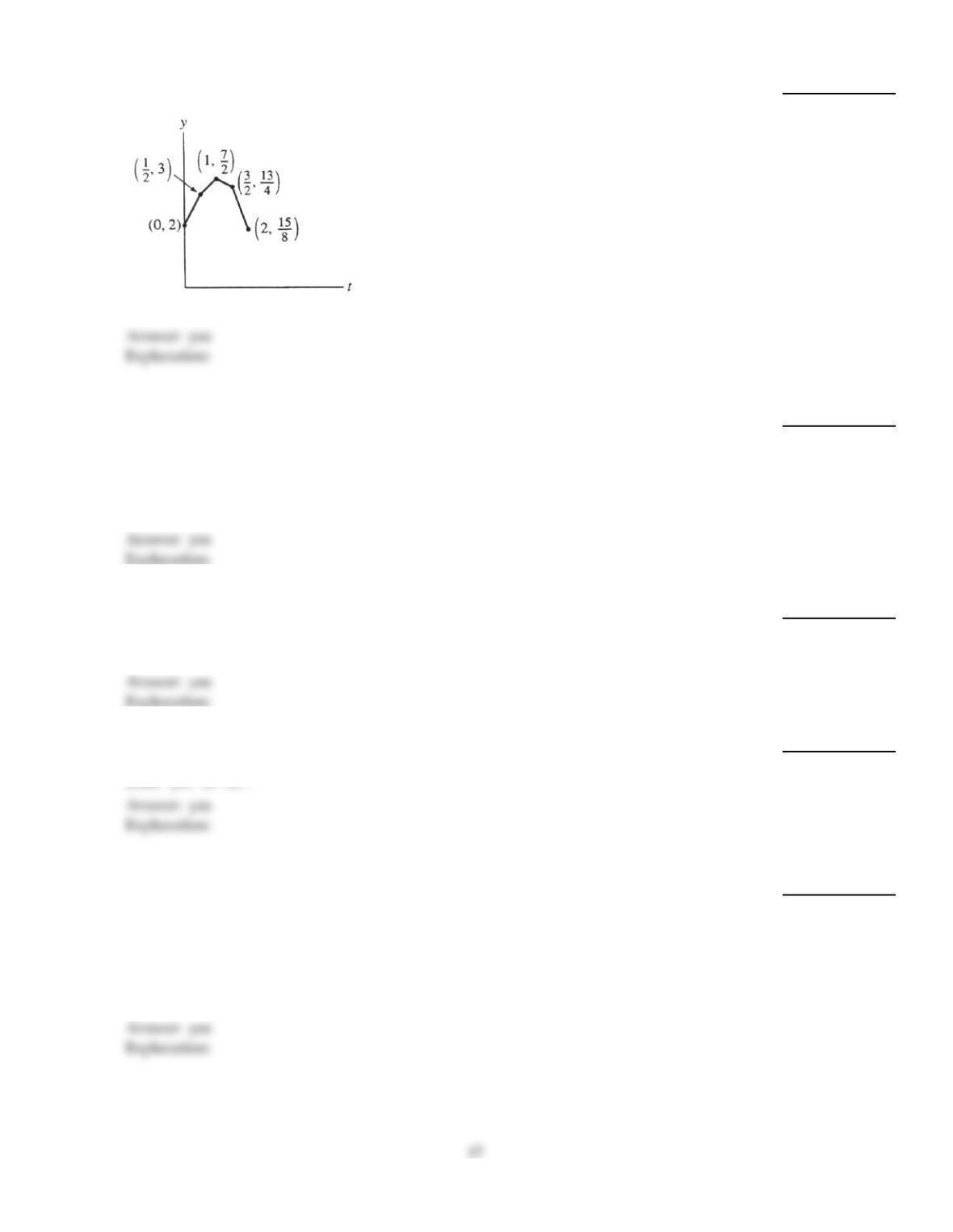
65)
Use Euler’s method with n = 4 on the interval 0
t 2 to approximate the solution f(t) to
y= y – 4t, y(0) = 2. Is the following graph accurate?
Enter “yes” or “no”.
65)
Solve the problem.
66)
The birth rate in a certain city is 2% per year and the death rate is 2.5% per year. Also,
there is a net movement of population into the city at the rate of 4000 people per year. Let
N = f(t) be the city’s population at time t. Write the differential equation satisfied by f(t).
Does this equation accurately represent this situation: y= 4000 – 0.005y?
Enter “yes” or “no”.
66)
67)
Given the differential equation with the given initial condition: yy =tet2;y(0) = 1
is this the solution y =et2/2 ?
Enter “yes” or “no”.
67)
68)
Given the differential equation with the given initial condition: y= t cos t; y(0) = 0
is this the solution y = t sin t + cos t – 1 ?
Enter “yes” or “no”.
68)
Solve the problem.
69)
Depending on the type of soil there is a constant M that represents the maximum amount
of water the soil can absorb per cubic ft. If the rate of absorption is proportional to the
difference between the maximum amount of water that could be absorbed and the amount
of water that has been absorbed, write a differential equation satisfied by y = f(t), the
amount of water in the soil at time t. Does this equation accurately describe this situation:
y= k(M – y); k > 0 ?
Enter “yes” or “no”.
69)
70)
Given the differential equation: y’ =1
ty is this the solution y = ± 2 ln|t| + C?
Enter “yes” or “no”.
70)
Solve the problem.
71)
A millionaire wants to set up a trust for her grandchild. She wants to put a lump sum of
money into an account earning 10% interest. She’d like her grandchild to be able to
withdraw $100 every month for the rest of the child‘s life. Write a differential equation
satisfied by f(t), the amount of money in the account at time t. Does the equation,
y= 0.1y – 100, accurately describe this situation?
Enter “yes” or “no”.
71)
72)
Use Euler’s method with n = 2 to approximate the solution f(t) to y= 2y – t, y(0) = 1.
Estimate f(1).
Enter just a reduced fraction of form a
b.
72)
73)
Combine the terms y and y into the derivative of a product, then solve the equation.
y
t3–3y
t4= t Is this the solution: y =t5
2+ Ct3?
Enter “yes” or “no”.
73)
Solve the problem.
74)
A cool object is to be heated to a maximum temperature M = M°C. At any time t, the rate
at which the temperature rises is proportional to the difference between the actual
temperature and the maximal temperature. If the object is originally 0°C, find and solve a
differential equation describing this situation. Is this the solution: y(t) = M – Me–kt?Enter
“yes” or “no”.
74)
75)
Use Euler’s method with n = 4 to approximate the solution f(t) to y= t + y – 1, y(0) = 2 for
0 t 2. Estimate f(2).
Enter just a reduced fraction of form a
b.
75)
18
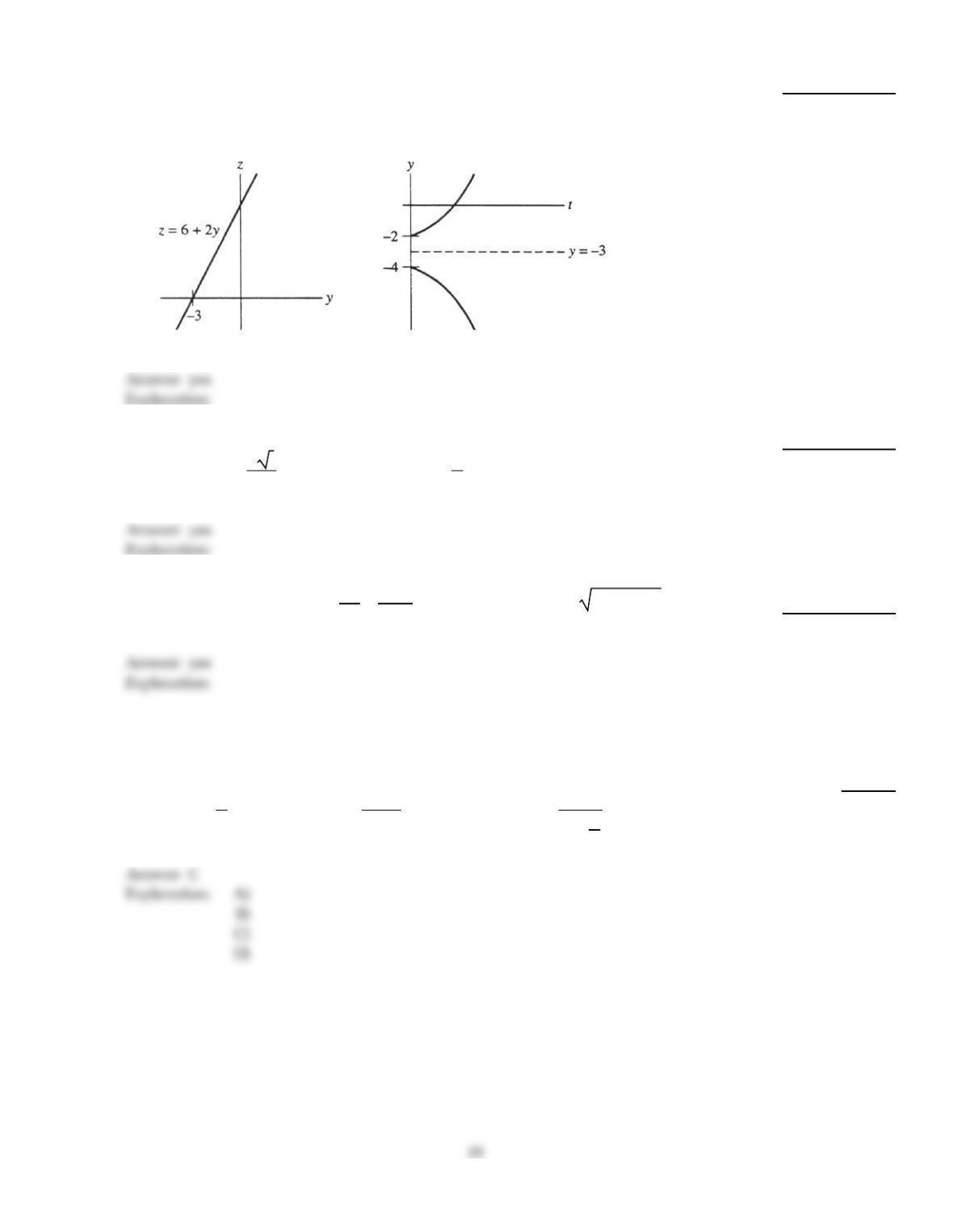
76)
One or more initial conditions are given for the differential equation. Use the qualitative
theory of autonomous differential equations to sketch the graphs of the corresponding
solution. Include a yz–graph as well as a ty–graph. y= 6 + 2y; y(0) = – 4; y(0) = – 2
Do these graphs represent the situation?
Enter just “yes” or “no”.
76)
77)
Combine the terms y and y into the derivative of a product, then solve the equation.
e3t2y+ 6te3t2y =5 t
4. Is this the solution: y =5
6t3/2e–3t2+ Ce–3t2?
Enter “yes” or “no”.
77)
78)
Given the differential equation: dy
dt =t +et
y, is this the solution y = ± t2+ 2et+C?
Enter “yes” or “no”.
78)
MULTIPLE CHOICE. Choose the one alternative that best completes the statement or answers the question.
Solve the differential equation with the given initial condition.
79)
y= 3t2(4 – y)2, y(0) = 2
79)
A)
y =t3+1
2
B)
y =1
t3+ 2
C)
y = 4 –1
t3+1
2
D)
y = 4 +t3

80)
Consider the differential equation y‘=t3(y + 3). Which of the following statements is/are true?
(I) f(t) = – 3 is a constant solution to this differential equation.
(II) f(t) = 0 is a constant solution to this differential equation.
(III) If f(t) is a solution to the differential equation with initial conditions y(1) = 0, then f(1) = 3.
80)
A)
I only
B)
I, II, and III
C)
I and III
D)
III only
E)
II only
Solve the equation using an integrating factor.
81)
y+3
xy = 6x2, t > 0
81)
A)
y =Cx3+x–3
B)
y = Cx–3
C)
y =x3+ C
D)
y =x3+ Cx–3
D
Solve the problem.
82)
A population of ants, y, living in a colony grows at a rate
dy
dt = 0.05y – 0.1y1/2,
where t is time in weeks. The initial population is 1000 insects. Using Euler’s method with h = 1,
what is the number of ants after 2 weeks?
82)
A)
1086 ants
B)
1096 ants
C)
1070 ants
D)
1063 ants
B
C