1
Environment: Science Behind the Stories, 2e Cdn. Ed. (Withgott)
Chapter 10 Forests and Forest Management
10.1 Graph and Figure Interpretation Questions
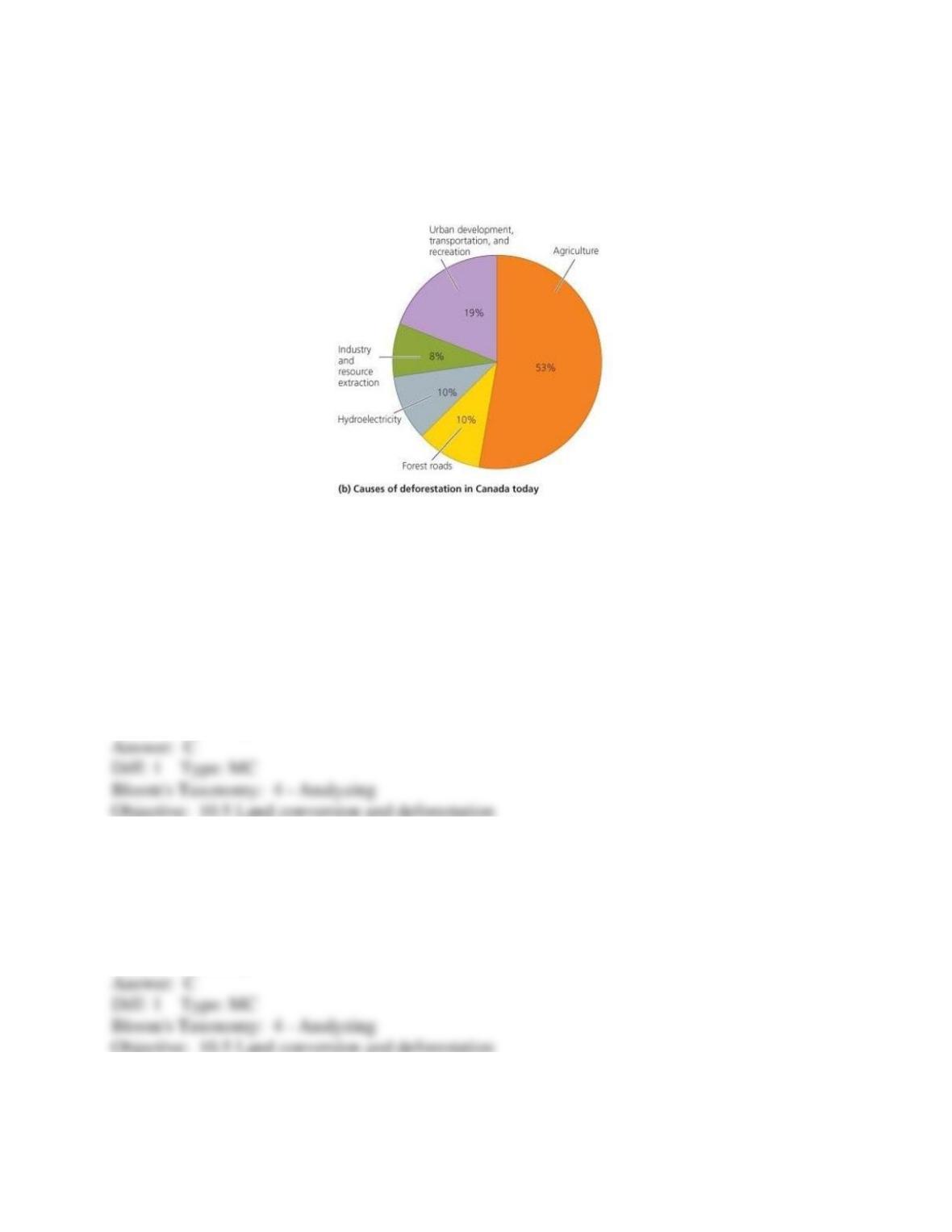
Figure 10.1
Use Figure 10.1 to answer the following questions.
1) Refer to Figure 10.1. The second major cause of deforestation is ________.
A) forest fires
B) agriculture
C) urban development, transportation, and recreation
D) industry and resource extraction
E) hydroelectricity
2) Refer to Figure 10.1. The largest cause of deforestation in Canada today is ________.
A) forest fires
B) industry and resource extraction
C) agriculture
D) forest roads
E) hydroelectricity
3) Refer to Figure 10.1. The production of forest roads is a greater cause of deforestation than
________.
A) industry and resource extraction
2
B) hydroelectricity
C) urban development, transportation, and recreation
D) agriculture
E) industry and resource extraction and hydroelectricity combined
Answer: A
Diff: 1 Type: MC
Bloom’s Taxonomy: 4 – Analyzing
Objective: 10.5 Land conversion and deforestation
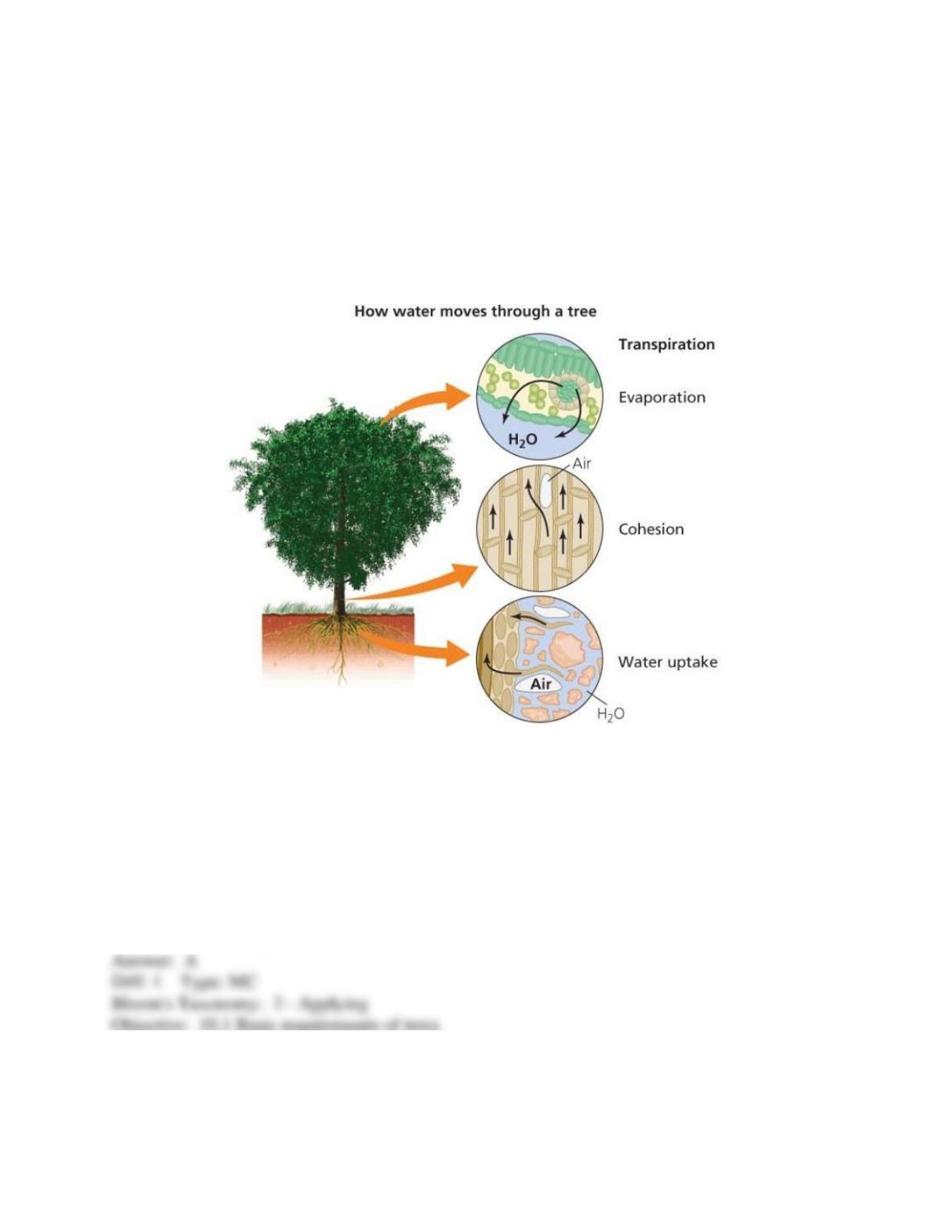
Figure 10.2
Use Figure 10.2 to answer the following questions
4) Refer to Figure 10.2. The stomata are directly involved in ________.
A) transpiration and evaporation
B) cohesion
C) water uptake
D) evaporation and water uptake
E) transpiration, evaporation, and water uptake
5) Refer to Figure 10.2. According to climate models used by IPCC, the climate change will
increase temperature and precipitation in the northern part of Russia’s boreal forests (taiga). For
trees growing there this would mean ________.
A) increased transpiration and increased water uptake

B) increased transpiration and decreased water uptake
C) decreased transpiration and increased water uptake
D) decreased transpiration and decreased water uptake
E) increased transpiration and decreased cohesion
6) Refer to Figure 10.2. When stomata open, they allow CO2 in, but “at the price” of letting
some water out. Trees grown under high CO2 conditions tend to have fewer stomata, because
they need fewer openings to get the same amount of CO2 into their leaves for photosynthesis.
This means that the future CO2-rich atmosphere might benefit MOST the trees that grow today
in soils with ________.
A) shortage of nutrients
B) shortage of water
C) abundance of water and abundance of nutrients
D) abundance of water but shortage of nutrients
E) trees in all the soils listed above are likely to benefit equally

10.2 Matching Questions
Match the following.
A) adhesion
B) CP Rail
C) Parks Canada
D) hardwood
E) down
F) softwood
G) Clayoquot Sound
H) Canadian Forest Service
I) An increase in infestation as warmer winters do not kill enough beetles
J) osmosis
K) up
L) light forest
M) woodland
N) A decrease in infestation as beetles emerge earlier in spring when there is not enough food for
them to survive
O) MacMillan-Bloedel
P) Hudson Bay
1) Tzeporah Berman became a figurehead for a movement in British Columbia to stop the
logging of a particular area.
2) Its mission is to protect natural resources for future generations through the use of restrictions
and prohibition of resource extraction, while providing public access for current enjoyment
3) A wooded area with openings between trees allowing light to penetrate
4) Owns and manages large tracts of timber in Western Canada
5) Fire burning ________ the slope of a mountain can spread very fast
6) Timber harvested from pine and spruce trees
7) Soil water moves into the roots mainly by this process
8) Possible effect of climate change on pine beetle infestation
Diff: 3 Type: MA
Bloom’s Taxonomy: 3 – Applying
Objective: 10.5 Land conversion and deforestation
10.3 Short Answer Questions
1) Why do most ecologists and foresters view tree plantations more as crop agriculture than as
ecologically functional forests?
2) Why does the government offer farm subsidies?
3) Grazing can be sustainable if it minimizes damage to ________. (List three objects/factors.)
4) Name four forest types (regions) in the Canadian forest of the west.
5) What are logging concessions, and do they make forestry sustainable?
6) Describe briefly Canada’s forests of the north.
7) Is taiga the same as boreal forest?
8) ________ encompasses making decisions on how resources are extracted and then monitoring
resource recovery to make sure resource levels are not overly depleted and that wasteful
practices are modified toward greater sustainability.
9) What one word describes clearing forests and the resulting loss of this practice?

10) Forest Service scientists in some districts have become involved in extensive programs of
________, attempting to protect, recover, or restore whole plant and animal communities that
had been lost or degraded.
11) What is swidden agriculture, and under what conditions could it be sustainable?
12) Several organizations examine the practices of timber companies and offer ________ to
products produced using methods they consider sustainable.

8
10.4 Multiple-Choice Questions
1) Fire history in an open pine woodland ecosystem would be best determined by ________.
A) the density of vegetation
B) charcoal in the soil
C) soil chemistry
D) tree ring scars
E) ambient air temperature
2) The Sarawak tribes ________.
A) were compensated for allowing clear-cutting of their forest
B) are pressured to switch from hunting-gathering to farming
C) depend on oil palm farming for income
D) failed to mount a protest in the face of the destruction of their way of life
E) went extinct
3) You are travelling through an open area dominated by grasses with widely scattered trees.
You are most likely in the biome called ________.
A) tropical dry forest
B) steppe
C) savannah
D) grassland
E) shrubland
4) The Canadian forest strategy includes which of the following objectives?
A) managing individual, commercially important, tree species
B) reversing privatization of forests by purchasing private woodlots
C) improving the sustainability of forest communities through legislation and policies
D) conveying ownership of forested areas from the Crown to private forest companies
E) protecting threatened forest-dwelling species
5) Forests cover ________% of Canada, and constitute ________% of all Earth’s forested areas.

(Use approximate numbers.)
A) 50; 10
B) 30; 20
C) 40; 10
D) 30; 10
E) 50; 20
6) ________% of Earth’s forests are forest plantations.
A) Less than 1
B) Approximately 3
C) Approximately 7
D) Almost 10
E) Almost 20
7) Which of the following is the LEAST likely to contribute to the recently observed increase in
the number and intensity of catastrophic forest fires?
A) prescribed burns
B) changing climate
C) fire suppression
D) accumulation of dead wood
E) fuel buildup
8) South America and Africa suffer the highest rates of deforestation. Which of the following is
NOT one of the likely contributing factors?
A) climate change affecting forests in these two regions more than in other regions
B) logging concessions for multinational corporation
C) fallow periods that are too short in swidden agriculture
D) cutting trees for cooking and heating
E) governments’ subsidies for clearing the land for farming

9) Forests in Canada do NOT include ________ forests.
A) old-growth
B) subalpine
C) deciduous
D) temperate rain
E) temperate mangrove
10) Deforestation ________.
A) decreases carbon dioxide concentration in the atmosphere
B) prevents erosion
C) contributes to population explosion
D) has the greatest impacts in tropical areas and arid regions
E) increased substantially between the 1990s and 2011
11) Why do developing nations impose few or no restrictions on logging?
A) Local residents use most of the timber, and the government does not want to impose
restrictions on its citizens.
B) They are desperate for economic development.
C) Most timber is extracted by local corporations that support the government.
D) There is practically an infinite supply of timber because wood is a renewable resource.
E) No old-growth forests remain in developing nations.
12) Clear-cutting ________.
A) restricts timber harvesting to mountaintops
B) is harvesting trees from coastal areas only
C) involves the elimination of subsidies to farmers
D) is a form of violent protest favoured by radical environmental organizations
E) removes all trees from an area

13) The spruce budworm is a known pest of Douglas fir trees. The hatching of this insect’s larvae
is triggered by the warmer temperatures in the early spring, while the development of fir trees is
timed by amount of available light and day length. Recently, winters in a given area have
become warmer, perhaps as a result of the warming trend. You would expect: that with the larvae
hatching ________ in the year,
the development of fir trees would ________, and the damage caused by spruce budworms
infestations would ________.
A) earlier; be unchanged; decrease
B) later; be unchanged; decrease
C) earlier; start earlier in the year; increase
D) earlier; be unchanged; increase
E) earlier; start later in the year; increase
14) The Iisaak ________.
A) were rewarded for allowing clear-cutting of their forest
B) were left without resources when the Malaysian government allowed clear-cutting in their
forest
C) began an oil palm farm and made lots of money once trees were removed from their
homeland
D) are native Alaskans opposed to oil drilling in ANWR
E) is a native Canadian company that logs in an environmentally sensitive manner
15) Most of the world’s forests occur as ________.
A) temperate deciduous forest
B) chaparral
C) taiga and rainforest
D) tropical dry forest
E) temperate rainforest