Chapter 10
Introduction to Liabilities: Economic Consequences, Current Liabilities, and
Contingencies
MULTIPLE CHOICE QUESTIONS
1. The recognition of a deferred tax liability that results from the use of straight-line
depreciation on financial statements and double-declining balance on tax returns will
a. increase the current ratio.
b. increase the debt/equity ratio.
c. increase the quick ratio.
d. decrease the debt/asset ratio.
2. Net worth is
a. assets plus liabilities.
b. total income since the company began operations.
c. total shareholders’ equity.
d. another name for net income.
3. Which one of the following events increases working capital?
a. Purchase of inventory on credit
b. Payment of an installment of notes payable
c. Payment of sales taxes for the state
d. Selling merchandise on credit at a profit
4. An employee of Susann Inc. failed two drug tests. The employee has sued and Susann
Inc.’s. lawyers appropriately believe that, at best, it is only reasonably possible that
Susann Inc. will lose the court case. The proper accounting treatment of the lawsuit will
a. increase earnings per share.
b. increase the debt/asset ratio.
c. decrease the current ratio.
d. not affect the debt/equity ratio.
10-2 Test Bank – Chapter 10 – Introduction to Liabilities: Economic Consequences, Current Liabilities, & Contingencies
5. Which one of the following events does not have any impact on total working capital?
a. A cash dividend to be paid next month is declared.
b. Warranty expense is accrued.
c. Salaries previously accrued are paid.
d. Debt which was previously long-term matures next year.
6. If the current ratio is currently greater than 1.0, which one of the following events would
increase the current ratio?
a. Purchase of inventory on account
b. Receipt of money from a customer prior to the performance of service
c. Accrual of warranty expense
d. Sale of plant asset at a gain
7. If the quick ratio is currently greater than 1.0, which one of the following events would
increase the quick ratio?
a. Warranty expense is accrued.
b. A cash dividend previously declared is paid.
c. Long-term debt is paid off.
d. Inventory is purchased on account.
8. Which one of the following events decreases the debt/asset ratio?
a. Bonds are retired with a gain.
b. Warranty expense is accrued.
c. Some of the long-term debt matures next year.
d. The board of directors declares a cash dividend to be paid next month.
9. Which one of the following transactions decreases a company’s quick assets?
a. The board of directors declares a cash dividend to be paid next month.
b. Salary expense is accrued.
c. Depreciation expense is recorded.
d. A payment is made for next year’s insurance.
Test Bank – Chapter 10 – Introduction to Liabilities: Economic Consequences, Current Liabilities, & Contingencies 10-3
10. Which one of the following is the result of the amortization of a discount on a short-term
note payable?
a. Increases assets and decreases liabilities
b. Decreases assets and increases liabilities
c. Increases liabilities and decreases shareholders’ equity
d. Decreases liabilities and owners’ equity
11. One of Tonic Corp’s employees invented a revolutionary coffee lid that cools coffee as
you drink it in order to prevent burns. Two children ordered coffee and burned their
mouths after failing to properly secure the lids. The children’s parents sued. Tonic
Corp’s. lawyers believe that it is highly probable that judgment will be rendered against
Tonic Corp and it is likely a payment in excess of $2 million will be incurred. The proper
accounting treatment of the lawsuit will
a. decrease total liabilities.
b. increase total liabilities.
c. increase the current ratio.
d. require accountants to wait until the suit is settled to account for the event.
12. Accounts payable typically arise because
a. cash is received from a customer that will be paid back in the future.
b. cash is received from customers prior to the rendering of services or delivery of
products.
c. the firm temporarily borrows cash for operations.
d. amounts are owed to others for goods, supplies, and services purchased on open
account.
13. Collecting sales taxes from customers always
a. decreases net income.
b. increases the debt/equity ratio.
c. increases the current ratio.
d. decreases net worth.
10-4 Test Bank – Chapter 10 – Introduction to Liabilities: Economic Consequences, Current Liabilities, & Contingencies
14. If a contingent loss which is expected to be paid next year is accrued, this would:
a. decrease the debt/equity ratio.
b. decrease the debt/asset ratio.
c. decrease the current ratio.
d. have no effect on the quick ratio.
15. Short-term notes payable typically arise because
a. the firm temporarily requires cash for operations.
b. cash is received from customers prior to the rendering of services or delivery of
products.
c. the board of directors have declared a dividend that will be paid at a later date.
d. cash is received as a security deposit.
16. Dividends payable typically arise because
a. creditors want a return on funds loaned to a company.
b. cash is paid for dividends previously declared in another accounting period.
c. the board of directors declare a dividend that will be paid at a later date.
d. bond investors demand a return.
17. If a loss contingency related to a lawsuit against a firm is deemed to have a reasonable
probability of requiring ultimate payment, then the proper accounting treatment of the
loss contingency will
a. require note disclosure.
b. decrease the debt/asset ratio.
c. increase the accounts payable/sales ratio.
d. decrease the debt/equity ratio.
18. Unearned revenue typically arises because
a. cash is received as a security deposit.
b. cash is received from customers prior to the rendering of services or delivery of
products.
c. a company temporarily requires cash for operations.
d. merchandise is sold to customers prior to payment.
Test Bank – Chapter 10 – Introduction to Liabilities: Economic Consequences, Current Liabilities, & Contingencies 10-5
19. A liability for a deposit may arise because
a. cash deposits are received from customers for layaways.
b. cash is paid as a security deposit that will be refunded in the future.
c. the company deposits sales receipts too early.
d. merchandise is delivered to customers prior to payment.
20. Accruing warranty expense will
a. increase the debt/equity ratio.
b. increase the current ratio.
c. reduce uncollectible accounts during the period.
d. increase inventory turnover.
21. If a loss contingency related to a lawsuit against a firm is deemed to have a remote
probability of requiring ultimate payment, then the proper accounting treatment of the
loss contingency will
a. increase the debt/equity ratio.
b. increase the debt/asset ratio.
c. have no effect on earnings per share.
d. increase the quick ratio.
22. An increase in a deferred tax liability is recognized when
a. the tax accountant omits taxable revenue from the tax returns.
b. net income measured under GAAP is greater than taxable income on tax returns
because of temporary timing differences.
c. the amount of tax paid to the government is more than that calculated by the
accountant on the company’s tax return.
d. a tax audit by the IRS causes an increase in taxes due from a previous year’s tax
return.
23. Contingent liabilities whose ultimate payment is highly probable and can be reasonably
estimated must be
a. ignored until actual payment is made.
b. disclosed only in the footnotes to the financial statements.
c. recorded in the body of the balance sheet.
d. disclosed in the auditor’s report.
24. Contingent liabilities whose ultimate payment is remote should be
a. recorded in the body of the balance sheet.
b. disclosed in the footnotes to the financial statements.
c. disclosed in the auditor’s report.
d. ignored.
25. Contingent liabilities whose ultimate payment is reasonably probable should be
a. recorded in the body of the balance sheet.
b. disclosed in the footnotes to the financial statements.
c. ignored.
d. disclosed in the auditor’s report.
26. If a loss contingency related to a lawsuit against a firm is deemed to have a high
probability of requiring ultimate payment and can be reasonably estimated, then the
proper accounting treatment of the loss contingency will
a. decrease the debt/equity ratio.
b. decrease the debt/asset ratio.
c. decrease earnings per share.
d. increase net income.
27. Sweeney, Inc. borrowed $30,000 from the bank by signing a 9-month note payable. The
proper accounting treatment of recording the note will
a. increase assets and liabilities.
b. decrease assets and increase liabilities.
c. increase liabilities and owners’ equity.
d. increase assets and decrease owners’ equity.
28. An income tax accrual at yearend will most likely
a. decrease earnings per share.
b. decrease the debt/asset ratio.
c. decrease the debt/equity ratio.
d. be a contingency.
Test Bank – Chapter 10 – Introduction to Liabilities: Economic Consequences, Current Liabilities, & Contingencies 10-7
29. Ranch Company estimates warranty expense as 5% of sales. On January 1, warranties
payable was $13,000. During the year Ranch paid $5,000 to meet its warranty
obligations and recorded sales of $120,000. The December 31 liability for the warranty is
a. $10,000.
b. $12,000.
c. $6,000.
d. $14,000.
Solution: $13,000 + ($120,000 x 5%) − $5,000 = $14,000
30. Which one of the following would increase the bonus for a CEO who is paid a bonus
equal to a percentage of current GAAP net income?
a. Recording a decrease in the company’s self–insured worker’s compensation expense
b. Decreasing the estimated life of plant and equipment by an average of 8 years
c. Increasing wages for the warehouse employees
d. Collecting payments in advance from customers
31. A suit for breach of contract seeking damages of $3,000,000 was filed against Clark
Corporation on March 1, 2017. Clark’s legal counsel believes that a negative outcome is
highly probable. A reasonable estimate of the court’s award to the plaintiff is $600,000.
Settlement is expected to occur during the latter part of 2017. What accounting is
necessary for the year ending June 30, 2017?
a. Note disclosure only
b. Accrue a contingent liability of $3,000,000 and provide note disclosure explaining the
contingency
c. Accrue a contingent liability of $600,000 and provide note disclosure explaining the
contingency
d. No disclosure or accrual necessary
32. Abbott Co. has 5 employees who worked the entire year. Each employee earns 6 paid
vacation days annually. Vacation days may be taken during December of 2016 and all
of 2017. All unused vacation days are paid when the employee leaves the company.
The daily wage in 2016 per employee is $100. This is an example of
a. a definite liability.
b. a third party liability.
c. a gain contingency.
d. unearned revenue.
10-8 Test Bank – Chapter 10 – Introduction to Liabilities: Economic Consequences, Current Liabilities, & Contingencies
33. Which one of the following is a current liability?
a. Portions of notes payable due beyond the next accounting period
b. Sales taxes paid on new equipment acquired
c. Estimated costs of hurricanes which might develop in the Caribbean during next
hurricane season
d. Football tickets sold to customers for games in the coming season
34. Current liabilities include
a. amounts due from suppliers for credits on accounts due to returns
b. taxes withheld from employees’ payroll checks which must be remitted to the IRS.
c. amounts paid for warranty repairs during the current year.
d. cash dividends to be declared by the board of directors during the next six months.
Use the information from Cen, Inc. to answer questions 35 and 36.
Cen, Inc. reported the following on its December 31, 2017, balance sheet:
Current liabilities:
2017
2016
One-year short-term notes payable, net of discount of
$ 9,800
$6,400
$300 and $400, respectively
Accrued interest on notes payable
340
280
Current portion of long-term debt
1,250
2,340
Trade accounts payable
500
700
35. How much is the maturity value of the one-year note payable that is outstanding at the
end of 2017?
a. $9,500
b. $9,800
c. $10,100
d. $10,400
Solution: $9,800 + $300 = $10,100
36. Which statement is true concerning Cen’s interest?
a. Cen paid a total of $60 interest during 2017.
b. Interest was incurred during the year on more than one note.
c. Interest of $3,200 was accrued and paid during 2017.
d. The ‘accrued interest on notes payable’ amount relates only to the one-year short-
term notes payable.
Test Bank – Chapter 10 – Introduction to Liabilities: Economic Consequences, Current Liabilities, & Contingencies 10-9
37. Which one of the following would most likely be reported as a current liability?
a. Frequent flyer program miles accumulated by airline travelers
b. Self-insurance risks on anticipated losses
c. Customers merchandise returns exchanged for different merchandise
d. The CEO’s stock option package for the current year
38. Liabilities are
a. sometimes credit and other times debit balances.
b. deferred amounts which will be recognized on the balance sheet when the actual
due date arrives.
c. obligations arising from past transactions and payable in assets or services in the
future.
d. obligations to transfer ownership of one company to other entities.
39. What business transaction must occur in order to reduce Estimated Warranty Payable?
a. Goods under warranty are repaired in the period after the sale
b. Warranty costs are accrued at the end of the accounting period
c. Sale of goods on account
d. Customers take advantage of cash discounts for early payment
40. A contingent liability
a. is definite in existence, but its amount and due date are not yet known.
b. has the same requirements as a contingent gain.
c. must be accrued even when it is not reasonably estimable.
d. is disclosed only in the financial statement notes if highly probable and the amount
can be estimated.
41. Gain contingencies
a. should be accrued when probable and the amount can be reasonably estimated.
b. are reported as revenues on the income statement.
c. should be accrued for anticipated lottery winnings.
d. are almost never accrued and are rarely disclosed.
10–10 Test Bank – Chapter 10 – Introduction to Liabilities: Economic Consequences, Current Liabilities, & Contingencies
42. A company has a decreasing current ratio. Creditors should be concerned
a. with long-term solvency.
b. about the company’s ability to pay current debts as they come due.
c. about the company’s profitability.
d. about whether earnings per share is increasing or decreasing.
43. A pension is
a. a cost such as health insurance paid on behalf of a retired or disabled employee.
b. a contingent inflow of cash anticipated from assets earning interest.
c. required of all employers.
d. usually determined by the employees’ years of service.
44. Alpine, Inc. sells baseball tickets for professional baseball games. Cash receipts for
baseball tickets are credited to Unearned Ticket Revenue. During 2017, Alpine collected
$30,000 for a September, 2017 baseball game and $42,000 for a March, 2018 baseball
game. The September game was played as scheduled, although $2,000 of tickets was
refunded to fans that canceled because they had been permanently kicked out of the
stadium for disorderly conduct. How much should be reported as Unearned Ticket
Revenue at December 31, 2017?
a. $0
b. $42,000
c. $72,000
d. $40,000
45. A measure of the extent to which reported income is conservative is called
a. ERISA.
b. a gain contingency.
c. the conservatism ratio.
d. a line of credit.
Test Bank – Chapter 10 – Introduction to Liabilities: Economic Consequences, Current Liabilities, & Contingencies 10-11
46. Warranties should be accrued if it is
a. probable that an expense has been incurred and the amount is reasonably
estimable.
b. possible that an expense has been incurred regardless of whether the amount is
estimable or not.
c. possible that an expense will be incurred and the amount is reasonably estimable.
d. remote that any expense has been incurred.
47. In addition to recognizing income tax expense, the accounting necessary to record
income taxes requires
a. a credit to income tax payable based on net income times the tax rate.
b. a debit to the income tax expense account for the amount of cash that must be paid
for taxes.
c. computations of the amounts to record in the deferred income tax account.
d. all companies to report taxable income on the income statement
48. Two types of differences exist between computing income for tax purposes and
computing income for financial accounting purposes. The differences are
a. defined benefit taxes and defined contribution taxes.
b. deferred tax assets and deferred tax liabilities.
c. revenues and expenses.
d. temporary and permanent.
49. The economic essence of one of the following should not be reported in the balance
sheet as a current liability. Which one is not reported?
a. Free sandwich offers printed on hockey ticket stubs
b. Amounts sued for damages associated with injuries from an allegedly defective weed
eater
c. Mail-in rebates from software by software companies
d. Amounts payable to an employee for a recent expense report
10–12 Test Bank – Chapter 10 – Introduction to Liabilities: Economic Consequences, Current Liabilities, & Contingencies
50. A defined benefit plan differs from a defined contribution plan in that a defined benefit
plan
a. has a liability that must be actuarially computed.
b. is required by ERISA.
c. requires a corporation to make a series of payments of a specified amount to a
pension fund.
d. requires journal entries, and the defined contribution plan does not.
51. Pension expense is
a. accrued each period as employees require payments.
b. recognized as a long-term deferred asset.
c. accrued as employees earn their rights to future benefits.
d. calculated by dividing an employee’s annual salary into the number of years the
employee is expected to require pension payments.
52. Simpson Incorporated sells fishing lures and monofilament leader material. During June,
Simpson distributed 6,000 coupons to receive a free lure to each customer who
purchased a dozen spools of monofilament leader material. Through December 31,
2017, Simpson honored 1,200 coupons redeemed. Simpson expects a total of 5,200
total coupons to be redeemed. Simpson sells lures for $1.00 each. The cost of each lure
to Simpson is 45 cents. How much should Simpson report as a liability at December 31,
2017?
a. $6,000
b. $1,800
c. $3,600
d. $2,340
Test Bank – Chapter 10 – Introduction to Liabilities: Economic Consequences, Current Liabilities, & Contingencies 10-13
53. Jake Company borrowed $100,000 from Guaranty Trust Bank to finance the purchase of
new equipment. The loan contract provides for a 12 percent annual interest rate and
states that the principal must be paid in full in ten years. The contract also requires that
Jake maintains a current ratio of 1.5:1. Before Jake borrowed the $100,000, the
company’s current assets and current liabilities were $120,000 and $68,000
respectively.
If Jake invests $50,000 of the borrowed funds in equipment and keeps the rest as cash
or short-term investment, what would be its current ratio?
a. 1.76
b. 2.50
c. 1.44
d. 3.24
54. Jake Company borrowed $100,000 from Guaranty Trust Bank to finance the purchase of
new equipment. The loan contract provides for a 12 percent annual interest rate and
states that the principal must be paid in full in ten years. The contract also requires that
Jake maintains a current ratio of 1.5:1. Before Jake borrowed the $100,000, the
company’s current assets and current liabilities were $120,000 and $68,000
respectively.
If Jake invests $50,000 of the borrowed funds in equipment and keeps the rest as cash
or short-term investment, what is the maximum amount of current liabilities it could have
without violating the debt contract?
a. $45,333
b. $146,667
c. $125,333
d. $113,333
10–14 Test Bank – Chapter 10 – Introduction to Liabilities: Economic Consequences, Current Liabilities, & Contingencies
55. Jake Company borrowed $100,000 from Guaranty Trust Bank to finance the purchase of
new equipment. The loan contract provides for a 12 percent annual interest rate and
states that the principal must be paid in full in ten years. The contract also requires that
Jake maintains a current ratio of 1.5:1. Before Jake borrowed the $100,000, the
company’s current assets and current liabilities were $120,000 and $68,000
respectively.
If Jake invests $80,000 of the borrowed funds in equipment and keeps the rest as cash
or short-term investment, what would be its current ratio?
a. 2.94
b. 3.24
c. 2.06
d. 0.83
56. Jake Company borrowed $100,000 from Guaranty Trust Bank to finance the purchase of
new equipment. The loan contract provides for a 12 percent annual interest rate and
states that the principal must be paid in full in ten years. The contract also requires that
Jake maintains a current ratio of 1.5:1. Before Jake borrowed the $100,000, the
company’s current assets and current liabilities were $120,000 and $68,000
respectively.
If Jake invests $80,000 of the borrowed funds in equipment and keeps the rest as cash
or short-term investment, what is the maximum amount of current liabilities it could have
without violating the debt contract?
a. $93,333
b. $133,333
c. $146,667
d. $102,000
Test Bank – Chapter 10 – Introduction to Liabilities: Economic Consequences, Current Liabilities, & Contingencies 10-15
57. Jake Company borrowed $100,000 from Guaranty Trust Bank to finance the purchase of
new equipment. The loan contract provides for a 12 percent annual interest rate and
states that the principal must be paid in full in ten years. The contract also requires that
Jake maintains a current ratio of 1.5:1. Before Jake borrowed the $100,000, the
company’s current assets and current liabilities were $120,000 and $68,000
respectively.
If Jake invests the entire $100,000 of the borrowed funds in equipment, what would be
its current ratio?
a. 3.24
b. 1.76
c. 1.31
d. 1.50
58. Jake Company borrowed $100,000 from Guaranty Trust Bank to finance the purchase of
new equipment. The loan contract provides for a 12 percent annual interest rate and
states that the principal must be paid in full in ten years. The contract also requires that
Jake maintains a current ratio of 1.5:1. Before Jake borrowed the $100,000, the
company’s current assets and current liabilities were $120,000 and $68,000
respectively.
If Jake invests the entire $100,000 of the borrowed funds in equipment, what is the
maximum amount of current liabilities it could have without violating the debt contract?
a. $146,667
b. $102,000
c. $80,000
d. $125,333
10–16 Test Bank – Chapter 10 – Introduction to Liabilities: Economic Consequences, Current Liabilities, & Contingencies
59. Meadville Industries sells gift certificates that are redeemable in merchandise. During
2017, Meadville sold gift certificates for $88,000. Merchandise with the total price of
$52,000 was redeemed during the year. For Meadville, the cost of the merchandise sold
was $32,000. Meadville sold gift certificates for the first time in 2017. The journal entry
recording the sale of the gift certificates will include:
a. a debit to Certificate Liability for $88,000
b. a debit to Unearned Revenue for $88,000
c. a credit to Sales for $88,000
d. a credit to Unearned Revenue for $88,000
60. Meadville Industries sells gift certificates that are redeemable in merchandise. During
2017, Meadville sold gift certificates for $88,000. Merchandise with the total price of
$52,000 was redeemed during the year. For Meadville, the cost of the merchandise sold
was $32,000. Meadville sold gift certificates for the first time in 2017. Assuming that
Meadville uses the perpetual inventory method, the journal entry recording the
redemption of the gift certificates during 2017 will include:
a. a credit to Cost of Goods Sold for $32,000
b. a debit to Unearned Revenue for $88,000
c. a credit to Sales for $52,000
d. a credit to Unearned Revenue for $52,000
Test Bank – Chapter 10 – Introduction to Liabilities: Economic Consequences, Current Liabilities, & Contingencies 10-17
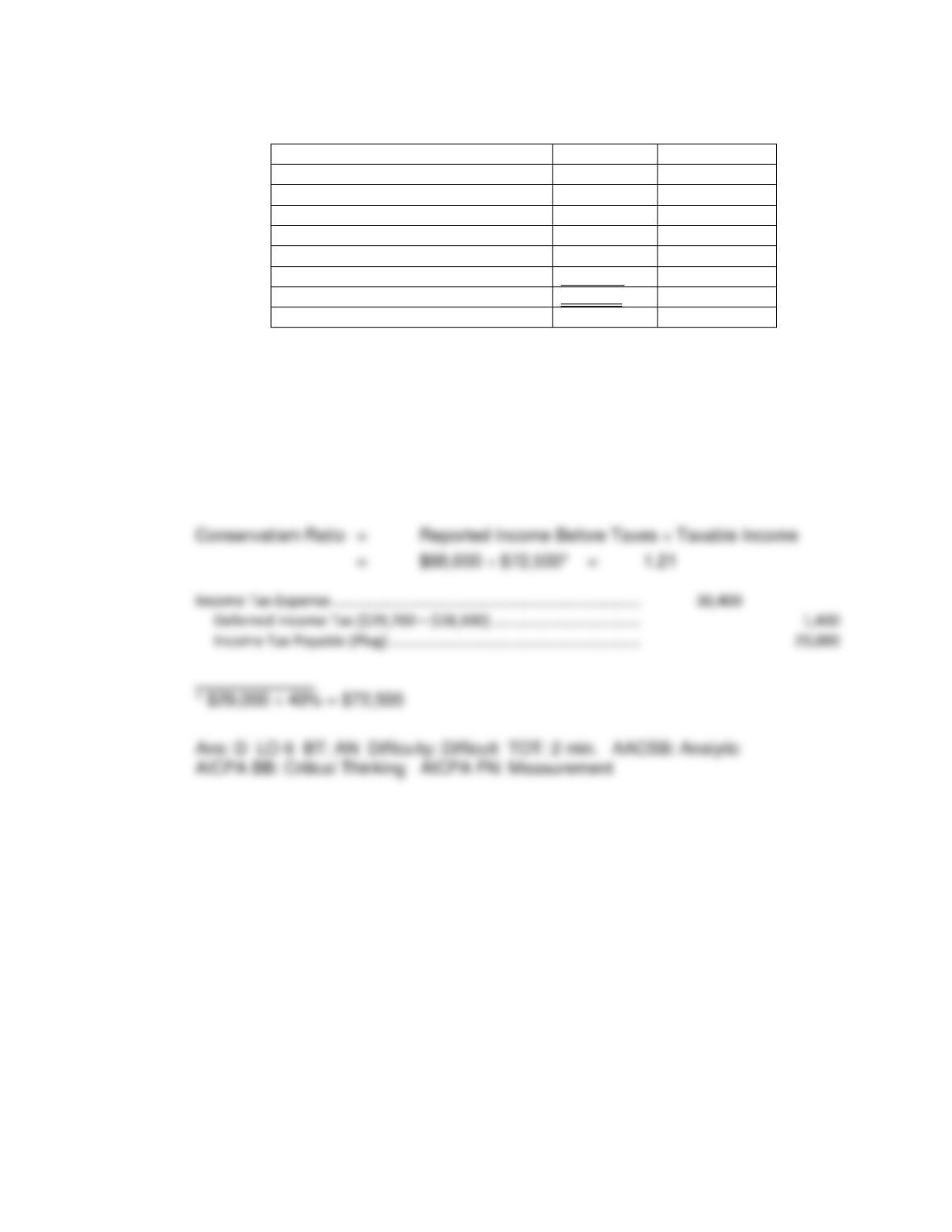
61. The following information was taken from the annual report of Jones Inc.
2017
2016
BALANCE SHEET
Deferred income tax liability
$29,700
$28,300
INCOME STATEMENT
Income before taxes
$88,000
Income tax expense
(30,400)
Net income
$57,600
Effective income tax rate 40%
What is Jones’s conservatism ratio?
a. 1.02
b. 1.52
c. 2.89
d. 1.21
Solution:
10–18 Test Bank – Chapter 10 – Introduction to Liabilities: Economic Consequences, Current Liabilities, & Contingencies
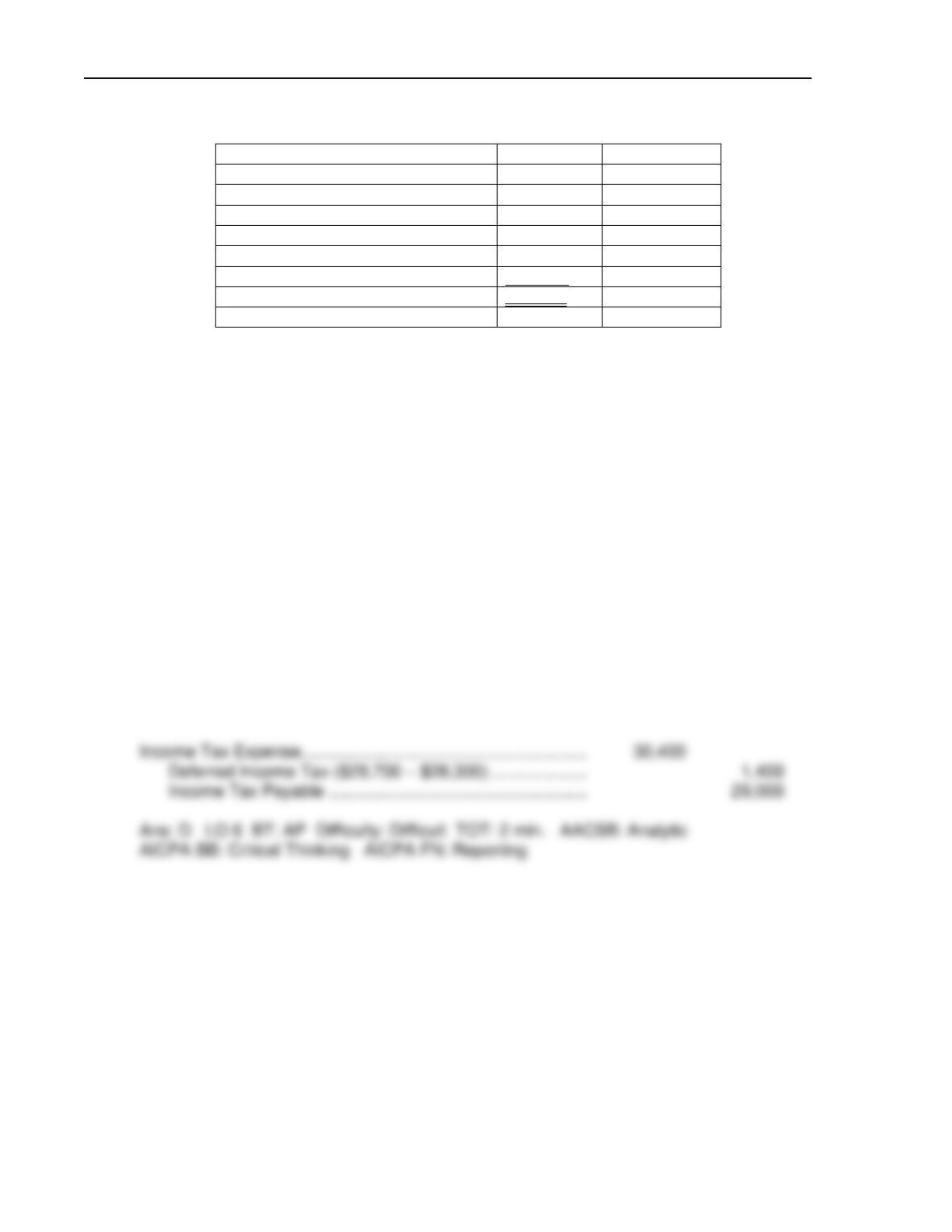
62. The following information was taken from the annual report of Jones Inc.
2017
2016
BALANCE SHEET
Deferred income tax liability
$29,700
$28,300
INCOME STATEMENT
Income before taxes
$88,000
Income tax expense
(30,400)
Net income
$57,600
Effective income tax rate 40%
Based on this information, what journal entry should Jones make in 2017 to record its
income taxes?
a. Income Tax Expense ……………………………………………… 30,400
Deferred Income Tax …………………………………………….. 29,700
Deferred Income Tax …………………………………………. 28,300
Income Tax Payable ………………………………………….. 31,800
b. Income Tax Expense ……………………………………………… 30,400
Deferred Income Tax …………………………………………. 29,700
Income Tax Payable ………………………………………….. 700
c. Income Tax Expense ……………………………………………… 31,800
Deferred Income Tax …………………………………………. 1,400
Income Tax Payable ………………………………………….. 30,400
d. Income Tax Expense ……………………………………………… 30,400
Deferred Income Tax …………………………………………. 1,400
Income Tax Payable ………………………………………….. 29,000
Solution:
Test Bank – Chapter 10 – Introduction to Liabilities: Economic Consequences, Current Liabilities, & Contingencies 10-19
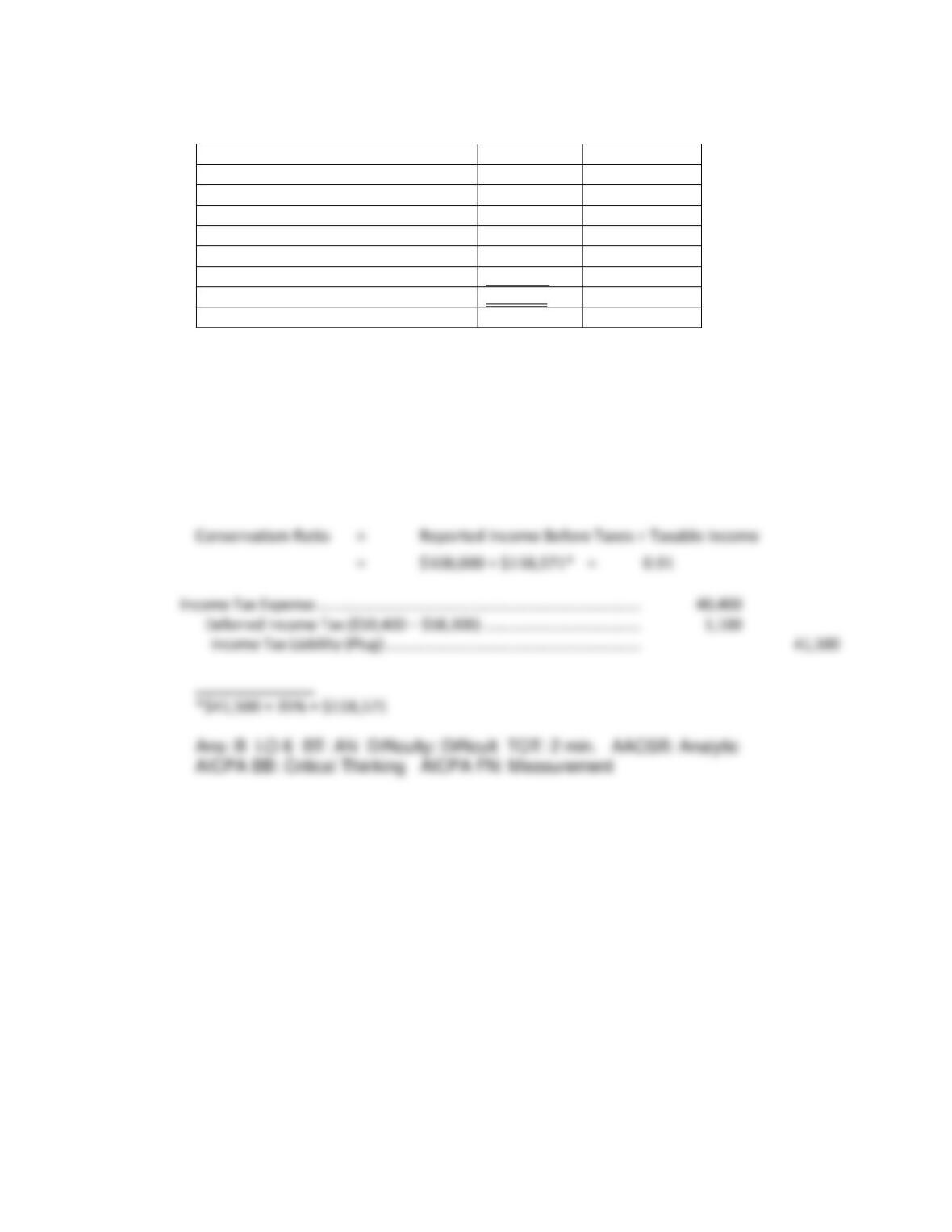
63. The following information was taken from the annual report of Leno Inc.
2017
2016
BALANCE SHEET
Deferred income tax liability
$58,300
$59,400
INCOME STATEMENT
Income before taxes
$108,000
Income tax expense
(40,400)
Net income
$67,600
Effective income tax rate 35%
What is Leno’s conservatism ratio?
a. 0.63
b. 0.91
c. 0.69
d. 0.86
Solution:
10–20 Test Bank – Chapter 10 – Introduction to Liabilities: Economic Consequences, Current Liabilities, & Contingencies
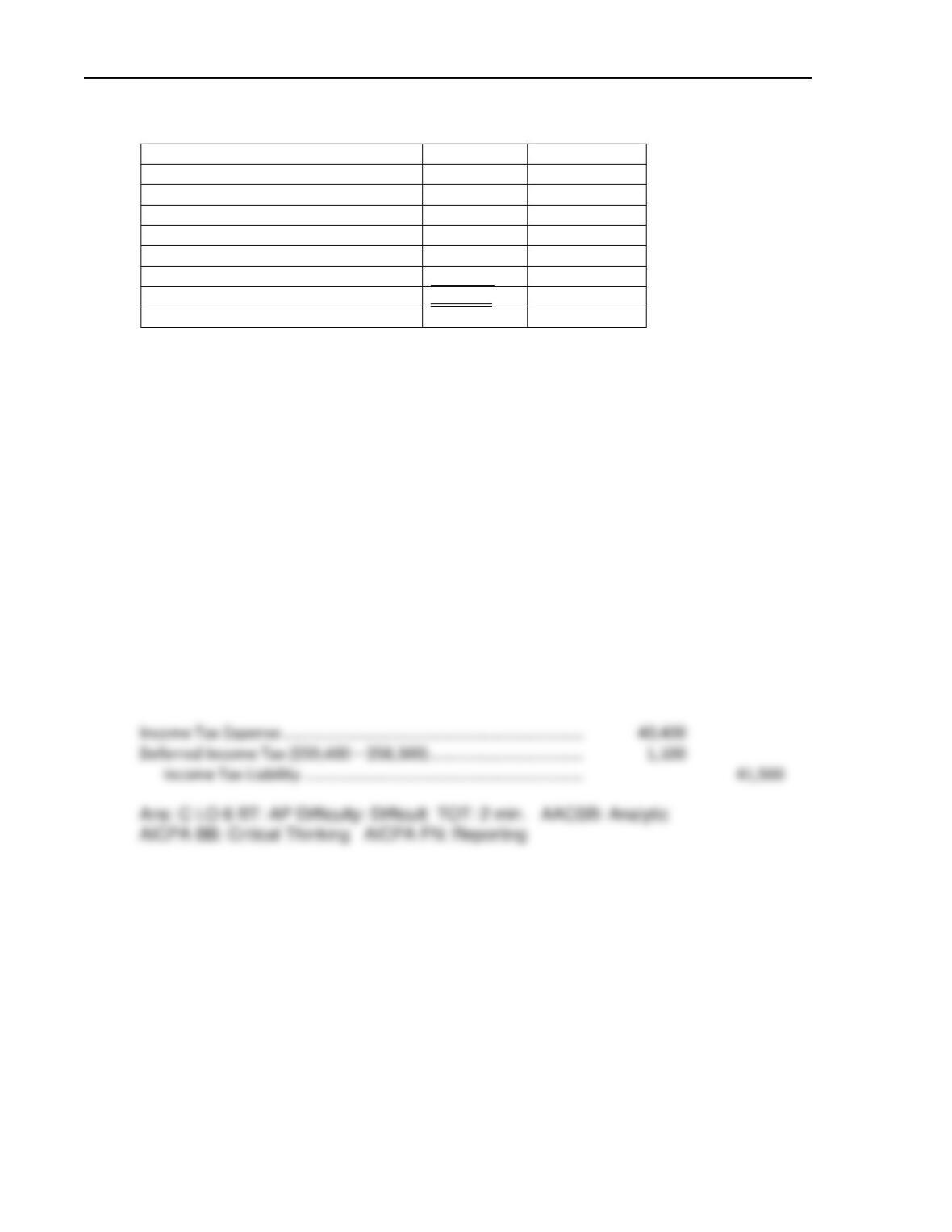
64. The following information was taken from the annual report of Leno Inc.
2017
2016
BALANCE SHEET
Deferred income tax liability
$58,300
$59,400
INCOME STATEMENT
Income before taxes
$108,000
Income tax expense
(40,400)
Net income
$67,600
Effective income tax rate 35%
Based on this information, what journal entry should Leno make in 2010 to record its
income taxes?
a. Income Tax Expense ……………………………………………… 40,400
Deferred Income Tax …………………………………………….. 58,300
Deferred Income Tax …………………………………………. 59,400
Income Tax Payable ………………………………………….. 39,300
b. Income Tax Expense ……………………………………………… 40,400
Deferred Income Tax …………………………………………….. 19,000
Income Tax Payable ………………………………………….. 59,400
c. Income Tax Expense ……………………………………………… 40,400
Deferred Income Tax …………………………………………….. 1,100
Income Tax Payable ………………………………………….. 41,500
d. Income Tax Expense ……………………………………………… 40,400
Deferred Income Tax …………………………………………….. 17,900
Income Tax Payable ………………………………………….. 58,300
Solution: