Exam
Name___________________________________
MULTIPLE CHOICE. Choose the one alternative that best completes the statement or answers the question.
Provide an appropriate response.
1)
Suppose a rectangle has length 39 and width 22. Which of the following is the best estimate of
its perimeter?
1)
A)
77
B)
30
C)
22
D)
17
2)
If a > 0, which of the following correctly describes – – a ?
2)
A)
Negative
B)
Not a real number
C)
Zero
D)
Positive
3)
If a < 0, which of the following correctly describes – – a ?
3)
A)
Negative
B)
Positive
C)
Not a real number
D)
Zero
4)
A triangle has a base of 224 and a height of 104. What is the best estimate for its area?
4)
A)
1155
B)
75
C)
82.5
D)
70
5)
Suppose a rectangle has length 68 and width 80. Which of the following is the best estimate of
its area?
5)
A)
34
B)
25
C)
137
D)
72
6)
A rectangle has a length of 142 and a width of 118. What is the best estimate for its area?
6)
A)
110
B)
132
C)
121
D)
120
7)
A rectangle has a length of 80 and a width of 60. What is the best estimate for its dimensions?
7)
A)
9 by 7
B)
8 by 7
C)
9 by 8
D)
8 by 8
SHORT ANSWER. Write the word or phrase that best completes each statement or answers the question.
8)
Tell whether the statement is true or false. If it is false, give the correct answer. Explain
your answer. The easiest way to simplify the expression 7
5–2 is to multiply both the
numerator and denominator by 5–2.
8)
9)
Tell whether the statement is true or false. If it is false, give the correct answer. Explain.
4x·4x= x
9)
4x2 by the product rule
10)
Choose values for n, a, and b to demonstrate the truth or falsity of the statement:
na+nb=na + b.
10)
11)
If a 0, 1
a is called the reciprocal of a. Use this definition to express the reciprocal of 6–4i
in the form a + bi.
11)
2
12)
Explain why the expression cannot be simplified further.
12 a–10 a
12)
13)
Tell whether the statement is true or false. If it is false, give the correct answer. Explain
your answer. Assume that x represents a positive real number. x·x= x
13)
14)
How many real number cube roots does any positive number have?
14)
15)
Tell whether the statement is true or false. If it is false, give the correct answer. Explain
your answer. The easiest way to simplify the expression 7
8 is to multiply both the
numerator and denominator of 7
8 by 8.
15)
16)
Explain how to evaluate (–125)4/3.
16)
17)
What is wrong with this? (8x3)–1=8x–3
17)
18)
How many real number cube roots does any negative number have?
18)
19)
Tell whether the statement is true or false. If it is false, give the correct answer. Explain
your answer. The easiest way to simplify the expression 9
3–3 is to multiply both the
numerator and denominator by 3+3.
19)
20)
Explain why 3–10 and –310 represent the same number.
20)
21)
True or false? 4+25 =4+25
21)
22)
Can a represent a negative real number?
22)
23)
Is (–2)(–8) = 4?
23)
24)
Tell whether the statement is true or false. If it is false, give the correct answer. Explain
your answer. The easiest way to simplify the expression 34
7 is to multiply both the
numerator and denominator of
34
37
by 37.
24)
25)
Tell whether the statement is true or false. If it is false, give the correct answer. Explain.
3x·3x= x
25)
4
26)
Is 49 =7 ?
26)
27)
How many real square roots does any negative number have?
27)
28)
Tell whether the statement is true or false. If it is false, give the correct answer. Explain
your answer. The easiest way to simplify the expression 3 9
25 is to multiply both the
numerator and denominator of
39
325
by 325.
28)
29)
Explain the procedure you would use to find the quotient 3+ 5i
5+ 5i. Do not actually find the
quotient.
29)
30)
Explain why if n is odd, x1/n is defined even if x is negative.
30)
31)
If n is a positive integer, does nxn= x? Explain.
31)
32)
Explain why the sum 3216 +3125 –532 can be simplified quickly.
32)
5
33)
Can 3–7 exist as a real number?
33)
34)
Give the definition or an example of the phrase: Rationalizing the denominator.
34)
35)
Can a represent a negative real number?
35)
36)
How many square roots does any negative number have?
36)
37)
Is 11 simplified?
37)
MULTIPLE CHOICE. Choose the one alternative that best completes the statement or answers the question.
Simplify the expression involving rational exponents.
38)
125 –1/3
38)
A)
–1
5
B)
1
5
C)
1
6
D)
–5
Use the rules of exponents to simplify the expression. Write the answer with positive exponents. Assume that all
variables represent positive real numbers.
39)
(x1/3)2
(x3)5/3
39)
A)
1
x13/3
B)
1
x17/3
C)
x17/3
D)
x13/3
Solve the equation.
40)
5x +x +56 =8+ 3x
40)
A)
{–8, –1
4}
B)
{64}
C)
{16}
D)
{8, 1
4}
Provide an appropriate response.
41)
True or false? If a < 0 and b < 0, then a·b=ab.
41)
A)
True
B)
False
Solve the equation.
42)
x + 6 +2 – x = 4
42)
A)
{2, –2}
B)
{31, –2}
C)
{–2}
D)
{0}
Write the number as a product of a real number and i. Simplify the radical expression.
43)
–36
43)
A)
i 6
B)
6i
C)
±6
D)
–6i
Use the rules of exponents to simplify the expression. Write the answer with positive exponents. Assume that all
variables represent positive real numbers.
44)
(r1/6s1/6)2
44)
A)
r1/3s1/3
B)
r2s2
C)
r1/12s1/12
D)
r1/36s1/36
Multiply.
45)
(4 – 2i)(9+ 8i)
45)
A)
52 + 14i
B)
20 – 50i
C)
–16i2+ 14i + 36
D)
52 – 14i
Solve the problem.
46)
A manufacturer’s cost is given by C =500n1/3 + 2000, where C is the cost in dollars and n is the
number of parts produced. Find the cost when 64 parts are produced.
46)
A)
$125
B)
$4000
C)
$3000
D)
$6000
B
Rationalize the denominator. Assume that all variables represent positive real numbers and that the denominator is not
zero.
47)
5
7–2
47)
A)
35 + 5 2
47
B)
5
7–5
2
C)
35 – 5 2
47
D)
35 + 5 2
5
A
Find the square root.
48)
36
48)
A)
Not a real number
B)
18
C)
7
D)
6
D
A
Simplify the radical. Assume that all variables represent positive real numbers.
49)
4
81
49)
A)
18
B)
1
C)
2
9
D)
9
2
Multiply.
50)
7i(5– 3i)
50)
A)
21 + 35i
B)
35i – 21i2
C)
35i– 21
D)
35i + 21i2
Simplify. Assume that all variables represent positive real numbers.
51)
–315 – 9 15
51)
A)
615
B)
–515
C)
–12 15
D)
11 15
52)
2
3–72
108
52)
A)
–1
B)
–1
6
C)
–6
D)
0
Use the rules of exponents to simplify the expression. Write the answer with positive exponents. Assume that all
variables represent positive real numbers.
53)
x1/2
x3/4 ·x–4
53)
A)
x15/4
B)
1
x15/4
C)
1
x21/4
D)
x21/4
Evaluate.
54)
–441
54)
A)
21
B)
Not a real number
C)
–220
D)
–21
D
Multiply using the product rule.
55)
325xy ·39xy
55)
A)
3225x2y2
B)
334x2y2
C)
8xy
D)
15xy
A
Simplify the root.
56)
5(–5)5
56)
A)
25
B)
Not a real number
C)
5
D)
–5
D
A
Write the number as a product of a real number and i. Simplify the radical expression.
57)
–1600
57)
A)
±40
B)
40i
C)
–40i
D)
i40
Add or subtract as indicated. Write your answer in the form a +
bi.
58)
(4 + 8i) – (–5+ i)
58)
A)
–9– 7i
B)
–1+ 9i
C)
9– 7i
D)
9+ 7i
D
Simplify. Assume that all variables represent positive real numbers.
59)
128 – 4 32 – 7 8
59)
A)
44 2
B)
22 2
C)
–22 2
D)
–32 2
C
Express the radical in simplified form.
60)
–500
60)
A)
–10 5
B)
10 5
C)
–10 –5
D)
Not a real number
D
Provide an appropriate response.
61)
True or false? i3= – i
61)
A)
True
B)
False
A
B
Simplify. Assume that all variables represent positive real numbers.
62)
93m7p5– 7m2p3mp2
62)
A)
Cannot be simplified
B)
16mp23mp2
C)
2m2p3mp2
D)
2
Write the expression in the form a +
bi.
63)
9– i
–2+8i
63)
A)
–35
34 i
B)
–13
34 –35
34 i
C)
1
68 –35
34 i
D)
13
34 –35
34 i
B
Add or subtract as indicated. Write your answer in the form a +
bi.
64)
(2 – 3i) + (9+ 5i)
64)
A)
11 – 2i
B)
–7+ 8i
C)
–11 – 2i
D)
11 + 2i
D
Multiply, then simplify the product. Assume that all variables represent positive real numbers.
65)
( 7 – 2)( 2+ 6)
65)
A)
14 + 4 2– 12
B)
14 – 12
C)
14 + 6 7– 2 2– 12
D)
514 – 12
C
Multiply.
66)
i(7– 9i)(4– 7i)
66)
A)
63i3+ 85i2+ 28i
B)
91 + 13i
C)
85 – 35i
D)
–85 + 35i
C
C
Express the radical in simplified form.
67)
–125
67)
A)
–5 5
B)
11
C)
5
D)
–25 5
Simplify by first converting to rational exponents. Assume that all variables represent positive real numbers.
68)
3z·
5z3
68)
A)
15 z4
B)
8z3
C)
15 z14
D)
8z4
Simplify. Assume that all variables represent positive real numbers.
69)
25 +49
69)
A)
2 3
B)
6
C)
12
D)
74
Solve the problem.
70)
The cost of manufacturing clocks is given by c =9n + 4, where c is the total cost and n is the
number produced. What is the cost when no clocks are produced?
70)
A)
9
B)
6
C)
36
D)
18
Use the rules of exponents to simplify the expression. Write the answer with positive exponents. Assume that all
variables represent positive real numbers.
71)
(1024h20k22)3/2
71)
A)
32,768h30k30
B)
32,768k30h33
C)
1024h30k33
D)
32,768h30k33
Write the expression in the form a +
bi.
72)
6 + 2i
9 – 3i
72)
A)
–48
65 –36
65 i
B)
8
15 +2
5i
C)
14
15
D)
5
6–1
12 i
Solve the equation.
73)
34 + 6t –31 – 8t = 0
73)
A)
3
14
B)
–3
14
C)
–14
3
D)
14
3
Simplify the expression involving rational exponents.
74)
–64
27
–4/3
74)
A)
81
256
B)
256
81
C)
Not a real number
D)
–256
81
75)
274/3
75)
A)
729
B)
81
C)
243
D)
2187
Find the equation of a circle satisfying the given conditions.
76)
Center: (7, 6); radius: 4
76)
A)
(x + 7)2+ (y + 6)2=16
B)
(x + 6)2+ (y + 7)2=4
C)
(x – 7)2+ (y – 6)2=16
D)
(x – 6)2+ (y – 7)2=4
Multiply, then simplify the product. Assume that all variables represent positive real numbers.
77)
(11 + 1)( 11 – 1)
77)
A)
10 + 2 11
B)
10
C)
10 – 2 11
D)
12
Provide an appropriate response.
78)
Can the sum be simplified without first simplifying the individual radical expressions?
511 64 +911 1000
78)
A)
Yes
B)
No
Solve the equation.
79)
2x + 3 +4 – x = 4
79)
A)
{–3}
B)
{3}
C)
D)
3, 11
9
80)
2x + 3 –x + 1 = 1
80)
A)
{3, –1}
B)
C)
{–3, –1}
D)
{3}
15
Rewrite the expressions with rational exponents as radical expressions, and then solve the equation.
81)
(–2– 4t)1/3 –(–4– 8t)1/3 = 0
81)
A)
1
2
B)
C)
–1
2
D)
– 2
Add or subtract as indicated. Write your answer in the form a +
bi.
82)
[(4+ 3i) – (5+ 6i)] – (10 – 7i)
82)
A)
19 + 4i
B)
–11 + 2i
C)
–11 + 4i
D)
19 + 2i
Simplify by first writing the radicals with the same index. Then multiply.
83)
3·34
83)
A)
612
B)
6144
C)
6108
D)
6432
Find the decimal approximation for the radical. Round the answer to three decimal places.
84)
469
84)
A)
2.914
B)
2.896
C)
2.882
D)
2.904
Use the rules of exponents to simplify the expression. Write the answer with positive exponents. Assume that all
variables represent positive real numbers.
85)
x3/5
x6/5 ·x–5
85)
A)
1
x34/5
B)
x22/5
C)
x34/5
D)
1
x22/5
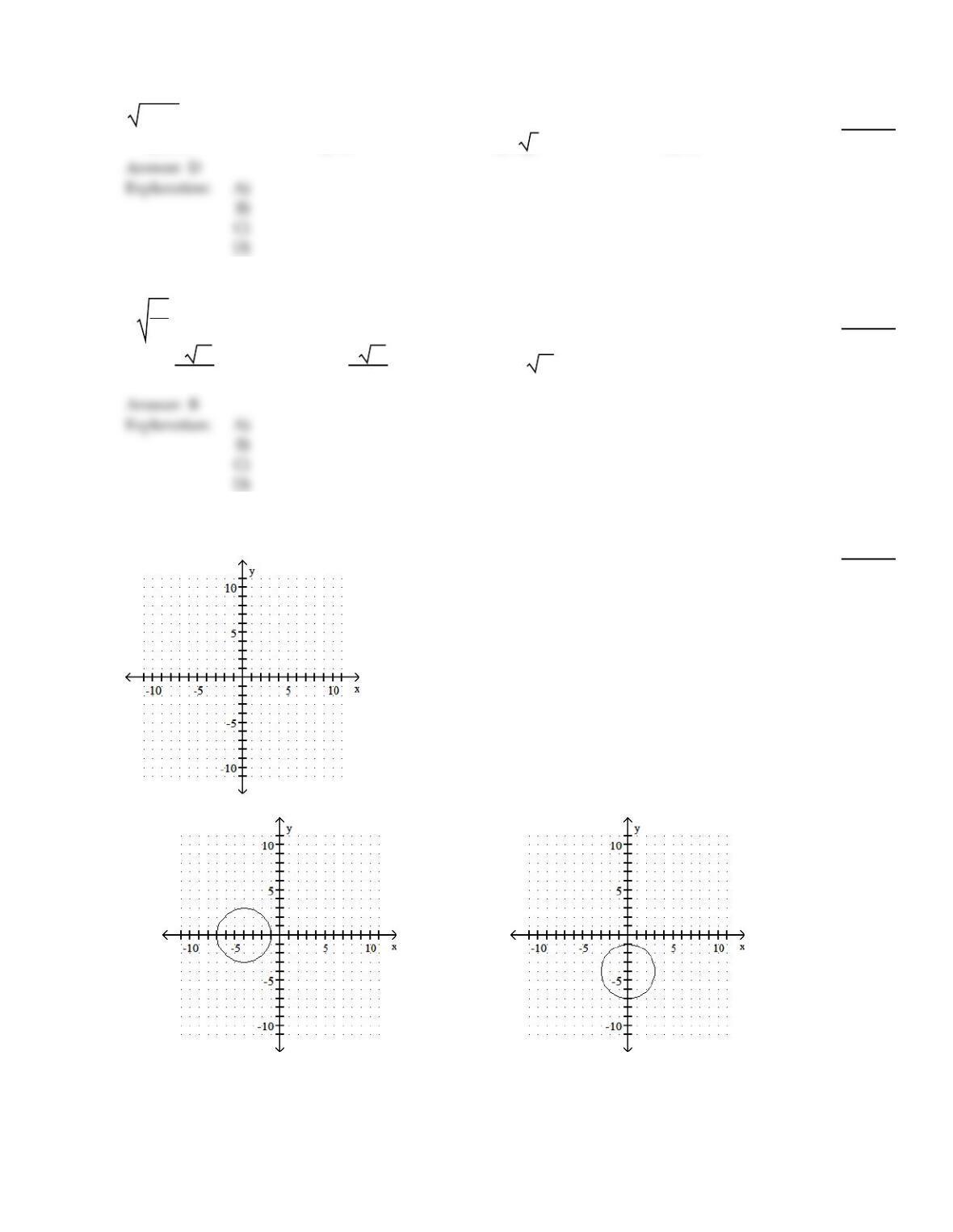
Express the radical in simplified form. Assume that all variables represent positive real numbers.
86)
4256a4
86)
A)
256a
B)
4a2
C)
4 a
D)
4a
Rationalize the denominator. Assume that all variables represent positive real numbers.
87)
– 9
40
87)
A)
–310
10
B)
–310
20
C)
–310
D)
–40
Graph the circle.
88)
(x – 4)2+y2=9
88)
A)
B)
17
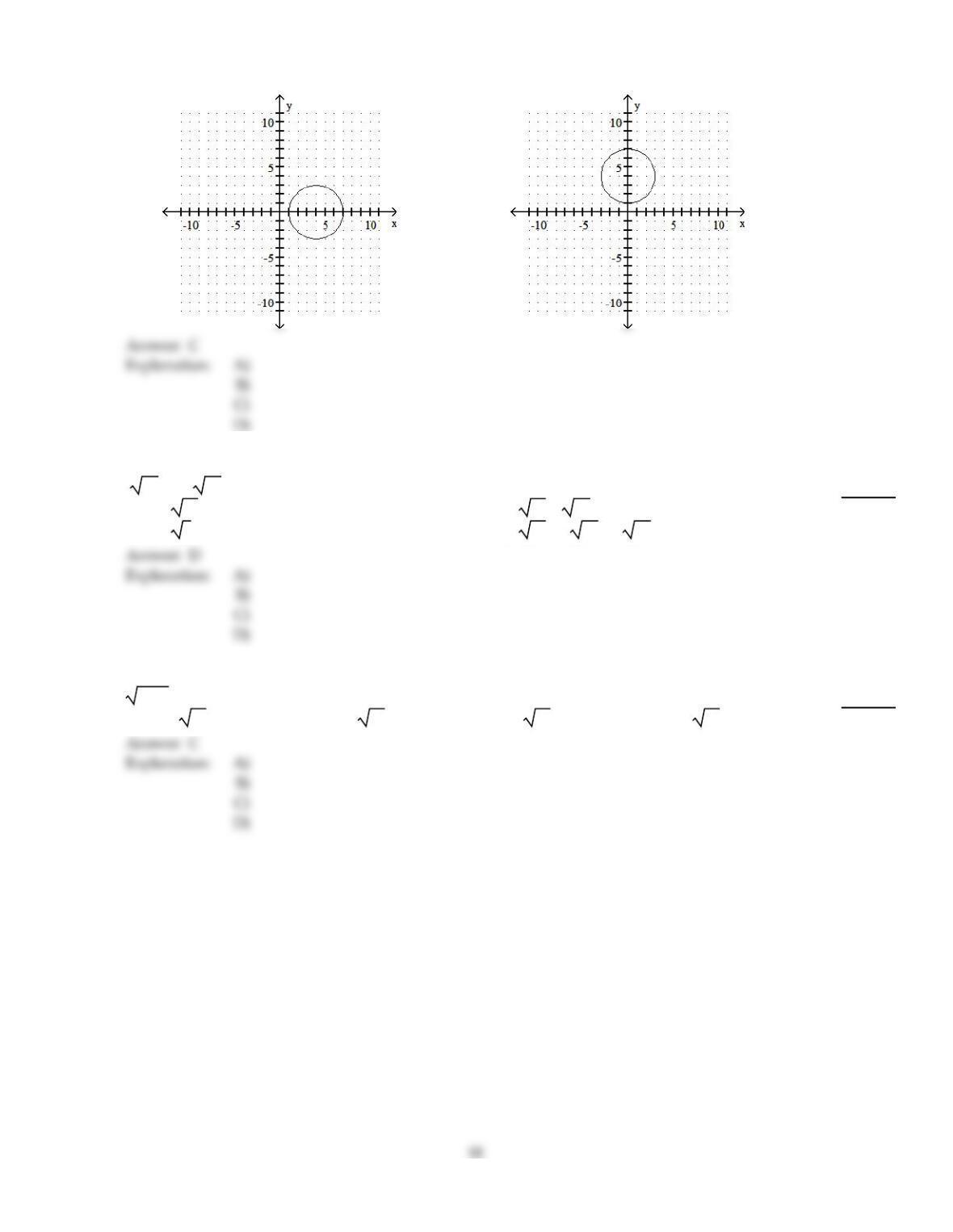
C)
D)
Multiply, then simplify the product. Assume that all variables represent positive real numbers.
89)
( 7x – 2)( 5x – 3)
89)
A)
x35 + 6
B)
x35 +5x + 6
C)
x 5 + 6
D)
x35 – 3 7x – 2 5x + 6
Write the number as a product of a real number and i. Simplify the radical expression.
90)
–184
90)
A)
–246
B)
–2i 46
C)
2i 46
D)
246
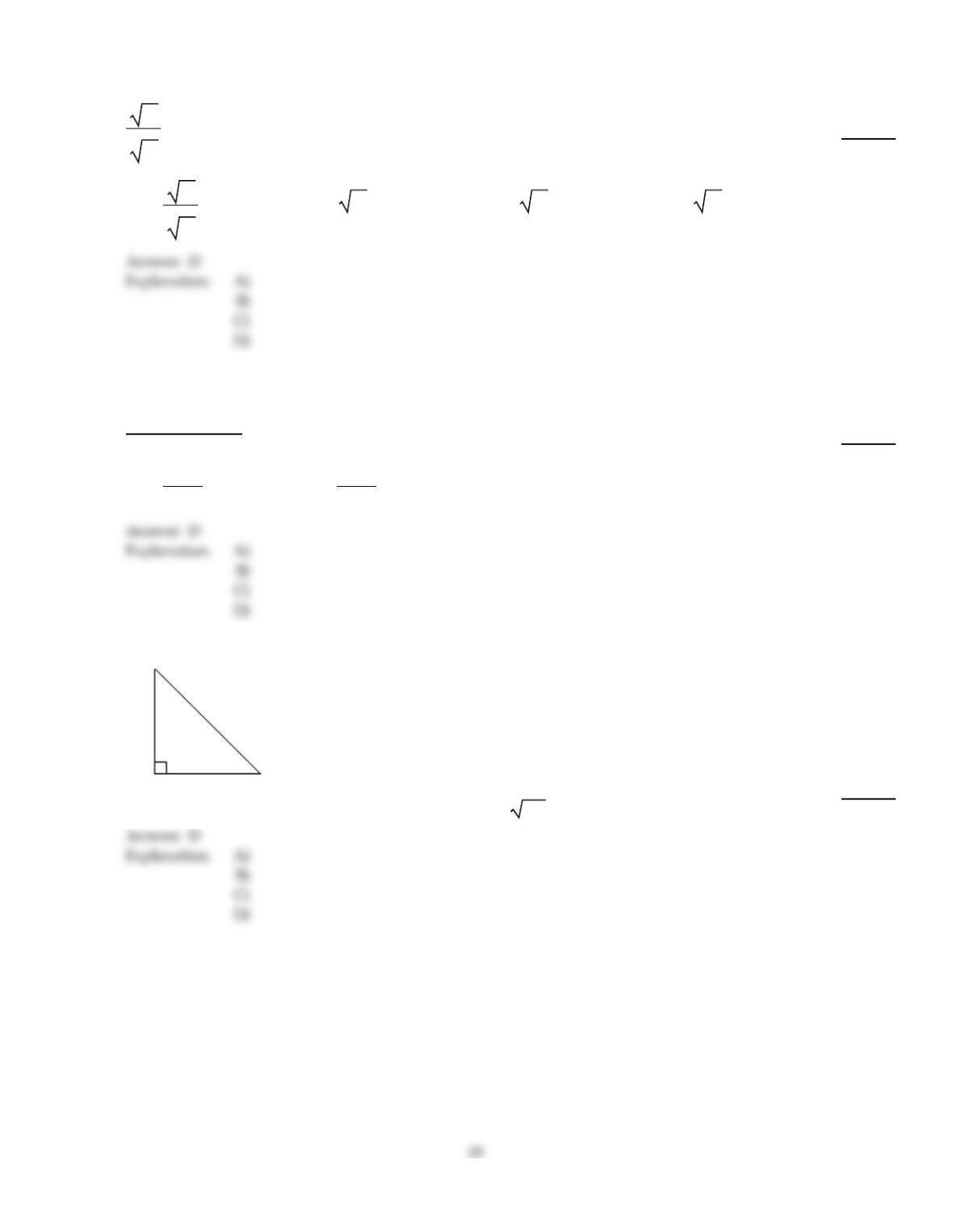
Simplify by first converting to rational exponents. Assume that all variables represent positive real numbers.
91)
5v3
8v3
91)
A)
5v3
8v3
B)
3v3
C)
13 v3
D)
40 v9
Use the rules of exponents to simplify the expression. Write the answer with positive exponents. Assume that all
variables represent positive real numbers.
92)
x1/2 ·x3/10 ·x2/5
(x2)–1/2
92)
A)
1
x22/7
B)
1
x11/5
C)
x22/7
D)
x11/5
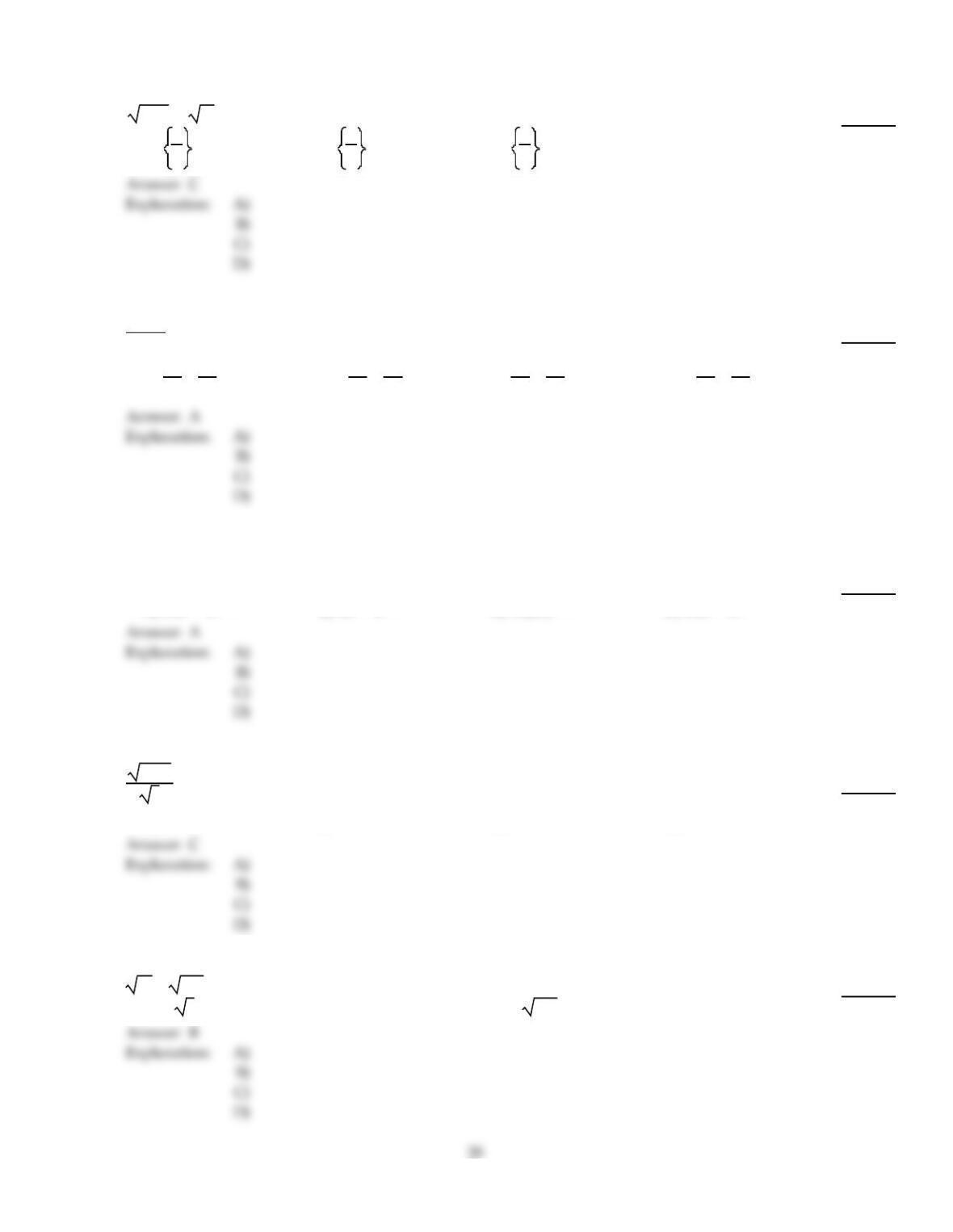
Find the unknown length in the right triangle. Simplify the answer if necessary.
93)
12 c
5
93)
A)
9
B)
11
C)
119
D)
13
Solve the equation.
94)
4r+ 3 =46r
94)
A)
5
3
B)
1
2
C)
3
5
D)
Write the expression in the form a +
bi.
95)
8i
4 + 9i
95)
A)
72
97 +32
97 i
B)
–72
65 –32
65 i
C)
72
65 –32
65 i
D)
–72
97 +32
97 i
Use the rules of exponents to simplify the expression. Write the answer with positive exponents. Assume that all
variables represent positive real numbers.
96)
(4a1/7b5/7)3
96)
A)
64a3/7b15/7
B)
4a3/7b15/7
C)
64(ab)15/7
D)
12a3/7b5/7
Multiply or divide as indicated.
97)
–324
9
97)
A)
–6
B)
6
C)
6i
D)
–6i
Simplify. Assume that all variables represent positive real numbers.
98)
16 –121
98)
A)
–7
B)
–7
C)
–105
D)
–3.5