Chapter 10 Data Administration, Database Administration, and Data Dictionaries
10-1
Last Update: November 13, 2011 — 8PM
Chapter 11: Data Administration, Database Administration, and Data Dictionaries
Multiple Choice
1. Data administration is mainly ____ function.
a. a programming
b. a planning and analysis
c. a hardware maintenance
d. an operational, day-to-day monitoring and management
e. a finance and accounting
2. Database administration is mainly ____ function.
a. a programming
b. a planning and analysis
c. a hardware maintenance
d. an operational, day-to-day monitoring and management
e. a finance and accounting
3. All of the following are advantages of data and database administration, except ____.
a. modularized, efficient programming
b. data as a shared corporate resource
c. efficiency in job specialization
d. operational management of data
e. managing externally acquired databases
4. Having dedicated experts whose job it is to perform database design would be most
directly characterized as ____.
a. modularized, efficient programming
b. data as a shared corporate resource
c. efficiency in job specialization

Chapter 10 Data Administration, Database Administration, and Data Dictionaries
10-2
d. operational management of data
e. managing externally acquired databases
5. Managing Enterprise Resource Planning (ERP) databases would be most directly
characterized as ____.
a. modularized, efficient programming
b. data as a shared corporate resource
c. efficiency in job specialization
d. operational management of data
e. managing externally acquired databases
6. All of the following are responsibilities of data administration, except ____.
a. DBMS performance monitoring
b. arbitration of disputes and usage authorization
c. documentation and publicity
d. data standards
e. data planning
7. Informing potential users of what data already exists in the database would be most
directly characterized as ____.
a. DBMS performance monitoring
b. arbitration of disputes and usage authorization
c. documentation and publicity
d. data standards
e. data planning
8. All of the following are responsibilities of data administration, except ____.
a. liaison to systems analysts and programmers
b. data coordination
c. training
Chapter 10 Data Administration, Database Administration, and Data Dictionaries
10-3
d. promoting data’s competitive advantage
e. DBMS usage and security monitoring
9. Maintaining a reasonable amount of control over centralized/decentralized data would
be most directly characterized as ____.
a. liaison to systems analysts and programmers
b. data coordination
c. training
d. promoting data’s competitive advantage
e. DBMS usage and security monitoring
10. All of the following are responsibilities of database administration, except ____.
a. DBMS data and software maintenance
b. DBMS performance monitoring
c. Data dictionary operations
d. Data planning
e. DBMS troubleshooting
11. Handling a DBMS application failure during execution would be most directly
characterized as ____.
a. DBMS data and software maintenance
b. DBMS performance monitoring
c. Data dictionary operations
d. Data planning
e. DBMS troubleshooting
12. Installing new versions of the DBMS and installing “fixes” or “patches” (corrections)
to the DBMS would be most directly characterized as ____.
a. DBMS data and software maintenance
b. DBMS performance monitoring

Chapter 10 Data Administration, Database Administration, and Data Dictionaries
10-4
c. Data dictionary operations
d. Data planning
e. DBMS troubleshooting
13. The term that describes data about data is ____.
a. application data
b. ultradata
c. metadata
d. analysis data
e. retrodata
14. All of the following are realizations of the metadata concept, except ____.
a. active data dictionary
b. operational database
c. data repository
d. data catalog
e. passive data dictionary
15. The most appropriate tool for accurately supporting the relational query optimizer is
the ____.
a. active data dictionary
b. operational database
c. data repository
d. data catalog
e. passive data dictionary
16. All of the following are likely data dictionary entities in the relational database
environment, except ____.
a. tables
b. disks

Chapter 10 Data Administration, Database Administration, and Data Dictionaries
10-5
c. queries
d. application programs
e. operational data
17. The pair of dictionary entities that are in the “impact of change” relationship are
____.
a. tables and attributes
b. people and databases
c. programs and tables
d. tables and disks
e. Web pages and jobs
18. All of the following are characteristics of relational DBMS catalogs, except ____.
a. they are highly active
b. their main purpose is to accurately support the relational query optimizer
c. they are themselves relational databases
d. they include the full range of data dictionary entities
e. they try to find an efficient access path to satisfy a query
True/False
1. Database administration is a planning and analysis function that is responsible for
setting data policy and standards, for promoting the company’s data as a competitive
resource, for accounting for the use of data, and for providing liaison support to
systems analysts during application development.
2. The data administration function is operationally oriented and is responsible for the
day-to–day monitoring and management of the company’s various active databases,
Chapter 10 Data Administration, Database Administration, and Data Dictionaries
as well as providing liaison support to program designers during application
development.
3. Data administration typically carries out many of the policies set by database
administration.
4. One of the advantages of data and database administration is efficiency in job
specialization.
5. Due to the nature of data, it is not considered to be a “scarce” resource as other
corporate resources are.
6. One of the advantages of data and database administration is having dedicated
personnel to manage externally acquired databases.
7. Among the responsibilities of data administration are data coordination and data
planning.
8. Among the responsibilities of data administration are arbitration of disputes and
usage authorization.
9. Among the responsibilities of data administration are DBMS performance monitoring
and DBMS troubleshooting.
10. Having data administration enforce data standards is helpful in establishing supply
chains with other companies.
11. Data administration personnel serving as liaisons to systems analysts and
programmers help determine which of the data items needed for an application
already exist in the database.
12. Among the responsibilities of database administration is the physical design of shared
databases.
13. Among the responsibilities of database administration are data planning and
arbitration of disputes.
14. Data administration is not concerned with performance monitoring because that is the
responsibility of the company’s systems programmers.
15. Data administration is not concerned with data security because that is the
responsibility of the company’s firewalls.
16. The data administration group is responsible for the operational aspects of the data
dictionary, as opposed to the planning aspects, which are the responsibility of
database administration.
17. A data dictionary is a program that the IS function uses to help manage itself.
18. The term metadata means data about data.
19. A tables table is part of a data dictionary in a relational database environment.
20. A passive data dictionary is one that interacts with the IS environment on a real-time
basis.
21. The nature of the interaction of an active data dictionary with the IS environment can
be a matter of input into the data dictionary, output from it, or both.
22. An example of an active data dictionary’s use in the “input sense” is if it must be
consulted to see who is authorized to access particular data.
23. Among the typical entities stored in a data dictionary are attributes, disks, and
queries.
24. The term “impact of change” refers to a data dictionary relationship between the table
and attribute entities.
25. A relational DBMS catalog is a limited-scope, passive data dictionary.
26. In a relational DBMS, the main purpose of the relational catalog is to accurately
support the relational query optimizer.
27. A data repository is a large-scale data dictionary with advanced entity types.
Chapter 10 Data Administration, Database Administration, and Data Dictionaries
10-10
Problems
1. The Central Zoo.
a. You have just been given the responsibility for data management at the Central Zoo.
The Central Zoo maintains a modest information systems environment with a server
and a LAN that connects all of the zoo’s departments. You have been asked to
design and manage the typical data administration and database administration
functions at the Central Zoo. Do so, describing the tasks necessary to maintain the
zoo’s data.
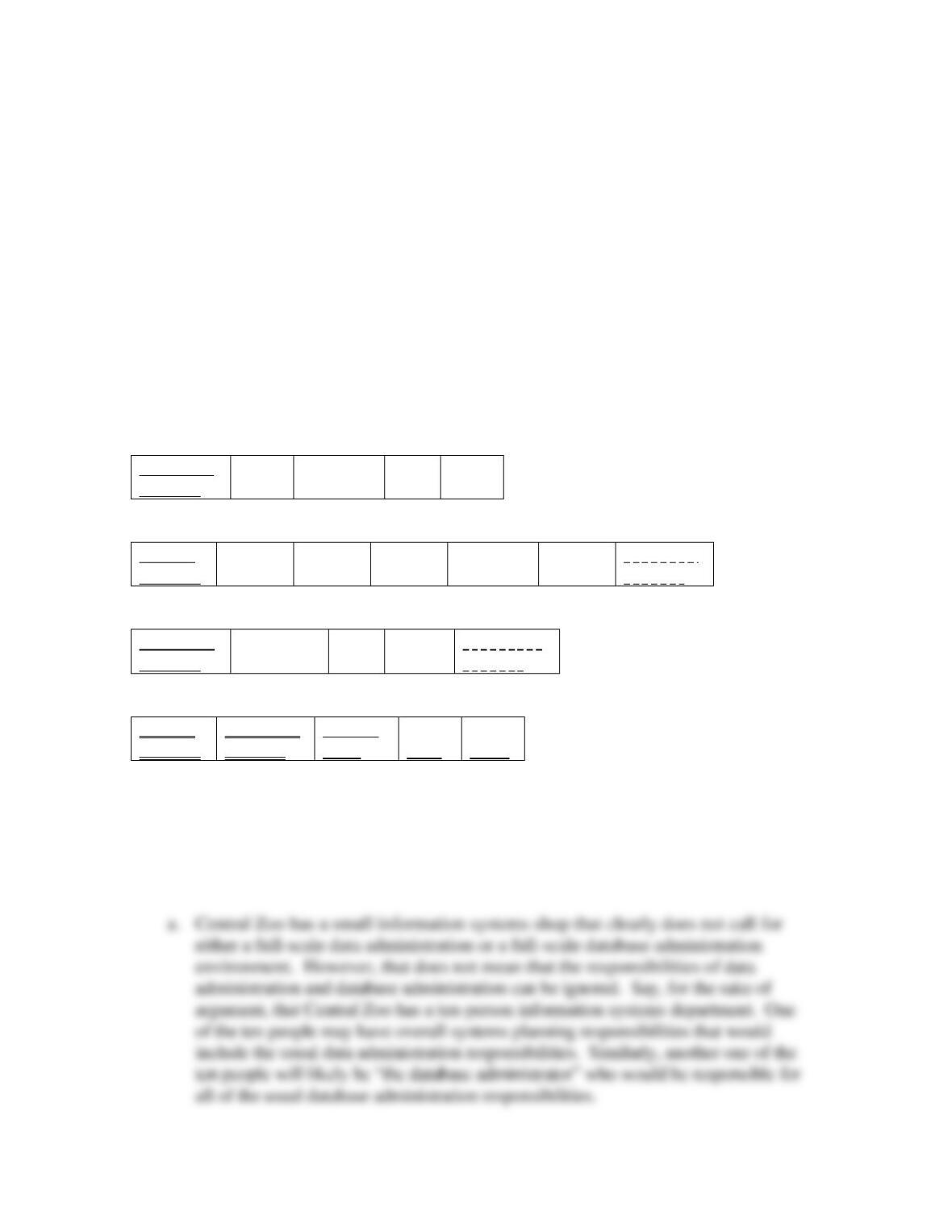
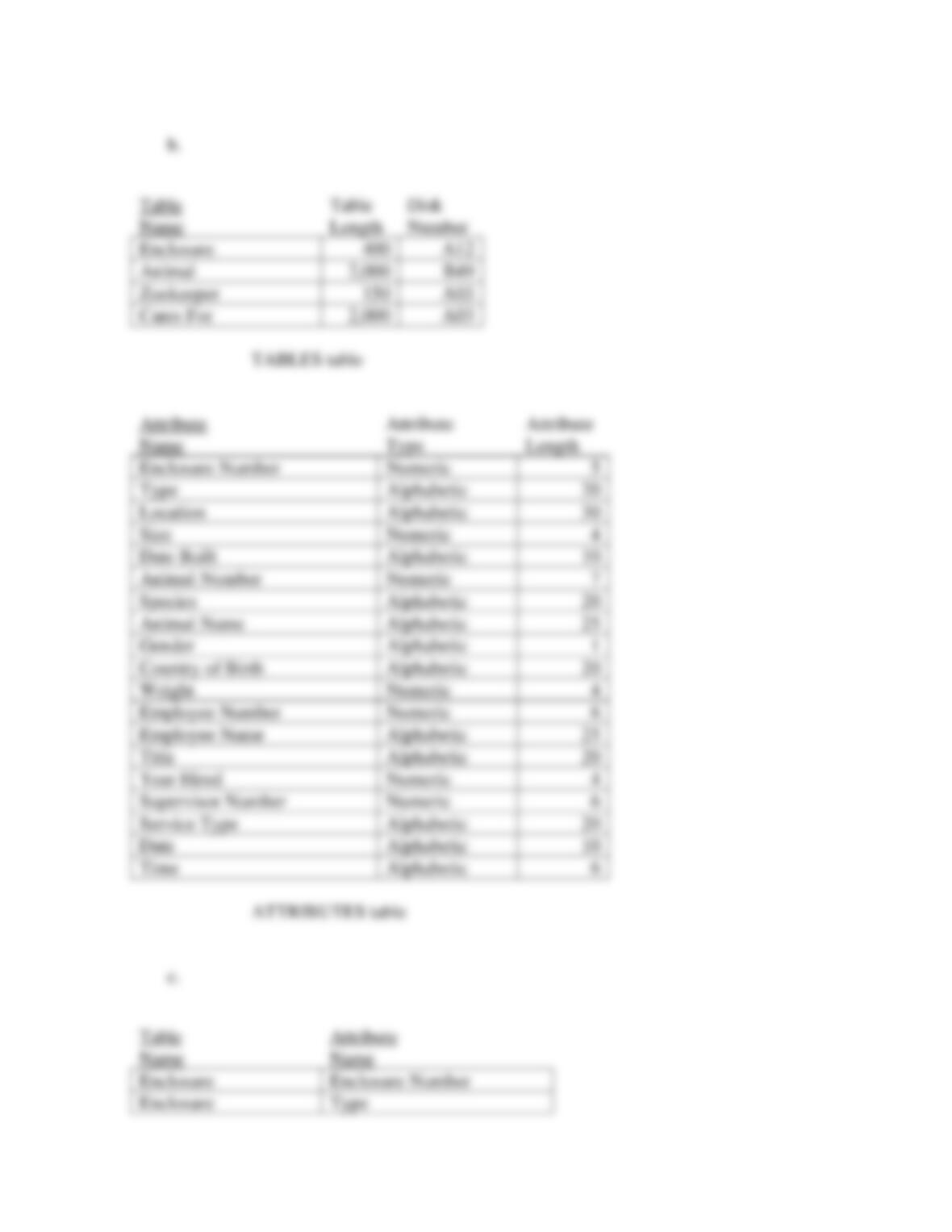
b. Create a data dictionary TABLES table and an ATTRIBUTES table and enter data
in them for the following Central Zoo database. Your TABLES table should have
Table Name, Table Length, and Disk Number columns. Your ATTRIBUTES tables
should have Attribute Name, Attribute Type, and Attribute Length columns. Use
your judgement in developing the values for these columns.
Enclosure
Number
Type
Location
Size
Date
Built
ENCLOSURE
Animal
Number
Species
Animal
Name
Gender
Country
of Birth
Weight
Enclosure
Number
ANIMAL
Employee
Number
Employee
Name
Title
Year
Hired
Supervisor
Number
ZOOKEEPER
Animal
Number
Employee
Number
Service
Type
Date
Time
CARES FOR
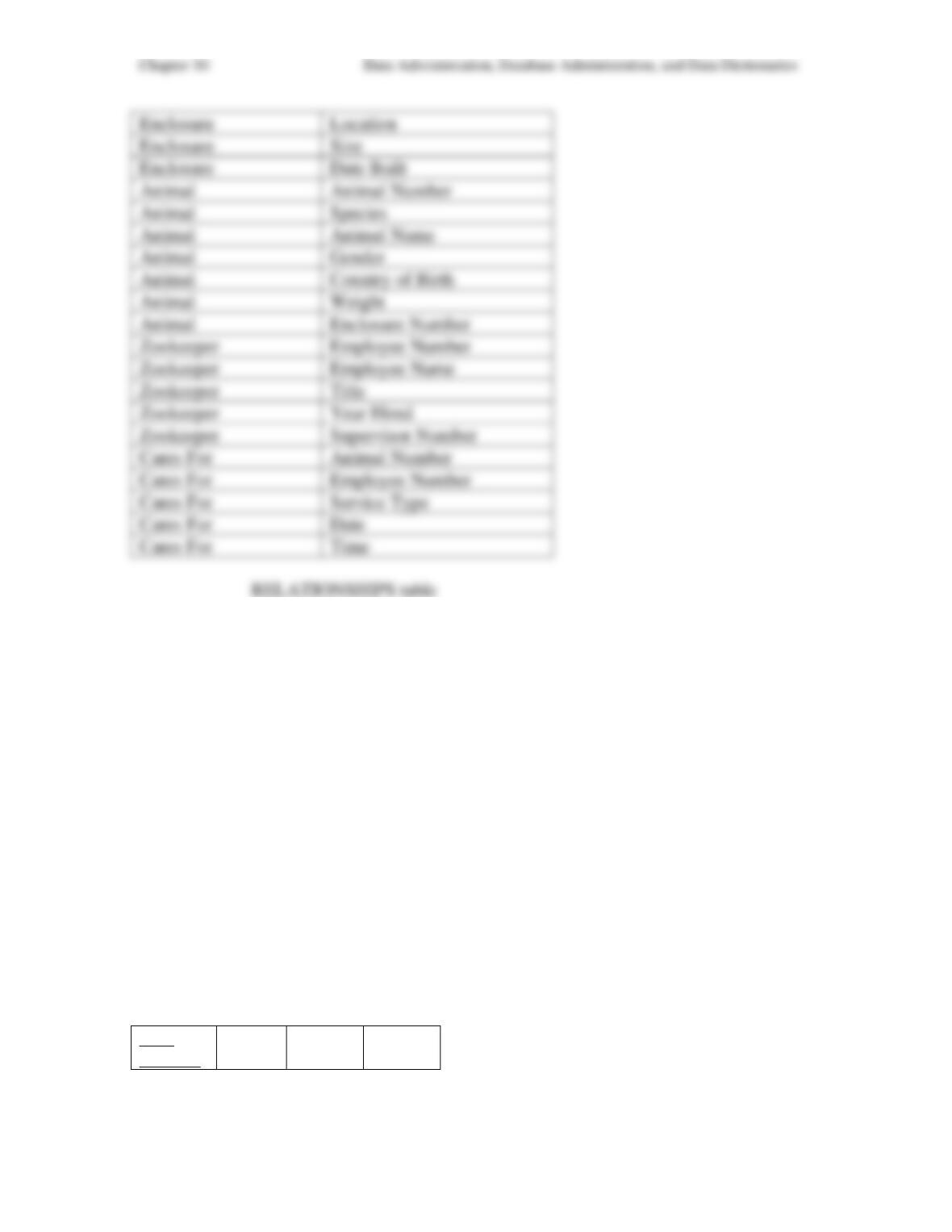
c. Create a RELATIONSHIPS table for this tables and attributes data.
Answer
Chapter 10 Data Administration, Database Administration, and Data Dictionaries
10-11
10-12
2. Grand Travel Airlines.
a. You have just been named Director of Data Administration of Grand Travel
Airlines. Grand Travel Airlines has a centralized, mainframe-based information
systems environment at its headquarters with telecommunications links to a server at
each airport that it services. Each server, in turn, controls a LAN that includes a
microcomputer at each check-in counter and gate. Check-in and other data taken in
at the counters and gates is immediately transmitted to the mainframe at
headquarters. You have been given the responsibility of creating data administration
and database administration departments for Grand Travel Airlines. Design these
data administration and database administration departments describing their
responsibilities.
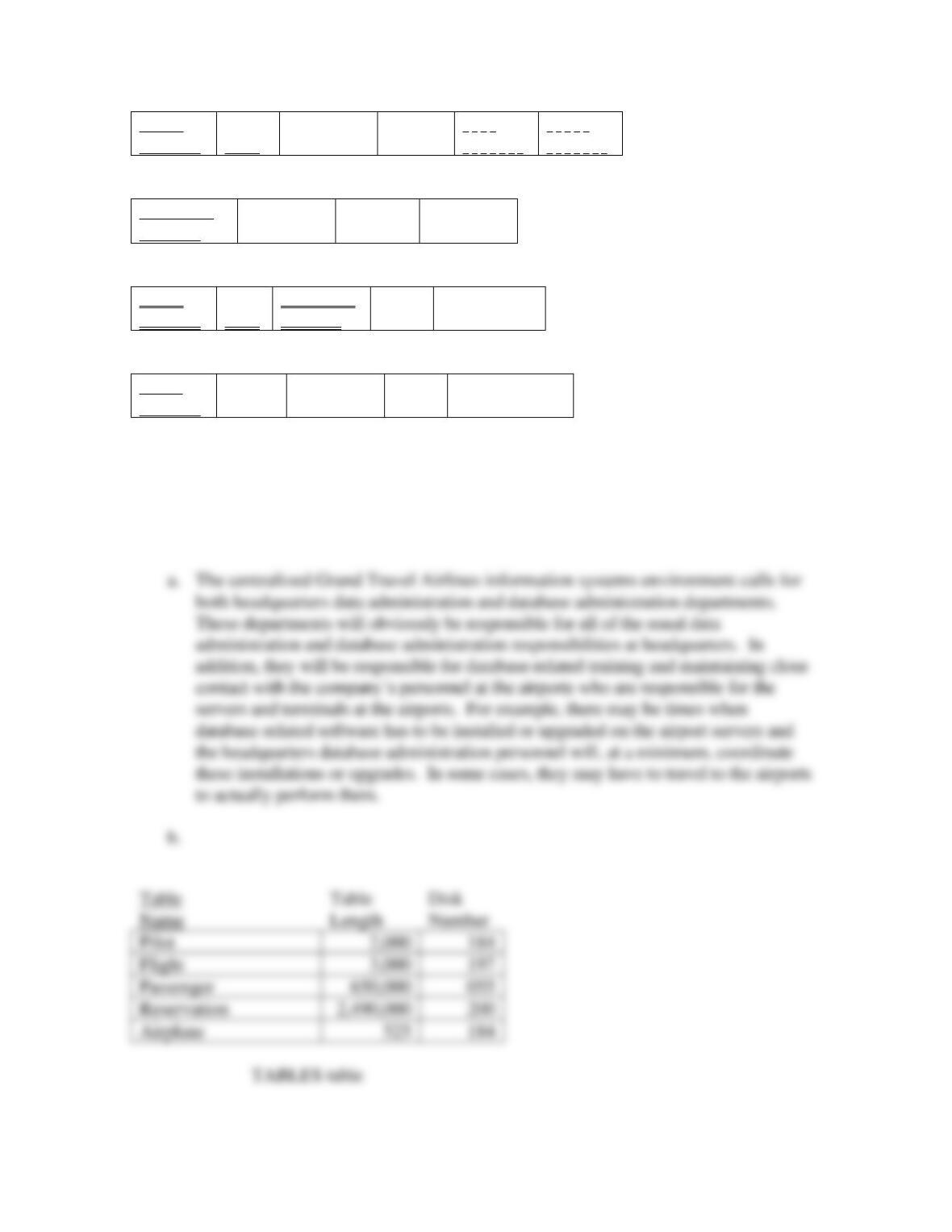
b. Create a data dictionary TABLES table and an ATTRIBUTES table and enter data
in them for the following Grand Travel Airlines database. Your TABLES table
should have Table Name, Table Length, and Disk Number columns. Your
ATTRIBUTES tables should have Attribute Name, Attribute Type, and Attribute
Length columns. Use your judgement in developing the values for these columns.
Pilot
Number
Pilot
Name
Date of
Birth
Date of
Hire
PILOT
Enclosure
Size
Enclosure
Date Built
Animal
Animal Number
Animal
Species
Animal
Animal Name
Animal
Gender
Animal
Country of Birth
Animal
Weight
Animal
Enclosure Number
Zookeeper
Employee Number
Zookeeper
Employee Name
Zookeeper
Title
Zookeeper
Year Hired
Zookeeper
Supervisor Number
Cares For
Animal Number
Cares For
Employee Number
Cares For
Service Type
Cares For
Date
Cares For
Time
Chapter 10 Data Administration, Database Administration, and Data Dictionaries
10-13
Flight
Number
Date
Departure
Time
Arrival
Time
Pilot
Number
Serial
Number
FLIGHT
Passenger
Number
Passenger
Name
Address
Telephone
Number
PASSENGER
Flight
Number
Date
Passenger
Number
Fare
Reservation
Date
RESERVATION
Serial
Number
Model
Passenger
Capacity
Year
Built
Manufacturer
AIRPLANE
c. Create a RELATIONSHIPS table for this tables and attributes data.
Answer
Name
Length
Number
Pilot
Flight
Passenger
Reservation
Airplane